She Came to Fire Him. He Opened the Door and Ruined Her Heart.
Laura Mendoza did not believe in excuses.
She believed in contracts, deadlines, numbers, and results. She believed that if a person wanted something badly enough, they worked until their hands shook and their eyes burned. Weakness, she often said, was just laziness wearing better clothes.
By thirty-nine, Laura had built one of the most powerful real estate empires on the coast. Mendoza Group owned luxury towers, private villas, seaside hotels, and office buildings that glittered above the city like monuments to ambition. Her name appeared on magazine covers. Her penthouse appeared in architecture spreads. Her employees whispered when she walked past, not because she shouted, but because her silence was more frightening than anyone else’s anger.
Her office occupied the top floor of a glass skyscraper facing the ocean. Every morning, sunlight spilled through windows as wide as theater screens, turning the marble floors gold. Everything around her was controlled, expensive, and perfect.
Until Carlos Rodríguez failed to show up for work.
Again.
Laura stood behind her desk, staring at the attendance report on Patricia’s tablet.
“That is the third absence this month,” she said.
Patricia, her assistant, held the tablet with both hands. “Yes, ma’am. He called at five-thirty this morning.”
“And his excuse?”
Patricia hesitated. “A family emergency.”
Laura laughed once, coldly.
“Family emergency,” she repeated. “How convenient.”
Patricia shifted her weight. “Carlos has worked here for three years. He’s never been late before this month. He’s quiet, but he’s always been dependable.”
“Dependable people don’t disappear three times in four weeks.”
“He said one of his children—”
Laura’s eyes snapped up. “Children?”
Patricia stopped.
Laura walked toward the mirror beside her private lounge and adjusted the sleeve of her ivory blazer. Her diamond watch caught the morning light.
“In three years, Carlos never mentioned a child. Not one. No wife. No family. Nothing.” She turned back sharply. “Now suddenly he has emergencies?”
“He may be private,” Patricia said softly.
“He may be lying.”
The office went quiet.
Laura hated lies. She hated disorder. She hated the way people brought their personal chaos into professional spaces and expected the world to bend around them.
“Give me his address,” she said.
Patricia blinked. “You want to visit him?”
“I want to see this emergency before he has time to decorate it.”
“Laura, maybe calling him again would be better.”
“His address, Patricia.”
Minutes later, the file appeared on the screen.
847 Los Naranjos Street.
San Miguel neighborhood.
Laura studied it with a faint curl of her lip. San Miguel was far from her clean boulevards, ocean-view towers, and gated communities. It was the kind of neighborhood investors described as “underdeveloped” before they bought it cheap and erased it.
She picked up her handbag. “Cancel my ten o’clock.”
Patricia looked worried. “What are you going to do?”
“What I should have done the first time he missed work.”
Thirty minutes later, Laura’s black Mercedes-Benz rolled slowly through dirt streets lined with modest houses. Children stopped chasing a flat soccer ball to stare. Women paused over laundry buckets. A man fixing a motorcycle wiped grease from his hands and watched the car pass as if it had fallen from another planet.
Laura sat in the back seat, expression unreadable.
The houses were small and tired, painted in leftover colors, patched with tin, wood, and prayer. Puddles filled the uneven road. Stray dogs slept under broken fences. The smell of frying oil, dust, and damp concrete drifted through the window.
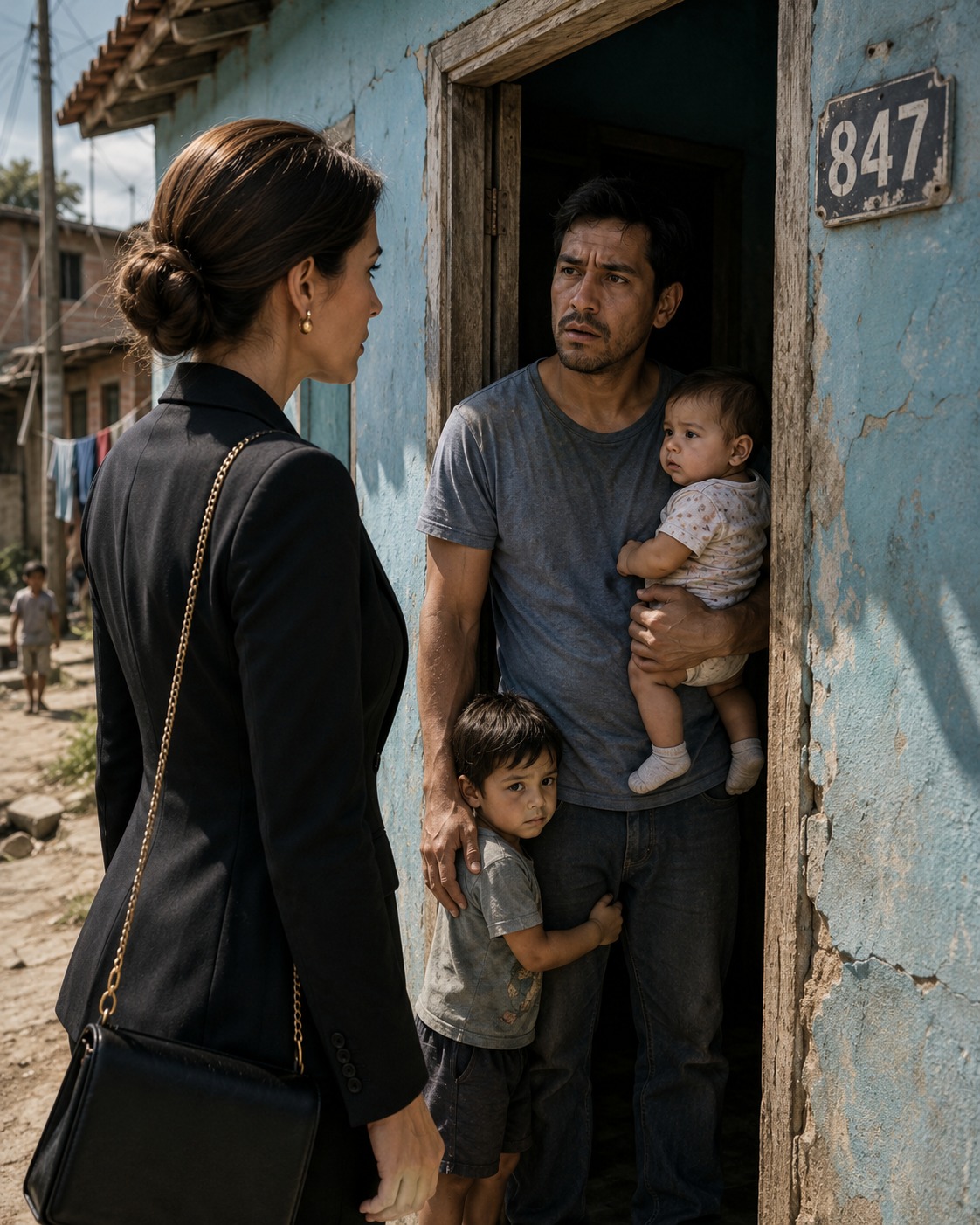
Her driver stopped in front of a faded blue house with a cracked wooden door. The number 847 hung crookedly on the wall.
“This is it, ma’am.”
Laura stepped out, careful not to let her heels touch the mud. She lifted her chin and walked to the door.
She knocked hard.
Silence.
She knocked again. “Carlos?”
From inside came the thin, exhausted cry of a baby.
Laura frowned.
Then came hurried footsteps, a child’s whisper, and the scrape of a lock.
The door opened.
Carlos Rodríguez stood there, but he did not look like the quiet man who cleaned her office before sunrise. His hair was messy. His gray T-shirt was worn and stained. Purple shadows sat deep under his eyes. In one arm, he held a baby wrapped in a faded blanket. A little boy clung tightly to his leg.
Behind him, two more children peered from the dim room.
Carlos went pale.
“Mrs. Mendoza,” he whispered. “What are you doing here?”
Laura had prepared a speech in the car. It involved responsibility, employment standards, and consequences.
But the words vanished.
Inside the house, she saw medicine bottles on a small table. A pile of unpaid bills. A school backpack with a broken zipper. A little girl lying on a mattress in the corner with a wet cloth on her forehead.
The baby coughed weakly.
The boy on Carlos’s leg looked up at Laura with terrified eyes.
“Please don’t take our daddy away,” he said.
Laura felt something hit her chest.
Carlos closed his eyes. “Mateo, go inside.”
But the boy did not move.
Laura stepped into the house.
It was barely larger than her closet. A fan turned slowly overhead. The walls were cracked. The kitchen was a small corner with two burners and a pot of rice. The whole room smelled of fever medicine, baby powder, and fear.
Carlos shifted the baby in his arms. “I’m sorry you had to come here.”
Laura looked at him. “Why didn’t you tell the company?”
“Tell them what?” His laugh was tired and bitter. “That my wife died eight months ago? That I have four children? That the baby keeps getting sick? That I sleep two hours a night and still come in before sunrise because if I lose that job, we don’t eat?”
Laura said nothing.
“I didn’t want pity,” he continued. “And I didn’t want to be replaced.”
The little girl on the mattress opened her eyes. “Papá?”
Carlos hurried to her. “Sofía, don’t sit up.”
Laura watched him kneel beside the child with a tenderness so complete it made the room feel sacred.
“How long has she had a fever?” Laura asked.
“Since yesterday.”
“And the baby?”
Carlos looked down at the infant. “This morning. The clinic said if it got worse, I should take her to the hospital.”
“Then why are you here?”
He looked at her as if the answer should have been obvious. “Because I don’t have enough money for the hospital deposit.”
Laura’s throat tightened.
On her wrist, her watch cost more than everything in this room.
She reached into her handbag. Carlos immediately stood.
“No,” he said. “Please. Don’t.”
Laura stopped. “Your children need a doctor.”
“I’m not begging.”
“I didn’t say you were.”
His pride stood between them like a wall, thin but stubborn.
Laura pulled out her phone instead. “Patricia, send my driver back to the entrance. Tell him we’re going to Saint Gabriel Hospital. Call ahead. Pediatric emergency. Two children.”
Carlos stared at her. “Mrs. Mendoza—”
“Now, Carlos.”
For the first time that day, her command sounded less like a weapon and more like a promise.
At the hospital, Carlos carried the baby while Laura carried Sofía. The girl was light, far too light. She rested her head against Laura’s shoulder, burning with fever.
“You smell nice,” Sofía murmured.
Laura almost smiled. “Thank you.”
“My mamá smelled like flowers.”
Laura looked down at her. “What was her name?”
“Elena,” the girl whispered. “Elena Ruiz.”
Laura froze for half a second, but kept walking.
Ruiz.
The name slipped into some old, locked room in her memory.
At the emergency desk, the nurse asked for payment information. Carlos’s shoulders collapsed.
Laura handed over her black card.
“Everything they need,” she said.
Carlos looked humiliated. “I’ll pay you back.”
Laura turned to him. “Your children will get treated first. We can argue later.”
Hours passed.
The baby had a respiratory infection, dangerous but treatable. Sofía was dehydrated with a severe fever. Both would recover if monitored overnight.
Carlos sat in the waiting room, elbows on his knees, face buried in his hands. Mateo and the younger boy, Nico, slept curled together on two chairs.
Laura sat across from him.
She should have left after paying. She had meetings, calls, contracts, people waiting for her. But every time she stood, one of the children shifted, and Carlos looked toward the hospital doors with an expression that made her sit back down.
Near midnight, Carlos finally spoke.
“You must think I’m pathetic.”
Laura looked at him. “No.”
“You came to fire me.”
“Yes.”
He looked up.
Laura did not soften the truth. “I thought you were lying. I thought you were irresponsible.”
“And now?”
She glanced at the children. “Now I think I was wrong.”
Carlos breathed out slowly, as if he had been holding that breath for years.
The next morning, Laura drove them home.
Before leaving, she noticed Sofía watching her from the doorway.
“Miss Laura,” the girl said, “Papá has a letter with your name.”
Carlos turned sharply. “Sofía.”
Laura’s eyes narrowed. “A letter?”
Carlos’s face drained of color. “It’s nothing.”
“Letters with my name are usually not nothing.”
He looked trapped.
Sofía pointed toward a wooden box under the table. “Mamá said if things got bad, Papá had to show it to her.”
Carlos closed his eyes. “She was sick when she said that. She didn’t know what she was saying.”
Laura walked to the box.
“Please,” Carlos said. “You don’t want to read it.”
But Laura opened it.
Inside were old photographs, birth certificates, hospital papers, and one sealed envelope. The paper was yellowed at the edges. On the front, written in careful handwriting, was her name.
Laura Mendoza.
Her fingers trembled before she realized they were moving.
She opened it.
Dear Laura,
You don’t know me, but I have known about you all my life.
My name is Elena Ruiz. I am your sister.
Laura stopped breathing.
The room blurred.
Carlos reached toward her, then stopped.
Laura read on.
Our father was Eduardo Mendoza. My mother worked in his house before he married your mother. When she became pregnant, his family paid her to disappear. He sent money for a few years, then nothing. My mother never hated him. I did.
I watched you in newspapers and magazines. I told myself I would never ask you for anything. You had your life, and I had mine.
But if you are reading this, it means Carlos is alone with our children. He is a good man. Too good. He will starve before asking for help. Please don’t punish him for being proud.
Laura covered her mouth.
Her father.
Eduardo Mendoza, the man whose portrait hung in the lobby of her company. The man whose name opened doors. The man she had worshipped as a child and mourned as a saint.
He had abandoned a daughter.
Her sister.
Laura looked at Carlos. “You knew?”
Carlos’s eyes were wet. “Elena told me after she got sick. She made me promise never to use it. She said she didn’t want money from the Mendoza family.”
“She was my sister,” Laura whispered.
“Yes.”
“And you never told me.”
“I cleaned your office, Mrs. Mendoza. What was I supposed to say? ‘Good morning, your father had a secret daughter and she died poor while I emptied your trash’?”
The words struck her harder than anger.
Laura sat down because her knees failed.
The children were silent.
Sofía walked to her and placed a small hand on Laura’s arm. “Mamá said you looked strong in pictures.”
Laura stared at the child’s face. The shape of her eyes. The curve of her cheek.
Family.
Not charity. Not obligation. Blood.
The next weeks changed everything.
Laura gave Carlos paid leave, then quietly arranged medical care, groceries, and repairs to the house. Carlos fought her on every gift until she stopped calling them gifts.
“They’re family expenses,” she said.
He had no answer for that.
At the company, rumors spread. Laura Mendoza had personally intervened for a janitor. Laura Mendoza had been seen in San Miguel. Laura Mendoza had canceled investor dinners and school-board meetings to attend pediatric appointments.
People thought she had gone soft.
They were wrong.
She had become dangerous in a new way.
She began reviewing old company records. Land purchases. Evictions. Neighborhood redevelopment plans. San Miguel appeared again and again in future acquisition files, marked as “high-potential clearance zone.”
Clearance.
The word made her sick.
One evening, Patricia entered her office and found Laura surrounded by boxes of archived documents.
“Are you all right?” Patricia asked.
Laura held up a file. “My father bought land through shell companies for twenty years.”
Patricia frowned. “That’s not unusual for developers.”
“He also pushed out families who couldn’t read the contracts they signed.”
Patricia said nothing.
Laura opened another file. “Elena’s mother lived on land we acquired in 1998. She was forced out after Eduardo stopped sending money.”
Patricia’s face changed.
Laura looked toward the ocean, no longer feeling like she owned it.
“I built my empire on a foundation I never bothered to inspect.”
The final truth came from the oldest archive box.
A notarized document. A transfer of shares. A private trust in the name of Elena Ruiz, created by Eduardo Mendoza one year before his death but never delivered. The trust contained ten percent of the original Mendoza holdings.
Ten percent that had multiplied into millions.
Laura sat alone in her office long after midnight, reading the document again and again.
Her father had tried, at the end, to leave something to Elena.
Someone had buried it.
The signature on the cancellation request belonged to Laura’s mother.
For two days, Laura told no one.
Then she went to Carlos’s house.
The children were eating soup at the table. The roof had been repaired. The baby, Isabel, slept peacefully in a crib Laura had ordered but Carlos pretended to dislike.
Carlos opened the door, wiping his hands on a towel. “Is something wrong?”
Laura handed him the folder.
“Elena owned part of Mendoza Group,” she said.
Carlos stared at her. “What?”
“My father created a trust for her. My mother hid it. Legally, it should have passed to Elena’s children.”
Carlos backed away. “No. Laura, no.”
“Yes.”
“I don’t want your company.”
“It isn’t mine to give. It’s theirs.”
He opened the folder with shaking hands.
Mateo looked up from his soup. “Papá?”
Carlos read the document, then sank into a chair.
“How much?” he whispered.
Laura looked at the children. “Enough that they will never go hungry again. Enough that they can live wherever they want. Enough that their mother’s name will not disappear.”
Carlos covered his face.
Sofía walked to Laura and hugged her waist. Laura stood stiffly for one second, then slowly wrapped her arms around the girl.
Something inside her broke.
And for once, it breaking did not destroy her.
It freed her.
Six months later, Laura held a press conference in front of the San Miguel community center, a building her company had once planned to demolish.
Cameras flashed. Reporters shouted questions.
Laura stood at the podium. Beside her were Carlos and the children. Carlos wore a clean navy shirt and looked deeply uncomfortable. Mateo held his hand. Sofía stood close to Laura, brave and solemn.
Laura looked into the cameras.
“Mendoza Group will no longer proceed with the San Miguel clearance project,” she announced. “Instead, we are launching the Elena Ruiz Foundation, dedicated to housing protection, medical support for working families, and educational scholarships for children in vulnerable neighborhoods.”
The reporters erupted.
Laura lifted a hand.
“There is more. A previously undisclosed family trust has confirmed that Elena Ruiz, my late sister, held a rightful stake in Mendoza Group. That stake now belongs to her children.”
Gasps moved through the crowd.
Carlos turned to Laura, stunned. “You didn’t have to say that publicly.”
Laura leaned slightly toward him. “Yes, I did.”
A reporter shouted, “Ms. Mendoza, are you saying your employee’s children are now heirs to your company?”
Laura looked at Sofía. Then at Mateo, Nico, and baby Isabel.
“No,” she said. “I’m saying they always were.”
That night, after the cameras left and the city began telling the story in a hundred different ways, Laura returned to her penthouse.
For years, the silence there had felt like success.
Now it felt empty.
On her glass table was a framed photograph Sofía had given her. It showed Elena holding baby Isabel, smiling tiredly but beautifully. Behind the photo, in blue ink, Elena had written:
Family is not the people who share your blood. Family is the people who show up before it is too late.
Laura touched the words.
Then her phone rang.
It was Carlos.
“Everything okay?” she asked.
His voice was quiet. “Sofía wants to know if her Aunt Laura is coming for dinner tomorrow.”
Aunt Laura.
The title pierced her more deeply than any award ever had.
She looked out over the city, past the towers, past the lights, toward the neighborhood she once entered with judgment in her heart.
“Yes,” she said. “Tell her I’ll be there.”
There was a pause.
Then Carlos said, “Laura?”
“Yes?”
“Elena would have liked you.”
Laura closed her eyes.
For the first time in years, tears slipped freely down her face.
“No,” she whispered. “I think she would have challenged me.”
Carlos laughed softly. “Probably.”
The next evening, Laura arrived at the little blue house without a driver, without a designer blazer, and without the cold armor she had worn for most of her life.
Mateo ran to hug her. Nico showed her a drawing. Sofía took her hand and pulled her inside. Baby Isabel reached for her with both arms.
Carlos stood by the table, watching.
There was rice, beans, chicken, laughter, noise, spilled juice, and a fan turning slowly overhead.
Nothing was polished.
Nothing was perfect.
Yet Laura Mendoza, who had spent her life buying the best view in every room, finally understood the truth.
The richest place she had ever entered was the home of the man she had come to fire.
And the discovery that changed his life completely had changed hers even more.