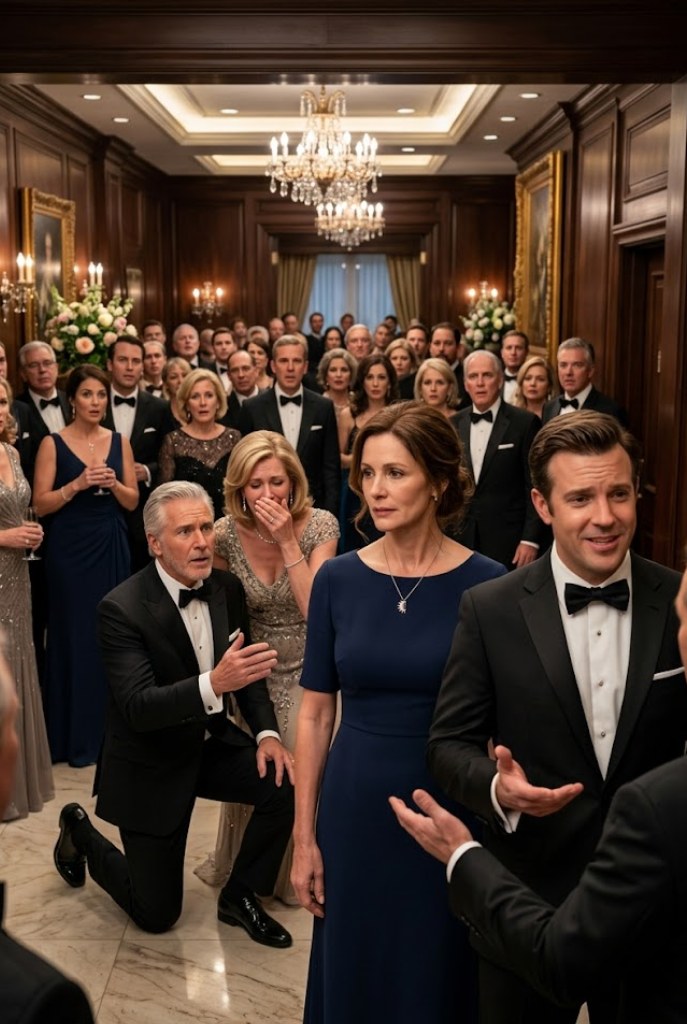
The night Daniel Whitmore told his wife to hide in the darkest corner of the ballroom, Emily Carter was wearing the simplest dress anyone in that glittering room would see all evening. It was navy blue, modest at the neckline, plain through the waist, with sleeves she had carefully pressed until the fabric held a clean, quiet line beneath the yellow light of their bathroom mirror. There was no designer label hidden along the seam. No custom beadwork. No whisper of Paris, Milan, or Manhattan stitched into the hem. Near the bottom, just where the fabric brushed her calf when she walked, there was a tiny repair she had sewn herself that afternoon while sitting at the kitchen table, the same old table where she paid bills, sorted mail, and sometimes ate dinner alone while Daniel was “networking.” The thread was almost the same color, not perfect, but close enough that anyone kind would never notice. Anyone unkind would see it at once.
Emily had known before leaving the house that Daniel would notice.
She had still chosen to wear it.
The dress was clean. It was ironed with care. It smelled faintly of lavender because she had tucked a small sachet into the closet drawer where she kept the few pieces of clothing she considered special. To Daniel, it was nothing. To Emily, it carried memory. It was the dress she had bought for herself after receiving her first full-time paycheck from the nonprofit health clinic in Oak Cliff. Rosa Bennett had still been alive then, sitting in her worn recliner with a blanket across her knees, clapping her hands softly when Emily stepped into the room to show her.
“Look at you,” Rosa had said, her brown eyes shining with the kind of pride that could make a poor room feel rich. “Mija, you look like somebody who knows where she’s going.”
Emily had laughed then, embarrassed and happy, turning once in front of the little television while Rosa pretended to be a judge at a beauty pageant. The dress had not been expensive even then. But Rosa had touched the sleeve as if it were silk, as if Emily had walked in wearing something made for a queen.
Now, ten years later, Rosa was gone, the nonprofit clinic had become part of Emily’s past, and the dress was the only piece of herself she had dared carry into Daniel’s world that night.
Outside the historic Arlington Manor Hotel in downtown Dallas, black cars slid up to the curb like polished shadows. Valets in crisp jackets hurried from door to door. Women stepped onto the sidewalk in gowns that shimmered like poured champagne. Men adjusted cuff links and laughed into the soft Texas night as if the whole city had been built to admire them. Above the entrance, golden lights washed across the stone facade of the old hotel, making every window glow. The Arlington had once hosted presidents, oil barons, film stars, and families whose last names appeared on hospitals, museums, and university buildings. Tonight, it hosted the annual Whitmore Corporation leadership gala, an event Daniel had described for weeks as “the most important night of my life.”
Emily had listened each time he said it. She had asked questions. She had offered to help him rehearse his remarks. She had even stayed up late one night polishing his shoes while he paced the living room, practicing how he would greet Richard Kensington, the billionaire owner of Whitmore Corporation and the man whose approval, according to Daniel, could change everything.
“This is the night people see me,” Daniel had told her that morning, standing in their closet among rows of suits that cost more than Rosa had once earned in months. “Not as a mid-level executive. Not as somebody waiting for permission. They’ll see me as leadership material.”
Emily had smiled at him, because she still knew how to be loyal even when love had become difficult.
“They should,” she had said. “You’ve worked hard.”
Daniel had looked at her then, eyes moving over her face with an expression she could not quite read. For a moment, she had hoped he might say something gentle. That he was grateful. That he was glad she would be beside him. Instead, his gaze had dropped to the navy dress hanging from the closet door.
“You’re not wearing that, are you?”
And all the hope in the room had quietly folded in on itself.
Now, at the curb, Daniel stepped from his black Aston Martin as though arriving at a coronation. He tossed the keys to the valet without looking at him, smoothed one hand over his dark hair, and checked the face of his gold Rolex. The watch caught the hotel lights and flashed. Emily stepped out on the other side, gathering her dress carefully so the repaired hem would not snag against the door. She had barely placed both feet on the sidewalk when Daniel turned and looked at her the way he sometimes looked at an unexpected stain on his shirt.
“Please, Emily,” he muttered.
She paused. “What?”
He lowered his voice, though the sharpness in it felt louder than the music drifting from inside the hotel. “Tonight matters. The board is here. Investors are here. Senators, CEOs, media people, and Richard Kensington himself. My boss. The owner of the entire company.”
“I know,” she said softly. “That’s why I came. I wanted to support you.”
Daniel gave a short laugh with no humor in it. He stepped closer, not like a husband leaning toward his wife, but like a manager correcting an employee before a presentation. “You don’t get it.”
Emily kept her hands clasped in front of her. “I’m trying to.”
“That dress,” he said, his mouth tightening. “Emily, look around.”
She did, though she already knew what he wanted her to see. A woman in emerald satin floated past them, diamonds bright at her throat. Another in silver lace lifted one hand as a photographer called her name. Men in tuxedos turned toward them and away again, the glance so quick it could have meant nothing, or everything.
“You look like you belong with the catering staff,” Daniel said.
The words struck with such clean cruelty that Emily did not react at first. Her body simply absorbed them. Her face remained calm because she had spent years learning how to keep calm when Daniel cut into her pride. A person did not survive marriage to a man like Daniel Whitmore by answering every wound. A person survived by breathing, by choosing silence when silence felt safer, by telling herself that maybe he was anxious, maybe he did not mean it, maybe tomorrow he would be sorry.
But some sentences did not leave room for maybe.
Emily looked down at the dress. She saw the navy fabric, the careful seam, the small repair near the hem. She saw Rosa’s hands, bent with arthritis, smoothing the sleeve years ago. She saw herself as a young woman standing in a small living room, laughing because she still believed the world might someday open kindly.
When she looked back up, Daniel was no longer watching her face. He was watching the entrance, checking who might have seen them.
“It’s too late now,” he said under his breath. “Just don’t draw attention.”
She almost asked him what kind of attention he thought she was capable of drawing. She almost reminded him that she had stood beside him at hospital fundraisers, investor dinners, company picnics, and charity auctions for five years, always quiet, always polite, always careful not to embarrass him. But arguing on the sidewalk would only make him angrier, and Emily had long ago learned that Daniel’s anger was not always loud. Sometimes it came later as silence, cold and deliberate, spreading through the house until she felt like a guest in her own marriage.
So she said, “I understand.”
The lie tasted bitter.
Daniel gave a clipped nod, as if she had finally accepted a reasonable instruction, then offered his arm only when they reached the front steps and cameras were near. Emily placed her hand lightly against his sleeve. From a distance, they might have looked like a successful couple arriving together, polished and composed, a handsome executive and his wife entering a night of privilege. No one could see the space between them. No one could hear the words he had just spoken. No one knew that beneath Emily’s collarbone, hidden by fabric and touched by the delicate chain around her neck, there was a pale scar shaped like a crescent moon, a mark from a fire she could not remember and a life no one had ever been able to explain.
Around her neck hung an old silver necklace in the shape of half a sun.
It was not beautiful in the way expensive things were beautiful. It had no jewels, no bright polish, no brand stamped discreetly on the clasp. The silver had softened with age, its edges worn by years of touch. Emily had reached for it in moments of fear since childhood, closing her fingers around the half-circle rays whenever she needed courage. Rosa had given it to her on a rainy afternoon when Emily was eight, after she came home crying because another child at school had called her “the girl nobody wanted.”
Rosa had sat beside her on the bed, the mattress dipping under her weight, and placed the necklace in Emily’s palm.
“This was with you when I found you,” Rosa said.
Emily had stared at it. “Where did you find me?”
Rosa had been quiet for a long moment. Rain tapped the window. Somewhere in the apartment building, a baby cried. Rosa’s face, usually warm with easy affection, had looked heavy.
“Near Fort Worth,” she said at last. “After a terrible fire. You were very little. Three, maybe four. Sick with smoke in your lungs. Burned here.” She touched Emily’s collarbone gently. “You were holding this so tight the nurses had to wait until you slept to clean your hand.”
Emily remembered asking, “Where was my mother?”
Rosa’s eyes had filled, though she had smiled through it. “I don’t know, mija.”
“My father?”
“I don’t know.”
“Then who am I?”
Rosa had pulled her close, rocking her against the soft cotton of her blouse. “You are Emily Carter because that is the name we gave you when no one came. You are my girl because I chose you. And whatever came before, whatever was lost, love found you again. Don’t ever think you came from nothing.”
But children ask questions even when adults cannot bear to answer. Emily asked them for years. Why had no one come for her? Why had there been no missing poster? Why did the police reports lead nowhere? Why did the hospital records list her as unidentified before Rosa petitioned to foster and then adopt her? Why did she wake sometimes from dreams of orange light and a woman’s voice calling a name that vanished when she opened her eyes?
Elizabeth.
Sometimes she heard it in sleep, thin as smoke, gone by morning.
Rosa never lied to her. That was one of the many things Emily loved about her. She said what she knew and admitted what she did not. She told Emily that the night she found her had been chaotic after a multi-car crash outside Fort Worth, near an industrial access road where smoke, rain, and sirens blurred everything. Rosa had been driving back from a church kitchen where she had helped prepare food for families in need. She saw flames before she saw the child. Emily had been stumbling near the ditch, coughing, barefoot, her nightgown blackened with soot, clutching the necklace so tightly her small fist had turned white. Rosa had wrapped her in a blanket and screamed for paramedics. Later, when no parent appeared, when no relative claimed her, when officials moved too slowly and Emily screamed every time a stranger tried to take her away, Rosa stayed.
“I did not plan to become a mother again,” Rosa once told her. “But God puts a child in your arms, and then your plans become very small.”
Emily had grown up loved, though never wealthy. Rosa sold tamales, sweet bread, and hot chocolate from a food cart she pushed through South Dallas in the mornings and parked near construction sites in the afternoons. She came home smelling of corn masa, cinnamon, and smoke from the little warmer she used to keep everything hot. Her hands were rough. Her feet ached. Money was always something to count twice. But she celebrated every birthday with candles, every report card with sweet bread, every heartbreak with a cup of chocolate thick enough to hold a spoon upright.
If Emily had learned dignity anywhere, she had learned it in Rosa’s kitchen.
Daniel had once admired that, or pretended to. When they met, Emily was thirty, working at the nonprofit clinic in Oak Cliff, where she helped patients fill out forms they did not understand and fought with insurance offices that treated poor people like problems. Daniel had arrived with photographers for a corporate donation event, a check presentation arranged by Whitmore Corporation’s community outreach division. He was handsome in a dark suit, with an easy smile and the kind of confidence that made people step aside before he asked. Emily remembered thinking he looked like someone who had never had to choose between paying an electric bill and buying groceries.
He approached her after the cameras moved on.
“You’re the only person here who looks unimpressed,” he said.
Emily had laughed despite herself. “I’m impressed by the donation. Less impressed by people taking pictures of themselves giving it.”
Daniel laughed too, and for once it had sounded real. He asked her name. Then he asked about the clinic. Then he asked why she cared so much. She told him about Rosa, about growing up around people who needed help and people too proud to ask for it. Daniel listened with his head tilted slightly, as though every word mattered. Later, he sent flowers to the clinic. Then he invited her to coffee. Then dinner. Then he began showing up without photographers, bringing supplies the clinic actually needed instead of oversized checks meant for publicity.
“You’re honest,” he told her one evening while they walked through Klyde Warren Park beneath strings of lights. “You don’t perform. Women in my world are always performing.”
Emily should have heard the warning in that sentence. At the time, she heard only admiration.
Daniel proposed eight months later, at a restaurant where the cheapest bottle of wine cost more than Rosa’s weekly grocery budget. Rosa cried when Emily showed her the ring. She cried harder at the wedding. Daniel’s family attended with tight smiles and polite distance. His mother complimented Emily’s bouquet and then asked which college her “people” had attended. Emily did not know what “people” meant, so she answered honestly. Rosa had not attended college. Emily had worked through community college and later finished her degree at night. Daniel squeezed her hand under the table, not affectionately, but in warning.
That squeeze became a language over the years.
Speak less.
Smile now.
Don’t say that.
Stop.
At first, the corrections came gently enough to mistake for care.
“Don’t mention the food cart at dinner,” Daniel would say while adjusting his tie. “People don’t need the whole poverty story.”
Or, “You pronounce certain words too strongly. It makes you sound less educated.”
Or, “My colleagues won’t understand the clinic stories. They’ll think you’re trying to make them feel guilty.”
Later, the words sharpened.
“You don’t know how these rooms work.”
“Do you have to be so emotional?”
“That necklace doesn’t go with anything. Why do you insist on wearing it?”
“You’re my wife, Emily. You represent me.”
Represent me. That was how Daniel saw her by the fifth year of marriage. Not as Emily, not as a woman who had built a life out of unanswered questions and stubborn tenderness, but as an extension of his image. A detail in his presentation. Something to polish, conceal, or explain away.
And that night at the Arlington Manor Hotel, he intended to conceal her.
The ballroom doors opened before them, and warm light spilled over Emily like a stage she had not auditioned for. Crystal chandeliers hung from a painted ceiling two stories high. Gold-trimmed mirrors reflected the crowd until it seemed there were twice as many guests, twice as many jewels, twice as many eyes. A string quartet played near a marble fountain filled with floating white orchids. Waiters moved silently with trays of champagne. At the far end, a raised platform waited beneath the Whitmore Corporation logo, projected in silver and blue across a velvet curtain.
Daniel inhaled as if breathing in destiny.
Emily inhaled and smelled roses, perfume, wine, and roasted meat. Beneath it all, perhaps imagined, she caught a memory of cinnamon and hot chocolate from Rosa’s cart.
Daniel leaned toward her without looking at her. His smile stayed fixed for the room.
“Stay near the kitchen or the restrooms,” he whispered sharply. “Do not introduce yourself as my wife tonight. If anyone asks, say you work for the event.”
For one second, Emily thought she had misheard him.
The quartet played on. A woman laughed nearby. A camera flashed. Daniel’s mouth still held its public smile.
Emily turned slowly. “What did you say?”
His eyes flicked toward her. “Don’t make me repeat myself.”
“You want me to tell people I work here?”
“I want you not to ruin this night.”
Something opened inside her then, not loudly, not dramatically, but with the quiet crack of ice under pressure. She could feel the room moving around her. She could see people greeting Daniel with admiration, clapping his shoulder, calling his name. To them, he was polished ambition. A rising man. A husband, perhaps. A leader in waiting. They did not know he had just asked the woman he married to erase herself so his image would remain clean.
“Daniel,” she said, barely above a whisper, “I am your wife.”
His jaw tightened. “Then act like someone who understands what that means.”
She touched the necklace at her throat. The familiar silver warmed beneath her fingers.
For a moment, she imagined Rosa standing beside her in that ballroom, short and sturdy in her flowered blouse, hair pinned back, hands on her hips. Rosa would not have shouted. She almost never shouted. But she would have looked at Daniel with those steady eyes and said, “No man who loves you asks you to disappear.”
Emily knew that. Somewhere deep beneath years of compromise, she knew it.
But knowing a truth and living by it are not always the same thing.
Daniel was already moving away, his hand raised toward a cluster of executives. Emily stood where he left her, in the flow of wealth and fragrance and laughter, feeling as if she had stepped outside her own body. She looked toward the kitchen doors. Then toward the restrooms. Then toward her husband, who had already become brighter without her, expanding into the room, smiling with his teeth, shaking hands with both palms.
After a while, Emily walked to the side of the ballroom and stood near the dessert table.
It was not exactly the kitchen. It was not exactly hiding. It was close enough to obedience that Daniel would not punish her for it later.
She watched him perform.
Daniel Whitmore had always known how to become what a room wanted. With older men, he became respectful and hungry. With younger executives, he became witty and bold. With wealthy women, he became charming in a way that stayed just inside the border of appropriate. He laughed loudly at jokes that were not funny. He touched elbows. He remembered names. He repeated phrases he had practiced in the mirror about growth, vision, infrastructure, and strategic expansion. Standing near the pastries, Emily could not help thinking that Daniel loved rooms like this more than he had ever loved any person inside them.
A waiter approached her with champagne. She shook her head. He smiled kindly and moved on. A few minutes later, a woman in a sequined black gown glanced at Emily’s dress, then at the dessert table behind her, and asked, “Excuse me, do you know if these are gluten-free?”
Emily’s face warmed.
“I’m sorry,” she said. “I don’t work here.”
The woman blinked, embarrassed but not apologetic. “Oh. Sorry.”
“It’s all right.”
It was not all right, but Emily had been saying those words since childhood. It’s all right. I’m fine. Don’t worry. I understand. She had used them as bandages over wounds too deep for anyone to see.
She looked down at the pastries arranged in careful rows: lemon tarts, chocolate domes, tiny cakes wrapped in gold leaf. Rosa would have laughed at them, not unkindly, but with amusement. “Food too pretty to eat is food with too much time on its hands,” she would have said, then handed Emily a warm tamale wrapped in paper and told her beauty mattered less than feeding someone hungry.
Emily smiled despite herself.
Then she heard Daniel’s laugh from across the room and the smile faded.
He was standing with a tall silver-haired woman Emily recognized from company articles: Margaret Vale, senior board member, old Dallas money, famous for funding political campaigns and destroying weak executives with a single question. Beside her stood two men Daniel had spent weeks studying. Investors. Men whose opinions traveled faster than official reports.
Daniel was glowing.
Emily realized, watching him, that he had not looked for her once.
The first hour passed slowly. Speeches were delayed because Richard Kensington had not yet arrived. Daniel checked his watch every few minutes. Conversations swelled and shifted. Emily remained near the side wall, occasionally moving so staff could pass. A photographer took pictures of the crowd but never pointed the camera at her. She wondered what would happen if she simply left. She could walk out, call a rideshare, go home, take off the navy dress, and sit in the quiet kitchen until Daniel returned furious. The thought tempted her. But something kept her rooted.
Maybe pride.
Maybe exhaustion.
Maybe the small foolish hope that Daniel might look across the room, see her standing alone, and remember that she had come because she loved him.
Then the ballroom changed.
It happened before anyone announced a name. A subtle movement near the entrance. Security guards straightening. Board members turning. Conversations thinning, then stopping in ripples. A hush traveled across the room like wind across water.
Richard Kensington had arrived.
Emily had seen his photograph many times. Everyone in Dallas had. He was the kind of man newspapers described with words like titan, magnate, visionary, kingmaker. At seventy-two, he still carried himself with an old-world authority that made younger men stand taller in his presence. His hair was white, combed neatly back. His tuxedo was simple, perfectly cut. He did not wear flashy jewelry or the loud confidence of men trying to prove they belonged. He entered as if belonging had never been in question.
Beside him walked an older woman with silver-blond hair swept into a low chignon. Eleanor Kensington. His sister. Emily knew her face too, though less from business magazines and more from charity coverage. Eleanor funded children’s hospitals, libraries, and scholarships. She wore a deep burgundy gown and carried no purse. One gloved hand rested lightly on Richard’s arm. Behind them came two security guards and a younger assistant carrying a leather folder.
The room seemed to lower itself around them.
Daniel nearly stumbled in his rush to cross the ballroom.
Emily watched him smooth his jacket, check his expression, and step into Richard Kensington’s path with the eagerness of a man reaching for a door he believed led to his future.
“Mr. Kensington,” Daniel said, loud enough for people nearby to hear. “What an honor. Daniel Whitmore, strategic development.”
Richard Kensington shook his hand without warmth. “I know who you are.”
Daniel’s smile twitched. “Of course, sir. It’s a privilege to have you here tonight.”
Richard’s gaze moved past him, not rudely, but with the distracted heaviness of a man carrying thoughts no gala could lighten. Eleanor looked around the ballroom with a composed expression, though Emily noticed something tired in her eyes.
“I was told you brought your wife tonight,” Richard said.
The words seemed casual. They were not.
Daniel’s posture stiffened so slightly only someone who knew him well would have noticed. Emily noticed.
“Yes, sir,” Daniel said. “She’s… somewhere nearby. She’s shy. Not used to this kind of world.”
Emily felt the sentence reach her before Daniel’s eyes did.
This kind of world.
As if she were a child brought into a museum, warned not to touch anything.
Richard Kensington’s expression did not change. “I would like to meet her.”
There was no request in his tone.
Daniel looked around, and for the first time all night, his eyes sought Emily. Not with affection. Not with apology. With irritation.
He lifted two fingers in a small command.
Come here.
Emily stood still for one heartbeat longer than he expected. It was a tiny act of rebellion, so small no one else could have seen it, but she felt it in her spine. Then she walked forward.
The room did not part for her the way it had parted for Richard Kensington. People noticed her only because she moved toward power. Her navy dress seemed even simpler beneath the chandeliers. Her shoes, modest and slightly worn at the heel, made almost no sound on the polished floor. She kept her shoulders straight. She did not lower her eyes.
Daniel’s smile had gone tight by the time she reached him.
“Emily,” he said quickly, “this is Mr. Richard Kensington and Ms. Eleanor Kensington.”
Emily extended her hand with the manners Rosa had taught her at the kitchen table using chipped teacups and imaginary guests.
“It’s an honor to meet you,” she said.
Daniel added, with a small laugh meant to smooth over everything and explain her before she could speak for herself, “Emily is helping with the event tonight.”
For a moment, Emily’s outstretched hand remained between them.
Richard Kensington did not take it.
His eyes had dropped to her necklace.
The change in him was so immediate, so total, that the air around them seemed to tighten. His face lost color. The authority that had held him upright all evening faltered as though someone had struck him from inside. Eleanor, beside him, followed his gaze to Emily’s throat. The moment she saw the silver half-sun resting against Emily’s skin, she made a sound that was not a word. A soft, broken gasp. Her gloved hand flew to her mouth.
Emily’s hand slowly lowered.
Daniel laughed nervously. “Oh, don’t mind that old thing,” he said, too quickly. “I keep telling her not to wear flea-market junk to formal events.”
Emily turned toward him, stunned by the cruelty of hearing Rosa’s necklace dismissed in front of strangers.
Daniel grabbed her arm just above the elbow. His fingers dug in enough to warn, not enough to leave a mark anyone could see.
“Go back to the corner, Emily,” he muttered through his smile. “You’re embarrassing me.”
No one in the ballroom yet understood that Daniel Whitmore had just made the worst mistake of his life.
Richard Kensington’s voice thundered through the room.
“Take your hand off her. Now.”
The quartet stopped playing.
Conversations died mid-sentence. A champagne flute chimed faintly as someone’s hand trembled against another glass. Every face within twenty feet turned toward them, and then those people turned others, and silence spread until the whole ballroom seemed to hold its breath.
Daniel released Emily instantly.
His confidence shattered so fast that Emily almost felt sorry for him. Almost.
“Sir, I—”
Richard ignored him.
He stepped closer to Emily, slowly, as if approaching a miracle that might vanish if startled. His eyes remained fixed on the necklace. Up close, Emily could see tears gathering there, bright and impossible.
“That necklace,” he whispered. His voice had lost all thunder now. It was fragile. “Where did you get it?”
Emily’s mouth went dry. She touched the silver half-sun, suddenly aware of hundreds of eyes.
“It belonged to the woman who raised me,” she said. “Rosa Bennett. She found me after a car fire thirty years ago near Fort Worth. I was very young. Sick from the smoke. Burned.” Her fingers drifted toward the scar beneath her collarbone. “I was holding this necklace.”
Eleanor made another broken sound. This time it became a sob.
Richard’s hand lifted, then stopped before touching the necklace, as though he knew he had no right. His face crumpled with a grief so old it seemed carved into him.
“May I?” he asked.
Emily did not know why she nodded. Perhaps because his pain felt real. Perhaps because some part of her, some forgotten child inside her body, recognized the way he looked at her.
She unclasped the chain with trembling fingers and placed the half-sun in his palm.
Richard held it as if it were alive.
Beside him, Eleanor reached beneath the neckline of her burgundy gown and pulled out a gold chain. Her hands shook so badly the clasp caught against the fabric. When she finally freed it, something silver swung into the light.
The other half of a sun.
A murmur passed through the ballroom.
Emily stared at it.
The piece hanging from Eleanor’s chain was shaped to fit the broken edge of Emily’s necklace. Its rays curved outward in the same pattern, worn by time in the same places. Eleanor held her half beside Emily’s. The two pieces met perfectly, forming a small silver sun no larger than a child’s palm.
Emily stopped breathing.
Daniel forced out a laugh that sounded like a man slipping on ice. “Sir, with all due respect, necklaces like that can be bought anywh—”
“Shut up,” Eleanor snapped.
The sharpness of it stunned the room almost as much as Richard’s command had.
Eleanor did not look at Daniel again. She turned Emily’s half of the necklace over with trembling care. “There should be an inscription,” she said, though her voice sounded as if it were coming from far away. “Richard, turn it over.”
Richard did.
The engraving was faded. Emily had seen it a thousand times and never understood it. She had traced it as a child with her thumbnail, inventing meanings, asking Rosa if the letters could be initials. Rosa had said maybe. Police had photographed it. Investigators had recorded it. No one had connected it to anything.
Now, under the chandeliers, Richard Kensington read the words and closed his eyes.
E.K. — My light always returns.
Emily felt the room tilt.
E.K.
Elizabeth Kensington.
Not Emily Carter.
Elizabeth.
The name from the dreams.
The name smoke had carried through her sleep all her life.
Richard opened his eyes. The tears spilled freely now. The most powerful man in the room, a man whose signature could move markets, whose silence could end careers, whose name was etched onto towers and contracts and university halls, lowered himself to his knees in front of her.
“Elizabeth,” he choked out. “My daughter. My little Elizabeth.”
The ballroom erupted into stunned whispers.
Emily stepped back, but there was nowhere to go. Daniel was behind her, rigid. Eleanor was crying openly. Richard remained on his knees, looking up at her with such naked love and disbelief that it hurt to see. Emily’s mind tried to reject it. Things like this happened in movies, not in ballrooms. Not to women in repaired dresses. Not to girls found half-conscious by a food cart vendor beside a burning road. Not to wives told to hide near the bathrooms.
“My name is Emily,” she whispered.
Richard nodded quickly, painfully. “Yes. Yes, of course. Emily. Whatever name you were given, whatever name you choose. But when you were born—” His voice broke. “When you were born, we named you Elizabeth Rose Kensington. Your mother chose Elizabeth. I chose Rose because she said you were our miracle after so many years of waiting.”
Rose.
Emily almost fell.
Rosa had often called her “mi rosa” when she was little. My rose. Emily had assumed it was affection, nothing more. Perhaps it had been. Perhaps Rosa had known the sound belonged to her somehow. Or perhaps love, real love, found old names even when history did not.
Eleanor reached for her, then stopped, crying too hard to speak. “The accident,” she managed. “We were told no one survived. We buried an empty coffin because there was no body, but they told us—” She pressed her hands to her mouth. “They told us the fire was too severe. We mourned you for thirty years.”
Richard rose slowly, as though age had found him all at once. “I searched,” he said. “For ten years, I searched every hospital, every shelter, every agency that might have taken in an unidentified child. Private investigators. Police. Retired detectives. Reward notices. I never stopped hoping, not really, even when everyone told me grief was making me cruel to myself.” He looked at Emily as if afraid she might turn to smoke. “You were three years old. You had a little laugh that sounded like hiccups. You hated peas. You slept with a stuffed rabbit missing one ear. Your mother used to sing to you in the blue nursery upstairs.”
Emily put one hand over her mouth.
There were no memories, not clear ones. Only fragments. Blue light on a wall. A woman humming. A hand fastening something around her neck. The smell of rain. Tires screaming. Heat. Smoke. A voice calling Elizabeth.
She had spent her whole life telling herself those fragments were dreams.
Now the dreams had names.
Daniel moved suddenly, stepping beside her with the urgency of a man watching fortune rearrange itself before his eyes. His face had changed. The embarrassment was gone. The irritation was gone. In their place came something Emily had seen before when Daniel looked at promotions, stock options, invitations, access. Hunger.
“Baby,” he said, reaching for her waist. “Emily, my God. I always knew there was something special about you.”
Emily stepped away before his hand could settle on her.
Daniel froze, then laughed softly, trying to recover. “Mr. Kensington, I swear, this is overwhelming for all of us. Emily and I—Elizabeth, I mean—we’ve been married five years. I have always treated her like a queen.”
The lie moved through the room like a bad smell.
Emily looked at him. Really looked. For years, she had seen pieces of Daniel and excused the whole. She had seen the charm and excused the cruelty. Seen the ambition and excused the contempt. Seen the public smile and told herself the private coldness came from pressure. Now, standing between the man who had told her to hide and the father who had fallen to his knees at the sight of her necklace, Emily saw Daniel clearly.
He did not love her.
He loved what she might now become.
“Don’t touch me,” she said.
Daniel blinked rapidly. “Emily, sweetheart, emotions are high right now.”
“No.” Her voice was quiet, but it carried in the silence. “For the first time in five years, I think my emotions are exactly where they should be.”
His face tightened. “This isn’t the place.”
“That’s interesting,” Emily said. “Because an hour ago, this was the place where you told me to pretend I worked for the event.”
A low murmur spread through the guests.
Daniel’s eyes flashed with warning, but the warning no longer worked. Something inside Emily had shifted beyond his reach.
“You told me to stay near the kitchen or the restrooms,” she continued. “You told me not to introduce myself as your wife. You said I looked like I belonged with the catering staff.”
Someone nearby inhaled sharply.
“Emily,” Daniel said through clenched teeth, “do not do this here.”
“You mocked my dress. You mocked this necklace. You called it flea-market junk.” Her hand closed around the restored sun pieces, now resting in Richard’s palm. “That necklace was the only thing I had from the life I lost. It was the only clue to who I was before Rosa Bennett saved me. And you treated it like garbage because you thought I was nobody.”
Daniel’s face drained of color.
“I never said you were nobody.”
“You made me feel like it every day.”
The words came easier now, not because they hurt less, but because the truth had waited too long.
“You corrected the way I spoke. You told me not to mention the woman who raised me because her life embarrassed you. You were ashamed that I worked at a clinic. Ashamed that I came from South Dallas. Ashamed that I didn’t know which fork to use at your mother’s dinners. Ashamed that I cared more about people than appearances.” Emily’s voice trembled once, then steadied. “But now that you think I’m your boss’s daughter, suddenly I matter?”
The investors nearby looked at Daniel with open disgust. Margaret Vale folded her arms, her expression like winter.
Daniel turned toward Richard, panic rising. “Sir, please. This is a private marital disagreement. She’s overwhelmed. You can understand that.”
Richard Kensington’s grief hardened into something colder and far more dangerous. He still held the necklace in his hand. When he spoke, his voice was quiet, but the room seemed to lean away from it.
“You put your hands on my daughter.”
Daniel swallowed. “I was guiding her.”
“You humiliated her in front of my guests.”
“I didn’t realize—”
“That she was rich?” Richard asked.
Daniel flinched.
“That she belonged to someone powerful?” Richard continued. “That she had a name you could use? Is that what you didn’t realize?”
“Mr. Kensington, I have always respected your family and this company.”
“You do not know the meaning of respect.”
Daniel looked around as if searching for an ally. None appeared. The same people who had laughed with him minutes earlier now studied him as though he were something unpleasant revealed under bright light.
Richard stepped closer. “You are fired, effective immediately.”
Daniel’s mouth opened.
“And if you have any sense left,” Richard said, “you will leave my sight before I decide to ruin the rest of your life as thoroughly as you tried to diminish hers.”
For a long second, Daniel did not move. His ambition, his pride, his carefully constructed future seemed to collapse silently around him. Emily watched the calculations race behind his eyes. Apologize. Beg. Deny. Blame her. Charm someone. Save something.
He chose Emily.
Not out of love, but because she was suddenly the door he needed.
“Emily,” he said, softer now. “Please. We’re married. You know me.”
“Yes,” she said. “I do.”
That was all.
Daniel looked at her face and found no opening there. He looked at Richard and found only judgment. He looked at the board members, the investors, the senators, the executives, the people he had spent years trying to impress, and saw that every bridge he needed was already burning.
He left without another word.
No one stopped him.
The ballroom remained silent as he crossed the polished floor, past the chandeliers, past the cameras, past the dessert table where Emily had stood alone. At the doors, he turned once, perhaps hoping she would call after him, perhaps hoping some last performance might save him. Emily did not move. Daniel disappeared into the hallway, and the doors closed behind him with a soft click that sounded to Emily like the end of a long illness.
Only then did she realize she was shaking.
Eleanor came forward. “May I hug you?” she asked, her voice breaking.
Emily looked at her, this woman who might be her aunt, this stranger who carried the other half of her life on a gold chain. She should have been afraid. She should have stepped away. Instead, she nodded.
Eleanor wrapped her arms around her with a sob. The embrace was careful at first, then fierce. Emily stood stiffly for one second, two, and then something in her body surrendered. She leaned into Eleanor and cried in a way she had not cried since Rosa died, not neatly, not silently, but with the stunned grief of a child who had spent too long being brave.
Richard stood beside them, one hand pressed over his mouth, his shoulders shaking.
The guests watched, but Emily no longer felt exposed. For the first time that evening, she did not feel like a mistake in the room. She felt like someone who had been missing from it.
Margaret Vale was the first to move. She stepped toward the quartet and murmured something. The musicians quietly gathered their instruments and left the stage. Then Margaret approached Richard with uncommon gentleness.
“Richard,” she said, “would you like us to clear the room?”
He looked at Emily.
Emily wiped her face, embarrassed by the tears and then angry at herself for being embarrassed. A woman could discover her entire identity in front of strangers; surely she had earned the right to cry.
“I need air,” she said.
Richard nodded immediately. “Of course.”
He did not take her arm without permission. He simply walked beside her as Eleanor stayed close on the other side. The crowd parted now, not for wealth, not for power, but for something older and more human. Shock. Reverence. Shame. People lowered their eyes as Emily passed. Some looked at her with pity, some with awe, some with the hungry curiosity of those who knew they were witnessing a story that would travel across Dallas before midnight.
At the entrance, a young valet who had earlier accepted Daniel’s keys now stood frozen as Richard Kensington emerged with Emily at his side.
“Ma’am,” he said, then seemed unsure which title belonged to her.
Emily almost laughed.
Ma’am was enough.
The night air touched her face like cool water. Downtown Dallas glittered around them, indifferent and alive. Sirens wailed somewhere far away. A bus sighed at the curb. The hotel lights glowed behind her, and for a moment Emily could not make herself step farther. She had entered the building as Daniel Whitmore’s hidden wife. She had left as a daughter returned from the dead.
Richard stood quietly near her, giving her the gift Daniel never had: space.
Finally, Emily spoke. “I don’t know how to be who you think I am.”
Richard’s answer came at once. “You do not have to be anyone tonight.”
She looked at him. “But if this is true—”
“It is true,” Eleanor said softly. “The necklace, the scar, the timing, the place. We will do DNA testing, of course. We will do everything carefully. But I knew the moment I saw your face.”
“My face?”
Eleanor smiled through tears. “You look like your mother.”
The words entered Emily gently and destroyed her all the same.
“My mother,” she repeated.
Richard looked away, toward the dark street. His grief was quieter now, but no less deep. “Her name was Catherine. Catherine Vale Kensington. She was thirty-eight when we lost her. She had red hair, terrible patience for fools, and the most generous heart I ever knew.” He swallowed. “She would have loved the woman you became.”
Emily did not know what to do with that. She had imagined her mother a thousand different ways. Poor. Wealthy. Young. Frightened. Loving. Dead. Alive. A woman who had lost her. A woman who had left her. Now she had a name, a face she had not yet seen, and a grief waiting in a house she did not remember.
“Did she die in the crash?” Emily asked.
Richard closed his eyes. “Yes.”
The answer was expected. It still hurt.
“And you thought I did too.”
“They told us the fire consumed the vehicle.” Richard’s voice roughened. “Your car seat was found in the wreckage. There were remains they believed… there were mistakes. Terrible mistakes. The investigation was chaos. The crash involved multiple vehicles, heavy rain, an explosion from a fuel truck nearby. Records disappeared. Witness statements contradicted each other. I hired everyone I could hire, threatened everyone I could threaten, begged everyone who might know anything. But the trail died.”
Emily wrapped her arms around herself.
“I was in the hospital system,” she said. “Rosa told me they listed me as unidentified.”
Richard flinched. “We checked hospitals.”
“I believe you.”
And strangely, she did. Whatever else was unclear, his pain was not a performance. Emily had lived long enough with a man who performed affection to recognize the difference.
Eleanor touched Emily’s shoulder. “Rosa Bennett. Is she still alive?”
Emily shook her head. “She died six years ago.”
Eleanor’s face softened with sorrow. “I wish I could thank her.”
Emily looked toward the hotel doors, imagining Rosa there, wiping her hands on an apron, unimpressed by chandeliers and billionaires. “She knew I was waiting for answers. She kept every document. Every hospital note. Every police contact. Every newspaper clipping about accidents near Fort Worth that year. She tried so hard to find where I came from.” Emily’s voice cracked. “She used to say love found me twice. Once wherever I was born, and once when she picked me up from the road.”
Richard bowed his head. “Then I owe that woman everything.”
Emily said nothing because the truth of it was too large.
A black SUV pulled up. Richard’s security guard opened the rear door, but Richard did not move.
“Emily,” he said carefully, “you owe me nothing tonight. You do not have to come with us. You do not have to speak to reporters. You do not have to accept anything faster than your heart can bear. But I would like to make sure you are safe. Is there somewhere you want to go?”
Home, she almost said.
But the house she shared with Daniel no longer felt like home. It felt like a place where her belongings waited among his judgments.
“I don’t know,” she admitted.
Eleanor squeezed her hand. “Come to my house. No press. No board members. No expectations. Just tea, tissues, and a guest room with too many pillows.”
It was such an ordinary offer that Emily nearly cried again.
Richard looked at her. “Or I can arrange a hotel suite under another name. Anything you prefer.”
Emily glanced down at her dress. The repaired hem shifted in the breeze. She had spent so many years asking herself what Daniel would allow, what Daniel would think, what Daniel would punish with silence. Now two strangers who might be her blood waited for her choice as if it mattered.
“I need to get my things,” she said.
Richard’s expression changed. “From your house?”
“Yes.”
“Tonight?”
“I don’t want him touching Rosa’s things.”
That, more than anything, decided it.
Within fifteen minutes, Emily was seated in the back of the SUV between Eleanor and a silence too enormous for conversation. Richard sat in the front passenger seat, speaking quietly into his phone, arranging things with the calm efficiency of a man accustomed to crisis. He did not call reporters. He did not call lawyers first. He called a security team and then, after a pause, a doctor he trusted for DNA testing. He called someone named Martin and said, “No statement tonight. None. If anyone asks, the family requests privacy.” Then he looked back at Emily as if checking that the word family had not harmed her.
It had not harmed her.
It had frightened her.
There was a difference.
The house Emily shared with Daniel stood in a gated neighborhood north of Dallas, a place of manicured lawns and stone mailboxes. Daniel had chosen it because the address impressed people. Emily had never liked it. The rooms were too large, the walls too pale, the furniture too expensive to feel comfortable. Daniel’s taste lived there more than their marriage did. Still, her books were in the den. Rosa’s old recipe box was in the kitchen cabinet. A framed photograph of Rosa stood on Emily’s bedside table because Daniel had refused to let it sit in the living room.
“She doesn’t match the aesthetic,” he had said.
Emily had moved the photo without arguing.
Now, as the SUV stopped outside the house, lights glowed behind the front windows. Daniel was already home.
Richard turned. “You do not have to go in.”
“Yes,” Emily said. “I do.”
Eleanor started to protest, then stopped when she saw Emily’s face.
Two security guards accompanied them to the door. Richard came too, though Emily suspected no one could have stopped him. She entered using her key. The house smelled of Daniel’s cologne and the lemon cleaner the housekeeper used every Thursday. From the kitchen came the sound of a cabinet slamming.
Daniel appeared in the hallway, tie loosened, face flushed. For half a second, rage was naked on his face. Then he saw Richard behind her and rearranged himself.
“Emily,” he said, voice softening into injury. “Thank God. I’ve been worried sick.”
Emily looked at him for a long moment.
It was almost impressive, how quickly he could become the victim of pain he caused.
“I’m here for my things.”
His expression flickered. “Your things? Baby, don’t be dramatic. Tonight was confusing. I panicked, okay? I said things badly. But we can fix this.”
Richard said nothing. His silence made the hallway feel smaller.
Daniel took one step closer. “Emily, listen to me. You don’t know these people. Not really. I’m your husband.”
“You told me not to say that tonight.”
His jaw tightened. “I made a mistake.”
“You made a choice.”
“I was under pressure.”
“So was I.”
He looked at Richard, then back to her. “Are we really going to throw away five years because of one bad night?”
Emily almost laughed. One bad night. That was the kind of phrase people used when they wanted the final wound separated from all the others that came before it. As if humiliation arrived alone. As if cruelty did not build a house one brick at a time.
“No,” she said. “We’re ending five years because tonight finally made me honest about them.”
Daniel’s eyes hardened. “Be careful. You’re emotional right now. You don’t want to make decisions you’ll regret.”
Richard moved slightly. It was enough.
Daniel saw it and stepped back.
Emily walked past him toward the bedroom. Her hands shook only once, when she lifted Rosa’s photograph from the bedside table. In it, Rosa sat on a park bench wearing a yellow cardigan, smiling at the camera with her whole soul. Emily pressed the frame against her chest.
She took the recipe box. A shoebox filled with documents about her childhood. A few clothes. Her laptop. The old quilt Rosa had sewn from fabric scraps. A worn Bible that had belonged to Rosa, though Emily did not take it for religion so much as for the notes Rosa had written in the margins: recipes, phone numbers, reminders to call Emily’s school, prayers for courage.
Daniel followed her from room to room.
“This is insane,” he said. “You’re letting a shocking moment cloud your judgment.”
Emily folded clothes into a suitcase. “No, Daniel. The shocking moment cleared it.”
“You think they’ll love you? You think billionaires just welcome people with open arms? They’ll test you. They’ll control you. At least I know you.”
She stopped.
“You knew how to hurt me,” she said. “That isn’t the same thing.”
His face twisted. “And what about everything I gave you?”
Emily looked around the room, at the expensive lamps, the custom curtains, the bed Daniel had selected because a designer recommended it. “You gave me things you wanted people to see. Rosa gave me a home.”
Daniel’s voice dropped. “You walk out that door, don’t expect to come crawling back.”
The old Emily would have gone cold with fear.
The woman standing in front of him felt almost peaceful.
“I won’t.”
She zipped the suitcase.
At the front door, Daniel tried one final time. Not with apology. Not with accountability. With calculation disguised as tenderness.
“Emily,” he said, lowering his voice so Richard might not hear every word. “Whatever happened tonight, you and I can handle it privately. Think about what this could mean for us. For our future. You’ll need someone who understands business, public life, the Kensington world. I can help you.”
Emily turned to him.
There had been a time when his face could make her ache. A time when she believed love meant understanding the wound behind someone’s cruelty. Now she saw only a man who had mistaken access for affection.
“You had five years to stand beside me,” she said. “You chose to stand above me.”
Then she walked out.
Richard carried Rosa’s recipe box himself.
Eleanor’s home was not what Emily expected. She had imagined marble floors, museum furniture, staff moving silently through hallways. There was wealth, of course. The house sat behind iron gates in Highland Park, with old oak trees bending over the driveway and windows warm with lamplight. But inside, it felt lived in. Books leaned in uneven stacks. Family photographs crowded a piano. A golden retriever with a gray muzzle lifted his head from a rug and wagged his tail sleepily when Eleanor entered.
“This is Winston,” Eleanor said, wiping her eyes. “He is terrible at respecting emotional boundaries.”
Winston immediately pressed his head against Emily’s leg.
For the first time all night, Emily laughed.
The sound surprised everyone, including her.
Eleanor made tea while Richard stood near the kitchen island holding the restored silver sun. He had returned Emily’s half before they left the hotel, but Eleanor had removed her own chain and placed both pieces on the table between them. Together, they looked less like jewelry than evidence.
Emily sat wrapped in Rosa’s quilt. Her suitcase waited by the stairs. The clock on Eleanor’s kitchen wall read 1:17 a.m.
No one seemed to know how to begin.
Finally, Richard took out his wallet. From behind a credit card, he removed a folded photograph so worn at the edges it seemed to have survived years of handling. He placed it in front of Emily.
A little girl stared back at her.
She was three, maybe four, with light brown hair curling around her cheeks and solemn gray-blue eyes that looked too much like Emily’s own. She wore a yellow dress and held a stuffed rabbit missing one ear. Behind her stood a woman with red hair, laughing as she tried to tie a ribbon in the child’s hair. The woman’s face was half-turned, alive with motion.
Emily touched the photograph with one fingertip.
“Is that me?”
Richard’s breath shuddered. “Yes.”
“And that’s Catherine?”
“Your mother.”
Emily stared until the image blurred.
There she was. Not imagined. Not abandoned. Not a blank space in a file. She had existed in someone’s arms. She had worn yellow. She had had a toy rabbit. A mother had tried to tie ribbons in her hair. A father had kept her photograph hidden in his wallet for thirty years.
“I don’t remember her,” Emily whispered.
Richard sat across from her. “You were so little.”
“I feel like I should.”
“No,” Eleanor said gently. “Memory is not a measure of love.”
Emily looked at her, grateful and shattered.
Richard opened the leather folder his assistant had carried at the gala. Inside were copies of old articles, reports, photographs. He hesitated before showing them. “Not tonight, unless you want.”
Emily did not want. But she needed.
So she nodded.
The story emerged in pieces.
Thirty years earlier, Richard Kensington had been forty-two and already one of the most powerful businessmen in Texas. His wife, Catherine, had been known for funding pediatric care programs and irritating wealthy donors by insisting they stop talking and write checks. Their daughter, Elizabeth Rose, had been born after years of failed pregnancies and private grief. Richard spoke of her babyhood with a tenderness that seemed to embarrass him and heal him at the same time. Eleanor filled in details when he could not continue.
Elizabeth loved peaches. Elizabeth called Eleanor “Nora” because she could not say Eleanor. Elizabeth hid under tables during parties and made executives pretend to be dragons before she would come out. Catherine wore one half of the sun necklace, Elizabeth wore the other on a shortened chain during special family days, and Richard had ordered the inscription after Catherine once said, “No matter where she goes, my light always returns to me.”
The night of the crash, Catherine had been taking Elizabeth from a family property near Fort Worth back to Dallas. Heavy rain. A company driver. A route changed at the last minute because of construction. A collision near an industrial access road. Fire. Confusion. Witnesses arguing about what they had seen. Catherine dead at the scene. The driver dead. A child presumed dead because a burned car seat was found inside the wreckage and officials believed no one so small could have escaped the flames.
“But I did,” Emily said.
Richard nodded. “Somehow.”
“Rosa found me.”
“Yes.”
“And no one connected me to the crash.”
Richard’s hand closed into a fist. “Someone made sure of that.”
The words settled heavily.
Eleanor looked at him with warning. “Richard.”
Emily sat straighter. “What does that mean?”
Richard rubbed a hand over his face. In the kitchen light, he looked older than he had in the ballroom. Not weak. Never weak. But worn down by grief that had waited too long for answers.
“At the time, I believed it was incompetence,” he said. “Bad police work. Disaster confusion. Records lost because agencies weren’t communicating. Later, I suspected more. There were business conflicts then. Ugly ones. Whitmore Corporation was expanding aggressively. I had enemies.”
Emily’s stomach tightened. “You think someone caused the crash?”
“I thought it for years. I could never prove it.”
Eleanor touched Emily’s hand. “That is for another day.”
But Emily knew already that another day had begun.
She slept badly in Eleanor’s guest room, if what she did could be called sleep. She lay beneath soft blankets, staring at shadows on the ceiling while the events of the night replayed in fragments. Daniel’s voice: You look like you belong with the catering staff. Richard on his knees. Eleanor’s half of the necklace. The photograph of the little girl in yellow. Rosa’s grave, six years old and waiting under a live oak in South Dallas.
Near dawn, Emily dreamed of fire.
She was small again, though in the dream she was also herself, watching from above. Rain battered glass. A woman screamed her name. Elizabeth. Not Emily. Elizabeth. Tires slid. Metal screamed. Heat burst bright. Someone’s hands pushed at a buckle. A necklace chain snapped. Smoke filled her mouth. Then cold mud under her feet. Lights flashing red and blue. Rosa’s voice, not yet familiar, calling, “Baby! Oh, sweet baby, come here!”
Emily woke with a gasp.
For a moment, she did not know where she was.
Then Winston, the old golden retriever, lifted his head from the floor beside the bed and thumped his tail once.
Emily sat up slowly, pressing a hand against her scar.
Morning came gray and quiet. Eleanor had left folded clothes outside the door with a note: Wear anything. Keep anything. No pressure to come down.
No pressure.
Emily read those two words three times.
When she finally went downstairs, Richard was in the kitchen wearing yesterday’s dress shirt with the sleeves rolled up, staring at a cup of coffee he had not touched. Eleanor stood at the stove making scrambled eggs. Winston sat hopefully at her feet.
“Good morning,” Eleanor said, then immediately laughed at herself through tears. “That feels absurdly normal.”
“It’s nice,” Emily said. “Normal sounds good.”
Richard stood too quickly, almost knocking his chair back. “Did you sleep?”
“A little.”
“I called Dr. Samuel Price. He’s handled private genetic testing for the family before. He can come here this morning, but only if you agree. There is no rush.”
Emily wrapped both hands around the mug Eleanor offered. “I agree.”
The DNA test was simple. A cheek swab. A sealed kit. Signatures. Consent forms. Emily found herself almost angry at how small the act was. Thirty years of longing, grief, mystery, and unanswered questions reduced to cotton against the inside of her mouth.
Dr. Price was kind and discreet. He did not stare at her. He did not mention the news, though Emily knew by then that the news had escaped.
By 8:00 a.m., Daniel’s humiliation had begun to spread.
A junior board member’s wife had posted something vague online about “witnessing divine justice at the Arlington gala.” Someone else mentioned Richard Kensington’s “long-lost daughter.” By breakfast, phones were vibrating steadily. Richard’s public relations team sent draft statements. Reporters gathered outside the gates of Eleanor’s house by noon. The Kensington name, dormant in Emily’s life for thirty years, suddenly roared around her like weather.
Emily turned off her phone after the seventy-third message.
Some were from people she knew. Former clinic coworkers asking if she was okay. Neighbors pretending concern. Daniel’s mother demanding Emily call before she “destroyed Daniel’s life over a misunderstanding.” Unknown numbers. Media requests. A message from Daniel himself:
We need to talk. Do not let them turn you against me.
A second:
I love you.
A third, ten minutes later:
You owe me a conversation.
Emily stared at that one longer than the others.
You owe me.
Even his love arrived as debt.
She blocked his number.
The next days moved like a storm. Richard’s attorneys arranged privacy protections. A security team quietly took position outside Eleanor’s home. The DNA sample was expedited, though Richard kept insisting Emily did not need proof to be treated with care. Emily appreciated that, but she needed proof. Not for them. For herself. She had lived too long with uncertainty to accept a miracle without evidence.
In the quiet spaces between legal calls and family histories, Emily learned her mother’s face.
Eleanor brought out photo albums. Catherine laughing on a sailboat. Catherine pregnant, barefoot in a garden. Catherine holding baby Elizabeth against her shoulder, exhausted and radiant. Richard younger, darker-haired, asleep in an armchair with a toddler sprawled across his chest. A birthday cake shaped like a sun. A nursery painted pale blue with white clouds. Elizabeth at two, covered in peach juice. Elizabeth at three, glaring at the camera because someone had taken away a marker she used to draw on the wall.
Emily did not remember these things, but her body reacted to them strangely. A pressure behind the ribs. A sense of recognizing a song without knowing the words.
Richard never pushed. He answered questions when she asked and fell silent when she looked overwhelmed. Sometimes she caught him watching her with joy so fragile it nearly broke her heart. Sometimes she saw terror there too, as if he feared he would wake and lose her again.
On the third evening, Emily found him in Eleanor’s library, standing before a framed portrait of Catherine.
“She was beautiful,” Emily said.
Richard did not turn. “Yes.”
The portrait showed Catherine in her thirties, red hair swept over one shoulder, eyes direct and amused, as if she had just heard something foolish and was deciding whether to forgive it.
Emily stood beside him. “Do you still love her?”
Richard’s smile was sad. “Love doesn’t stop because the person leaves. It changes rooms.”
Emily thought of Rosa. “Yes.”
Richard looked at her then. “I need to tell you something, and I need you to understand that I am not telling you to burden you.”
Emily braced herself.
“When Catherine died, I became difficult. Harder than before. I was never an easy man, but after losing both of you, I became… ruthless.” He exhaled. “People admired it in business. They called it focus. Discipline. Strength. It was grief with a suit on.”
Emily said nothing.
“I searched for you until everyone around me begged me to stop. Eleanor never did. But others did. Police. Attorneys. Friends. They told me I was torturing myself. Eventually, I stopped talking about the search. I did not stop funding it. Not completely. Every few years, I would send someone back through old records. Hospitals. Agencies. Missing children databases. Nothing.” His voice lowered. “And now I know you were alive thirty miles away for much of it.”
“You couldn’t have known.”
“I should have.”
Emily turned toward him. “Rosa used to say guilt is love with nowhere to kneel.”
Richard’s face changed.
“She sounds wise.”
“She was.”
“I wish I had known her.”
Emily looked back at Catherine’s portrait. “Me too.”
The DNA results came five days after the gala.
Emily was in the kitchen helping Eleanor make soup when Richard’s attorney called. Richard answered in the hall. Emily heard his voice once, low and strained. Then silence. Eleanor set down the knife she was using to chop carrots.
Richard returned with the phone still in his hand.
For a moment, he only looked at Emily.
Then he covered his face and wept.
The test confirmed with 99.999 percent probability that Emily Carter was the biological daughter of Richard Kensington. Eleanor was confirmed as her paternal aunt. There was no legal ambiguity, no statistical shadow wide enough for doubt.
Emily expected to feel transformed.
Instead, she felt quiet.
She sat at the kitchen table while Eleanor cried and Richard knelt beside her chair, not dramatically this time, but because his legs seemed to fail him. He took Emily’s hand only after she offered it.
“My daughter,” he said.
Emily looked at him, this man she had known for less than a week and somehow waited for all her life.
“My father,” she answered.
The words were strange in her mouth.
They were also true.
That night, the Kensington family released a brief statement. It asked for privacy, confirmed that Richard Kensington had been reunited with his daughter after thirty years, and expressed gratitude to the late Rosa Bennett, whose courage and love had saved Emily’s life. It said nothing about Daniel. It did not need to.
The world filled in the blanks.
Within twenty-four hours, every major outlet in Texas carried some version of the story. Long-Lost Kensington Heiress Found at Dallas Gala. Billionaire Reunited with Daughter Presumed Dead for Thirty Years. Executive Fired After Publicly Humiliating Wife Revealed as Owner’s Daughter. Emily hated the word heiress immediately. It made her sound like a jewel discovered in a vault, not a woman who had spent years filing clinic forms, clipping coupons, and learning how to make soup stretch for three days.
But the public loved the story because it gave them everything people crave: wealth, cruelty, revelation, justice, tears, and a woman rising in the exact room where she had been told to disappear.
Daniel’s version came through lawyers first.
He claimed he had been misunderstood. He claimed he and Emily had a loving marriage strained by “private pressures.” He claimed his firing was emotional and retaliatory. Then a video emerged.
Someone at the gala had recorded the moment Richard shouted at Daniel. The clip did not include everything, but it included enough. Daniel’s hand on Emily’s arm. His voice saying, “Go back to the corner, Emily. You’re embarrassing me.” Richard’s command. Eleanor’s sob. Daniel’s later claim that he treated her like a queen became impossible to defend.
Whitmore Corporation issued a statement confirming Daniel’s termination and reaffirming its commitment to dignity, respect, and workplace ethics. Margaret Vale resigned from the advisory committee Daniel had hoped to join and gave an interview without saying his name.
“Character,” she said, “is how a person treats someone when he believes they have no power.”
The sentence followed Daniel everywhere.
Major companies stopped returning his calls. Recruiters who had once praised his leadership potential became unavailable. Invitations disappeared. Friends grew busy. His mother gave one disastrous interview blaming Emily’s “sudden social elevation” for making her vindictive, which only worsened things. Within two weeks, Daniel Whitmore’s name had become less a résumé than a warning.
Emily watched it from a distance and felt less satisfaction than people expected.
She had imagined, in old private moments, what revenge might feel like. Back when Daniel corrected her in front of guests, or laughed at her childhood stories, or punished her with silence for embarrassing him, she sometimes pictured him exposed. She pictured someone powerful seeing through him. She pictured him feeling as small as he made her feel.
Now that it had happened, she felt mostly tired.
The divorce filing was simple. Richard offered the best attorneys in Texas. Emily chose one who specialized in coercive control and financial manipulation, a woman named Ava Monroe with sharp eyes and a calm voice. Ava reviewed Emily’s documents, messages, account records, and prenuptial agreement. Daniel, confident when he had married a woman he considered beneath him, had insisted on terms that protected his assets thoroughly.
“I don’t want his money,” Emily said.
Ava looked at her over the file. “Good. But I want to make sure he doesn’t take yours.”
Emily almost said, “I don’t have any.”
Then she remembered that she was Richard Kensington’s daughter.
It was one thing to know it emotionally. Another to confront the legal machinery of inheritance, trusts, family holdings, restored identity, and security protocols. Richard explained carefully that Catherine’s estate had included provisions for Elizabeth Rose Kensington, long frozen because she was presumed dead. There were accounts, properties, shares, and structures Emily did not understand. She listened politely, then went upstairs and cried into Rosa’s quilt because money could not go back in time. It could not buy Rosa easier years. It could not return Catherine. It could not erase the little girl in the hospital with no name.
Richard found her there and did not try to comfort with promises.
“I would burn every dollar,” he said from the doorway, “to have had you safe.”
Emily believed him.
The divorce took less than three weeks because Daniel misjudged everything. He thought Emily would be sentimental. She was not. He thought Richard would pay him quietly to disappear. Richard did not. He thought threatening to write a memoir about his marriage to “the Kensington heiress” would frighten them. Ava Monroe sent one letter, and Daniel’s attorney advised him to stop speaking immediately.
In the final meeting, held in a glass-walled office overlooking downtown Dallas, Daniel arrived wearing the same kind of suit he had worn the night of the gala. He looked thinner. Angrier. Less polished around the edges. Emily sat across from him with Ava on one side and Richard’s attorney on the other. Richard had offered to come. Emily asked him not to. This was hers.
Daniel stared at her as if trying to locate the woman who used to apologize first.
“You look different,” he said.
Emily did not answer.
“Is that what money does?” he asked. “Changes people in two weeks?”
Ava lifted her eyes from the documents. “Mr. Whitmore.”
Emily touched her necklace. The two halves had been joined by a jeweler Richard trusted, carefully restored without erasing the worn places. It rested whole against her throat now. The silver sun felt heavier than before, but not in a bad way.
“Money didn’t change me,” Emily said. “Leaving you did.”
Daniel’s jaw tightened. “You think you’re strong because they’re behind you.”
“No. I know I’m strong because I survived years of you standing in front of me.”
His eyes flashed. “I loved you.”
Emily looked at him for a long moment. Once, those words would have reached into her and found the place that wanted to believe. Now they stopped at the surface.
“You loved having someone to look down on,” she said. “That isn’t love.”
The papers were signed. The marriage ended quietly, without raised voices, without tears. Daniel walked out first, because men like him often needed the illusion of leaving. Emily stayed seated after he was gone, staring at the signature that returned her to herself.
Ava closed the folder. “How do you feel?”
Emily considered lying.
Then she smiled faintly. “Hungry.”
Ava laughed.
Emily went to lunch alone. Not because she had no one, but because she wanted to. She chose a small diner in Oak Cliff where Rosa used to take her after doctor appointments. She ordered chicken soup and sweet tea. The waitress did not know her. No one stared. No one whispered heiress. Emily sat in a vinyl booth with sunlight falling across the table and ate slowly, tasting freedom in something as ordinary as choosing where to sit.
After lunch, she drove to South Dallas.
Rosa Bennett was buried in a modest cemetery beneath a live oak that dropped leaves onto the grass no matter how often groundskeepers cleared them. Emily had chosen the plot because Rosa loved trees. She had also chosen the headstone, a simple gray marker engraved with:
Rosa Elena Bennett
Beloved mother, neighbor, and friend
She fed the hungry and sheltered the lost
Emily had visited often after the funeral, then less often during the worst years of her marriage because Daniel disliked “morbid habits.” Standing there now, she felt ashamed of the months she had stayed away.
“I’m sorry,” she whispered.
Wind moved through the oak.
She knelt and brushed leaves from the stone. For a while, she said nothing. Then everything came out. The gala. Daniel. Richard. Eleanor. The necklace. Catherine. The DNA test. The divorce. The way the world suddenly wanted to call her lucky, as if luck had not arrived thirty years late and stepped over Rosa’s grave to find her.
“You would have liked Eleanor,” Emily said through tears. “She makes terrible tea but good eggs. Richard is… he’s trying. He carries grief like a briefcase he forgot how to put down.”
She laughed softly, wiping her face.
“I wish you could tell me what to do.”
The answer, when it came, was not a voice. Emily did not believe in that kind of thing, not exactly. But she heard Rosa anyway in memory, clear as morning.
Do what love taught you.
A week later, Emily brought Richard to the grave.
He arrived with white roses, not the extravagant arrangement his staff had suggested, but a simple bundle he had bought himself after Emily told him Rosa would have considered anything larger wasteful. He stood before the headstone for a long time. Eleanor came too, wearing flat shoes because the ground was uneven. Winston would have come if allowed, Eleanor said, but he had poor cemetery manners.
Richard knelt slowly, ignoring the damp grass.
“Mrs. Bennett,” he said, his voice unsteady, “my name is Richard Kensington. You never knew me. But you saved my daughter when I could not. You gave her a name, a home, a childhood, discipline, tenderness, and dignity. You loved her when the world failed her. I have thanked presidents, surgeons, generals, and kings of industry in my life, and none of them deserved it more than you.”
He placed the roses gently against the stone.
“Thank you,” he whispered. “For loving my daughter when I could not.”
Emily stood behind him wearing the navy dress from the gala.
She had chosen it deliberately.
The tiny repair still marked the hem. The fabric was still plain. But when Richard saw her in it that morning, he did not frown. He only looked at her with tears in his eyes and said, “That dress was there the night I found you again. I think it is beautiful.”
At Rosa’s grave, Emily believed him.
Afterward, they drove through the old streets where Emily had grown up. She showed Richard the apartment building with cracked stairs where Rosa had rented a second-floor unit. The corner where the food cart once stood. The school where Emily had learned to fight with words instead of fists. The clinic in Oak Cliff where she had worked when Daniel first met her. Richard listened without interrupting. Eleanor asked questions. Neither treated her past like something to overcome.
At the clinic, an older nurse named Maribel recognized Emily and pulled her into a hug so fierce Emily nearly dropped her purse.
“Girl, you’re on every television in Texas,” Maribel said. “And you still look like you forgot to eat lunch.”
Emily laughed.
Maribel turned to Richard. “You her father?”
Richard straightened. “Yes.”
Maribel looked him up and down, unimpressed by wealth in the way only nurses and women who have seen real suffering can be. “You got a lot of catching up to do.”
Richard nodded solemnly. “I do.”
“Good,” Maribel said. “Start by making sure she rests. This one thinks being tired is a personality.”
Emily groaned. Eleanor laughed so hard she had to lean against the reception desk.
The clinic visit changed something in Emily. She had spent the days after the revelation being pulled between identities: Emily Carter, clinic worker, orphan, wife, survivor; Elizabeth Kensington, lost daughter, heiress, headline. But standing in the clinic where patients waited with forms in their hands, where children coughed into their sleeves, where exhausted mothers balanced hope against paperwork, she remembered what had always made sense to her.
People needed help long before they needed stories.
A month after the gala, Emily asked Richard to meet her in his office.
Whitmore Corporation’s headquarters occupied the top floors of a glass tower downtown. Daniel had once spoken of the executive suite as if it were Olympus. Emily entered through private security now, escorted by a woman who called her Ms. Carter-Kensington because no one knew which name she preferred.
Richard’s office looked over Dallas. The view was enormous. Highways curved like ribbons of light. Buildings rose in hard silver lines. Somewhere beyond them were the streets where Rosa had pushed her cart and the cemetery where Catherine’s memory had waited beside an empty coffin.
Richard stood when Emily entered. “Is everything all right?”
“Yes,” she said. “But I want to talk about money.”
He gestured for her to sit, his expression careful. “All right.”
“I don’t know how to be wealthy.”
“No decent person does at first.”
That startled a laugh out of her.
He smiled. “I mean it. Wealth is a tool. Some people mistake it for proof of worth. That is how they become ridiculous.”
Emily thought of Daniel. “I’ve seen that.”
Richard’s face darkened briefly, then softened. “What do you want to do?”
She took a folder from her bag. Inside were notes, rough budgets, names of organizations she had researched, contacts from her old clinic, shelters, legal aid offices, counselors who worked with survivors of emotional and financial abuse. She had been waking before dawn to write, plan, cross out, and write again.
“I want to start a foundation,” she said. “In Rosa’s name.”
Richard looked at the folder but did not touch it yet.
Emily continued. “Not something decorative. Not a charity that spends half its budget on galas so rich people can applaud each other. I want practical help. Emergency housing. Legal representation. Financial counseling. Therapy. Job placement. Childcare support. Transportation. Small grants paid quickly, without making women prove their suffering ten different ways to strangers.”
Richard leaned back slowly.
Emily’s voice grew stronger. “I know what it feels like to have a man make the world smaller around you. Daniel never hit me. I used to tell myself that meant it wasn’t abuse. But he controlled what I said, what I wore, who I spoke to, what parts of myself I was allowed to bring into a room. He made me feel grateful for being tolerated. There are women living with worse. Women with no Richard Kensington appearing at a gala. No public rescue. No inherited money. No safe guest room waiting. I want to build something for them.”
Richard was quiet for a long time.
Then he opened the folder.
He read every page.
Emily watched his expression shift from paternal concern to business focus to something like pride. He asked questions. Hard ones. How would they vet recipients without creating barriers? Which organizations had trust in underserved communities? How would they protect women from retaliation? What governance structure would prevent the foundation from becoming a vanity project? Emily had answers for some and admitted what she did not know for others.
Richard seemed most pleased when she said, “I need people smarter than me.”
“That,” he said, “is the first requirement of leadership.”
Three months later, the Rosa Bennett Foundation existed on paper. Six months later, it opened its doors.
Emily refused to hold the grand opening at a hotel ballroom.
“No chandeliers,” she told the planning committee.
Eleanor, who had joined the board and taken to bossing contractors with cheerful ruthlessness, said, “Thank God.”
They chose a renovated community center in South Dallas, not far from where Rosa had once sold tamales. The building had warm brick walls, large windows, counseling rooms painted in calming colors, a childcare space filled with books and soft rugs, a legal aid office, a computer lab, and a kitchen where financial workshops could be held over meals because Emily believed people learned better when they were fed.
Near the entrance hung a photograph of Rosa standing beside her food cart, laughing with one hand raised as if telling the photographer to go away. Beneath it was a small plaque:
Rosa Bennett believed dignity was not charity. It was a human right.
On opening day, hundreds of people came. Reporters, yes. Donors, yes. City officials, clinic workers, shelter directors, former patients, neighbors from Emily’s childhood, women who had heard the story and come because some part of it felt like their own. Richard stood near the back, refusing interviews. Eleanor moved through the crowd making sure everyone had water. Winston, wearing a therapy-dog vest he had only partially earned, accepted admiration near the children’s area.
Emily stood in a small room before the speech, looking at herself in a mirror.
She wore no diamonds. No couture gown. No symbol of inherited wealth. She wore a cream blouse, dark trousers, and the restored silver sun necklace. Her hair was pinned simply. On her wrist was Rosa’s old watch, scratched and slightly loose.
A knock sounded.
“Come in,” Emily said.
Richard entered. He stopped at the sight of her, and for a moment she saw again the man in the ballroom staring at the necklace as if the dead had spoken.
“You look like yourself,” he said.
“That’s the goal.”
He smiled. “Are you nervous?”
“Terrified.”
“Good. It means it matters.”
Emily touched the necklace. “Do you ever get used to people watching you?”
“No,” Richard said. “You only learn the difference between being seen and being consumed.”
She considered that.
“Daniel wanted people to see him,” she said. “I think I spent years trying not to be seen at all.”
“And now?”
Emily looked at Rosa’s watch, at Catherine’s necklace, at her own reflection standing between two lives.
“Now I want them to see the work.”
Richard’s eyes softened. “Your mother would be proud of you.”
Emily nodded, and for the first time, the sentence did not only hurt.
When she stepped up to the microphone, the room quieted.
The crowd blurred at first. Faces, cameras, lights, expectation. Then Emily found anchors. Maribel from the clinic, arms crossed and eyes wet. Eleanor holding a tissue she pretended not to need. Richard at the back, standing straight but trembling slightly. A young woman near the front clutching a toddler against her hip. An older woman in a faded coat. A man from the neighborhood who used to buy Rosa’s hot chocolate on cold mornings. People who had known Emily before the world renamed her. People who had not known her at all but needed proof that humiliation was not the final word.
Emily took a breath.
“For years,” she began, “someone tried to convince me that my worth depended on money, status, and where I came from.”
Her voice sounded calmer than she felt.
“He told me to speak less. To hide parts of my childhood. To dress differently. To leave my memories outside the rooms he wanted to enter. He told me my roots were embarrassing. He told me my love for the woman who raised me made me seem small.”
The room was still.
“Then one night, in a ballroom full of powerful people, he told me to hide near the bathrooms because he was ashamed of me.”
A few people lowered their heads. Some knew the story. Hearing it from her made it different.
Emily touched the necklace.
“That same night, I learned that the necklace he mocked was the clue that brought me back to my biological family. I learned that the scar I had hidden most of my life was not a mark of shame, but a mark of survival. I learned that the woman who found me in the smoke and raised me with almost nothing had given me something no amount of wealth can buy.”
She looked toward Rosa’s photograph.
“She gave me dignity.”
The word moved through her like breath.
“Dignity is not inherited through a last name. It is not purchased with wealth. It is not proven by designer clothing, expensive watches, private schools, or invitations into rooms where people smile without kindness. Dignity is what remains when those things are stripped away. It is the voice inside you that says, even when someone tries to make you feel small, I am still here.”
People were crying now. Quietly. Openly.
Emily continued.
“I stand here today as Richard Kensington’s daughter, and I am grateful for the miracle of finding my family. But I also stand here as Rosa Bennett’s daughter. The daughter of a woman who sold tamales before sunrise, who counted coins at the kitchen table, who made every child in her neighborhood feel fed, who picked up a burned and frightened little girl from the side of a road and decided love was stronger than paperwork.”
Richard bowed his head.
“This foundation exists because most women who are humiliated, controlled, threatened, or financially trapped do not receive a public rescue. Their pain does not unfold beneath chandeliers. No billionaire steps forward to defend them. No room falls silent. Many suffer quietly in kitchens, bedrooms, cars, offices, churches, and apartment hallways. Many are told that because no one sees the bruises, the wounds are not real.”
Emily’s voice strengthened.
“They are real.”
The room seemed to breathe with her.
“Emotional abuse is real. Financial control is real. Isolation is real. Being mocked until you stop speaking is real. Being corrected until you stop trusting yourself is real. Being made to believe you should feel grateful for crumbs of affection is real. And leaving is not simple. It takes money. Safety. Legal help. Childcare. Community. Courage. Sometimes it takes someone standing beside you before you can remember how to stand alone.”
She looked at the young woman holding the toddler.
“The Rosa Bennett Foundation is here to stand beside you.”
A sound moved through the room, not applause yet, but something close to recognition.
“We will not ask women to make their pain entertaining before we help them. We will not measure their worth by their bank accounts, accents, clothes, education, or last names. We will not confuse dignity with politeness or survival with weakness. We will help because help should not be reserved for those who can afford to escape.”
Now Emily smiled, softly.
“Sometimes life lets people break you in public so the world can witness how powerfully you rise. But I have learned that rising is not always loud. Sometimes rising is signing the divorce papers. Sometimes it is blocking the number. Sometimes it is packing one suitcase. Sometimes it is telling the truth after years of protecting someone who never protected you. Sometimes it is walking into a room in the same simple dress someone mocked and realizing the shame was never yours.”
Applause began before she finished, but she lifted one hand gently, and the room quieted again.
“I used to think my story began in loss,” she said. “A crash. A fire. A missing child. An empty coffin. A woman selling food who found me in the dark. Then I thought maybe it began in that ballroom, when the truth came out. But now I know my story began every time someone loved me without needing me to be impressive. It began when Rosa wrapped me in a blanket. When clinic patients trusted me with their forms. When women told me the truth in whispers because no one else had listened. And it begins again today, with every person who walks through these doors and learns they do not have to hide anymore.”
She stepped back from the microphone.
For one heartbeat, silence held.
Then the room rose.
The applause was not elegant. It was not the polished applause of a gala, measured and polite. It was loud, uneven, human. People stood clapping with tears on their faces. Maribel whistled. Eleanor gave up pretending she was not crying. Richard pressed one hand over his heart.
Emily looked out at them and did not feel consumed.
She felt seen.
After the ceremony, donors wanted photographs, reporters wanted quotes, officials wanted handshakes. Emily gave what she could and escaped when she needed air. She slipped into the hallway near the counseling rooms and leaned against the wall, closing her eyes.
A small voice said, “Are you Miss Emily?”
Emily opened her eyes.
A woman stood a few feet away, maybe in her late twenties, wearing faded jeans, a gray sweater, and sneakers with one fraying lace. Her hair was pulled back tightly. Her eyes were red from crying. Beside her stood a little boy holding a paper cup of juice with both hands.
“Yes,” Emily said gently. “I’m Emily.”
The woman swallowed. “I’m sorry. I know everybody wants to talk to you.”
“It’s all right.”
The woman looked down at her son, then back up. “My name is Lacey. I heard your story on the news. I almost turned it off because I thought, you know, rich people drama.” She gave a shaky laugh. “But then you talked about how he made you feel small. How he corrected you. How he made you think you were lucky he stayed.”
Emily’s chest tightened.
Lacey’s eyes filled. “My husband does that. Not in public. Everybody loves him. He’s funny. He pays the bills. He never hits me, so I kept telling myself I was being dramatic. But last week my son asked me why Daddy gets to decide whether Mommy is allowed to talk.”
The little boy looked up at his mother, not understanding the adult weight in the sentence.
Lacey wiped her face quickly. “I packed a bag this morning. It’s in my car. I drove here because I didn’t know where else to go. I don’t even know if I’m doing the right thing.”
Emily stepped forward and took her hands.
“You came here,” Emily said. “That is a right thing.”
Lacey broke then. Not loudly. Just enough for her shoulders to fold. Emily hugged her tightly while the little boy leaned against his mother’s leg, still holding the juice.
Over Lacey’s shoulder, Emily saw Richard standing at the end of the hallway. He had come looking for her, perhaps worried, perhaps proud. He stopped when he saw the woman in Emily’s arms. Something in his face changed. The businessman disappeared. The grieving father disappeared. In their place stood a man watching his daughter become exactly who she was meant to be.
Emily held Lacey until her breathing steadied.
Then she led her to the intake room, where a counselor was waiting.
That was the first woman the Rosa Bennett Foundation helped.
She would not be the last.
In the months that followed, Emily worked harder than she ever had in her life. Wealth opened doors, but it did not build trust. Trust required showing up. She met with shelter directors, legal advocates, social workers, survivors, police liaisons, financial educators, therapists, and community leaders who had seen foundations come and go, each arriving with promises and leaving when publicity faded. Emily listened more than she spoke. When she made mistakes, she corrected them. When someone told her a policy was impractical, she changed it. When donors suggested the foundation host a luxury gala, Emily said no so firmly Eleanor laughed for three straight minutes afterward.
They held community dinners instead.
Real food. Rosa’s recipes. Tamales, beans, rice, sweet bread, hot chocolate thick with cinnamon. Richard attended the first dinner in a rolled-up shirt, awkwardly serving plates beside Maribel while children stared at him because someone had told them he was a billionaire and they expected him to look different.
One little girl asked, “Do you have a castle?”
Richard considered this seriously. “No.”
“Do you have a dragon?”
“Not currently.”
“Then what’s the point?”
Emily laughed until she had to sit down.
She began to learn Richard not as a headline or a miracle, but as a person. He was brilliant, impatient, emotionally clumsy, and fiercely loyal. He burned toast. He hated pears. He remembered every employee’s child’s name but forgot his own passwords. He could terrify a boardroom into silence, then spend twenty minutes trying to coax Winston into taking a pill hidden in cheese. He carried guilt like a second skeleton, but he was learning to set pieces of it down.
Eleanor became easier to love quickly. She was opinionated, dramatic, generous, and nosy in ways that should have irritated Emily but somehow comforted her. She taught Emily which family members were kind, which were tolerable, and which should be avoided unless one wanted to hear unsolicited opinions about inheritance law. She gave Emily Catherine’s letters when Emily was ready, tied in blue ribbon, each one written before Emily was born or during her babyhood.
Catherine’s voice on paper was sharp, funny, tender.
Richard thinks the baby will inherit his discipline. I have informed him she is far too intelligent for that.
Elizabeth threw peaches at a senator today. I have never been prouder.
If anything ever happens to me, Nora, make sure she knows she was wanted. Not needed as an heir, not displayed as a Kensington, wanted. Before she was born, after she was born, every second.
Emily read that letter alone and cried for an hour.
She kept a photograph of Catherine beside one of Rosa. At first, she felt guilty, as if loving one mother betrayed the other. Eleanor was the one who corrected her.
“Child,” she said one afternoon while they sorted foundation files, “love is not a chair. Only one person does not get to sit there.”
Emily laughed, but the words stayed.
As for Daniel, his life shrank in the way lives built on image often do when image fails. He moved out of the gated house after selling it at a loss. He tried consulting. Clients disappeared when they realized his name brought more gossip than value. He left Dallas for a while, then returned quietly. Once, six months after the divorce, Emily saw him across a restaurant. He was sitting with a woman much younger than him, speaking animatedly, performing charm. Then he noticed Emily.
For a moment, everything stopped.
Emily was having lunch with Ava Monroe and two foundation attorneys. She wore a green dress that day and Rosa’s watch. Daniel stared as if expecting some old pull to remain between them.
Emily felt nothing but recognition.
Not longing. Not fear. Not anger.
Just recognition, the way one recognizes a street where an accident happened and keeps driving.
Daniel stood, perhaps intending to approach. Emily looked at him steadily. Ava noticed and turned. Daniel sat back down.
He did not come over.
That evening, Emily went home to the small house she had bought near the foundation. Not a mansion. Not a Kensington property. A warm brick house with a porch, creaking floors, shelves full of books, and a kitchen large enough for Rosa’s recipe box to sit by the stove. Richard had argued gently about security. Emily compromised with cameras, a gate, and a guest room Eleanor claimed as her own despite living fifteen minutes away.
Emily cooked soup that night. She set the table for one, then added a second bowl when Richard called and asked if he could stop by. He arrived with bread and no staff. They ate in the kitchen while rain tapped the windows.
“Your mother used to cook when she was thinking,” Richard said.
“Catherine?”
“Yes.”
“Was she good?”
“No,” he said. “Terrible. But confident.”
Emily smiled. “Rosa was excellent and still complained about everything she made.”
“Then you come from balance.”
They sat in comfortable silence for a while.
Then Richard said, “I met with the investigator today.”
Emily looked up.
They had not stopped pursuing the truth of the crash. With Richard’s resources and renewed public attention, old records surfaced. A retired paramedic came forward, admitting he remembered a child being transported separately but had never connected it to the Kensington crash because the scene had been chaotic and his report later disappeared. A former police clerk found archived notes showing a witness claimed a dark sedan had forced Catherine’s car off course before the collision. Financial records connected one of Richard’s old business rivals, Malcolm Hargrove, to a private security contractor with a history of sabotage and intimidation. Hargrove had died years earlier, but his estate records held secrets.
Emily set down her spoon. “What did they find?”
Richard’s face hardened. “Enough to confirm the crash was not an accident. Not in court, perhaps. Too many people are dead. Too much evidence was buried too well. But enough for the truth.”
Emily absorbed this slowly.
Someone had tried to kill her family. Someone had killed Catherine. Someone had turned Richard into a grieving father and Emily into a nameless child on the road. Someone had made Rosa necessary.
“Why?” she asked, though she knew the answer would never satisfy.
“Power. Contracts. Revenge. Fear that I would win a telecommunications deal worth billions.” Richard’s voice was flat with old rage. “Hargrove believed removing Catherine and you would break me before the vote.”
Emily’s stomach turned. “Did it?”
Richard looked at her. “For a while.”
Rain slid down the window.
Emily thought of Catherine in the car. Elizabeth in the back seat. Fire. Rosa’s blanket. Thirty years of consequences born from one man’s greed.
“I want his name in the record,” Emily said.
Richard nodded. “So do I.”
A public report was released weeks later, carefully worded but devastating. It detailed the reopened investigation, the likely sabotage, the mishandled records, and the systemic failures that allowed an unidentified injured child to disappear into bureaucracy while her family searched for her. Malcolm Hargrove’s name returned to headlines, no longer as a forgotten business rival but as a man whose ambition had destroyed lives. The city announced an independent review of emergency identification procedures in historic cases. A hospital network apologized formally. A police department expressed regret in language too cautious to satisfy anyone, but the record changed.
Emily did not feel closure.
Closure, she decided, was a word people used when they wanted grief to become tidy.
What she felt was truth.
Truth did not heal everything, but it stopped the wound from lying.
On the first anniversary of the gala, Emily returned to the Arlington Manor Hotel.
She did not want to. Eleanor suggested burning sage outside it, which Richard vetoed. Maribel suggested marching through the lobby in the navy dress and ordering the most expensive dessert. Ava suggested not giving buildings emotional power they did not deserve. Emily considered all of these options and chose her own.
The hotel ballroom was empty when she arrived. Richard had arranged private access without asking why. The chandeliers were off, leaving the room lit only by afternoon sun through tall windows. Without guests, music, flowers, and glitter, the ballroom looked smaller. Just polished floors, painted ceilings, and echoes.
Emily stood near the dessert table’s former location.
She could see herself there as she had been that night: quiet, humiliated, touching the necklace, trying to disappear without breaking apart. She wanted to go to that woman and take her hand. Tell her she was not foolish for staying so long. Tell her survival sometimes looked like silence until the day it became speech. Tell her the dress was beautiful. Tell her Rosa had been right. Love had found her twice, and would find her again.
Behind her, the door opened softly.
Emily turned.
Richard stood there with Eleanor. He held no speech, no camera, no symbolic gift. Just himself.
“I thought you might want company,” he said.
Emily smiled. “I do.”
Eleanor looked around the room and sniffed. “Still too many chandeliers.”
Emily laughed.
The sound rose to the painted ceiling and came back bright.
She walked to the center of the ballroom, directly beneath the place where Richard had knelt. For a moment, she imagined all the people who had watched. Daniel’s pale face. Eleanor’s sob. Richard’s hand holding the necklace. The silence before everything changed.
“I thought this room broke me,” Emily said.
Richard came to stand beside her. “Did it?”
“No.” She touched the silver sun at her throat. “It revealed what was already broken. Then it revealed what wasn’t.”
Eleanor took her hand.
They stood there together, not as a spectacle this time, not as a headline, but as a family built from grief, accident, choice, and return.
A year earlier, Daniel had told Emily to hide in the darkest corner of the ballroom.
Now, in the empty room, sunlight spread across the floor and found her where she stood.
She did not step away from it.
She had spent so much of her life believing identity was something other people gave or withheld. Rosa had given her a name when the world had none. Daniel had tried to give her shame and call it guidance. Richard had restored a history but never demanded she surrender the life she had built. Catherine had given her a beginning. Eleanor had given her belonging without pressure. The foundation had given her purpose. And Emily, at last, had given herself permission to stand fully inside her own story.
Not hidden.
Not ashamed.
Not waiting for someone else to decide whether she was worthy of the room.
Months later, on a cool December evening, the Rosa Bennett Foundation held its first community holiday dinner. Not a gala. Never a gala. Folding tables filled the main hall. Children taped paper suns to the windows. Volunteers carried trays from the kitchen. Survivors, donors, staff, neighbors, lawyers, counselors, and families ate together without assigned seating. Richard served hot chocolate from a large silver pot, wearing an apron that said Rosa’s Kitchen and pretending not to enjoy the attention. Eleanor organized a chaotic gift table with military precision. Winston slept under a chair wearing a red bow he despised.
Emily stood at the entrance watching it all.
Lacey, the first woman the foundation had helped, came up beside her. Her little boy ran past wearing a paper crown, laughing.
“We got the apartment,” Lacey said.
Emily turned. “You did?”
Lacey nodded, tears already shining. “Signed the lease yesterday. He has his own room. I start work Monday.”
Emily hugged her.
“I’m proud of you,” she said.
Lacey laughed shakily. “I’m proud of me too. That’s new.”
After Lacey returned to her son, Emily looked toward Rosa’s photograph on the wall. Someone had placed a small wreath beneath it. The room smelled of cinnamon, masa, coffee, and winter rain. Voices overlapped warmly. A baby cried. Someone laughed too loudly. A child spilled juice. A volunteer called for more napkins.
It was not elegant.
It was alive.
Richard came to stand beside her, handing her a cup of hot chocolate.
“Too much cinnamon?” he asked.
Emily tasted it. “Not enough.”
“I followed the recipe.”
“Rosa measured with her soul. The recipe is only a suggestion.”
Richard nodded gravely. “That explains my failure.”
Emily smiled.
For a while, they watched the room together.
Then Richard said, “I used to think getting you back would mean returning to the life we lost.”
Emily looked at him.
“But that life is gone,” he continued. “Catherine is gone. Your childhood with us is gone. The years are gone. I can hate that forever, and some part of me probably will. But this—” He gestured toward the room, toward Lacey and her son, toward Eleanor laughing with Maribel, toward Winston stealing a roll from a child’s plate. “This exists because you became Emily Carter. Because Rosa loved you. Because you survived Daniel. Because you chose what to do with pain.”
Emily held the warm cup between both hands.
“I used to wish none of it had happened,” she said.
“Of course.”
“I still do sometimes.” She looked at Rosa’s photograph, then at Richard. “But if I can’t change what happened, I can decide what it feeds.”
Richard’s eyes filled. “That sounds like something Rosa would say.”
“She would say it with better food.”
He laughed.
Later that night, after the dinner ended and volunteers stacked chairs, Emily stayed behind to lock up. Richard offered to wait, but she told him she wanted a few minutes alone. He understood. He was getting better at understanding.
The foundation was quiet after everyone left. The paper suns in the windows rustled softly when the heater came on. In the counseling room, a box of tissues sat beside a lamp. In the children’s room, crayons rolled under a table. In the kitchen, someone had left a dish towel draped over the sink the way Rosa used to.
Emily walked to Rosa’s photograph.
For a long time, she simply stood there.
Then she touched the silver necklace at her throat.
“I’m okay,” she whispered.
The words surprised her. Not because they were dramatic, but because they were true. Not perfectly. Not every moment. There were still mornings she woke from smoke-filled dreams. Still days when headlines made her feel less like a person than a symbol. Still moments when a man’s sharp tone in a restaurant made her body remember Daniel before her mind could stop it. Healing had not made her untouched by the past.
But she was okay.
She had a father who loved her imperfectly and fiercely. An aunt who invaded her refrigerator and her heart. A mother whose letters waited when she needed them. A mother who had raised her, whose recipes fed rooms full of people. A name she chose for herself: Emily Carter Kensington, not because one erased the other, but because both were true. A foundation that turned private pain into public shelter. A life no longer organized around one man’s approval.
She turned off the final light and stepped outside.
The December air was cold by Dallas standards, sharp enough to make her pull her coat closer. Across the street, the city moved in ordinary ways. Cars passed. A dog barked. Somewhere, music played from an open window. Emily locked the door and stood beneath the foundation sign.
Rosa Bennett Foundation.
The letters glowed softly in the dark.
Emily thought of the night of the gala, of Daniel’s hand on her arm, of his voice telling her to go back to the corner. She thought of the little girl near Fort Worth, coughing in smoke, clutching half a sun. She thought of Rosa lifting that child from the road. She thought of Catherine’s letter: Make sure she knows she was wanted. She thought of Richard kneeling in a ballroom, not caring who watched him cry. She thought of Lacey saying, I’m proud of me too.
For years, Emily had believed her story was about being lost.
Then she believed it was about being found.
Now she understood it was about becoming.
She walked to her car under a clear winter sky, the restored silver sun resting whole against her heart. The world had once tried to divide her life into before and after: before the crash, after the crash; before Rosa, after Rosa; before Daniel, after Daniel; before the gala, after the gala. But Emily no longer trusted clean divisions. Life was not a necklace broken neatly in two. It was fire and rain, grief and rescue, humiliation and courage, blood and choice, all of it held together by hands willing to repair what others had shattered.
The repaired places remained visible if someone looked closely.
Emily no longer minded.
They proved she had not disappeared.
As she drove home through Dallas, past towers of glass and neighborhoods of small houses glowing with porch lights, Emily felt the old ache inside her, the one that had once been an empty space where answers should have lived. It was still there, but it had changed shape. It was no longer a hole. It was a doorway. Through it passed memory, love, grief, purpose, and light.
And somewhere beyond the city, beneath a live oak in South Dallas, Rosa Bennett rested with white roses on her grave, never knowing how many lives would be sheltered because she had stopped on a rainy road for a child everyone else had lost.
Emily knew.
Richard knew.
Every woman who walked through the foundation doors would know in some way too.
The story had not truly begun in the shadows of that ballroom. It had not begun with Daniel’s shame, or Richard’s wealth, or the astonished whispers of powerful people who finally understood they had been watching the wrong person all evening.
It began with a woman selling tamales who saw a frightened child in the smoke and chose love.
It began with a little girl who survived fire without knowing she was carrying proof of where she belonged.
It began every time Emily touched the half-sun necklace and kept going.
And it began again, brighter than ever, the moment she stopped asking permission to stand in the light.