- Jenna lived twenty minutes from the hospital in a second-floor apartment above a row of brick retail shops in Arlington, Virginia.
- By the time she reached my sister, Martin had already tried calling her six times in rapid succession. Simone immediately took over the phone, instructing Jenna to lock her deadbolts, step away from the windows, and under no circumstances open the door.
- Detective Blake dispatched Arlington police officers to her address while Daniel Ruiz, still at the hospital completing his paramedic incident log, asked Jenna to keep her line open on speakerphone.
- Through the distorted audio, a heavy, rhythmic knock echoed from her hallway.
- “Jenna,” Martin’s voice called out, muffled through the wood. “We need to discuss the stolen company property.”
- Jenna gasped into the receiver, whispering that her eight-year-old son, Miles, was in the back bedroom.
- Another series of loud knocks rattled the door frame.
- “You recorded confidential corporate material on a personal device,” Martin said, his voice rising. “Open this door before this becomes a formal criminal matter.”
- Detective Blake leaned over the speaker. “Jenna, can you see him through the peephole?”
- “Yes,” she whispered, her voice trembling. “He isn’t alone. Someone else is standing with him.”
- The second person was Elise Warren, the HR director.
- Elise spoke next, using the smooth, measured tone she typically reserved for exit interviews and termination meetings. “No one wants to frighten you, Jenna. We only need the mobile phone containing the unauthorized, unredacted recording. Hand it over, and we can ensure your position with the company remains secure.”
- Simone shook her head in disgust. “Tell her you are represented by legal counsel and to speak directly through your lawyer.”
- Jenna repeated the statement verbatim through the solid door.
- The hallway fell dead silent.
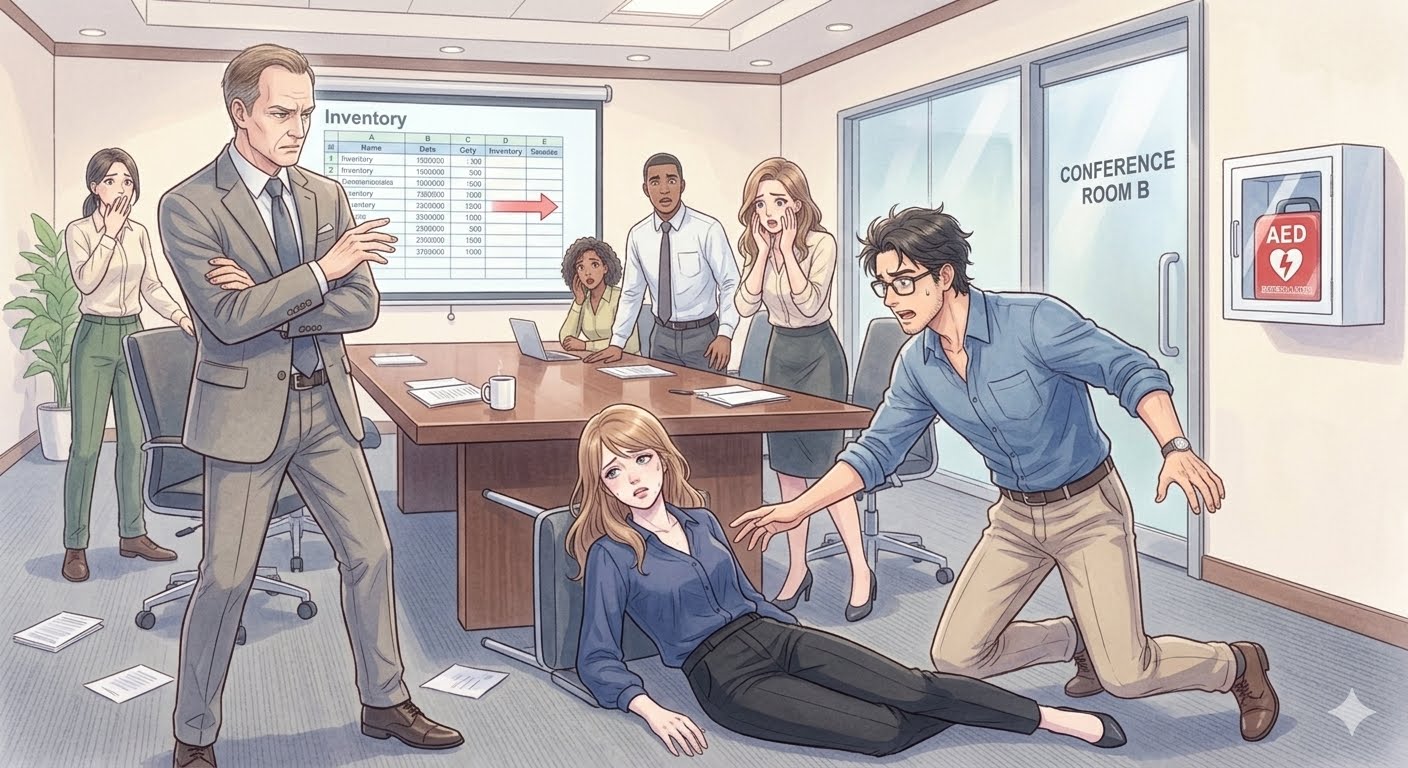
- Then Martin spoke again, his tone sharp and accusing. “Claire has manipulated all of you. She faked a collapse during a critical performance review because she knew we were about to confront her regarding major inventory discrepancies in her department reports.”
- The accusation left me speechless.
- The inventory discrepancies I had been presenting before my collapse were real—but they weren’t my mistakes.
- For three weeks leading up to that morning, I had been auditing missing medical supplies tied to lucrative government healthcare contracts. Warehouse manifests listed dozens of high-value diagnostic devices as “damaged in transit,” wrote them off, and then quietly funneled them to a secondary distributor.
- Martin had ordered me in writing to cease auditing those log sheets. The meeting where my heart stopped had been scheduled because I refused to drop the investigation.
- I looked up at Simone. “That’s why he told everyone I was acting.”
- “Or that’s why he needed everyone to believe you were acting,” Simone corrected dryly.
- Over the phone, the distant wail of police sirens began echoing down Jenna’s street. Martin and Elise abruptly turned toward the emergency stairwell, but responding officers intercepted them in the ground-floor lobby.
- Neither was taken into custody that night. Martin claimed he was attempting to recover stolen corporate data, while Elise insisted she was merely attempting to mitigate a severe compliance breach. However, officers formally documented the visit, cataloged the call logs, and took Jenna’s sworn statement regarding the intimidation attempt.
- By the following morning, the situation had escalated far beyond an internal HR dispute.
- Federal investigators from the Department of Health and Human Services reached out to Simone after reviewing our legal team’s preservation notice and my audited inventory files. Because our company supplied equipment to federally funded healthcare facilities, missing inventory pointed directly toward corporate billing fraud and contract falsification.
- Corporate executives immediately pivoted their public stance.
- They abandoned claims that I had suffered a “panic attack” and began referring to my cardiac arrest as an “unforeseeable medical emergency.” They cast Martin as a rogue manager acting entirely on his own and publicly announced his immediate termination.
- Internal emails, however, told a far darker story.
- An anonymous employee in the IT department leaked internal email chains directly to Jenna and Nathan. The timestamps revealed that Elise Warren had emailed senior leadership less than fifteen minutes after the ambulance departed with my body.
- Her initial message made no inquiry about whether I was alive. Instead, she asked whether the conference-room security footage could be purged under standard data-retention schedules. The Chief Operating Officer responded that the footage should remain untouched until outside counsel could assess the company’s legal “exposure,” while another vice president instructed HR to collect signed statements from all witnesses before employees could “coordinate their recollections.”
- Simone filed comprehensive civil claims alleging disability discrimination, retaliation, reckless endangerment, and spoliation of evidence. Nathan and Jenna filed separate whistleblower and retaliation complaints after management threatened their employment.
- Concurrently, federal labor regulators launched an investigation into the facility’s safety violations, focusing on why the AED cabinet had been kept locked for months and why employees were actively warned against providing medical aid without corporate authorization.
- Martin retained his own criminal defense attorney, who released a statement claiming his client honestly believed I was conscious and fabricating symptoms.
- The security video rendered that defense completely useless.
- The footage clearly showed Nathan announcing I had no pulse. It showed Jenna begging for permission to dial 911. It showed Martin glancing directly at the mounted AED unit before ordering everyone to stay in their seats.
- Daniel’s testimony proved even more damning. He produced official sign-in logs from the emergency training seminar six weeks prior. Martin had completed full instruction on identifying sudden cardiac arrest, executing proper CPR, and deploying an AED. During his practical evaluation, he had correctly identified an uncommunicative patient, instructed a peer to call 911, and applied an AED trainer in under three minutes.
- He had scored ninety-eight percent on the written exam. He knew every single protocol.
- During Martin’s formal deposition, Simone asked him point-blank why he physically pulled Nathan away from my body.
- Martin cited corporate liability concerns.
- “Whose liability?” Simone pressed.
- “The company’s,” he muttered.
- “Did you consider Claire Bennett’s life?”
- Martin looked at his attorney, who nodded silently.
- “I did not believe she was dying,” Martin insisted.
- “You were informed she had no pulse.”
- “I was operating under immense stress.”
- “You explicitly ordered your staff not to render aid.”
- “I didn’t want an untrained employee exacerbating an unknown condition.”
- “You were certified.”
- Martin offered no response.
- Simone leaned forward, posing the question that would later make national headlines:
- “Mr. Hale, when Ms. Bennett collapsed on that carpet, were you afraid she was going to die—or were you afraid she was going to live and finish her presentation?”
- His attorney objected loudly, but Martin sat frozen, unable to answer.
- PART 4 — JUSTICE AND REMNANTRY
- Federal prosecutors eventually unraveled the full extent of the inventory scheme. Martin had been generating fraudulent write-offs for hundreds of portable heart monitors, infusion pumps, and diagnostic tablets, quietly transferring them to a secondary logistics company owned by a former college roommate before reselling them to private medical centers.
- The scheme had generated millions over two years. Elise Warren had not profited directly from the sales, but she had systematically buried employee grievances against Martin to preserve corporate standing. Executive leadership had turned a blind eye because his division consistently turned a massive profit.
- My presentation contained the exact serial numbers linking the missing devices to those secondary buyers. Martin had walked into that conference room intending to discredit my performance, place me on administrative leave, and purge my computer drive. My collapse simply provided him an unexpected alternative. By framing my medical emergency as a dramatic outburst, he hoped to render me untrustworthy before anyone looked at the data.
- What he failed to anticipate was Nathan defying his authority, Jenna securing the video evidence, and Daniel recognizing him from the training session.
- Six months after my collapse, I walked into the federal courthouse using a cane. The pulmonary clot was gone, but the period of severe hypoxia had left lingering nerve damage in my right leg and mild short-term memory impairment.
- Nathan met me near the court steps. He had been fired three weeks after saving my life, officially cited for “insubordination and unauthorized physical contact with a manager”—the moment he shoved Martin off his shoulders to reach my chest.
- Jenna had resigned after being reassigned to a remote facility that quadrupled her daily commute. She and Miles had relocated closer to family.
- Daniel attended the trial in full paramedic dress uniform on his day off.
- Martin faced a mountain of federal indictments, including wire fraud, contract falsification, witness tampering, and conspiracy. His refusal to render aid could not be charged as attempted murder under state law because prosecutors could not prove specific intent to kill, but his deliberate inaction was entered as key evidence of witness suppression and consciousness of guilt.
- Elise Warren entered a guilty plea to misprision of a felony and testified against senior leadership in exchange for a reduced sentence, detailing her attempt to retrieve the phone from Jenna’s apartment.
- Martin refused every plea deal offered.
- At trial, his defense team attempted to portray him as a stressed executive who froze during an overwhelming crisis. They argued that bystander paralysis is a common psychological reaction.
- Then the prosecutor played the security video on a high-definition monitor facing the jury.
- For nine minutes and eleven seconds, the courtroom sat in total silence. The jury watched Martin circle my motionless body. They watched him check his wristwatch. They watched him grab Nathan’s shoulder and pull him backward. They heard his flat, dismissive voice fill the courtroom:
- “She wants attention.”
- When the video finished, the prosecution projected Martin’s CPR certification certificate alongside his near-perfect test scores.
- Daniel took the stand, detailing the physiological reality of sudden cardiac arrest. He described my cyanotic skin, absent respiration, and lack of a central pulse, explaining to the jury that every single minute without chest compressions dramatically reduces survival odds. He refrained from speculating on Martin’s motives, sticking purely to medical facts and what any certified individual was trained to recognize.
- Nathan testified next.
- “I knew I might break her ribs,” Nathan told the jury. “But I knew doing nothing was going to kill her.”
- On cross-examination, the defense attorney asked if Nathan had been angry with Martin prior to that morning.
- “No,” Nathan replied.
- “Did you push your supervisor?”
- “Yes.”
- “So you physically assaulted your superior officer?”
- Nathan looked the defense attorney straight in the eyes. “I moved a man who was standing between me and a person without a pulse.”
- Jenna’s testimony lasted nearly four hours. She detailed the corporate threats, the attempted cover-up, and the night Martin showed up at her apartment door. When the defense implied she had saved the video for personal financial gain, Jenna pulled the cracked phone from her purse and laid it on the witness stand.
- “I copied it because Claire was fighting for her life in surgery,” she said cleanly. “And management was already telling everyone in the building to forget what they saw.”
- The jury returned a guilty verdict on nearly all counts. Several corporate officers were subsequently indicted or entered guilty pleas. The company lost its government vendor status, suffered massive civil penalties, and eventually entered bankruptcy liquidation.
- My civil lawsuit was settled out of court for an undisclosed sum, securing funds for my ongoing neurological therapy, physical rehabilitation, and living expenses. Nathan and Jenna received substantial compensation through independent whistleblower and retaliation settlements.
- The money resolved the financial burden, but it could not erase the psychological scar of those nine minutes.
- For months after the trial, the sound of rolling office chairs caused my chest to tighten. I couldn’t enter a public building without immediately locating the nearest AED cabinet. I suffered recurring nightmares of lying trapped on that cold carpet while voices debated above me.
- Therapy and physical rehabilitation helped restore my independence. Nathan visited every weekend during my recovery, always dismissing any praise. He insisted he wasn’t a hero—just someone who was more terrified of watching a person die than losing a job.
- One year after my collapse, Daniel invited me to address a corporate safety seminar hosted by local emergency services.
- I was hesitant at first, but I stood before the room of twelve corporate managers seated in front of CPR mannequins and AED trainers.
- I spoke open-heartedly about the fall, the paralysis of the room, and the critical difference between inaction and courage.
- “The man who saved my life had no medical background,” I told them. “He simply chose to act. That choice is everything.”
- Afterward, an attendee asked if I had managed to forgive Martin.
- I offered a calm, measured answer. “I don’t structure my life around his choices anymore.”
- Martin became a legal case study, an archive of court transcripts, and an instructional video used in corporate safety compliance courses. He no longer holds power over my life, my career, or my health.
- Two years after my cardiac arrest, I took a position with a non-profit watchdog organization monitoring public healthcare procurement. My new office is modest, with large windows overlooking the city streets.
- On my first day, the executive director took me on a tour of the floor, pointing out the fire exits, first-aid kits, and the unlocked AED mounted directly beside the front entrance.
- “No keys, no passcodes,” she said gently. “Anyone can access it.”
- I stood there looking at the white box for a long moment.
- Then I walked into my new office and set a framed photograph on my desk—one taken outside the rehabilitation center featuring Rebecca, Jenna, Nathan, Daniel, and me.
- I survived because one person refused to obey an order.
- The company fell because another person refused to delete the truth.
- And Martin’s ultimate mistake was believing that everyone in that room would stay quiet forever—just because, for nine minutes and eleven seconds, they had been too afraid to move.
PART 3 — COMPLICITY AND DISCLOSURE