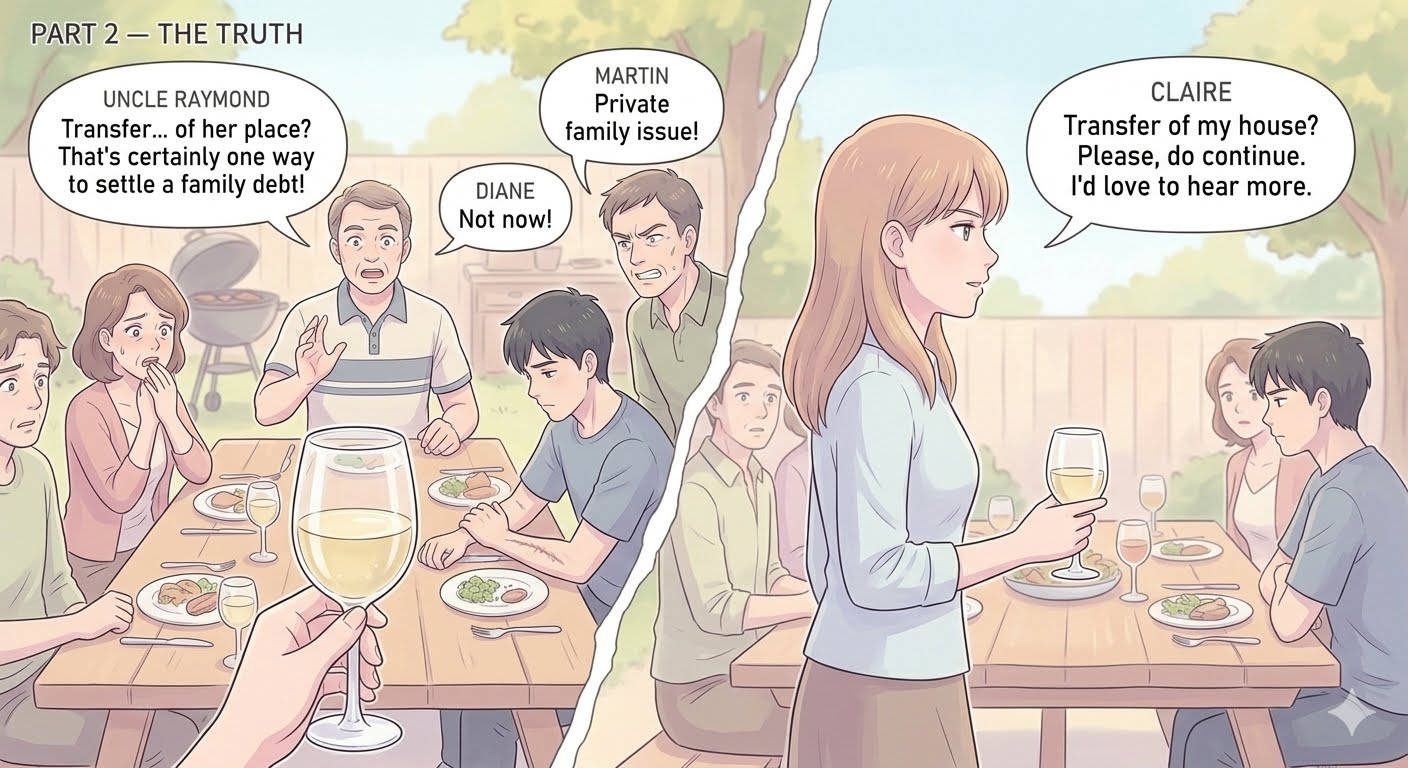
- My parents were anticipating anger, and they were masters at weaponizing it. My mother would dissolve into tears, my father would lower his voice to accuse me of publicly humiliating them, and Grant would display his scar for sympathy. Then, some well-meaning relative would urge everyone to calm down, and the whole scene would end with me apologizing for reacting to their betrayal.
- I had played my assigned role in that script too many times.
- So, I stayed seated.
- “Dad,” I asked quietly, “would you care to explain why the state paid you $180,000 back in 2014?”
- Aunt Linda’s fork clattered onto her plate. My mother’s mouth fell open, and Grant turned sharply toward our father.
- It was a small, subtle movement, but I caught it. Grant had known about the forged quitclaim deed, and he’d known our parents were pressuring me. But that nervous glance told me he had no idea I’d uncovered the original compensation payout.
- My father recovered his composure first. “You have no right digging into private financial documents.”
- “I obtained the compensation file through my attorney after discovering someone forged my signature on a deed.”
- “You work for the state,” my mother interjected defensively. “You used your position to spy on your own family.”
- “No. I used the standard records process available to any crime victim represented by counsel.”
- That distinction mattered to me, even if it meant nothing to them. I had spent my career watching people ruin solid cases by cutting corners, and my family expected me to get emotional enough to make the same mistake. I hadn’t.
- Uncle Raymond extended his hand. “Show me.”
- My father stepped between us, blocking his view. “This doesn’t concern you, Raymond.”
- “You’re the one who showed me the deed,” Raymond countered. “You told me Claire agreed to hand over the house.”
- “She did agree.”
- “I never did,” I said flatly.
- My father pointed a finger at me. “You said you understood your responsibility to this family.”
- “Understanding your pressure is not giving consent.”
- The first tears welled up in my mother’s eyes, appearing with a precision I almost had to admire.
- “All we ever tried to do was keep this family together,” she sobbed. “Grant sacrificed his body for you, and you’re treating him like a criminal.”
- Grant pushed back his chair, rolled up his sleeve, and thrust his forearm forward. The pale, jagged scar stretched from his wrist to his elbow.
- “Look at it,” he demanded. “Tell everyone here this isn’t real.”
- “The injury is real,” I replied.
- “Then what are you saying?”
- “I’m saying the state compensated this family for your surgery, physical therapy, lost wages, and long-term recovery over a decade ago.”
- “That money was gone within a year!” my father snapped.
- The admission slipped out before he could catch himself. The entire table fell dead silent.
- Uncle Raymond slowly lowered the document in his hands. “What do you mean, gone?”
- My father stared at him, suddenly trapped.
- I opened another document on my phone.
- “The state deposited the $180,000 on November 18, 2014,” I explained. “Because you had me managing your bills during Grant’s recovery, I had legal access to your statements. Within six months of receiving that payout, $62,000 went toward a boat, $31,000 paid for a private social club membership, over $40,000 was withdrawn at casinos, and another $23,000 funded a cruise through Europe.”
- A cousin near the grill muttered, “You’ve got to be kidding me.”
- My mother’s weeping vanished instantly. It was always remarkable how fast her grief evaporated once it stopped working.
- “We deserved something after what we went through!” she argued.
- I looked directly at her. “After what you went through?”
- “Our son was almost killed!”
- “Grant fell down the basement stairs.”
- The statement hit the table like shattered glass.
- Grant’s posture collapsed. For eleven years, he had met every question with righteous indignation, wounded pride, or dramatic disbelief. But now, raw panic flashed across his face.
- “You don’t even remember that night,” he stammered.
- “I remember far more than you think.”
- “You were hysterical.”
- “I was terrified.”
- “You were confused!”
- “That’s what all of you spent a decade convincing me to believe.”
- My father took a menacing step closer. “You need to stop talking.”
- The threat in his voice was clear, but Uncle Raymond stepped right beside me. “No, Martin,” he said softly. “Let her finish.”
- For a long moment, nobody moved. Smoke flared from the grill behind us, and somewhere in the distance, the faint hum of a neighbor’s lawnmower filled the quiet.
- I thought about the video file saved on my phone.
- For eleven years, Grant had recounted his heroic stand against five men in a dark alley. He described their weapons, their insults, and his choice to risk his life for mine. Our relatives knew every detail by heart because Grant refined the story every time he told it.
- I used to hold a different memory of that night, but trauma, endless repetition, and family gaslighting had eroded my confidence until I questioned my own sanity.
- Then, the previous year, I noticed a reference to surveillance footage while reviewing the original police file. A convenience store across the street had captured the entire incident on camera. Retrieving the archived footage took eleven months, two legal requests, and an attorney’s intervention.
- I had only watched it once. Once was enough.
- I held up my phone. “The police kept the convenience store footage.”
- Grant’s face went completely pale. My mother gripped the back of her chair until her knuckles turned white.
- I looked at my brother and delivered the question I’d carried for eleven years: “Should I show them what actually happened, or do you want to tell them yourself?”
- Part 4
- Grant’s chair scraped loudly against the patio stones as he backed away.
- “You’re twisting the truth!”
- “I haven’t even played it yet.”
- “That camera didn’t record audio!”
- “No, but the video of the alley is crystal clear.”
- “You have no idea what those men were saying to us!”
- “I know what you did.”
- My father reached across the table to grab my phone, but Uncle Raymond held out a firm arm, stopping him cold.
- “Step back, Martin.”
- My father glared at his younger brother. Raymond had always been the quieter of the two, but his presence carried weight because he never spoke carelessly. Looking at my father now, Raymond’s eyes held something far worse than anger—he looked utterly disgusted.
- I pressed play.
- Because the screen was small, relatives crowded in behind me. Rachel moved in closest, pressing a hand over her mouth.
- The grainy black-and-white video showed a sidewalk lit by the glare of a storefront sign. My nineteen-year-old self appeared on the left in jeans and a jacket, with Grant walking beside me. Five men stepped out from the shadow of an alley. Their body language was aggressive—one shouted, another spread his arms, and a third stepped into our path.
- On the screen, I stopped moving.
- Grant immediately stepped behind me. Then, he grabbed both of my shoulders and forcefully shoved me toward the men.
- A collective draw of breath rippled through the family watching.
- The men in the alley looked startled; two of them laughed. Grant turned and bolted, sprinting across the lot and disappearing behind a row of houses without looking back once.
- The video showed my younger self stumble, regain her footing, and back away slowly. One of the men raised his hands to show he was unarmed, while another pointed in the direction Grant had fled. Then, they simply walked away and left me alone.
- The clip ended. Rachel broke down in tears.
- Uncle Raymond stared at Grant. “You pushed your little sister into them.”
- Grant’s mouth opened and closed before he managed to choke out, “They were just trying to scare us!”
- “You didn’t know that when you threw me at them and ran,” I said.
- “They had something in their hands!”
- “You told everyone they beat your arm with a pipe.”
- “They could have!”
- “Except they never touched you.”
- My father interjected, trying to regain control. “Grant panicked! He was just a kid! We adjusted the story because he was ashamed of running.”
- “You did a lot more than adjust a story.”
- I pulled up the hospital report. “The ER physician noted a compound fracture caused by a severe fall—injuries consistent with tumbling down a flight of stairs and extending an arm to break the impact.”
- Grant had made it home before I did. Wanting to avoid our parents seeing him in a panic, he had sneaked in through the side door to reach his basement room and lost his footing on the stairs.
- When I walked through the front door minutes later, my mother was screaming over him at the bottom of the steps.
- By the next morning, the narrative was born: Grant was injured protecting me. Within a week, my parents were telling everyone he fought off five attackers. Within a month, Grant added the detail about the iron pipe.
- The lie flourished because it benefited everyone involved. My brother received money, endless sympathy, and an excuse for every personal failure that followed. My parents gained financial compensation and admiration as devoted parents guiding a hero through recovery.
- And I was handed the bill.
- “When I asked about the police report at twenty-one, Mom told me it was too painful to talk about,” I said. “When I asked why the medical files noted a fall, she claimed the hospital made a clerical error. When I asked Dad why no charges were ever filed, he claimed the police were incompetent. You lied to me for eleven years and convinced me my own memory was damaged by trauma.”
- My mother collapsed into a lawn chair, her face crumpling into real grief. But it wasn’t remorse—it was just the horror of facing consequences.
- Aunt Linda spoke up from across the yard. “You borrowed fifteen thousand dollars from me last summer, Diane. You told me Grant needed an emergency procedure.”
- My mother flinched.
- “Did he ever have that surgery?” Linda demanded.
- Silence fell over the patio.
- Linda’s husband put an arm around her, his expression hardening. Another relative stepped forward. “Martin, you took eight thousand from me claiming his insurance denied a claim.”
- “You borrowed five thousand from my parents, too!” a cousin chimed in from near the fence.
- The entire energy of the gathering shifted. Up until now, everyone assumed they were witnessing an isolated family squabble over a house. Now, they realized the lie had been a machine built to bleed the whole extended family dry for over a decade.
- My father saw the room turning. He pointed a trembling finger at me. “This is what you wanted! You brought this here to turn everyone against us!”
- “No, Dad. I just wanted you to stop.”
- “You’ve been building a file on your own family for years!”
- “I waited years for you to make things right.”
- “You set a trap!”
- “I prepared myself for the day you took things too far.”
- Grant let out a bitter, nervous laugh. “And what was ‘too far,’ Claire? Asking you to settle what you owe?”
- “Forging my name on a legal deed.”
- I reached into my bag, pulled out a certified copy of the forged quitclaim deed, and laid it on the picnic table. Beside it, I placed a second legal document.
- “This is the official fraud complaint my attorney filed with the county recorder this morning.”
- My father leaned over to read the heading, all the color draining from his face. “You reported us to the authorities?”
- “I reported a fraudulent land transfer.”
- My mother grabbed my wrist, her hands icy cold. “Withdraw it, Claire. Please. We can fix the deed between us.”
- “You had eleven years to fix this between us.”
- She squeezed harder. “What will people say? What about our reputation?”
- I gestured to the circle of relatives staring back at them. “I think they’re already figuring it out.”
- Uncle Raymond picked up the forged document and flipped it over to check the back. He read the signature of the notary public who had attested to my presence.
- He read the name aloud.
- Rachel wiped her eyes and looked up. “Wait… that’s Grant’s girlfriend’s mother.”
- And just like that, the scope of the scheme grew even wider.
- Part 5
- The notary seal belonged to Carol Mercer. Her daughter, Vanessa, had been dating Grant for nearly four years. Carol ran a small tax practice near the highway and kept a neon “Notary Public” sign in her window.
- I’d met her twice. At Christmas, she praised Grant as a “heroic, self-sacrificing man,” and at my mother’s birthday, she pulled me aside to remind me how lucky I was to have a brother who had nearly died for me. Now, her official state seal was stamped onto a forged document claiming I had appeared before her in person.
- Rachel pulled up her phone. “Vanessa posted something online last week…”
- Grant lunged toward her. “Put that down!”
- Uncle Raymond stepped in his path, blocking him effortlessly.
- Rachel scrolled for a second and turned her screen toward me.
- The picture showed Grant and Vanessa standing in front of my house—my front door, my manicured hydrangeas, my porch swing. Vanessa was holding a ring of keys in the air while Grant pointed at the roof. The caption read: “So excited for our new beginning in our forever home! 🏡❤️”
- The post had been set to private, hidden from my feed.
- My mother pressed her hands to her temples. “You weren’t supposed to see that yet…”
- The slip stunned even Grant. “Mom, stop!”
- “What?” she snapped, her composure entirely gone. “It’s already ruined anyway!”
- A strange, quiet clarity washed over me. For weeks, I had wondered if the forged deed was just a high-pressure scare tactic—a way to bully me into voluntarily signing over the property to avoid a legal mess. But the photo proved the truth.
- They weren’t threatening to steal my home; they believed they already had. Grant and Vanessa were preparing to move in, and my parents had assured them I would quietly vacate the premises.
- “Where exactly did you think I was going to live?” I asked softly.
- My mother gave me a tired, condescending look. “You make good money, Claire. You can easily afford to rent an apartment.”
- “That doesn’t answer my question.”
- “You’re single! You don’t have a family! Grant and Vanessa are trying to start a life together.”
- “So because I’m on my own, my life requires less space? My home matters less?”
- “You know what I mean!”
- “Yes,” I said. “For the first time in my life, I finally do.”
- My family had always treated my self-sufficiency as an open line of credit. Because I worked hard and managed my money, I was expected to finance their bad decisions. Because I didn’t have children, my time was treated as community property. Because I was quiet, they assumed I would eventually yield.
- My father snatched up the legal complaint and shoved it back toward me. “You’re going to call your lawyer and withdraw this before Monday morning.”
- “No.”
- “I am your father!”
- “That doesn’t give you the right to sign my name to a legal document.”
- “You think some county bureaucrat is going to destroy a family over a paperwork dispute?”
- “My attorney has already submitted the certified bank records, the victim compensation files, our text logs, and the audio recording from last Sunday.”
- The backyard fell dead silent again.
- My father’s eyes narrowed. “What audio recording?”
- I hit play on my phone. My father’s harsh voice resonated clearly from the speaker:
- “You have thirty days to sign over the title, Claire. If you don’t, I’ll take you to court for the full $180,000 plus interest.”
- Then my mother’s voice joined in: “A grateful daughter would have given him the house years ago.”
- Finally, Grant’s voice played: “Don’t make this ugly, Claire. I know where you work, and I know your neighbors. You can do this quietly, or everyone finds out what kind of person you really are.”
- The clip ended. Grant stared at me in disbelief. “You recorded a private family dinner?”
- “I recorded an extortion attempt.”
- “We were negotiating!”
- “You were threatening my job and my home.”
- My father moved toward me again, but this time, Uncle Raymond didn’t just stand in the way—he placed both hands on Martin’s chest and firmly shoved him back.
- “That is enough, Martin. Back off.”
- My father’s face contorted in rage. “You’re taking her side over your own brother’s? Over your family?”
- “I’m taking the side of the niece you just tried to rob.”
- My mother looked around the patio, desperately searching for a single sympathetic face among her relatives. She found none. Even the younger cousins were staring at the ground in uncomfortable silence. A stray breeze blew a paper napkin across the grass, catching against the leg of my father’s overturned chair.
- I picked up my purse and pulled the strap over my shoulder.
- “Here is what happens next,” I announced clearly. “The county recorder has placed a legal freeze on the title, so the transfer is dead. My attorney has turned the file over to the District Attorney’s financial crimes division. They will decide whether to press charges for felony forgery and notary fraud.”
- My mother took a step toward me, her hands outstretched. “Claire, please…”
- The tone was entirely different now—no longer commanding or guilt-ridden, but hollowed out by fear.
- “You can’t put your father and brother in prison,” she pleaded.
- “I’m not putting anyone anywhere. You made your choices.”
- “You’re destroying this family!”
- “No, Mom. I’m just documenting what you did to it.”
- Just as I turned toward the driveway, the side gate unlatched and Grant’s girlfriend walked onto the patio.
- Vanessa was holding a bakery box tied with a red ribbon. She looked from Grant to the silent crowd, her eyes landing on the legal papers scattered across the picnic table. Her polite smile faded instantly.
- “What’s going on?” she asked.
- Rachel answered from the edge of the patio: “Claire found the deed.”
- Vanessa looked at Grant, then at my parents, her face losing all color. “You told me Claire signed the transfer papers weeks ago.”
- “I never signed anything,” I said.
- Vanessa dropped the bakery box. It hit the stone patio with a thud, the lid popping open to reveal a frosted cake smeared across the pavers.
- She backed away from Grant as he reached for her. “Vanessa, babe, let me explain—”
- “Don’t touch me!” she snapped, her voice shaking. “My mother notarized that deed because you and your father swore Claire signed it right in front of you!”
- She turned to me, her eyes wide with panic. “They told me you were relocating to Seattle for work next month!”
- I almost laughed out loud. I had never once mentioned moving to Seattle.
- Vanessa looked at Grant with absolute horror. “You told me she was packing! You were planning to have a moving crew haul her furniture to a storage unit next weekend while she was at work!”
- The revelation hit harder than the forged deed itself. They weren’t even waiting for the legal process to unfold—they had already picked out the exact day they were going to erase me from my own life.
- I left the reunion without looking back.
- Behind me, the backyard erupted into chaos. Aunt Linda demanded to see bank records, Vanessa screamed at Grant, and Uncle Raymond pressed my father on how many relatives he had scammed out of money. The uproar followed me all the way to my car, fading only when the door clicked shut.
- Inside the quiet vehicle, the air smelled faintly of sun-warmed leather and peppermint gum. My hands didn’t start shaking until after I turned the key in the ignition.
- For years, I had plays of exposing the truth, imagining how powerful I would feel. Instead, I just felt hollow. Winning didn’t erase the terrified nineteen-year-old girl in that security video. It didn’t restore the money stolen from me, erase the miserable holidays, or undo the years spent believing that wanting to survive made me selfish.
- Before I even pulled out of the driveway, my phone began vibrating continuously.
- Rachel: I swear I didn’t know.
- Aunt Linda: Your mother borrowed money from us four times. I need to speak with your lawyer.
- Uncle Raymond: Get home safely. I’m so sorry.
- Grant called three times. My mother called seven. My father didn’t call at all.
- I drove home through late-afternoon traffic with the radio off. The sky faded to a dull silver, and every red light seemed to drag on forever.
- When I turned onto my street, a moving truck was parked two houses down. For one sickening second, I panicked, assuming it was Grant. It wasn’t, but I still sat in my idling car, staring at my front porch before gathering the courage to step out.
- My key turned the lock. My alarm code cleared. Everything inside was untouched. Yet, the house felt violated just knowing they had plotted to enter, box up my life, and move into the rooms I had bought with my own hard work.
- I walked slowly through each space: the kitchen with the chipped green tile I’d always meant to replace, the sunlit living room, and the small home office where I spent my days analyzing fraud cases for strangers who lied to banks, courts, and insurance companies.
- I used to think fraud was obvious—a altered document, a forged signature, an impossible timeline. But within a family, fraud wore a loving mask. It brought you soup when you were sick, remembered your birthday, and rebranded coercion as love and theft as a family obligation.
- At 8:40 p.m., a knock sounded at the door. I checked the camera feed: Rachel stood on the porch, holding a cardboard box.
- I opened the door, but kept my body blocking the entryway.
- Her eyes were red and swollen. “I found these in Dad’s desk,” she whispered, handing over the box.
- Inside were color-coded folders labeled with our relatives’ names: Uncle Raymond, Aunt Linda, Cousin Michael, Grandma Ruth. Each held meticulous notes, canceled checks, signed promises of repayment, and manufactured excuses tied to Grant’s fictitious medical emergencies.
- Then I saw the folder bearing my name. It was thickest of all.
- Inside, my father had kept a detailed ledger tracking the “debt” he claimed I owed. Starting at $180,000, the balance hadn’t decreased despite the tens of thousands I had given them over the years. He had tacked on compounded interest, arbitrary administrative fees, projected future care, and even the cost of the meals my mother had cooked while Grant recovered.
- At the bottom of the final page, my father had written: Claire’s house should settle most of it. Remaining balance can be recovered through retirement account or life insurance.
- I read the cold ink twice.
- Rachel watched my face carefully. “I’m so sorry.”
- “Did you know about these files?” I asked.
- “No.”
- “Did you know Grant lied about the attack?”
- “No.”
- “Did you ever suspect the story didn’t make sense?”
- She looked down at her shoes. “Yes.”
- Her honesty caught me off guard. “Why didn’t you say anything?”
- “Because whenever anyone questioned Grant, Mom made us feel like we were trying to destroy the family.”
- I snapped the folder shut. “You chose silence.”
- “I know.”
- “And that silence enabled them.”
- “I know.” Tears spilled down her cheeks, but she didn’t step forward to ask for a hug. I respected that. “I’m not asking for your forgiveness,” she said quietly. “I just thought you needed to see these.”
- I took the box. “Thank you.”
- She lingered on the porch steps. “Can we ever be sisters again?”
- “I don’t know.” It wasn’t spoken out of malice, just complete honesty.
- Rachel gave a sad nod and walked back to her car.
- The next morning, I delivered the folders to Hannah.
- By Tuesday, four relatives had retained their own legal counsel. By Friday, the county official completely voided the fraudulent deed. Two weeks later, law enforcement executed search warrants at my parents’ house and Carol Mercer’s notary office.
- The family group chat dissolved overnight, replaced by a desperate counterattack. My mother spread rumors to neighbors that I’d had a mental breakdown. Grant reported me to my employer, claiming I’d illegally accessed state databases. My father publicly claimed I’d fabricated evidence to secure his estate early.
- Every claim was formally investigated. Every claim fell apart.
- Then, on a dreary, rainy Thursday morning, Hannah called me.
- “They found a draft document attempting to change the beneficiary on your retirement account,” she said.
- I tightened my grip on the phone. “What are you saying?”
- “It means your house was never their end goal.”
- The draft form named Grant as the sole beneficiary of my state retirement account. Though it hadn’t been filed and lacked a signature, investigators found copies of my ID, an old HR form, and pages of scrap paper where someone had repeatedly practiced forging my signature.
- My father had been planning his next move.
- That discovery shattered the last bit of rationalization I’d held onto. A tiny part of me had desperately wanted to believe my parents were just acting out of warped favoritism for Grant. But the retirement papers proved it was pure malice. They didn’t just want a house; they wanted to strip me of everything I owned.
- The legal fallout took nine gruelling months.
- During that time, I upgraded my locks, installed high-end security cameras, locked down my credit, updated every legal beneficiary, and established an ironclad trust ensuring neither my parents nor Grant could ever touch my assets or make medical decisions on my behalf.
- I also entered therapy, which proved far harder than gathering evidence. Documents follow logic; emotions don’t.
- Some sessions were spent unpacking the alleyway incident; others were spent revisiting Sunday dinners where my mother served me food while casually reminding me that Grant’s arm would never fully heal because of me.
- My therapist eventually asked what I felt whenever I considered cutting them off.
- “Guilty,” I admitted.
- “What does guilt mean to you?”
- “That I’m doing something wrong.”
- “Not always,” she noted. “Sometimes guilt just means you’ve stopped obeying the rules someone used to control you.”
- I wrote those words on an index card and kept it in my wallet.
- The District Attorney pressed forward with heavy charges after Carol Mercer broke. She confessed to notarizing the deed without me present, claiming my father and Grant assured her I’d signed it and was simply too busy to swing by. Facing criminal liability, she surrendered her notary license and pleaded guilty to official misconduct in exchange for her testimony.
- From there, the dominoes fell. Grant blamed our father. My father blamed Grant. My mother blamed me. None took accountability until it was time to negotiate plea deals.
- On the day the pleas were finalized, I sat beside Hannah in a quiet courthouse conference room listening to the steady tap of rain against the window.
- Assistant District Attorney Natalie Park laid three thick case files on the table.
- “Your father is pleading guilty to felony forgery, attempted grand theft, and conspiracy,” she outlined. “Sentencing is up to the judge, but the plea calls for prison time, probation, and full restitution.”
- I nodded steadily.
- “Your mother pleaded guilty to conspiracy, financial fraud, and making false statements to federal victim funds.”
- “Will she serve time?”
- “Less than your father, but yes.”
- “And Grant?”
- “He’s pleading guilty to conspiracy, attempted grand theft, and felony extortion. He avoids prison only if he maintains strict restitution payments, completes extensive community service, and abides by a permanent no-contact order with you.”
- I stared out at the gray sky.
- For eleven years, my family insisted Grant’s arm was worth $180,000. Now that figure was back in court calculations, but it wasn’t a debt I owed.
- The state clawed back the fraudulent victim compensation. My relatives filed civil suits for the money stolen under false pretenses. I was awarded full restitution for my stolen funds, legal fees, security upgrades, and property losses.
- Total restitution owed across all victims exceeded $300,000.
- “Will they actually be able to pay that?” I asked.
- Natalie gave a stern, tight smile. “They’ll be forced to liquidate the boat, the social club membership, and several major assets. Your parents will likely have to sell their house.”
- I expected to feel a surge of triumph, but instead, an overwhelming sense of nostalgia hit me. I remembered the hallway wallpaper where my father marked our heights growing up, him teaching me to ride a bike, and my mother baking fresh cinnamon bread on winter mornings.
- Those good memories didn’t change what they had done. Good people can still do terrible things, and parents can love you and still be dangerous. That was the hardest lesson to accept.
- Leaving the room, I ran into my mother standing near the elevators with her public defender. She looked frail, much smaller than I remembered.
- “Claire…” she breathed.
- Hannah glanced at me, ready to shield me, but I stepped forward and stopped a few feet away.
- My mother wrung a crumpled tissue in her trembling hands. “I know you hate me.”
- “I don’t hate you.”
- A flicker of hope lit up her eyes.
- “I just don’t trust you,” I clarified softly. “And I don’t need you anymore.”
- Her eyes welled up. “We made terrible mistakes, Claire.”
- “A mistake is missing a turn. You forged my signature and spent eleven years gaslighting me.”
- “We were just trying to help your brother!”
- “You enabled him into believing he had a right to steal my home.”
- “He was always more fragile than you,” she wept.
- “And that was your justification for sacrificing me.”
- She covered her face. “Can you ever find it in your heart to forgive us?”
- I took a breath. “Forgiveness wouldn’t mean letting you back into my life.”
- “We’re your parents!”
- “That’s just biology, Mom. It’s not an excuse to abuse me.”
- The elevator chimed open behind her. She stepped inside, extending a trembling hand toward me as the doors began to slide shut.
- I stood motionless.
- The last look on her face wasn’t rage—it was utter disbelief. Even after the arrest warrants, the asset seizures, and the guilty pleas, a part of her still believed I would eventually fold and play the victim role she had written for me.
- The doors closed, sealing the separation.
- That was the moment I realized I had won. It wasn’t about holding onto the house or reclaiming my stolen money. It was realizing I had finally become someone my family could no longer bully, guilt, or control.
- A year after the reunion, I finally remodeled my kitchen, laying deep blue, artisan-crafted tiles with natural variations that caught the morning light. The installer warned me that uniform tiles would look cleaner, but I loved the character of the imperfections.
- They looked resilient. Beautiful, despite being imperfect.
- When the work was done, I threw open the windows to let the breeze wash away the scent of paint and grout. As sunlight flooded the room, the house finally felt like mine—not just legally, but emotionally.
- My father served fourteen months in state prison before his release on strict parole. My mother served eight. Grant avoided jail time by working long hours for a commercial contractor who didn’t care about his self-made hero story, applying his wages directly to his restitution court payments.
- Vanessa had dumped him the week after the reunion.
- Rachel moved away from our parents, got her own apartment, and started therapy. We text occasionally about practical things, and whenever she apologizes, she doesn’t press me for comfort. I respect her for that. But we never rebuilt our old bond. Some relationships don’t end in screaming matches; they just shrink until they match the actual level of trust left.
- Uncle Raymond drops by every couple of months.
- The first time he visited, he walked up my driveway carrying a toolbox and a bottle of expensive wine.
- “Noticed your porch railing was rattling,” he said casually.
- “You drove forty miles to fix a railing?”
- He smiled. “I also came to share some good wine.”
- He fixed the railing without bringing up my parents. Before leaving, he apologized again for falling for Grant’s narrative for so long.
- “You had no reason not to believe them,” I said.
- “I should have looked closer.”
- “A lot of people should have.”
- He looked out over the yard. “Families always reward the person who keeps the peace. They rarely notice that the peace is built on forcing someone else to stay quiet.”
- That night, I placed the empty bottle beside the cheap, plastic-stemmed wineglass I had taken from my parents’ backyard the day of the reunion. I kept it as a reminder that the moment my life changed started with an ordinary glass in my hand, listening to someone casually slip up about a secret.
- Later that year, the state financial crimes division invited me to present a seminar on domestic fraud, asset coercion, and duplicate victim claims. I omitted my family’s names, but laid out the mechanics clearly:
- A payout is issued.
- The funds are squandered.
- The victim is lied to about an ongoing debt.
- Guilt replaces accounting.
- Family loyalty silences questions.
- The scheme works because people refuse to accept that parents could systematically exploit their own child.
- After the seminar, a young fraud investigator approached me. “How did you know to start documenting everything?”
- “I didn’t at first.”
- “What changed your mind?”
- “Every time they told the story, small facts shifted. And whenever I asked for clarity, they attacked my character instead of giving me answers.”
- She nodded in recognition. “Classic fraud behavior.”
- “Classic family dynamics, too.”
- The monthly restitution checks continue to arrive like clockwork. I recovered every cent stolen from me, along with full legal fees and property protection expenses. I donated a portion of the funds to a shelter helping survivors of financial abuse rebuild their lives. I didn’t tell my relatives about the donation; I no longer needed their approval.
- That was real freedom.
- Nearly two years after the reunion, Rachel stopped by unannounced on a Saturday afternoon. I met her at the door, speaking through the locked screen.
- “What’s going on, Rachel?”
- She held out a small envelope. “I found this while helping Mom and Dad clean out their storage unit.”
- Inside was an old photo taken a week before Grant’s injury. Grant and I were standing by my father’s old car, his arm wrapped around my shoulders as we both laughed hysterically at something off-camera.
- On the back, in Grant’s handwriting: Best little sister in the world.
- A sudden wave of grief hit me, so sharp I had to steady myself against the doorframe.
- Rachel watched me quietly. “I thought you should have it.”
- “Thank you.”
- She lingered. “Grant still asks about you.”
- “He shouldn’t.”
- “He says he wants to apologize to you face-to-face one day.”
- “He can want whatever he wants.”
- “Would you ever hear him out?”
- “No.”
- Rachel lowered her head. “He says he was just terrified that night.”
- “I was terrified, too.”
- “He knows that now.”
- “No, he knows how to say the words. That’s not the same as taking accountability.”
- She nodded slowly. “I won’t bring him up again.”
- I tucked the envelope away. “Rachel.”
- She looked up.
- “I hope you build a good life for yourself.”
- Her eyes softened. “I hope you do, too.”
- “I already am.”
- After she drove off, I placed the photograph into a drawer rather than destroying it. Healing didn’t mean pretending the happy times were a lie; it just meant refusing to let past nostalgia justify ongoing abuse.
- That evening, I poured a glass of wine and sat on my front porch. The repaired railing was completely solid under my hand. Cicadas chimed in the trees, sprinklers clicked rhythmically across the neighborhood, and the setting sun painted my windows in gold.
- My phone was quiet.
- No frantic demands. No guilt trips. No passive-aggressive reminders of imaginary debts. No lectures on what a “grateful daughter” owed her family.
- For eleven years, my family had controlled me using a fake story: Grant was the hero, my parents were the long-suffering martyrs, and I was the ungrateful debtor who owed them her life.
- In the end, I didn’t beat them with a bigger, louder story. I beat them with dates, bank statements, certified records, video evidence, and the patience to let them dig their own legal grave.
- They tried to steal my home because they mistook my quiet nature for weakness. They assumed years of manufactured guilt meant I would hand over the deed without a fight.
- They were dead wrong.
- My house stayed in my name. My money stayed in my account. My future belonged entirely to me.
- I never reconciled with my parents, and I never reconnected with Grant. I didn’t need revenge to break them—the truth destroyed their lies all on its own.
- Sometimes justice comes with flashing lights and sirens. Mine came under a patio umbrella on a hot summer afternoon, when Uncle Raymond raised his beer and asked a simple question about a house nobody had the right to take.
- My mother went silent.
- My father turned pale.
- My brother looked down.
- And after eleven long years, I finally looked at all of them without a single drop of guilt.
- The debt was never mine to pay.
- Neither was the shame.
- I left both right where they belonged.
Part 3 At the reunion, I chose not to lay out the state compensation record right away.