Chapter 1: The Shattered Glass
At my cousin’s wedding reception, the air smelled exactly as it had a decade ago—a suffocating blend of floor wax, expensive floral centerpieces, and old judgments. I was sitting at Table Six, trying to remain invisible, when my ex-mother-in-law decided to command the room.
Nadine Langley did not simply stand; she ascended. Raising her crystal flute of champagne, she pitched her voice to that specific, carrying volume designed to reach three tables away under the guise of an intimate murmur.
“Looks like nobody had the appetite for my son’s leftovers,” she purred, her eyes locking onto mine with predatory delight. “Five years later, and still occupying a chair all by herself. I always told Chad he was meant for better things than a hysterical woman who invents imaginary affairs just to wreck a good man’s reputation.”
I didn’t blink. I didn’t defend myself. I let the heavy, awkward silence stretch over the surrounding tables. People shifted in their seats, their eyes darting between their plates and my face.
Before the tension could break, a small, bell-like voice sliced through the ambient jazz drifting from the bandstand.
“Mommy!”
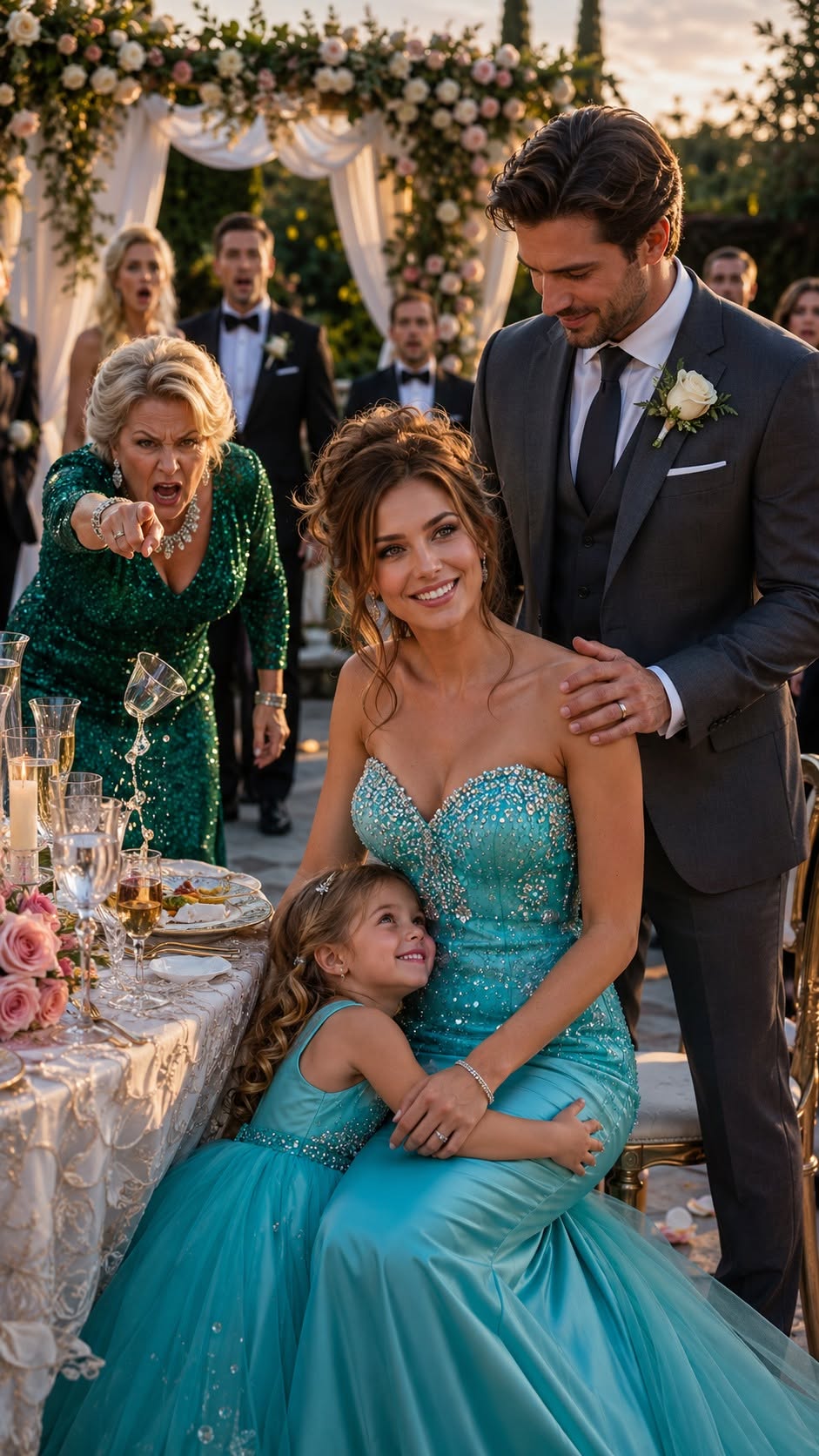
Norah, my four-year-old daughter, came barreling toward me from the dessert buffet. She was a vision of chaotic joy in a pale-green tulle dress, clutching a half-eaten petit four. She didn’t possess the capacity to read the toxic temperature of the room; she just saw her mother and ran.
Nadine’s aristocratic features contorted into a mask of manufactured pity. She crouched down, bringing her face level with my daughter’s, putting on a theatrical display of sympathy for the audience she had gathered. “Oh, you poor, sweet little thing,” Nadine cooed, dripping venom wrapped in honey. “No father in the picture. Naturally.”
Norah stopped chewing. She frowned, genuinely baffled by the strange lady’s words. Her little brow furrowed as she looked from Nadine to me, and then pointed a sticky finger across the crowded dance floor.
“My daddy is right over there,” Norah stated with absolute, unshakeable toddler logic.
Nadine pivoted gracefully, following the trajectory of my daughter’s finger.
Standing near the gift table, holding a napkin wrapped around a second pastry, was my husband. Dr. Elliot Marsh stood tall in his tailored charcoal suit, watching his daughter with the easy, infinite patience of a man who loved his life.
I watched it happen. I watched five years of Nadine’s carefully curated fiction disintegrate in real-time.
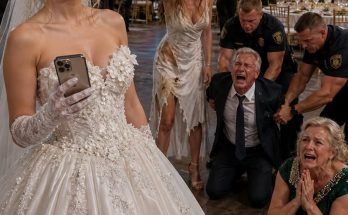
The champagne flute slipped from her manicured fingers. It didn’t shatter with cinematic violence; it simply tipped from her paralyzed grip, hit the polished hardwood, and broke with a sharp, pathetic tink. The golden liquid splashed over the toes of her designer heels.
Everyone within thirty feet pretended to look away, but the collective gasp was palpable. In the ringing silence that followed, I heard Nadine whisper a single word, her voice entirely stripped of its usual arrogance.
“Marsh,” she breathed.
She had spent half a decade writing the tragedy of who I was supposed to be. She had no idea that the room was about to witness the ending she had never authorized. Across the room, my old friend June caught my eye. She gave me a microscopic nod, her lips mouthing three silent words: Watch her next.
Chapter 2: The Gaslight Protocol
To understand why the undisputed matriarch of Ashgrove’s high society had just dropped her glass in sheer terror at the sight of my husband, I have to take you back to the winter my world was systematically dismantled.
Back then, I wasn’t the calm 36-year-old woman sitting on the periphery. I was Lily Forester, the twenty-something engine behind the Ashgrove Children’s Foundation. I organized their annual gala, transforming it from a dreary church-basement bake sale into the county’s premier social event. I kept spreadsheets the way some people kept secrets. I logged receipts, vendor contracts, and seating charts. My meticulous nature was the least glamorous thing about me, but it would eventually become my only armor.
I had married Chad Langley when I was twenty-five. Chad was effortlessly charming, quick with a compliment, and seemingly devoted to his family. It took me years to realize that Chad didn’t actually possess his own opinions; he merely performed the decisions his mother had pre-approved.
Nadine had been warm, initially. When we got engaged, she slipped a heavy cardstock envelope into my purse. Inside, written in her elegant, slanting cursive, were the words: You are the daughter I never had. She had underlined never. I kept that card in my jewelry box like a talisman, pulling it out whenever Chad and I argued, using it to convince myself that I was safe.
The decay began quietly. We had a joint savings account, our “house fund,” which had painstakingly grown to $38,000. Then, the phantom withdrawals started. Two hundred here, a thousand there. When I questioned Chad, he deployed a weaponized gentleness.
“You’ve always been so careless with finances, Lily,” he would say, looking at me with deep concern. “You forget things. You know your mind gets muddled when you’re stressed.”
He said it with such quiet conviction that I actually began to audit my own sanity. That is the insidious nature of being told softly, repeatedly, that you are the architect of your own confusion. It doesn’t feel like violence; it feels like love.
Chad began taking “weekend vendor trips.” Then, one Tuesday, I found a crumpled hotel folio in his suit pocket. The hotel was two hours away. The date was a Saturday he claimed to be in Chicago. At the bottom of the bill: two lemon waters and a $150 bottle of Cabernet. Chad despised wine. He claimed it triggered his migraines.
I didn’t weep. I didn’t scream. I reverted to my nature. I made photocopies.
For two hours, I sat at my laptop, matching his unexplained bank withdrawals against the calendar on my phone. The rhythm of his betrayal emerged in perfect, damning syncopation. A cash withdrawal on a Thursday equaled a hotel charge on a Saturday. Digging deeper, I found a $900 jewelry charge from eighteen months prior—a charge he had sworn was a corporate client gift.
I built a digital folder. I labeled it only with the current year. I had just completed the most thorough forensic accounting of my life, knowing no one would ever give me a medal for it.
Before I could even confront Chad, my phone vibrated. It was 9:00 PM. Nadine’s name glowed on the screen.
“Lily, sweetheart,” her voice flowed through the speaker, thick with preemptive sorrow. “I think we need to sit down before things spiral out of hand. These little hiccups happen in a marriage. I’d hate for a private squabble to become public gossip. For your sake, mostly.”
How did she know? I hadn’t breathed a word to anyone. A seasick nausea twisted in my gut. She didn’t sound like a mother discovering her son’s infidelity; she sounded like a stage manager cuing the next scene.
Two nights later, I found myself ambushed in my own living room. Nadine sat in my armchair, her hands folded primly. A pot of chamomile tea sat untouched on the coffee table.
“We are just so worried about you, Lily,” Nadine murmured. “Chad has been so remarkably patient, but these wild accusations… this obsessive tracking of bank accounts.” She shook her head, her eyes welling with crocodile tears. “You fixate, dear. I think this paranoia is coming from a very dark place inside your own mind.”
I reached into my bag and pulled out the folder. I laid the hotel receipts and the bank statements next to the cold tea. “The money is gone, Nadine,” I said, my voice trembling. “He bought jewelry. He booked hotels.”
Nadine didn’t even glance at the papers. She looked at me with immense, heartbreaking pity. “Oh, darling. Do you hear yourself? Trailing your husband’s credit cards, building little dossiers? This is exactly the instability we are so terrified of.”
In three sentences, my empirical evidence was weaponized into a symptom of mental illness. A sane woman wouldn’t keep files. A healthy wife would trust her husband. By producing the truth, I had only solidified her diagnosis of my insanity. It was a textbook execution of DARVO: Deny, Attack, Reverse Victim and Offender. By the time they left, I was no longer the betrayed wife; I was the unhinged, jealous woman trying to ruin a good man.
I was systematically erased. The charity board kindly asked me to “step down to focus on my wellness,” replacing me with one of Nadine’s cronies. Friends stopped calling.
But the fatal blow came from my own blood. Sitting at my parents’ dining table, I tried to show them the folder. My mother, Colleen, reached across the wood, covering my hand.
“Nadine wouldn’t just invent something like this, Lily,” my mother whispered, her eyes full of tragic love. “She has absolutely no reason to lie. You’ve always been a little… intense. A little quick to imagine the worst.”
Intense. Quick to imagine the worst.
They were Nadine’s exact phrases. My mother was reading from a script she didn’t even know she had been handed. That night, I packed my bags. I didn’t fight for the $38,000. I wanted peace more than I wanted justice, a mistake that cost me five years of my life.
Cliffhanger: I thought fleeing the battlefield meant I had survived. I didn’t realize that leaving the story unfinished meant Nadine was free to cast a new victim.
Chapter 3: The Pediatrician and the Understudy
I moved forty minutes away to Cedar Falls. Forty minutes doesn’t sound like an exile, but in local geography, it was a different universe. No one in Cedar Falls knew the Ashgrove folklore. I could walk into a bakery and just be a woman buying bread, not the fragile neurotic who ruined Chad Langley’s life.
I took a job coordinating volunteers for a regional clinic. That’s where I met Elliot.
Dr. Elliot Marsh was a local legend, though he’d loathe the title. He was the pediatrician who stayed late to stack folding chairs after a free community health drive. He coached Little League. He was a man whose actions matched his words in the dark, when no one was around to applaud him.
When things between us turned serious, I sat him down in a diner and laid out the ugly, Ashgrove version of my life. I gave him the “crazy ex-wife” narrative in high definition, waiting for him to run.
Elliot took a sip of his black coffee, looked me dead in the eye, and said, “I don’t need a town’s footnotes on you, Lily. I’ve met the author.”
He didn’t investigate. He didn’t demand my “side” like a judge weighing a verdict. He simply chose to believe the woman sitting across from him over the ghosts of a town he didn’t care about. We married quietly. A year later, Norah was born. My life was small, bulletproof, and utterly joyful.
Until the heavy cream envelope arrived in the mail. My cousin’s wedding. Back in Ashgrove.
I had RSVP’d yes, convincing myself that four years was a sufficient statute of limitations on a rumor. I didn’t factor in that the groom’s family was tangled in Nadine’s charity web, guaranteeing her attendance.
Which brings us back to the shattered champagne glass on the hardwood floor.
After Nadine’s grand humiliation misfired, the room fractured into frantic, whispering factions. Elliot came to my side, hoisted a sticky Norah onto his hip, and pressed his free hand into the small of my back—a silent anchor.
Needing a moment to process the adrenaline coursing through my veins, I slipped away from the ballroom and walked down the dim, quiet corridor toward the coat check.
I wasn’t alone.
Standing by a potted ficus, nervously twisting the massive diamond ring on her left hand, was Sloan. She was Chad’s current wife. Five years ago, I had known her only as the initial ‘S’ on the hotel folios—the “other woman.”
She looked pale, the expensive silk of her gown doing nothing to hide the exhaustion in her posture. She stared at me for a long time.
“You’re not who she told everyone you were,” Sloan said, her voice dry and hollow.
“No,” I replied softly. “I’m not.”
Sloan let out a laugh that sounded like scraping metal. “Do you have any idea what it’s like? To be someone’s ‘better idea’?”
I stayed quiet. When someone is teetering on the edge of a confession, silence is the strongest gravity.
“I was Nadine’s better idea,” Sloan confessed, her eyes locked on the carpet. “She introduced me to Chad at one of her galas in 2019. I thought it was flattering—this handsome guy pursuing me. It wasn’t a coincidence. Nothing in Nadine’s world is organic. She decided I was a superior genetic and social match for the Langley crest. She arranged the introductions. She fostered the affair.”
The floorboards beneath me felt suddenly unstable. She didn’t cover up the affair. She commissioned it.
“And when your marriage finally buckled under the weight of it,” Sloan continued, looking up at me with haunted eyes, “she swept in and told the town you were the demolition crew. I believed her version of you, Lily. Because it was intoxicating. If you were the lunatic, then I was the savior. I was the sane, beautiful prize he deserved.”
Sloan stopped twisting her ring. Her hands dropped to her sides.
“But it’s happening again,” she whispered, a violent tremor in her jaw. “Chad and I are failing. And she has already started laying the groundwork. The little comments at the country club. How I’ve become difficult. How I’m not quite stable. How Chad has been so, so patient.”
The exact script. Word for damn word.
“She is building the next narrative,” Sloan said, stepping closer to me. “The one where this marriage fails because of my hysteria. So when she’s ready to dispose of me, the jury will already have reached a verdict.” Sloan looked at me, no longer a rival, but a fellow hostage. “She orchestrated the whole thing, Lily. The affair, the gaslighting, the destruction. If you have the stomach for it… ask her yourself.”
Cliffhanger: I wasn’t going to ask Nadine anything. I was going to execute a sequence I had kept dormant in my pocket for five years, and the first casualty was standing right behind me.
Chapter 4: The Digital Ghost
I didn’t need to ask Nadine. I already had her confession.
I stepped further down the hall, pulling my clutch open. I didn’t just keep spreadsheets; I kept digital ghosts. Five years ago, during the darkest week of my life, Nadine had left me a voicemail. On the advice of a lawyer friend, I hadn’t just saved it on my phone—I had exported it, backed it up to a cloud drive, and carried it across three different devices like a loaded gun I was too terrified to fire.
I opened the folder. I pressed play.
I heard Nadine’s voice, five years younger but equally lethal, filtering through the phone speaker. She was managing me, trying to ensure I signed the divorce papers quietly.
“I introduced them, Lily. I did,” the recorded voice admitted with casual, chilling arrogance. “Some matches are simply better for a family’s standing. Let this end quietly, dear.”
I listened to it twice. As the recording finished the second time, I heard the scuff of a shoe.
I looked up. Standing at the junction of the hallway was my mother, Colleen. She was wearing her good navy dress, looking older, smaller, and entirely devastated. She had witnessed the scene with Elliot. She had come to find me. And she had heard the audio echoing down the empty plaster hallway.
“Was that…” my mother started, her voice choking on the syllables.
I didn’t speak. I just restarted the audio file and held the phone up in the air.
“I introduced them, Lily. I did. Some matches are simply better for a family’s standing. Let this end quietly…”
My mother went frighteningly still. The color drained from her face, leaving her looking like polished bone.
“She said that to me,” my mother whispered, pressing trembling fingers to her mouth. “‘Some matches are better for a family.‘ She said it to me about you, Lily, when she was pretending to be worried about your mental health. Word… for word.”
Tears, hot and fast, finally spilled over my mother’s cheeks. I watched the horrible realization click into place behind her eyes. She realized that the deep concern she had felt for me five years ago hadn’t been organic. Nadine had planted the seeds, watered them with calculated whispers at Sunday services and charity luncheons, until my mother genuinely believed she had grown the doubts herself. My parents hadn’t abandoned me; they had been surgically amputated from me by a master manipulator.
“I was reciting a script she wrote,” my mother sobbed, the sound muffled behind her hands.
My father, Warren, rounded the corner a moment later. He took one look at his weeping wife and the iron-flat expression on my face. My mother gave him the fractured summary. I watched my quiet, gentle father’s jaw lock. The veins in his neck pulled taut.
He looked down the hallway, toward the pulsing lights of the ballroom. “Where is she right now?” he asked, his voice dropping an octave into something dangerously primal.
I had everything I needed. I had the financial records, the audio confession, Sloan’s defection, and the righteous fury of a father scorned. I could have marched into that room and detonated a nuclear bomb over Nadine Langley’s social empire. I could have made it a screaming, hysterical spectacle.
But I had spent five years being the “loud, unstable” story. I refused to give them another one.
“Wait here, Dad,” I said, slipping my phone back into my clutch. “Let me handle this my way.”
Cliffhanger: I turned my back on my parents and walked toward the ballroom. It was time to pull the plug on the machine.
Chapter 5: The Quiet Execution
I re-entered the reception hall. The air was buzzing with the frantic energy of damage control.
Incredibly, Nadine was still operating. Even after dropping her glass, even after realizing she had insulted the wife of the county’s most revered doctor, she was pivoting. She stood near the center of the floor, a fresh glass of champagne in her hand, surrounded by her loyal sycophants. She was already rewriting history.
“She was always so deeply fragile,” Nadine was saying, projecting her voice just enough to overwrite the room’s memory. “Some women simply are. One feels for the child, naturally, but you truly have to wonder what kind of mother…”
She saw me approaching.
I didn’t stomp. I didn’t rush. People brace themselves for volume; when you approach with absolute stillness, they don’t know how to defend themselves. I stopped three feet away, breaching the perimeter of her circle. The ambient chatter of the room died, table by table, until the silence was deafening.
I looked Nadine dead in the eyes. I kept my voice soft—softer than she had ever been with me.
“I kept your message, Nadine,” I said calmly.
She blinked, a microscopic fracture in her composure. “I’m quite sure I don’t know—”
“The voicemail from November,” I interrupted, my tone perfectly even. “The one where you admitted you introduced them. Where you explicitly said, ‘some matches are simply better for a family.’ The one where you begged me to let it end quietly.”
I let the words hang in the heavy air for three heartbeats.
“I’ve held onto it for five years,” I asked, tilting my head slightly. “Should I keep holding onto it, the way I held onto everything else you demanded I keep quiet?”
I have never, in my entire life, seen a human face do what Nadine’s did in that moment.
She couldn’t deny it; I had just cited the audio file. She couldn’t explain it; any explanation was a confession. The magnificent machine that had run Ashgrove’s high society for decades simply seized and died. Her jaw opened, but no sound came out.
The silence was the most violent thing I had ever orchestrated. Every instinct in my body screamed at me to fill the void, to explain myself to the crowd. But I swallowed the urge. I let her stand there, suffocating inside her own quiet, exactly the way she had forced me to suffer in mine.
Desperate, Nadine executed her final, fail-safe maneuver. She looked to her right, turning to the woman she had groomed to be my replacement, expecting the blind loyalty she always commanded. She looked at Sloan to pick up the narrative and save her.
Sloan looked at Nadine. Then, very deliberately, Sloan reached over and set her champagne glass down on the nearest table.
“She’s not lying,” Sloan said clearly to the circle of women.
Three words. No screaming. No dramatic monologue. Sloan simply stepped off the conveyor belt.
That was the exact second the legend of Nadine Langley perished. It didn’t end with a brawl or security guards. It ended the way all grand illusions end: the audience simply stopped believing the magician. I watched the elite women of Ashgrove take a collective, subconscious half-step away from Nadine, treating her as if she had suddenly become radioactive.
If Dr. Marsh chose me, and my own mother backed me, and her hand-picked daughter-in-law refused to lie for her… then the story was a fabrication. And they had all been complicit.
I didn’t say another word. I turned my back on the architect of my misery and walked away. Behind me, I heard the humiliating rustle of silk as the most powerful woman in Ashgrove bent down to the floor, entirely alone, to pick up the jagged shards of her broken glass. No one offered to help her.
There is a myth about vindication—that it feels like a triumphant parade. It doesn’t. It just feels like taking off a heavy backpack you forgot you were wearing.
Elliot met me halfway across the room. He didn’t demand an after-action report. He just smiled, kissed my temple, and asked, “You okay?”
“Yeah,” I breathed. And for the first time in a half-decade, it was the absolute truth.
Epilogue: The Architecture of Peace
The fallout was a quiet, suffocating avalanche.
Nadine wasn’t formally exiled from Ashgrove; she was simply, systematically erased. June kept me updated over the next few months. Nadine’s invitations stopped arriving. Her name was quietly omitted from committee letterheads. The phone stopped ringing. Society women didn’t confront her; they just let her rot in the realization that her social currency had hyper-inflated into worthlessness. She had done it to me first; she knew exactly how the poison worked.
Apologies trickled into Cedar Falls. Some came via handwritten letters from women who realized they had been pawns. I forgave them, but I didn’t invite them back into my life. Forgiveness is untying the anchor; it doesn’t mean you have to let them on your boat.
Sloan texted me three weeks later. She had filed for divorce. “You unplugged the machine without ever raising your voice,” she wrote. “I didn’t know that was an option. I’m getting out before she recasts my role.”
My parents drove up to Cedar Falls a month later. We sat at my kitchen island. There was no grand, cinematic weeping. My mother simply looked at me, the arrogance of the past entirely burned away.
“I should have believed my own daughter,” she said. No caveats. No excuses about Nadine being persuasive. Just the stark, brutal truth.
She slid a small cardboard box across the granite counter. Inside was a photograph June had rescued from a charity bulletin board five years ago. It was a picture of me, radiant and laughing in the center of a gala I had built, surrounded by people before the lies infected them.
“I wanted you to have this,” my mother whispered. “So you remember that you were always her, even when the rest of us forgot.”
That night, after Elliot and Norah were asleep, I went into my closet and found the jewelry box. I took out the thick, cream-colored card. You are the daughter I never had.
For years, I had agonized over whether the card was a lie or a forgotten truth. I finally realized it was neither. It was merely a prop. Nadine wrote the script that served her current objective. When she needed a daughter, she wrote a card. When she needed a scapegoat, she wrote a monster. The pen was always in her hand.
I didn’t burn the card. Burning it would have been dramatic, another performance. I just dropped it into a shoebox of old tax returns and closed the lid, stripping it of its power.
Norah will never know that she dismantled a tyrant’s empire with six words and a pointed finger. She doesn’t know there was ever a war over her mother’s sanity. She will grow up in a house where her father stays, where her mother speaks her mind, and where her grandparents drive forty minutes just to prove they are sorry.
I used to think my silence was a badge of dignity. I know better now. Calmness is not the same as capitulation. You can be the quietest woman in the room and still violently refuse to let anyone else hold the pen to your life.
Nadine Langley spent five years writing a tragic fiction about me. She just never realized I was the one who was going to publish the final chapter.