Chapter 1: The Hollowed Sanctuary
“You have to be reasonable, Gloria,” my mother’s voice chirped through the receiver, echoing sharply against the cavernous, empty walls of the hall. “Your sister only gets one shot at a perfect engagement. You and Nolan can always do this little thing again.”
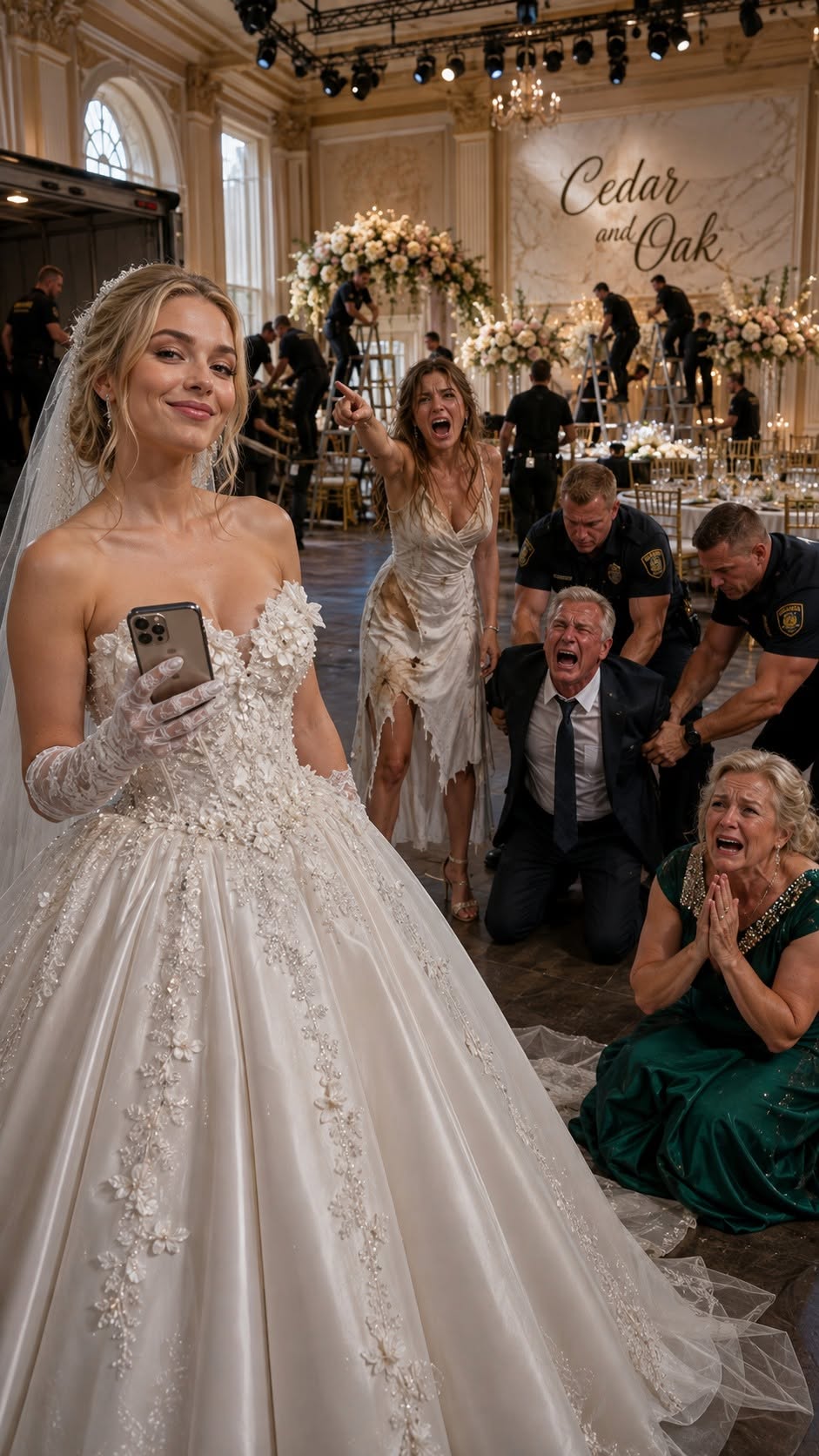
I stood perfectly still on a strip of blue painter’s tape. That tape marked the spot where my wedding aisle was supposed to begin. Now, it was just an adhesive scar on a hardwood floor. There were no velvet-draped tables. No gilded chiavari chairs. No cascading floral arrangements. No towering confection of a cake. My father had spent the entire morning commandeering a fleet of rented box trucks, hauling every single ounce of my wedding across the county. Why? So my younger sister, Colette, could dazzle the aristocratic family my parents had decided were the only people on earth who truly mattered.
Thirty-seven minutes remained until my first wedding guest was scheduled to walk through those heavy oak doors.
For two decades, my family had meticulously groomed me for this exact role. I was the shock absorber. I was the resilient one, the quiet fixer who would swallow the indignity, patch the holes, and never demand an apology. But on that balmy April afternoon, they were about to discover a terrifying truth: when the person you have chronically underestimated finally decides to stop absorbing your damage, the recoil is absolute.
My name is Gloria Thale. I am thirty-four years old. And this is the chronicle of the day I stopped being the dependable doormat and became the architect of my own vindication.
To comprehend how a family arrives at a morning so profoundly cruel, you must first understand my life’s work—and how thoroughly my parents dismissed it. I construct atmospheric realities for a living. Weddings, corporate galas, diamond anniversary banquets—the sort of high-stakes environments where people pay astronomical sums to guarantee perfection. My design firm, Larkspur & Co., was born in the cramped trunk of a rusted hatchback over a decade ago.
Today, I command a sprawling warehouse, a fiercely loyal crew, and a reputation that spans three counties. Every arrangement that leaves my dock bears a singular hallmark: a small, cream-colored tag, bound with waxed twine, holding a pressed, dried sprig of blue larkspur. It is my signature. My master florist, Delphine Carver, often joked she could navigate any event space blindfolded and identify my handiwork just by the texture of the linen and the architecture of the stems. I used to brush off the compliment. I had no idea how prophetic it would become.
My family, however, possessed a different vocabulary for my empire. To them, it was simply “the flower thing.”
At neighborhood dinners, my mother would wave a dismissive hand in my direction. “Oh, Gloria? She does little parties,” she would trill, using the exact vocal cadence one might use to describe a toddler’s finger-painting hobby. My father once genuinely asked when I planned to secure a “real job” with a “real corporate office.” When I quietly informed him that I owned the commercial building my firm operated from, he chuckled, patted my shoulder as if I’d told a quaint joke, and walked away.
But the most fatal flaw in their ignorance was that they never bothered to ask who those “little parties” were for.
Seven years prior to my ruined wedding day, I received a frantic call from a woman named Eleanor Ashford. The Ashfords were the geopolitical center of our region’s high society. They possessed old, generational wealth; their surname was etched into the marble wings of children’s hospitals. Eleanor had been abandoned by her event planner a week before a massive philanthropic gala. I stepped in, redesigned the event in nine days, and executed it flawlessly.
She never hired anyone else again. “Only you, Gloria,” read a text from Eleanor that I still have pinned in my phone. “No one else touches our family’s name.”
I never breathed a word about the Ashfords to my parents. Partly because discretion is the bedrock of my industry, but mostly because my parents never asked a single question about my life that wasn’t a thinly veiled segue to discuss Colette. So, my dual life remained compartmentalized.
The only person who truly saw me was Nolan. He was a structural inspector for the county, a man who evaluated the hidden bones of bridges and skyscrapers. He possessed a forensic eye for what was built to endure, and what was merely a facade. We met at midnight while I was dismantling a corporate retreat; he patiently waited for me to finish wrapping a floral arch just to ask for my number.
When we got engaged, our wedding budget was meticulously calculated at $62,000. I covered $41,000 directly from the Larkspur & Co. operating accounts—my own wholesale relationships, my own deposits, my own blood and sweat. Nolan covered the rest. Not a single cent came from my parents.
“Your wedding, your signature on the dotted line,” my lead rental supplier, Hollis Vandermir, had grunted when we finalized the paperwork. “I don’t move a single teaspoon without your authorization.”
I had smiled at his gruff professionalism.
But as I stood in the stripped sanctuary of Cedar and Oak, the memory of Hollis’s words tasted like ash. My phone buzzed in my hand. A notification from the family group chat.
It was a photo uploaded by Colette. A panoramic shot of Ivywood Hall, bathed in golden-hour light. And there, staged against the venue’s pristine walls, was my bespoke floral arbor. My imported chairs. My painstakingly curated color palette. And dangling from the centerpieces, catching the flash of the camera, were my cream-colored tags with the pressed blue larkspur.
“Look what magically came together for my special night!” Colette had captioned it, punctuated with a glittering heart emoji.
They hadn’t just taken the furniture. My eyes frantically scanned the barren floor where my sweetheart table was supposed to sit. My chest seized, a cold, jagged panic finally piercing the numbness. Gone. The cloudy, antique glass bud vase that belonged to my late grandmother—the very first vessel I had ever styled in my career, the lucky charm I brought to every milestone—was gone. Swept up in the theft, likely sitting on Colette’s gift table, completely unrecognized by the people who had stolen it.
The betrayal wasn’t just logistical. It was surgical. And as the silence of the empty hall roared in my ears, the shock evaporated, leaving behind a glacial, terrifying clarity.