- Part 1: The Roadblock
- The coffee was still warm when my son told me he would not move the truck.
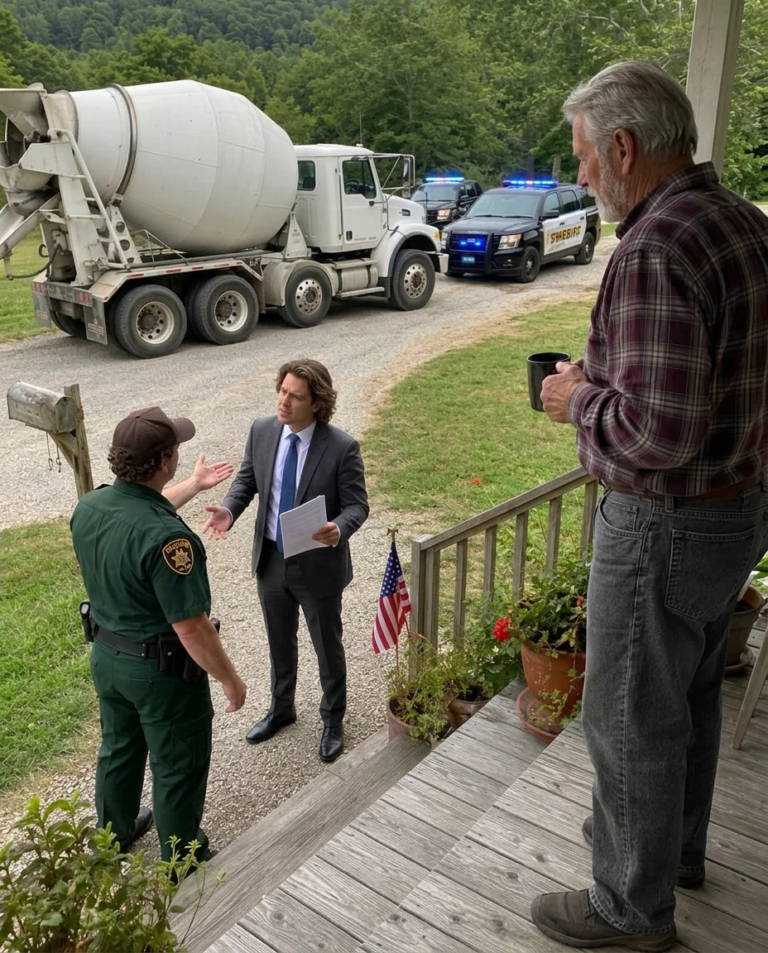
- I had stepped onto the porch at six that morning, expecting only the Tennessee hills brightening beneath the sunrise. Instead, a concrete mixer sat sideways across my driveway, its front bumper near the embankment and its rear wheels against the tree line. There was no way around it.
- Michael stood beside the vehicle in a navy suit, holding a folded contract.
- “The truck stays until we settle the land issue, Dad.”
- For forty years, that property had been my home. Margaret and I repaired the house, planted the garden, and hung a rope swing from the old oak for Michael.
- Margaret had been gone two years, but her gloves, recipes, and memories remained everywhere.
- Michael knew what the land meant to me. He knew every tree had a story and every room carried the life his mother and I had built. Yet he had started asking about it before she was buried.
- He claimed the acreage was too much for me, then offered to buy my home for less than half its value.
- When I refused, his visits stopped.
- That morning, I understood that his silence had not been hurt. It had been strategy. He believed grief and isolation would make me easier to control.
- “You planned this,” I said.
- “I tried talking to you.”
- “You tried buying my home for half its value.”
- “You are seventy-one and alone,” he replied. “You cannot maintain this forever.”
- He nodded toward the truck and said he would stay until I agreed to discuss the contract.
- My coffee trembled slightly. Michael noticed and smiled.
- That smile clarified everything.
- “You counted on my grief.”
- “Call it whatever you want. The truck is not moving.”
- I went inside, locked the door, and climbed upstairs.
- Margaret had insisted we keep an old satellite phone behind the winter coats.
- The battery barely awakened, but one signal bar appeared.
- I called Harry Collins, my neighbor of thirty-five years and a retired sheriff’s deputy. After hearing about the truck, contract, and threat, he asked whether my porch camera had recorded everything.
- “Yes.”
- “Do not touch the recording. Stay inside.”
- Twenty-eight minutes later, Harry’s pickup appeared around the bend, followed by two sheriff’s cruisers.
- Part 2: The Truth
- Michael’s confidence vanished when he saw the police.
- One deputy questioned him beside the concrete mixer while another came to my porch. I explained that Michael had blocked my only road and intended to keep it closed until I discussed signing his agreement.
- “The camera recorded the conversation,” I added.
- The deputy looked toward it.
- “We will need a copy.”
- “You can have it.”
- Michael received citations, and the report was sent to the county attorney because he had used the roadblock to pressure me.
- The truck was removed. Before leaving, Harry placed a hand on my shoulder.
- “He is your son,” he said.
- “I know.”
- “That does not change what he did.”
- “I know that too.”
- Twenty minutes later, Michael knocked. I let him sit at the kitchen table where he had eaten thousands of childhood meals.
- “I have contacted an attorney,” I said. “I will not discuss the property without counsel.”
- “That is fair.”
- Then he looked down.
- “What I did was wrong. I knew it when I rented the truck. I told myself I was being practical.”
- “I am old, Michael. I am not incapable.”
- “I know.”
- “Your mother would have been furious.”
- Pain crossed his face.
- “I know that too.”
- Finally, he admitted that his failing business and serious debts had made him view my land as the answer to everything.
- “If you had come here and honestly asked for help, what do you think I would have done?”
- He stared at the table.
- “I do not know.”
- “You would have found out. Instead, you planned this.”
- He nodded.
- I told him the legal process would continue. An apology could not erase what he had done.
- “This property is not an unused asset,” I said. “Your mother is here. Every room, tree, and garden bed holds part of our life. You, Sarah, Margaret, and I are all in this place. I will not sign away forty years because you chose coercion instead of honesty.”
- “I am sorry, Dad.”
- “I know.”
- “That is not enough.”
- “No. But it is where we begin.”
- My attorney preserved the recording. Michael covered the costs and signed away any claim to the land during my lifetime.
- What happened that morning was now written down. It could not be denied, softened, or rewritten later as a harmless family disagreement.
- For once, the truth existed outside our memories.
- Part 3: What Margaret Knew
- Sarah visited the following month. We talked about Michael, remembered her mother, and cooked dinner together.
- It was my best evening since she died.
- Michael and I spoke only three times that winter. The conversations were difficult, but more honest than many of our polite family dinners had ever been.
- I refused to sell the property. After he revealed his finances, however, I arranged a documented loan for his most urgent debts.
- It was not forgiveness.
- It was practical love with boundaries.
- During our second conversation, Michael mentioned the rope swing.
- He remembered the summer I built it and how he stayed outside until dark, returning home sunburned and grass-stained.
- “I forgot what the property really was,” he admitted. “I turned it into a number.”
- “I know.”
- “The swing is still there?”
- “It is.”
- “Does it still hold?”
- “I tied the knots myself. I tie good knots.”
- He was quiet.
- “Maybe I could see it in the spring.”
- “Maybe in the spring.”
- Spring arrived, turning the hills green. I planted Margaret’s garden using instructions from her final year.
- Harry began joining me for coffee on Thursday mornings.
- One April morning, he asked whether the property dispute was settled.
- “It is documented as thoroughly as possible.”
- “And Michael?”
- “We are working on it slowly.”
- “Slowly is fine.”
- We watched the garden move in the breeze.
- “Margaret would have handled this differently,” Harry said.
- “She would have handled it better.”
- “She always understood people more clearly than you.”
- “That is true.”
- “Still, you handled it.”
- I thought about the satellite phone behind the winter coats. Margaret had teased me for keeping it, but she had also told me to put it somewhere I would remember.
- When I needed help, it was exactly where she had told me to leave it.
- “She helped,” I said.
- Harry looked at me.
- “Margaret understood that the things that matter should always remain within reach.”
- He said nothing because nothing needed to be said. He understood that I was not speaking only about the phone, but about the lessons, memories, and courage Margaret had left behind.
- We drank our coffee while the garden returned to life below us.
- The old rope swing moved gently beneath the oak, its weathered seat still hanging from the knots I had tied for my son decades earlier.
- Patient.
- Present.
- Waiting for whatever came next.
My Son Blocked the Road to My Home and Demanded My Land, but He Forgot About the Hidden Phone