- For a brief second, I wondered if I had walked to the wrong apartment. The hallway was unmistakable—the same beige carpet, the same brass light above Unit 214 flickering softly, the same dent along the baseboard where someone had wrestled a couch around the corner.
- Then music drifted from inside. A woman laughed.
- My sister’s voice.
- I tried the key once more. It slid in, met unexpected resistance, and refused to rotate. The door had been held open with a rubber stopper, leaving a gap of several inches. Through the opening, I noticed cardboard boxes piled against the living-room wall and a pair of pink high heels beside my brand-new couch.
- Someone had replaced my lock while I was at work.
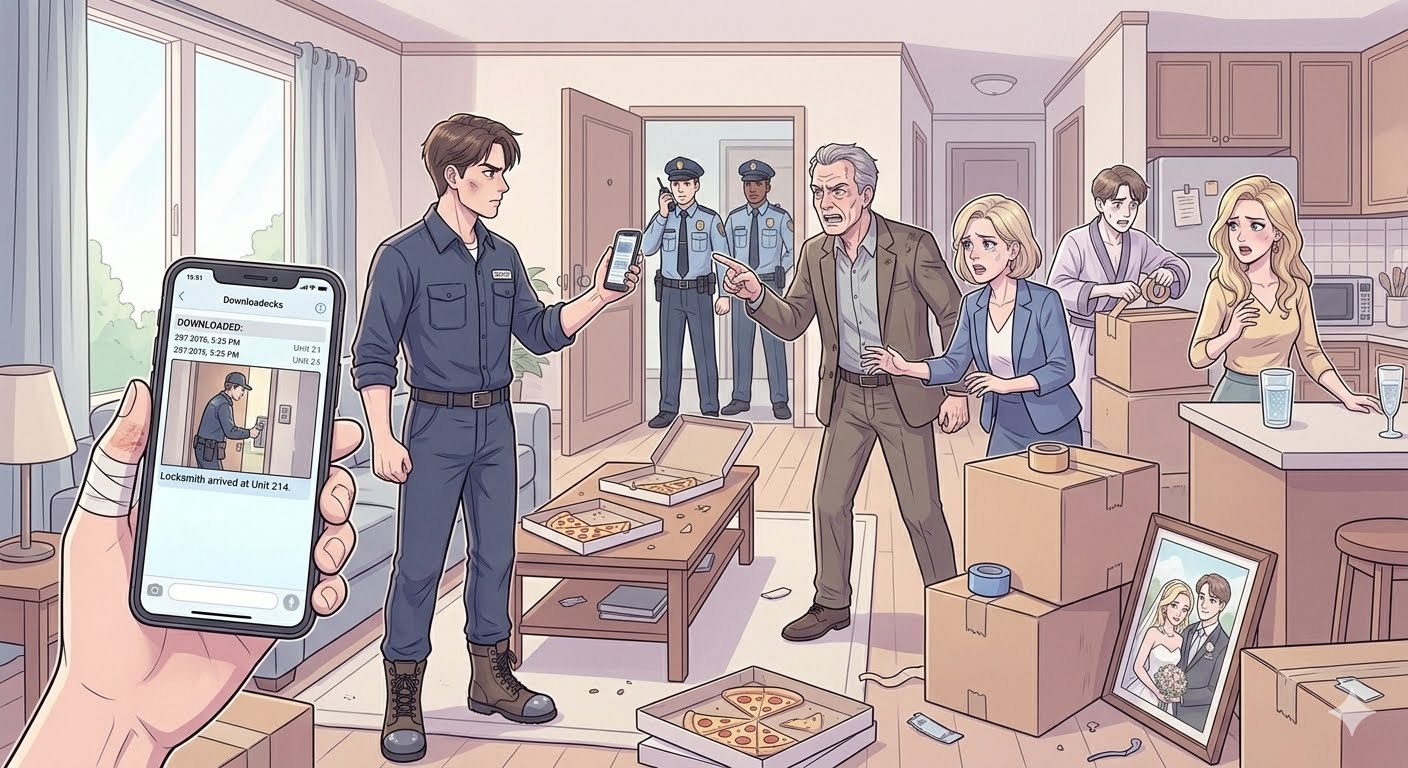
- I pushed the door farther open. Emily stood in the center of my living room holding a glass of sparkling wine, directing her husband toward the hallway.
- “Put the clothes in the bigger closet,” she said. “Daniel barely owns anything.”
- Luke carried one of their suitcases toward my bedroom. My father stood beside the kitchen counter assembling a metal shelving rack. My mother had every cabinet open, rearranging my dishes as though fixing an error I had made. Pizza boxes were scattered across the coffee table, music came from a speaker that wasn’t mine, and a second television stood next to my own.
- Emily noticed me and smiled. “There he is.”
- Everyone looked over. Luke stopped mid-step with the suitcase in his hands, Mom quietly shut a cabinet door, and Dad slowly lowered his screwdriver.
- I stayed in the doorway wearing steel-toed boots and my navy work shirt from the manufacturing plant, hands still carrying the faint scent of machine oil.
- “What are you doing?”
- Emily raised her glass. “Surprising you.”
- “With what?”
- “Our move.”
- The apartment fell silent except for the music. My eyes shifted toward the boxes—one marked EMILY—WINTER CLOTHES, another KITCHEN—FRAGILE. A framed wedding photograph rested against my wall.
- “You’re moving here?”
- “You have two bedrooms,” Emily replied. “You only use one. We need the other.”
- Luke lowered the suitcase. “We’ll help with expenses.”
- “How did you get inside?”
- Dad got to his feet. “Let’s not start with accusations.”
- “My lock is different.”
- “We had it changed.”
- “You replaced the lock on an apartment that doesn’t belong to you.”
- Dad’s face grew tense. “I explained the situation.”
- “To whom?”
- “A locksmith.”
- “And what exactly did you tell him?”
- “That it was a family emergency.”
- I stared at my father. The people standing inside my home had not acted on impulse. They had hired a locksmith, packed boxes, loaded furniture, and organized the entire day around the hours they knew I would be at work.
- Emily set her glass down. “You’re making that face.”
- “What face?”
- “The one where you pretend everything is some personal attack.”
- “You came into my apartment without my permission.”
- “Because we knew you’d overthink it.”
- My mother stepped forward. “Daniel, keep your voice down.”
- “I’m not speaking loudly.”
- “Your sister needs space.”
- “Then she can rent an apartment.”
- “You know they’re trying to save money.”
- “I was trying to save money when I lived in a camper.”
- “That was different.”
- The response came so quickly it sounded practiced. Almost everything in our family changed whenever Emily was involved.
- I was thirty-four when my parents decided the first stable home I had ever built should become the answer to my sister’s problem. To understand why they believed they had the right to do that, you first have to understand the roles assigned to us long before we were old enough to challenge them.
- Emily was four years younger than me. Growing up in a three-bedroom ranch in the Dayton suburbs, our family appeared ordinary from the outside. Inside, closeness followed a strict hierarchy: Emily was the sensitive child who needed encouragement; I was the dependable one expected to handle disappointment.
- When Emily wanted piano or art lessons, my parents signed her up immediately. I inherited used baseball gear. When Emily wanted a new bicycle, Dad bought her a bright turquoise one with white tires. When I asked at seventeen to attend a summer engineering program, Dad told me we couldn’t afford “extras” and that I should focus on earning money for college. The following year, they withdrew business funds to send Emily on a school trip to Paris.
- She attended a private university funded by our parents; I went to community college while working night shifts at a warehouse. When Emily graduated, they threw a lavish backyard party. When I earned my degree, we picked up takeout because everyone was busy with tax season.
- After college, Emily moved back home, trying six different jobs over five years—none of which stuck. Mom defended every resignation as Emily “finding her place.”
- Eventually, Emily met Luke, who worked in IT support. They moved into my parents’ house, got married in a ballroom ceremony mostly paid for by my parents, and then returned right back to that same bedroom. With four adults in the house, Emily complained endlessly about the lack of space, yet refused to rent an apartment, asking, “Why pay someone else’s mortgage?”
- I had moved out at twenty, living with roommates and working warehouse and restaurant shifts while driving a beat-up truck with two hundred thousand miles on it. I saved every dollar I could.
- Then came the shutdown year. The restaurant closed, the warehouse laid off staff, and my roommate moved back home. I sold my furniture, canceled every expense, and bought an old slide-in camper for eight hundred dollars with my remaining cash.
- When I called my parents asking to park the camper in their driveway until I found work, Dad demanded fifteen hundred dollars a month for “water and electricity.” When I drove over anyway, hoping seeing me in person would change their minds, Emily stepped outside in her slippers, looked at the camper, and laughed.
- “You’re really going to live in that? Like somebody camping in a parking lot?”
- Luke came out behind her and snapped several pictures with his phone.
- “This is too unbelievable not to share,” he said, chuckling.
- “Don’t do that,” I told him.
- He lifted both hands mockingly, as if I were the unreasonable one. “Relax, I’m kidding.”
- Dad stood firmly near the front door. “You cannot stay in our house unless we reach a proper agreement about rent.”
- Without another word, I climbed back into the cab of my truck. Nobody invited me inside for dinner. Nobody asked whether I had a safe, warm place to spend the night.
- That evening, I parked at the far edge of a strip mall lot beneath a streetlamp that flickered every twenty seconds. I barely slept. Every passing engine made me sit bolt upright; every shadow moving across the glass felt like someone approaching the camper. By sunrise, my neck ached from leaning against the thin plywood wall.
- That night became my routine for the next four months.
- During the day, I parked near public libraries, using their internet to fill out dozens of job applications. At night, I rotated between grocery store lots, truck stops, and quiet side streets near industrial parks. Some property managers let me stay; others knocked on my window and told me to move along.
- I joined a cheap twenty-four-hour gym to access showers and hot water. I carried a portable battery bank for my phone and a small LED flashlight. Whenever the battery died, I sat in the pitch-black interior, listening to the rain drum against the aluminum roof.
- I became an expert at looking temporary:
-
Keep the camper spotless.
-
Never leave folding chairs outside.
-
Arrive late, leave early.
-
Never give anyone a reason to notice you for too long.
- The hardest part wasn’t the physical discomfort; it was the way a person slowly becomes invisible when no address belongs to him. Forms demanded a permanent residence. Future coworkers would eventually ask where I went after my shift. Meanwhile, family photos on Emily’s social media showed happy Sunday dinners inside the house whose driveway supposedly had no space for my small camper. One picture even showed Luke’s new gas grill sitting on the exact patch of concrete where I had asked to park.
- I stopped looking at her page.
- Four months after losing both of my jobs, a small manufacturing company hired me as an entry-level machine operator. The plant was located outside a town about forty minutes from where I had been parking. It produced precision components for agricultural equipment and employed fewer than sixty people.
- The owner, Tom Walsh, interviewed me in a glass office overlooking the noisy factory floor. He reviewed my work history line by line.
- “You worked two full-time jobs at once?”
- “For several years, yes.”
- “Why?”
- “Rent.”
- He studied me quietly for a moment. “That is a complete answer.”
- The position was full-time with health benefits. The starting wage wasn’t remarkable, but it was dependable. I showed up an hour early every morning because I panicked that my truck might break down. I stayed late whenever anyone offered additional machine training.
- Tom noticed. One evening, he walked toward the rear parking lot while I was carrying a bag of groceries into the camper.
- “You live in there?”
- “For now.”
- “How long?”
- “Four months.”
- He looked across the wide, empty section of pavement behind the warehouse. The company had once parked delivery trailers there, but it had sat unused for years.
- “You can park in the back lot.”
- I assumed he meant just for the night. “For how long?”
- “Until you find somewhere better.”
- “I can pay rent for the space.”
- “No.”
- “I should contribute something.”
- He pointed toward an old maintenance shed along the tree line. “The gutters need cleaning, weeds are taking over the chain-link fence, and the break-room cabinet has been hanging crooked since 2016. Give me a few hours of work every Sunday.”
- I agreed before he even finished speaking.
- Tom let me run a heavy-duty extension cord from the building and use a utility sink beside the employee restroom. He also gave me a keycard that opened the rear entrance until ten every night. For the first time in months, I knew where I would sleep before the sun went down.
- The night security guard was a man named Frank Ellis. He was sixty-two, carried a stainless thermos covered in fishing stickers, and ate his dinner at midnight sharp regardless of his shift. During my first week back there, he knocked on the camper door and handed me a plastic container of hot chili.
- “My wife made too much.”
- “Did she?”
- “No,” Frank smiled softly. “I told her about you.”
- I nearly turned it down, because accepting help had become a complicated thing for me. Frank held the container out firmly. “It’s chili, Daniel. Not a contract.”
- I accepted it.
- Frank and I became good friends. He taught me which hydraulic pumps made subtle whining sounds before maintenance problems appeared; I helped him replace the burnt-out headlights on his old sedan. Tom’s brother, Mike, trained me to operate a second production line. I volunteered for every overtime shift available.
- Within a year, Tom promoted me to shift leader. Eighteen months later, I became the production supervisor. My income was higher than what I had earned from my previous two jobs combined.
- I kept living in the camper.
- Some of my new coworkers thought I was eccentric. Others understood after I explained that my housing cost was virtually zero, and my ultimate goal was to buy a home no one could ever question. I saved more than half of every single paycheck.
- The first time my bank account balance reached ten thousand dollars, I sat on the edge of my narrow camper mattress and stared at the screen for ten minutes. The money no longer felt like a symbol of sacrifice; it looked like an open door.
- By early summer, I began touring apartments near the plant. I found a bright two-bedroom unit in an older brick building surrounded by tall, mature oaks. The kitchen was compact, the carpet showed slight wear near the hallway, and the balcony looked out over the parking lot—but it had reliable heating, clean windows, and a heavy front door with a lock that matched my key.
- The rent was two thousand dollars, which was higher than I had budgeted, but the location reduced my commute to a quick ten-minute drive. The property manager offered a lower rate if I committed to a longer lease, so I signed the paperwork on the spot.
- On moving day, Frank and Tom helped me haul the few boxes I owned up the stairs. Tom set my secondhand kitchen table down by the window.
- “You need chairs, Daniel.”
- “I have one.”
- “A table with one chair looks like an interrogation room.”
- The following week, Frank showed up with three mismatched wooden chairs his neighbor had planned to haul to the dump. I sanded the wood down and painted them a uniform slate gray. Little by little, my apartment became a real home:
-
A navy blue couch from a clearance warehouse.
-
Two warm floor lamps.
-
A framed, black-and-white factory photograph Tom presented to me when our plant reached a safety milestone.
- I set up the second bedroom as a small home office and storage area.
- For several weeks, I deliberately told almost no one in my family. It wasn’t out of spite; it was about protecting my peace. I updated my driver’s license, registered my mailing address, and spent quiet evenings learning what silence sounded like when it truly belonged to me.
- Then Aunt Grace called. She was my mother’s younger sister and one of the few relatives who had checked on me during those long months in the camper.
- “I heard you bought a place,” she said warmly.
- “I rented an apartment, actually.”
- “That is wonderful news, Daniel.”
- “Who told you?”
- “Emily posted about it online.”
- I logged into social media for the first time in nearly a year. Emily had written a long, glowing post about me: My brother has been through so much, but I always knew he would find his way.
- She framed my new home as living proof that family encouragement made all the difference, and relatives were flooding her comment section with praise for being such a supportive sister. One comment read: You must be so proud after standing beside him through the hard times!
- Emily had replied with a simple heart emoji.
- I didn’t correct the story in public. I had spent too much of my youth arguing against my parents’ preferred version of reality to waste my energy on a comment section.
- A week later, my cousin Sophia asked for my address so she could mail a housewarming gift. I trusted her, so I gave it to her. A package arrived containing a small potted plant and a handwritten card: Aunt Grace says every real home needs something alive in the window. I set it on the table beside the couch.
- It never crossed my mind that my address would be shared beyond her.
- Three weeks later, I returned home from my shift to find my key jammed in a newly installed lock. Inside, Emily was orchestrating the takeover of my home.
- I stood in my own living room staring at my family. My father had tricked a locksmith, my mother had reorganized my kitchen shelves, my sister had dumped her clothes in my bedroom and taken photos to celebrate her new space, and Luke had already plugged his gaming console into my television.
- “You need to leave,” I said, my voice deadpan.
- Emily’s cheerful smile vanished. “You haven’t even listened to our arrangement!”
- “There is no arrangement.”
- “We’ll pay you three hundred dollars a month.”
- “My rent is two thousand.”
- “We would only use the extra bedroom!”
- “You would be using my kitchen, my bathroom, my utilities, my parking spot, and every square foot of my home.”
- Luke stepped forward, using a placating tone. “Daniel, we’ve already moved most of our heavy boxes upstairs.”
- “That was your choice.”
- Dad set his screwdriver down on the counter with a heavy thud. “Daniel, you lived in a camper for almost two years. You’ve never been materialistic.”
- “I lived in that camper because I had nowhere else to go!”
- “And now you have extra space,” Mom chimed in softly. “Your sister doesn’t.”
- “She already has a room in your house.”
- “She and Luke need privacy.”
- “Then they can rent an apartment of their own.”
- Emily’s eyes filled with tears so instantly that I knew she had rehearsed the gesture. “I told everyone online how proud I was of you!”
- “You told everyone you helped me.”
- “I supported you emotionally!”
- “You laughed at my camper.”
- “That was years ago!”
- “It was less than three!” I fired back.
- “You always keep a running tally of every mistake people make,” she sobbed.
- “No, Emily. I just remember where I slept.”
- Dad took a threatening step forward. “Watch your tone with your sister.”
- “You hired a locksmith to drill out my lock.”
- “We believed you would be reasonable once everyone was already settled in!”
- “Which means you knew damn well I would never agree to this.”
- Mom raised a hand dismissively. “Families shouldn’t need formal invitations, Daniel.”
- “My home requires one.”
- Emily’s crying turned dramatic. “I cannot believe you are humiliating us after we carried all these boxes up two flights of stairs!”
- “Then carry them right back down.”
- Luke turned nervously toward my father. “Richard, this is getting completely out of hand.”
- “It got out of hand the moment you broke into a locked apartment,” I said.
- Dad’s face darkened. “We didn’t break anything!”
- “The original lock is sitting on that box with fresh tool marks all over the metal!”
- “The locksmith removed it properly.”
- “Based on what lie?”
- Dad swallowed hard and said nothing.
- I pulled out my cell phone and dialed the building manager. Her name was Marla Jennings; she lived in an adjacent building and picked up on the second ring.
- “Daniel?”
- “Marla, someone replaced the lock on Unit 214 without my permission.”
- “What?”
- “My family hired a locksmith and moved in while I was at work.”
- Marla’s voice turned ice-cold. “Are they still inside your unit?”
- “Yes.”
- “Tell them to stay put. I am contacting our emergency maintenance tech, calling security, and documenting everything.”
- Emily stopped her fake crying instantly. “What are you doing?”
- “Creating an official record.”
- Dad pointed a thick finger at my screen. “Hang up that phone before you make a decision you’ll regret for the rest of your life!”
- Next, I dialed the local police department’s non-emergency line. I provided my name, my address, and a clear, composed account of what I had found upon returning from work. The dispatcher assured me an officer would be dispatched to my unit.
- Emily snatched up her purse. “You actually called the police on your own family?!”
- “I reported an illegal break-in.”
- Luke immediately began grabbing boxes and stacking them onto the luggage cart.
- Mom stared directly at me, her face pale with fury. “If you go through with this, Daniel, don’t expect us to keep pretending everything is fine.”
- “Nothing about this family has ever been fine.”
- “You’re going to lose your family over this!”
- Those words were meant to terrify me. Instead, I looked around at the four people standing among my belongings, and a profound sense of detachment washed over me.
- “That sounds entirely manageable.”
- It took them twenty frantic minutes to haul all of their belongings back down to their cars. They left their greasy pizza boxes on my coffee table, though Emily made sure to grab her glass of sparkling wine. Dad disassembled his metal shelving unit, leaving a stray screw beneath my couch.
- When the responding officer arrived, I presented my signed lease agreement, my state identification, the damaged original lock, the replacement hardware, photos of their stacked boxes, and text logs proving no permission had ever been requested or granted. Marla arrived alongside the property technician and confirmed to the officer that I was the sole legal tenant listed on the lease.
- The officer took my formal statement and reviewed the evidence. “You need to have this new lock replaced immediately,” he advised. “There’s no telling how many duplicate keys were cut today.”
- Marla agreed, scheduling a fresh lock installation for early the next morning.
- That night, I pushed my heavy dining table against the front door. I knew furniture couldn’t provide real security, but it offered a small measure of comfort.
- Before midnight, my phone buzzed with seventeen incoming messages. Relatives I hadn’t spoken to in years claimed I had publicly humiliated my parents. One uncle wrote that an extra bedroom should never matter more than blood. A cousin insisted Emily and Luke had only wanted a temporary place to catch their breath.
- My mother sent a single, bitter text: You have always mistaken independence for an excuse to be selfish.
- Then Aunt Grace called.
- “Daniel, are you safe?”
- “I’m fine, Aunt Grace.”
- “Did they really change the locks on your door?”
- “Yes.”
- She went quiet for a long moment. “I am so, so sorry, Daniel.”
- “For what?”
- “For every single time this family convinced itself you were fine simply because you didn’t complain out loud.”
- Late that night, Emily published a dramatic statement on social media. She claimed she had reached out to her brother during a housing crisis and been heartlessly turned away, alleging that she and Luke were struggling to build a future while “certain relatives” refused to let go of childhood grudges. Dozens of people commented with offers of sympathy.
- I posted no public response. Instead, I sent the detailed truth—including photos of the damaged lock and the security footage—privately to my cousin Oliver, my cousin Sophia, and Aunt Grace.
- Aunt Grace left a single comment beneath Emily’s public post: Is it true that you hired a locksmith to break into his apartment and replace his lock while he was at work?
- Emily deleted the entire post within the hour.
- The truth spread quickly through the extended family. As relatives learned what had actually happened, the sympathy evaporated. People who had praised Emily began asking why a locksmith was necessary in the first place, and Luke quietly stopped appearing in her social media updates.
- The following week, a county police investigator contacted me. The locksmith had been identified through a service sticker left on the door frame. He explained that my father had claimed his son was locked out during a family emergency, presenting a driver’s license showing the same last name. The technician genuinely believed he was helping a family member in distress; he had never been informed that I was at work, that I hadn’t authorized the service, or that a new family was attempting to move in.
- The investigator asked if I wanted to press formal charges for trespass and unlawful entry. I asked for a few days to think it over.
- For a week, I wrestled with the decision. Part of me wanted to cut my losses, block their numbers, and move on. But another part kept remembering my bedroom door pushed wide open, stranger’s blankets spread across my mattress, and Emily taking photos of my space as if it were hers for the taking.
- They hadn’t made a mistake. They had calculated everything around my absence, relying on guilt and social pressure to force my compliance once reversing the move became inconvenient.
- While I was deciding, Sophia called me. “Luke and Emily had a massive fight.”
- “I’m trying to stay out of their marriage, Sophia.”
- “I know, but you should hear this. Luke wanted to use their savings to rent an apartment. Emily refused because she didn’t want to spend money when my aunt and uncle have a free house. He told her the ranch house was suffocating them and that they needed real independence. Emily threw a fit, insisting rent was a waste of money.”
- Luke spent the next few days sleeping on a friend’s couch.
- Three days later, I found Emily sitting on the concrete steps outside my apartment building. She stood up as I approached.
- “I need to talk to you, Daniel.”
- “How did you get into the building?”
- “Someone held the door for me.”
- “That figures.”
- She began to cry. “I came to apologize.”
- “For invading my home?”
- “For the way everything happened.”
- “Those are two very different things.”
- “Mom and Dad convinced me you would agree once you saw us here!”
- “You packed your entire life into boxes before even asking me!”
- “We desperately needed space!”
- “You wanted free space at my expense.”
- Her face twisted with resentment. “I have spent my whole life feeling like I came second to you!”
- I let out a harsh laugh.
- She looked stung. “You think my feelings are funny?”
- “I worked night shifts to pay for community college while Mom and Dad paid your private tuition and rent,” I said coldly. “I lived in a parking lot while you stayed in their house for free. Explain to me how you came second.”
- “You were always the responsible one! You made everyone compare me to you!”
- “I wasn’t even in the room for those conversations.”
- “You always had everything figured out!”
- “Because nobody ever showed up to help me when I failed!”
- She wiped her cheeks angrily. “Mom and Dad supported me because I had more needs than you!”
- “Why did you have more needs, Emily?”
- She opened her mouth, but no words came out.
- “You were raised to believe that whenever you felt uncomfortable, someone else had to sacrifice to fix it,” I told her. “That doesn’t make my home your property.”
- “I’m trying to make things right here!”
- “Then get a job. Rent an apartment. Pay your own bills. Tell the truth online.”
- Her posture stiffened. “You have no right to judge my choices!”
- “You asked how to fix this.”
- “Not everyone wants to work themselves into early exhaustion like you do!”
- “I worked because no one was coming to rescue me,” I said plainly.
- “You’re just bitter because your life was hard!”
- “No. I am realistic because I survived it.” I stepped past her toward the glass entry doors. “I am done being this family’s emergency backup plan.”
- I asked her to leave the property. She walked away sobbing.
- That evening, my mother sent a barrage of guilt-tripping text messages, accusing me of cruelty and claiming Emily had returned home “devastated.” A real brother supports his sister instead of holding grudges, she wrote. I didn’t reply.
- The next morning, I called the investigator back. “I want to proceed with formal charges.”
- A profound sense of relief washed over me. It wasn’t about revenge; it was the quiet realization that my boundaries were worth protecting.
- A week later, my father called, asking to meet for coffee.
- “Anything you have to say can be said right now over the phone,” I replied.
- “I want to apologize face-to-face, son.”
- “An apology without accountability is just a request to feel better.”
- “What is that supposed to mean?”
- “It means you spent my entire life prioritizing Emily while telling yourself I was strong enough to handle receiving less.”
- “We tried to be fair, Daniel!”
- “Did you?”
- “Your sister had different needs!”
- “You paid for her private school, her trip to Europe, her college degree, her rent, and five years of adult living expenses.”
- “We helped her when she needed it!”
- “I needed a place to park my camper for one month.”
- The line went dead silent.
- “You were always independent,” Dad stammered finally. “We knew you’d be okay.”
- “Did you ever ask?”
- “What?”
- “Did you ever ask if I was okay?”
- He had no answer.
- “The police complaint is moving forward,” I said, and hung up.
- Shortly after, Luke called me from an unfamiliar number, asking to meet privately. We met at a diner near the manufacturing plant. He looked thoroughly exhausted.
- “I am so sorry, Daniel,” he said sincerely.
- “For which part?”
- “For going along with their plan. I wanted out of that house so badly that I let myself believe them when they said you’d be fine with it.”
- “You watched the locksmith drill out my lock, Luke.”
- He dropped his gaze. “I knew it was wrong the second he pulled out his tools. But I still carried the boxes upstairs.”
- “Why are you telling me this now?”
- “Because Emily refuses to look for work or talk about renting a place. I’m realizing how many lies I accepted because believing them made my life easier.”
- “That’s a tough realization,” I said quietly.
- We parted on neutral terms. I felt a measure of sympathy for him, but his marriage was his own responsibility.
- A month later, formal charges for criminal trespass and misdemeanor property damage were filed against my parents. Emily’s involvement was reviewed separately, as she hadn’t directly hired the locksmith, though her name remained on the police report.
- The family fractured completely. Half claimed I had taken a minor disagreement too far; the other half believed my parents had crossed a line that no family bond could forgive.
- By winter, Luke moved out of my parents’ house and filed for divorce. Emily left me a furious voicemail blaming me for destroying her marriage, which I promptly deleted before blocking her number entirely.
- When Thanksgiving arrived, Aunt Grace invited me to her home. Knowing some contentious relatives would be present, I politely declined. Instead, I spent the day in my quiet apartment, eating Chinese takeout and watching old action movies with Frank, who had nowhere else to be before his night shift. It was the quietest Thanksgiving of my life—and the most peaceful.
- In February, the court hearing took place.
- I took the stand first. I presented my lease, the photographs of the damaged lock mechanism, the security footage, and the text logs.
- When the defense attorney pressed me, asking why I hadn’t simply worked out a compromise with my family, I looked the lawyer dead in the eye:
- “Help that begins by breaking into someone’s home isn’t help—it’s an invasion. I spent years surviving on my own because my family deemed me ‘capable.’ I didn’t work myself to the bone just to hand the keys of my sanctuary over to the people who locked me out in the cold.”
- The judge ruled in my favor, issuing a formal reprimand and ordering my father to pay full restitution for the lock replacement and property repairs, along with completing community service.
- When I stepped out of the courthouse into the crisp winter air, my phone was completely silent. I walked to my truck, unlocked the door with my own key, and drove home to the life I had earned.
- “No.”
- “Why did you participate in moving into the unit?”
- “I wanted to leave their house.”
- The defense attorney questioned whether Luke was a reliable witness because he was currently divorcing Emily.
- Luke admitted the marriage was ending. Then he looked at the attorney and said, “The divorce does not change the lock, the boxes, or what I carried upstairs.”
- His testimony matched every photograph, the locksmith’s statement, the building manager’s records, and the report from my original police call.
- The hearing lasted three days, and the decision came after several hours of deliberation. My parents were found legally responsible for arranging unauthorized access and falsely representing their authority over the apartment.
- Mom covered her face with her hands. Dad lowered his head into his palms.
- I did not feel victorious. I felt the heavy, quiet exhaustion that comes when a truth finally becomes official after years of being dismissed as an exaggeration.
- Emily accepted a separate agreement requiring a fine, community service, and supervised compliance with a no-contact condition. My parents received probation, community service, and an order to pay restitution covering the locksmith’s charges, the replacement locks, property-management expenses, and a portion of my legal fees. They were formally instructed not to contact me unless I chose to reach out first.
- The judge addressed them directly before adjourning the court: “Being a parent does not grant unlimited authority over an adult child’s home. A family relationship cannot erase the fundamental need for consent.”
- Mom cried even harder. Dad never looked at me.
- The extended family split immediately afterward. Some relatives stopped speaking to me because they believed I had publicly damaged my parents’ reputation. Others stood firmly by my side. A few kept insisting both sides had made mistakes, although none of them could explain what my mistake had been beyond refusing to accept what was done to me.
- I allowed those strained relationships to quietly end.
- Luke’s divorce from Emily became final shortly after. They had very little property to divide because years of living rent-free had never resulted in any meaningful savings. He moved to another city to start over.
- Emily remained at my parents’ house. Aunt Grace told me she rarely left her room and still had not found steady employment. Dad lost two business clients who no longer trusted his integrity, and Mom stopped attending several community events because she no longer wanted to answer questions.
- I did not celebrate any of it. Consequences are rarely satisfying when they happen to people you once hoped would love you the right way. But sadness did not make my boundary wrong.
- Last weekend, I invited Aunt Grace, Oliver, Sophia, Tom, Frank, and several coworkers over for dinner at my apartment.
- The living room was full. Every mismatched chair was occupied. Someone sat on the couch balancing a plate on one knee. Frank complained that my chili needed more pepper, while Tom insisted no human being needed as much pepper as Frank considered normal.
- After dinner, we played cards around the table. No one mentioned the hearing. No one asked me to defend my choices.
- At one point, Sophia looked around the room and smiled. “This place feels different now, Daniel.”
- “How?”
- “It feels lived in.”
- I knew exactly what she meant. For months after the break-in, I had treated the apartment like a sealed bunker. I checked the deadbolt twice every night. I tensed whenever footsteps paused in the hallway outside.
- That evening, the front door opened and closed because people I had personally chosen to invite were walking through it. Aunt Grace brought dessert. Oliver washed the dishes without anyone asking. Tom fixed a loose handle on my kitchen drawer because he couldn’t sit beside something broken without repairing it. Frank watered the plant by the window and nearly drowned it.
- The apartment was no longer proof that I had escaped life in the camper, nor was it evidence in a legal hearing. It was simply my home.
- Before everyone left, Oliver asked whether I regretted continuing with the police complaint.
- “No.”
- “Not even a little?”
- “I regret that it ever became necessary,” I said.
- “That’s a different thing.”
- “It is.” I looked toward the front door. “They made their own choices. Dad called the locksmith. Mom helped organize the move. Emily and Luke packed their belongings. They walked inside, replaced the lock, and refused to leave until I created an official record. I didn’t create those choices. I just stopped carrying the weight of them.”
- After my guests left, I stood alone in the living room.
- No music played without my permission. No boxes were stacked against the wall. My bedroom belonged only to me.
- On the table rested a photograph Sophia had snapped during dinner. Everyone was laughing; I stood near the center holding a deck of cards while Frank jokingly accused Tom of cheating. No one in that picture was in my apartment because they felt entitled to free housing. They were there because I had chosen to open my door to them.
- I placed the frame beside the plant in the window.
- For most of my life, my parents treated my independence as proof that I needed less care. Emily treated my stability as a family resource waiting to be used. I had treated survival as something I was supposed to accomplish quietly enough that nobody would feel guilty for leaving me to handle it alone.
- Living in the camper taught me that I could survive almost anything. The apartment taught me something far more important:
- Endurance is not consent.
- Being capable does not make your work, your space, your money, or your peace available to anyone unwilling to build their own.
- My family once believed that an extra bedroom meant they were entitled to take my home. They were wrong. A home is never defined by unused square footage; it is defined by the person whose key unlocks the door—and by the people that person chooses to welcome inside.
- I switched off the living-room lamp and checked the lock once.
- Only once.
- Then I went to bed, without pushing the table against the door.
My key jammed halfway into the lock of my own front door.