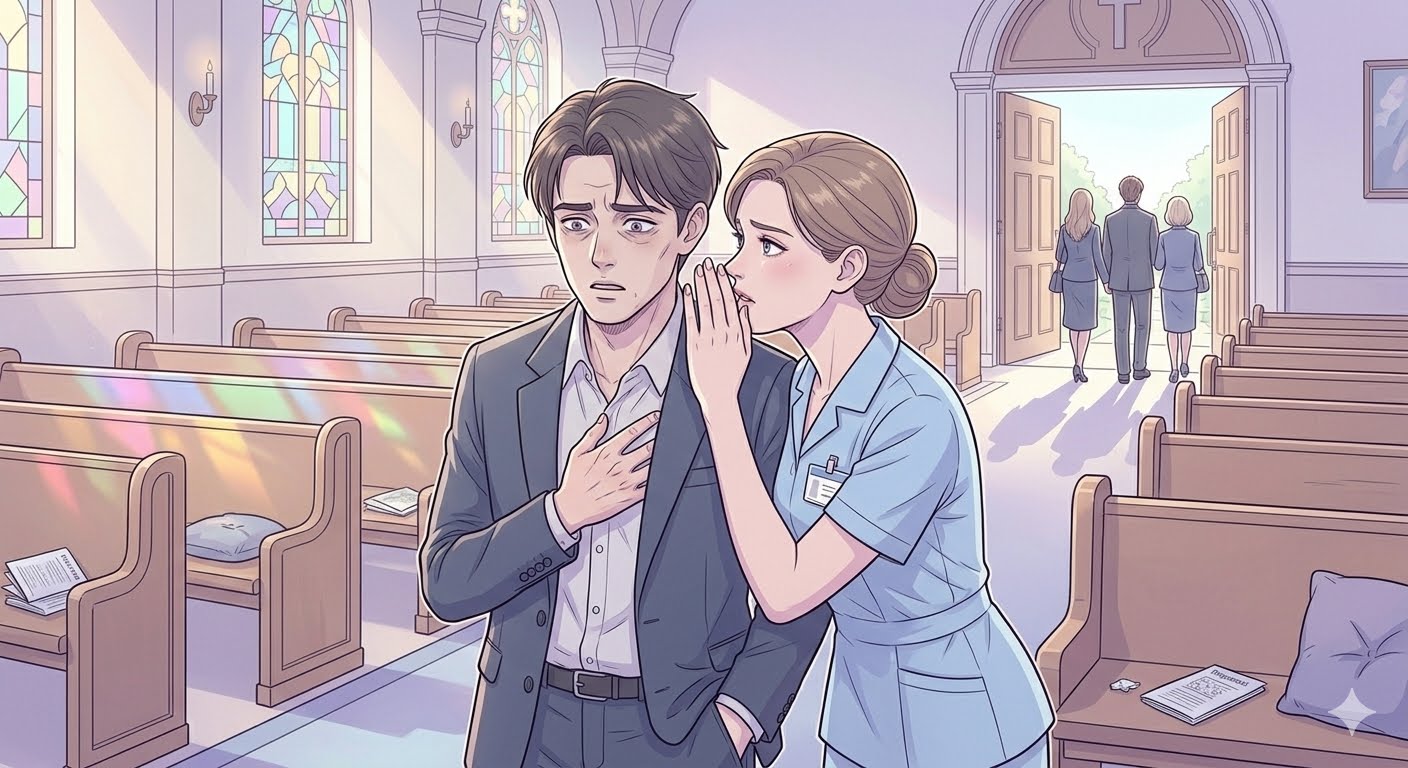
- “Crystal,” she said, her voice breathy and tense. “Your father asked me to wait until today before telling you what really happened the night your daughter disappeared.”
- Behind us, the church doors remained open as mourners filed down the steps carrying flowers and sharing stories about what a noble man my father had been. Hunter, my ex-husband, stood near the gate holding two paper cups of water. The moment he caught my expression, he set them down and moved quickly toward me.
- I raised a hand. “Stay close,” I called. “Just not right here.”
- He halted. Nurse Joyce glanced nervously around before reaching into her purse and pulling out a thick white envelope. My name was written across the front in my father’s shaky handwriting.
- For the past six months, I had visited him almost every day. Even after he lost his speech, he would reach for my hand. I had assumed he wanted comfort.
- “What is that?” I asked.
- “His confession,” Joyce whispered, her gaze dropping to the pavement.
- My fingers turned cold. “About Abigail?”
- She nodded.
- Five years ago, my five-year-old daughter vanished from my father’s backyard. One moment she was drawing in the dirt with a stick while he sat on the back steps; the next, she was gone. Police searched the woods and the lake, while volunteers combed the roads. They found no witnesses, no evidence, and no trace of Abigail. For five years, my father insisted he had only looked away for a minute. For five years, I told him it wasn’t his fault.
- “Give me the envelope,” I said.
- Joyce tightened her grip. “There’s something you need to understand first. He made me promise not to tell you while he was alive.”
- “And you agreed?”
- “I urged him to tell you himself.”
- “But he didn’t. He chose the one day I couldn’t demand answers from him.”
- “He was too weak, Crystal. He said unfairness was all he had left to give you.”
- I pulled the envelope from her hand. Hunter crossed the grass to my side.
- “Crystal? What’s going on?”
- “Dad lied,” I said, holding up the envelope. “About Abigail. He left a confession.”
- The color drained from Hunter’s face. “Then open it.”
- “Not here. At Dad’s house.”
- My father’s house still smelled faintly of cinnamon candy. His jacket hung on the rack, and his reading glasses remained on the side table.
- Hunter waited by the doorway. “Do you want me to leave?”
- “No. Just stay right there.”
- I walked into the kitchen and sat at the table where Abigail used to color. On the refrigerator, a faded drawing of a purple creature was still held up by a magnet.
- My hands trembled as I tore open the envelope. Three handwritten pages slid out, and the very first sentence struck me like a physical blow: Crystal, I lied about where Abigail went.
- “Dad, what did you do?” I whispered.
- “What does it say?” Hunter called from the hall, stepping inside.
- “Give me a moment,” I said, forcing myself to read on.
- Dad wrote that the fence bordering his backyard had been broken for weeks. Beyond it was a steep, overgrown path leading to a drainage channel. A neighbor had paid him to repair the barrier along the dangerous slope, but Dad had kept procrastinating.
- That afternoon, Dad had been arguing on the phone over a missed medical appointment while Abigail slipped through the gap in the fence. By the time he noticed her yellow hair ribbon and followed, he heard a sudden splash and her scream.
- My breath hitched. He had rushed down the path alone and spent twenty minutes searching the stream. Finding only her yellow ribbon caught in the brush, he panicked. By the time he returned to the yard, I was already there, screaming her name.
- Covered in mud and terrified of being blamed for the neglected barrier, he pointed away from the path. “She ran toward the lake,” he had told me.
- For five years, he watched the police dive into the lake and volunteers trek through the woods, knowing full well a sudden rainstorm that night had flooded the drainage channel before anyone could look there.
- His letter concluded with a bitter truth: I called my silence love because cowardice was harder to admit. I let you comfort me for five years when I should have been begging for your forgiveness.
- I handed the pages to Hunter. He read them, dropped his phone, and reached out to smash a vase against the counter.
- “Don’t,” I snapped. “He sent us the wrong way, Hunter, but don’t break anything else in this house.”
- He lowered his hand, his chest heaving. “He let us destroy ourselves. Our marriage…”
- “We give this to the lead investigator,” I said, refolding the letter. “Today. We stop protecting his memory and start searching where he told everyone not to.”
- At the police station, the investigator read the confession twice before looking up at me.
- “If your father had told us this five years ago, we would have searched that channel immediately,” he admitted quietly. “The drainage system runs beneath several streets. Some sections haven’t been opened in years.”
- “Then open them,” I said, handing him copies of the pages. “Reopen her case today.”
- Two days later, search crews entered the drainage system near my father’s property. Hunter and I stood behind the yellow tape, watching them work alongside the neighbor who had paid for the unfixed barrier—a man who now stammered excuses about warning tape and delayed repairs.
- The phone call came the following afternoon.
- When Hunter and I arrived at the station, the investigator laid an evidence bag on the table. Inside was a tarnished silver bracelet decorated with a tiny yellow star.
- “She hated the clasp because it pinched,” I whispered, touching the plastic casing. “I put it on her that morning.”
- Along with fabric remnants matching her clothes, the discovery was enough for authorities to confirm that Abigail had entered the channel that fateful day. The active missing person case was officially closed, replaced by an ongoing investigation into the neglected property and my father’s cover-up.
- A week later, I visited my father’s grave one last time before going to see the new, sturdy barrier erected at the drainage site.
- “I spent five years protecting you from your guilt,” I said to the freshly turned earth. “You spent those years protecting yourself from my questions. I might never have forgiven you for what you did—but at least I would have known where to look.”
- At the site, Hunter was waiting with a yellow ribbon. Together, we tied it to the post next to a small brass memorial plaque bearing our daughter’s name. It hung slightly crooked, so I reached out and pressed the corner until it was perfectly level.
- My father had built a lie to save himself, steering us all into the dark. But Abigail was no longer lost. She was finally anchored in the truth, and no one would ever misplace her story again.
Nurse Joyce caught my arm before I reached the church parking lot.