- Every evening when I came home, he was there.
- Same spot. Same wooden bench near the entrance. Same dirty coat that looked far too thin for the chilly weather.
- The first time I noticed him, I told myself not to be cruel. People ended up on the street for reasons the rest of us did not always understand. I knew that. My mother had raised me to say a quiet prayer before judging someone’s life from the outside.
- But she had also raised me to be careful—especially at night.
- So I started doing this thing where I slowed my pace before reaching my building. I would pretend to check my phone, thumb hovering over the screen, while secretly waiting to see if he moved. He never did. He just sat there with his shoulders hunched, his hands buried deep in his coat pockets, his face turned slightly upward toward the second-floor window.
- My window.
- At least, that was what it felt like.
- I lived alone on the second floor of a modest apartment building on a street that looked friendly during the day and uneasy after dark. The front entrance had a flickering light above it that my landlord, Derek, kept promising to fix.
- “Next week, Brittany,” he told me every time I brought it up. “I already called someone.”
- But next week came and went, and the light still blinked like a warning.
- The man on the bench appeared to be in his late sixties, though it was hard to tell beneath the gray beard and weather-worn skin. His coat was brown, torn near one sleeve, and always buttoned wrong. Sometimes he wore gloves; sometimes he did not. On cold evenings, I caught myself wondering how he could stand sitting there for so long without shaking apart.
- Then he would lift his eyes to my window again, and my sympathy would instantly shrink into fear.
- The neighbors avoided him too. Nobody greeted him. Mrs. Alvarez from the first floor would grip her grocery bags tighter whenever she passed. Young mothers pulled their children closer, whispering, “Come here, baby,” as if the man might snatch them away. Even the delivery drivers stopped parking near the bench.
- Sometimes I caught him mumbling to himself—not loud enough to decipher, just little broken sounds under his breath, like he was arguing with someone who was not there.
- Honestly, he terrified me.
- For months, I built my life around avoiding him. I changed which side of the street I walked on. I called my friend Tessa while heading home so I would not look vulnerable. I kept my keys wedged between my fingers, even though my dad once told me that trick did not really help much.
- “You never know about people,” my mom said when I told her about the man outside my building.
- “What do you mean every night?” my dad asked, his voice sharpening.
- “I mean every evening when I come home, he’s sitting there.”
- “Does he talk to you?”
- “No.”
- “Does he follow you?”
- “No, but he stares.”
- “At you?”
- I hesitated. “At my window.”
- There was a long pause on the line.
- “Brittany,” Mom said carefully, “maybe you should report it.”
- I almost did. Several times, I opened the non-emergency number on my phone. But then I would look outside and see him sitting with his head bowed, shoulders rounded, looking less dangerous than lonely.
- So I did nothing.
- Until the day everything went wrong.
- It started at work, where a customer screamed at me because an online order had arrived late, as if I personally drove the delivery truck and threw his package into traffic. I worked at a small boutique selling home goods—the kind of place where people expected soft voices, scented candles, and endless patience.
- “I need a refund and an apology,” the man snapped, leaning aggressively over the counter.
- “I understand you’re upset,” I said, trying to keep my tone calm.
- “No, you don’t understand anything,” he barked. “You people are useless.”
- My manager, Naomi, stood ten feet away and said nothing. Other customers pretended not to listen, which somehow made it worse. My cheeks burned so hot I could feel tears welling up, and I hated myself for showing weakness.
- After work, I picked up a package from the shipping store down the block. Halfway home, the bottom tore open. A bottle of expensive face serum bounced onto the sidewalk and shattered, spreading scented liquid across the concrete like a tiny, ridiculous crime scene.
- By the time I reached my building, I was shaking with rage. My coat was damp from the drizzle. My hair stuck to my forehead. My hands smelled like glass, cardboard, and ruined lavender serum.
- And there he was again.
- Sitting there like always. Same bench. Same dirty coat. Same lifted eyes, staring up at the second-floor window.
- Something inside me snapped.
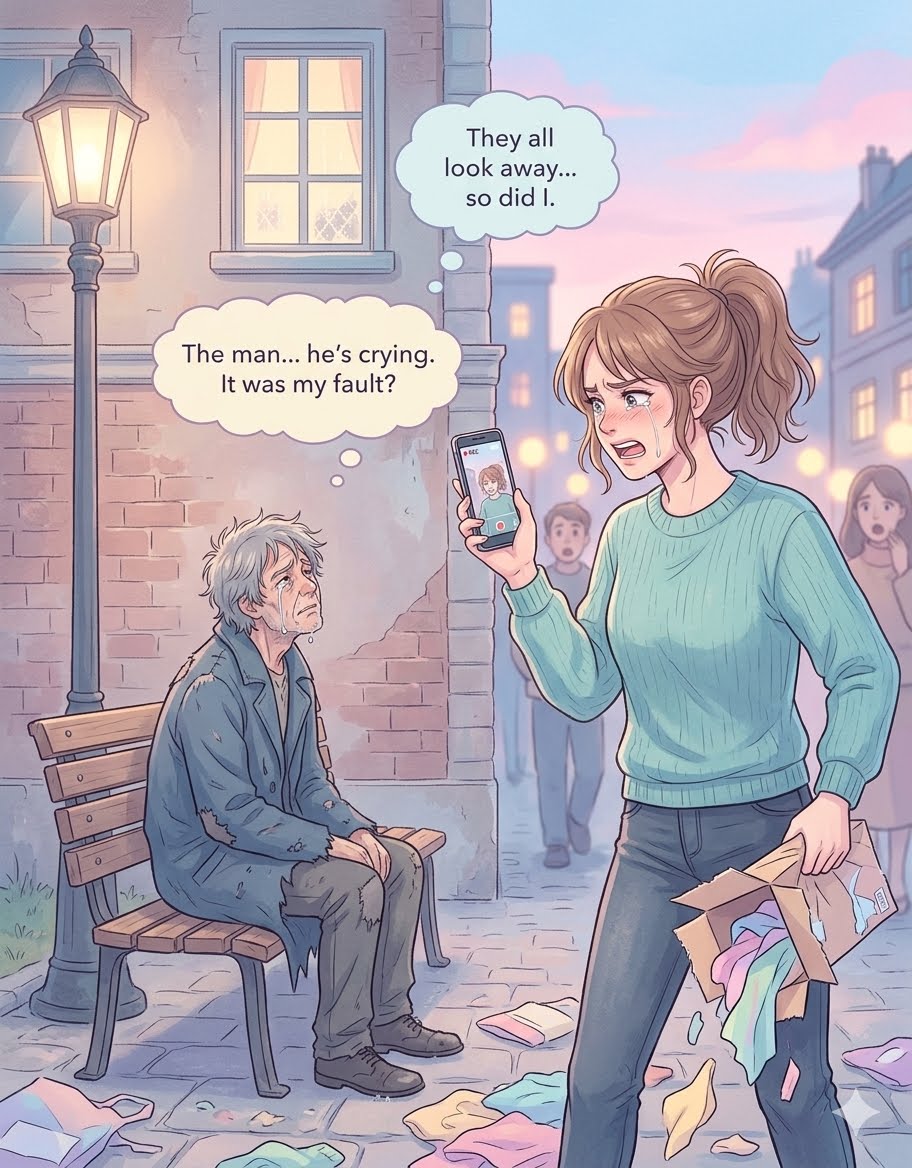
- I recall clutching my phone so tightly that my knuckles throbbed. I strode directly toward him, lifting the camera and already recording before I even reached the bench.
- “Do you seriously have nothing better to do?!” I yelled, my voice spilling out raw, ugly, and loud. “You sit here every single night terrifying people! Everyone’s scared of you! What is WRONG with you?!”
- Onlookers began to stare. Mrs. Alvarez froze near the mailboxes. A man with a bicycle slowed down on the sidewalk. Somewhere behind me, a child went quiet.
- The man went dead still.
- For one terrifying second, I thought he might retaliate. I thought he would stand, point a finger in my face, and prove every fear I had carried for months.
- Instead… his expression completely shattered.
- His mouth trembled first, then his shoulders, and then he began to weep—heavy, silent tears streaming down his weathered cheeks, his whole body folding around a sound so painful it made my stomach twist.
- I instantly wished to stop recording, but I was too paralyzed by shock to move my thumb.
- Through his tears, he slowly glanced up toward the second-floor window—then he uttered six words that left me feeling physically ill.
- “She waited for me until death.”
- The words barely rose above the rain, but somehow they silenced everything.
- My phone was still pointed at him, the red recording dot glowing on the screen. I could see his broken face through the camera—his wet cheeks, his trembling mouth, the way his eyes kept drifting back to that second-floor window like it was the last light left in the world.
- “What?” I whispered.
- He flinched, as if my voice hurt him.
- “I’m sorry,” he choked out.
- That made it so much worse.
- I had screamed at him. I had humiliated him in front of my neighbors. I had called him terrifying and wrong, and somehow, he was the one apologizing to me.
- “I didn’t mean to frighten you,” he continued, his voice cracking. “I just come here to see her window.”
- Mrs. Alvarez stood frozen by the mailboxes. The man with the bike lowered his eyes. Nobody spoke.
- I finally stopped recording, my thumb feeling completely numb against the screen.
- “Who?” I asked softly.
- He wiped his face with the back of his hand, but the tears kept coming. “Martha.”
- The name landed softly between us. He looked at the empty space on the bench beside him, as if someone had once sat there with him.
- “She lived there,” he said, nodding toward the second floor. “We both did, once.”
- My throat tightened.
- He took a shaky, thin breath. “I wasn’t always like this. I had suits. Plans. People who answered my calls.” A sad laugh escaped him, but it collapsed quickly. “I was young and proud. Too proud.”
- I could not move.
- “She was the best thing that ever happened to me,” he went on. “Martha would stand in that window every morning with her coffee. She’d tap the glass when I left for work, like she was sending me off to conquer the world.”
- His eyes softened, and for a moment I could see the man he must have been—not the man in the dirty coat, not the stranger everyone avoided, but someone loved. Someone cherished.
- “I wanted to give her everything,” he murmured. “A house. A garden. A kitchen big enough for all the food she used to burn.”
- A tiny sound came from Mrs. Alvarez. It might have been a sob.
- “She burned food?” I asked, needing to say something—anything.
- His lips trembled into the faintest smile. “Every Sunday. She said the smoke gave it character.”
- Then the smile vanished.
- “I left the country to build a business,” he said. “I thought if I could just make enough money, I could come back and surprise her. I wanted to return rich. I wanted to put keys in her hand and tell her she never had to worry again.”
- The rain dotted his sleeves, but he didn’t seem to notice.
- “I wrote letters,” he said. “At first. Then work got harder. Money got tighter. I was ashamed. I kept telling myself, ‘When I have something worth showing, I’ll go back.’”
- His hands curled into fists on his knees.
- “But years passed,” he whispered. “And she thought I had abandoned her.”
- My chest ached in a way that made breathing feel strange.
- “She stopped getting letters?” I asked quietly.
- “I stopped sending them.” His face twisted. “Not because I stopped loving her. Because I thought love needed proof. Money. Success. Something grand.” He shook his head. “She just needed me. That was all.”
- The words struck harder than they should have. Maybe because I could still hear my own voice from moments earlier—sharp, cruel, and slicing into a man already cut open by memory.
- “When I came back,” he said, “I had nothing grand. The business failed. I was older. Tired. But I came here anyway. I stood right there on the sidewalk, looked up, and waited for her to come to the window.”
- His voice dropped to a whisper. “She never did.”
- No one around us breathed.
- “The woman living there then told me Martha had been sick. Very sick. She waited for years, constantly saying I’d come back. Even near the end.” He pressed his fingers against his eyes. “She died alone in that room.”
- A cold wave passed through me.
- I looked up at my own window—the one I had cursed him for staring at, the one I had convinced myself made him dangerous. I imagined a young woman standing there with coffee in her hand, tapping the glass for the man she loved. I imagined her waiting, hoping, doubting, and finally fading away.
- And I had filmed his grief like it was evidence.
- “I’m so sorry,” I said, but the words felt far too small.
- He looked at me, and his grace broke me more than anger ever could have.
- “No,” he said gently. “I’m sorry. You were scared. I should have known. I should not sit here and make people afraid.”
- “Please don’t apologize,” I choked out. “Please. I didn’t know.”
- “How could you?” he asked.
- He gave me a mercy I had never offered him.
- The onlookers began to drift away in silent shame. Mrs. Alvarez wiped her eyes and went inside without meeting my gaze. The man with the bike walked off slowly, as if he had forgotten where he was going.
- I sat down beside him on the wet bench. “My name is Brittany.”
- He stared at the ground for a long moment. “Elliot.”
- “Elliot,” I repeated softly. “Would you let me bring you some hot tea?”
- He looked startled by the offer, as if kindness were a language he no longer trusted. “I don’t want trouble.”
- “You’re not trouble,” I told him, my voice shaking. “You’re a person.”
- His eyes filled with tears again, and mine did too.
- That night, I deleted the video before I even went upstairs. Then I brought him tea in my favorite mug and a warm blanket. We sat together beneath the flickering entrance light while he told me about Martha’s laugh, her terrible cooking, and the way she used to dance barefoot in their tiny kitchen.
- I listened to every word.
- When I finally went upstairs, I stood at my window and looked down. Elliot was still on the bench, staring up with tears glistening on his face.
- For the first time, I did not feel afraid. I felt the kind of quiet shame that forces you to grow—and behind it, a quiet promise taking root.
- As long as I lived behind Martha’s old window, Elliot would never have to grieve alone again.
The Watcher Outside My Window