- Part 1: The Auction
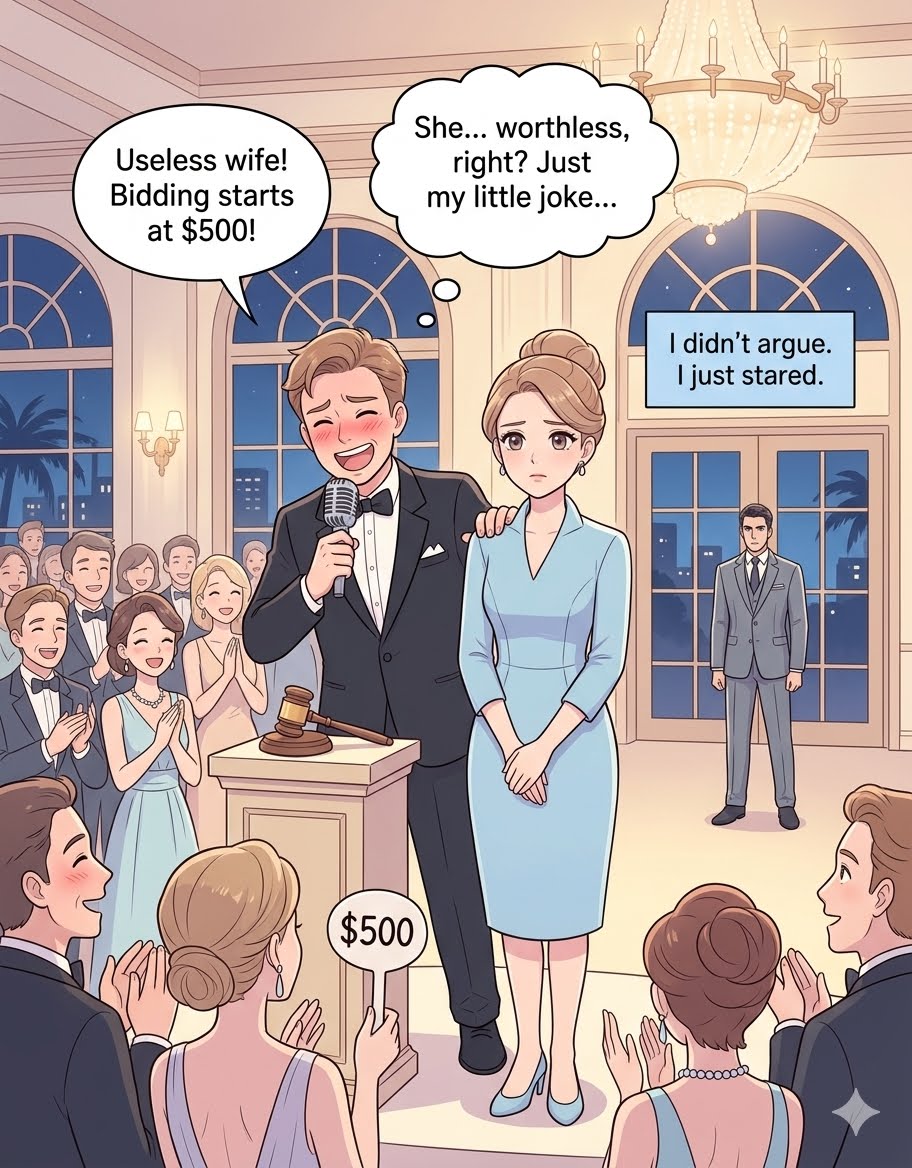
- “Let’s start the auction at five hundred dollars!” my husband shouted, raising the microphone before nearly three hundred guests. “Who is going to take this useless wife off my hands?”
- The luxury hotel ballroom in Miami erupted in loud, echoing laughter.
- I stood completely motionless beneath the glare of the stage lights, wearing the navy blue dress I had bought specifically for that evening, my hands clasped tightly in front of me. Harold Prescott smiled broadly, as though he had just delivered the absolute best joke of the year. Near the cocktail bar, one of his business associates raised a plastic stir stick and called out five hundred dollars, purely to play along with the prank.
- I did not cry, nor did I start an argument. I simply stared at him with quiet detachment.
- That deep humiliation had not suddenly begun that night. It had been steadily building for twenty-seven long years—accumulating through subtle insults and deliberate silences—until I had become almost invisible within my own marriage.
- I had personally organized that entire Prescott Foundation charity gala. I had carefully chosen the floral centerpieces, invited every guest, coordinated with the press, arranged the menu, secured the corporate sponsors, and even selected the fine wine Harold was currently boasting was his own personal choice. For eleven straight years, I did every bit of the hard work behind the scenes while he stepped forward to take all the applause.
- He had arrived forty minutes late to the venue, kissed my cheek in front of the executive board, and casually announced, “My wife always manages to make everything seem so simple.” Then he spent the next hour proudly taking full credit for every single one of my decisions.
- During dinner, he drank several glasses of bourbon and slipped into his usual routine of condescending jokes at my expense. He told the table that I was old-fashioned, that I still tracked household expenses in a physical notebook, and that my idea of extreme excitement was merely changing the flowers in the dining room.
- “Anastasia is easily the least interesting woman in this entire room,” Harold announced to the crowded table. “I say that with genuine affection, of course.”
- Everyone at the table laughed heartily. I forced a polite smile too, because for many years, I had mistakenly confused endless patience with true dignity.
- Later in the evening, when one of his business partners suggested a symbolic mock auction to raise additional funds for the charity, Harold immediately grabbed my hand and pulled me up onto the main stage. For a brief second, I foolishly thought he was actually going to thank me publicly for my hard work.
- Instead, he placed a heavy hand on my shoulder as if displaying a secondhand item at a yard sale.
- “Five hundred dollars for my wife,” Harold declared loudly into the microphone. “She cooks, she organizes, and she almost never complains.”
- The room burst into laughter again, much louder than before.
- I looked out at those laughing faces and recognized people I had welcomed into my home, sent thoughtful gifts to, visited in hospitals, and congratulated on their birthdays. They were all celebrating merrily while my own husband turned me into cheap merchandise.
- Then a powerful, unfamiliar voice emerged from the back of the room.
- “Two million dollars.”
- An immediate, heavy silence fell over the entire ballroom.
- A tall man wearing a tailor-made gray suit stood right by the main entrance. He appeared to be in his early sixties, and he was not looking at Harold at all. He was looking directly at me with a solemn, unreadable expression.
- Harold let out a deeply nervous, awkward laugh. “Well, it seems we have an extraordinarily generous donor tonight,” he stammered into the microphone.
- The stranger began walking steadily down the center aisle while guests quickly moved aside to clear a path.
- “My name is Owen Rodgers,” the man said as he reached the stage.
- Several guests audibly held their breath upon hearing that name. I recognized the surname instantly; he was a renowned venture capitalist, philanthropist, and owner of one of the country’s largest investment firms.
- Harold extended his hand with an eager smile. “Mr. Rodgers, it is an absolute honor to have you here.”
- Owen Rodgers completely ignored the outstretched hand.
- “I did not come here tonight to support your foundation,” Owen stated bluntly. “I came because I knew your wife would be in attendance.”
- Harold’s cheerful mask slipped into confusion. “Do you two know each other?”
- “I have never seen this man before in my life,” I replied honestly.
- Owen held my gaze with absolute seriousness. “Mrs. Prescott, I urgently need to speak with you tomorrow. There is something very important that you should have known many years ago.”
- “I accept your invitation,” I agreed before I could talk myself out of it.
- During the quiet drive home, Harold gripped the steering wheel so tightly that his knuckles turned white. “What exactly did you do to make a man like that offer two million dollars for you?” he demanded angrily.
- “I did absolutely nothing,” I answered calmly.
- He clearly did not believe a word I said.
- That exact same night, he called his private investigator and ordered a full background check on Owen Rodgers. By dawn, he received an urgent response that left his face completely pale: the wealthy industrialist had been actively searching for a woman named Anastasia Robbins for several years.
- Harold understood, much earlier than I did, that the joke auction had opened a door that no one could ever close again.
- Part 2: The Sister’s Legacy
- Owen chose a quiet, unassuming diner in Atlanta, far away from the upscale establishments where Harold was usually recognized. He stood up politely as soon as I arrived and waited until the waiter walked away before speaking.
- “I want to apologize for my dramatic behavior last night,” Owen said gently. “I simply could not sit there silently while those people treated you so terribly.”
- “How do you know who I am?” I asked directly.
- Owen took a deep breath before answering. “Thirty years ago, you worked as an elementary school teacher in Ohio. On a very rainy afternoon, you found a frightened teenager sitting outside the central bus station.”
- The distant memory suddenly flooded back, bringing up the vivid image of a soaked young girl holding a torn backpack with eyes full of absolute terror.
- “Her name was Naomi,” I whispered softly.
- Owen nodded with a faint smile. “That was Naomi Parsons, my younger sister. She had run away from a terrible home situation and planned to board the very first bus out of town. But you bought her a warm dinner, called a social worker, and stayed by her side until sunrise.”
- “I remember visiting her at the youth shelter afterward and helping her keep up with her schoolwork,” I added quietly.
- “She went on to become a human rights lawyer,” Owen continued with pride. “She dedicated her whole life to helping young people without families, and she always said her path started because a kind teacher asked if she was hungry.”
- He reached into his jacket pocket and pulled out a heavy paper envelope.
- “Naomi passed away eight months ago from illness,” Owen said, his voice tightening with emotion. “Before she passed, she made me promise that I would search for you.”
- I felt as though I could hardly breathe as I took the paper.
- I read Naomi’s letter later that night while locked inside the guest bedroom of my house. She thanked me deeply for showing her that true kindness exists, but she did not just leave me with sweet words. She had officially named me a key board member of her charitable foundation, with full executive authority over its programs.
- While I was processing all of this, Harold hired another investigator, firmly convinced that Owen and I were secret lovers. The investigation report found zero evidence of any romantic affair between us. Instead, it uncovered decades of selfless acts my husband had never bothered to ask about—needy children I had fed, grieving widows I had supported, and local veterans I had assisted.
- At the same time, a video recording of the auction went viral across social media. Within four days, it gained tens of millions of views, drawing thousands of public comments calling Harold a cruel and abusive husband. Major corporate sponsors immediately canceled their contracts with his firm, two lucrative real estate developments broke off negotiations, and his corporate board demanded an emergency meeting.
- “Everything I built is completely falling apart!” Harold raged late one night. “I need you to come on national television with me and tell the public that the auction was just an inside joke between us!”
- “I am not going to lie to the public just to save your reputation,” I replied firmly.
- A few days later, Owen took me to visit one of the homeless shelters fully funded by Naomi’s estate. While there, I met a young mother named Judith who had been sleeping in her car with her two small children for months. I sat next to her, bought her family warm meals, and listened to her struggles. The foundation immediately agreed to cover six full months of her rent while she completed her vocational nursing course.
- Upon my return home late that evening, Harold immediately noticed the visible shift in my composure.
- “You do not need any of this anymore, do you?” Harold asked bitterly. “You do not need this mansion, you do not need my money, and you certainly do not need me.”
- Before I could answer, a courier arrived at our front door with a thick cream envelope. It was an official invitation to the annual gala of the Parsons Family Charity Foundation. Directly underneath my printed name were two bold words that caught my eye: Keynote Speaker.
- The final page stated that Naomi’s official will would be read publicly that night—alongside the real reason why Owen had offered two million dollars for me at the auction.
- Harold read the invitation right over my shoulder, his hands trembling noticeably.
- “Anastasia,” Harold said nervously, “there is something major that I never told you about that specific foundation.”
- In that heavy moment, I realized that the secret did not belong only to Owen and Naomi. My own husband had been deliberately hiding a massive part of the truth from me for years.
- Part 3: The Truth and The Gala
- “What exactly do you know about that foundation?” I asked Harold sharply.
- Harold quickly closed the kitchen door behind him, looking like a man who had accidentally shattered something irreplaceable.
- “Five years ago, my firm tried to purchase the downtown property where one of their main shelters operates,” Harold confessed. “My investment group wanted to demolish the building and construct a luxury hotel resort, but Naomi Parsons firmly refused to sell the land.”
- “And what on earth does any of that have to do with me?” I questioned, stepping closer.
- “Naomi personally led the legal opposition against us,” Harold explained softly. “She publicly accused my company of harassing the local families living in that neighborhood.”
- I instantly remembered those tense weeks years ago when Harold would arrive home in a blind rage, shouting about a stubborn lawyer who was blocking his multimillion-dollar business deal. He had never mentioned her name back then, and I had never bothered to ask, because by that point we were merely sharing a house rather than a real life.
- “Then my legal team discovered that she was actively searching for you,” Harold continued, looking down at the floor. “One of my attorneys spotted your maiden name listed in some of her legal documents.”
- “Did you know who Naomi Parsons was this entire time?” I asked, my voice shaking with rising disbelief.
- “Yes, I knew,” Harold admitted quietly.
- “For how long have you known this?”
- “For almost four long years,” Harold confessed.
- I had to lean against the edge of the granite counter to keep my balance. For four years, my husband knew that the young girl I had saved decades ago was trying to find me, yet he deliberately chose to stay silent because the truth might ruin his real estate deal.
- “Did any personal letters arrive at the house or office for me?” I asked, staring directly into his eyes.
- Harold remained completely silent.
- “Did you receive her letters?” I repeated loudly.
- “Two letters arrived at the corporate office,” Harold finally muttered. “My secretary received them, and I personally ordered her to hide them in the file room.”
- I did not scream or shout. Instead, a deep, cold clarity settled over my mind. The humiliating public auction was no longer the worst thing he had ever done to me. A cruel joke could be blamed on bad alcohol or ego, but systematically isolating me from a dying woman was a calculated choice.
- “Naomi died believing that I intentionally ignored her letters,” I said slowly.
- Harold attempted to step closer. “I was only trying to protect our family business!”
- “No, you were protecting your total control over my life,” I countered instantly. “You knew that if I found out who she was, I would build a life outside of your shadow.”
- I walked upstairs to the guest room, packed up Naomi’s letter, grabbed my essential documents, and packed a single suitcase. I left the mansion that very night. Two days later, I signed a lease for a small apartment in a leafy neighborhood in Savannah, complete with bright white walls and a large oak tree outside the window. It was not a luxury mansion, but it belonged entirely to me.
- When I met with Owen to tell him what I had discovered, he listened in solemn silence.
- “Naomi strongly suspected that someone was blocking her personal letters,” Owen told me gently. “That is precisely why she recorded a final video message specifically for you.”
- The gala took place inside the Grand Ballroom of a historic hotel in Philadelphia, attended by hundreds of prominent business leaders, attorneys, community organizers, and curious reporters drawn by the recent viral scandal.
- I dressed carefully for the evening, choosing a dark green gown and styling my own hair without asking for anyone’s approval. Looking into the mirror, I finally saw a woman standing tall in her own space.
- Owen greeted me warmly at the entrance. “You have nothing to prove to anyone in that room,” he reminded me gently. “Just tell your truth.”
- When the host announced my name, I walked confidently onto the stage while my heart pounded steadily. Sitting alone in the very last row was Harold, completely lacking the proud smile he always wore for news cameras.
- I began my speech by sharing the story of a cold afternoon in Ohio, explaining how I almost walked right past a scared teenager because I was exhausted from work. I told the audience that the young girl did not ask for help, but I saw the fear in her eyes and chose to sit beside her.
- “For many years, I assumed I had simply bought a stranger a warm meal,” I shared with the audience. “Now I realize that life-changing moments rarely seem important while they are actually happening.”
- The main room lights dimmed softly.
- Naomi appeared on the large projection screens, looking frail from her illness but possessing deeply expressive eyes.
- “Anastasia, you might not remember every detail of that night, but I certainly do,” Naomi’s voice echoed through the speakers. “I remember the warm soup, the kindness in your voice, and how you never once asked what I had done wrong to end up on the street.”
- The entire room remained completely motionless.
- Naomi explained how that brief encounter gave her the courage to accept help, complete her education, and dedicate her life to advocating for others.
- “For decades, I searched for the woman who saved my life,” Naomi shared on the recording. “When I finally located her, certain individuals actively prevented my messages from reaching her hands. But I do not want revenge; I only want to expose how much damage occurs when people hide the truth for personal gain.”
- Detailed record logs suddenly appeared on the screen, showing the official delivery receipts of the letters sent to Harold’s office, alongside internal emails where he ordered his assistant to file them away to protect his corporate project.
- A loud murmur of shock passed through the audience. Harold lowered his head in utter shame.
- “Anastasia,” Naomi concluded warmly, “I am leaving you a permanent seat on this foundation’s executive board, because you were an essential part of its mission long before it existed. The two million dollars my brother pledged at that auction will be used in your honor to build a modern community center for women in Ohio.”
- In that moment, I finally understood the exact meaning behind that massive monetary pledge. Owen had not tried to buy me at the auction; he had transformed Harold’s public insult into a lasting promise to protect others.
- The screen faded to black, and the entire audience stood up in a resounding ovation.
- I cried quietly—for the scared teenager at the bus station, for the woman she became, and for myself, having finally stopped making myself small just to make a man feel powerful.
- Part 4: A Real Home
- When the main event ended, the foundation lawyers explained that Naomi’s estate had set aside immense funding to expand shelters nationwide, entrusting me with real leadership responsibility.
- “I do not have formal corporate training to run a major foundation,” I admitted to one of the directors.
- The director smiled kindly. “You have been doing this exact meaningful work for decades without needing a title.”
- Around midnight, Harold was waiting for me near the cloakroom.
- “I sat there and watched everything,” Harold said softly. “I spent four years hiding the truth just to protect land deals and corporate profits, because I convinced myself I was doing the right thing.”
- “And what do you realize now?” I asked him quietly.
- “Now I realize I was only protecting myself from discovering that you never actually needed me,” Harold answered honestly. “In twenty-seven years of marriage, I never once asked about your daily life or why you cared so much for strangers, because I foolishly thought your world began only when I entered the room.”
- I stood there silently, listening to his words.
- “I am truly sorry, Anastasia,” Harold added, his voice breaking. “I was married to an extraordinary woman, and I only truly saw her value when someone else forced the entire world to look at her.”
- I could tell that his apology was finally sincere.
- “I forgive you,” I told him calmly. “However, forgiving you does not mean I am ever coming back to you.”
- Harold nodded slowly and stepped aside to let me pass.
- The public consequences for his business were immediate: the board launched an internal investigation into his land dealings, forcing him to step down as chief executive officer and sell off company shares to settle liabilities. Our divorce proceedings were entirely peaceful, as we met with attorneys to divide our marital assets cleanly.
- Right before signing the final legal papers, Harold looked up at me. “Do you think we could have been truly happy if I had actually valued you sooner?”
- “I do not know,” I replied softly. “And I no longer need to know the answer to that.”
- Over the following months, my life transformed completely without any need for public cameras. Our foundation opened new support shelters and expanded youth scholarships significantly. The new community center opened in the fall, featuring a simple plaque near the front entrance that read:
-
NAOMI’S HOUSE
“Kindness does not disappear. It always finds a way to return.”
- Owen and I continued to work closely together, often sharing quiet dinners after long board meetings to discuss community programs and shared memories. There was deep mutual affection between us, but I felt no rush to define our relationship. I no longer needed to be defined as anyone’s wife to know my own value.
- One autumn afternoon, Owen took me to visit Naomi’s resting place at the quiet cemetery. He placed fresh white flowers beside her headstone before stepping back to give me privacy.
- I knelt down beside the grass. “You thought I was the one who saved you all those years ago,” I whispered softly to the stone. “In truth, you came back to save me when I did not even realize I was lost.”
- As I walked back toward the exit, I noticed a young woman sitting quietly on a park bench near the main gates. She appeared to be around twenty years old, holding a worn backpack tightly against her chest while watching people pass by with guarded eyes.
- I instantly recognized that guarded stillness—I had seen it in the rain thirty years ago.
- I walked over and sat down at the far end of the wooden bench, keeping a polite distance so as not to startle her.
- “Are you hungry?” I asked gently, offering a warm smile.
- The young woman hesitated for a few moments before looking up at me. “Yes, I am,” she answered softly.
- Her name was Michelle, and she had recently fled an unsafe home situation with nowhere to go. We went to a nearby diner, where I arranged for her to stay at one of our local shelters, staying by her side until she felt safe.
- The cycle of kindness began all over again, completely free of cameras, applause, or microphones.
- That night at the hotel gala, when three hundred people laughed at my expense, was not the tragic end of my dignity—it was the very last time I ever allowed another person to define my worth.