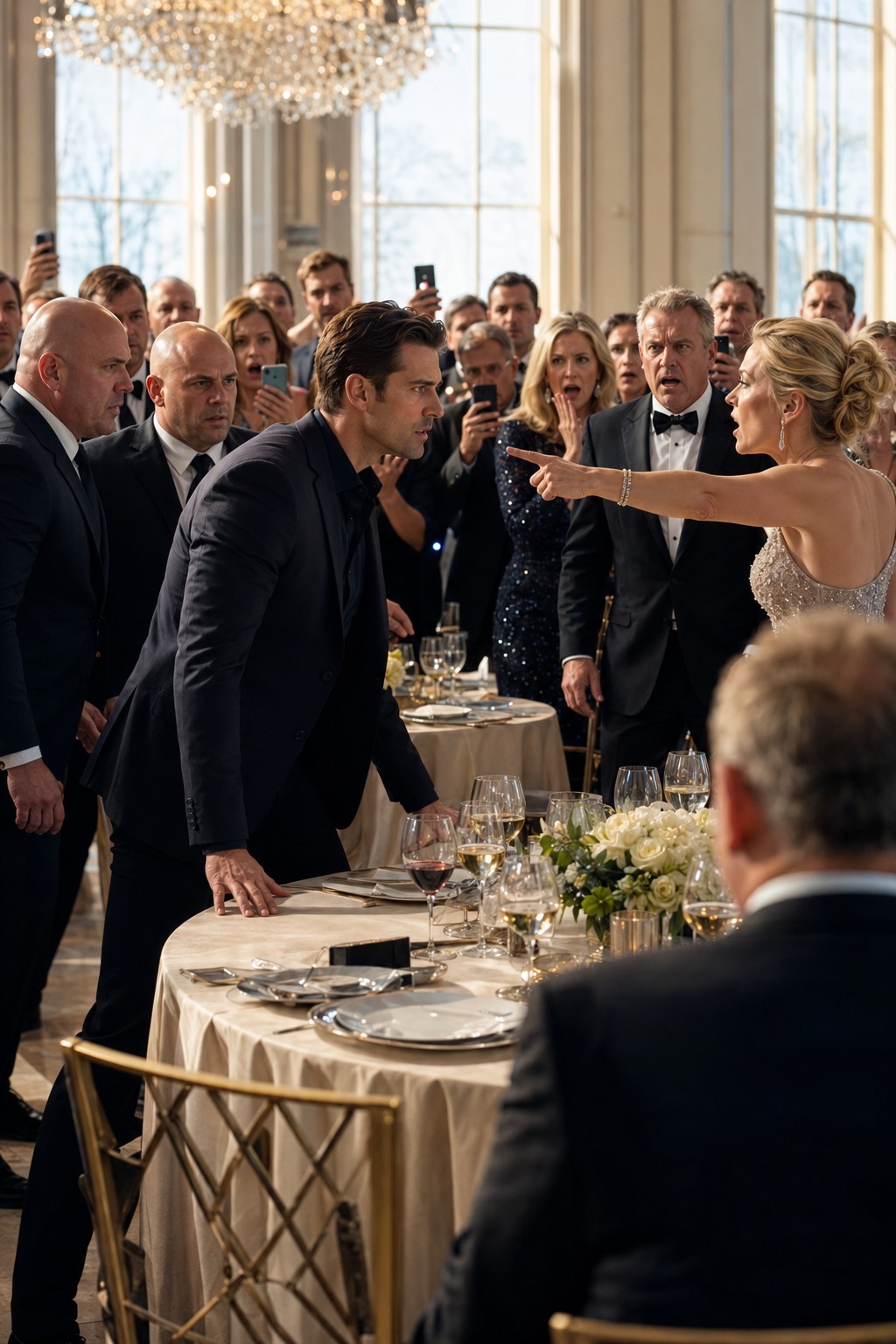
I Was Sitting At My VIP Seat. The CEO’s Wife Said, “This Table Is For Owners. Security, Remove Him.” Everyone Watched. Phones Were Recording. I Stood Up And Said, “You Just Made This Very Easy For Me.”
### Part 1
The ballroom at the Four Seasons in Chicago looked like it had been built for people who needed mirrors to remind them they mattered.
Every chandelier glittered like a frozen explosion. The white tablecloths fell in perfect lines. Waiters moved between the tables with trays of champagne held at shoulder height, their faces blank and polite, like they had practiced not noticing the conversations around them.
I noticed everything.
That was part of my job.
My name is Wade Sutton. I was fifty-four years old that Tuesday night in November, old enough to know that expensive rooms tell on people. They make the nervous talk louder. They make the powerful stand a little taller. They make the insecure reach for names, titles, watches, spouses, anything that proves they belong.
I arrived twenty-two minutes before the program was scheduled to begin. I had no entourage, no designer coat, no watch heavy enough to announce itself from across the room. Just a dark suit, a plain tie, and a black leather folder tucked under my arm.
At the check-in table, a young woman in a headset smiled without looking at me first.
“Name?”
“Wade Sutton.”
Her fingers moved over the tablet. The smile changed when my name appeared. Not warmer, exactly. Sharper.
“Of course, Mr. Sutton. Table three.”
She handed me a small cream-colored card with WS printed in neat black letters. No full name. No title. Just two initials that would have meant nothing to most of the people in that ballroom.
To me, they meant I was exactly where I was supposed to be.
Table three sat in the VIP section, close enough to the stage that I could see the tiny scratches on the microphone stand. A row of cameras had already been set up along the back wall for the investor livestream. One of them swept lazily across the front tables while a technician adjusted the feed.
I clocked the cameras automatically. Ceiling domes near the exits. Two security men by the double doors. One by the side corridor. A live audience, a digital audience, and enough documentation in the room to make memory unnecessary.
I placed my folder on the chair beside me and sat down.
The table smelled faintly of lilies and furniture polish. Someone had arranged the centerpiece too high, a tower of white flowers in a glass vase that made it difficult to see across the table. I moved my water glass two inches to the left and checked my phone.
Three messages from Celeste Navarro, managing partner at Aldercroft Capital.
No surprises tonight.
Listen more than you talk.
Call me if anything feels off.
I almost smiled at the last one. In my line of work, things rarely felt off all at once. They arrived as small scratches. A missed disclosure. A rushed certification. A CEO answering a simple question too quickly.
Or a room full of people who believed money had already forgiven them.
Vantage Aerospace had been negotiating with Aldercroft for eight months. Their executives had flown to New York. Our people had flown to Dallas, Phoenix, and twice to Chicago. The deal was enormous, even by private capital standards, but I had learned not to be impressed by zeros. Zeros were quiet. People were loud.
I was there to watch Vantage behave in public.
That was all.
At least, that was what most people thought.
A waiter stopped beside me. “Anything besides water, sir?”
“Water is fine.”
He poured carefully, and I watched the surface ripple against the rim.
Around me, the room filled with expensive laughter. Reed Callahan, Vantage’s CEO, had not arrived yet, but his name moved through the room ahead of him. People said it while leaning in. They said it with raised eyebrows. Reed had built Vantage from a regional aerospace contractor into a company big enough to make institutional investors clear their schedules.
His wife, Lydia Callahan, entered ten minutes later.
I recognized her from the company materials before anyone said her name. Silver-blond hair set in soft waves. Emerald earrings. A black dress that looked simple in the way only very expensive clothes can look simple. She crossed the ballroom like the room had been arranged around her path.
People shifted when she passed.
Not dramatically. Just enough.
She paused near the VIP tables, greeting two board members, then turned her head and looked straight at me.
Her smile disappeared so quickly I wondered if anyone else saw it.
First, she looked at my face.
Then my suit.
Then the empty chair beside me.
Then the place card.
WS.
Her eyes narrowed slightly, not in confusion, but correction. Like she had found a dirty glass on a clean table.
I looked back at my phone.
I had seen that look before. In boardrooms. In private clubs. At airport lounges where men in polo shirts asked if I was “with maintenance” because I carried my own bag.
Usually, I let it pass.
That night, I felt something small and cold settle behind my ribs.
Lydia turned to the event coordinator standing beside her. A thin woman in navy with a headset and a clipboard followed her gaze to me. Her name, if I remembered the prep file correctly, was Fiona Ashby.
Fiona’s expression tightened.
Lydia said something I could not hear.
Fiona hesitated.
That hesitation was the first clue that she knew enough to be careful.
Then Lydia said it again, and the hesitation vanished.
Fiona started toward me.
I placed my phone facedown beside the water glass and waited.
By the time she reached the table, the quartet had shifted into a bright, harmless piece of music. Violins floated above the hum of conversation. Cameras blinked red along the back wall.
Fiona leaned down with a practiced smile.
“Sir, I think there may be a seating issue.”
I looked at the place card in front of me.
“So do I,” I said quietly. “Someone seems to think there is one.”
Her smile twitched.
“This section is reserved.”
“Yes.”
“For VIP guests.”
I touched the edge of the card with one finger.
“WS,” I said. “That’s me.”
Fiona glanced over her shoulder.
Lydia Callahan was watching us now, chin slightly raised, one hand resting against the back of a chair that was not hers.
Fiona looked back at me, and her voice lowered.
“I understand, sir, but Mrs. Callahan believes this table has been assigned incorrectly.”
That was when the room changed.
Not visibly. Not yet.
But somewhere under the flowers, the music, the glassware, and the soft polite lies of a corporate gala, something had already cracked.
Then Lydia walked over herself.
She did not ask my name.
She did not ask for clarification.
She looked down at me like I had forced her to handle a problem beneath her station and said, “This table is for owners.”
Her eyes moved over my plain tie.
“Not support staff.”
For one second, nobody near us spoke.
And then Lydia lifted two fingers toward the side wall and said, “Security.”
The guard nearest the door turned his head.
I looked past Lydia and saw one other thing.
Brixton Callahan, Reed’s son and Vantage’s vice president of strategy, stood fifteen feet away with a champagne flute in his hand.
He knew me.
He saw me.
And he looked away.
That was when I understood this was no longer a misunderstanding.
It was a choice.
### Part 2
The security guard arrived faster than he should have.
That told me someone had already been watching me.
He was tall, maybe six-four, with an earpiece curled behind his right ear and the blank expression of a man trained to act first and apologize through someone else later. His tuxedo jacket pulled tight across his shoulders. He stopped beside my chair and placed one hand on the back of it, the other near my shoulder.
“Sir,” he said, “I’m going to need you to come with me.”
I looked up at him.
“No, you’re not.”
His face hardened by a degree.
Around us, conversation thinned. Not stopped, not yet. Wealthy people rarely admit they are watching drama until it becomes safe to call it concern. But heads turned. Forks paused. A woman at table five lowered her champagne glass without drinking.
Lydia’s expression remained calm.
That calm bothered me more than anger would have.
Angry people make mistakes because they are hot. Calm people make mistakes because they believe the world has already agreed with them.
Fiona stood behind Lydia, her clipboard pressed to her stomach. Her eyes flicked once toward the place card again. WS. Then away.
“Please don’t make this uncomfortable,” Fiona said.
I almost laughed.
Instead, I kept my voice low.
“You should verify the seating chart before this goes any further.”
Lydia gave a soft little exhale, almost a laugh, but not enough to be called one.
“We have verified enough.”
That sentence would come back later. In a boardroom. On a transcript. In a letter from a law firm that charged by the hour and rounded up.
The guard put both hands on me.
Not violently. That was the important part. Not enough for a bruise. Not enough for a criminal charge anyone would want to fight over. Just firm pressure on my shoulders, an attempt to lift me from my own chair with the quiet confidence of a man who believed he had been authorized.
The old version of me might have reacted.
I grew up in a neighborhood where letting someone put hands on you without answering made you look weak. My father worked loading docks on the South Side and taught me that respect was not something you begged for. You either carried it or you made people regret taking it.
But age changes the tools you reach for.
At twenty-five, I might have shoved the guard back.
At fifty-four, I knew the cameras were better than my hands.
So I did nothing.
I let the pressure register. I let the people around us see it. I let the room collect the facts.
Then I looked at Brixton.
He still stood near the aisle, his champagne untouched. He had been in three meetings with me. In one of them, he had laughed too loudly at his father’s joke about “paper people slowing down real builders.” In another, he had asked me whether Aldercroft’s authorization controls were “ceremonial at this stage.”
I had told him no.
He had smiled like I was being adorable.
Now his mother was having me removed from the VIP section, and he knew exactly what that meant.
I held his eyes for half a second.
He looked away again.
That was the moment I stopped giving Vantage Aerospace the benefit of the doubt.
The guard pulled.
My chair scraped the polished floor.
The sound cut through the quartet, ugly and sharp.
Several people turned fully now. A man at the next table whispered, “What’s going on?” Someone else raised a phone low against the table edge. Not openly, not bravely, but enough.
Lydia saw the phone and frowned.
That was her second mistake.
People like Lydia are used to rooms protecting them. They forget that phones have made every room a witness.
“Remove him discreetly,” she said.
The word discreetly landed in the air like perfume over smoke.
The guard shifted his grip.
Then a woman’s voice cracked across the VIP section.
“Get your hands off him right now.”
The guard froze.
Every head near us turned.
Paige Donovan came through the gap between tables with the kind of speed people use when they know they are already late. She was Vantage’s head of investor relations, early forties, dark hair pulled back, tablet in one hand, panic controlled so tightly it came out as fury.
Behind her came Nolan Graves, Vantage’s general counsel.
He was not running. Lawyers at his level rarely run. But he was moving at a pace just short of it, and his face had gone the color of old paper.
The guard released my shoulders.
I remained seated.
That mattered to me. I had not been removed. Not yet.
Paige stopped at the edge of table three. She looked first at me, then at the guard, then at Lydia.
“What are you doing?” she asked.
Lydia blinked once, surprised not by the question, but by the tone.
“There was a seating issue.”
“No,” Paige said. “There wasn’t.”
Fiona opened her mouth, then closed it.
Nolan had reached us now. His eyes moved from my place card to my folder to my face, and I saw recognition sharpen into dread.
“Mr. Sutton,” he said carefully.
That was when the people closest to us truly went quiet.
Not because they knew who I was.
Because Nolan did.
Paige turned slightly so her voice would carry. She was not shouting now. She did not need to.
“This is Wade Sutton.”
Lydia’s mouth tightened.
Paige continued, each word clean and deliberate.
“He is Aldercroft Capital’s authorized representative for the Vantage transaction.”
A murmur moved through the tables.
It started small, then widened.
I watched Lydia’s eyes change. Confusion first. Then irritation. Then something thinner.
Fear, maybe.
Not fear of me.
Fear of what she had touched without understanding it.
Paige was not done.
“The final capital authorization requires his signature.”
Nolan closed his eyes for the briefest second.
Paige looked directly at Lydia.
“If he says no, the money does not move.”
Somewhere behind us, the string quartet stopped playing.
The silence after it was enormous.
A red light blinked on the nearest camera.
And for the first time all night, Lydia Callahan looked at the place card in front of me as if the two little letters on it had teeth.
### Part 3
There are moments in life when a room understands something before the people inside it are ready to admit they understand.
That ballroom had one of those moments.
No one gasped. No one shouted. This was not that kind of crowd. These were investors, executives, spouses, advisers, people who knew how to hide shock behind careful posture. But the air changed. Shoulders stiffened. Phones rose higher. A waiter stopped with a tray of champagne halfway between tables and stared at nothing.
Lydia Callahan looked from Paige to Nolan, then back to me.
“I wasn’t aware,” she said.
It was not an apology.
It was the first brick in a defense.
I stood up slowly, not because I wanted drama, but because everyone was already watching, and I wanted the movement clean. My chair moved back half an inch. I buttoned my jacket. I picked up my folder.
The guard stepped away from me like my suit had caught fire.
Brixton was still near the aisle. His face had gone flat. He knew enough now not to look anywhere for too long.
I turned to Lydia.
“You just made this very easy for me.”
I did not raise my voice. I did not explain what this was. People with real exposure understand unfinished sentences. Lydia understood enough to go still.
Then I walked out.
The ballroom doors closed behind me with a soft hydraulic sigh, and the hallway swallowed the music, the whispers, the smell of lilies and champagne. Out there, everything was quieter. Cooler. A long window looked down over Michigan Avenue, where traffic moved in red and white lines through the November dark.
I stood by the window and let my breathing settle.
My phone buzzed before I could make the call.
Celeste Navarro.
I answered.
“Tell me,” she said.
That was one thing I respected about Celeste. She never wasted the first sentence.
I gave her the sequence without decoration. Arrival. Assigned seat. Place card. Lydia Callahan. Fiona Ashby. Security. Hands on shoulders. Brixton observing and failing to intervene. Paige identifying me. Nolan present. Cameras active. Livestream running.
Celeste did not interrupt once.
When I finished, she asked, “Was it documented?”
I looked down the hallway. A ceiling camera stared back from a smoked-glass dome.
“Yes.”
“Live?”
“Part of the event was being streamed.”
She was silent for two seconds.
In our business, two seconds can hold a lot.
“Do not speak to Vantage again until legal reviews everything,” she said. “No hallway conversations. No apology huddles. No handshake. Nothing off the record.”
“Understood.”
“I mean it, Wade.”
“I know.”
Her voice softened by half a degree. “Are you all right?”
That question surprised me more than the guard had.
I looked at my reflection in the dark glass. Gray at the temples. Tie still straight. Face calm. A man who had been touched in a way he did not permit and had chosen not to react because reaction would have been a gift.
“I’m fine,” I said.
“Good. I’ll call you back.”
She hung up.
Behind the ballroom doors, the volume rose suddenly, like someone had opened a valve. A ripple of voices. Then a man’s deeper tone cutting through. I did not need to see Reed Callahan enter to know he had arrived.
But the doors opened anyway.
Not fully. Just enough for a staff member to slip out, face pale, headset crooked. Through the gap, I saw Reed near the front of the room.
He was taller than he looked in photographs, broad-shouldered, silver hair combed back, tuxedo perfect. The kind of man who made eye contact as if it were a business strategy. He had probably expected applause when he entered.
Instead, he saw his wife standing rigid near table three, his event coordinator looking sick, his general counsel speaking rapidly in his ear, and half the VIP section pretending not to record the aftermath.
Reed’s eyes found mine through the open doorway.
Only for a second.
Then Nolan turned him away, and the door closed again.
I stayed in the hallway.
A few minutes later, Paige came out. She did not approach too closely. Smart. She stopped six feet away, hands folded around her tablet.
“Mr. Sutton,” she said, “I am deeply sorry.”
“I know.”
She swallowed.
“I should have gotten there sooner.”
“Yes.”
The honesty of that answer hurt her. I saw it. I did not soften it. Comfort was not my job.
“Reed would like to speak with you privately,” she said.
“I’m sure he would.”
“We can set up a room. Nolan will be present.”
“No conversation until my counsel clears it.”
She nodded as if she had expected that.
Then she glanced back at the ballroom doors. Her face shifted, just a little. Not fear exactly. Recognition.
“What happens now?” she asked.
That was the first honest question anyone from Vantage had asked me all night.
I looked toward the ballroom where people had mistaken manners for immunity.
“Now,” I said, “the agreement matters.”
Paige’s eyes lowered.
She knew which agreement.
She knew which section.
And she knew, before Reed Callahan had even finished hearing the story, that the night was already moving beyond apology.
### Part 4
They got their meeting forty-two minutes later.
Not because Reed wanted it. Not because Nolan requested it. Because Celeste called me back after Aldercroft legal had pulled the livestream archive and confirmed enough of the sequence to allow a controlled conversation.
“Listen,” she said. “Do not negotiate. Do not comfort. Do not accept language. If they say misunderstanding, ask them what fact they misunderstood.”
That was Celeste at her best. Surgical.
The hotel put us in an executive lounge two floors below the ballroom. It had low leather chairs, a round table, smoked glass walls, and the faint smell of burnt coffee. Someone had turned off the overhead lights and left only two brass lamps glowing near the corners. The city glittered outside the windows like it had no stake in anything.
Reed sat across from me.
Nolan sat to his right.
Spencer Hartwell, Vantage’s CFO, sat to his left, his bow tie loosened and his face damp at the hairline.
Paige stood near the wall with her tablet, quiet.
Lydia was not in the room.
That was the first smart choice they had made.
Reed folded his hands on the table.
“Wade,” he began.
“Mr. Sutton,” Celeste said from my phone, which lay faceup on the table between us.
Reed paused.
I had put her on speaker with everyone’s knowledge. Aldercroft counsel was on the line too, silent but present. The room had become smaller the moment they realized no sentence would stay local.
“Mr. Sutton,” Reed corrected. “What happened upstairs was an unfortunate misunderstanding.”
I leaned back.
“What fact was misunderstood?”
His jaw tightened slightly.
“Nobody intended disrespect.”
“That is not a fact. That is a claim about intent.”
Nolan looked down at his notes.
Spencer’s eyes stayed fixed on the table.
Reed inhaled through his nose. He was adjusting now, recalibrating from charm to containment.
“My wife did not recognize you.”
“No one asked her to recognize me.”
“She believed there had been a seating error.”
“There was a place card in front of me.”
“Event staff should have handled it differently.”
“Event staff acted after your wife instructed them.”
The room went quiet.
Reed looked at Nolan.
Nolan did not save him.
That told me a lot.
I opened my folder for the first time that night. The sound of the zipper seemed louder than it should have. I removed the investment agreement, tabbed and marked. Page thirty-one. Section fourteen.
Conduct integrity.
Most people think billion-dollar deals turn on valuation, leverage, debt coverage, earnings projections. Sometimes they do. But the clauses people skim are often the ones written in blood from older disasters.
I read the relevant language aloud.
Documented conduct by senior leadership, executive representatives, affiliated parties, or agents acting under apparent authority, during the negotiation and pre-close period, that materially damages the reputation, viability, or governance confidence of the transaction, grants Aldercroft Capital the immediate right to suspend or withdraw capital commitment at its sole discretion.
I looked up.
“No requirement to prove intent,” I said. “No cure period once documentation exists. No obligation to issue a joint statement. No requirement that the conduct occur in a boardroom.”
Spencer reached for his copy of the agreement with hands that were not quite steady. He flipped pages too quickly, missed the tab, went back, found it.
His face changed when he read it.
That was the moment the CFO understood the money was not late.
It was endangered.
Nolan spoke quietly.
“The clause says what he says it says.”
Reed’s eyes flashed toward him.
Nolan held his ground. Lawyers who survive at that level know when denial becomes malpractice.
Reed turned back to me.
“We can repair this.”
“No.”
“You haven’t heard the proposal.”
“I don’t need to.”
His control thinned for the first time.
“This is a two-point-nine-billion-dollar commitment.”
“Yes.”
“You would pull that over a seating mistake?”
There it was.
Not an apology. Not accountability. A reduction.
I closed the agreement.
“No,” I said. “I would pull it over documented governance conduct demonstrating that senior-affiliated representatives can direct company agents to remove an authorized capital representative from an assigned VIP seat during a live investor event while an executive who knows that representative watches and remains silent.”
Spencer looked like someone had opened a trapdoor beneath his chair.
Reed said nothing.
I let the silence sit until it became uncomfortable.
Then I added, “The seating mistake was yours. The governance problem is mine.”
Celeste spoke from the phone.
“Aldercroft will review the documentation tonight. Until then, Vantage should preserve all recordings, staff communications, seating records, security logs, livestream archives, and internal messages relating to the incident.”
Nolan nodded once.
“We’ll issue a preservation notice immediately.”
Reed stared at me.
He wanted to say something personal. I could see it. Men like Reed often believed every locked door had a private handle if they could just get close enough to the person holding it.
But I was not there as a person he could persuade.
I was there as a control.
I stood.
The meeting was over.
At the door, Reed finally said, “Mr. Sutton.”
I stopped but did not turn.
“What would you do in my position?”
I looked back then.
“I would have read the room before I let my wife run it.”
His face went still.
I left the lounge and walked toward the elevators.
As the doors opened, I saw Lydia Callahan reflected in the brass trim near the opposite hallway. She had been standing just out of sight.
Her lips moved, barely audible.
“Who is he really?”
The elevator doors closed before anyone answered.
### Part 5
I did not sleep right away.
That surprises people when I tell the story. They assume I went upstairs satisfied, took off my tie, and rested like a man who had just won. That is not how it felt.
It felt like weather.
Something had formed miles away, moved across pressure systems I did not control, and finally broken over a room full of flowers and white tablecloths. I had been under it, yes. But I had not made the storm.
In my hotel room, I placed the folder on the desk, took off my jacket, and stood for a while in the quiet. The carpet was soft under my shoes. The city lights blinked through the curtains. Somewhere below, a siren moved east and faded.
My phone stayed faceup beside the lamp.
At 10:38, Celeste texted.
Legal has ballroom feed. Reviewing now.
At 10:51.
Security angle confirms contact.
At 11:06.
Audio partial. Enough.
At 11:29.
Third-party phone footage circulating already.
I sat on the edge of the bed and rubbed one hand over my face.
That was the part Vantage could not control. The footage no longer lived only in hotel systems and livestream archives. It was already in pockets, messages, private investor chats, the places where reputations go before they become headlines.
At 11:47, Celeste called.
Her voice was calm, which told me the decision had moved past emotion.
“Section fourteen is triggered unambiguously.”
I looked at the dark window.
“All angles?”
“Enough. Ceiling camera shows the approach, the place card, Callahan’s wife signaling security. Livestream captures Paige identifying you. Phone footage has the guard’s hands on your shoulders. Security log confirms response to Mrs. Callahan’s instruction through event staff.”
“Brixton?”
“Visible.”
I closed my eyes for a second.
He had not touched me. He had not spoken. But silence can be conduct when a person has a duty to correct the room.
Celeste continued.
“We are drafting the withdrawal notice tonight. It will go out at market open unless something material changes before then.”
“Nothing will.”
“No,” she said. “I don’t believe it will.”
There was a pause.
Then she said, “You handled it correctly.”
I did not answer right away.
Correctly is a strange word. It sounds clean. It does not include the feel of a stranger’s hands pressing into your shoulders. It does not include the old heat that rises in your chest when someone decides you are removable. It does not include the discipline it takes to sit still because the record matters more than the moment.
“Thank you,” I said.
“Get some sleep.”
After we hung up, I loosened my tie and thought about my father.
He had died nine years earlier, still believing rich men made different mistakes than poor men. I used to believe that too. Then I spent enough time around both to learn the truth.
Money does not change character.
It only gives character better lighting.
My father would have hated that ballroom. He would have hated the lilies, the cameras, the way people laughed with their teeth but not their eyes. He would also have hated that I let a man put hands on me.
But if he had lived long enough to see the kind of leverage a signature could hold, maybe he would have understood.
Maybe.
I slept for four hours.
At 6:12 a.m., I woke before the alarm. The room was blue with early light. My shirt from the night before hung over the chair. My phone had fifteen missed notifications, none from people I needed to answer.
At 7:42 a.m., the letter went out.
Two paragraphs. Formal. Dry. Devastating.
Aldercroft Capital hereby withdraws its capital commitment to the proposed Vantage Aerospace transaction, effective immediately, pursuant to Section 14 of the Investment Agreement.
No adjectives.
No outrage.
No mention of Lydia Callahan’s dress, Fiona Ashby’s clipboard, Brixton’s champagne flute, or the guard’s hands.
Contracts do not need poetry to end things.
By 8:03, Reed called.
I watched his name appear on my phone.
Then disappear.
No voicemail.
At 8:19, Spencer Hartwell called.
At 8:26, Nolan Graves.
At 8:31, Paige Donovan sent a message.
I am sorry again. I know you likely cannot respond. For what it is worth, I am preserving everything.
That one I read twice.
Then I put the phone facedown and ordered coffee.
The hotel delivered it in a silver pot with a tiny white cup and a folded napkin. The coffee tasted burnt, but I drank it anyway. Downstairs, men and women were probably gathering in conference rooms, speaking in controlled voices, pretending they were not afraid.
By 9:00 a.m., the first external call hit Aldercroft’s switchboard.
By 9:17, one of the co-investors asked whether our withdrawal affected their tranche.
By 9:44, a partner bank requested clarification on “governance concerns.”
That phrase had not been public yet.
Which meant it was already spreading privately.
At 10:15, Reed called again.
This time, he left a voicemail.
I did not listen to it.
I already knew what it would contain.
Regret shaped like strategy.
### Part 6
By noon, Vantage Aerospace was no longer managing an incident.
It was managing a market reaction.
That is a different animal. Incidents can be contained with statements, apologies, internal reviews, sometimes a sacrifice or two. Market reactions are colder. They do not care if your wife feels embarrassed or if your son panicked or if your event coordinator misunderstood the social hierarchy of table assignments.
Markets ask only one question.
What else is wrong?
Vantage’s stock opened soft, dipped harder by midmorning, then slid in ugly little steps that made analysts refresh their screens and pretend they were not enjoying the drama. The first financial headline appeared at 11:38.
Major Investor Withdraws $2.9 Billion Commitment From Vantage Aerospace Amid Governance Concerns.
Governance concerns.
Two words with a clean shirt and a knife in the pocket.
Nobody outside the deal needed to know Lydia’s name for the phrase to do damage. Governance concerns meant adult supervision had failed somewhere. It meant due diligence teams would reopen files. It meant credit committees would ask for updated memos. It meant every friendly assumption around Vantage had just become a question.
Inside Aldercroft, the mood was not celebratory.
That is another thing people misunderstand. We did not gather around screens and laugh while Vantage bled value. We had other deals, other calls, other problems. Large funds are not revenge machines. They are risk machines. Risk enters, risk is measured, risk is removed if necessary.
By 1:00 p.m., I was back in New York at our office, sitting in a glass conference room with Celeste and two lawyers.
A transcript of the livestream sat on the table.
Still images from hotel security were clipped to the back.
One frame showed Lydia’s hand lifted toward security.
One showed Fiona leaning over me.
One showed the guard’s hands on my shoulders.
One showed Brixton in the background, head turned toward us, face clear enough that no one could argue he had not seen.
Celeste tapped that image once.
“He’s a problem.”
“Yes.”
“He knew you.”
“Yes.”
“Would you testify to that if needed?”
“I would state it.”
She nodded.
Careful language mattered.
By late afternoon, Vantage’s board announced an internal review. They did not mention me by name. They did not mention Lydia. They said the board had become aware of “a concern arising from conduct at an investor event” and would assess “process failures and governance implications.”
I read the statement while standing near the office kitchen, holding coffee I did not want.
One of our junior analysts, a twenty-seven-year-old named Marcus, came in, saw the statement on my phone, and froze.
“Sorry,” he said. “Didn’t mean to—”
“It’s public.”
He hesitated. “Is it true?”
“Which part?”
“That they had you removed from your own table?”
I looked at him.
He was trying not to sound too interested. Failing.
“Yes.”
Marcus stared.
“Why didn’t you just tell them who you were?”
That question followed me all week.
I could have answered it five ways.
Because I did.
Because the place card did.
Because their own executives knew.
Because people reveal more when they think you have no power.
Instead, I said, “It was not my job to teach them their guest list.”
He nodded slowly, like he was filing that away somewhere important.
Two days later, the board review began.
I was not in the room when Brixton Callahan sat before the panel, but I heard enough later to picture it. A long table. Printed timelines. Lawyers on both sides. Bottled water untouched. The kind of room where silence does more work than questions.
They asked him whether he had attended three meetings with me.
Yes.
They asked whether he knew my role in the Aldercroft transaction.
Yes.
They asked whether he saw me seated at table three.
Yes.
They asked whether he saw his mother approach me.
Yes.
They asked whether he saw security place hands on me.
He paused there.
That pause was its own answer.
Then came the question that mattered.
“Did you take any action to identify Mr. Sutton to Mrs. Callahan, event staff, or security before escalation occurred?”
There was no good response.
If he said no, he admitted failure.
If he said he was unsure, the footage corrected him.
If he blamed confusion, the meeting records corrected him.
By then, Brixton was not protecting Vantage.
He was protecting himself from a room full of people who could count seconds.
Paige gave her statement the same day. She said she saw the exchange developing, moved as quickly as she could, and intervened when she realized security was acting. She did not flatter herself. She did not hide the thirty seconds she waited. That made her the rarest person in the review.
Useful.
Fiona Ashby’s statement was more complicated.
She claimed Lydia had “expressed concern” about an unidentified attendee in the VIP section. She claimed she approached politely. She claimed security was called only after I “declined to cooperate.”
Then the hotel audio came in.
Partial, but enough.
This table is for owners. Not support staff.
Security.
After that, Fiona’s statement became less useful.
By Friday afternoon, Reed Callahan had contacted two other institutional funds.
By Monday, he had contacted four.
By Wednesday, Celeste walked into my office, closed the door, and said, “They’re shopping the gap.”
“I assumed they would.”
“You haven’t heard from anyone?”
“One email.”
She looked at me.
I turned my monitor slightly and showed her the message from a former colleague at Westbridge Capital.
Heard about Aldercroft’s withdrawal. Leadership here may take a meeting with Vantage. Anything I should know?
My reply sat beneath it.
I would review their governance record carefully before signing anything.
Celeste read it, then smiled without warmth.
“Efficient.”
“Accurate.”
“Very.”
She left.
An hour later, Westbridge passed on the meeting.
By the end of the week, so had the others.
And somewhere in Chicago, Reed Callahan learned that a door closes differently when nobody has to slam it.
### Part 7
The first time Reed tried to reach me outside official channels, he used a number I did not recognize.
That told me he was getting desperate.
It was a Thursday evening, nine days after the gala. I was in my apartment, standing at the kitchen counter, cutting a lemon into uneven wedges for tea. Rain tapped softly against the window over the sink. My place was quiet in the way New York apartments get quiet only when the weather bullies the city into slowing down.
The phone buzzed.
Unknown caller.
I let it ring.
Then a text appeared.
Mr. Sutton, this is Reed Callahan. I would appreciate ten minutes. No lawyers. Man to man.
I looked at the message for a long moment.
Man to man.
That phrase has always amused me. Men use it when they want to move a problem out of the room where records exist and into the room where pressure can pretend to be sincerity.
I forwarded the message to Celeste and Aldercroft counsel.
Then I made my tea.
Five minutes later, Celeste replied.
Absolutely not.
Aldercroft counsel replied with more words and the same meaning.
I did not answer Reed.
The next morning, Vantage issued a second statement. This one was worse than the first because it tried to sound human.
Vantage Aerospace values every investor partner and regrets any confusion arising from a seating protocol matter at our annual investor event. We are conducting a thorough review and remain confident in our leadership, mission, and long-term capital strategy.
Seating protocol matter.
I read that phrase twice.
Then I laughed once, alone in my office, because sometimes language becomes so cowardly it circles back into comedy.
That afternoon, Paige Donovan called my office line.
That meant she wanted the call logged.
I respected that.
“Mr. Sutton,” she said, “I need to make you aware of something.”
Her voice sounded tired.
“Go ahead.”
“A draft statement is circulating internally. It has not been released.”
“Why are you telling me?”
“Because your name isn’t in it, but the description refers to you.”
I waited.
She took a breath.
“It characterizes the incident as involving an unidentified attendee who declined multiple polite requests to verify credentials before security assistance was sought.”
There are kinds of silence that are empty and kinds that are full.
The silence after Paige said that was full.
“Who drafted it?” I asked.
“Corporate communications initiated it. Legal has not approved it.”
“That does not answer my question.”
Another pause.
“Mrs. Callahan provided comments.”
Of course she had.
People like Lydia rarely stop at the first mistake. They try to edit reality afterward.
“Send it to Nolan,” I said. “Tell him Aldercroft expects preservation of all drafts and comments.”
“I already did.”
That surprised me.
Paige continued, “I also informed the independent board committee.”
Useful, again.
“Thank you,” I said.
Her voice lowered. “I know it doesn’t undo anything.”
“No. It doesn’t.”
“I understand.”
After we hung up, I sat still for a minute and listened to the soft hum of the office HVAC. Through the glass wall, I could see analysts moving between desks, carrying laptops and coffee cups, living in the ordinary rhythm of a day that did not know it had just acquired another layer.
I had not been angry at the gala.
Now I was close.
Not because Lydia had misjudged me. Not because she had called security. Those were facts already processed.
It was the attempted rewrite that bothered me.
The need to turn a documented choice into a vague procedural fog. The instinct to make the person removed from the chair responsible for the hands placed on his shoulders.
That instinct was not embarrassment.
It was character.
I called Celeste.
She answered on the first ring.
“I assume you heard.”
“Yes,” she said. “Paige copied Nolan, Nolan copied the committee, the committee copied outside counsel, and outside counsel just sent us a preservation addendum.”
“Fast.”
“Fear improves response time.”
I looked out at the skyline.
“Does this change anything?”
“It confirms we were right.”
That was all.
But confirmation has weight.
The board committee requested a formal interview with me the following week. Aldercroft agreed under strict conditions. Recorded, counsel present, scope limited to factual sequence and transaction impact.
When I told my sister about it that weekend, she went quiet.
My sister, Denise, teaches fourth grade in Milwaukee and has no patience for corporate language. She heard the whole story while making dinner for her kids, the phone tucked somewhere near her shoulder. I could hear pans clattering, a dog barking, a child asking where his red folder was.
“So this woman had security grab you,” Denise said, “and now she’s trying to say you caused it?”
“That is the shape of it.”
“She sounds awful.”
“She is consistent.”
Denise snorted.
“Are you okay?”
There it was again.
The question people asked after the facts because they knew facts were not the whole thing.
“I’m okay.”
“Wade.”
“I am.”
She let the silence stretch the way only siblings can.
Then she said, “You know Dad would’ve wanted you to knock that guard on his ass.”
“I know.”
“But Mom would’ve told you to own the building instead.”
I smiled then.
Our mother had been five-foot-two and terrifying in church shoes.
“She would have,” I said.
“So do that.”
The line clicked with household noise.
A child yelled. Denise yelled back.
Then she returned to the phone and said, “Not literally. I know how you people get.”
“I understood.”
But after we hung up, I kept thinking about what she had said.
Own the building.
Not the hotel. Not Vantage. Not Reed Callahan’s pride.
The record.
That was the building.
And Lydia Callahan had just walked back inside carrying matches.
### Part 8
The board interview took place in a law office that looked designed to remove emotion from the human body.
Gray carpet. Frosted glass. A conference table long enough to make everyone seem farther away than they were. Pitchers of water placed at mathematically even intervals. No flowers. No music. No spouses.
I arrived with Aldercroft counsel at 9:00 a.m.
The independent committee had three members present: Marjorie Hale, a former banking regulator with silver hair and eyes that missed nothing; Dennis Cho, a retired manufacturing executive; and Alan Brewer, who had the soft hands and cautious voice of a man who had spent most of his life asking questions someone else wrote.
Outside counsel sat beside them.
A court reporter sat near the wall.
Two cameras recorded.
Good.
Marjorie Hale began.
“Mr. Sutton, we appreciate your cooperation.”
“I’m here to provide facts.”
“Understood.”
They walked me through the evening minute by minute.
Arrival time. Check-in. Place card. Seating. First contact with Fiona Ashby. Lydia Callahan’s words. Security response. Physical contact. Paige Donovan’s intervention. Nolan Graves’s presence. Brixton Callahan’s line of sight.
I answered cleanly.
No adjectives unless asked.
No speculation unless labeled as such.
When Marjorie asked, “How would you characterize Mrs. Callahan’s tone?” I said, “Controlled.”
When Dennis asked, “Did she appear confused?” I said, “No.”
When Alan asked, “Did you refuse to identify yourself?” I said, “I identified the place card as mine. No one asked for government identification, a business card, or transaction credentials before security was called.”
Outside counsel made notes.
Then Marjorie asked the question I knew was coming.
“Was Aldercroft’s withdrawal caused solely by this incident?”
Aldercroft counsel shifted beside me.
I answered before he needed to object.
“The withdrawal was made pursuant to Section 14. The incident was the documented trigger. Aldercroft had already noted governance concerns during diligence, including executive overreach, informal decision pathways, and inconsistent internal controls around transaction communications.”
That landed.
Marjorie’s pen stopped moving.
“Can you elaborate?”
“Not beyond the scope agreed today.”
She looked at our counsel, then back at me.
“Understood.”
But she had heard enough to know the gala had not created the crack. It had revealed it.
That was an important distinction.
Near the end of the interview, they played the footage.
I had seen still frames. I had read transcripts. But I had not watched the full sequence since that night.
There I was, seated at table three, water glass near my right hand. Fiona leaning down. Lydia approaching. Her mouth forming the words. The guard arriving. His hands pressing onto my shoulders. My chair scraping back.
Then Paige moving fast.
Then Brixton in the background, turning away.
The room stayed silent after the video ended.
No one rushed to speak. Even lawyers understand that some evidence needs a moment to breathe.
Marjorie finally said, “Thank you, Mr. Sutton.”
I stood.
At the door, she stopped me.
“One last question, outside the formal sequence.”
Aldercroft counsel stiffened.
I waited.
Marjorie said, “If Vantage were to make leadership changes and request reconsideration, would Aldercroft reopen the transaction?”
There it was.
The window Reed had been trying to find.
I looked at her.
“No.”
Her face did not move.
“May I ask why?”
“Because reconsideration would teach the wrong lesson.”
Dennis Cho leaned back slightly.
I continued.
“A clause like Section 14 exists so that conduct has consequences before capital moves, not after. If documented governance failure can be cured by embarrassment and a new statement, then the clause is decoration. Aldercroft does not write decorative controls.”
Marjorie nodded once.
Not approval. Recognition.
Outside the conference room, our counsel exhaled.
“That was clear.”
“It needed to be.”
We were waiting for the elevator when the doors at the end of the hallway opened and Reed Callahan stepped out.
He was not supposed to be there.
Or maybe he was, and no one had told me.
He wore a navy suit and no tie. His face looked thinner than it had at the gala, as if nine days had taken more from him than sleep. Nolan Graves walked beside him, saw me, and stopped.
Reed did not.
He came straight toward me.
Aldercroft counsel moved half a step forward.
Reed lifted both hands slightly.
“No ambush. I know better.”
I said nothing.
He looked at me with something close to exhaustion.
“I read your interview prep,” he said.
“Then you know I have nothing to add.”
“I know what my wife did was unacceptable.”
That sentence was new.
Too late, but new.
“And Brixton?” I asked.
Reed’s face tightened.
“My son made a mistake.”
“No. He made a calculation.”
That hit harder than I expected it to. Reed looked away for the first time.
The elevator doors opened behind me.
Before I stepped in, Reed said, “What do you want?”
I turned back.
There was a time when that question might have tempted me. Not because I wanted money. Because I wanted people like Reed to understand the insult beneath the transaction language. I wanted him to understand that his wife had not just made an error in seating. She had looked at a man and decided he was disposable.
But men like Reed often turn understanding into negotiation.
So I gave him nothing to buy.
“I want nothing from you.”
The elevator doors began to close.
Reed’s voice came through the narrowing gap.
“Then why does it feel like you’re taking everything?”
The doors shut before I answered.
Good.
Some questions punish the person who has to keep asking them.
### Part 9
Brixton resigned on a Friday.
There was no dramatic announcement. No heartfelt LinkedIn post about pursuing new opportunities. No quote from Reed praising his son’s strategic vision. On Monday morning, Brixton Callahan was listed on Vantage Aerospace’s leadership page as vice president of strategy. By Friday afternoon, his photo was gone.
The internet notices everything eventually.
By 3:00 p.m., people in finance chats were sending screenshots.
By 4:30, an aerospace reporter posted that Vantage had “quietly updated its executive page amid an ongoing governance review.”
By 6:00, someone had paired that update with a blurry clip from the gala showing Brixton turning away.
That clip did more damage than a statement would have.
It was only three seconds long. But it told a complete story.
A man sees a problem he helped create.
A man recognizes the person being mistreated.
A man protects his comfort instead of the company.
Three seconds can be expensive.
I watched the clip once, then closed it.
I did not enjoy it.
That disappointed some part of me I did not like admitting existed. A younger, meaner part maybe. The part that remembered every room where someone had assumed I was there to carry luggage, check coats, fix a projector, explain myself. That part wanted satisfaction.
But the feeling did not arrive.
What arrived instead was a kind of tired confirmation.
People are who they are when correction costs them something.
Brixton had been ambitious, polished, and careless in the way sons of founders often are. He knew the company’s story but not its weight. He had inherited access and mistaken it for judgment. At the gala, he had not failed because he lacked information.
He failed because he had information and chose not to spend it.
The board understood that.
So did the market.
Fiona Ashby disappeared more quietly. Her firm removed Vantage from its public client list within two weeks. I heard from Paige that Fiona had claimed she was pressured by Lydia, then claimed she had misunderstood the seating software, then claimed the security team escalated independently.
The problem with changing stories is that each new version makes the previous one evidence.
Lydia, meanwhile, did not disappear.
Women like Lydia rarely do. They retreat to rooms where people still agree with them, then send other people out to test whether the world has softened.
Her first attempt came through charity circles.
I heard about it from a board member’s assistant who used to work at Aldercroft and still had friends in our office. Lydia had apparently described the incident at a private luncheon as “a humiliating overreaction by a fund employee who wanted attention.”
Fund employee.
That phrase traveled badly.
By then, too many people had seen the footage. More importantly, too many people understood the transaction. Calling me a fund employee did not make me smaller. It made her look like she still had not learned what room she was in.
Her second attempt was the draft statement Paige had warned me about.
That one never went public.
The independent board committee killed it, then included the draft in its internal findings as evidence of post-incident reputational mismanagement. Lydia’s comments in the margin became their own little disaster.
Too defensive.
Do not name him.
Emphasize failure to cooperate.
Remove “VIP.”
Avoid mention of physical contact.
I read those comments later in a legal packet and sat with them for a long time.
Avoid mention of physical contact.
That was the sentence that stayed.
Not because it was clever. Because it was small.
After everything, she still thought the problem was wording.
Reed lasted longer.
Founders usually do. Companies wrap themselves around founders like vines around old brick. Even when the brick cracks, people fear what happens if they pull too hard.
But Reed’s calls stopped. His unofficial messages stopped. His allies went quiet. The four funds he approached all declined. A fifth did not even take the meeting.
By the end of the month, Vantage announced a “governance refresh.”
That is corporate language for adults have entered the house.
They added two independent directors. They separated the chair and CEO roles. They created a formal transaction oversight committee. They restricted family participation in investor-facing events. They issued updated protocols for guest verification, security escalation, and executive conduct.
All of it was reasonable.
All of it was late.
Paige sent me no message when the announcement came out. She did not need to. I knew her fingerprints were on parts of it. The language had her restraint. Clean. Specific. No apology theater.
Aldercroft had already moved the capital elsewhere.
That part never made a headline, but it mattered more than the noise. Money does not sit still out of sentiment. The allocation committee redirected the $2.9 billion commitment into a different industrial platform with less glamour, better controls, and a CEO who introduced his receptionist by name when we visited.
I liked that CEO.
Not because he was humble. Humility can be performed.
I liked him because when a junior engineer corrected him in a plant walkthrough, he stopped, listened, and said, “You’re right. I missed that.”
People reveal themselves in small corrections.
One afternoon in December, almost six weeks after the gala, I found an envelope on my desk.
No return address.
Inside was a handwritten note on thick cream paper.
Mr. Sutton, I regret the discomfort caused at the Vantage event. The evening escalated in ways no one intended. I hope in time you will understand the pressure we were all under.
No signature.
But I knew the handwriting from the margin comments.
Lydia.
I read it once.
Then I placed it in the legal file.
Not because it deserved a response.
Because even a bad apology is documentation.
### Part 10
I saw Paige again in Atlanta.
It was a private markets conference held in a hotel that smelled like lemon polish and overheated carpet. The name badges were too large, the coffee was too weak, and every conversation began with someone pretending they were not there to raise money.
I was on a panel about capital controls at 10:00 a.m. Paige was on one after lunch about investor communications during disruption.
Disruption.
Another clean word that can cover almost anything if you let it.
I watched her panel from the back of the room. She looked composed, navy blazer, no jewelry except small gold hoops, hands folded when she was not speaking. Someone asked how companies should respond when a reputational issue emerges during a transaction period.
A few people glanced at her.
She did not flinch.
“Quickly,” she said. “Accurately. Without minimizing the facts.”
That was it.
No story. No self-defense. No corporate fog.
Afterward, I found her near a hallway table where hotel staff had set out cookies that tasted like sweet cardboard.
“Good answer,” I said.
She turned, saw me, and something like relief crossed her face.
“Mr. Sutton.”
“Wade is fine.”
She took that in carefully, as if the permission mattered.
“Thank you.”
We walked toward a quieter corner near a window overlooking the hotel driveway. Outside, rideshare cars pulled up in a steady line. People got out holding garment bags and laptop cases, each one entering the building with the private hope that the right conversation would change their year.
Paige held a paper cup of coffee with both hands.
“I left Vantage,” she said.
That surprised me.
“When?”
“Two weeks ago.”
“Voluntarily?”
“Yes.”
I believed her.
“Where are you going?”
“Not sure yet. Consulting for a while, maybe. I had offers, but I need to breathe.”
The word breathe carried more than she meant it to.
“I’m sorry,” she said.
“You already said that.”
“I know. I still am.”
I looked out at the cars.
She continued, “I saw it starting. Fiona approached you, and I knew something was wrong, but I thought it would resolve in ten seconds. Then Mrs. Callahan came over, and I thought Nolan would see it. Then security moved, and I was already walking, but…”
She stopped.
“Thirty seconds,” I said.
Her eyes closed briefly.
“Yes.”
“Paige, by the time you got there, the record existed.”
“That doesn’t make me feel better.”
“I didn’t think it would.”
She laughed once, softly, without humor.
“I keep thinking about how many things go wrong because people wait for one more sign.”
That was true enough that neither of us spoke for a moment.
Then she said, “Can I ask you something?”
“Yes.”
“Did you know before that night? That you would pull the commitment if something happened?”
I considered lying politely.
Instead, I said, “I knew Vantage was fragile.”
Her face changed.
“Governance?”
“Yes.”
“Reed always thought charisma could outrun process.”
“That is common.”
“Lydia thought process was for people who needed permission.”
“That is also common.”
Paige looked down at her coffee.
“Brixton thought everything was a rehearsal.”
I smiled faintly.
“That one may be less common, but not rare.”
She shook her head.
“I should have left earlier.”
“Maybe.”
“You don’t soften things, do you?”
“Not when softness makes them less true.”
For the first time, she smiled like she meant it.
A man from a pension fund recognized her and began walking over. Our conversation was ending.
Before he reached us, Paige said, “For what it’s worth, I’m glad the clause existed.”
“So am I.”
“And I’m glad you used it.”
I looked at her then.
That was the closest anyone from Vantage had come to saying the quiet part out loud.
Not that they were sorry they got caught.
Not that they wished the optics were better.
That the consequence was deserved.
The pension fund man arrived, all handshake and conference energy. Paige shifted smoothly into professional mode. I stepped away.
That evening, back in my hotel room, I checked the industry news.
Vantage had postponed its quarterly investor day.
Reed would remain CEO, but an independent chair had been appointed above him. Lydia Callahan would no longer participate in investor events or foundation-related corporate appearances. The governance committee’s findings would not be released publicly, but “remedial actions” were underway.
Brixton’s name was still gone.
I set the phone down.
Outside my window, planes moved in slow lines above the Atlanta skyline.
Aerospace companies talk a lot about lift. Thrust. Drag. Failure points. The forces that decide whether a machine rises or falls.
Vantage had understood all of that in metal.
They had ignored it in people.
### Part 11
In January, Reed made one last attempt.
This time, he did it properly.
A formal letter arrived through counsel, addressed to Aldercroft Capital, requesting a meeting to discuss whether the withdrawn commitment could be reconsidered in light of governance reforms implemented by Vantage Aerospace.
It was three pages long. Careful. Respectful. Expensive.
It listed every change the board had made. Independent chair. Oversight committee. Revised event protocols. Mandatory executive conduct training. Restrictions on family involvement. Updated security procedures. Enhanced transaction controls.
No mention of Lydia by name.
No mention of Brixton by name.
No mention of the guard’s hands.
The letter ended with a sentence that sounded like Reed and not his lawyers.
We believe the long-term value of the transaction should not be permanently impaired by a single regrettable evening.
I read that sentence twice.
Then I walked it down to Celeste’s office.
She was eating almonds from a paper cup and reviewing a term sheet. Her office always looked like a controlled storm, stacks of documents arranged in a system only she understood. She read the letter without expression.
When she finished, she said, “No.”
I nodded.
“But we should respond formally.”
“Of course.”
She leaned back.
“Do you want input?”
“No.”
She studied me.
“You sure?”
“Yes.”
“Wade.”
I knew that tone. It meant she was about to be managing partner and friend at the same time.
“You were the one they put hands on. If you want a sentence in the response, take it.”
I stood by the window and looked down at the street. Snow had turned gray along the curb. People moved through slush with their heads bent, collars up, each one carrying some private burden no one else could see.
Did I want a sentence?
There were many I could have written.
Your wife humiliated herself.
Your son failed you.
Your company mistook access for entitlement.
You are sorry only because the cost finally reached you.
All true enough.
All useless.
“No,” I said. “The agreement already spoke.”
Celeste smiled a little.
“That is the most Wade Sutton answer possible.”
Aldercroft’s reply went out the next morning.
It acknowledged receipt. It recognized the governance reforms. It stated that Aldercroft would not reopen the withdrawn transaction. It left open the possibility of evaluating Vantage in the future under new circumstances, new diligence, and no reliance on prior terms.
That was not forgiveness.
That was procedure.
A week later, Reed stepped down as chair, though he remained CEO. The independent chair gave interviews about transparency, accountability, and rebuilding trust. Analysts debated whether Vantage was now undervalued or still toxic. Commentators who had never seen the inside of the transaction wrote confident paragraphs about what Aldercroft should or should not have done.
I ignored most of it.
Then Lydia’s real apology arrived.
Not a note this time.
A request.
She wanted to meet privately.
The message came through Paige, which annoyed me on Paige’s behalf. Lydia had apparently reached out to her after hearing we had spoken in Atlanta. Paige forwarded the request with one sentence.
I am passing this along because she asked, not because I recommend accepting.
That made me laugh.
Lydia proposed coffee at a private lounge in Manhattan. Neutral ground, she called it. No attorneys. No press. No agenda except “human closure.”
Human closure.
I sent it to counsel.
Counsel sent back a recommendation I expected.
Decline.
So I did.
Two days later, a second request came. This time through a retired board member who knew someone who knew Celeste.
Then a third through a charity contact.
Then, finally, Lydia Callahan appeared where she knew I would be.
It was outside the Midtown building where Aldercroft had offices. A cold morning, wind cutting hard between glass towers. I came out carrying my briefcase, heading for a waiting car to LaGuardia, when I saw her near the planter by the curb.
No emerald earrings this time.
No black dress.
Camel coat. Leather gloves. Hair pulled back. She looked smaller in daylight, though not fragile. Lydia Callahan would never permit herself to look fragile.
She stepped forward.
“Mr. Sutton.”
The driver opened the rear door of the car, then paused.
I looked at Lydia.
“This is inappropriate.”
“I know.”
That was unexpected.
She swallowed.
“I won’t take much time.”
“You won’t take any.”
Her mouth tightened, but she held herself together.
“I wanted to apologize face-to-face.”
“No. You wanted relief face-to-face.”
Color rose in her cheeks.
“That isn’t fair.”
“It is accurate.”
She glanced toward the building entrance, perhaps aware of the security camera above it. Good. She was learning.
“I made a terrible assumption,” she said.
“Yes.”
“I was under pressure that night.”
“No.”
She blinked.
“No?”
“Pressure did not make you look at me and see someone removable. Pressure only removed the time you usually take to hide it.”
For the first time, she looked genuinely struck.
Not ruined. Not transformed. People do not transform that neatly.
But struck.
“I didn’t know who you were,” she said softly.
“That was never the problem.”
The wind moved between us. A taxi honked at the corner. Someone rushed past with a paper bag and nearly slipped on ice.
Lydia’s eyes shone, but no tears fell.
“What do you want me to say?”
There was Reed’s question again, wearing different clothes.
What do you want?
As if the injured party must provide the script that frees the person who caused the harm.
“I don’t want you to say anything.”
“Then what am I supposed to do?”
“Live with what you did.”
Her face changed then, and for one second, I saw the cost reach her without translation. Not the money. Not the social embarrassment. The fact that there would be no private absolution. No handshake. No quote she could carry back to her circle proving Wade Sutton had accepted her apology and everyone could move on.
The driver cleared his throat gently.
I stepped toward the car.
Lydia said, “I truly am sorry.”
I stopped with one hand on the door.
“I believe you are sorry it cost something.”
Then I got in.
As the car pulled away, I saw her still standing by the planter, coat moving in the wind, looking less like a queen of rooms and more like someone who had finally found a door her name could not open.
### Part 12
People think the end of a story like this is the punishment.
It is not.
Punishment is loud. It gives people something to point at. A resignation. A stock slide. A canceled deal. A social fall. Those things happened, and people talked about them because people always talk when the powerful stumble.
But endings are quieter.
The real ending came on a Monday morning in February, when I opened a new file and realized I had gone three full days without thinking about Vantage Aerospace.
The new company made industrial cooling systems. Not glamorous. No gala. No founder mythology. No wife who floated through ballrooms correcting reality. Just a management team in steel-toed shoes walking us through a plant that smelled like oil, hot metal, and burnt coffee.
Their CEO, a woman named Maren Ellis, met us in the lobby wearing safety glasses pushed up on her head.
“Before we start,” she said, “our floor supervisor will lead the tour. He knows more than I do about line three.”
A man beside her, maybe thirty, looked embarrassed.
Maren noticed and said, “Don’t get shy now, Luis. You complain enough in meetings.”
Everyone laughed, including Luis.
I watched that exchange more carefully than I watched their slide deck.
Later, when we sat in a conference room with scratched tables and vending machine coffee, Maren answered every question directly. When she did not know, she said so. When her CFO corrected a number, she thanked him. When a junior operations analyst challenged a timeline, she asked him to explain.
No performance.
No royalty.
Just process.
Afterward, Celeste and I rode back to the airport in silence for a while.
Then she said, “You like them.”
“I like how they correct each other.”
“That may be the least sentimental investment thesis I’ve ever heard.”
“It is also a good one.”
She smiled and looked out the window.
Aldercroft eventually committed capital to Maren’s company. Not because they were nice. Nice is not diligence. We committed because the numbers worked, the controls were real, and the people behaved like information mattered more than ego.
The money moved in tranches.
With conditions.
With signatures.
Mine among them.
The first time I authorized a release under that deal, I thought briefly of table three. The white flowers. The guard’s hands. Lydia’s voice saying support staff like the words had no weight.
Then I signed.
Not with satisfaction.
With clarity.
In March, Vantage’s delayed investor day finally happened. I did not watch live, but clips circulated afterward. Reed stood onstage looking older, his smile practiced but dimmed. The independent chair spoke before he did. That alone told the market what it needed to know.
Governance first.
Founder second.
Lydia was not visible.
Brixton was not mentioned.
Paige, by then, had launched her consulting practice. I sent her first client after a portfolio company asked me for a recommendation on crisis communications. I did not do it as charity. Paige was good. More importantly, she knew what thirty seconds could cost.
She emailed me after the referral.
Thank you. I won’t waste it.
I believed her.
Fiona Ashby resurfaced too, eventually, at a smaller event firm. People do. Careers rarely end cleanly unless crimes are involved. But her name carried a footnote now. In rooms where guest lists mattered, people remembered.
Lydia’s charity circles adjusted around her. Some doors stayed open because money has a short memory when checks clear. Others did not. She lost a foundation board seat in May, officially due to “time constraints.” That phrase made me smile for the first time in the whole affair.
Time constraints.
Another clean shirt with a knife in the pocket.
As for Reed, he kept trying to rebuild the story.
Not with me.
With the market.
That was his right. Companies survive worse things than arrogance if they learn quickly enough. Maybe Vantage would. Maybe it would not. I had no need to predict it.
People asked me sometimes whether I forgave Lydia.
The question always came dressed as wisdom. As if forgiveness were the final invoice every injured person must issue before the books can close.
My answer was simple.
No.
I did not forgive her.
I also did not carry her.
That distinction matters.
Forgiveness would have been a gift she wanted because it made her feel restored. Carrying anger would have been a gift too, because it would have kept her important in my life. I gave her neither.
I gave her consequences.
Then I gave myself distance.
One afternoon, Marcus, the junior analyst who had asked why I did not identify myself sooner, came into my office with a draft memo. He had improved. Less fluff. Better questions. More attention to behavior, not just metrics.
At the bottom of one section, he had written:
Management response under minor stress suggests likely response under major stress.
I pointed to the sentence.
“Keep thinking that way.”
He grinned.
“Learned from the best.”
“No,” I said. “You learned from Vantage.”
His grin faded into understanding.
That pleased me.
Mistakes are expensive. They should at least educate someone.
### Part 13
The last time anyone mentioned the gala to me in person was almost a year later.
I was back in Chicago for a diligence meeting, not at the Four Seasons, but close enough that I walked past it on my way to dinner. The evening was cold and clear. The hotel windows glowed gold against the dark, and for a moment I could see the ballroom in my mind as sharply as if I were standing inside it.
The flowers.
The music.
The place card.
WS.
I stopped on the sidewalk longer than I meant to.
People moved around me, bundled in coats, carrying shopping bags, talking into phones, laughing, arguing, living their ordinary lives beneath windows where one family’s arrogance had become a market event.
I felt nothing dramatic.
No surge of victory. No old humiliation. No desire to walk inside and stand at table three like a man reclaiming sacred ground.
It was just a hotel.
That was all.
The next morning, I met a colleague for coffee before my flight. His name was Aaron Mills, a restructuring lawyer with a memory like a locked cabinet. He had heard pieces of the Vantage story, as everyone in our world had, but never from me.
We sat near the window of a café where the tables were too small and the espresso machine hissed every thirty seconds.
Aaron stirred his coffee and said, “So what really happened that night?”
I looked at him.
He smiled. “Come on. I’ve heard six versions.”
“Six?”
“At least. In one, you stood up and gave a speech.”
“No.”
“In another, you bought Vantage stock puts before the gala.”
“Also no.”
“In my favorite, Lydia Callahan didn’t know you because you arrived undercover.”
I laughed then.
That one was almost charming.
“No undercover. No speech. No plot.”
“Then what happened?”
I looked out the window at the morning traffic.
“A woman saw a man in a plain suit sitting in a chair she believed he had not earned.”
Aaron waited.
“She had security put hands on him. Her son knew better and stayed quiet. Her company’s controls worked exactly once it was too late to save them.”
“That’s it?”
“That’s it.”
He leaned back.
“And the two-point-nine billion?”
“Went somewhere else.”
Aaron nodded slowly.
“Cold.”
“Clean.”
He smiled. “That too.”
After coffee, I went to the airport. My flight was delayed, because O’Hare enjoys reminding business travelers that nobody is truly powerful. I sat near the gate with my laptop open, reviewing a covenant checklist while a child two rows away kicked his sneakers against a metal chair.
Across from me, a man in an expensive vest argued into his phone about upgrade priority. He kept saying, “Do they know who I am?” louder each time, as if volume might repair the system.
I watched him for a moment, then went back to my checklist.
That sentence used to irritate me.
Do they know who I am?
Now it mostly made me tired.
The better question is different.
Who are you when they do not?
That is the question Lydia Callahan answered in three seconds. That is the question Brixton answered by turning away. That is the question Reed answered when he tried to call a governance failure a seating matter. That is the question Paige answered when she moved, late but still moving. That is the question every company answers when the person in the chair does not look like the money behind him.
Power is not always loud.
Sometimes it is not the man with the microphone, the wife with the emerald earrings, the son with the title, or the founder with his name on the building.
Sometimes power is a clause no one expected to use.
Sometimes it is a camera blinking red in the back of a ballroom.
Sometimes it is a place card with two initials on heavy cream paper.
And sometimes it is a man sitting quietly at table three, drinking water, checking his phone, and giving everyone around him enough room to show exactly who they are.
Vantage Aerospace did not lose $2.9 billion because I was angry.
They lost it because their own people looked at a simple situation and chose arrogance over verification, status over respect, silence over correction, and spin over accountability.
I did not ruin their deal.
I recognized their conduct.
I documented the facts.
I followed the agreement.
Then I moved the money somewhere better.
That is the part people miss when they look for revenge. Revenge would have required me to chase them. I never chased anyone. I simply stopped holding open a door they had convinced themselves they owned.
The flight finally boarded. I closed my laptop, picked up my briefcase, and joined the line.
When the gate agent scanned my pass, she smiled and said, “Have a good flight, Mr. Sutton.”
“Thank you,” I said.
No one in that airport knew about table three.
No one cared.
And that suited me fine.
THE END!
Disclaimer: Our stories are inspired by real-life events but are carefully rewritten for entertainment. Any resemblance to actual people or situations is purely coincidental.