Chapter 1: The Weight of the Dust
The hum of the 114-cubic-inch Milwaukee-Eight engine was the only thing that kept the ghosts at bay. Underneath the matte black helmet, the world was just a blur of grey asphalt and the smell of oncoming rain. I’m Jaxson Miller, but most folks in this corner of Ohio just call me Jax. Or they don’t call me at all, which suits me just fine. Silence is a commodity you learn to value when your past is loud enough to keep you awake at night.
I was twenty miles outside of Oakhaven, my boots vibrating against the pegs. My back ached with a dull, familiar throb—a souvenir from a ditch in Kandahar that had claimed my best friend, Miller (no relation, just a brother-in-arms), and my sense of purpose fifteen years ago. Since then, I’ve been a man of grease and gears, running a small shop where the machines are more honest than the people. A bike doesn’t lie to you. It doesn’t tell you it’s fine when the gasket is blown. It just leaks.
The sky was the color of a bruised plum, heavy and low, the kind of Midwestern sky that promises a storm that’ll wash the topsoil right off the fields. I needed gas and a pack of Camels before the sky opened up. I pulled into the “Pit Stop,” a derelict station that looked like it was being slowly reclaimed by the weeds and the rust. The pumps were ancient, the neon “OPEN” sign flickered like a dying heartbeat, and the air smelled of stale beer, burnt coffee, and the metallic tang of desperation.
I kicked the kickstand down, the heavy metallic clack echoing in the stillness. I didn’t see them at first. I only heard them.
Laughter. It wasn’t the sound of kids having fun. It was that sharp, jagged sound of someone enjoying a power they hadn’t earned. It was the sound of a pack.
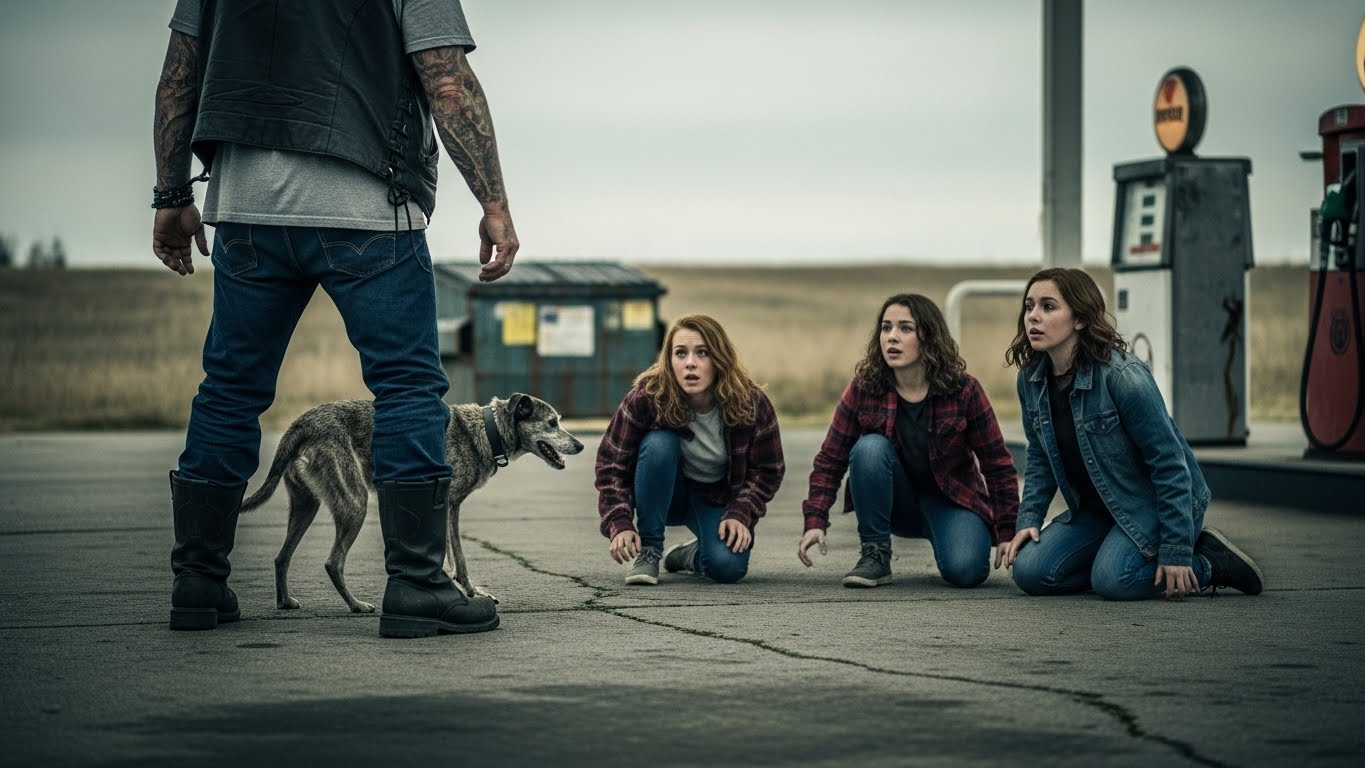
I pulled my gloves off, finger by finger, watching the three of them near the rusted-out dumpster at the edge of the lot. They were teenagers, maybe seventeen or eighteen, dressed in high-end hoodies and expensive sneakers that didn’t match the dirt under their feet. They looked like they belonged in a suburban mall, not out here where the cell service dies and the woods get thick. The one in the center, a tall kid with a bleached-blonde buzz cut and a sneer that looked permanent, held a half-eaten burger in one hand and a lit cigarette in the other.
“Look at him, Tyler! He’s pathetic,” one of the others yelled, tossing a plastic soda bottle.
The bottle hit something white and matted against the brick wall.
My chest tightened. It was a dog. Or what was left of one. A Pitbull-Lab mix, though you could hardly tell through the filth and the ribs sticking out like a skeletal cage. He was backed into a corner, his head tucked low, his tail pressed so hard against his stomach it looked painful. He wasn’t growling. He wasn’t barking. He had reached that terrifying stage of trauma where the soul just waits for the next blow.
Tyler, the leader, flicked his cigarette. The glowing cherry landed right on the dog’s scarred ear. The animal flinched, a small, choked yelp escaping his throat, but he didn’t move. He just sank lower into the oily puddle he was sitting in.
“C’mon, Sparky! Do something!” Tyler laughed, reaching for a heavy glass Snapple bottle.
I felt a coldness wash over me. It wasn’t anger—not yet. It was a total, absolute clarity. The kind you get right before the world goes loud in a firefight. I didn’t think about my probation. I didn’t think about the fact that Tyler’s dad probably owned half the town or that I was one bad day away from losing my shop. I just felt the weight of my shadow as I stepped off the bike and began to walk.
Chapter 2: The Shadow Falls
The pavement was hot through my boots, radiating a shimmering heat that made the horizon dance. Every step I took felt like a drumbeat in my chest. The kids didn’t notice me at first; they were too caught up in the high of being the biggest things in the parking lot. They were debating who could hit the dog’s nose first with a handful of gravel they’d scraped up from the edge of the lot.
“Bet you ten bucks I can make him cry,” the youngest one said. He had soft features and a haircut that probably cost more than my first bike. His voice was cracking with puberty and a brand of unearned malice that made my stomach turn.
Tyler raised the glass bottle, his arm winding back in a practiced throwing motion. “Watch this. I’m gonna peg him right between the eyes.”
I didn’t yell. I didn’t scream. I didn’t do any of the things people do in the movies. I just kept walking until my shadow stretched out long and dark across the gravel, swallowing the dog, the trash, and eventually, Tyler’s feet.
The air in the parking lot seemed to drop ten degrees. Tyler froze, his arm still cocked back, the glass bottle glinting in the dying light. He looked down at the dark shape covering his shoes, a long silhouette of a man in a leather vest with a serrated edge of a beard. Slowly, he turned his head.
I’m six-foot-four. I’ve got scars on my neck from shrapnel and a beard that hasn’t seen a razor since the last time I felt like I belonged in polite society. I was wearing my grease-stained leather vest, the “Vets for Vets” patch visible on my chest, a reminder of a life I’d tried to bury. I didn’t say a word. I just looked at him with the kind of eyes that have seen things Tyler wouldn’t believe in his worst nightmares.
“Uh… hey, man,” Tyler said, his sneer wavering like a reflection in a disturbed pond. He tried to reclaim his bravado, looking at his friends for backup. They were already backing away, their eyes wide, their hands empty. “We’re just… playing around. It’s just a stray. Probably has rabies anyway. Doing the town a favor, really.”
I looked down at the dog. Up close, it was worse. Much worse. The dog’s eyes were clouded with fear and infection, but for a split second, he looked up at me. There was no hope in those eyes, just a silent, hollow question: Is it over yet?
I looked back at Tyler. I stepped into his personal space, close enough to smell the expensive cologne, the cheap cigarettes, and the sudden, sharp scent of his fear. I didn’t touch him, but I let him feel the heat coming off me.
“Drop the bottle,” I said. My voice was low, a tectonic rumble that felt like it came from the soles of my boots.
“Look, you don’t know who my dad—”
I didn’t let him finish. I reached out, my hand moving faster than a kid like him could track, and gripped his wrist. Not hard enough to break it—not yet—but hard enough to let him know I could snap it like a dry twig if the mood took me. The Snapple bottle slipped from his fingers and shattered against the asphalt, glass shards spraying like diamonds in the dirt.
“I don’t care if your father is the King of England or the guy who signs my death warrant,” I whispered, leaning in so our noses almost touched. “Right now, you’re standing in my shadow. And in my shadow, we don’t hurt things that can’t fight back. We don’t throw trash at the broken. Do you understand the physics of this situation, Tyler?”
Tyler’s face went pale. The “tough guy” act evaporated, leaving behind a scared boy who realized he’d finally run into a wall he couldn’t climb or buy.
“Pick it up,” I said, nodding toward the trash they’d thrown.
“What?”
“The trash. All of it. The bottles, the burger, the cigarette butts. Pick it up with your bare hands, or I’m going to decide that you’re the next thing that needs to be hauled to the dump.”
His friends didn’t wait for a second invitation. They scrambled, grabbing wrappers and plastic with a desperate energy. Tyler stayed frozen for a second, his ego warring with his survival instinct. Survival won. He knelt, his trembling hands picking up the debris near the dog’s paws, his fingers touching the oily water.
The dog didn’t move. He just watched the boy who had been torturing him moments ago suddenly turn into a janitor.
“Now get out of here,” I said once they had their hands full of garbage. “If I see any of you near this station again, or if I hear about you touching a hair on an animal’s head, I won’t be this polite. I’ve got a long memory and a lot of time on my hands. Do you understand me?”
They didn’t answer. They ran for a shiny white Jeep Wrangler parked near the road, the kind of vehicle that says “my parents pay my insurance.” The tires screeched as they peeled out, leaving a cloud of dust and the acrid smell of burnt rubber.
Silence returned to the Pit Stop, but it was a different kind of silence. The rain finally began to fall, fat, heavy drops that hissed against the hot pavement. I turned to the dog. He was shivering now, the adrenaline of the confrontation fading into the cold reality of his injuries.
“Hey, buddy,” I said, my voice softening, shedding the gravelly edge I used for the bullies. I reached out a hand, palm up, keeping it low. “I’m not going to hurt you. I promise. I’m just a guy with a bike and a lot of bad memories. We’re practically kin.”
The dog let out a low, broken whine. He didn’t come to me. He just collapsed onto his side, his breathing shallow and ragged. He was giving up. The light in his eyes was dimming.
“Not today,” I muttered, stripping off my leather vest. It was the most valuable thing I owned, but right now, it was just a blanket. “You aren’t dying in a parking lot today. Not while I’m standing here.”
Chapter 3: The Fragile Line
I lifted the dog as if he were made of glass. He was lighter than he looked, mostly fur and bone held together by a stubborn spark of life. I felt his heartbeat through my shirt—fast, erratic, like a bird trapped in a cage. He didn’t struggle. He didn’t have the strength left to be afraid of me.
I didn’t have a car, and you can’t carry a dying dog on a Harley without a sidecar. But I knew the guy who ran the Pit Stop—an old timer named Silas who spent more time sleeping in the back room than he did selling gas.
“Silas!” I roared, kicking the door of the station open. The bell jingled weakly.
A man who looked like a piece of sun-dried leather sat up from a lawn chair behind the counter. “Jax? What the hell? I’m closed.”
“I need your truck,” I said, not breaking stride. “And I need it now.”
Silas looked at the bundle in my arms, the blood-stained leather vest, and the dog’s limp head. He didn’t ask questions. Silas was a Korean War vet; he knew the look in a man’s eyes when he was on a mission. He reached under the counter and tossed me a set of keys attached to a rusted Ford keychain.
“The blue F-150 out back,” Silas grunted. “Don’t wreck it. The brakes are… suggestions.”
“Thanks, Silas.”
I laid the dog on the bench seat of the truck, placing him on my vest. The interior of the Ford smelled like wet hay and tobacco. I started the engine—it groaned and sputtered before roaring into a rough idle. I drove like a man possessed, navigating the winding backroads toward Oakhaven.
My destination was a small, white-sided building on the edge of town: Vance Veterinary Services.
I hit the brakes—Silas wasn’t kidding, they were definitely “suggestions”—and skidded into the gravel lot. I scooped the dog up and kicked the front door open.
“Sarah!” I yelled.
A woman in her late thirties emerged from the back, her dark hair tied in a messy bun, her green scrubs splattered with something unidentifiable. This was Dr. Sarah Vance. She was the only person in this town who didn’t look at me like I was a ticking time bomb. Probably because she was a bit of one herself.
“Jax? What happened? Did you get into another—” She stopped mid-sentence when she saw the dog. Her professional mask slammed down instantly. “Table three. Now.”
I laid him down. Under the bright fluorescent lights, the damage was sickening. The cigarette burns, the deep lacerations from what looked like a wire fence, the sheer level of malnutrition.
“Who did this?” she asked, her voice tight as she began checking his vitals, her hands moving with surgical precision.
“Kids. Tyler Sterling and his pack,” I said, my jaw clenching so hard it ached.
Sarah froze for a split second at the mention of the name ‘Sterling.’ Everyone in Oakhaven knew the Sterlings. Tyler’s father, Judge Richard Sterling, was the man who decided who went to jail and who got a slap on the wrist. He was also the man who had been trying to buy Sarah’s clinic land for a new “development project” for the last two years.
“He’s in bad shape, Jax,” Sarah whispered, ignoring the name for a moment as she hooked up an IV. “Shock, severe dehydration, possible internal bleeding. And he’s got a fever that could cook an egg. I don’t know if he’ll make it through the night.”
“He has to,” I said. I realized I was gripping the edge of the metal table so hard the steel was biting into my palms. “He didn’t give up in that parking lot. He waited for me. You make him stay, Sarah. Whatever it costs. I’ll work off the bill. I’ll fix every vehicle you own. I’ll rebuild the roof. Just don’t let him go.”
Sarah looked up at me, her eyes softening. She saw the desperation I was trying to hide. She knew I wasn’t just talking about the dog. I was talking about the idea that something in this world could be saved.
“I’ll do my best, Jax,” she said. “But you need to be careful. If you touched Tyler Sterling… his father isn’t the type to let that go. He’s got a long reach and a mean streak.”
“Let him reach,” I said, looking down at the dog as his eyes fluttered. “I’ve spent my whole life in the dirt. I’m real comfortable down there. He’s the one who’s got a long way to fall.”
I sat in the waiting room that night, the sound of the rain against the window the only company I had. I didn’t realize until later that I still had the dog’s blood on my hands. I didn’t wash it off. I just sat there, waiting for a sign that the world wasn’t as dark as I remembered.
Chapter 4: The Morning After
The fluorescent lights of the clinic hummed with a low, buzzing frequency that vibrated in my teeth. I hadn’t slept. I’d spent the night on a plastic chair that felt like it was designed by an inquisitor, watching the steady drip of the IV and the slow, rhythmic rise and fall of the dog’s chest.
Around 4:00 AM, Sarah came out of the back room, her face pale and lined with exhaustion. She leaned against the doorframe, a mug of coffee in her hand that smelled more like burnt beans than hope.
“He’s stabilized,” she said, her voice a dry rasp. “His temperature is down. He took some water. He’s a fighter, Jax. Most dogs would have let go hours ago.”
I felt a weight lift off my chest, a pressure I hadn’t realized I was carrying. “Good. He deserves a win.”
“He’s going to need a name,” she added, stepping closer to the table. “I can’t keep calling him ‘Patient 402’ on the charts.”
I looked at the dog. He was awake now, his eyes tracking me. They weren’t clouded anymore; they were a deep, soulful amber. He looked like he’d seen the edge of the world and decided it wasn’t for him. He looked like a soldier who’d been through the meat grinder and somehow came out the other side.
“Sarge,” I said. “He looks like a Sarge.”
Sarah smiled, a genuine one that reached her eyes. “Sarge it is. Now, you need to go home, Jax. Get some sleep. Wash that blood off your hands. I’ll keep him here for a few days for observation.”
I nodded, but as I stood up, the front door of the clinic chimed. It was too early for appointments.
A man in a tan sheriff’s deputy uniform stepped inside. He was young, maybe mid-twenties, with a buzz cut and a posture that screamed ‘I’m new to the badge.’ I recognized him—Deputy Reed. His dad had played poker with my old man before the booze took them both.
“Jax,” Reed said, his voice hesitant. He didn’t look at me. He looked at the floor.
“Reed,” I replied, my muscles tensing. “Little early for a social call.”
“I’m not here for social reasons, Jax. Judge Sterling called the station. His son… Tyler… he’s got a broken wrist and some pretty nasty bruising. He says you assaulted him and his friends at the Pit Stop last night.”
I felt a cold laugh bubble up in my throat. “Assaulted? I saved a dog’s life. I stopped a group of punks from torturing a helpless animal. Did Tyler mention the cigarette burns he put on Sarge’s ears? Or the glass he was about to throw?”
Reed sighed, finally looking up. There was pity in his eyes. “It doesn’t matter what I think, Jax. It matters what the Judge thinks. He’s filing a formal complaint. He wants you picked up for questioning. And he’s mentioning your… previous history. Your ‘propensity for violence,’ he called it.”
Sarah stepped forward, her hand on her hip. “That’s a load of crap, Reed, and you know it. Look at this dog. This is evidence of animal cruelty. If anything, Tyler should be the one in handcuffs.”
“The Judge says the dog attacked them first,” Reed said softly. “He says they were just defending themselves.”
I looked at Sarge. He was staring at the deputy, his ears back, a low, barely audible vibration in his chest. He knew. Even in his weakened state, he knew the smell of trouble.
“I’m not going anywhere, Reed,” I said, my voice dropping an octave. “I’ve got work to do at the shop. If the Judge wants to talk, he can come find me. But if you try to take me in for defending a dog that couldn’t defend himself, you better bring more than one deputy.”
Reed looked like he wanted to be anywhere else. “Jax, don’t make this harder. Just come down, give a statement—”
“I’m done giving statements to men like Sterling,” I snapped. “Go tell the Judge that the shadow he’s worried about isn’t going away.”
Chapter 5: The Price of a Soul
By noon, the news had traveled through Oakhaven like a wildfire in a dry forest. In a small town, you don’t need the internet to spread a story; you just need a few people at the diner and a lot of boredom.
I was back at Miller’s Custom Cycles, my hands elbow-deep in the guts of a ’74 Shovelhead. It was the only way I could keep my mind from spinning. The shop was quiet, the air thick with the smell of oil and old metal.
Then, the black sedan pulled up.
It wasn’t a police car. It was a Mercedes-Benz, the color of a shark’s belly. Richard Sterling stepped out. He was a man who exuded a calculated, cold power. He wore a suit that cost more than my entire inventory, and his hair was perfectly silver, slicked back with the precision of a man who never had a hair out of place.
He didn’t walk into the shop. He stood at the edge of the grease-stained concrete, looking at me like I was an unpleasant stain.
“Miller,” he said. His voice was smooth, cultured, and utterly devoid of warmth.
“Judge,” I said, not looking up from the engine. “You lost? The courthouse is three miles back that way.”
“My son is in the hospital, Miller. He’s terrified. He says a ‘deranged veteran’ threatened to kill him.”
I finally looked up, wiping my hands on a rag that was more black than grey. “Your son is a liar, Richard. He’s a bully who likes to hurt things smaller than him because he’s never had to face anything bigger. I didn’t touch him. I stopped him from killing a dog. If his wrist is hurt, it’s probably from the weight of his own ego.”
Sterling stepped into the shop, his expensive shoes clicking on the floor. “I don’t care about the dog. It’s a mongrel. A piece of trash. What I care about is my reputation and my son’s future. You humiliated him. You made him look weak in front of his peers.”
“He is weak,” I said, stepping toward him. I was a head taller than him, and I made sure he felt every inch of it. “And you’re the one who made him that way. You’ve spent his whole life cleaning up his messes, so he thinks the world is his personal trash can.”
Sterling’s eyes narrowed. The mask of the “fair and just judge” slipped, revealing the predator underneath. “Listen to me very carefully, Jaxson. I know all about your time in the service. I know about the ‘incident’ in Columbus three years ago. I know you’re one phone call away from having your business license revoked and your parole officer knocking on this door with a warrant.”
He leaned in, his voice a low hiss. “Give me the dog. Tyler wants it ‘dealt with’ to settle the score. You hand over that animal, and I’ll make the assault charges go away. We can both go back to our lives.”
My blood turned to ice. It wasn’t just about a dog anymore. It was about everything. It was about Miller dying in that ditch while I watched. It was about the way the powerful think they can trade lives like poker chips.
“Get off my property,” I said. It wasn’t a shout. It was a command.
“Excuse me?”
“You heard me. You want the dog? You’re going to have to walk through me to get him. And I promise you, Richard, I’ve been through a lot worse than a crooked judge. You think you’re the law? I’ve seen what happens when the law fails. I’ve lived in the holes it leaves behind.”
Sterling backed away, his face turning a mottled red. “You’ve made a very big mistake, Miller. By tomorrow morning, you won’t have a shop. You won’t have a bike. And that dog will be in a furnace.”
He turned on his heel and marched back to his Mercedes. As the car sped away, I felt the walls closing in. I knew he wasn’t joking. In a town like this, the Judge didn’t just interpret the law—he owned it.
Chapter 6: The Breaking Point
The sun set, but the heat didn’t break. The air felt heavy, charged with the static of an approaching storm. I spent the evening moving Sarge. I knew the clinic wasn’t safe anymore—not after Sterling’s threat.
I called Sarah. She met me at the back entrance of the clinic at 10:00 PM. She looked scared, but her jaw was set. She’d spent her life fighting to keep her clinic from the Sterlings; she wasn’t about to give up now.
“I’ve got his meds packed,” she whispered as we loaded a still-weak but alert Sarge into the back of my old truck. “Jax, where are you going to take him? They’ll check your shop first.”
“I’ve got a place,” I said. “An old cabin my grandfather built out by the reservoir. It’s off the grid. No one’s been there in years.”
“Be careful,” she said, her hand lingering on my arm. “The Judge called the board of health. They’re coming to ‘inspect’ my clinic tomorrow morning. He’s trying to shut me down to get to you.”
“I’m sorry, Sarah. I didn’t mean to drag you into this.”
“You didn’t,” she said firmly. “I dragged myself in the moment I decided I liked the dog more than the Judge. Go. Now.”
I drove toward the reservoir, the headlights of the F-150 cutting through the thick Ohio fog. Sarge sat in the passenger seat, his head resting on my thigh. For the first time in years, I didn’t feel the weight of the ghosts. I felt a purpose.
But the peace didn’t last.
As I climbed the ridge toward the cabin, I saw a glow in the distance. A flickering, orange light that didn’t belong in the woods.
My heart hammered against my ribs. I floored the truck, the engine screaming as I rounded the final bend.
My shop.
It wasn’t the cabin—it was my shop back in town. I could see the smoke rising even from here. I’d left the scanner on in the truck, and the local dispatch was screaming about a structure fire on Main Street.
“Miller’s Custom Cycles is fully involved,” the voice crackled. “Suspected arson. Witnesses reported a white Jeep leaving the scene.”
I slammed my fist against the steering wheel. Tyler. The kid couldn’t let it go. He hadn’t just wanted the dog; he wanted to burn my life to the ground.
I looked at Sarge. He was looking at me, his amber eyes reflecting the dashboard lights. He could feel my rage. He leaned over and licked my hand—a rough, sandpaper tongue that felt like a tether to reality.
“They think they can burn it all down, Sarge,” I whispered, the fire in my eyes matching the one in my heart. “They think they can take everything and we’ll just fade away.”
I turned the truck around. I wasn’t going to the cabin anymore. If they wanted a war, I was done defending. It was time to go on the offensive. I knew where the Sterlings lived. I knew the layout of their gated estate. And I knew that in the dark, a man who has nothing left to lose is the most dangerous thing on earth.
I reached behind the seat and pulled out my old duffel bag. Inside wasn’t a gun. It was something much more effective for a man like Richard Sterling. It was a folder of documents I’d been holding onto for years—records of the ‘consulting fees’ his father had paid my father back when the town was being built. Corruption is a family tradition for the Sterlings, and I was about to make it public.
“Hold on, buddy,” I said to Sarge. “It’s about to get loud.”
Chapter 7: The Weight of Truth
The Sterling estate was a monument to old money and new secrets. It sat at the end of a long, winding driveway lined with manicured oaks that looked like they’d been told how to grow. I didn’t sneak in. I drove the rusted F-150 right up to the front circle, the engine coughing out a final plume of black smoke that hung in the pristine air like a middle finger.
I didn’t leave Sarge in the truck. I helped him out, his legs wobbly but his spirit steady. We walked up the marble steps together—the broken biker and the battered dog.
The front door opened before I could reach for the brass knocker. Richard Sterling stood there in a silk robe, a glass of amber liquid in his hand. Behind him, I could see Tyler, his arm in a fresh white cast, his face turning from smug to terrified the moment he saw me.
“You’ve got a lot of nerve coming here, Miller,” the Judge said, his voice trembling with a mix of rage and genuine shock. “I’ve already called the Sheriff. They’re on their way to arrest you for the arson of your own shop for insurance fraud. That’s the story, by the way. In case you were wondering.”
I didn’t flinch. I just held up the weather-beaten manila folder. “I don’t care about the shop, Richard. Steel and grease can be replaced. But this? This is a bit more permanent.”
I tossed the folder at his feet. It splayed open, revealing the ledger pages and the photocopied checks. Sterling’s face didn’t just go pale; it went grey, the color of ash.
“My father was a lot of things, but he was a hoarder of leverage,” I said, my voice calm, almost tired. “He kept every receipt from the ‘back-room deals’ you made when you were a city attorney. The kickbacks from the construction firms. The bribes to overlook the environmental leaks at the old mill. It’s all there. Every cent you used to buy this house and that robe.”
Tyler stepped forward, looking from the papers to his father. “Dad? What is that?”
“Go inside, Tyler!” the Judge barked, but the command lacked its usual bite. He looked at me, and for the first time, the predator saw the trap. “What do you want, Miller? Money? I can write you a check right now that will rebuild your shop ten times over.”
I looked down at Sarge. The dog was staring at Tyler. There was no aggression in Sarge’s eyes—just a profound, quiet dignity. He had survived them. He was the living evidence of their failure to break something pure.
“I don’t want your money,” I said. “I want you to resign. Tomorrow morning. Cite ‘health reasons’ or ‘family priorities,’ I don’t care. But you’re done deciding who’s a criminal and who isn’t. And as for your son…”
I looked at Tyler. The boy looked small. Smaller than I’d ever seen him.
“He’s going to spend every Saturday for the next year at Sarah’s clinic,” I said. “Cleaning kennels. Shoveling waste. Learning that the world doesn’t belong to him. If he misses a day, or if I hear one word of complaint, these papers go to the State Attorney and the local news.”
The Judge looked at the papers, then at his son, then at the man who had nothing left to lose. He knew he was beaten. Not by a fist, but by the weight of his own shadow.
“Pick up the papers, Richard,” I said, turning back toward the truck. “The fog’s rolling in, and I’ve got a dog that needs a real bed.”
Chapter 8: Where the Light Gets In
Six months later, the smell of fresh cedar and motor oil filled the air on Main Street. The community had done something I never expected—they’d shown up. When the news broke that the Judge was stepping down and that “local hero” Jaxson Miller had lost his shop to a “mysterious fire,” folks started dropping by with tools, lumber, and hands ready to work.
Sarah was there almost every day, ostensibly to check on Sarge, but eventually, she started bringing me coffee just because. We didn’t talk much about the past. We talked about the future.
Tyler Sterling was there, too. Every Saturday, just like I’d demanded. At first, he’d been sullen and slow, but Sarah was tougher than I was. She didn’t give him an inch. Last week, I saw him sitting on the floor of a kennel, gently bathing a stray cat. He didn’t see me watching. For the first time, he didn’t look like a shadow of his father. He looked like a human being.
Sarge had filled out. His coat was glossy, the scars on his ears now just silver lines of badge-of-honor courage. He didn’t cower anymore. He sat at the front door of the new shop, a silent sentinel who greeted every customer with a slow wag of his tail.
One evening, as the sun was setting, casting a golden glow over the town, I sat on the bench outside the shop. Sarge rested his heavy head on my knee. The “Vets for Vets” patch was on a new vest now, but the man underneath felt different. The ghosts weren’t gone—they never really are—but they were quieter. They didn’t scream anymore. They just watched.
I looked down at the dog who had saved my life by letting me save his. I realized that the shadow I’d been so afraid of wasn’t a place of darkness at all. It was a place of protection. It was the space we create when we stand up for those who can’t stand for themselves.
I reached down and scratched Sarge behind his scarred ear. He let out a long, contented sigh, closing his eyes in the warmth of the fading light.
In a world that tries so hard to break the gentle, sometimes the only thing left to do is be the shadow that keeps the rain off their backs.
I finally understood that you don’t find peace by running away from the storm; you find it by becoming the anchor that holds through it.