Chapter 1: The Sound of Cruelty
The rain in Aurora didn’t wash things clean; it just turned the grit of the industrial district into a slick, grey soup. This part of Illinois was forgotten by the postcard-makers—a landscape of rusted water towers, cracked asphalt, and warehouses that breathed out the smell of damp concrete and ancient oil.
Cooper—at least, that was the name on a rusted tag he’d lost three winters ago—wasn’t looking for trouble. He was looking for a dry patch of asphalt under the eaves of the abandoned Miller’s Warehouse. He was a mix of everything and nothing: part Golden Retriever, part Shepherd, all heartbreak. His ribs were a visible roadmap of a hard life, his copper fur matted with oil and dried blood. He limped, a permanent reminder of a hit-and-run on Route 34 that had never quite healed right.
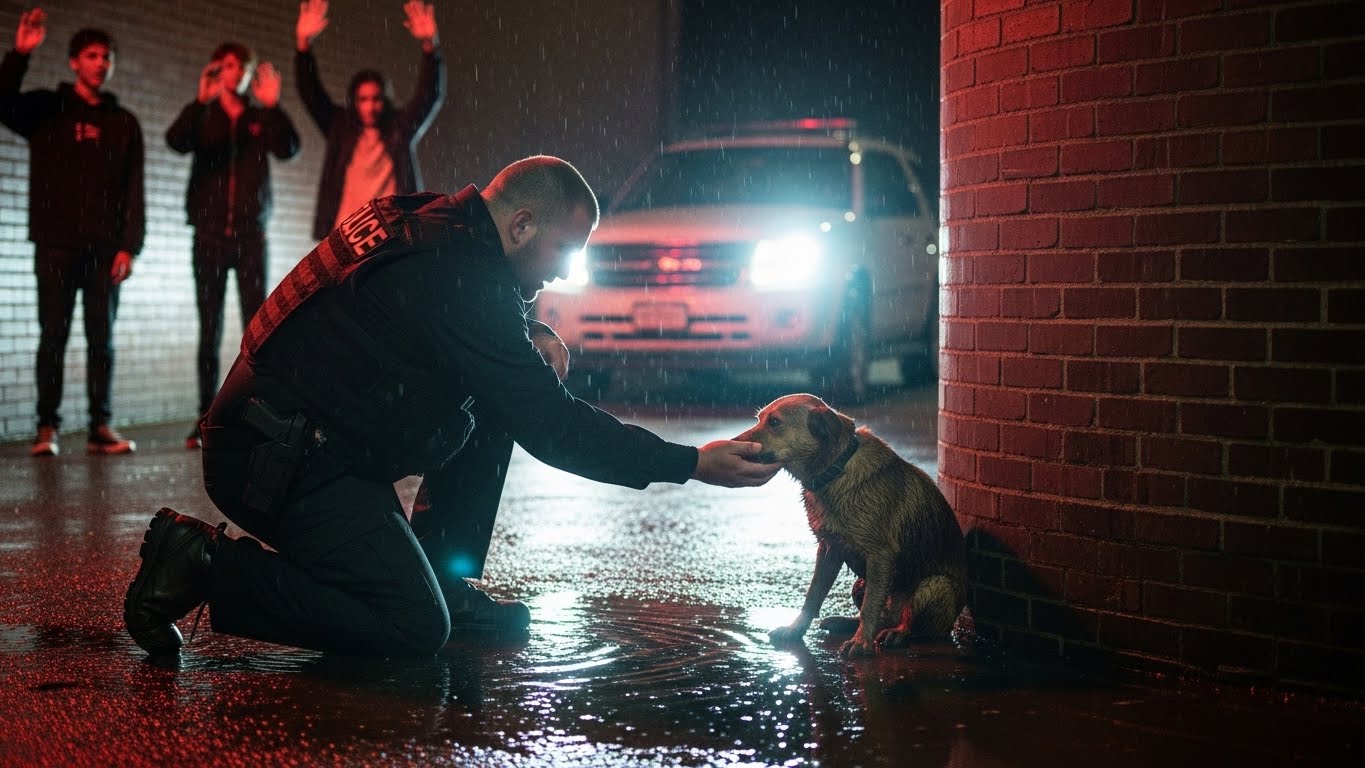
To Cooper, the world was a series of threats and short-lived comforts. He remembered the smell of a lavender dryer sheet from a house he lived in years ago, but that memory was fading, replaced by the sharp scent of exhaust and the sour taste of dumpster scraps.
He smelled them before he saw them. The scent of cheap blueberry vape juice, stale Monster Energy, and that sharp, metallic tang of teenage adrenaline.
“Look at this pathetic piece of trash,” a voice sneered.
Cooper’s ears flicked back. He lowered his head, his tail tucking tight against his scarred underbelly. He knew this tone. It was the tone of the “Bored and Dangerous.” There were four of them. They wore North Face hoodies and Jordans that cost more than a month of dog food, yet they carried a darkness that even the stray could sense.
The leader was Tyler Vance. He was seventeen, with a jawline carved by privilege and a look of practiced indifference. He was the kind of boy who had never been told ‘no’ in his manicured suburban life, which made him crave the feeling of power even more. In his hand, he swung a length of galvanized pipe he’d pulled from a scrap heap.
“I bet it doesn’t even scream,” Tyler said, his voice dropping to a low, jagged edge.
Cooper tried to retreat, his pads slipping on the wet concrete. He let out a low, submissive whimper—a plea for mercy in a language they refused to speak. He backed into a corner where two brick walls met—a dead end littered with broken glass and old pallets.
The first blow caught him across the flank. It wasn’t just the pain; it was the shock of it. Cooper collapsed, his breath leaving him in a ragged puff of white vapor. The boys didn’t stop. They moved in a circle, a pack of predators who had forgotten their humanity in the pursuit of a “viral” moment. One of them, a kid named Leo with a nervous twitch, held up a phone, the camera lens a cold, unblinking eye.
“Get closer, Tyler! Hit him again!” Leo urged.
They laughed—a high, discordant sound that echoed off the corrugated metal. Cooper curled into a ball, trying to protect his throat. He felt the cold steel of the pipe again, this time against his ribs. He felt a snap, a white-hot flare of agony that dimmed the world. He waited for the final darkness. He had survived the streets, the hunger, and the winter, only to die for the amusement of children who had everything and felt nothing.
He closed his eyes, his heart drumming a frantic, dying rhythm. The rain fell harder, drumming a funeral march on the trash cans.
Chapter 2: The Shadow of the Law
Marcus Thorne didn’t believe in coincidences. He believed in patterns, in tactical advantages, and in the heavy weight of the Sig Sauer P320 holstered against his hip. He was forty-two, with a face like a topographical map of bad neighborhoods and eyes that had seen too much through the optic of a long rifle. As a Sergeant in the Aurora SWAT unit, his life was measured in “breach points” and “seconds to impact.”
He was currently five hours past the end of a double shift. His body ached—a deep, marrow-deep throb from a day spent in fifty pounds of gear. He just wanted a hot shower, a glass of cheap bourbon, and the silence of his empty apartment. Since the divorce, the silence was the only thing he really owned.
But as he turned his matte-black Chevy Tahoe onto the industrial strip, a shortcut to the interstate, his headlights swept across the mouth of the Miller’s Warehouse alley.
He saw the flash of metal. He saw the rhythmic, downward motion of the hoodies. Most people would have seen a group of kids hanging out. Marcus saw a “Violent Incident in Progress.”
He didn’t think. He reacted. It was the “Switch.” Every operator knows it—that moment where the exhaustion vanishes and the lizard brain takes over, fueled by a decade of training and a visceral hatred for bullies.
He threw the Tahoe into park, the tires screaming against the wet asphalt. He didn’t use his sirens. Silence was a tactical choice. He wanted them to feel the shadow before they saw the man.
Marcus swung the door open. He didn’t run; he moved with a predatory grace, his boots splashing through the oily puddles. He wore his tactical vest over a grey hoodie, the “POLICE” patch on the chest subdued but unmistakable in the glare of his high beams.
“Drop it,” Marcus said.
His voice wasn’t a shout. It was a low-frequency growl that seemed to vibrate in the boys’ chests.
The group froze. Tyler, the pipe still raised for another strike, squinted into the blinding white light. “Who the hell are you? Get lost, old man. We’re just messing around with a mutt.”
Marcus didn’t stop walking. He entered the circle of light, his shadow stretching out like a titan across the brick walls. He looked at the dog—a broken, shivering heap of copper fur. He saw the blood. He saw the jagged edge of the pipe.
“I said,” Marcus repeated, his voice dropping an octave, “drop the pipe. Now.”
Tyler tried to muster his suburban arrogance. He was used to talking his way out of speeding tickets and school suspensions. “You can’t do anything. We’re minors. My dad’s a partner at Miller & Associates, he’ll have your badge if you touch me.”
In a blur of motion that defied Marcus’s age, he was suddenly inside Tyler’s personal space. He didn’t draw his weapon. He didn’t need to. He grabbed the pipe with a hand like a vice and gripped the front of Tyler’s hoodie, lifting the boy until his toes barely touched the muck.
“I don’t care who your father is,” Marcus whispered, his face inches from the boy’s. “Right now, your father isn’t here. Right now, there is only you, me, and the creature you just tried to murder. And in my world, Tyler… we don’t like bullies. We break them.”
Marcus twisted the pipe out of the boy’s grip. He tossed it aside; it clattered against the brick with a final, hollow ring. The other three boys had backed away, the kid with the phone dropping it into a puddle.
“Line up,” Marcus commanded, pointing to the warehouse wall. “Hands on the brick. Spread your feet. If any of you moves before I tell you to, I will treat you as a threat to my safety. Do you understand the implications of that?”
They understood. The “tough guys” were gone, replaced by terrified children. They scrambled to the wall, sobbing and shivering in the rain.
Marcus turned his back on them—a calculated insult—and knelt in the mud next to the dog.
Chapter 3: The Broken and the Brave
The dog flinched so hard he nearly rolled over into the deeper puddle. He was waiting for the blow. He was waiting for the pipe to come back.
“Easy, buddy,” Marcus murmured.
It was a voice his teammates wouldn’t recognize—soft, gravelly, and laced with a tenderness he usually reserved for the headstones at the veterans’ cemetery. He reached out a gloved hand, palm up, letting the dog smell the leather, the rain, and the faint scent of gun oil.
Cooper’s nose twitched. He tasted the air. This human didn’t smell like the others. There was no “mean” in him. There was only a heavy, protective warmth. Cooper let out a broken, whistling breath and rested his chin on Marcus’s knee.
Marcus felt a sharp pang in his chest. He’d seen people shot, stabbed, and broken, but the sight of this animal—giving up its last bit of strength to trust a stranger—hit him harder than a flashbang.
“I’ve got you,” Marcus whispered. “The monsters are gone. I’ve got the watch now.”
He pulled his radio from his belt. “Dispatch, this is Sergeant Thorne. I’m off-duty at the Miller Warehouse on 4th. I have four juveniles in custody for felony animal cruelty and possession of a weapon. Send a transport unit and a supervisor. Also, notify Animal Control—actually, scratch that. Tell the emergency vet on 2nd Street to have a trauma team ready. I’m bringing a Code Red in myself.”
“Copy that, Sarge,” the dispatcher’s voice crackled, sounding surprised. “Units are three minutes out.”
The boys at the wall were crying now. Leo was blubbering about his college applications. Tyler was silent, his face pressed against the cold brick, finally realizing that his father’s money couldn’t buy off a man like Marcus Thorne.
A patrol car pulled up, blue and red lights painting the alley in a chaotic strobe. Two officers, Miller and Higgins, stepped out, their eyes wide as they saw the scene.
“Sarge?” Miller asked, looking at the boys and then at the dog in Marcus’s arms.
“Take them,” Marcus said, his voice returning to its iron-hard command. “Record the scene. Get the pipe. Get the phone that kid dropped—there’s video evidence on it. Charge them with everything the DA will allow. If I hear about a ‘slap on the wrist,’ I’m going to the Chief personally.”
“You got it, Sarge. What about the dog?”
Marcus carefully scooped Cooper up. The dog was heavier than he looked, dead weight in his arms. Marcus didn’t care about the blood staining his grey hoodie or the mud ruining his tactical vest.
“The dog is with me,” Marcus said.
He walked back to the Tahoe, laid Cooper gently on a moving blanket in the back seat, and slammed the door. He didn’t look back at the boys. They weren’t worth his anger anymore.
As he tore out of the alley, Marcus looked in the rearview mirror. Cooper’s eyes were open, fixed on him. They were the color of burnt sugar, filled with a question Marcus wasn’t sure he could answer.
“Just hang on, kid,” Marcus muttered, pushing the Tahoe through a yellow light. “I didn’t save you just to watch you go. You hear me? You’re not dying tonight.”
But as he pulled into the parking lot of the 24-hour emergency vet, he saw the way Cooper’s head drifted to the side, his breathing becoming shallow and ragged. Marcus realized then that the fight had only just begun—and this time, he couldn’t use a gun or his fists to win it.
Chapter 4: The White Room
The sliding glass doors of the West Aurora Animal Hospital hissed open, admitting a blast of cold, wet air and a man who looked like he’d just crawled out of a trench. Marcus didn’t wait for the receptionist to look up. He bypassed the velvet ropes of the waiting area and headed straight for the “Staff Only” swinging doors.
“Sir! You can’t go back there!” a young woman behind the desk shouted, her voice jumping an octave.
Marcus didn’t turn around. “Sergeant Thorne, Aurora PD. I have a critical trauma. Get Dr. Jenkins. Now.”
He burst into the treatment area, a sterile, brightly lit space that smelled of ozone and isopropyl alcohol. A woman in faded blue scrubs was already snapping on a pair of nitrile gloves. This was Dr. Sarah Jenkins. She was fifty, with a shock of iron-grey hair tied back in a messy bun and eyes that looked like they hadn’t seen sleep since the Reagan administration. She had the weary, cynical grace of a combat surgeon, and she didn’t flinch when the massive, mud-stained SWAT officer dropped a bleeding bundle onto her prep table.
“What do we have, Marcus?” she asked, her voice a calm anchor in the chaos. They knew each other; Aurora was a small town for those who dealt with its wreckage.
“Multiple blunt force traumas,” Marcus rasped, his own breath hitching. “Galvanized pipe. Ribs are definitely gone. Internal bleeding. He’s shocky.”
Sarah was already moving. She didn’t waste time on pleasantries. Her hands, calloused and steady, moved over Cooper’s body with practiced efficiency. “Jessica, get an IV started. Isotonic fluids, warm them up. I want a full blood panel and a portable X-ray in here thirty seconds ago!”
A younger tech, Jessica, scrambled into action. Marcus stood back, his hands hovering near his sides, feeling useless. In his world, he was the one who solved problems with a flashbang or a well-timed “clear.” Here, he was just a bystander to a different kind of war.
He watched as Sarah shaved a patch of Cooper’s copper fur. The dog didn’t even moan; he was too far gone. Under the bright surgical lights, the damage was sickening. Deep, purple contusions lined his flanks, and his breathing was a shallow, whistling struggle.
“He’s got a tension pneumothorax,” Sarah muttered, more to herself than Marcus. “Lung is collapsing. I need a chest tube. Marcus, step out. You’re taking up oxygen.”
“Sarah—”
“Out!” she snapped, not looking up as she reached for a scalpel. “Go wash the mud off your face. You look like a ghost.”
Marcus retreated to the waiting room. He sat in a hard plastic chair, the kind designed to discourage long stays. The fluorescent lights hummed a low, mocking tune. He looked down at his hands. They were stained with Cooper’s blood, mixed with the grime of the warehouse alley.
He thought about the boys. He thought about the way Tyler had looked at him—not with remorse, but with the indignation of a king whose crown had been bumped. It wasn’t just a dog they were killing; it was the last shred of decency in a world that was already running low.
Two hours crawled by. The rain continued to lash against the windows, a rhythmic drumming that sounded like the pipe hitting Cooper’s ribs. Thud. Thud. Thud.
Marcus closed his eyes and saw a different alley. Six years ago. A botched drug raid in a tenement on the North Side. His K9 partner, a Belgian Malinois named Bear, had taken a round meant for Marcus. He remembered the weight of Bear in his arms, the way the dog’s tail had given one last, weak wag before the light left his eyes. Marcus had been decorated for that night. He’d received a medal and a handshake from the Mayor. But he’d never been the same. He’d stopped being a “dog guy.” He’d stopped letting anything get close enough to leave a scar when it was gone.
And yet, here he was, at 3:00 AM, praying for a stray who didn’t even have a name.
The doors opened. Sarah Jenkins walked out, pulling her mask down. Her face was pale, and there was a dark smear of blood on her cheek.
“He’s stable,” she said, and Marcus felt a weight lift from his chest so suddenly he felt lightheaded. “For now. We had to remove a lobe of the lung, and he’s got three broken ribs that we had to plate. He’s a fighter, Marcus. Most dogs would have quit ten minutes into that beating.”
“Can I see him?”
“He’s in recovery. He’s heavily sedated. Go home, Marcus. You have a shift in six hours.”
“I’m staying,” Marcus said. It wasn’t a request.
Sarah looked at him, really looked at him, and sighed. “Fine. There’s coffee in the breakroom. It tastes like battery acid. Help yourself.”
As she turned to leave, she stopped. “The police department called. There’s someone in the lobby looking for you. A lawyer named Vance.”
Marcus felt the hair on the back of his neck stand up. The “Switch” flipped back on. “Thanks, Sarah. Keep an eye on the kid for me.”
Chapter 5: The King of Aurora
Howard Vance did not belong in a 24-hour emergency vet clinic. He belonged in a mahogany-row office or the back of a chauffeured Audi. He was wearing a charcoal grey suit that cost more than Marcus’s Tahoe, and his hair was perfectly coiffed despite the late hour. He stood in the center of the waiting room like he owned the air everyone else was breathing.
Standing next to him was a younger man, an associate or a fixer, holding a leather briefcase.
When Marcus stepped into the lobby, Howard didn’t offer a hand. He offered a condescending smile.
“Sergeant Thorne,” Howard said, his voice smooth and resonant, the kind of voice that swayed juries and intimidated city council members. “I’m Howard Vance. I believe you had a… run-in with my son tonight.”
Marcus stopped six feet away. “Your son committed a felony, Mr. Vance. Along with three of his friends. I didn’t have a ‘run-in.’ I made an arrest.”
Howard chuckled, a dry, mirthless sound. “Let’s not be dramatic, Sergeant. Kids will be kids. They found a stray animal, things got a bit out of hand. It’s a regrettable lapse in judgment, certainly. But ‘felony’? That seems a bit heavy-handed for a boy with a 4.2 GPA and a bright future at Yale.”
“He used a lead pipe on a living creature that was cornered and helpless,” Marcus said, his voice dropping to that dangerous, low frequency. “He enjoyed it. I watched him. That’s not a lapse in judgment, Howard. That’s a pathology.”
The lawyer’s smile faltered, replaced by a cold, calculating hardness. “Listen to me, Thorne. I know your record. I know about the ‘Bear’ incident. I know you’re a man who carries a lot of… baggage. You’re a hero in this town, and I respect that. But don’t mistake my courtesy for weakness.”
The associate opened the briefcase. Inside were stacks of hundred-dollar bills, neatly banded.
“There’s fifty thousand dollars here,” Howard said, gesturing to the case. “Consider it a ‘donation’ to whatever charity you like. Or perhaps a fund for the dog’s medical bills. All I want is for the body camera footage—which I understand you haven’t turned in yet since you were off-duty—to… go missing. The charges get dropped, the boys go to a ‘diversion program,’ and we all move on. No harm, no foul.”
Marcus looked at the money. Then he looked at Howard Vance. He thought about the blood on the warehouse floor. He thought about Cooper’s whistling breath.
“You think this is about money?” Marcus asked quietly.
“Everything is about money, Sergeant. Even justice. Especially justice in a town like Aurora.”
Marcus took a step forward, entering Howard’s personal space. The lawyer didn’t flinch, but the associate took a step back.
“Here’s how this is going to go,” Marcus said, his eyes locking onto Howard’s. “That money is going back into that briefcase. You are going to leave this clinic. And tomorrow morning, I am going to hand-deliver my personal dashcam footage and the witness statements to the District Attorney. I’m also going to file a report regarding an attempted bribe of a police officer.”
Howard’s face flushed a deep, angry red. “You’re making a mistake, Thorne. I have friends on the board. I have the Chief’s ear. You’ll be walking a beat in the worst ward of the city by Friday.”
“I’ve walked worse beats than this,” Marcus said. “Now get out. Before I decide to add ‘obstruction of justice’ to your son’s file tonight.”
Howard Vance snapped the briefcase shut. He leaned in, his voice a venomous hiss. “That dog is going to die anyway, Thorne. And when he does, you’ll have nothing. No dog, no career, and no friends. I’ll make sure of it.”
“The dog has a name,” Marcus said. “It’s Cooper. And he’s already a better man than you’ll ever be.”
As Vance stormed out, the glass doors shaking in his wake, Marcus felt a tremor in his own hands. It wasn’t fear; it was pure, unadulterated rage. He knew Vance wasn’t lying. The man had the power to make Marcus’s life a living hell.
He walked back to the recovery room. Cooper was lying in a plexiglass enclosure, hooked up to a dozen tubes and monitors. He looked so small, so fragile.
Marcus sat on the floor next to the cage. He leaned his head against the plastic.
“You hear that, Cooper?” Marcus whispered. “You’ve got a powerful enemy. But you’ve got me, too. And I’m a real son of a bitch when I’m cornered.”
Chapter 6: The Long Night
By 4:30 AM, the hospital had fallen into a heavy, artificial silence. The only sounds were the rhythmic beep-hiss of the ventilator and the distant hum of a floor waxer in the lobby.
Marcus was drifting. In the half-light of the recovery room, the boundaries between the past and the present began to blur. He saw the warehouse alley, but instead of Cooper, it was Bear lying there. Instead of Tyler Vance, it was the ghost of every criminal he’d ever chased.
He felt a hand on his shoulder. It was Sarah. She was holding two paper cups of coffee.
“He’s waking up,” she said softly.
Marcus scrambled to his feet, his joints popping. He looked into the enclosure. Cooper’s eyes were open—just slits, really, but he was conscious. He was looking around the room, his pupils dilated from the morphine, his body twitching with the remnants of the trauma.
“He’s scared,” Marcus said.
“He’s confused,” Sarah corrected. “He doesn’t know why he’s in a cage. He doesn’t know why he hurts.”
She opened the door to the enclosure. “He needs to know he’s safe. You’re the last thing he saw before the lights went out. Go on.”
Marcus reached in. He was terrified of breaking the dog further, but as his hand touched the soft fur behind Cooper’s ears, the dog didn’t flinch. Instead, he leaned his head—just an inch—into Marcus’s palm. A long, shuddering sigh escaped his lungs.
“Hey, pal,” Marcus whispered. “You’re okay. You’re at the Hilton now. Room service is coming.”
Cooper’s tail didn’t wag—it couldn’t—but the tip of it gave a tiny, almost imperceptible flick against the bedding.
“I talked to Vance,” Marcus said to Sarah, not looking away from the dog.
“I heard the shouting from the back,” Sarah replied, taking a cautious sip of her coffee. “He’s a dangerous man, Marcus. Not ‘lead pipe’ dangerous, but ‘destroy your pension and your reputation’ dangerous. Why are you doing this? It’s just a stray. You could have turned him over to the county and let the system handle it.”
Marcus was silent for a long time. He watched the way Cooper’s chest rose and fell, the mechanical assist of the machine working in tandem with the dog’s own will to live.
“Because the system is what broke him,” Marcus finally said. “The system is Tyler Vance thinking he can kill for fun because his dad pays the property taxes. The system is people looking the other way because it’s ‘not their problem.’ I’ve spent twenty years being a part of the system, Sarah. Tonight, I just wanted to be a human being.”
He looked at Sarah, his eyes raw. “And honestly? I think I need him more than he needs me. Since Bear… I’ve been a machine. I go to work, I come home, I stare at the wall. I forgot how to feel anything but the ‘Switch.’ This dog… he reminded me that there’s still something worth protecting that isn’t a crime scene.”
Sarah nodded slowly. She reached out and patted Marcus’s arm. “Well, you picked a hell of a way to find your soul again, Thorne. But for what it’s worth? I think Cooper chose well.”
As the first grey light of dawn began to bleed through the rain-streaked windows, Cooper’s breathing deepened. He fell into a natural sleep, his head resting securely on Marcus’s hand.
Marcus didn’t move. He knew the storm wasn’t over. He knew that when the sun came up, the legal battle would begin. He knew his career was on the line, and that Howard Vance would come for him with everything he had.
But for the first time in six years, Marcus Thorne wasn’t thinking about the next tactical move. He wasn’t thinking about the “breach point.” He was just a man, sitting in the dark, watching over a friend.
And as he sat there, he felt a strange, unfamiliar warmth in his chest. It was the feeling of a closed heart beginning to crack open. It was painful, and it was terrifying, and it was the most alive he’d felt in a decade.
“We’re going to win, Cooper,” Marcus whispered into the quiet room. “I don’t care what it costs. We’re going to win.”
Outside, the rain finally began to taper off, leaving behind a world that was cold, wet, and utterly changed.
Chapter 7: The Cost of a Conscience
The air in the Chief’s office at the Aurora Police Department was thick with the scent of stale coffee and the heavy, electric tension of a career about to be dismantled. It was 8:00 AM, forty-eight hours after the incident at the warehouse. Marcus Thorne stood in front of Chief Miller’s desk, his boots polished, his uniform crisp, and his back as straight as a steel girder. He hadn’t slept. Every time he closed his eyes, he felt the vibration of the lead pipe hitting bone, or he saw the cold, predatory smirk on Howard Vance’s face.
Chief Miller wasn’t looking at him. He was looking at a file on his desk—a thick stack of “complaints” and “procedural inquiries” that had arrived with the morning mail.
“Howard Vance called the Mayor three times yesterday, Marcus,” Miller said, his voice weary. “He’s filed a formal complaint alleging police brutality, illegal detention of minors, and—this is my favorite—extortion. He claims you tried to shake him down for fifty grand in the vet clinic.”
Marcus didn’t blink. “He’s lying. He brought the money to me in a briefcase. I have the hospital surveillance footage of him entering and leaving with it. I also have the dashcam from my Tahoe.”
“The dashcam you weren’t authorized to be running while off-duty?” Miller finally looked up. His eyes were sympathetic, but his hands were tied by the invisible strings of city politics. “The union is going to have a hard time with this one. Vance is calling for your immediate termination. He’s threatening a civil suit that could bankrupt the department.”
“Is that what we are now?” Marcus asked, his voice low and dangerous. “A business? We weigh the cost of a lawsuit against the life of a living being?”
“It’s not just about the dog, Marcus! It’s about the optics! You handled four high-school kids like they were active shooters. You put hands on the son of the most powerful man in the county.”
“Those ‘kids’ were minutes away from killing something for the fun of it,” Marcus stepped forward, his knuckles white. “If I hadn’t been there, they’d be burying a carcass today and planning their next target. Is that the kind of ‘future leader’ we’re protecting in this town?”
Miller sighed, rubbing his temples. “I’m putting you on administrative leave, Marcus. Indefinite. Pending an Internal Affairs investigation. Turn in your badge and your service weapon.”
The silence that followed was deafening. Marcus looked at the gold shield on the desk. It had been his life for twenty years. It was the only thing that had kept the darkness at bay after Bear died. He thought about the empty apartment waiting for him, the silence that usually greeted him.
Then, he thought about the way Cooper’s tail had flicked against his hand in the dark of the recovery room.
Marcus reached for his belt. He unholstered the Sig Sauer, cleared the chamber with a practiced, metallic clack, and laid it on the desk. Then, he unpinned the badge. It felt heavier than it ever had before.
“You’re making a mistake, Chief,” Marcus said softly. “Not because of me. But because of what you’re telling every other officer in this building. You’re telling them that the law is for sale.”
“I’m trying to save your pension, Thorne!” Miller shouted as Marcus turned for the door.
“Keep the pension,” Marcus said, not looking back. “I’ve got better things to do with my time.”
He walked out of the precinct, his head held high. He felt the eyes of his fellow officers on him—some with pity, some with respect, and some with the same cold indifference he had fought his entire life. He walked down the steps and into the bright, unforgiving Illinois sun.
He drove straight to the clinic.
Sarah was waiting for him in the lobby. She didn’t ask about the badge; she saw the lack of it in the way he carried his shoulders.
“He’s ready to go home,” she said. “He’s on a strict regimen of antibiotics and pain meds, and he’s going to need a lot of physical therapy. He might always have a bit of a limp.”
“He’s not the only one,” Marcus said.
She led him to the back. Cooper was standing—shakily, but standing—on a thick rug. He was wearing a surgical cone and a colorful compression vest to protect his ribs. When he saw Marcus, his entire body didn’t just wag; it vibrated.
It was a clumsy, painful-looking dance of joy. Cooper let out a series of high-pitched, frantic yips, his copper tail thumping against the kennel door.
Marcus knelt, oblivious to the fact that he was ruining his dress blues in the hospital grime. He buried his face in the dog’s neck, smelling the medicinal shampoo and the faint, sweet scent of a creature that was simply happy to be alive.
“Ready to go home, pal?” Marcus whispered.
Cooper licked the salt from Marcus’s cheek, his amber eyes clear and filled with a devotion that no lawyer’s bribe could ever buy.
Chapter 8: The Way Back
Three months later.
The suburban streets of Aurora were transitioning into the golden, crisp embrace of autumn. On a quiet cul-de-sac, far from the industrial grit of the warehouse district, the door to a modest ranch-style house opened.
Marcus Thorne stepped out onto the porch. He wasn’t wearing a uniform. He was wearing a faded flannel shirt and a pair of jeans. He looked younger—the deep, jagged lines of tension around his eyes had softened, replaced by the weary peace of a man who had finally put down a burden he’d been carrying for far too long.
Behind him, the rhythmic click-clack of claws on hardwood signaled the arrival of the master of the house.
Cooper stepped out onto the porch. He still had the limp—a slight hitch in his left hind leg—but his coat was thick, shiny, and the color of a new penny. He no longer looked like a roadmap of pain; he looked like a dog who knew exactly where his next meal was coming from and whose bed he would be sleeping on.
“Easy, Coop,” Marcus said, reaching down to scratch that one specific spot behind the ear that made the dog’s leg twitch. “We’re just going to the park. No need to blow a gasket.”
The legal battle had been a bloodbath. Howard Vance had tried everything. He’d leaked fake stories to the local press, he’d pressured the DA, and he’d even tried to have Marcus’s apartment lease terminated. But he had underestimated one thing: the power of the internet.
The kid, Leo—the one with the nervous twitch—hadn’t deleted the video. He’d saved it to a cloud drive. And in a fit of conscience (or perhaps just fear), he’d sent it to a local investigative reporter.
When the footage hit the news, the city exploded. The sight of four wealthy teenagers systematically torturing a helpless animal while laughing was more than the public could stomach. The “optics” Howard Vance had relied on flipped overnight. The Mayor was forced to issue a public apology. The charges against the boys were upgraded to aggravated animal cruelty and assault.
Tyler Vance was currently serving six months in a juvenile detention facility, followed by five hundred hours of community service at—poetically enough—the very animal shelter he used to mock. Howard Vance had “stepped down” from his firm following an ethics investigation into the attempted bribe.
Marcus had been offered his job back. The Chief had come to his house personally, badge in hand, promising a promotion and a clean record.
Marcus had looked at the badge, then he’d looked at Cooper, who was currently napping on the rug at his feet.
“I think I’m done with the ‘Switch,’ Chief,” Marcus had said. “I’m going to focus on being a civilian for a while.”
Now, as they walked toward the park, the neighborhood kids waved. A few people stopped to pet Cooper, who soaked up the attention with a gentle, patient dignity. He didn’t flinch anymore when people reached out. He didn’t hide in the shadows.
They reached the crest of a hill overlooking the Fox River. The water was a deep, shimmering blue, reflecting the vastness of the American sky. Marcus sat on a bench and unclipped Cooper’s leash, letting the dog wander through the fallen leaves.
Marcus watched him. He thought about the man he had been in that rainy alley—a man who was “soul-weary” and ready to give up on a world that felt like it was nothing but bullies and victims. He thought about the “Switch” he’d lived by, the mechanical, cold efficiency that had protected his body but starved his heart.
He realized then that the rescue hadn’t happened in the alley. It had happened in the months that followed. It had happened in the middle of the night when Cooper would rest his head on Marcus’s chest during a nightmare. It had happened in the quiet mornings when they watched the sun come up together.
Cooper trotted back to the bench, a particularly large maple leaf stuck to his wet nose. He sat down and leaned his weight against Marcus’s leg, a solid, warm presence that anchored him to the earth.
Marcus reached down and felt the steady, rhythmic beat of Cooper’s heart. It was strong. It was resilient. It was a miracle.
“Good boy,” Marcus whispered, his voice cracking just a little.
He looked out over the river, feeling the cool breeze on his face. The scars were still there—on both of them. They always would be. But as the sun began to set, painting the world in shades of fire and gold, Marcus Thorne finally felt like he was home.
He hadn’t just saved a stray dog that night behind the old mill; he had saved the only part of himself that still knew how to love.
If you saw someone hurting a defenseless animal, would you risk your entire career and reputation to stop them, or would you look the other way to protect yourself?