Part 1
The sentence split my life in half before I even reached the dining room.
I was carrying a pumpkin pie through my parents’ hallway outside Pittsburgh when I heard my mother tell Aunt Sandra, “She owes us.”
Sandra gave a soft laugh. “Emily has done pretty well for herself.”
“She should have,” my mother replied. “We fed her for eighteen years.”
I froze.
For fifteen years, I had sent my parents four thousand dollars every month. Every first of the month, without fail. It had started when my father injured his back and my mother called crying about the mortgage, medication, and bills they could not pay.
Back then, I was twenty-three, working my first paralegal job in Boston, earning very little and eating cheap noodles in a tiny apartment. I told myself the help would be temporary.
But temporary became one year. Then five. Then ten. Then fifteen.
I paid for the mortgage, the roof, the prescriptions, the taxes, the SUV expenses, and even the kitchen remodel my mother claimed she needed because she was embarrassed to invite guests over.
And now, standing in that same kitchen, I heard her say I still owed her because she had fed me as a child.
At dinner, I said nothing. I passed food, smiled politely, and kept my voice calm.
That calm scared me more than anger.
Later that night, I locked myself in the guest room and checked my bank account. After rent, credit card payments, and the flight home, I had only $611.83 left.
My next automatic transfer to my parents was scheduled for January first.
Four thousand dollars.
More than six times what I had left.
I called Claire, my financial adviser.
“Stop the transfer,” I whispered.
“Emily, are you sure?”
“Close the family account,” I said. “Tonight.”
For the first time in fifteen years, I was sure.
Part 2
The next morning, my mother handed me a shopping list before I left for the airport.
She did not ask if I had slept. She did not ask why my eyes were swollen.
She only said, “Order that air fryer your father wanted. The good one, not the cheap one.”
On the plane back to Boston, she texted again, reminding me that January’s money might need to be sent early because of the holiday.
No thank-you. No concern. Just a reminder, like I was a bill.
When I got home, I opened my laptop and began gathering records.
Bank statements. Wire confirmations. Mortgage payments. Insurance bills. Prescription reimbursements. Screenshots of messages. Every transfer, every date, every amount.
By midnight, the monthly payments alone totaled $720,000.
That did not include the roof, the kitchen, the SUV, gifts, flights, or endless emergencies.
Seven hundred and twenty thousand dollars.
And I had $611.83 left.
On December twenty-ninth, my mother texted:
Did you send it?
Then:
Mortgage drafts before the holiday weekend.
Then:
I already put down the deposit for New Year’s Eve food.
I replied:
I can’t anymore.
Her answer came instantly.
Can’t or won’t?
That was when I knew she had been waiting for this moment, ready to make me feel guilty.
I printed everything.
On New Year’s Eve, I drove back to Pittsburgh with the folder on the passenger seat.
My mother opened the door, annoyed first and surprised second.
Inside, my father watched football. Aunt Sandra arranged food on the remodeled counters I had paid for. The cinnamon candle burned again.
I walked into the dining room and placed the folder in the middle of the table.
“What is this?” my mother asked.
I looked at her.
“Since we’re talking about what I owe, I thought we should finally do the math.”
Part 3
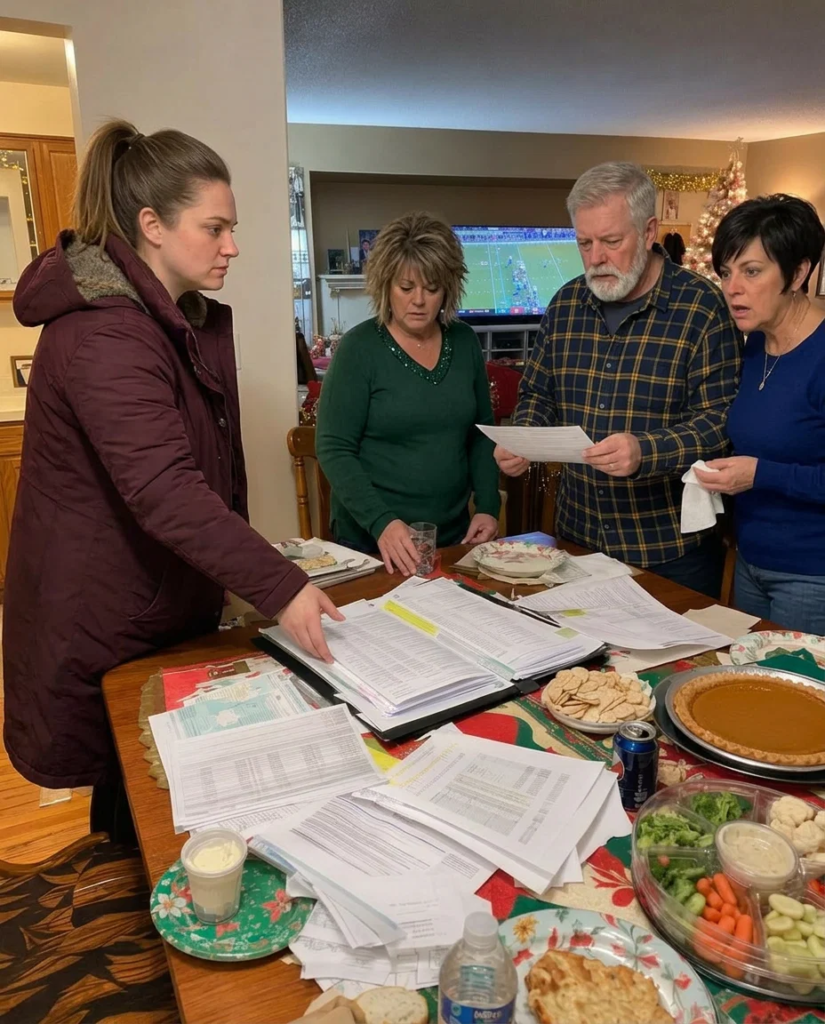
I spread the papers across the table.
Mortgage payments. Monthly deposits. Roof costs. Kitchen expenses. SUV bills. Prescription payments. Every number, every month, every year.
Then I placed my current bank balance beside them.
$611.83.
The room went silent.
My father picked up the summary page. When he reached the total, the color drained from his face.
“Patty,” he said quietly, “what exactly have you been taking from her?”
My mother looked betrayed, not sorry.
I pulled out the last page.
“The transfer has already been canceled,” I said.
Her hand froze.
“You canceled January?” she asked.
“I canceled every automatic deposit.”
“You can’t do that before the mortgage draft.”
“I already did.”
“You don’t get to cut us off.”
“I didn’t cut you off,” I said. “I stopped paying a bill no one admitted was mine.”
For once, my mother had no answer.
My father admitted he thought I had only been helping sometimes. I told him the truth.
“Dad, it was four thousand dollars every month. For fifteen years.”
Sandra asked why I had never said anything.
“I did,” I said. “Every month. In dollars.”
Then I placed my mother’s shopping list on the table, with the air fryer still written on it.
“You gave me this after I paid for the kitchen you were standing in. After you told Sandra I owed you for feeding me.”
My mother whispered, “I didn’t mean it like that.”
“Yes,” I said. “You did.”
My father apologized. It was not enough, but it was the first honest thing anyone had said in years.
I told them the monthly transfers were over. I would help Dad review the real bills, but I would no longer sacrifice my life to protect their comfort.
Then I left.
On January first, no transfer went out.
The world did not end.
My mother called seven times. I ignored every call.
That afternoon, my father sent me a photo of the papers still spread across the dining table.
Under it, he wrote:
I’m going through them.
I cried.
Not because everything was fixed, but because the truth was finally visible.
For fifteen years, I had paid to keep pretending I was loved correctly.
Now, the account was closed.