I built
my parents a lake cabin for their 40th anniversary, and for a while, it was the best decision I had ever made.
Then my father sent me a text that said only: Please come now.
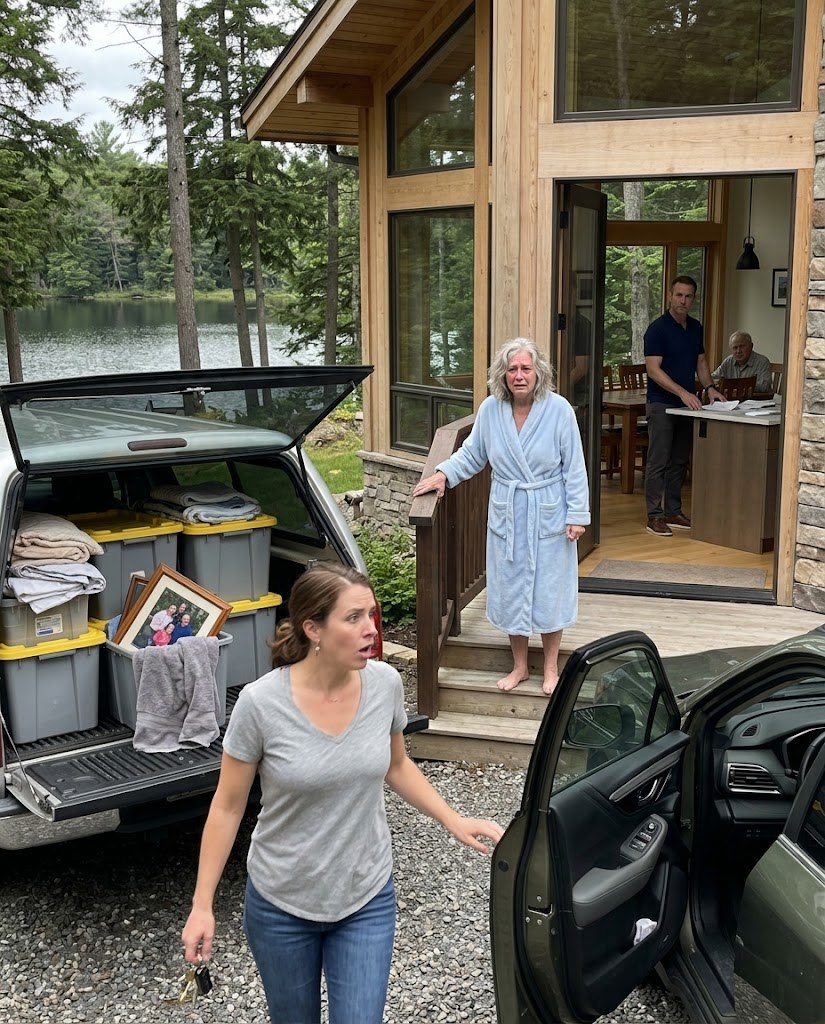
By the time I got there, my mother was in a robe on the porch at two in the afternoon, my sister’s car was in the driveway, and an unfamiliar truck was parked by the side door with the hatch open like somebody was loading or unloading a life.
I knew before I stepped inside that something was wrong.
I just didn’t know how far it had gone.
The kitchen looked like a clean, organized version of a home invasion.
Cabinet doors stood open.
The hall closet had been emptied halfway into plastic bins.
Fresh white sheet sets were stacked on the counter beside a package of mini shampoo bottles and a bulk order of black makeup cloths still inside the shipping carton.
My guest room desk drawer had been forced open.
And on the island, directly under the pendant lights I had chosen because my mother liked warm light better than cool, sat a packet of documents with sticky tabs along the side.
My father was seated at the kitchen table, pale and rigid, his hand trembling against the chair arm.
My mother hovered just behind him in her robe, one hand on his shoulder, like if she let go, something worse would happen.
My sister Vanessa stood near the mudroom wrapping framed family photographs in dish towels.
Craig was at the island with my laptop open.
He looked up when I came in and did not act surprised.
He smiled.
That calm, patronizing smile men use when they think they are already in control of the room.
“Riley,” he said.
“Good.
You’re here.
We can clear this up.”
My mother made a broken sound under her breath.
My father pushed himself halfway up from his chair, failed, then slapped his palm on the table hard enough to rattle the water glass beside him.
“Don’t let him talk around it,” my dad said, his voice shaking from more than Parkinson’s.
“Don’t let him do that thing.”
I walked straight to the island.
The top page said MANAGEMENT AGREEMENT.
Underneath it was a short-term rental revenue projection, then a sample listing setup sheet, then a draft letter addressed to a probate and trust litigation firm.
My eyes locked onto one line in particular.
Interested parties have reason to believe the current trust arrangement may not reflect the grantors’ evolving needs or informed intent.
I read it twice.
Then I looked at Craig.
“What is this?” I asked.
He folded his arms.
“A practical solution.”
Vanessa finally turned around.
Her face was flushed, but not with shame.
With anxiety.
With the strain of somebody who knows the lie is collapsing in real time.
“We’re trying to help,” she said too quickly.
That was almost enough to make me laugh.
Instead I asked, “Why is my laptop open?”
Craig answered before Vanessa could.
“Because the trust paperwork is in your files, and we needed clarity.”
Needed clarity.
He said it like he had borrowed a charger.
I closed the laptop and turned it toward me.
The password field had been bypassed through sleep mode because
I had left too quickly on my last visit and never fully shut it down.
My stomach dropped.
On the screen, minimized but still visible, were scanned copies of the deed transfer, trust schedule, property tax documentation, and the correspondence with the attorney who had set up the irrevocable trust.
He had gone through everything.
I looked at my mother.
“How long?”
Her eyes filled immediately.
“They came this morning.
Vanessa said Craig found a way to make the cabin ‘work for everyone.’ She said maybe some of the income could help with future care.”
I turned to my father.
“Did you sign anything?”
His jaw tightened.
“No.
He kept pushing the papers at me.
Said we needed to do it today before summer booking windows closed.”
“And the trust challenge?” I asked.
My father’s face changed then.
Not confusion.
Humiliation.
That was when I knew the ugliest part was still coming.
Craig exhaled like he was the only mature person present.
“Your father is upset because he misunderstood the conversation.”
My dad pointed at him with a shaking finger.
“You said she could lose the house.”
The room went still.
Craig didn’t deny it.
He just tilted his head slightly and said, “I said your mother could face uncertainty if long-term care costs escalate and this asset remains under rigid control.
That is objectively true.”
“No,” my mom whispered.
“That is not what you said.
You told him if he died first, I might not be able to stay here unless we ‘fixed the paperwork now.’ You said Riley made it too restrictive.”
I felt something cold move through me.
That trust had one purpose above all else: to protect my parents from exactly this kind of pressure.
They were the only lifetime beneficiaries.
Neither of them could be removed.
Neither of them could be displaced.
The property could not be sold, borrowed against, or redirected through family manipulation.
I had paid an attorney very well to make sure no smooth-talking relative could turn sentiment into leverage.
Craig knew that now.
Which meant he wasn’t trying to understand the documents.
He was trying to break around them.
I picked up the draft letter to the litigation firm.
“Who wrote this?”
He didn’t answer.
Vanessa did.
“Craig’s friend knows an attorney.”
Of course he did.
The whiteboard by the mudroom caught my eye then.
Check-in instructions.
Cleaning schedule.
Supply restock list.
Wi-Fi password.
A box labeled OWNER CLOSET – DO NOT ACCESS.
I stared at it.
Then at the stacked towels.
Then at the bins.
Then at the keypad lock on the counter.
“You were turning it into a rental,” I said.
Craig’s tone became patient, even faintly superior.
“A premium one.
This location could do extremely well.
The place sits empty part of the week.
It’s an underutilized asset.”
My mother’s face hardened at the phrase.
Underutilized asset.
That was the moment this stopped being an argument about paperwork and became exactly what it was: an attempted extraction.
My parents weren’t people to him.
They were occupancy.
The cabin wasn’t sanctuary.
It was margin.
Vanessa rushed in then, trying to soften it.
“Not full-time.
Just selective bookings.
We thought maybe weekdays when you weren’t here, Mom and Dad could stay at our place—”
My father let out one sharp,
disbelieving laugh.
“Your place?” he said.
“The condo with one bathroom where Craig complains if I shuffle too loud at night?”
Vanessa’s expression cracked.
“It’s not like that.”
“It is exactly like that,” my mother said, and I had almost forgotten how dangerous she could sound when she was done protecting everybody else’s feelings.
She stepped away from my father’s chair and squared herself toward them, robe tied tight at the waist, hair unbrushed, face exhausted and fierce.
“For thirteen years,” she said, “your father and I have organized our entire life around what keeps him steady, calm, and safe.
This house was given to us to make those years kinder.
Kinder.
And you walked in here with hotel supplies.”
Vanessa started crying.
Real tears this time.
But tears had never been a reliable indicator of innocence where my sister was concerned.
Craig tried again.
“No one is stealing anything.
We’re proposing a revenue stream to offset inevitable care burdens.
Riley’s structure is overcontrolled and not financially strategic.”
The fact that he said financially strategic in my parents’ kitchen nearly made me see red.
I set the trust papers down carefully.
Then I asked the question I should have asked first.
“How did you even find out about the trust?”
Vanessa wiped her face.
“Mom mentioned there were papers in the office after the anniversary.”
My mother looked horrified.
“I did not tell you where.”
“No,” Vanessa admitted.
“But I knew Riley handled all the legal side, and when Craig said we should review things for planning…”
She stopped.
Because now she could hear herself.
Craig cut in.
“Families review estate structures all the time.”
“Not by forcing open desk drawers,” I said.
He had the grace to look annoyed, not embarrassed.
That told me everything I needed.
I took out my phone, opened my cloud folder, and pulled up the executed trust documents along with the attorney’s memorandum.
Then I called the attorney on speaker.
He didn’t answer the first time.
He answered the second.
When he picked up, I kept my voice steady.
“Hi, Martin.
I’m at the lake property.
My sister and brother-in-law are here attempting to pressure my parents into signing a management agreement and appear to be preparing a challenge to the trust.
I need you to confirm, on speaker, whether either beneficiary can be displaced from occupancy by any outside family member under the current structure.”
There was a pause.
Then Martin, who was in his late sixties and had the driest voice of any attorney I knew, said, “Absolutely not.
No one besides the named lifetime beneficiaries has a right to control use, occupancy, management, or commercialization of that property.
Any attempt to induce signatures through misrepresentation should cease immediately.”
Craig’s face changed for the first time.
Not much.
Just enough.
Martin continued, “And Riley, if someone accessed your private files without permission, do not let documents leave the premises.
I suggest you document the scene and contact local law enforcement if necessary.”
Necessary.
Another good word.
Clean.
Precise.
Heavy.
I thanked him and hung up.
Then I started taking pictures.
The whiteboard.
The bins.
The open desk drawer.
The keypad lock.
The documents.
The truck.
Every item arranged for a business that had never been authorized to exist.
Vanessa panicked.
“Riley, stop.
You’re making this look insane.”
I turned to her.
“It is insane.”
She shook her head hard.
“You don’t understand.
We’re drowning.”
That landed differently.
Not because it excused anything, but because it was the first true sentence anyone had said besides my parents.
Craig stepped toward her.
“Don’t do this.”
She jerked away from him.
Which told me there was more.
My mother saw it too.
“Vanessa.
What is going on?”
Vanessa’s composure broke all at once.
She sank onto the bench by the window and covered her face.
When she spoke, the words came out shredded.
“Craig lost money.
A lot of money.
He said it was temporary, then it got worse.
He refinanced things without telling me.
We’re behind on everything.
He said this place could save us for a season if we just got control of the bookings before summer.”
Craig snapped, “That is not an accurate representation.”
She looked up at him with a kind of stunned disgust that told me the marriage had been rotting for longer than anyone knew.
“Then tell them about the credit cards.
Tell them about the business loan.
Tell them why you kept asking me what Mom and Dad owned free and clear.”
The room went silent except for my father’s breathing.
Craig’s mask slipped completely then.
“Everyone in this room is acting naïve.
This property is sitting here untouched half the week while real costs are coming.
Healthcare, home care, modifications, transport—what do you think happens next? Sentiment does not pay invoices.”
“My daughter did,” my father said.
It was one of the simplest sentences I had ever heard.
It was also the one that ended him.
Because Craig had no answer for that.
He had spreadsheets and pressure tactics and euphemisms, but he had no answer for love expressed in irrevocable form.
I told him to leave.
He didn’t move.
So I told him I had photos of unauthorized entry into locked storage, attempted coercion of vulnerable adults, and documentary evidence of a plan to commercialize protected property without beneficiary consent.
I also told him the county sheriff’s office was twelve minutes away, and that while I preferred not to escalate in front of my parents, I was fully prepared to.
That got him moving.
He started talking the whole way to the door, still trying to salvage dignity through language.
Miscommunication.
Overreaction.
Family planning.
Exploratory options.
Words.
Just words.
Cheap ones.
The kind with no structural integrity.
Vanessa stood when he reached the mudroom.
For a second I thought she might follow him.
Instead she said, very quietly, “Give me the keys.”
He stared at her.
“The truck keys,” she said again.
“And my house keys.”
My sister had never sounded like that before.
Not in all the years I had known her.
Not sharp.
Not dramatic.
Just finished.
Craig laughed once, unbelieving.
Then he saw no one was going to rescue him from the moment and dropped the keys on the bench.
He left without another word.
The sound of the truck backing down the gravel drive felt like a pressure valve releasing from the entire house.
My mother sat down hard in the nearest chair.
My father covered his eyes.
Vanessa remained standing in the mudroom, staring at the door like she no longer
recognized the life on the other side of it.
I wish I could tell you everything healed right there.
It didn’t.
The next two hours were not cinematic.
They were messy, tired, humiliating, and real.
My mother cried because she felt stupid for letting them in.
My father cried because he had almost signed something while trying to protect her.
Vanessa cried because she had spent years telling herself Craig was ambitious when he was really just predatory with a nice watch.
I made tea no one drank and put every document into a file folder while my hands shook so badly I had to staple the corners twice.
Then I changed the locks.
All of them.
That same night.
I disabled the garage keypad, added camera coverage to the driveway and side entrance, moved the trust binder off-site, and set up a legal alert with Martin in case anyone filed anything against the property.
I also arranged for a notary and physician documentation within the week so my parents’ current wishes and mental clarity were reaffirmed in writing, dated and witnessed.
I knew exactly how ugly family disputes could get once money entered the room wearing concern like a disguise.
Vanessa left the cabin the next morning and went to stay with a friend.
For three days, she barely responded to anyone.
Then she asked to meet me alone.
We met at a diner halfway between the city and the lake.
She looked ten years older than she had the week before.
No makeup.
Puffy eyes.
Shoulders rounded inward.
For once, there was nothing performative about her.
She told me everything.
Craig had been gambling in ways she hadn’t fully understood at first—high-risk trading, sports betting, stupid confidence masquerading as strategy.
When losses mounted, he took out loans, shifted balances, hid notices, and started talking obsessively about “unlocked family value.” The cabin had obsessed him the moment he learned it existed.
Not because of what it meant, but because of what it could earn, leverage, or become.
“Did you know what he was planning?” I asked.
She stared down at her coffee.
“Not all of it,” she said.
“I knew he wanted bookings.
I knew he thought you’d overreact.
I didn’t know he was telling Dad Mom could lose the house.
I swear to you, I didn’t know that part.”
I believed her.
Not because she deserved automatic trust, but because guilt has textures, and hers was finally honest.
In the weeks that followed, Vanessa filed for separation.
Then divorce.
Craig sent two nasty emails through an attorney suggesting the family had defamed him and interfered with legitimate business planning.
Martin replied once, with attached exhibits.
After that, the noise stopped.
My parents stayed at the cabin more often after that, not less.
At first I worried the whole thing had poisoned it for them.
But one evening in late spring, I drove up after work and found my father on the porch with a blanket over his knees, watching the lake go silver in the falling light.
My mother was inside humming while she cooked soup.
The house smelled like onions and butter and cedar.
Everything was quiet.
The real kind.
Dad looked over at me and said, “You know what the worst part was?”
I sat down
beside him.
He tapped the porch rail once with his thumb.
“For a minute,” he said, “he made me think your gift was a trap.
That your protection had a catch hidden in it somewhere.
And that made me ashamed.”
I didn’t answer right away.
Then I said, “That was the point.”
He nodded.
We watched the water for a while.
Finally he said, “Well, he was wrong.”
Inside, my mother called us in to eat.
She sounded rested.
I still don’t think people understand what a miracle that was.
Vanessa and I are not magically close now.
Some breaks do not seal cleanly.
But she comes by sometimes without an agenda.
She brings groceries my mother actually likes.
She sits with Dad on bad afternoons and doesn’t narrate it afterward like she deserves a medal.
She is, very slowly, learning the difference between showing up and centering herself inside someone else’s crisis.
Maybe that is redemption.
Maybe it is just late maturity.
Maybe those are sometimes the same thing.
As for the cabin, it remains exactly what I intended it to be.
Not an asset class.
Not a revenue stream.
Not a bargaining chip for relatives with financial problems.
A refuge.
A place where my father can still feel like himself for long stretches of a day, and where my mother can set her shoulders down once in a while and remember she is more than the person carrying everything.
I built it because I loved them.
I protected it because I knew love, in families like mine, needs paperwork.
And even now, when I think about that day, about the robe on the porch and the open truck and the stack of documents on my island, the part that stays with me most is not Craig’s greed.
It is how quickly greed learns the language of concern.
That was the red flag.
Not the money talk itself, but the way every selfish plan arrived disguised as help.
I still wonder what would have happened if I had gotten there an hour later.
I wonder whether my father would have signed just to make sure my mother felt safe.
I wonder whether Vanessa would have stopped any of it on her own.
I wonder whether forgiveness should depend more on what someone intended or what they allowed to happen while pretending not to see it.
I don’t have perfect answers.
I only know this:
The house is still theirs.
The porch still catches the last sun.
And when the light hits the lake just right, it looks exactly the way it did the first morning I stood on that land and thought, without a single doubt, this is where peace belongs.