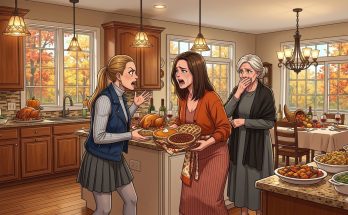
For several seconds, I could hear only the refrigerator humming.
Daniel was staring at me.
I was staring at the recipe tin.
And Margaret’s voice was still coming through the phone.
“Carol?”
“I’m here.”
“Do you want me to send the photograph?”
“Yes.”
A moment later, Daniel’s phone buzzed.
He opened the message.
The photograph filled the screen.
Four adults stood outside St. Catherine’s.
Beatrice Hartley.
Leonard Hartley.
My mother, Ruth.
Evelyn Bennett.
And in Evelyn’s arms—
a baby boy.
On the back, someone had written:
THIS IS THE CHILD RUTH REFUSED TO LET BEATRICE ERASE.
Underneath:
RICHARD CARTER — NOT THE FIRST.
I sat down.
Daniel enlarged the image.
“Mom, this can’t be Dad.”
“No.”
Richard was already twenty-three years old in 1974.
“Then what does ‘not the first’ mean?”
“I don’t know.”
Margaret was still on speaker.
“Rachel has another page.”
“From where?”
“She says it was behind the photograph.”
“What does it say?”
Margaret hesitated.
“It’s a birth record.”
My stomach tightened.
“For whom?”
“Richard Carter.”
Daniel and I stared at each other.
“What year?”
“1951.”
That matched my husband.
I stood again.
“Send it.”
Another message arrived.
The document looked old.
MALE INFANT — CARTER, RICHARD
Date of birth:
August 4, 1951.
Mother:
MARGARET CARTER
Father:
UNKNOWN
I froze.
“My husband’s mother was named Eleanor.”
Daniel nodded.
“Grandma Eleanor.”
I looked at the paper again.
Margaret Carter.
Not Eleanor.
“Who is Margaret Carter?”
Margaret Hartley answered softly:
“I think I know.”
“What?”
“My father had a sister.”
I frowned.
“Leonard?”
“Yes.”
“What was her name?”
Margaret’s voice dropped.
“Margaret.”
The room went silent.
Leonard Hartley had a sister named Margaret.
A woman apparently recorded as the mother of a baby boy called Richard Carter.
Daniel whispered:
“So Dad could have been a Hartley?”
“Possibly.”
I hated how quickly possibility tried to become certainty.
“No.”
Daniel looked at me.
“No?”
“We verify.”
He nodded.
“Right.”
I picked up the photograph again.
The infant in Evelyn Bennett’s arms was from 1974.
So why had somebody written Richard Carter beneath it?
Then I noticed something.
The handwriting wasn’t Ruth’s.
I had just read pages of my mother’s notes.
This was different.
Sharper.
More upright.
“Daniel.”
“What?”
“That isn’t Grandma Ruth’s handwriting.”
He looked closely.
“You’re right.”
Margaret heard us.
“Rachel says her mother told her Dorothy wrote it.”
Dorothy Hartley.
Beatrice’s daughter.
Leonard’s sister.
The woman who had helped type false records.
I closed my eyes.
“Then we ask Dorothy.”
Dorothy was brought back to Margaret’s house that afternoon.
Not secretly.
Not dramatically.
Officer Reyes was present.
So was Ms. Chen.
Rachel Moore agreed to stay and explain what she had found.
I came with Daniel.
When Dorothy saw the photograph, she didn’t look surprised.
“That one.”
I sat across from her.
“You wrote on the back.”
“Yes.”
“What does ‘Richard Carter — not the first’ mean?”
Dorothy folded her hands.
“Because the man you married was the second child to use that name.”
I stared.
“What?”
“Richard Carter was originally the name given to a baby born in 1951.”
“The child on that birth record?”
“Yes.”
“Was that baby my husband?”
“No.”
Daniel stepped closer.
“Then who was Dad?”
Dorothy looked at me.
“Your Richard was born two days later.”
My mouth went dry.
“To Eleanor Carter?”
“Yes.”
“Then why did he have the same name?”
“Because the first Richard died.”
I stopped.
“Died?”
“At two days old.”
Daniel frowned.
“What happened?”
“Respiratory failure.”
“And?”
Dorothy looked down.
“Eleanor and Frank Carter had been waiting years for a child.”
My heart began pounding.
“No.”
Dorothy continued.
“Their baby was stillborn.”
I gripped the chair.
“No.”
“They were devastated.”
“And somebody gave them another baby.”
“Yes.”
“Beatrice?”
“Yes.”
I closed my eyes.
My husband.
My Richard.
Had apparently been placed into the Carter family through the same illegal network that later touched Daniel.
“Who was his biological mother?”
Dorothy looked toward the birth record.
“Not Margaret Carter.”
“Then who?”
“I never knew.”
“Who was his biological father?”
“I don’t know.”
Daniel looked angry.
“Then what do you know?”
Dorothy didn’t flinch.
“I know Beatrice reused the name of the first infant.”
“Why?”
“Because the paperwork already existed.”
That sentence made me sick.
A child reduced to convenient paperwork.
I looked at the photograph from 1974.
“Then why write Richard’s name under a baby born twenty-three years later?”
Dorothy’s expression changed.
“That baby wasn’t Richard.”
“Then why?”
“It was a warning.”
“To whom?”
“Ruth.”
My mother.
“What warning?”
Dorothy looked at Rachel.
Rachel sat stiffly beside Margaret.
Then Dorothy said:
“Beatrice used the phrase ‘another Richard Carter’ whenever she planned to erase one child’s identity and replace it with another.”
My skin crawled.
It wasn’t a name.
It was a code.
Daniel whispered:
“So the baby Evelyn is holding…”
“Was going to be erased.”
“Yes.”
“And Grandma Ruth stopped it.”
“Yes.”
That matched the note.
THE CHILD RUTH REFUSED TO LET BEATRICE ERASE.
“What happened to him?” I asked.
Dorothy looked toward Rachel.
Rachel’s face tightened.
“My mother knew.”
“Helen Moore?”
“Yes.”
“Did she tell you?”
“Only once.”
“What did she say?”
Rachel stared at the photograph.
“She said Ruth took the baby.”
My mouth fell open.
“My mother took him?”
“Yes.”
“Where?”
“She didn’t know.”
“Was he adopted?”
“I think so.”
“Do we have a name?”
Rachel nodded.
“Yes.”
My heart pounded.
“What?”
She looked directly at me.
“George.”
The room went silent.
Patricia’s husband.
Melissa’s father.
George Harper.
I stood.
“No.”
Daniel whispered:
“That would make George—”
“Possibly that baby,” I finished.
Rachel nodded.
“My mother said Ruth arranged a legal adoption outside St. Catherine’s.”
I stared at Dorothy.
“Is that true?”
Dorothy looked ashamed.
“Yes.”
“Why?”
“Ruth was terrified Beatrice would use him in another placement.”
“So she got him out.”
“Yes.”
“Who raised him?”
“The Harper family.”
Thomas’s adoptive relatives.
That explained why George and Thomas had grown up as cousins.
Not blood relatives.
Both connected to Ruth’s search.
My head hurt.
“Did George know?”
Dorothy hesitated.
“Eventually.”
“When?”
“In his thirties.”
That would explain his obsession with the records.
The ledger.
Leonard.
The promises.
His own identity was inside them.
“Did my mother tell him?”
“No.”
“Who did?”
“Leonard.”
Of course.
Daniel rubbed his face.
“So Leonard used George’s identity to control him.”
Dorothy nodded.
“He promised answers in exchange for silence.”
“And later money.”
“Yes.”
That fit.
George wasn’t just chasing a bakery share.
He was chasing proof of who he was.
And Leonard had tied those answers to secrecy for decades.
I thought about the man sitting silently at Thanksgiving.
Suddenly he looked less like a villain and more like another person born into a lie.
That did not excuse anything he’d done.
But it explained some of it.
Then Ms. Chen asked:
“Dorothy, do you know who Richard Carter’s biological parents were?”
Dorothy shook her head.
“No.”
Rachel looked uneasy.
“I might.”
Everyone turned.
“What?”
“My mother had one more photograph.”
Of course.
“Where?”
Rachel opened her bag.
Not hidden.
Not dramatic.
She handed it directly to Ms. Chen.
“Police already scanned it.”
Good.
Ms. Chen passed us a copy.
A young woman sat on a park bench.
Beside her stood Beatrice.
On the back:
1951 — E.C.
My heart pounded.
E.C.
Eleanor Carter?
No.
Rachel said:
“My mother wrote a name in her journal.”
“What name?”
“Elizabeth Cole.”
I didn’t recognize it.
Dorothy did.
Her face changed.
“Elizabeth.”
“You knew her?”
“She worked at St. Catherine’s laundry.”
“Was she Richard’s mother?”
“I don’t know.”
Then Rachel added:
“My mother believed she was.”
Daniel looked at me.
Another possibility.
Another record to verify.
I refused to let it become fact.
“Do we know whether she had descendants?”
Ms. Chen answered.
“We’re checking.”
Good.
Then Rachel turned toward me.
“There is something else about Richard.”
I almost groaned.
She gave a small apologetic smile.
“It isn’t another parent.”
“Thank God.”
“It’s about why he started investigating.”
I sat.
“Tell me.”
“My mother met him.”
“When?”
“1999.”
That surprised me.
“Richard met Helen Moore?”
“Yes.”
“Where?”
“At Hartley’s.”
Again.
Everything seemed to lead back to that bakery.
“Why?”
“Helen had found Ruth’s name in an adoption file.”
“My mother?”
“Yes.”
“She thought Ruth could help her understand who she was.”
“Did she?”
“No. Ruth refused to speak to her.”
I frowned.
“That doesn’t sound like my mother.”
Rachel nodded.
“My mother thought the same.”
“Why would Ruth refuse?”
“Because Richard was there.”
I stared.
“What?”
“Ruth saw Richard walk in and ended the conversation.”
My stomach tightened.
“Why?”
Rachel looked toward the photograph of the 1951 baby record.
“My mother believed Ruth was afraid Richard would recognize something.”
“Recognize what?”
Rachel took out another copied photograph.
Richard.
Young.
Maybe twenty.
Standing beside my mother.
Nothing unusual.
Then she placed the second photograph beside it.
Elizabeth Cole.
The woman from 1951.
The resemblance was obvious.
Same eyes.
Same jaw.
Same narrow chin.
Daniel whispered:
“Dad looked like her.”
“Yes.”
Rachel nodded.
“Helen believed Elizabeth Cole was Richard’s biological mother.”
Possible.
But then I noticed something else.
In the background of Elizabeth’s photograph stood a man.
Half turned.
Young.
Thin.
A familiar profile.
Leonard Hartley.
I stared.
“No.”
Daniel saw it too.
“Leonard?”
Dorothy leaned closer.
Her face changed.
“That’s him.”
My stomach sank.
If Elizabeth Cole was Richard’s biological mother…
And Leonard Hartley his biological father…
Then my husband had been Leonard’s son.
Which would mean—
Daniel and Richard might have been biological half-brothers if Leonard was also Daniel’s biological father.
I sat down.
The room went very quiet.
But again, Ms. Chen stopped us.
“This is an inference from photographs and incomplete records. It is not proof.”
I looked at her.
“Thank you.”
She nodded.
“We need testing where possible.”
Of course.
But the implication still sat there.
Daniel whispered:
“If Leonard was Dad’s father and mine…”
I reached for his hand.
“Richard was still your father.”
“I know.”
“And you were still his son.”
“I know.”
Blood could be strange.
Life was simpler.
Richard had raised Daniel.
That truth required no laboratory.
Then Dorothy spoke.
“Richard knew Leonard might be his father.”
My head snapped toward her.
“He knew?”
“Yes.”
“How long?”
“Since 2001.”
Twenty-five years.
“He knew before he died.”
“Yes.”
“Did he ever confront Leonard?”
“Leonard died before Richard was certain.”
“Did he tell my mother?”
“Ruth knew.”
My anger returned.
“So the two of them shared this secret.”
“Yes.”
“And neither told me.”
Dorothy nodded.
I laughed once.
Not happily.
“My whole family apparently mistook silence for love.”
Nobody argued.
Because it was true.
Then Officer Reyes’s phone buzzed.
He checked the message.
“George has agreed to another interview.”
Patricia, who had joined us quietly, looked up.
“Is he coming here?”
“No.”
“Why?”
“He says he has something to turn over.”
My stomach tightened.
“What?”
“A sealed package.”
“From whom?”
“Ruth Carter.”
My mother.
I closed my eyes.
“Of course.”
Reyes continued.
“He says Ruth gave it to him in 1998.”
“What does it say?”
“He hasn’t opened it.”
That surprised me.
“Why not?”
“Because she wrote on the front that it belonged to Richard.”
My heart tightened.
Richard.
“Then why didn’t he give it to him?”
“George says he tried.”
“When?”
“2001.”
“And?”
“Richard refused it.”
I stared.
“My husband refused a letter from my mother?”
“Yes.”
“Why?”
“George says Richard told him: ‘If Ruth wanted Carol to know, she’d tell Carol.’”
That sounded like Richard.
Finally.
One boundary.
One moment where he refused to open another person’s secret.
“Where is the package now?”
“Police have it.”
“And?”
“There’s another name written beneath Richard’s.”
“What name?”
Officer Reyes looked directly at me.
“Yours.”
My heart pounded.
“How?”
“The envelope says:
FOR RICHARD. IF HE REFUSES, GIVE THIS TO CAROL AFTER I’M GONE.”
My mother had died twenty years ago.
And George had kept it.
I looked at Patricia.
She lowered her eyes.
“Did you know?”
“No.”
I believed her.
For once.
Officer Reyes continued:
“There’s one more instruction.”
“What?”
He read it from his phone.
CAROL MUST READ THIS BEFORE SHE DECIDES WHAT TO DO WITH HARTLEY’S.
I frowned.
“Hartley’s?”
Margaret looked equally confused.
Then Dorothy went still.
“What?” I asked.
She stared at me.
“You don’t know.”
“Know what?”
Dorothy looked toward Margaret.
Then back at me.
“Leonard didn’t leave the bakery entirely to Margaret.”
My stomach tightened.
“He left most of it to her.”
“And?”
“He left another share in trust.”
“For the women in the records?”
“Partly.”
“How much?”
Dorothy hesitated.
“Twenty-five percent.”
I stared.
“To whom?”
She looked directly at me.
“To Richard Carter.”
My husband.
Daniel whispered:
“Dad owned part of Hartley’s?”
“Not outright,” Dorothy said. “The trust activated only if he accepted it.”
“Did he?”
“No.”
“Why?”
“Because he believed the money came from guilt.”
That matched his letter.
Guilt can write checks too.
“So what happened to his share?”
Dorothy looked at me.
“The trust says if Richard refused it, the interest passes to his spouse.”
I stared at her.
“No.”
“Yes.”
“Me?”
“Yes.”
I almost laughed.
I baked pies in a business I apparently partly owned and nobody thought to mention it.
But before anyone could turn this into some ridiculous revenge fantasy, I shook my head.
“Not today.”
Dorothy frowned.
“What?”
“I don’t care what percentage is mine.”
“Carol—”
“I care about whether people were harmed and whether the records are handled properly.”
Margaret nodded.
“Good.”
“We deal with ownership later.”
“Agreed.”
Then I looked at Officer Reyes.
“I want my mother’s letter.”
“As soon as it is documented.”
“Fine.”
No rushing.
No grabbing evidence.
I was learning.
Three hours later, Reyes returned with a scanned copy.
The original remained secured.
I sat beside Daniel.
Thomas sat across from us.
Margaret nearby.
I opened the copy.
Ruth’s handwriting.
Richard,
If George gives you this and you refuse to read it, then Carol will. That is probably for the best.
I smiled despite myself.
She knew Richard.
Then:
Leonard Hartley believes money can correct what he helped do. It cannot.
He has placed shares of the bakery into trusts for several people affected by St. Catherine’s. Accept or refuse as you choose.
Then:
What matters is this: Leonard is almost certainly your biological father.
My breath caught.
Almost certainly.
Not definite.
Ruth continued:
I found Elizabeth Cole. She confirmed Leonard was the father of the child she surrendered in 1951. She was told the baby died. He did not. He became you.
I covered my mouth.
Richard.
My husband.
A child stolen through false paperwork.
Just like so many others.
Daniel’s eyes filled.
Then came the line that changed the meaning of everything.
Richard, Leonard later became involved in Carol’s fertility treatment without knowing Carol would become your wife.
I stopped.
So this wasn’t a planned family entanglement.
It was another consequence of decades of secrecy.
When he discovered Carol’s identity, he tried to stop the procedure. Harold refused.
My heart pounded.
Richard had believed Leonard knowingly became involved.
But Ruth’s letter suggested Leonard tried to stop it.
Again, conflicting records.
Again, we would verify what we could.
Then:
If Leonard was the source used for Daniel, that makes you and Daniel biologically related. But do not let anyone tell either of you this makes your life together unnatural or false. You raised that boy. He is yours in every way that matters.
Daniel started crying.
I put my arm around him.
I kept reading.
Carol will be angry that we kept this from her. She should be.
I laughed through tears.
Finally.
Someone had predicted me accurately.
Do not ask her to forgive quickly.
My throat tightened.
Then:
There is one final thing I need Carol to know.
I slowed.
I did not stop the transfer at St. Catherine’s alone.
I frowned.
Eleanor Carter helped me.
Richard’s adoptive mother.
My mother-in-law.
The woman I had loved for thirty years.
She had died before Richard.
I stared at the page.
Eleanor knew Richard had been illegally placed with her family. She lived with that guilt every day of her life. When she learned Beatrice was trying to take Daniel, she came to the hospital and stood beside me.
My eyes filled.
I remembered Eleanor arriving that afternoon.
I thought she had come to meet her grandson.
Apparently she had already been fighting to keep him.
She told Beatrice: “You stole one baby into my arms. You will not steal another out of Carol’s.”
I broke.
I put the page down and cried.
Daniel held me.
For several minutes, there was no mystery.
No ledger.
No percentages.
Just two women who had protected my son when I didn’t even know he was in danger.
Ruth.
Eleanor.
My mother and my mother-in-law.
When I could see again, I finished.
Carol, if you ever learn this, do not remember Eleanor as a thief. She was lied to too. When she learned the truth, she spent the rest of her life trying to make sure nobody repeated it.
Then the final lines:
As for Hartley’s, do whatever lets you sleep at night. Sell your interest. Give it away. Keep baking pies. But if you keep any part of that place, make sure it becomes something Beatrice would never recognize.
Make it honest.
I lowered the letter.
Nobody spoke.
Then Margaret quietly said:
“I think we can do that.”
I looked at her.
“The bakery?”
“Yes.”
“We don’t even know what I legally own yet.”
“I know.”
“And there may be claims.”
“I know.”
“And investigations.”
“I know.”
“But whatever survives…”
Margaret nodded.
“We make it honest.”
For the first time, the future felt more interesting than the past.
Then my phone rang.
Emily.
I answered immediately.
“Grandma?”
“Hi, sweetheart.”
“Can I come over?”
“Of course.”
“Dad too?”
I looked at Daniel.
“He’s already with me.”
She hesitated.
“Mom says she’ll bring me.”
My chest tightened.
“That’s fine.”
Another pause.
“Grandma?”
“Yes?”
“I want to ask you something about Thanksgiving.”
My heart sank.
“What?”
“Can we have it at your house next year?”
I looked at Daniel.
His eyes filled.
Emily continued:
“Not because I feel sorry for you.”
I smiled.
“Good.”
“I just want your pie.”
I laughed.
“You can order one.”
“No.”
Her voice became firm.
“I want you at the table.”
That was different.
That was everything.
“I’d like that.”
“Really?”
“Yes.”
Then she said:
“And Grandma?”
“Yes?”
“Can we use the white gravy boat with the gold edge?”
I looked across the room.
There it sat.
My mother’s gravy boat.
The thing I had walked into Melissa’s house to reclaim.
The little piece of china that had cracked open fifty years of secrets.
I smiled.
“We can.”
And for the first time since I read that bakery ticket with fourteen chairs, I began to imagine a Thanksgiving where nobody had to lie about who belonged at the table.
But we weren’t finished yet.
Because before Emily hung up, she added:
“Grandma, Mom found another note.”
Of course she did.
I closed my eyes.
“Where?”
“Inside Grandpa Richard’s old carving knife case.”
My heart pounded.
“What does it say?”
Emily read the first line:
FOR DANIEL — OPEN ONLY AFTER YOU KNOW THE TRUTH ABOUT ME.
I looked at my son.
Daniel stared back at me.
And I handed him the phone.
Because whatever Richard had left this time—
it belonged to his son.
PART 23 — THE LETTER RICHARD LEFT FOR HIS SON
Daniel took the phone from me and listened while Emily read the first line again.
FOR DANIEL — OPEN ONLY AFTER YOU KNOW THE TRUTH ABOUT ME.
He went very still.
“Where exactly did Mom find it?” he asked.
Emily answered from the other end.
“In Grandpa’s carving knife case. The long wooden one.”
Daniel closed his eyes.
I knew that case.
Richard used it every Thanksgiving.
Every year he sharpened the knife himself, laid it beside the turkey, and complained that nobody else knew how to carve properly.
After he died, I gave the knife set to Daniel.
Or at least I thought I had.
Apparently Richard had hidden one more thing inside it.
Daniel told Emily not to open the envelope.
This time, nobody argued.
Some secrets belonged to the person named on them.
Melissa brought Emily over an hour later.
She carried the knife case.
No drama.
No attempt to read anything first.
That mattered.
Daniel sat at my dining table.
The same table where he had eaten cereal before school.
Where Richard had helped him with algebra.
Where I had once grounded him for coming home two hours late and then slipped him pie because I was weak.
The envelope lay in front of him.
I sat across the room.
Not beside him.
Not hovering.
His letter.
His choice.
He opened it.
The first thing that fell out was a photograph.
Daniel picked it up.
His face changed.
“What?”
He turned it toward me.
Richard and Daniel.
Fishing.
Daniel looked maybe twelve.
Richard had one arm around his shoulder.
Both of them were grinning at the camera.
On the back Richard had written:
MY SON. NOTHING AFTER THIS SENTENCE CHANGES THAT.
Daniel stopped breathing.
I covered my mouth.
Then he unfolded the letter.
He read silently at first.
His eyes moved slowly.
Then stopped.
He looked at me.
“Mom.”
“What?”
“Dad knew.”
My heart tightened.
“Knew what?”
“About Thanksgiving.”
I stared.
Daniel continued reading.
Then he said:
“He knew Melissa was excluding you before he died.”
That part wasn’t completely new.
Richard had confronted Melissa.
But something in Daniel’s face told me there was more.
“He wrote about me.”
“What did he say?”
Daniel looked down again.
Then read aloud.
“Daniel, if you are reading this after your mother has learned the truth, there is a good chance you are angry at Melissa, angry at me, and maybe angry at yourself.”
Daniel stopped.
“That sounds like him.”
“Yes.”
He continued.
“You should be angry at me first.”
My throat tightened.
“Because I knew your mother was being left out, and I thought I could fix it quietly.”
Daniel looked up.
“He tried to handle it himself.”
Of course he did.
Richard hated public conflict.
Loved solving problems.
And apparently had no idea how much damage silence could do.
Daniel continued.
“I confronted Melissa after Thanksgiving 2022.”
That was earlier than we thought.
The first excluded Thanksgiving.
“She told me Carol had chosen not to come because the holiday reminded her of me being sick.”
I shook my head.
Never.
Richard wrote:
“I believed her for exactly three days.”
Despite everything, I smiled.
That also sounded like him.
Daniel kept reading.
“Then I called Carol and asked how Thanksgiving was.”
I remembered that call.
Richard was sitting in his recliner.
He asked whether my little hen turned out well.
I had laughed.
Told him it was dry.
I thought he was simply making conversation.
He had been checking.
Daniel read:
“She said she had eaten alone.”
My eyes filled.
Then:
“I knew then that Melissa was lying.”
Daniel stopped.
His jaw tightened.
“Dad knew for two years.”
“Yes.”
“He knew and still didn’t tell me.”
“Yes.”
Anger flashed across his face.
I let it.
He deserved it.
Then he continued.
“I did not tell you immediately because by then I had learned enough about Emily and the old St. Catherine’s records to know Melissa was acting out of fear.”
Daniel laughed bitterly.
“Everybody acted out of fear.”
Yes.
They had.
Richard wrote:
“Fear explains behavior. It does not excuse it.”
I nodded.
Good.
Then:
“I told Melissa she had one year to tell you herself.”
Daniel looked at his wife.
Melissa lowered her eyes.
“One year?”
She nodded.
“He said if I didn’t, he would.”
“You didn’t.”
“No.”
“And he died.”
“Yes.”
Her voice broke.
Daniel looked back at the letter.
“After I die, if she still hasn’t told you, I want you to know this: your mother did not refuse those invitations.”
Daniel stopped.
His eyes filled.
“She never refused.”
“No.”
“She never even knew.”
“No.”
He pressed the letter against the table for a moment.
Then he whispered:
“I’m sorry, Mom.”
I stood and walked toward him.
“No.”
He looked up.
“I should have known.”
“You should have asked.”
“Yes.”
“That is different from knowing.”
He swallowed.
“I still should have asked.”
“Yes.”
I wasn’t going to erase his responsibility.
But I wasn’t going to turn it into cruelty either.
I touched his shoulder.
“You’ve apologized.”
“I know.”
“What matters now is whether you become the kind of man who asks next time.”
He nodded.
“I will.”
Then he looked back down.
“There’s more.”
Of course.
But this time I wasn’t afraid of Richard’s letter.
It felt less like a trap.
More like a conversation with him.
Daniel continued.
“Now for the truth about me.”
His voice changed.
He read slower.
“I do not know with absolute certainty who my biological father was.”
That surprised us both.
Richard had gathered evidence suggesting Leonard Hartley.
But he had known the evidence was incomplete.
“Ruth believed Leonard was your biological father. I believed that too. But belief is not proof.”
Again.
Verify.
Daniel almost smiled.
“He really did learn.”
“Yes.”
Richard continued:
“What I know is that I was raised by Frank and Eleanor Carter. Eleanor eventually learned I had been illegally placed with them. Frank died without knowing.”
I had never known that.
Eleanor had carried the truth alone.
Then:
“When Eleanor learned what Beatrice had done, she nearly returned me.”
Daniel looked shocked.
“Returned him?”
I whispered:
“He would have been a child.”
Daniel kept reading.
“She packed a suitcase. She put me in the car. She drove all the way to St. Catherine’s.”
My heart pounded.
Then:
“And she could not do it.”
I closed my eyes.
Eleanor.
My mother-in-law.
She had loved Richard.
Whatever paper said, he was her son.
“She turned around in the hospital parking lot and drove me home.”
Daniel swallowed.
Then:
“She spent the rest of her life afraid that loving me meant participating in something wrong.”
That hurt.
Because I knew exactly what Richard would have told her.
Love wasn’t the crime.
The deception was.
The people who stole choice were responsible.
Not the mother who loved the child placed in her arms.
Daniel continued.
“I tell you this because you may now be wondering what biology means for you and Emily.”
He stopped.
We both looked upstairs.
Emily had gone to my guest room to rest.
Richard had written this years before we knew what we’d eventually discover.
“Emily may or may not be biologically yours.”
Daniel’s eyes filled.
“He didn’t know yet.”
“No.”
“Richard continued: If she is not, do not make Eleanor’s mistake and believe love becomes theft simply because somebody lied before you knew the truth.”
Daniel covered his face.
That broke him.
I walked around the table and put my arms around my son.
He cried against my shoulder.
Not loudly.
The way grown men sometimes cry when the child inside them finally understands something.
“I love her,” he said.
“I know.”
“She’s mine.”
“I know.”
“Even if Michael…”
“I know.”
I let him cry.
Then he sat back.
Melissa had tears streaming down her face too.
But she stayed where she was.
This was Daniel’s moment.
He continued reading.
“Now, Daniel, I need to ask you for one thing.”
His voice steadied.
“Do not inherit my habit of protecting people by deciding what they can survive.”
The room went quiet.
Richard was talking to all of us now.
“Tell the truth. Tell it carefully. Tell it with compassion. But tell it.”
Daniel looked toward Melissa.
She looked down.
Then:
“If your marriage survives Melissa’s silence, rebuild it honestly.”
Melissa began crying harder.
“If it does not survive, end it honestly.”
That was Richard.
No demand.
No command to forgive.
No command to divorce.
Choice.
Then:
“Do not stay because of me.”
“Do not leave because of me.”
“Decide based on the life you actually have.”
Daniel folded the letter slightly.
His hands were shaking.
I whispered:
“Keep going.”
He nodded.
The last page was shorter.
“Your mother will probably be furious that I hid so much.”
I laughed.
“Yes.”
Daniel smiled through tears.
“Tell her I know.”
I laughed harder.
Even Melissa smiled faintly.
Then:
“Tell her I was afraid too.”
My laughter disappeared.
“Tell her I loved her badly in some moments and well in others, but I loved her in all of them.”
My eyes filled.
That sentence was more honest than any grand declaration.
Not perfect love.
Not heroic love.
Human love.
Richard.
Then the final lines:
“Daniel, if all of this eventually comes down to blood, money, the bakery, inheritance, or names in old ledgers, remember something.”
Daniel stopped.
“What?”
He read:
“The best thing I ever gave you was not my DNA.”
Silence.
“It was my time.”
My heart broke cleanly.
Daniel cried again.
So did I.
Then the last sentence:
“Spend yours better than I spent mine.”
Daniel lowered the letter.
Nobody spoke for a long time.
Then Emily appeared at the hallway entrance.
She had been standing there.
I don’t know how long.
“Dad?”
Daniel wiped his face.
“Hey.”
She walked over.
“Can I hug you?”
He opened his arms.
She climbed into them like she had when she was little.
And that was the moment something in this family finally began healing.
Not because the mysteries were solved.
Not because everyone was forgiven.
But because someone asked before touching another person’s pain.
Can I hug you?
Choice.
Again.
Always choice.
Later that evening, Melissa asked Daniel if they could talk privately.
He said yes.
They went into the kitchen.
I didn’t follow.
I did not listen.
That was their marriage.
Not mine.
Emily stayed with me.
We made tea.
She found the sweet potato pie.
“You made another one?”
“Yes.”
“Why?”
“Stress baking.”
She laughed.
Then she asked:
“Can I have some?”
“You’re seventeen. You don’t need permission for pie.”
She cut two slices.
Then looked at me.
“Grandma?”
“Yes?”
“Are you going to own Hartley’s?”
I nearly choked on my tea.
“Good Lord, child.”
She smiled.
“Mom said you might.”
“I might own part of it legally. We don’t know yet.”
“What would you do?”
I thought.
The old bakery.
The ovens.
The basement records.
Leonard’s guilt.
Beatrice’s network.
Margaret’s life.
My mother’s work.
Richard’s refusal to accept money he believed was stained by silence.
“I’d keep baking.”
Emily grinned.
“Seriously?”
“Seriously.”
“You’d own a bakery and still bake?”
“I like baking.”
Then I thought more.
“But I’d change some things.”
“Like what?”
I looked at her.
“No hidden rooms.”
She laughed.
“Good start.”
“No secret ownership.”
“Also good.”
“No family recipes stolen from excluded grandmothers.”
She laughed harder.
“That seems very specific.”
“I’ve had a week.”
Then I said:
“And maybe a fund.”
“For what?”
“For people trying to find family records.”
Emily’s expression softened.
“Like Grandma Ruth did?”
“Yes.”
“But professionally.”
“Very professionally.”
“No random old people hiding documents in pies?”
“Absolutely not.”
We both laughed.
Then the front door opened.
Daniel came out.
Melissa followed.
They had both been crying.
But neither looked furious.
That didn’t mean everything was fine.
It meant they had talked.
Daniel sat.
Melissa remained standing.
She looked at me.
“Carol, I have something to tell you.”
I almost groaned.
She quickly added:
“It isn’t a secret.”
“Thank God.”
“I’m leaving for a while.”
Daniel looked down.
I understood.
“You two separating?”
Daniel answered.
“Temporarily.”
Melissa nodded.
“We need space.”
“That sounds wise.”
She looked surprised.
“You’re not going to tell him to leave me?”
“No.”
“Or tell him to forgive me?”
“No.”
“Why?”
“Because Richard specifically asked me to stop deciding other people’s lives.”
Daniel almost smiled.
“So what happens?”
Melissa looked at him.
“We try counseling.”
“Good.”
“And if it doesn’t work?”
Daniel answered.
“Then it doesn’t.”
No drama.
No threats.
No fake happy ending.
Just adults finally making decisions in daylight.
Melissa went upstairs to say goodbye to Emily.
Then Daniel sat beside me.
“Mom.”
“Yes?”
“What do you want for Thanksgiving next year?”
I smiled.
“We are discussing this eleven months early?”
“I’m making sure I ask.”
That made me laugh.
“I don’t know yet.”
“Okay.”
“But I have one condition.”
“What?”
“No fourteen-person surprise table.”
He smiled.
“Deal.”
Then my phone rang.
Margaret.
I answered.
“Please tell me nobody found another baby.”
She laughed.
“No babies.”
“Wonderful. What happened?”
“The lawyer finished reviewing the Hartley trust.”
My stomach tightened.
“And?”
“You do own part of the bakery.”
I sighed.
“How much?”
“Twenty-five percent.”
Emily’s eyes widened.
Daniel stared.
I sat back.
“All right.”
Margaret sounded amused.
“That’s all?”
“What am I supposed to do? Faint?”
“Most people would react more strongly.”
“I have found two relatives, three fake records, a hidden basement, a storage vault, and my mother’s secret ledger this week. Twenty-five percent of a bakery is almost relaxing.”
Margaret laughed.
Then her voice became serious.
“There’s a condition attached.”
Of course there was.
“What?”
“The trust says your interest becomes permanent only after you decide what happens to the historical records.”
I frowned.
“That sounds wrong.”
“Why?”
“Ownership shouldn’t depend on controlling victims’ records.”
There was a pause.
“I agree.”
“Can we challenge the condition?”
“Our attorney thinks so.”
“Then challenge it.”
Margaret exhaled.
“Good.”
“What did you think I’d do?”
“I wasn’t sure.”
“Those records do not belong to me just because my name is on a trust.”
Daniel smiled.
My mother would have approved.
Then Margaret said:
“There is another document.”
I closed my eyes.
“Margaret.”
“I know.”
“Is it at least not hidden in food?”
“No.”
“Fine. What is it?”
“Leonard’s final instruction regarding the bakery.”
“And?”
Margaret hesitated.
“He wrote that if you ever became an owner, you should be shown the old employee roster from 2015.”
I frowned.
“I started in 2015.”
“Yes.”
“What about it?”
“Your application is there.”
“So?”
“Carol…”
“What?”
“You never applied to Hartley’s.”
I stared at the phone.
“What?”
“I hired you.”
“Yes.”
“Because you came in asking about the help-wanted sign.”
“Yes.”
There was a long silence.
Then Margaret said:
“There was no help-wanted sign.”
I went still.
I remembered it clearly.
A handwritten card taped to the bakery window:
BAKER NEEDED. EARLY SHIFT. ASK INSIDE.
“I saw it.”
“I believe you.”
“Then what are you saying?”
“I didn’t put it there.”
My skin prickled.
“Who did?”
Margaret had gone quiet.
“Margaret?”
“The employee roster includes a note from the morning you walked in.”
“What note?”
She read it aloud.
CAROL WILL COME TODAY. GIVE HER THE BACK OVEN POSITION. DO NOT TELL HER WHO ASKED.
My heart started pounding.
“Whose handwriting?”
Margaret answered softly.
“Richard’s.”
I stood.
“No.”
Daniel looked at me.
“Dad?”
Margaret continued.
“Your husband arranged for you to work at Hartley’s eleven years ago.”
I could barely breathe.
Eleven years.
Long before his death.
Long before the Thanksgiving lies.
Long before I knew anything.
“Why?”
“I don’t know.”
Then she added:
“But there’s a second line.”
“What?”
Margaret read:
SHE NEEDS TO BE CLOSE TO THE RECORDS BEFORE SHE KNOWS WHY.
I stared toward my kitchen.
At my apron hanging on the chair.
At the recipe tin.
At my mother’s gravy boat.
Richard had not merely investigated Hartley’s.
He had quietly placed me inside it.
Eleven years before I ever knew there was anything to find.
Daniel whispered:
“Why would Dad do that?”
I didn’t answer.
Because for the first time in this entire story, I wasn’t sure whether Richard had been protecting me, manipulating me—
or preparing me for something he believed I would eventually have to choose.
And whatever that choice was, we were now only five parts away from the end.
 PART 24 — WHY RICHARD PUT ME INSIDE HARTLEY’S