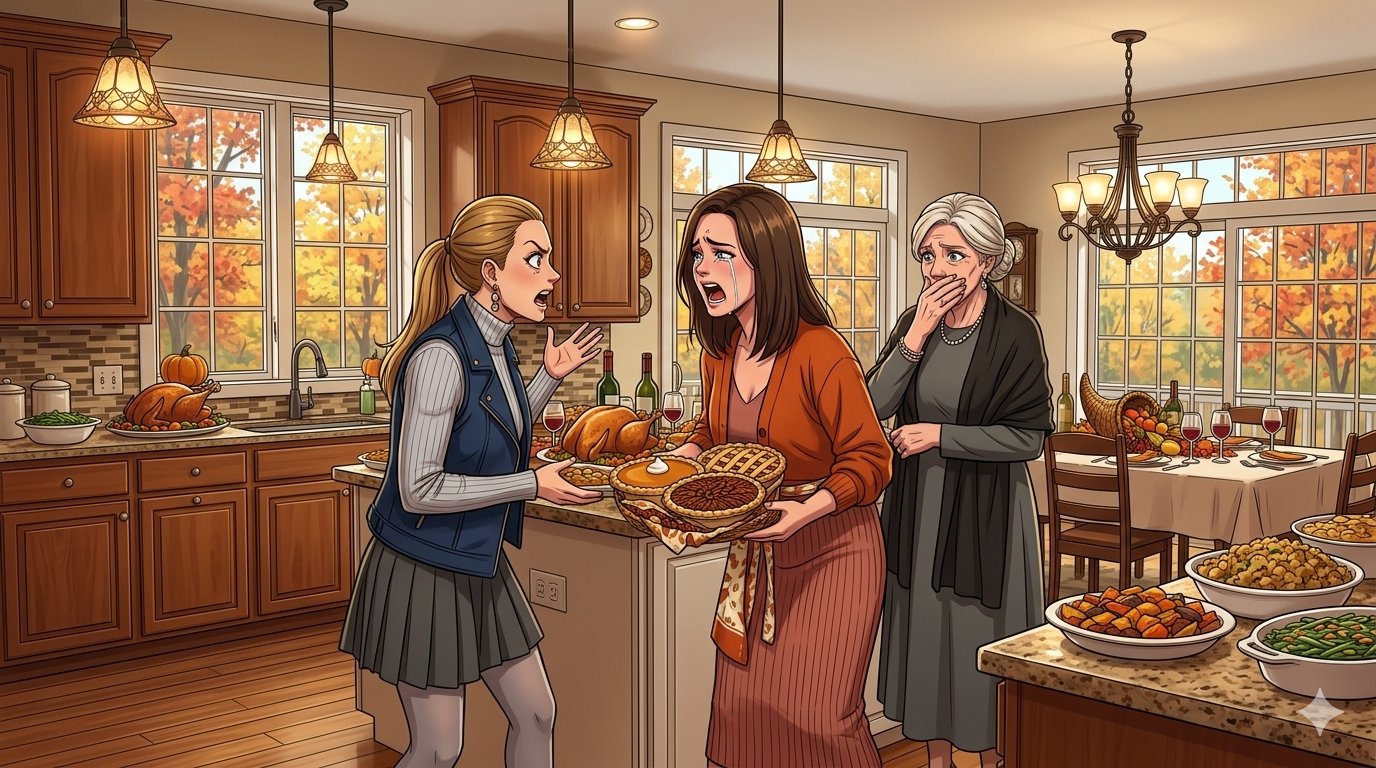
PART 3 — THE PIE LADY AT THE DOOR
My son stared at me as though I had stepped out of a photograph.
“Mom?”
Nobody behind him spoke.
I looked down at the gravy boat in his hand.
Then I looked back at him.
“Happy Thanksgiving, Daniel.”
His mouth opened, but before he could answer, a woman’s voice came from somewhere behind him.
“Who is it?”
Melissa.
I heard her heels crossing the hardwood floor.
Then she appeared beside my son.
She was wearing a cream-colored dress and the pearl earrings I had given her on her wedding day.
For half a second, she smiled automatically.
Then she saw me.
The smile disappeared.
Not slowly.
Completely.
Her eyes dropped to the four Hartley’s bakery boxes stacked in my arms.
Then to my apron, which I had deliberately left on beneath my good coat.
Then back to my face.
“Carol?”
I smiled.
“Hello, Melissa.”
The room behind her had become so quiet I could hear silverware touching china.
And then an older woman stood from the table.
Melissa’s mother, Patricia.
I recognized her immediately. We had met dozens of times over the years—weddings, baptisms, birthdays.
But Patricia looked confused.
She glanced at me.
Then at Melissa.
Then back at me.
“Carol?”
“Yes.”
Patricia pointed toward the boxes in my arms.
“You work at Hartley’s?”
“I do.”
“How long?”
“Eleven years.”
Something changed in her expression.
Melissa saw it too.
“Mom,” she said quickly, “why don’t you sit down? We’ll handle this.”
But Patricia didn’t move.
Instead she looked at the pies.
Then she said the sentence Melissa had probably been praying she wouldn’t say.
“Isn’t that the pie lady you told us refuses to come to Thanksgiving?”
Nobody breathed.
Daniel turned toward his wife.
“What?”
Melissa’s face went pale.
“Mom, that’s not what I said.”
Patricia frowned.
“Yes, it is.”
“Patricia,” Melissa’s father murmured.
“No, George. She said it every year.”
Daniel was still staring at his wife.
“What is she talking about?”
Melissa reached for the boxes.
“Carol, why don’t we put those in the kitchen?”
I didn’t give them to her.
Instead, I stepped across the threshold.
Daniel automatically moved aside.
I carried the pies to the dining table myself.
Fourteen faces followed me.
I recognized some of them.
Melissa’s parents.
Her sister.
Two cousins.
A neighbor.
And my grandchildren.
My granddaughter Emily stared at me as if she couldn’t understand why Grandma had arrived wearing a bakery apron.
“Grandma!”
That one word nearly broke me.
Because she sounded happy.
Actually happy.
She pushed her chair back.
“Why didn’t you tell me you were coming?”
I looked at her.
“I wasn’t invited, sweetheart.”
The silence afterward was different.
Heavier.
Melissa moved quickly.
“That’s not fair.”
I turned toward her.
“I haven’t accused you of anything.”
“You’re implying—”
“Melissa.”
Daniel’s voice stopped her.
I had not heard my son use that tone with his wife before.
He placed the gravy boat carefully on the table.
Then he looked at me.
“Mom, I told you we were keeping Thanksgiving small.”
“Yes.”
His eyes moved around the table.
Fourteen chairs.
Fourteen plates.
He swallowed.
“I thought…”
He stopped.
Melissa stepped closer.
“Daniel, can we please talk privately?”
I unbuttoned my coat.
“No need.”
Then I reached into my handbag.
Melissa saw what I was doing.
And for the first time that morning, I saw real fear in her eyes.
I took out three folded pieces of paper.
I had pressed them flat the night before.
One from three years ago.
One from two years ago.
One from last Thanksgiving.
I placed them beside the gravy boat.
Daniel frowned.
“What are those?”
“Bakery tickets.”
Melissa whispered my name.
“Carol.”
I ignored her.
I opened the first ticket.
“Hartley’s Bakery. Thanksgiving order. Melissa Carter. Three pies. Twelve guests.”
I opened the second.
“Melissa Carter. Four pies. Sixteen guests.”
Then the third.
“Melissa Carter. Four pies. Fourteen guests.”
Daniel stared down at them.
I watched him calculate the dates.
He knew.
Those were the same three years he had called me and said:
Just us this year, Mom.
We’re keeping things quiet.
Maybe Christmas.
He looked at Melissa.
“You ordered these?”
She crossed her arms.
“Yes, but—”
“You told me Mom didn’t want to come.”
Melissa’s eyes flashed toward me.
“I said she usually prefers staying home.”
“No.”
Patricia spoke from the other end of the table.
Everybody turned.
She slowly pushed her chair back.
“You told us Carol was invited every year.”
Melissa’s face tightened.
“Mom, please.”
Patricia continued.
“You said she refused because Thanksgiving made her sad after Richard died.”
My husband’s name entered the room like a cold draft.
I felt it in my chest.
Daniel looked at me.
“Mom?”
I shook my head.
“Nobody invited me.”
Emily’s face fell.
My grandson Jacob looked at his mother.
“You said Grandma didn’t like Thanksgiving anymore.”
That hurt worse than anything else.
Because now I understood.
The lie hadn’t only been told to adults.
It had been handed down to my grandchildren.
Melissa began speaking quickly.
“This is being blown completely out of proportion. Carol has always been uncomfortable around my family, and after Richard died—”
“Don’t use my husband to explain your lie.”
My voice wasn’t loud.
It didn’t need to be.
Melissa stopped.
I folded the tickets again.
Then Daniel picked up the newest one.
His eyes moved across the handwriting.
He stopped at the bottom.
“Extra nutmeg,” he read quietly.
Nobody said anything.
His eyes lifted toward me.
“Family recipe?”
I nodded.
“Mine.”
Daniel looked at the pies.
Then at the table.
Then at his wife.
For the first time, I think he understood what I had understood months earlier.
They wanted my traditions.
My recipes.
My dishes.
My memories.
Just not me.
I buttoned my coat again.
“Well,” I said, “the pies are delivered.”
Emily stood.
“Grandma, stay.”
My throat tightened.
I wanted to.
Lord help me, I wanted to pull out a chair and pretend those three years had never happened.
But I wasn’t going to teach my granddaughter that someone could erase you and all they had to do afterward was offer you a chair.
So I kissed her forehead.
“Not today, sweetheart.”
Then I turned toward Daniel.
“There is only one thing I came to collect.”
I pointed to the gravy boat.
“My mother’s.”
Daniel looked down at it.
Confusion crossed his face.
“Your mother’s?”
“Yes.”
He lifted it carefully.
“Mom, I thought you gave this to Melissa.”
I looked at her.
“I did not.”
Daniel’s face changed again.
Melissa immediately shook her head.
“Wait. That’s not what happened.”
“Then tell him what happened.”
“I thought it was part of the things you were getting rid of after Richard died.”
“No.”
“You had boxes everywhere.”
“Yes.”
“And you told us to take things—”
“I told you to take the boxes marked DONATE.”
Melissa stopped.
I pointed toward the gravy boat.
“That was wrapped inside my china cabinet.”
Patricia slowly sat down again.
Nobody touched their food.
Daniel handed the gravy boat to me.
“Mom, I’m sorry.”
I held it against my coat with both hands.
It felt lighter than I remembered.
Or maybe I had simply carried heavier things since the last time I held it.
I turned toward the door.
And that should have been the end of it.
Except someone behind me said:
“Carol?”
A man’s voice.
A voice I didn’t recognize.
I turned.
The stranger from the photograph was standing at the far end of the table.
Tall.
Gray-haired.
Perhaps seventy.
And he was wearing Richard’s green cardigan.
Up close there was no mistaking it.
I had sewn that brown button onto the left cuff myself after Richard caught it on the basement door.
The man noticed where I was looking.
His hand went instinctively to the cardigan.
“This?”
My fingers tightened around the gravy boat.
“Yes.”
He glanced at Melissa.
Then at Daniel.
His confusion seemed genuine.
“Melissa gave it to me.”
Daniel slowly turned toward his wife.
Melissa didn’t look at him.
The man began removing the cardigan.
“She told me it belonged to her father.”
Patricia’s head snapped toward her daughter.
“My father?”
Melissa said nothing.
The stranger looked embarrassed.
“I didn’t know.”
He folded the cardigan carefully and held it toward me.
“I’ve had this for almost three years.”
Three years.
The same three years.
I took the cardigan.
And when I did, something hard inside the inside pocket knocked against my wrist.
I froze.
The man noticed.
“What is it?”
I reached into the pocket.
My fingers closed around something small and rectangular.
I pulled it out.
It wasn’t money.
It wasn’t jewelry.
It was an old brass key.
A strip of faded masking tape was wrapped around the top.
And written across it, in handwriting I had not seen since the morning my husband died, were four words:
CAROL — HARTLEY’S RECIPE BOX
My knees nearly gave way.
Because I knew that key.
I had been looking for it for three years.
And suddenly Thanksgiving wasn’t about a missing invitation anymore.
I looked across the table at Melissa.
She was no longer pale.
She looked terrified.
And that was when I realized something I should have understood the moment I saw my gravy boat in that photograph.
Melissa hadn’t just taken something from my china cabinet.
She had gone through Richard’s things.
And whatever she had been looking for—
she hadn’t wanted me to find it first.
PART 4 — THE KEY IN MY HUSBAND’S CARDIGAN
For several seconds, I forgot there were fourteen people watching me.
All I could see was the little brass key lying across my palm.
CAROL — HARTLEY’S RECIPE BOX
Richard’s handwriting.
There are things you forget after losing someone.
The exact sound of their footsteps.
The way they cleared their throat before answering the telephone.
Whether they put one spoonful of sugar in their coffee or two.
And then there are things your heart recognizes before your mind catches up.
Richard always wrote my name with the C too large.
That C was too large.
“Mom?”
Daniel stepped toward me.
“What recipe box?”
I closed my fingers around the key.
Melissa answered before I could.
“I have no idea.”
Nobody had asked her.
That was the first mistake she made.
I looked at her.
“I didn’t ask whether you knew.”
Her mouth tightened.
“I’m just saying I’ve never seen that key before.”
The gray-haired man who had been wearing Richard’s cardigan looked increasingly uncomfortable.
He glanced between us.
“I think I should explain something.”
Patricia turned toward him.
“Please do, Thomas.”
So his name was Thomas.
Thomas placed both hands against the back of his chair.
“Melissa gave me that sweater after Thanksgiving three years ago.”
My stomach tightened.
“After Thanksgiving?”
“Yes.”
The first Thanksgiving I had supposedly chosen to spend alone.
Daniel looked at his wife.
“You went through Dad’s clothes?”
Melissa threw up her hands.
“Your mother was donating everything!”
“No,” I said.
She looked at me.
“I donated six boxes.”
I could still picture them lined along my hallway.
Richard’s old work shirts.
Two winter coats.
Shoes he hadn’t worn in years.
Books.
A stack of fishing magazines.
But the green cardigan wasn’t in those boxes.
I knew because I had slept with it folded beside me for the first month after he died.
It still smelled faintly of his aftershave.
I hadn’t been ready to let it go.
I had put it in the cedar chest in my bedroom.
Along with three other things I couldn’t bear to donate.
His watch.
His wedding tie.
And the little wooden recipe box he made for me during our first year of marriage.
Then one afternoon, after Daniel and Melissa had helped me “organize,” I couldn’t find the cardigan.
Or the key to the recipe box.
I thought grief had made me careless.
That is one of the cruel things about grief.
You stop trusting your own memory.
“I thought I misplaced it,” I said quietly.
Daniel heard me.
“What?”
“The cardigan. The key. A few other things.”
He looked toward Melissa.
“You told me Mom was confused after Dad died.”
Melissa stared at him.
“She was!”
The room changed.
I felt it.
Daniel did too.
“What does that mean?”
Melissa rubbed her forehead.
“Daniel, your father had just died. Your mother was exhausted. She couldn’t remember where she put things.”
“So you took them?”
“I didn’t take anything.”
Thomas cleared his throat.
“The sweater came from you.”
Melissa turned toward him.
“Thomas, please don’t make this worse.”
“I’m not trying to.”
He looked apologetically at me.
“She brought over several bags.”
Several.
Not one cardigan.
Several bags.
“What else?” I asked.
Melissa immediately said, “Carol—”
I didn’t look at her.
I kept my eyes on Thomas.
“What else was in those bags?”
He thought for a moment.
“Some clothes. A couple of books. An old desk clock.”
My breath caught.
“Brass?”
Thomas nodded.
“Little feet on the bottom?”
“Yes.”
Richard’s retirement clock.
The men at the plant had given it to him after thirty-eight years.
It had disappeared from my mantel.
I had blamed myself for that too.
Daniel pulled out a chair.
He didn’t sit.
He simply held the back of it as if he needed something solid beneath his hands.
“Melissa.”
She shook her head.
“Your mother told us to clear things out.”
“I told you to take six marked boxes.”
“I thought—”
“You thought my father’s retirement clock was garbage?”
Melissa stopped.
Thomas looked miserable.
“I still have the clock.”
“Keep it for now,” I said.
He blinked.
“I’ll collect everything later.”
Then I looked at Melissa.
“Because apparently we’re going to need a list.”
Patricia covered her mouth.
“Melissa, what did you do?”
“Nothing!”
Melissa’s voice finally rose.
She looked around the table.
“This is ridiculous. She comes here uninvited on Thanksgiving, humiliates me in front of everyone, and suddenly I’m some kind of thief?”
I didn’t answer.
Instead, I slipped Richard’s cardigan over my arm.
Then I placed the gravy boat carefully inside the empty delivery bag.
Melissa pointed at the tickets.
“You’ve been saving those for years. Who does that?”
“Someone who was tired of being told she remembered things wrong.”
That silenced her.
Daniel looked at me.
“Mom…”
There was something awful in his face.
Not anger.
Understanding.
He was beginning to remember.
Every time I had asked about a missing object.
Every time Melissa had said I must have donated it.
Every time Daniel had gently told me:
Mom, you’ve been under a lot of stress.
I had believed him.
Because he was my son.
And because I had begun believing Melissa too.
I suddenly felt very tired.
“I’m going home.”
Daniel stepped forward.
“No.”
I looked at him.
“Please stay.”
“I can’t.”
“Then I’m coming with you.”
Melissa stared at him.
“What?”
Daniel loosened his tie.
“I need to understand what’s happening.”
“On Thanksgiving?”
“Yes, Melissa. On Thanksgiving.”
“You have fourteen people here!”
Daniel looked around the table.
Then he said something I don’t think Melissa expected.
“And apparently my mother was supposed to make fifteen.”
Nobody answered.
Emily quietly started crying.
That nearly changed my mind.
I walked over and hugged her.
“Sweetheart, listen to me.”
She wrapped both arms around my waist.
“I wanted you here.”
“I know.”
“Mom said—”
“I know.”
I kissed the top of her head.
“None of this is yours to carry.”
When I straightened, Patricia was standing beside me.
She touched my arm.
“Carol.”
Her eyes were wet.
“I believed her.”
“So did I.”
That was all I said.
Then I walked toward the front door.
Daniel followed.
Behind us, Melissa called his name.
He didn’t stop.
But just before we reached the door, Thomas spoke again.
“Mrs. Carter?”
I turned.
He looked uncertain.
“There was one other thing.”
Melissa went completely still.
Thomas noticed.
So did I.
“What?”
“When Melissa gave me those bags, there was a small wooden box in one of them.”
My heart stopped.
“What kind of box?”
“Dark wood. Maybe this long.”
He held his hands about twelve inches apart.
“There were little flowers carved into the lid.”
Richard’s recipe box.
The one he made me in 1974.
The one containing handwritten recipes from my mother, grandmother, and eventually me.
The one I thought had disappeared because I couldn’t remember where I’d put it.
“Where is it?”
Thomas looked embarrassed.
“I gave it back.”
“To whom?”
His eyes moved toward Melissa.
“To her.”
Daniel turned slowly.
Melissa backed away from the table.
“I don’t have it.”
Thomas frowned.
“Yes, you do.”
“No.”
“You came to my house for it.”
Melissa’s mother whispered, “Oh my God.”
Thomas continued.
“It was maybe six months after you gave me the bags. You said you’d accidentally included something important.”
My hand tightened around the brass key.
“What was inside it when you had it?”
“I never opened it. It was locked.”
That explained why Melissa needed the key.
Except the key had remained forgotten inside Richard’s cardigan.
Which meant she had retrieved the box but had never been able to open it.
Daniel stared at his wife.
“Where is my mother’s recipe box?”
“I don’t know.”
Thomas shook his head.
“Melissa, you took it.”
“I said I don’t have it!”
Her voice cracked.
And then something happened that none of us expected.
My grandson Jacob, who had been silent the entire time, looked up from his chair.
He was twelve.
Old enough to understand more than adults sometimes realize.
“Mom.”
Melissa froze.
Jacob pointed toward the hallway.
“You do have it.”
Nobody moved.
Melissa stared at her son.
“What are you talking about?”
“The wooden box.”
“Jacob, stop.”
“I’ve seen it.”
Daniel stepped toward him.
“Where?”
Jacob looked at his father.
“In Mom’s office.”
Melissa moved quickly.
“That’s enough.”
But Jacob kept talking.
“It’s in the bottom drawer.”
The room was so quiet I could hear the refrigerator humming from the kitchen.
“She takes it out sometimes.”
Melissa’s face had lost every bit of color.
I looked down at the key in my palm.
Three years.
Three years of thinking grief had stolen pieces of my memory.
Three years of missing Thanksgivings.
Three years of believing I had misplaced things that had actually been carried out of my house.
I looked at my son.
He looked at me.
Neither of us needed to say anything.
Then Daniel turned toward the hallway.
Melissa stepped directly in front of him.
“No.”
He stopped.
“Move.”
“Daniel, listen to me.”
“Move, Melissa.”
“You don’t understand.”
“Then help me understand.”
She looked at me.
And there it was again.
Fear.
Not embarrassment.
Not anger.
Fear.
“Carol,” she whispered, “you really don’t want to open that box.”
I held up the brass key.
“My husband made that box for me.”
“You don’t understand what’s inside.”
My heart began pounding.
Because that was the moment everything changed.
Until then, I had assumed Melissa wanted my recipes.
Maybe she wanted the sweet potato pie recipe she had been pretending was a family tradition.
Maybe she wanted something sentimental.
But Melissa had just admitted something without realizing it.
She knew what was inside.
I stared at her.
“How?”
Her lips parted.
“How do you know what’s inside a box Thomas says was locked?”
Nobody spoke.
Melissa looked toward the floor.
And my son whispered:
“Answer her.”
She didn’t.
I took one step toward the hallway.
Melissa blocked me.
“Carol.”
I looked straight into her eyes.
“Move.”
For three years, I had allowed people to tell me what I remembered.
What I had donated.
What invitations I had supposedly refused.
What kind of mother and grandmother I had become.
Not anymore.
Melissa finally stepped aside.
Daniel walked beside me.
Jacob led us down the hallway.
Behind us, fourteen Thanksgiving dinners sat cooling on fourteen plates.
At the end of the hall was Melissa’s office.
Jacob pointed toward the desk.
“Bottom drawer.”
Melissa stood in the doorway.
I knelt.
Pulled the drawer open.
And there it was.
My recipe box.
Dark walnut.
Flowers carved into the lid.
A little scratch Richard had accidentally made across the corner before the varnish dried fifty-two years ago.
I touched it.
For one second, I was twenty-six again.
Richard was standing in our first kitchen saying:
Now you’ve got somewhere safe for all those recipes.
I lifted the box from the drawer.
It was heavier than I remembered.
I placed it on the desk.
Then I slid the brass key into the lock.
It turned.
Melissa made a small sound behind me.
“Please.”
I opened the lid.
My mother’s recipe cards were there.
My grandmother’s biscuit recipe.
My handwritten Christmas pudding.
The sweet potato pie card.
But underneath them was something that had never belonged in that box.
A sealed envelope.
Yellowed slightly at the edges.
My name was written across the front.
CAROL.
Richard’s handwriting again.
And beneath my name were six words that made Daniel lean closer.
If anything happens to me, read this.
I looked over my shoulder.
Melissa was crying now.
Not loudly.
Silently.
I turned back to the envelope.
And then I noticed something else.
The seal had already been broken.
PART 5 — THE ENVELOPE HAD ALREADY BEEN OPENED
I knew Richard’s envelopes.
For forty-two years, that man sealed everything as though he expected it to cross an ocean.
Birthday cards.
Electric bills.
Even little notes he left in my lunch bag when I worked Saturdays.
He would lick the entire flap, press it down with his thumb, then run a finger across the edge twice.
This envelope had been opened with a knife.
Cleanly.
Carefully.
And then tucked back beneath my recipes as if whoever had read it believed I would never find it.
I touched the sliced edge.
“Who opened this?”
Nobody answered.
Daniel stood beside me.
Behind us, Melissa was crying.
That was answer enough for him.
He turned.
“Did you read my father’s letter?”
Melissa wiped her face.
“Daniel—”
“Yes or no.”
She looked toward the dining room.
Her family was still there.
Nobody was eating anymore.
Patricia had followed us halfway down the hallway, but she stopped when Daniel raised his voice.
“Did you open it?”
Melissa whispered, “Yes.”
Daniel closed his eyes.
I didn’t.
I kept looking at her.
“When?”
She wrapped her arms around herself.
“After Richard died.”
“How long after?”
“I don’t remember.”
“You remember.”
Her eyes met mine.
“Maybe two weeks.”
Two weeks.
Fourteen days after I buried my husband, my daughter-in-law had been inside my bedroom going through his things.
I remembered that period only in pieces.
People bringing casseroles.
Flowers dying in vases faster than I could throw them away.
Daniel taking care of paperwork.
Melissa telling me she would organize the bedroom because I shouldn’t have to look at Richard’s clothes.
I had thanked her.
I had actually thanked her.
“What did the letter say?” Daniel asked.
Melissa shook her head.
“Your mother should read it.”
I almost laughed.
“That’s generous of you.”
“Carol, please.”
“No. You’ve already had your turn.”
I slid my finger beneath the cut flap.
Then I stopped.
My hands were shaking.
Daniel noticed.
“Mom, we don’t have to do this right now.”
“Yes, we do.”
Because I suddenly understood something.
Melissa had hidden this box for three years.
Whatever Richard had written inside that envelope had frightened her enough to steal it from a grieving widow.
That meant I had already waited three years too long.
I pulled out the letter.
There were two sheets.
Richard’s handwriting covered the first.
The second looked different.
Typed.
Official.
I unfolded the handwritten page first.
At the top was a date.
Four months before he died.
I began reading silently.
Then Daniel said:
“Read it out loud.”
I looked at him.
His face had gone pale.
So I did.
“Carol,
If you’re reading this, then either I finally worked up the nerve to tell you, or I didn’t get the chance.”
I stopped.
Richard had never been a dramatic man.
He didn’t speak in riddles.
He bought the same shaving cream for thirty-seven years.
If something was wrong, he said it.
At least I thought he did.
I continued.
“There is something I should have told you years ago. I kept quiet because I believed I was protecting Daniel.”
My son inhaled sharply.
I looked at him.
“What does that mean?”
“I don’t know.”
Melissa did.
I could see it.
She was staring at the floor.
I kept reading.
“When Daniel and Melissa first bought their house, they came to me for help.”
Daniel frowned.
“We didn’t.”
Melissa’s head snapped up.
Daniel looked at her.
“We never asked Dad for money.”
I lowered the letter.
Melissa said nothing.
“Did you?” he asked.
“No.”
Too fast.
I looked back at Richard’s words.
“They were short on the down payment. Melissa asked me not to tell you because she said Daniel was ashamed.”
Daniel stepped backward.
“I wasn’t ashamed. I didn’t even know.”
Melissa finally spoke.
“It wasn’t like that.”
Daniel stared at her.
“How much?”
“Daniel—”
“How much did you take from my father?”
She swallowed.
“Twenty thousand.”
My eyes closed.
Twenty thousand dollars.
Richard and I were comfortable.
But we weren’t rich.
Twenty thousand dollars was not loose change in a drawer.
Daniel looked stunned.
“Dad gave you twenty thousand dollars?”
“It was a loan.”
“Why didn’t you tell me?”
“Because I knew how you’d react.”
“How am I reacting?”
“Exactly like this!”
Daniel laughed once.
There was no humor in it.
“You secretly borrowed twenty thousand dollars from my father and somehow I’m the problem?”
I raised the letter.
“There’s more.”
They both went silent.
I continued.
“I gave her the money because I believed her. Six months later, I discovered there had never been a shortage on the house.”
Daniel’s face changed.
Melissa whispered, “Carol…”
I kept reading.
“She used the money to cover something else.”
The next sentence stopped me.
I read it twice before saying it aloud.
“A credit card in Carol’s name.”
My voice sounded unfamiliar.
Daniel looked at me.
“What?”
I stared at the page.
“I never had a credit card she could use.”
Melissa backed toward the doorway.
Richard’s letter continued.
“I found the statements accidentally when one was mailed to our address. At first I thought Carol had opened the account and forgotten to tell me. Then I looked at the purchases.”
My stomach turned.
I knew what was coming before I read it.
“Furniture. Clothing. Restaurants. Hotel stays. None of them were Carol’s.”
Daniel stared at his wife.
“You opened a card in Mom’s name?”
“No!”
Melissa’s answer echoed down the hallway.
Patricia came closer.
“Melissa?”
“I did not open anything in Carol’s name.”
I looked at the second page.
The typed one.
There was a bank logo at the top.
An account number partly covered with black ink.
And beneath it:
ACCOUNT HOLDER: CAROL ANN CARTER
I had never seen that account before in my life.
The balance printed at the bottom was:
$18,742.61
My knees weakened.
Daniel pulled the desk chair out for me.
I sat.
Melissa shook her head rapidly.
“No. Richard misunderstood.”
I looked up.
“Then explain it.”
“I can’t.”
“Try.”
She pressed both hands against her face.
“It’s complicated.”
That phrase.
People only call something complicated when the simple explanation makes them look terrible.
Daniel took the bank statement from my hand.
His eyes moved down the purchases.
Then stopped.
“What is this?”
Melissa didn’t answer.
“Melissa.”
He held the paper closer.
“November twenty-third.”
My heart skipped.
Thanksgiving week.
Three years ago.
The first Thanksgiving I had spent alone.
Daniel read the charge.
“Northfield Storage. Two thousand four hundred dollars.”
I frowned.
“Storage?”
Daniel looked at his wife.
“What did you store?”
“Nothing.”
“Then why is there a storage company on a credit card in my mother’s name?”
Melissa was crying harder now.
“I can explain.”
“Then explain!”
From the dining room, Jacob called:
“Dad?”
Daniel immediately lowered his voice.
That one word reminded us there were children in the house.
He rubbed his forehead.
“Go sit with Grandma Patricia, buddy.”
Jacob hesitated.
Then disappeared.
I looked back at Richard’s letter.
There was one paragraph left.
I almost didn’t want to read it.
But I did.
“If I am gone before this is settled, Carol needs to know I did not confront Melissa immediately because she promised me she would close the account and repay every dollar.”
I glanced at Melissa.
She wouldn’t look at me.
“But there is another reason I am writing this down.”
My mouth went dry.
“I no longer believe Melissa opened the account.”
Daniel frowned.
“What?”
I continued.
“I believe someone else did.”
Melissa suddenly stepped forward.
“Carol, stop.”
I looked up.
She was terrified again.
“Why?”
“Because Richard was wrong.”
“About what?”
“About all of it.”
“Then you shouldn’t be afraid of a dead man’s letter.”
Her face crumpled.
I looked down.
There were only four lines remaining.
“Three days ago, Melissa finally told me who opened the account.”
Daniel whispered:
“Who?”
I read the next sentence.
And stopped breathing.
Because Richard had written a name.
Not Melissa’s.
Not Daniel’s.
A name I knew.
A name I had not heard anyone say in almost twenty-five years.
I looked toward the dining room.
Then toward the green cardigan lying across the desk.
And finally at Melissa.
“You knew?”
She nodded.
Tears rolled down her cheeks.
Daniel stepped closer.
“Mom, whose name is it?”
I couldn’t answer immediately.
Because suddenly the stranger at the Thanksgiving table didn’t feel like the strangest part of the day anymore.
I handed the letter to Daniel.
He read the name.
His face emptied.
Then he looked at me.
“Mom…”
I closed my eyes.
Because written in my husband’s handwriting were the words:
The account was opened by Daniel’s biological father.
And Richard—
the man who had raised my son from the day he was born—
was not the man Richard claimed Daniel’s father to be.
