Then I found myself making more.
I wrote names on the envelopes until the pile was taller than I had expected.
For the first time, I understood how my mother might have started with a few packets of seeds for a little girl and found herself returning to see what grew.
There was pleasure in giving someone a small beginning.
It felt even better when I could come back and hear what they had done with it.
I put the envelopes in a box by the front door.
On the top one, I wrote a note for Emma.
These came from the flowers you helped protect.
The next afternoon, I took them to Lily’s house.
Emma opened her envelope immediately and counted the seeds in her palm.
There were too many to count.
She tried anyway.
When she lost her place, she looked up at me.
“Can I plant all of these?”
“You can plant some.”
“What about the others?”
“You could give them to somebody.”
She considered that for a moment.
“Then they could have flowers taller than their fence.”
“Yes.”
She closed her hand around the seeds.
“I know who needs some.”
I never asked who she meant.
I liked imagining her deciding for herself.
PART 6: THE LETTER UNDER THE FLOORBOARD
The following winter, I went back to Dad’s old house for the first time since I had sold it.
I had not planned to.
The new owner, a woman named Beth, called me on a Sunday afternoon.
“I hope this isn’t strange,” she said.
“We’re repairing the workshop floor, and we found something with your name on it.”
I looked at the box of sunflower seeds beside my kitchen window.
For a moment, I was back at Rosa’s table, staring at an invoice I had never known existed.
“What did you find?”
“An envelope.”
“It was tucked beneath a loose board near the workbench.”
“Is it sealed?”
“Yes.”
“I haven’t opened it.”
I thanked her and said I would come by the next morning.
After we hung up, I remained at the kitchen table for a long time.
Dad had kept the blue box beneath that same workbench.
He had left letters in drawers, notes on yellow paper, and photographs in places I was still discovering through other people.
I wondered whether he had meant to show me the envelope while he was alive.
I wondered whether I was ready to read it.
Then I heard his voice in my memory, telling me I had a tendency to make a difficult morning even longer by worrying about it the night before.
I made dinner.
I called Lily to ask how Emma was doing.
I went to bed.
In the morning, I drove to the house.
Beth met me at the door wearing paint-splattered jeans.
She had changed the porch light and planted herbs beneath the front window.
For one painful second, I wanted everything to look as Dad had left it.
Then I smelled fresh bread from somewhere inside and realized the house was being lived in.
Dad had cared about that.
Beth led me through the kitchen.
The old table was gone.
A row of mugs stood where Dad had kept his receipts.
I noticed these things without telling her what used to be there.
Out in the workshop, half the floorboards had been lifted.
Two workers were measuring something beneath the far wall.
Beth handed me an envelope stained along one edge with machine oil.
My name was written across the front.
I knew Dad’s handwriting at once.
I turned it over.
There was no date.
“I can give you a few minutes,” Beth said.
“Thank you.”
She returned to the house and closed the workshop door gently behind her.
I sat on the stool that had once stood beside Dad’s bench.
The wood beneath me creaked.
The envelope had been folded once before he sealed it.
I opened it carefully.
Inside was a letter and a photograph.
The photograph showed Dad standing beside a young man in front of the old Hail Mechanical shop.
The young man held a certificate.
He was smiling so broadly that his eyes were nearly closed.
On the back, Dad had written a name.
Eli Turner.
I did not recognize it.
I unfolded the letter.
Clare,
If you found this while sorting through the workshop, I owe you an explanation.
I put it here after Eli visited.
I meant to tell you the story at dinner, but you were having a hard week, and I thought it could wait.
I stopped.
Which hard week?
There had been so many near the end.
A project deadline.
Mark’s mother’s illness.
A plumbing problem at our house.
I could not remember.
I read on.
Eli was the first apprentice your mother and I helped.
He had more talent than confidence.
June saw that before I did.
She told me to stop giving the boy easy jobs and teach him something he could be proud of.
She was right, as usual.
The corner of my mouth lifted.
Dad had said that about Mom many times.
He came back last year to show me his certificate.
He now teaches apprentices himself.
I wanted you to meet him because he remembers a part of your mother’s life that I could never explain as well as he can.
I know I have kept too many of those stories to myself.
Every time I try to tell you one, I miss her before I reach the end.
I lowered the page.
For years, I had wondered why Dad could describe Mom’s habits but rarely finished a story about her.
I had thought he was protecting me from sadness.
I had not understood that telling the story made him miss her too.
Outside, someone moved a board.
The sound brought me back to the workshop.
There was one more paragraph.
I hope we have time to sit here together and talk about her.
If we don’t, please find Eli.
Ask him about the day the lights went out.
Love, Dad.
I read the last two lines again.
Then I looked at the photograph.
Eli’s face was unfamiliar.
His name was not.
I had seen it in the college’s old apprenticeship records.
Rosa knew how to find him.
“He teaches at North County,” she said.
“And yes, I remember the day the lights went out.”
“Will you tell me?”
“I could.”
She waited.
“But your father was right.”
“Eli should.”
I called North County that afternoon.
Eli returned my message before I finished work.
He had a warm voice and spoke quickly until I introduced myself.
Then he stopped.
“Clare Hail?”
“Yes.”
“Is your father with you?”
I looked at the letter on my desk.
“He died a few years ago.”
“I’m sorry.”
“He kept a picture of you.”
Eli let out a breath.
“I kept one of him too.”
We arranged to meet on Saturday at the college where he taught.
When I arrived, I found him in a workshop surrounded by students’ half-finished projects.
He was older than the young man in Dad’s photograph, with a full beard and silver at his temples.
He recognized me as soon as I came through the door.
“You look like June,” he said.
I had learned to accept those words without trying to hide how much they meant.
Eli showed me a seat beside a workbench.
For a while, we talked about Dad.
Eli told me my father never raised his voice in the workshop, which surprised me.
“He saved that for the radio when the news came on,” Eli said.
I laughed.
Then I showed him the letter.
He read it slowly.
When he reached the end, he took off his glasses.
“I didn’t know he remembered that day,” he said.
“What happened?”
Eli looked toward the windows.
“I was nineteen.”
“I’d been working there for about four months.”
“Your mother handled the office, and your father had me following him around with a toolbox.”
“He said I asked too many questions.”
“He also answered every one.”
Outside, rain began to tap against the glass.
“One afternoon a storm knocked out the power across the neighborhood.”
“Your father had two repairs scheduled.”
“One was at a restaurant with a kitchen full of food.”
“The other was at a house where an older man depended on an electric medical device.”
I felt my posture change.
“What did they do?”
“Your father called the man’s family and made sure someone got him to a place with power.”
“He asked another shop to help the restaurant.”
“Then your mother found out several apartments near the shop had no heat or working stoves.”
Eli leaned back.
“She opened the shop’s front room.”
“She brought in every chair we had.”
“Then she sent me to the grocery store for bread, cheese, and whatever else I could carry.”
“Was Dad there?”
“He came back soaked to the skin.”
“He thought we were going to close early.”
Eli smiled.
“Your mother handed him a towel and told him to find more chairs.”
I could picture Dad’s face.
“Did he?”
“He went to the storage room and found six.”
“The lights were out for hours.”
“People stayed in the shop until late.”
“June made sandwiches by flashlight.”
“She asked everyone what they needed, and she remembered the answers.”
Eli looked down at his hands.
“I was new to the city.”
“I didn’t have family nearby.”
“That was the first time I understood why people kept coming back to that shop even when someone cheaper was down the road.”
“Mom helped people,” I said.
“She did.”
“So did your father.”
“They made you feel there was room for you.”
I stayed with Eli until the rain stopped.
Before I left, he took a photograph from a drawer in his desk.
It showed the old shop by flashlight.
People sat close together in mismatched chairs.
Someone had caught Mom turning toward the camera with a plate in her hand.
Dad stood in the background, carrying a chair above his head.
Eli had made a copy for me.
I held it carefully.
For once, the photograph did not show my parents posing outside their business.
It showed them doing what people remembered them for.
That night, I spread the photographs across my kitchen table.
There was the bright blue shop sign.
Mom with Lily beside the apartment building.
Dad with Eli and his certificate.
And now the darkened shop, full of people waiting out a storm together.
I had spent years trying to preserve my parents by keeping their belongings safe.
Their photographs were still in good condition.
Dad’s glasses still sat in their case.
His yellow legal pad had only a few blank sheets left.
Those things mattered to me.
But people I had never met could tell me what my parents had done on an ordinary afternoon.
Their stories had traveled farther than anything stored in the house.
I thought about Dad placing the letter beneath the workshop floorboard.
He had wanted us to sit there together.
We never did.
I could not recover that conversation.
I could, however, keep having the ones he had pointed me toward.
I picked up my phone and sent Rosa a picture of Eli’s photograph.
A minute later, she replied.
June made me bring more cups that day.
I was annoyed because I had finally sat down.
I laughed aloud.
Then another message arrived.
Your father told me afterward that she would have opened the whole building if she could.
I looked at Mom in the photograph, holding a plate in the dark.
I thought she probably would have.
A month later, Rosa called with news about the college workshop.
A storm had damaged part of the roof.
Classes were being moved while repairs were arranged.
“The fund can cover a student’s tools,” she said.
“It can’t fix the roof.”
“Do they have a plan?”
“They’re getting estimates.”
“Can the students keep attending classes?”
“For now.”
Rosa hesitated.
“I called because you’re part of the committee.”
“I’ll send you what we know.”
I had learned enough about the fund to know a roof repair required more than a quick decision.
I asked Rosa for the estimates and the college’s plans.
I read them over two evenings.
Then I met with the director, the instructor, and the other committee members.
We talked about what the college could pay, what the insurer had approved, and how long the workshop would be closed.
It was not a dramatic meeting.
There were spreadsheets, questions, and a frustrating discussion about where to store several heavy machines.
I liked that everyone had come prepared.
By the end, we had a plan for temporary space and a way to cover the remaining repair costs without reducing support for the students.
When I got home, I placed my copy of the plan beside Dad’s letter.
He had helped people in emergencies with the tools and time he had.
I had more resources.
I also had people around the table who knew how to use them well.
The repaired workshop reopened in late spring.
Mateo was there to help move equipment back inside.
He had finished his course and found work, but he came on his day off.
When I asked why, he shrugged.
“Someone helped me get started here.”
He lifted one end of a workbench before I could ask anything else.
I took the other end.
That summer, the sunflowers returned.
Some came from seeds I had planted.
Others appeared where the previous year’s flowers had dropped them.
One grew between the fence and the path, in a place I would never have chosen.
It was the tallest of all.
Emma came over in August and declared it her favorite.
“It planted itself,” she said.
“It did.”
“Are you going to move it?”
“I don’t think it would like that.”
“Good.”
She went inside to find a ruler, determined to measure it even though neither of us had brought a ladder.
I stood by the fence and looked at the flower above me.
I had made room for a garden.
I had not decided exactly how every plant would grow.
For the first time in a long while, that felt comfortable.
When Emma came back, she held the ruler over her head and announced a measurement that was plainly too short.
I wrote it down anyway.
We could measure again next week.
PART 7: THE PLACE JUNE MADE ROOM FOR
The week after Emma measured the sunflower, a woman came to the college looking for Rosa.
Her name was Celia Ward.
She stood in the workshop doorway holding a cardboard box against her chest while students moved equipment around her.
Rosa was helping an instructor sort supplies when she saw her.
“Celia?”
The box nearly slipped from Celia’s hands as Rosa crossed the room.
They embraced for a long time.
I stepped away to give them privacy, but Rosa called me back.
“Clare, this is Celia.”
“She knew your mother.”
By then I had grown used to hearing those words.
They still stopped me every time.
Celia looked at me carefully.
“I knew her when we were young,” she said.
“Before you were born.”
Rosa pulled out chairs, and the three of us sat at a workbench.
Celia placed the box between us.
“I found these while clearing my brother’s house,” she explained.
“He kept everything.”
“He passed away in June.”
“I’m sorry,” I said.
“Thank you.”
She rested a hand on the lid.
“I was going to give this to Rosa.”
“Then I heard June’s daughter was helping here.”
I looked at the box.
“What’s inside?”
“Something we tried to build.”
Rosa gave a small, surprised laugh.
“I haven’t thought about it in years.”
Celia opened the box.
On top was a photograph of five people standing in front of a narrow brick building.
My mother stood in the middle, holding a clipboard.
Beside her was Rosa, much younger, with her hair falling past her shoulders.
On the back, someone had written:
First day at Briar House.
“Another building on Briar Street?” I asked.
Celia nodded.
“It was two doors down from Daniel Mercer’s mother’s apartments.”
I looked at her.
“What was Briar House?”
“We hoped it would be a place where people could learn trades and find work.”
“When was this?”
“The year before your mother became ill.”
Celia passed me a folder.
Inside were meeting notes, a list of donated supplies, and a drawing of how they planned to arrange the rooms.
There was a classroom, a small workshop, and an office.
The office had June written beside it in pencil.
“Your mother thought the people who needed training most were the ones who couldn’t afford to stop working for it,” Celia said.
“She wanted evening classes.”
“And someone on site to watch children.”
I studied the drawing.
There was a little square at the back labeled playroom.
I could imagine Mom leaning over the paper, making room for one more thing.
“What happened?”
“We opened,” Rosa said.
“For a while.”
“About eleven months,” Celia added.
“We taught basic repairs.”
“Rosa helped people practice for interviews.”
“We found work boots and bus passes when we could.”
“Then the building was sold.”
“We couldn’t afford another.”
Rosa looked at the photograph.
“June was already unwell by then.”
“She was still trying to find us a new place.”
Celia reached into the box and took out a slim notebook.
“This was hers.”
“She left it at my brother’s house after a meeting.”
“I meant to return it.”
“Then so much happened.”
She handed it to me.
Mom’s handwriting covered the first page.
If someone works all day and comes here at night, make sure they can eat before class.
Below that was a list of names and what each person could offer.
Rosa: interviewing, records.
Celia: wiring, instruction.
Ben: carpentry, repairs.
Frank: chairs and tables.
Near the bottom, Mom had written:
Ask John what he thinks about the furnace.
John was Dad.
I smiled.
“He would have had thoughts,” I said.
“He certainly did,” Rosa replied.
I turned the pages carefully.
Some held schedules.
Others held notes about people I had never met.
Next to one name, Mom had written, Can attend Tuesdays if someone watches the children.
Next to another, Needs bus fare until first paycheck.
They were practical notes.
They were also evidence of how closely she had listened.
Then I found a page titled What comes next.
There were three things on the list.
Keep evening classes open.
Find a permanent place.
Ask Clare to visit when she’s older.
I had to close the notebook.
No one spoke while I looked at my mother’s name on the cover.
I was old enough now.
She had never been given the chance to ask me herself.
I took the box home with Celia’s permission.
For several nights, I read through the notebook at my kitchen table.
I tried to understand Briar House as it had actually been.
The drawing made it seem solid and ready for the future.
The meeting notes told a messier story.
A teacher had missed sessions because his car broke down.
Donations arrived late.
The roof leaked in the back room.
Once, someone left the heat on all weekend and the next month’s bill nearly emptied their account.
Mom had written a sharp reminder in the margin about checking the thermostat.
I laughed when I found it.
I had been tempted, at first, to imagine Briar House as a perfect idea cut short.
The notebook gave me something better.
People had opened the doors, kept the lights on, solved problems, and helped others for as long as they could.
When the building was sold, they had tried to continue in borrowed rooms.
Some students had found work.
Others had drifted away.
Life had continued.
I called Celia to ask about the people whose names appeared most often.
She remembered more than I expected.
One had become a maintenance supervisor.
Another had left town.
A woman named Pauline had used the classes to get a job at a school, then returned on Thursdays to help watch children while their parents learned.
“She was wonderful,” Celia said.
“Is she still around?”
“She is.”
“I can ask whether she’d like to speak with you.”
“I’d like that.”
Celia hesitated.
“Clare, I didn’t bring the box because I expect you to reopen Briar House.”
“I know.”
“Your mother would be glad you read it.”
“I’m glad you found it.”
After we hung up, I stood by the kitchen window.
The sunflowers were dark shapes against the evening sky.
For once, I had no idea whether learning more about Mom meant I should do anything at all.
I decided to keep reading.
Pauline lived in a small yellow house with a ramp leading to the porch.
She opened the door before I reached the bell.
“You look more like your father,” she said.
“Everyone else says I look like Mom.”
“You have his walk.”
I had never thought about that.
Pauline invited me in.
She was in her seventies, with bright eyes and a voice that could make even an offer of tea sound like an instruction.
She remembered Briar House vividly.
“I went there to learn how to repair appliances,” she said.
“I ended up looking after six children in the back room.”
“Did you mind?”
“Some evenings.”
“Then one of the mothers got a job because she could finish the course.”
“That made the noisy evenings easier.”
She showed me a photograph of the playroom.
There were shelves of donated books, a rug with worn corners, and a little table covered in crayons.
“You might be in this one,” Pauline said.
I leaned closer.
A girl sat at the table with her back to the camera.
She had two brown braids.
“I had braids when I was little.”
“June sometimes brought you after school.”
I searched the photograph for my face.
There was only the back of my head.
Yet I knew the sweater.
Mom had knitted it.
One sleeve had always been a little longer than the other.
“I don’t remember coming here,” I said.
“You were young.”
Pauline sat beside me.
“You helped me put books away once.”
“I did?”
“You made stacks by size.”
“June said you’d probably grow up to organize the whole world.”
“That sounds exhausting.”
“She thought you’d enjoy it.”
I smiled.
I had spent years imagining Briar House as a part of Mom’s life that had been kept from me.
Here I was in the photograph, sitting in its playroom, too young to remember.
Pauline pointed to the corner of the picture.
“Your mother painted that shelf.”
“It was green because the paint was free.”
“She wanted blue.”
“Like the shop sign?”
“Exactly like the shop sign.”
I stayed until late afternoon.
When I left, Pauline pressed a copy of the photograph into my hand.
“Your mother had ideas,” she said.
“But she always noticed who was in the room.”
I put the photograph in my purse beside the notebook.
On the drive home, I tried to remember sitting at that little table.
I could not.
I could remember Mom humming while she washed dishes.
I could remember the scratch of her wool coat against my cheek when she hugged me after school.
Those memories were enough to bring her close for a while.
The next committee meeting at the college came in October.
We discussed budgets, student applications, and the repaired roof.
I brought Mom’s notebook in my bag but did not take it out until the end.
“There’s something I’d like you to see,” I said.
Rosa looked at me across the table.
I passed the notebook to the instructor, Ms. Alvarez.
She read the first pages while the others waited.
When she reached the drawing of Briar House, she looked up.
“Evening classes,” she said.
“Yes.”
“We’ve been asked about those.”
“How many times?”
“Enough that I remember the calls.”
She passed the notebook to the college director.
He studied the old schedule.
“We offer one evening course now,” he said.
“It fills quickly.”
“Could you offer more?”
“We’d need instructors, room time, and students who could attend regularly.”
I thought of Mom’s notes about bus fare and childcare.
“What stops people from attending?”
Ms. Alvarez answered first.
“Work hours.”
“Transportation.”
“Childcare.”
“Sometimes they don’t think they’re ready.”
We spent another hour talking.
Nobody proposed reopening Briar House.
Nobody promised a new building.
We asked what could be tried in the rooms we already had.
By the end of the meeting, the director agreed to look into adding a second evening course.
Rosa offered to speak with former students about what had helped them stay enrolled.
I agreed to help gather the information.
I went home with Mom’s notebook still in my bag and a list of phone calls to make.
It felt like the beginning of work she would have recognized.
The first evening course began in January.
It met twice a week after six.
The college arranged a nearby room where children could stay with qualified staff while their parents attended class.
There was food on a table outside the workshop before each session.
Nothing elaborate.
Sandwiches, fruit, sometimes soup.
On the first evening, I stood beside Rosa as students arrived in work clothes and winter coats.
One woman came with two small boys, who stopped in the doorway and held tightly to her hands.
A staff member knelt to introduce herself.
The older boy asked whether his mother would be far away.
“She’ll be just down the hall,” the woman said.
He considered this.
“Can she hear me?”
“If you need her, we’ll get her.”
He looked up at his mother.
She looked as nervous as he did.
Then he let go of her hand.
I thought about the note Mom had written beside a stranger’s name decades earlier.
Can attend Tuesdays if someone watches the children.
Rosa touched my arm.
“Come on,” she said.
“The sandwiches need more plates.”
We spent the evening carrying supplies, answering questions, and showing people where to go.
The class began ten minutes late.
Someone had forgotten the extension cords.
Rosa found them.
By eight, the children were building towers from blocks and the students were gathered around a demonstration.
I stood in the hallway with a paper cup of coffee.
Through the classroom window, I watched the woman with the two boys raise her hand to ask a question.
The instructor stopped and listened.
I wished Mom could have seen it.
I wished Dad could have told her what we had done.
Then I thought of their old shop, Briar House, and all the people who had kept sharing what they learned there.
Their work had reached this room.
I stayed until the class ended and helped stack the plates.
In March, Rosa turned seventy-five.
She told everyone she wanted a quiet dinner.
Celia told everyone Rosa had been saying that for years.
Lily offered her garden for a celebration.
We kept it small enough that Rosa did not try to leave when she arrived.
Pauline came.
So did Eli, Erin, Mateo, and several people from the college.
Emma drew a card covered in flowers and handed it to Rosa with both hands.
For a while, Rosa looked at it without speaking.
Then she thanked Emma and tucked it carefully into her purse.
After dinner, Rosa and I sat together beneath a tree while the others carried dishes inside.
“You know,” she said, “June used to worry that Briar House had failed.”
“Pauline said it helped people.”
“It did.”
“But June wanted it to last.”
I thought about the students arriving after work in January.
“I think part of it did.”
Rosa looked toward the house.
“She would be pleased about the evening class.”
“I hope so.”
“She would also tell you to make sure the children get enough to eat.”
“She wrote that down.”
“I know.”
Rosa smiled.
“She told me every week.”
The garden lights came on as the sun set.
Inside, someone began singing to Rosa before the cake was ready.
She shook her head, but she was smiling when she stood to go in.
I followed her.
 :PART 4-Before I knew what I had, my husband quit his job three days after my father passed away and began spending my inheritance.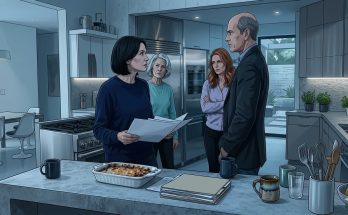

One Comment on “PART 3-Before I knew what I had, my husband quit his job three days after my father passed away and began spending my inheritance.”