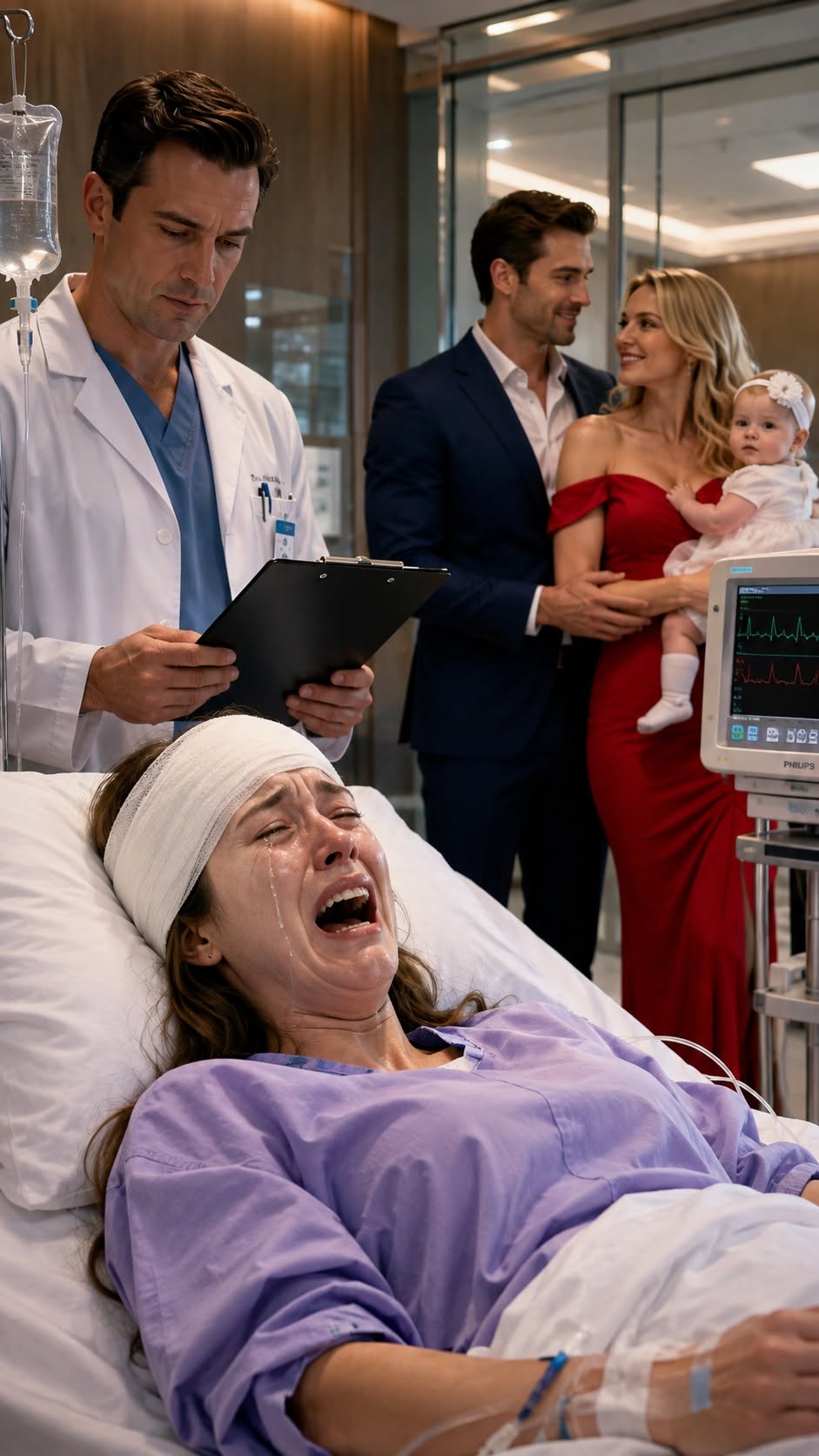
“Sign the dissolution papers before they crack your skull open. If you flatline on the table, at least Claudia and I can get married without wading through a bureaucratic nightmare.”
Those were the exact words my husband delivered to me, precisely two hours before a neurosurgeon was scheduled to slice into my brain.
My name is Camila Vance. I am forty-five years old, and for a decade and a half, I operated under the delusion that I was married to a flawed but fundamentally decent man. That sterile Tuesday morning, lying in a private suite at Northwestern Memorial Hospital in Chicago, I was desperately waiting for Alejandro to walk through the heavy wooden door. I needed him to grip my trembling hand, kiss my forehead, and anchor me against the suffocating terror of a craniotomy.
Instead, he breezed into the room wearing a bespoke charcoal suit, trailing a cloud of expensive vetiver cologne, and gripping a black leather legal portfolio.
“Why are you dressed like that?” I rasped, my throat already dry from the pre-surgical fasting.
“I have a critical client luncheon at noon,” he replied, his tone as smooth and unbothered as a pane of glass.
He unzipped the portfolio, extracted a thick sheaf of stapled documents, and tossed them directly onto the thin hospital blanket covering my legs.
“Claudia and I are ready to officially begin our life together. Her baby boy just turned one. My son, Camila. I have waited in the wings long enough.”
The heart monitor affixed to my chest spiked, the rhythmic beeping accelerating into a frantic, erratic chirp.
Claudia was not a phantom from a late-night text message. She had been my closest confidante since we were seventeen. When the MRI revealed the aggressive mass in my frontal lobe six months prior, she was the first person to envelop me in a tearful embrace. She had sworn, holding both my hands, that she would step in and manage Alejandro’s domestic life so I could focus entirely on radiation and survival.
Lying beneath the fluorescent lights, the true nature of her “management” crystallized with sickening clarity.
Alejandro continued speaking with a serene, sociopathic composure that paralyzed me far more effectively than any anesthetic.
“Look, I have no desire to be vicious about this,” he sighed, checking the gold Rolex on his wrist. “But you were never able to give me an heir. Now, you’re gravely ill. Claudia is vibrant, healthy, and she gifted me a son. I am entitled to a functioning family.”
“How long?” The words tasted like ash in my mouth. “How long have you been sleeping with her?”
“The timeline is entirely irrelevant at this juncture.”
“And the child?”
A smug, paternal pride illuminated his handsome features. “He is mine blood and bone. And honestly? As your oldest friend, Claudia firmly believes you should be gracious enough to be happy for us.”
He leaned over the aluminum bedrail, invading my space, his eyes devoid of anything resembling human warmth.
“Let’s be brutally pragmatic, Camila. If there’s a hemorrhage or a surgical complication today, I absolutely refuse to be gridlocked in probate courts, fighting inheritance disputes and hospital administrators. Just sign the damn paper and set us both free.”
Fifteen years of shared history, of anniversaries and quiet Sunday mornings, distilled into a crude legal transaction minutes before I was wheeled toward possible death.
I stared up at him. And in that fractured, suspended second, the paralyzing terror of the brain tumor entirely evaporated. It was replaced by a glacier of absolute, unadulterated clarity.
“Okay.”
Alejandro blinked, his aggressive posture faltering. “What?”
“I will sign it.”
I reached for the heavy silver pen he offered. My hand shook violently, the IV line taped to the back of my wrist tugging at my skin, but I managed to drag the ballpoint across the bottom signature line.
He snatched the document back, a triumphant, wolfish grin spreading across his face. “I knew your logical side would win out eventually. Good luck under the knife.”
He pivoted on his Italian leather heel and walked out of the room. He didn’t offer a final kiss. He didn’t touch my shoulder. He didn’t even glance back at the door.
I lay alone in the sterile silence, staring at the ceiling tiles. I didn’t shed a single tear.
Because as Alejandro strutted down the hospital corridor, clutching his expedited divorce decree, he was entirely oblivious to a catastrophic reality.
The sprawling, glass-walled penthouse in downtown Chicago where he planned to build his new life with my best friend had not been purchased by him. The platinum credit cards he swiped with reckless abandon to finance his designer wardrobe, his Michelin-star dinners, and his Rolexes were not underwritten by his mid-level corporate salary. And the generous monthly wire transfers dispatched to keep his parents’ failing carpentry workshop in Indiana afloat did not materialize from his fictional “stock dividends.”
Every single cent was mine.
But the execution of my vengeance depended entirely on one fragile contingency: I had to survive the next seven hours.
Chapter 2: The Architecture of a Lie
When my late father, Arthur Vance, passed away, he didn’t just leave me a modest life insurance policy. He left me a monolithic commercial real estate empire built over forty ruthless years. I inherited a portfolio of high-rise properties, commercial holding companies, and an independent, iron-clad trust.
I kept the entire apparatus strictly isolated from my marital assets. I never flaunted the wealth to Alejandro. I actively downplayed it, shrinking my own shadow to protect his aggressively fragile male ego. I allowed him to play the role of the dominant provider, quietly subsidizing his lavish lifestyle from behind the curtain so he could feel like a king.
It was the most devastating mistake of my life.
When the anesthesia began to burn through my veins, pulling me down into the heavy, chemical dark, I whispered a solitary vow against the surgical mask. If I open my eyes again, the illusion dies.
Seven hours later, I breached the surface of consciousness.
My neurosurgeon was leaning over the recovery bed, an exhausted but brilliant smile lighting up his face. “Camila. Can you hear me? The procedure was flawless. We excised the entire mass with zero neurological complications.”
I hadn’t just cheated death. I had bought myself a front-row ticket to Alejandro’s absolute destruction.
A week later, the moment I could sit upright without the room spinning, I reached for my phone and dialed Richard Vance—my father’s notoriously ruthless estate attorney, who had managed the family holdings since I was a teenager.
I recounted the hospital room ultimatum in stark, clinical detail.
A heavy, dangerous silence hummed over the encrypted line.
“Camila,” Richard finally said, his voice crisp and devoid of emotion. “I require your verbal authorization to execute three immediate protocols. One: We instantly sever the voluntary monthly subsidies to your in-laws in Indiana. Two: We revoke Alejandro’s authorized user status on all primary and secondary wealth accounts. Three: We liquidate and isolate the joint operational funds.”
“Execute it immediately.”
“And regarding the downtown penthouse?”
“Lock down the assets,” I commanded, my voice Raspy but firm. “I want no illegal evictions. We do this with surgical, terrifying legal precision.”
At exactly 9:00 AM the following morning, the financial guillotine dropped.
My phone vibrated violently against the plastic hospital tray. I answered it to the sound of Alejandro screaming.
“What the hell did you do to my accounts?!”
“Your accounts, Alejandro?” I asked, staring blankly at the heart monitor.
“Do not play these psychotic games with me! I am standing inside the Mercedes-Benz dealership trying to finalize the lease on a new SUV for Claudia, and the finance manager just humiliatingly declined my platinum card!”
“Perhaps,” I murmured softly, “you should try financing the vehicle with your actual salary.”
Before he could unleash another volley of curses, I severed the connection, entirely unaware that the true audacity of my replacements was about to walk right through my door.