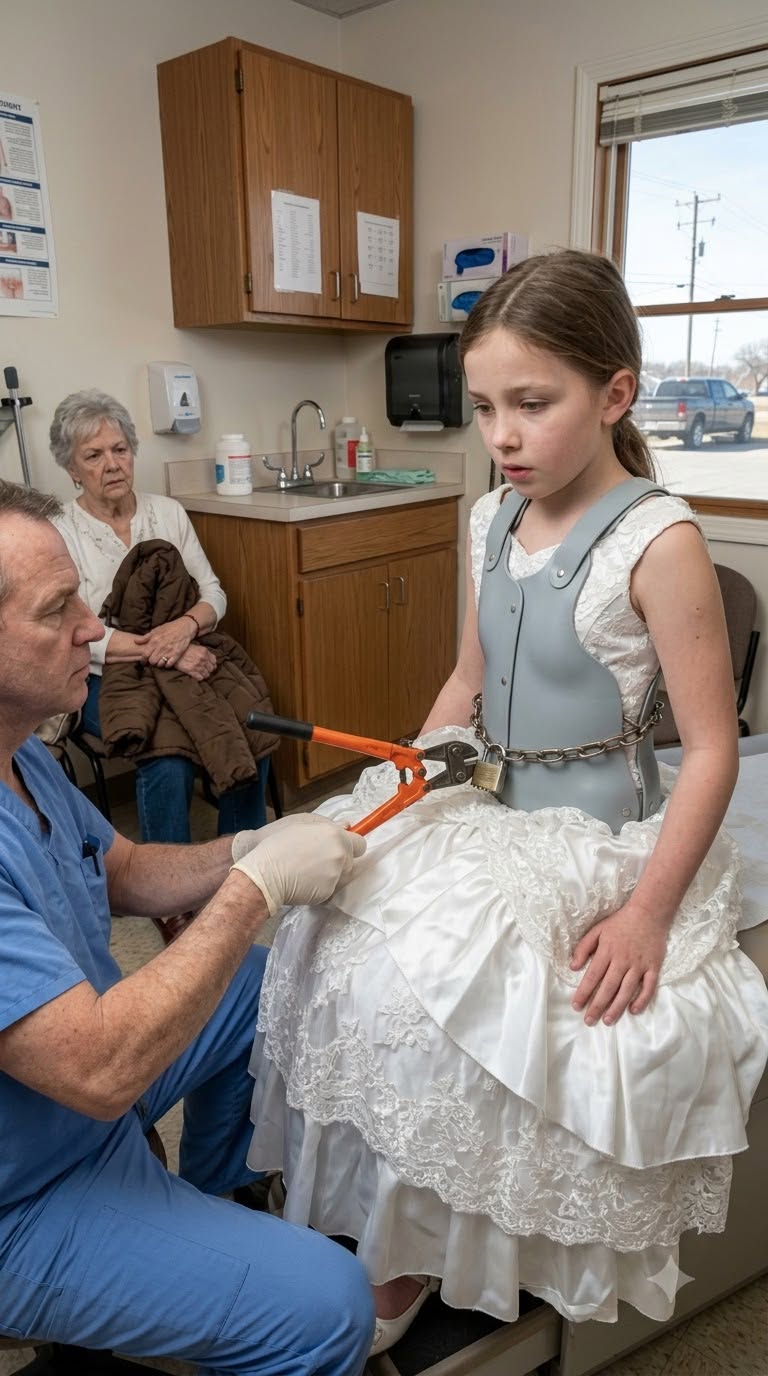
Chapter 1: The Weight of the Chain
The waiting room of Dr. Mercer’s Orthopedic Clinic was suffocatingly warm, smelling of rubbing alcohol and stale, burnt coffee. But it wasn’t the heat that made the air unbreathable; it was the venomous shrieking of a woman draped in a pristine, ivory cashmere coat.
“Are you entirely incompetent, or is your hearing aid malfunctioning?” the woman hissed, slamming her jewel-adorned hand against the reception counter. She was glaring down at Mrs. Higgins, the clinic’s elderly, frail receptionist.
“Ma’am, I apologize, but the doctor had an emergency—” Mrs. Higgins stammered, her thin, liver-spotted hands trembling as she tried to organize a stack of patient files.
“I do not care about some peasant’s emergency!” the wealthy woman shrieked, her face contorting into an ugly mask of entitlement. “My daughter has a tennis tournament tomorrow. I am a platinum donor to the hospital board. You will fetch the doctor right this second, you useless, decrepit old bat, or I will have your pension stripped by afternoon!”
I watched the old woman shrink back, her eyes pooling with humiliated tears. It was a loud, violent, and undeniable display of abuse. Everyone in the waiting room stared, paralyzed by the sheer audacity of the wealthy woman’s cruelty.
But my father didn’t look at them. He didn’t stop to intervene. His hand rested firmly on my good shoulder, guiding me past the screaming woman and the weeping receptionist, steering us toward the exit. In my other hand, I carried a brown paper bag. Inside it rested the two heavy, severed pieces of a steel chain.
My own abuse hadn’t been loud. It hadn’t been screamed in a waiting room. It had been quiet, systematic, and hidden beneath my clothes.
Outside, the morning air bit at my cheeks, much colder than a late-spring day had any right to be. I didn’t wait for Dad to unlock my door; I pulled the heavy passenger side of his Ford truck open and climbed onto the cracked vinyl seat. My stomach seized with a violent cramp before he even turned the ignition key. When he quietly asked if I wanted food, I simply nodded, afraid that if I opened my mouth, I might vomit.
We stopped at a rusted gas station a few miles down the county road. He bought me a sausage biscuit wrapped in foil and a small bottle of orange juice. I ate the biscuit first, letting the scalding grease burn the roof of my mouth just to feel something grounding.
Dad did not eat. I noticed that. He just gripped the steering wheel, his knuckles stark white.
For several agonizing minutes, I watched commercial trucks rumble in and out of the lot. The paper bag rested between us on the seat, making a soft, abrasive scraping noise against the vinyl every time one of us shifted our weight.
Suddenly, Dad reached toward the bag.
My reflexes were faster. I slammed my hand over the crumpled paper first.
“Can I keep it?” my voice was a fragile, reedy thing.
He slowly turned his head to look at me, his eyes shadowed with a profound, terrifying guilt. “The chain?”
I nodded once.
He lowered his hand, resting it heavily on his denim-clad thigh. “Yeah.”
I pulled the bag tight against my leg and took a bite of my biscuit. I kept chewing. I kept waiting for him to break the silence, to tell me I had misunderstood the situation, to explain why Grandma had been right. I was so accustomed to adults rewriting my reality that this prolonged silence felt like a temporary glitch in the matrix.
When he finally spoke, his voice was hollow. “How many times did Grandma lock the brace?”
I stopped chewing. I counted backward through the suffocating mornings, the frantic clinic appointments, the hurried sponge baths, and the terrifying nights when she would yank the straps tight before switching off my bedroom light.
“I don’t know,” I whispered.
Dad stared blankly through the windshield at a flickering neon beer sign.
I swallowed the dry bread. “A lot.”
He rubbed a patch of pale sawdust from the cuff of his flannel shirt, his thumb working the dust until it formed a tiny, perfect line on his jeans. “Did she lock it at night, too?”
I looked down at the paper bag. For years, I had absorbed the pain to protect the adults around me. Today, I chose not to protect him.
“Yes.”
His thumb stopped moving. The truck was dead silent. I unscrewed the orange juice and took a sip. It tasted metallic and overly sweet.
“She keeps the little key on a ring,” I continued, the words spilling out like water from a cracked dam. “She keeps it in the front pocket of her black leather purse. Sometimes, she’d let me hear it jingle before bed.”
Dad’s head snapped toward me, his jaw clenched so tight I thought his teeth might shatter. “She showed you the key?”
“No,” I replied, carefully folding my greasy biscuit wrapper into smaller and smaller squares. “She never needed to show it. I could hear it when she walked down the hall.”
The truck engine remained off. A large refrigerator compressor hummed aggressively through the gas station wall behind us, and I stared at a single, abandoned blue work glove lying in a puddle by the curb.
Dad finally exhaled a breath that sounded like a dry sob. “I should’ve asked you.”
I could have agreed. It would have been the easy thing to do. Instead, I looked at his hands and said, “I should’ve told you.”
He shook his head once, a sharp, denying motion. But before he could formulate a sentence that would make this horrific morning easier for either of us, I turned my face toward the cold glass of the passenger window.
We drove the rest of the way in silence, racing toward the house where the architect of my nightmare was surely waiting.