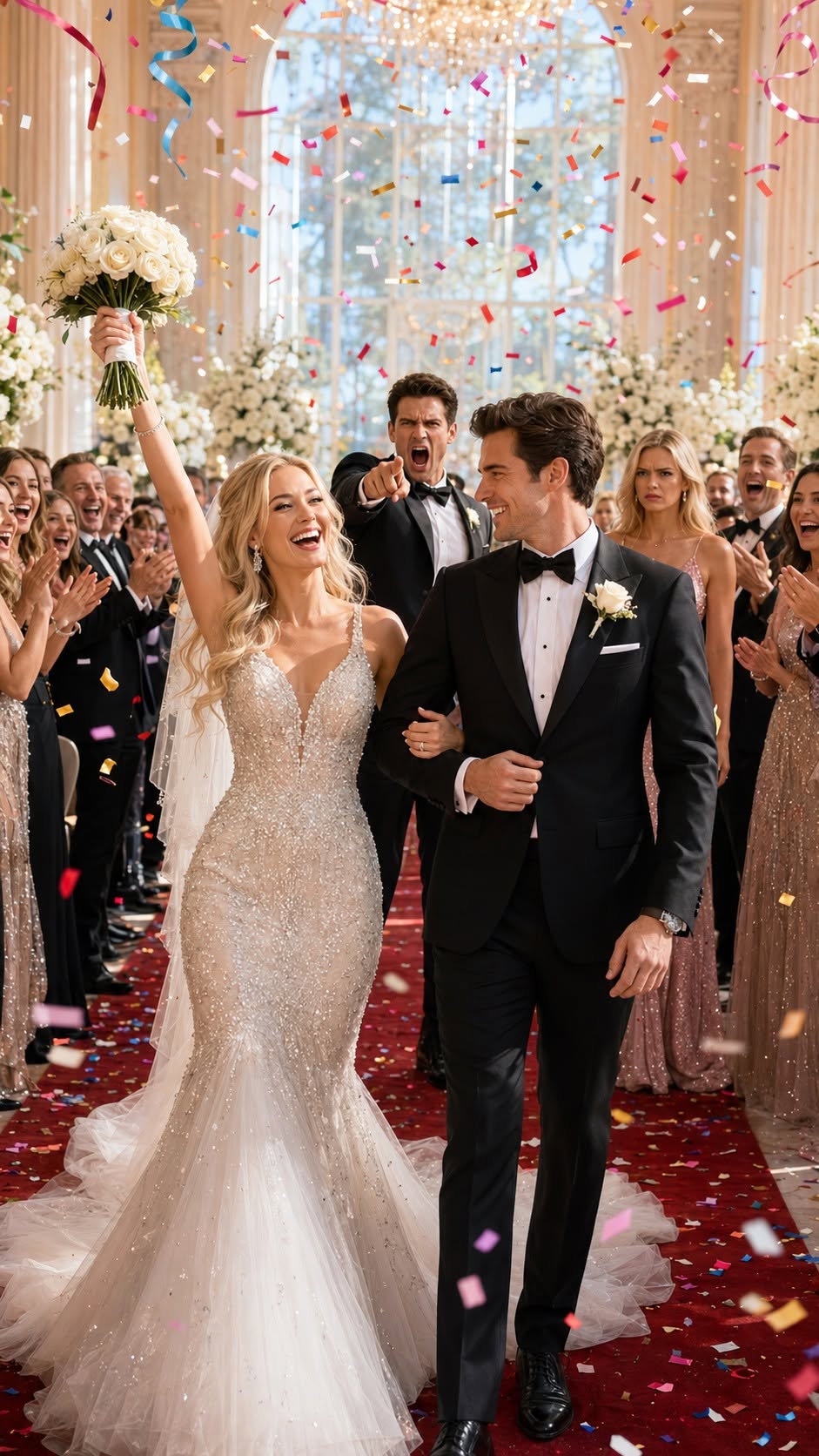
At exactly four fifty-eight in the afternoon, a mere five minutes before I was scheduled to walk down the aisle, Mason Lockwood walked into my bridal suite and demanded I strip off my ivory silk gown and exit through the service elevator.
He offered no apologies. He omitted the trivial detail that he had been sleeping with his Director of Public Relations, Emily Harrington, for the better part of a year. He conveniently forgot to mention that their romance had blossomed during the exact months I was personally co-signing the massive debt restructuring that kept his sinking empire, Lockwood Hospitality, from drowning.
Mason spoke with the sterile, detached cadence of a CEO addressing a minor logistical hiccup. The wedding ceremony, he explained smoothly, was canceled. However, the opulent reception—heavily attended by Wall Street investors and state officials—would pivot into a corporate presentation as planned. Emily would simply take my place in the press photographs. I was expected to vanish quietly, like a ghost who had overstayed her welcome, to avoid a public relations disaster.
For six grueling years, I had shielded this man from ruthless creditors and the suffocating judgments of his matriarchal mother, Eleanor Lockwood. I had masked his insecurities, propped up his balance sheets, and swallowed my own ambitions. Staring at his perfectly tailored tuxedo, the grotesque truth finally crystallized in my mind: Mason had never loved me. He had merely acquired my resilience as a corporate asset.
I shifted my gaze from the door to the antique clock ticking above the marble fireplace. Then, I looked at my phone, where my lead attorney, Victoria Morales, was on standby, waiting for a single, devastating text message.
Heavy footsteps echoed down the hardwood corridor. The suite door swung open, and Eleanor Lockwood glided in, draped in navy blue couture and an heirloom diamond collar. Her signature half-smile—the one she reserved for delivering upper-crust cruelty—was firmly plastered on her face. Right behind her stepped Emily, wearing a champagne gown and a Tiffany & Co. diamond tennis bracelet.
My breath caught. Mason had purchased that exact bracelet in Paris two months ago. When I had asked about it, he claimed it was an aggressive corporate gift for a hesitant Dubai investor.
Emily carefully clicked the door shut behind her, sealing us in. They hadn’t come to prevent a scandal. They had come to stage-manage my execution.
“Serena,” Eleanor murmured, adjusting her Rolex. “We need to handle this discreetly before the press catches wind. You must maintain your dignity. The Lockwood legacy cannot afford a hysterical scene.”
“Are you referring to your son’s chronic infidelity, Eleanor, or my reaction to it?” I asked, my voice terrifyingly calm.
Eleanor’s smile faltered, a microscopic crack in her porcelain veneer. Emily stepped forward, her eyes wide with feigned sympathy. “Serena, I never wanted you to find out like this. I didn’t want to cause you pain.”
I looked at her immaculate hair, her stolen diamonds, and the sheer audacity of her presence in my bridal suite. “A woman who doesn’t want to cause pain doesn’t dress in couture to steal the bride’s stage,” I replied icily.
Mason checked his watch, his face twisting with genuine irritation. He looked at me not as a heartbroken fiancé, but as a stubborn liability delaying his quarterly earnings call. “I can’t marry you, Serena. You constantly make me feel audited. Emily understands how to let me lead.”
He didn’t want a partner. He wanted a cheerleader with a blank checkbook.
“So, you want to cancel the wedding, but keep the investor presentation funded by my trust?” I asked, needing to hear him say it.
“Yes,” Mason replied, entirely missing the trap snapping shut around his ankles.
I picked up my phone and dialed Victoria.
“What are you doing?” Mason snapped, his irritation morphing into apprehension.
“Victoria,” I said into the receiver, ignoring him. “Execute Clause 17. Immediately.”
“What does that mean?” Emily squeaked, clutching Mason’s arm.
I looked dead into Mason’s widening eyes as the digital clock struck 5:00 PM. “It means, as of this exact second, the one hundred million dollar credit line keeping Lockwood Hospitality out of bankruptcy has just lost my collateral guarantee.”
But the financial guillotine wasn’t the only thing waiting for them, because a sharp knock suddenly echoed from the heavy oak doors, and the man standing on the other side was about to turn this severed engagement into a hostile takeover.
Chapter 2: The Aisle of Retribution
“You malicious bitch,” Mason hissed, the blood draining from his face. “You’re doing this out of spite!”
“I am executing the legal terms of our financing contract,” I replied, feeling a strange, freezing calm wash over me. “Any public admission of betrayal or unauthorized use of my collateral triggers an immediate suspension of funds pending a federal audit.”
“Get off my property!” Mason roared, pointing a trembling finger at the door.
“The venue contract is in my name,” I reminded him softly. “I’m not going anywhere.”
My phone buzzed. A text from Victoria: He is at the North entrance. Waiting on your signal.
I bypassed the stunned trio and walked out into the corridor, my heavy silk train whispering against the floorboards. I pushed open the double doors leading to the estate’s sprawling rose garden. The late spring air smelled of damp earth and blooming jasmine. Catering staff froze, sensing the radioactive tension radiating from my bridal gown.
Standing beneath a trellis of white roses was Ryan Sterling.
At thirty-seven, Ryan was Mason’s fiercest Wall Street rival. He didn’t wear flashy bespoke suits or project the loud, desperate arrogance of old money. He wore an immaculate, minimalist black tuxedo and possessed a gravitational pull that commanded boardrooms without a single raised voice. We had met years ago at a Boston architecture conference, sharing a platonic, lightning-in-a-bottle evening discussing corporate rot before Mason ever entered my life. Ryan had always maintained a respectful distance, even when he deduced that the brilliant financial maneuvers credited to Mason were actually my designs.
Ryan’s dark eyes swept over my veil, then locked onto my face. He didn’t offer useless platitudes. He didn’t ask if I was crying.
“Victoria told me you pulled the trigger on Clause 17,” Ryan said, his voice a low, steady rumble. “Do you want to evacuate? I can clear the press, cancel the dinner, and move the investor meeting to a secure location.”
I looked toward the ballroom windows. Inside sat my uncle, waiting to walk me down the aisle in place of my late father. Inside sat the journalists, the stakeholders, and the narrative Mason intended to hijack. If I fled through the garden, Eleanor would spin a tale of my fragile mental collapse. Emily would smile for the cameras. My pain would become their PR triumph.
“No,” I breathed, my hands balling into fists. “The ceremony is happening.”
Mason burst through the garden doors, panting, with Eleanor trailing behind him. “Who the hell are you marrying?!” Mason yelled, his arrogance returning in a desperate wave as he spotted his rival. “Are you out of your mind? You’re dragging Sterling into this?”
Two weeks ago, anticipating Mason’s cowardly nature, Victoria had forced me to draft a catastrophic contingency plan. Marriage was a legal loophole to secure my trust rights without relinquishing asset control. In total secrecy, Ryan and I had driven to an upstate clerk’s office and secured a New York State marriage license, alongside an ironclad prenuptial agreement featuring an immediate divorce clause. I had kept the documents locked away, treating them like a corporate insurance policy, praying I would never need to use them. Ryan had warned me never to sign them out of vengeance.
I looked at Ryan now. I saw the man who had laid out clear legal boundaries, who had never asked me to shrink my intellect to stroke his ego.
“I’m signing the prenup, Ryan,” I said, ignoring Mason completely.
Ryan didn’t gloat. He simply offered me his arm. “Are you certain, Serena? The fallout on Wall Street will be biblical.”
“I am done hiding,” I said, placing my trembling hand on his forearm.
“This is absurd!” Mason screamed, his face purple. “I won’t let you hijack my event!”
My wedding planner, Chloe, stepped out of the shadows, her iPad clutched to her chest. “Ms. Vance, what should I tell the officiant?”
“Tell him to change the groom’s name to Ryan Sterling,” I commanded. “And open the doors.”
As the heavy mahogany doors to the ballroom groaned open, exposing us to three hundred seated guests, the orchestra swelled into my mother’s favorite symphony. But the gasp that ripped through the crowd wasn’t for the bride—it was for the man standing beside her, and the absolute slaughter that was about to unfold on the altar.
Chapter 3: The Corporate Wedding
I walked down the aisle with a terrifying, deliberate slowness. My ivory silk dress felt as heavy as chainmail.
The silence in the ballroom was absolute, save for the frantic clicking of press cameras in the back rows. Uncle Arthur pressed a hand to his chest, his jaw unhinged. Richard Caldwell, Chairman of the Lockwood Board, stood up, his eyes darting between Ryan and the empty space where Mason should have been standing.
Mason had slumped into a front-row pew between Eleanor and Emily, looking like a man watching his own execution. He truly believed I would falter. He believed my dignity would force me to retreat. He was wrong.
When Ryan and I reached the altar, I didn’t turn to the bewildered officiant. I turned to the crowd and grabbed the microphone from the stand.
“Ladies and gentlemen, shareholders, and esteemed guests,” my voice echoed, crisp and metallic, through the cavernous room. “The primary protagonist of this evening has changed. Mere minutes ago, Mason Lockwood canceled our wedding to confess his ongoing affair with his Director of PR, Emily Harrington.”
A collective, horrified murmur rolled through the pews. Flashbulbs erupted like a lightning storm.
“This is a private matter!” Mason vaulted out of his seat, his voice cracking with panic. “Turn off the cameras!”
“You surrendered your right to privacy the moment you decided to use this event—funded entirely by my trust—as a stage to flaunt your mistress to our investors,” I shot back, my voice echoing like a whip crack. I gestured to the back of the room. “Victoria, pull up the slides.”
The massive projector screen behind the altar, originally rigged for Mason’s grand Dubai expansion reveal, flickered to life.
“Three years ago, my personal assets provided the sole collateral for Lockwood Hospitality’s one-hundred-million-dollar credit line,” I announced to the paralyzed room. The screen displayed a tangled web of financial charts. “Recently, I discovered that several shell companies connected to Mason have been siphoning off my collateral to fund a phantom entity named Falcon Holdings.”
Emily shook her head vehemently, shrinking back against the wooden pew. “I don’t know anything about that!”
“Your electronic signature is on the incorporation documents, Emily,” I stated coldly. The screen switched to a damning PDF. “You own twelve percent of a company entirely funded by fraudulent invoices for non-existent image consulting, luxury vacations to the Cayman Islands, and a half-million dollars in untraceable jewelry.”
Emily turned on Mason, her perfectly glossed lips trembling. “You told me those signatures were for standard tax write-offs!”
“Shut up!” Eleanor hissed, yanking Emily back by her champagne gown.
“Because of this unauthorized embezzlement,” Victoria’s voice boomed from the back of the room, “Serena Vance has officially executed Clause 17. All financial backing is suspended until a full federal audit is completed.”
Chairman Caldwell stepped into the aisle, his face pale with fury. “If the collateral is suspended, Lockwood Hospitality is insolvent by Monday morning! How long does this suspension last?”
“Until the collateral is transferred to a stable entity,” Victoria replied, pointing directly at the altar.
Three hundred pairs of eyes shifted to Ryan Sterling.
“Apex Capital submitted an acquisition offer ten days ago,” Ryan announced, his baritone cutting through the chaos. “We guarantee the preservation of all American jobs, the continuation of operations, and the protection of your creditors.”
Mason looked at Ryan, his eyes wild with betrayal. “You’ve been planning a hostile takeover behind my back!”
“It’s only hostile because you hid the buyout offer from your own Board of Directors to save your ego,” Ryan retorted smoothly. “Our offer stands. But it comes with one non-negotiable condition.”
The room held its breath.
“During the federal audit,” Ryan continued, his gaze locking onto Chairman Caldwell, “Mason Lockwood must be immediately stripped of his CEO title and suspended from all corporate grounds.”
Mason looked at me, his face collapsing into absolute despair, and whispered the one question that proved he still understood nothing about the woman he had just broken.
Chapter 4: The Ink and the Irony
“How could you do this to me?” Mason breathed, the microphone picking up his pathetic whimper.
I stared at the man I had spent six years propping up. He didn’t ask how badly he had shattered my heart. He didn’t apologize for the betrayal. He was only mourning his own reflection.
“I didn’t do this to you, Mason,” I replied, my voice dropping to a deadly whisper. “I simply decided to stop protecting you from the consequences of your own actions.”
The ballroom erupted. Chairman Caldwell was already shouting into his cell phone, demanding an emergency board meeting. Emily shoved Eleanor away, screaming about being used as a corporate scapegoat. The illusion of the Lockwood dynasty was peeling away like cheap wallpaper, revealing the damp, rotting cowardice beneath.
Victoria marched down the aisle, slapping two thick, leather-bound folders onto the communion table.
“Judge Warren,” Victoria called out.
An older man with silver hair stepped out from the third row. Judge Thomas Warren, a longtime friend of my late father, approached the altar. He looked at the chaos, then at the documents Victoria had laid out.
“Serena,” Judge Warren said gently, ignoring the shouting match happening in the front pew. “Are you absolutely certain you wish to proceed with this? You can tear this contract up right now. No one is coercing you.”
I looked at the State of New York marriage license. Then I looked at the prenuptial agreement, which mandated total asset separation and granted me absolute financial independence.
“I have lived for years under a suppression I mistook for love,” I told the judge, my hands remarkably steady. “Right now, I am completely free.”
“Mr. Sterling,” the judge turned to Ryan. “Do you consent to these terms, including the immediate divorce clause?”
Ryan looked into my eyes. “Her independence is not a favor, Your Honor. It is the baseline requirement for my presence here. I consent.”
I picked up the heavy fountain pen. As the nib scratched across the thick parchment, a bizarre, shivering adrenaline crashed over me. I wasn’t signing this out of a desperate need for a white knight. I was signing it because the boundaries were transparent, because my doubts were respected, and because I was finally building a fortress where no one could forge my name.
Ryan signed beneath my signature.
“By the power vested in me by the State of New York,” Judge Warren pronounced over the din of the arguing executives, “I pronounce you husband and wife.”
Ryan didn’t grab me for a theatrical kiss. He looked at me, silently asking for permission. When I gave a microscopic nod, he leaned in and pressed a warm, grounding kiss to my forehead.
A smattering of applause broke out, confused and hesitant. Was it a wedding? A breakup? A ruthless corporate merger?
It was all three.
I took the microphone one last time. “The reception dinner will proceed in the dining hall. The corporate presentation is canceled. Chairman Caldwell, I expect the Board in the East Wing conference room in thirty minutes.”
As Ryan and I walked back down the aisle, the adrenaline abruptly vanished, leaving behind a hollow, agonizing ache. I was legally protected, financially secure, and victorious. But as the heavy ballroom doors clicked shut behind us, my knees buckled. A woman can make a ruthlessly correct decision and still grieve the shattered pieces of the future she had dreamed of.
Thirty minutes later, I walked into the East Wing conference room. I had stripped off my bridal veil and pulled my hair into a severe knot. Victoria had draped a stark white blazer over the bodice of my wedding dress. I looked like an angel of death arriving for an audit.
Mason was already there, looking gaunt and terrified. Eleanor and Emily were nowhere to be seen—cowards always scatter when the bill comes due.
I dropped a four-hundred-page binder onto the mahogany table. “Let’s begin.”
For two grueling hours, I projected fake invoices, shell company routing numbers, and suppressed buyout offers onto the screen. Mason tried to claim Emily had forged his signature. I merely pointed out that blaming his mistress for his corporate negligence was a firing offense on its own.
The vote was swift. Six to one. Mason Lockwood was officially terminated as CEO of Lockwood Hospitality.
As the board members filed out, Mason lingered at the door. He glared at Ryan, then sneered at me. “One day, Serena, you’ll realize he only used you to swallow my company.”
“Ryan outlined exactly what he wanted in a legally binding contract,” I replied coldly. “You handed out fake promises in dark rooms where no one could hold you accountable. Leave, Mason.”
He walked out. The heavy door clicked shut.
The second the latch caught, the rigid posture holding my spine together snapped. I reached for a glass of water with trembling hands, but my fingers failed. The crystal glass slipped, shattering violently against the hardwood floor.
Ryan and Victoria froze.
I stared at the glittering shards, a ragged sob tearing its way up my throat, realizing that the hardest part of the war wasn’t the battle—it was the devastating silence of the aftermath, and a secret Eleanor had left ticking like a time bomb in the archives.
Chapter 5: Unearthing the Rot
I didn’t want to go to a lavish bridal suite, and I certainly couldn’t stomach a luxury hotel where the concierge would stare at my tear-stained face. Ryan quietly offered his Upper East Side townhouse, promising I could take the isolated guest house in the garden. I accepted.
That night, alone in a strange room, I spent twenty agonizing minutes unbuttoning the dozens of silk pearls down the back of my wedding dress. When it finally pooled around my ankles, it looked like the molted skin of a woman who no longer existed. I crawled into the unfamiliar bed and wept until my lungs burned—not because I missed Mason, but because mourning the death of your own blinding loyalty is a violent, exhausting grief.
The next morning, the real reckoning began.
I found Ryan in his sunlit kitchen, wearing a simple gray sweater, brewing espresso. Stripped of his corporate armor, he looked softer, human. He slid a steaming mug across the marble island.
“The press caught the scent,” Ryan said softly, tapping his iPad. “They know about the canceled wedding and the boardroom coup. They don’t have the embezzlement details yet. Are you ready for the fallout?”
“I don’t have a choice,” I murmured, staring at the plain silver band Victoria had hastily procured for me the day prior.
Over the next three months, my life shrank to blinding flashbulbs, sterile bank vaults, and relentless interrogations. I moved into a penthouse owned by my trust, and Ryan didn’t protest. We honored our contract: strict separation of assets, scheduled reviews, and absolute respect for each other’s space. The suffocating anxiety I expected from a marriage never materialized. Ryan didn’t demand access. He simply asked what logistical support I required to wage my war.
And a war it was.
The forensic audit unearthed filth deeper than I ever imagined. Falcon Holdings was a textbook money-laundering operation. But the true horror lay in two specific documents tucked into a locked digital sub-folder.
“They forged your signature,” Victoria announced one rainy Tuesday, sliding the printed copies across my desk. “These are guarantee extensions for an additional twenty million dollars in unsecured loans. You never saw these, did you?”
Nausea clawed at my throat. I stared at the perfect loops of my handwriting. “No. Have the handwriting experts verified the source?”
“It’s a digital lift,” Victoria’s eyes were dark with fury. “Extracted from a legitimate tax form you signed two years ago. We traced the IP address of the fabrication.”
“Let me guess,” I whispered. “Emily?”
“No,” Ryan said, stepping into my office, his jaw tight. “Eleanor. It was drafted on the secure desktop in her private Hamptons study.”
The matriarch who had lectured me on the elegance of the Lockwood legacy had digitally counterfeited my identity to keep her son’s sinking ship afloat.
“File the lawsuit,” I commanded, my voice devoid of mercy. “Burn it down.”
When the federal indictments dropped, the tabloids exploded. They branded me everything from a vindictive corporate succubus to a feminist avenger. I ignored them all, granting only a single interview to the Wall Street Journal to assure the two hundred Lockwood employees that their pensions were safe under the new Apex Capital restructuring.
A month later, Mason begged for a meeting.
We met in the sterile, glass-walled conference room of his defense attorney’s firm. He looked utterly hollowed out. His bespoke suits hung loosely on his shrinking frame, and the arrogance that used to fuel his every movement had evaporated.
He rambled for ten minutes about his frozen accounts, his confiscated Bahamian villa, and his impending federal trial. “You don’t even look like you’re hurting,” he spat bitterly, mistaking my composure for apathy.
“My outward calm was always the excuse you used to ignore my internal bleeding, Mason,” I replied, leaning back in my leather chair. “I mourned us months ago, when the relationship could still be saved. You’re only mourning the loss of your ATM.”
He flinched. “I never loved Emily. It was just stress. I was terrified of being known as the incompetent heir who survived on his wife’s charity!”
“So instead of learning, adapting, or simply saying thank you, you decided to humiliate me to stroke your own fragile ego,” I summarized flatly.
Mason dropped his head into his hands. “Do you love Ryan?”
I thought of the quiet mornings, the unforced respect, and the way Ryan never made me feel like my competence was a threat to his masculinity. “I am learning how to exist in a space where a man doesn’t need to erase my identity to assert his own.”
“Please, Serena,” Mason begged, reaching across the table, tears spilling down his gaunt cheeks. “Give me one more chance. I love you.”
“I know you do,” I said, looking at him with profound, devastating pity. “That is the tragedy of this, Mason. You can genuinely love someone and still destroy them so thoroughly that they can never, ever return to you.”
I stood up and walked out, leaving him alone with his ghosts.
But as I stepped out into the bustling Manhattan street, expecting to finally feel the weight of the past lift from my shoulders, a new, entirely different terror gripped my heart when Ryan stepped out of a black town car, holding a velvet box, ready to ask the one question I wasn’t sure I knew how to answer.
Chapter 6: Reclaiming the Signature
The transition from a legally bound business alliance to a genuine marriage didn’t happen in a single, cinematic flash. It happened in the quiet spaces where trauma usually demands panic, but Ryan offered patience instead.
I started seeing a therapist to excavate the deeply ingrained pathology that had kept me tethered to Mason. I realized I had been conditioned to equate love with utility; if I wasn’t saving someone, I didn’t believe I was worthy of their affection. Ryan slowly dismantled that fear. He didn’t need me to fix his company. He didn’t require me to manage his ego. He just wanted me to share my coffee with him in the morning.
Six months post-audit, the Lockwood empire was officially cleansed.
Mason pleaded guilty to federal wire fraud and embezzlement, securing a reduced sentence in a white-collar facility, permanently barred from acting as a corporate officer. Emily, terrified of prison, had turned state’s evidence, detailing exactly how the money was laundered.
Eleanor Lockwood fought to the bitter end, but the IRS is a vastly superior predator than a Hamptons socialite. She was forced to liquidate the ancestral family estate to cover the massive tax liens and federal fines. I felt no gleeful triumph hearing the news—only a quiet, poetic irony.
Apex Capital stabilized the hotels. Not a single maid, concierge, or line cook lost their job. The newly formed Board offered me the role of Chairwoman. I declined. I had no desire to sit on Mason’s stolen throne. Instead, I accepted a two-year term as Head of the Audit Committee, implementing dual-authentication digital signatures so no arrogant family could ever forge their way out of debt again.
When the official SEC restructuring documents were finalized, I stared at the signature line. For years, my name had been buried in the footnotes. I picked up my pen and signed boldly: Serena Vance. I didn’t append Sterling. I didn’t leave a shadow of Lockwood. Ryan completely understood.
A year after the implosion, Ryan and I launched the Vance Foundation, providing free legal, financial, and forensic consulting to women who had sacrificed their youth and assets to prop up family businesses, only to be tossed aside without a paper trail.
For the inaugural gala, I chose the exact same ballroom at the former Lockwood estate—now under new corporate ownership.
I didn’t want to surrender that physical space to my worst memories. I wanted to overwrite the trauma.
That evening, I walked down the identical corridor where Eleanor and Emily had once ambushed me. This time, I wore a crisp, immaculate white pantsuit. As I approached the ballroom entrance, I stopped under the sprawling arch of white freesia.
Ryan was standing there, looking breathtaking in a navy suit.
“Do you remember what the judge asked you right here a year ago?” Ryan asked, his voice a warm murmur over the ambient hum of the arriving guests.
“He asked if I was absolutely certain,” I recalled, smiling softly. “I wasn’t. I knew I had to escape Mason, but I had no idea if marrying you was a catastrophic mistake.”
“I didn’t know either,” Ryan admitted, his eyes crinkling. “But we built the certainty together.”
After I delivered my keynote speech—a speech where I declared that my life didn’t begin when I married a new man, but the moment I stopped asking a traitor for permission to exist—the ballroom erupted in a standing ovation that rattled the chandeliers. I saw women in the audience wiping their eyes. I saw survivors. I saw myself.
Ryan met me in the moonlit rose garden afterward. He reached into his jacket pocket and pulled out a small, dark velvet box.
“Isn’t this an administrative redundancy?” I teased, my heart suddenly hammering against my ribs.
He opened the box. Inside rested a simple, unadorned gold band.
“The first time, I asked you to sign a contract to survive a crisis,” Ryan said, stepping closer, the moonlight catching the gold. “Tonight, there are no hostile takeovers. There are no ticking clocks. I am asking you to choose me in the present, not as a shield, but as a partner.”
He didn’t ask me to void the divorce clause. He didn’t demand a fairy-tale promise of perfection. He just offered me the right to choose.
I took the ring from the box and slid it onto my finger. Engraved on the inside were the words: Nothing is built on your silence.
“Yes,” I breathed, wrapping my arms around his neck.
When we kissed beneath the floral arch, there were no paparazzi flashes. There was no suffocating wedding dress. There was only the profound, unshakable peace of a woman who had finally reclaimed her own name.
Later that week, I took my heavy ivory wedding dress out of storage. I didn’t burn it in a dramatic bonfire, nor did I donate it to be worn by someone else. I hired a tailor to meticulously deconstruct the silk, cutting it into hundreds of small, elegant document pouches.
We give one to every woman who walks through the doors of the Vance Foundation. I slip a small card inside each one: Your name must also appear in the history you are building.
I never explain where the fabric came from. I don’t need to. Because sometimes, the very things that once represented our deepest humiliation can be stitched together, thread by thread, into the armor we use to save the world.