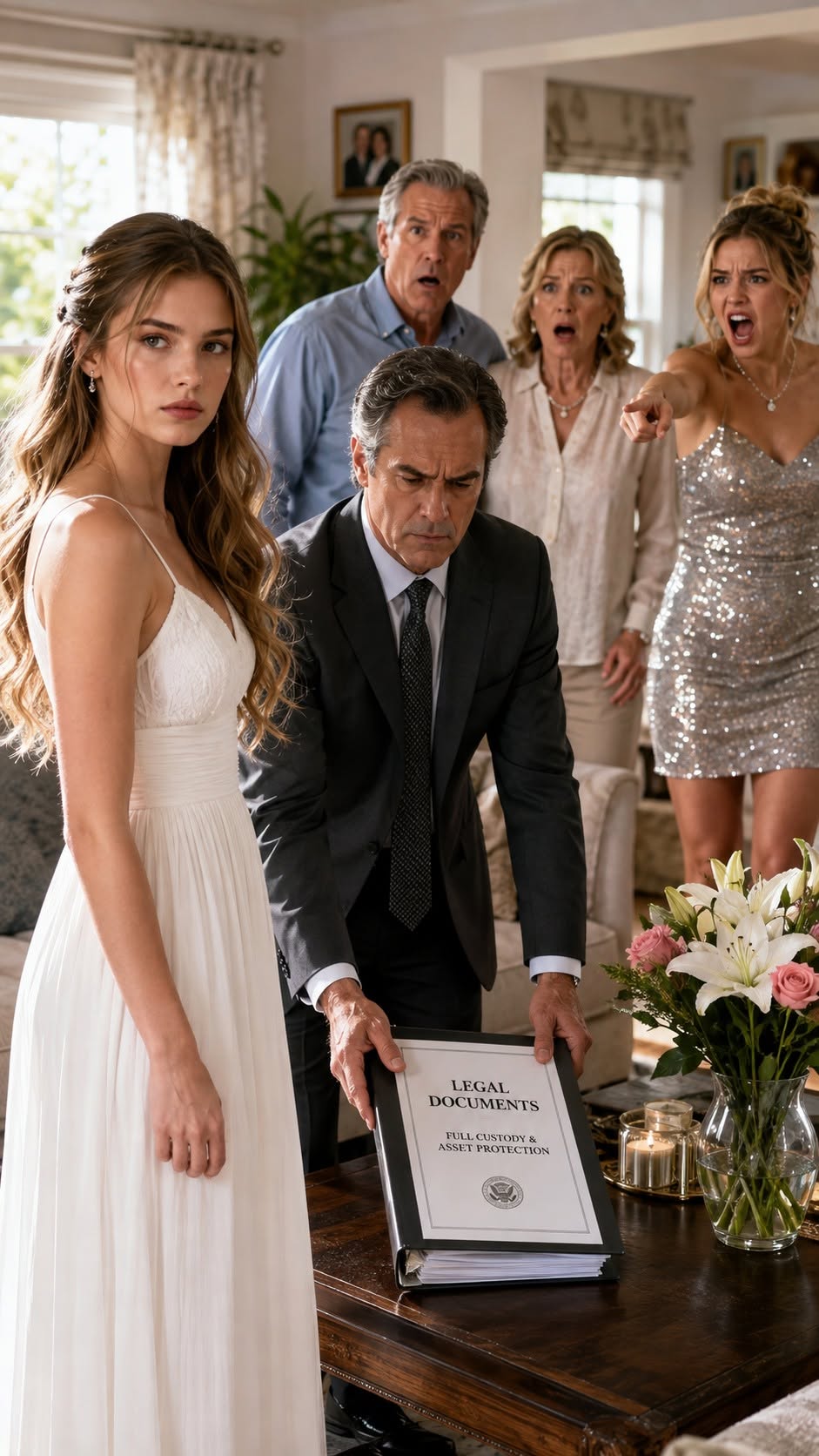
The cruelty in our household didn’t arrive with slammed doors or shattered glass. It wasn’t announced with raised voices. It seeped through the floorboards as quiet expectations, settling into the very foundation of our beige, two-story house in a manicured suburb of Columbus, Ohio.
To the neighbors, we were a portrait of suburban stability. Two parents, two daughters, a lawn my father edged with military precision every Sunday. But inside those walls, my parents had long ago bifurcated humanity into two distinct categories: the people you worried about, and the people you counted on.
My older sister, Rebecca, was the person you worried about. Eight years my senior, she was the family’s perpetual, exhausting project. She was an artist who felt things deeply—my mother’s favorite euphemism for Rebecca’s habit of abandoning every pursuit the moment it grew difficult. She dropped out of college twice. She moved to Chicago to paint, then to a different apartment when the muse abandoned her, then into a commercial studio she swore would become a business, only to vacate it months later when the work required actual labor. Every time the floor gave way beneath her, my parents sprinted to provide a safety net. In our house, love was a rescue mission.
And then there was me. Poppy. The sensible one. The person you counted on.
It sounds like a compliment, doesn’t it? It took me nearly eighteen years to decipher that it was a life sentence. Being counted on was merely a polite synonym for being entirely taken for granted. I was the foundational beam that held up the house while everyone else admired the wallpaper.
I remember coming home at sixteen with my first paycheck from a weekend job at a local hardware store. I loved that job. I loved the scent of sawdust and WD-40, the logical taxonomy of flat washers versus lock washers. I placed that thin paper envelope on the kitchen island like a trophy. My mother, Eleanor, barely glanced up from her phone. “Good for you, honey. See? You never need us to make a fuss,” she murmured, instantly returning to a frantic negotiation regarding Rebecca’s overdue rent.
I didn’t weep. Crying was a currency that held zero exchange rate in my household. Instead, I retreated to my room and opened a plain, blue-lined notebook. It wasn’t a diary. I had no patience for bleeding my feelings onto paper. It was a ledger. I tracked my shifts, my hourly wage, every cent I earned, and every cent I saved. It was intensely boring, and because it was boring, my family ignored it completely. It was the only territory in that house that belonged exclusively to me.
That ledger taught me the immutable language of numbers. Numbers do not flatter you. They do not call you sensible. They simply tell you the unvarnished truth.
By the summer I turned seventeen, the quiet assumptions had hardened into concrete facts. I sat at the dinner table while my parents orchestrated a complex financial maneuver to move Rebecca closer to home. They spoke over my head, mapping out logistics as if I were a potted plant in the corner of the room. We would never do that without asking you, my mother used to coo to Rebecca whenever a minor inconvenience arose. She had never spoken that sentence to me.
But my quiet observation was about to pay off. The summer before my eighteenth birthday, a strange new rhythm infected the house. My parents started house-hunting. The official narrative was that Rebecca needed roots. But the glossy printouts scattered near the coffee maker didn’t align with a single twenty-six-year-old’s lifestyle.
One afternoon, I found a listing for a sprawling estate. Someone had used a heavy graphite pencil to double-underline a specific feature, marking it with a tiny, triumphant star: Main floor in-law suite.
A cold knot formed in my stomach. Why would Rebecca need an in-law suite? I didn’t ask. I had been trained not to. I simply filed it away in the ledger of my mind. The hushed phone calls came next. My father, Glenn Bennett, stopping mid-sentence when I walked into the kitchen. The final puzzle piece was a heavy manila envelope that sat on the hall table for exactly one evening before vanishing into my father’s locked study.
I had memorized the return address. It was a local title company—the kind of entity that finalizes real estate transactions. And printed in the little plastic window was a specific date. A closing date.
It was scheduled for the exact morning after my eighteenth birthday.
They haven’t just found a house, I realized, my pulse thrashing against my ribs in the silent hallway. They have already bought it. But with whose money?
Chapter 2: The Ghost in the Ledger
To comprehend the sheer audacity of what was unfolding, you have to understand my grandfather. Walter Bennett was a man who built things to last. He founded Bennett Mechanical with nothing but a rusted truck and a toolbox, eventually growing it into a massive commercial contracting empire. Even after he became a wealthy man, he kept grease trapped beneath his fingernails.
He was the only person in our bloodline who actually saw me. While Rebecca complained about the dust and noise in his backyard workshop, I thrived there. I spent my summers handing him wrenches, breathing in the scent of ozone and old oil, listening to him explain how broken machines could be coerced back to life. On my eighth birthday, he didn’t buy me a toy. He pressed a small, worn brass key into my palm.
“A key means somebody trusts you to lock up after yourself,” he told me, his voice a gravelly rumble. “You’re the one I trust with mine.”
When I was nine, he sold the company. It was a massive windfall. And with three million dollars of that sale, he did something unprecedented. He didn’t divide it. He didn’t toss it into a communal family pot. He locked it away in a trust, solely in my name, explicitly designed to become entirely mine on the exact day I turned eighteen.
When he fell terminally ill during my thirteenth year, he pulled me close to his hospital bed, the monitors beeping a frantic, failing rhythm. “When you turn eighteen, Poppy, the first thing you do is call Fran. Before you let anyone talk you into anything. Promise me.”
I promised. He died three weeks later. And upon his death, my father became the trustee. The guardian of the money. Not the owner.
Standing in the hallway at seventeen, staring at the space where the title company envelope had been, a sickening realization washed over me. My father had a favorite phrase whenever money was discussed. “It’s all one pot, Pop,” he would say, casually erasing the legal boundaries of my grandfather’s dying wish.
I waited until my parents left for a Sunday service. I picked the lock on my father’s study—a neat trick Walter had taught me with a paperclip and a tension wrench—and slipped inside. The room smelled of stale coffee and printer ink. It took me twelve minutes to locate the hidden folder in his bottom drawer.
I sat in his leather chair, my hands trembling as I unfolded the crisp, white documents.
A purchase agreement. One point five million dollars. Cash. Signed by Glenn Bennett as the sole buyer. The closing was locked in for the morning after I turned eighteen—the very first morning I would legally have the power to sign away my three-million-dollar inheritance. He couldn’t steal it while I was a minor. So, he had built a labyrinthine assumption that I, his agreeable, docile daughter, would simply sign a wire transfer as a birthday gift to the family.
It wasn’t a house for Rebecca. The pencil-starred in-law suite confirmed it. He was using my grandfather’s blood and sweat to buy a sprawling retirement mansion for himself and my mother, and a free ride for my sister.
But it got worse. Clipped behind the agreement was a banking receipt. Earnest Money Deposit: $75,000. Beside it was a statement for a Home Equity Line of Credit. My father had leveraged the roof over our very heads—our beige house—to secure a deposit on a mansion he intended to purchase with money that wasn’t his.
Tears pricked my eyes, hot and furious. I cried for precisely sixty seconds, grieving the grandfather who was still, from beyond the grave, the only person attempting to protect me. Then, I wiped my face. Tears were a luxury. I had forensics to do.
I retreated to my bedroom and pulled a battered shoebox from beneath my bed. For four years, I had intercepted the annual trust statements addressed to my father on my behalf. I had photographed them, logged the numbers in my blue notebook, and hidden the evidence.
I spread four years of financial history across my rug. I matched the dates to my memory. A massive withdrawal the spring Rebecca’s Chicago lease imploded. Another chunk missing the month a brand-new car magically appeared in our driveway with a red bow.
I punched the numbers into my calculator, my breath shallow.
My father hadn’t just plotted to steal the house money. Over four years, the guardian of my future had siphoned $185,000 out of my trust to fund Rebecca’s failures.
The betrayal didn’t feel like a broken heart. It felt like a fault line cracking open right through my chest, swallowing the girl I used to be, leaving behind someone cold, sharp, and entirely awake. I pocketed my grandfather’s brass key, grabbed my car keys, and walked out the front door.
I had a phone call to make.
Chapter 3: The Midnight Architect
I drove to an empty parking lot behind a strip mall two towns over. The metallic tang of adrenaline coated my tongue as I dialed the number I had transcribed onto the back of my notebook five years ago.
Fran Whitaker answered on the second ring. I expected a sterile corporate greeting. Instead, the moment I spoke my name, a heavy, reverent silence fell over the line.
“Poppy,” she breathed, her voice softening into something maternal and fierce. “Walter told me you’d call. He made me swear I’d pick up.”
A sudden tightness gripped my throat, but I forced it down. I laid out the evidence meticulously. The $1.5 million purchase agreement. The closing date timed to my birthday. The $75,000 borrowed against our family home. The $185,000 stolen from the trust over four years.
Fran didn’t interrupt. When I finally ran out of breath, her voice was steel.
“I want to be unequivocally clear with you, Poppy, because your parents have not been. The second the clock strikes midnight on your eighteenth birthday, that money is yours. It is not communal. It is not ‘one pot.’ No one on this earth can force your hand to sign a wire transfer.” She paused, letting the gravity of the law settle over me. “But your father breached his fiduciary duty. I have the full accounting. We can ruin him for this.”
I gripped the steering wheel, the leather warm beneath my sweaty palms. Did I want to burn my family to the ground? The match was in my hand.
“I don’t want to ruin him,” I whispered into the quiet car. “I just want out. I want the money locked away where they can never touch it again.”
Fran exhaled, a sound of profound respect. “Then we do the one thing that neuters his entire plan. We set a ghost protocol.”
The strategy was brutally elegant. Fran prepared the documents for a new, impenetrable fortress: The Walter Bennett Legacy Trust. I would be the sole beneficiary, Fran the independent trustee. No funds could be moved without dual authorization and massive legal daylight. The paperwork was set to execute automatically.
“The second you turn eighteen,” Fran instructed, “we move every remaining cent into the new trust. By the time the sun rises on your birthday, the old account your father is banking on will be a ghost town. When the title company calls for the funds, there will be nothing to wire.”
“And my dad?” I asked.
“He signed the purchase agreement as a cash buyer. That’s his signature, his liability. If he doesn’t fund it, he loses his deposit. All you have to do is step out of the way and let gravity work.”
The next three days were an agonizing psychological masquerade. I had to inhabit the skin of the oblivious, sensible daughter while holding a live grenade in my pocket.
Rebecca drove down from Chicago, vibrating with manic energy. She practically tackled me in the hallway, shoving her phone in my face. “Look!” she squealed. “I bought a welcome mat for the new house! Is it insane that I’m decorating before we even close?”
I looked at the image. A soft gray mat with a tiny stitched house. She genuinely thought I was volunteering to buy her a home. My parents had weaponized her ignorance. “It’s not insane,” I lied smoothly, though bile rose in my throat. Every time I walked past that welcome mat, sitting in its plastic packaging by the front door, it felt like stepping on broken glass.
The night before my birthday, my father poured wine and raised his glass, his eyes crinkling with false warmth. “To new keys,” he announced to the dining room. “And new beginnings. All of us under one roof.”
I smiled. I drank the wine. I played the part to perfection.
At 10:00 PM, I retreated to my bedroom. I placed my grandfather’s brass key on my nightstand. I turned off all the lights, sitting in the blue glow of my phone screen. The house fell silent. Downstairs, my parents slept the deep, untroubled sleep of predators who believed the trap was secure.
11:55 PM. My hands were shaking so violently I had to rest them on my knees.
11:57 PM. A cold sweat broke out across the back of my neck. What if the system failed? What if my father had found a legal loophole?
11:58 PM.
The screen illuminated the darkness. A single, encrypted email from Fran Whitaker.
Transfer Complete. Walter Bennett Legacy Trust funded. Happy Birthday, Poppy.
I exhaled a breath I felt I’d been holding for eighteen years. I picked up the heavy brass key and squeezed it until it bit into my palm. The door was locked. Now, all I had to do was watch them try to open it.
Chapter 4: The Cinnamon Roll Coup
The kitchen smelled violently of artificial cinnamon and yeast. It was the smell of my childhood birthdays—a manufactured sweetness designed to simulate warmth.
I walked down the stairs wearing a nice blouse, exactly as my mother had requested the night before. A gold foil banner reading 18 hung limply over the kitchen island. My mother hummed by the oven. My father casually scrolled through his phone, a smug king awaiting his tribute.
“There she is!” Eleanor chirped, kissing my cheek. Her perfume smelled sharp, like rubbing alcohol and roses. “Our sensible girl, all grown up.”
Before I could reach for a mug, Rebecca launched herself across the kitchen, crushing me in a hug so tight it bruised my ribs. “Thank you for my house,” she sobbed into my shoulder, hot tears soaking my collar. “I can’t believe you’re doing this for me, Pop. You’re the best sister in the world.”
I gently peeled her off, keeping my face a mask of mild confusion. I poured dark coffee into my grandfather’s chipped mug.
“My house?” I asked, my voice terrifyingly calm. “That’s a big surprise.”
“We wanted it to be!” my mother beamed, flashing her polished, company-ready smile. “We’ve been planning it for months. We wanted today to be perfect.”
Right on cue, my father slid a thick manila folder across the granite island. He tapped it with his index finger, patronizing and light. “Part of your present, Pop. Just a little paperwork to make it official. We wire the funds this morning, and we close by noon.”
I didn’t touch the pen. I flipped the folder open. I let my eyes trace the ink of the $1.5 million contract, forcing them to watch me read it. The silence in the kitchen stretched, thick and suffocating.
“Whose name is on this as the buyer?” I asked, staring at the paper.
My father frowned. The machine was rattling, deviating from its programmed path. “Mine, for now. That’s just logistics, Pop. You just sign the transfer, and it’s handled.”
“And where is the money coming from?”
Eleanor let out a high, brittle laugh. “Sweetheart, don’t worry about the mechanics. It’s your grandfather’s trust. It’s all one pot, remember?”
I looked up, meeting my father’s eyes dead on. “I understand the mechanics perfectly. I just want to clarify the timeline. You committed to a million-and-a-half-dollar cash purchase weeks before I turned eighteen. Before the money was mine. What if I had said no?”
Glenn scoffed, a nervous, guttural sound. “Why would you say no? Nobody is saying no.”
“Nobody asked me,” I corrected, my voice dropping an octave. I flipped to the second page. “And this main floor in-law suite… Who is that for?”
My mother, desperate to maintain the illusion, stepped into the void. “It’s big enough for all of us! Your father and I will take the downstairs, so we can be close, and Rebecca has the upstairs—”
She stopped. The words hung in the air, toxic and exposed.
Rebecca froze, her tear-streaked face contorting into a mask of utter bewilderment. “You’re moving in? You… you said it was for me.”
The atmospheric pressure in the room plummeted. My father planted both hands flat on the island, deploying his stern, authoritative voice. “Poppy, enough. This is your grandfather’s money doing something for this family. Just sign the wire.”
I picked up the chipped mug, taking a slow, deliberate sip.
“I can’t sign it,” I whispered. “The money isn’t there anymore.”
Glenn blinked, his brain stalling. “What do you mean?”
“I moved it. Last night, at eleven fifty-eight. It’s in an irrevocable trust. My name only. Fran Whitaker handles the disbursements now.”
The silence that followed was apocalyptic. The cinnamon rolls in the oven began to burn, acrid smoke wafting into the room, but no one moved.
“That’s impossible,” Glenn stammered, all color draining from his face. “You don’t have the authority—you can’t just—”
“I know about the $185,000, Dad,” I cut him off, my voice cracking like a whip. “I have the four years of statements. I know you stole my inheritance to bail out her studio, to buy her car, to pay off her credit cards.”
Rebecca gasped, stepping back as if she had been physically struck. “What? Mom… whose money paid for my car?”
Nobody answered her. My mother gripped the counter, looking as though she might faint. My father opened his mouth to lie again, but before a sound could escape, his cell phone, sitting face-up on the island, began to vibrate.
The caller ID flashed in bright, unyielding letters: Denise Howerin – Realtor.
The clock had run out. The bomb was detonating.
Chapter 5: The Collapse of Assumptions
The phone buzzed against the granite like an angry hornet. Glenn stared at it, paralyzed by the sudden, violent realization that he was no longer the architect of our reality.
“You should answer it,” I suggested, my voice devoid of empathy.
When it went to voicemail, the kitchen felt like a tomb. Ten seconds later, it rang again. Denise was relentless. Glenn’s hand shook as he swiped the screen and lifted the device to his ear.
“Denise,” he croaked.
Even from three feet away, I could hear the realtor’s frantic, shrill voice echoing from the speaker. “Glenn! The title company hasn’t received the wire. We are supposed to close in less than three hours. There is zero in escrow. Are we clear to close?”
Glenn looked at me. It was the look of a drowning man begging the ocean for a gasp of air.
“Tell her the truth, Dad,” I said, loud enough for the phone to pick up. “There is no money. There was never going to be. And you need to cancel before they keep your deposit.” I paused, twisting the knife. “Where did that $75,000 deposit come from, anyway?”
Eleanor’s head whipped toward him, her eyes wide with a new, terrifying comprehension. “Glenn… what deposit? Where did you get seventy-five thousand dollars?”
He couldn’t speak. His jaw worked uselessly.
“He took out a second mortgage, Mom,” I answered for him. “He borrowed against the roof over our heads to put a non-refundable cash deposit down on a mansion he planned to steal from me.”
Denise was still shouting through the phone. “Glenn? Glenn, are you there?”
My father lowered the phone to the counter without hanging up. For the first time in his life, the impenetrable armor of his arrogance shattered. He looked at me not as a daughter, but as a hostile foreign power.
“Why would you do this?” he hissed, his voice trembling with raw, ugly indignation. “To your own family?”
The sheer narcissism of the question extinguished whatever lingering guilt I harbored.
“To my own family?” I repeated, standing up so fast my chair scraped violently against the tile. “You didn’t ask me. You scheduled my signature like a chore. You spent my money to buy her love, and then you bet our actual home on my obedience.”
I looked at Eleanor, whose tears were finally real, stripping away her company smile. I looked at Rebecca, who was staring at her hands as if they were covered in blood, realizing her entire adult identity was funded by theft.
“I didn’t do anything to this family,” I said softly, the absolute truth ringing in the smoky air. “I just stopped being the bank that funded your lies.”
I didn’t wait for a response. I turned on my heel and walked out of the kitchen. I passed the gray welcome mat still entombed in its plastic. I opened the front door and stepped out into the blinding, freezing morning sun. Behind me, Denise Howerin’s tiny, robotic voice was still screaming my father’s name from the kitchen island, a fitting soundtrack to the destruction of his empire.
Chapter 6: The Legacy of the Brass Key
I didn’t know where I was driving until my car pulled into the driveway of a small, familiar brick house twenty minutes away.
My grandmother, Lorraine Bennett, opened the door. She didn’t look surprised. She simply stepped aside, her eyes scanning my pale face. “Your grandfather told me you’d end up on this porch one day. Come in. I’ll put the kettle on.”
Sitting at her worn oak table, I spilled the entire story. The theft, the trap, the confrontation. When I finished, I fully expected her to chastise me for breaking the family apart. Instead, she wrapped both hands around her teacup, her gaze distant.
“Walter didn’t leave it to you so you could be cruel to them,” Lorraine said quietly. “People will say he cut his own son out. He didn’t. He watched Glenn bleed money for years. He knew that if he left that three million in your father’s reach, it would be evaporated in five years, and you would be left with dust.”
She reached across the table, her papery skin warm against my knuckles. “He made it yours at eighteen so it would legally vanish from Glenn’s control the second the law permitted. He didn’t do it because he loved them less. He did it because he saw you, Poppy. He knew you were the only one strong enough to hold the line.”
Tears, real and unbidden, finally spilled over my lashes. I hadn’t been invisible. Walter had seen me the whole time.
The consequences of my exit didn’t crash over my parents like a tsunami; they crept in like rot. Without my money to patch the gaping holes in their finances, the structure imploded. The closing failed. The sellers gleefully pocketed the $75,000 deposit. Unable to carry the massive debt of the Home Equity line of credit, my parents were forced to list the beige house on the market by January. They didn’t lose everything, but their world shrank drastically. They were forced to live honestly, which, for them, was the ultimate punishment.
Glenn came to Lorraine’s house once, begging me to release just enough funds to cover his debts, offering to “forgive” my embarrassment. I looked him in the eye and told him I was giving him a gift by not pressing criminal charges for the $185,000 he stole. He left, finally understanding the well was permanently dry.
Rebecca’s path was a slower, more painful resurrection. Two days after the explosion, she called me, weeping hysterically. When I confirmed the truth, she didn’t beg. She drove to the realtor’s office, slammed the sample key to the mansion on the desk, and walked away. Over the next year, she got a mediocre job. She stopped calling for rescues. The girl who needed catching finally learned how to stand.
As for me, I used the first fraction of my grandfather’s trust for two things. I paid my own tuition for an accounting degree, writing a check with my own name, for my own future.
The second thing I did was save the workshop.
Glenn had tried to force Lorraine to sell it for cash. Instead, using Fran’s legal framework, I poured funds into restoring the heavy timber roof and the old furnace. It smelled of sawdust and ozone once more.
On a crisp Saturday in April, I stood before the heavy wooden doors of the shop. I reached into my pocket and pulled out the smooth, brass key Walter had given me a decade ago. I slid it into the heavy padlock. It turned with a satisfying, metallic click.
I run classes there now on weekends. Just a few neighborhood kids. Last week, a quiet, watchful nine-year-old girl was struggling with a rusted bolt. I didn’t do it for her. I showed her how to grip the wrench, how to use leverage, and I let her break it free herself. The look of triumph on her face when the metal groaned and gave way was worth more than the entire balance of my trust account. I gave her the job of locking up that afternoon. I wanted her to know what it felt like to be trusted.
My mother sent a Christmas card this year. She didn’t apologize, because she is still functionally incapable of understanding her crime. I didn’t reply.
But Rebecca comes by the shop sometimes. Last weekend, she brought coffee, and tucked under her arm was the gray welcome mat with the little stitched house. She laid it down at the threshold of the workshop. It looked perfect there.
“A key means somebody trusts you,” Walter had told me.
I used to think he meant he trusted me. But standing in the doorway of my own life, breathing in the smell of oil and possibility, I finally understood the true lesson of the brass key.
The only person who ultimately has to trust you… is you. My family built their entire existence on the assumption that I would never find the courage to lock the door against them. They were wrong. And keeping the key to myself is the most profound peace I have ever known.