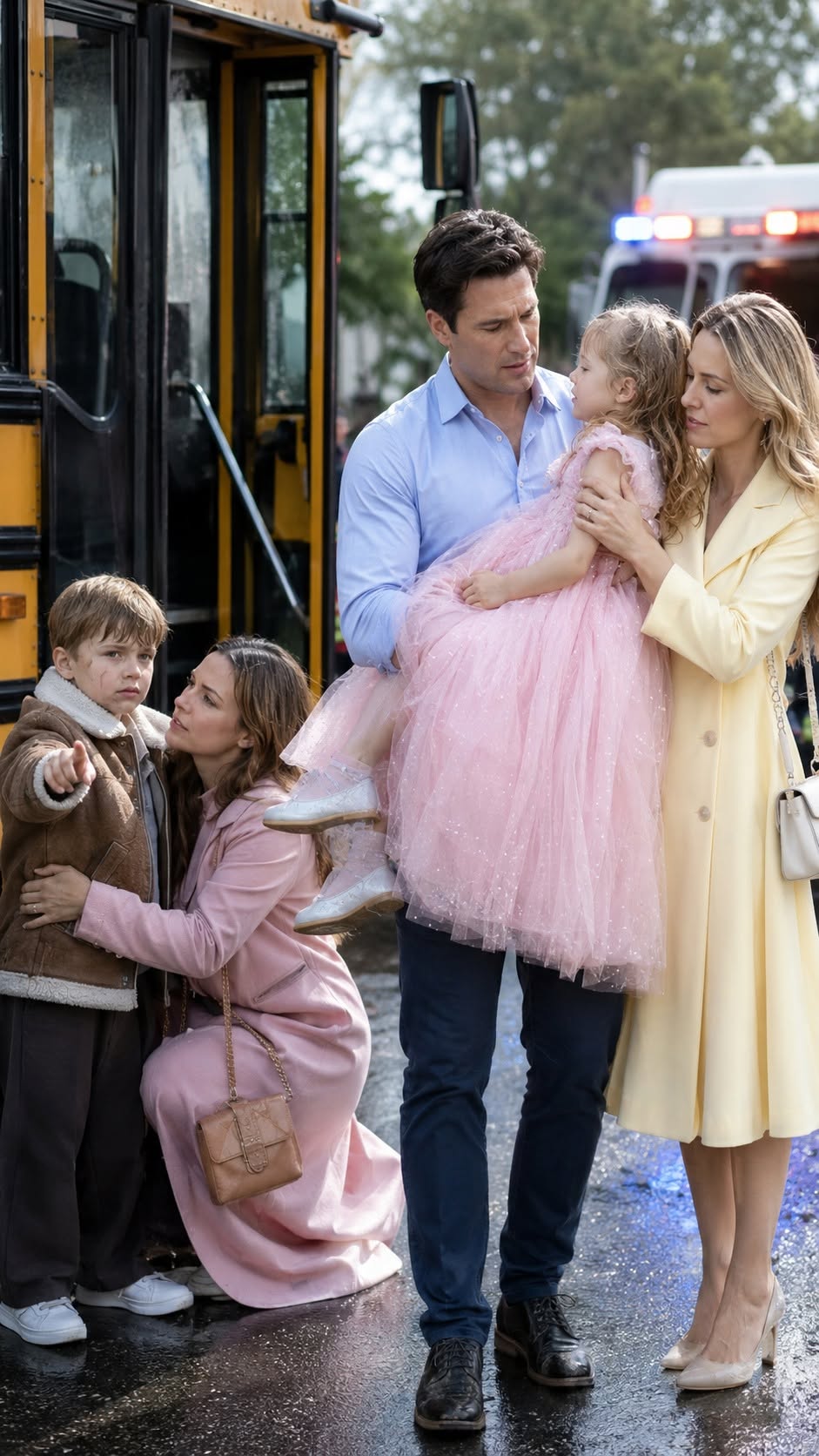
The heavy tires of the Oakbridge Academy charter bus groaned as we merged into the relentless flow of California’s Highway 101. In the third row, right by the smudged window, sat my five-year-old son, Callahan. He had his small face pressed against the glass, his breath fogging the pane as he silently counted the streetlights whipping past.
He was wearing that ridiculously expensive, custom-tailored navy blazer. My husband, Vance Sterling, had instructed his executive assistant to purchase it for Cal’s birthday last year. The tags were still dangling from the sleeve when the blazer was carelessly dumped onto our foyer shoe rack, forcing me to steam the fabric three times just to get the sharp creases out. But to Cal, that blazer was armor. It was solid gold. Every time we left the house, he insisted on wearing it, rubbing the shiny brass buttons on the collar until they caught the light.
He had explained his reasoning to me once, his large, earnest eyes looking up at me. “Mom, Dad bought this. If I wear it, Dad will spot me in a crowd right away.”
My heart had ached. He didn’t know the blazer was just a random item Vance’s assistant had hastily pulled off a rack at Saks Fifth Avenue. He didn’t know it was a full size too big, the shoulders drooping on his small frame.
I was sitting next to him, smoothing a stray lock of hair from his forehead, when my phone vibrated against my thigh. A text from Vance illuminated the screen: Don’t pick him up after the field trip. Have the driver take Cal straight to his piano lesson.
I typed a simple, obedient reply: Okay.
Three seconds later, a second message materialized: Blythe’s daughter, Harper, is on that bus too. Keep an eye on her.
Blythe. Vance’s high school sweetheart. She had moved back to the States from overseas three months ago, bringing her four-year-old daughter in tow. Vance insisted they were just old friends, that she had no one else to lean on. He had promptly set her up in one of his luxury investment condos in Atherton.
I didn’t reply to the second text. It wasn’t out of petty spite; there was simply nothing left to say in the hollow cavern of my six-year marriage. I had seen this exact script play out too many times. He told Cal to look out for Harper exactly the way he had instructed me to clear out our guest room so Blythe would have a place to crash initially. Exactly the way he told me to use my social connections to fast-track Blythe’s daughter into the same exclusive private preschool Cal attended.
Every single request, isolated in a vacuum, sounded like the charitable acts of a reasonable man. But woven together, they formed a suffocating tapestry of my own irrelevance.
Resting the device against my knee, I leaned forward, my fingers gently adjusting Cal’s collar. He turned his head, blessing me with a wide, toothless smile. “Mom, look! The streetlights are running backward.”
“That’s because we’re moving forward, baby,” I whispered, forcing a warm smile.
“What about Dad? Is Dad moving forward, too?”
He was asking if Vance would show up today. Oakbridge only allowed one chaperone per child. I had eagerly signed up, but this morning Vance abruptly announced he wanted to attend, demanding I surrender my spot. I yielded, as I always did. Then, at the very last minute, he claimed an urgent board meeting required his presence. The spot was wasted. Cal hadn’t cried. He had merely pressed his face against the glass and muttered a quiet, resigned, “Oh, okay.”
I took his small hand in mine. His fingers were icy. “Mom is here with you. It’s the same thing.”
He nodded, but the silence stretching between us spoke volumes.
Glancing across the aisle, I spotted Blythe’s daughter. Harper was perched in the fifth row next to a hired nanny, looking like a porcelain doll in a pink tulle dress. A massive satin bow was clipped into her hair. I recognized that bow. Last week, Vance’s assistant had dropped by the house with some legal documents and a gift bag from Saks, mentioning that Mr. Sterling wanted it delivered to “little Harper.” Cal had seen the bag. He had asked if Dad bought him something, too. When I couldn’t give him an answer, Cal never asked again.
That was the reality of my marriage. No screaming matches, no dramatic affairs splashed across reality TV. Just a slow, daily erosion where I was perpetually placed second. After the business call, after the old friend, after the hair bow for someone else’s child.
The California sun washed over Cal’s face as his lips moved silently, counting the lights.
Then, the world shattered.
It happened in a fraction of a second. A deafening, piercing screech of brakes erupted from the front of the bus. My maternal instincts hijacked my body before my brain could process the terror. My right arm lunged, wrapping fiercely around Cal’s waist, yanking him hard against my chest, while my left hand braced against the metal frame of the seat in front of us.
The first impact felt as if a mythological titan had kicked the rear of the bus. We were violently jerked forward. My forehead slammed into the metal seatback. For a terrifying second, stars exploded behind my eyes, and my vision went completely black.
The second impact was catastrophic. Above us, the overhead luggage rack let out a sickening, metallic groan. Rivets popped like gunshots. Backpacks, heavy thermoses, and plastic bins rained down upon the screaming children. I folded my entire body over Cal, creating a human shield in the triangular void between our seat and the backrest.
On the left side of the vehicle, the windows exploded inward. A rush of wind, thick with the acrid stench of burnt rubber and smoke, choked the cabin.
“Mom!” Cal was trembling violently against my collarbone, his tiny voice barely penetrating the absolute chaos.
“Don’t move! Hold onto Mom tightly. Do not let go!” I screamed over the din.
The bus finally ground to a shuddering halt, but the danger wasn’t over. I snapped my head up. The massive metal shelving unit above us was hanging at a crooked, horrifying angle. The bolts on the right side had been ripped clean out of the ceiling. The entire heavy iron plate was dangling by a single, strained bolt, weighed down by a dozen backpacks and a massive, industrial-sized box of bottled water.
I was paralyzed. Even the slightest vibration could snap that final thread of metal.
“Nobody move! Don’t stand up!” I shrieked, my voice tearing my vocal cords. Panic had already infected the front rows. Parents wailed, kids shrieked, and people violently pushed toward the jammed, crushed doors.
Cal was gripping my shirt so tightly his knuckles were devoid of blood.
And then, slicing through the nightmare, I heard Vance’s voice.
He had climbed in through the emergency roof hatch. Later, I would learn his meeting had ended early, and he had been speeding down the highway in his Range Rover to surprise Cal. He had witnessed the entire collision.
The second his expensive leather dress shoes hit the aisle, a conditioned reflex—forged in the fires of a six-year marriage—released the tension in my spine. He’s here. Everything will be okay. He will save his son.
Vance crouched low, his frantic gaze scanning the wreckage. He spotted us trapped in the third row. Cal was sheltered beneath me, his right hand clutching my shirt, but his left hand reached through the narrow gap between the seats. He grabbed the hem of his father’s tailored suit jacket.
“Dad!” Cal’s voice shook with primal terror. “Dad, that shelf is going to fall!”
I watched Vance’s eyes lock onto his son. He froze. For exactly one second, time stood still.
Then, Vance’s head snapped toward the fifth row.
In the fifth row sat Harper. Her satin bow had slipped, and a splash of orange juice stained her pink tulle, but she was entirely unhurt. The nanny was clutching her tightly. There wasn’t a single drop of blood on her face. She didn’t even need saving.
But Vance was already moving. He leaned down and grabbed Cal’s small hand—the one clinging desperately to his jacket. He didn’t gently detach it. He pulled.
Cal wouldn’t let go. A terrified five-year-old possesses an unnatural, desperate strength. His tiny fingers dug so deeply into the wool fabric that his nail beds turned stark white. “Dad, please don’t go!”
Vance didn’t utter a single syllable of comfort. With cold, mechanical precision, he used his right hand to pry his own son’s fingers open, one by agonizing one. First the pinky. Then the ring finger. Cal’s little hand was shaking violently, fighting to hold on to his hero. The middle finger. The index finger. The seams of the custom blazer groaned under the tension.
Finally, the thumb.
Vance completely detached his son’s hand, let it drop, and turned his back. Cal’s arm hung suspended in the smoky air, his fingers still curled as if grasping a ghost.
Vance pushed past our row, sprinted to the fifth, and snatched Harper from the nanny’s arms. He pressed the little girl tightly against his chest, shielding her head, and moved back toward the emergency hatch. From start to finish, he never once looked back at the boy he left to die.
I stared at his retreating back, and the universe simply stopped making sense. It wasn’t anger. Anger is a fiery emotion; it requires energy. This was an absolute, chilling void. A loud, high-pitched ringing filled my ears, stuffing my skull with cotton. The screams, the sirens, the grinding metal—it all faded behind a thick pane of glass.
Bile rose in my throat. My hands began to shake uncontrollably. I dug the fingernails of my right hand so deeply into my left palm that sharp crescent moons pierced the skin. The stinging pain was the only thing grounding my fractured mind.
Above us, the luggage rack let out a final, fatal creak. The last bolt was slipping.
“Cal, listen to Mom,” I commanded, my voice dropping to a low, dead calm. I pulled him out from under the seat, locking eyes with him. “I need you to crawl into the aisle. Crawl toward the front. Do not stand up. Do you hear me?”
Cal didn’t move. He wasn’t looking at me. He was staring straight down the aisle, watching Vance lift Harper through the emergency hatch into the sunlight. Her pink dress fluttered perfectly in the wind.
“Dad didn’t come for me.”
It wasn’t a question. It was a statement of absolute, devastating fact, delivered in a voice completely flat and devoid of tears. In that exact moment, a heavy, dull agony fractured something deep inside my ribcage.
“Mom will get you out,” I swore, ignoring the horrific shriek of metal above.
I shoved Cal hard into the aisle and threw my own body backward, wedging myself between the falling metal shelf and the seats. The raw edge of the iron slammed into my spine. The crushing weight of the water bottles pressed down, sending blinding, white-hot pain shooting through my nervous system. I reached up, grabbed the snapping bolt, and used every ounce of my adrenaline-fueled strength to yank the shelf away from the aisle.
I didn’t push it far enough.
The heavy box of water slid off the slanted metal plate and crashed directly onto Cal’s right leg.
“Cal!”
He cried out. Just once. Then, absolute silence.
Through the jagged gap in the seats, I saw his small leg trapped beneath the merciless weight, bent at an unnatural angle that made my breath catch. Crimson rapidly stained his pristine white socks. He wasn’t crying. He was just lying there, biting down on his lower lip until it turned white, his wide eyes staring into the void.
His oversized navy blazer had snagged on a jagged piece of metal, tearing a ragged hole from the shoulder down to the cuff. His right hand was still clenched in the exact same position it had been when Vance abandoned him. Five little fingers gripping absolute empty space.
Chapter Two: The Antiseptic Awakening
I don’t know how I pulled myself out from beneath the twisted debris. Something wet and warm was trickling down my spine, but the pain was a distant, irrelevant static. I dragged my battered body across the glass-strewn floor and pulled Cal’s head to my chest, my hands hovering desperately over his crushed leg, terrified to cause further damage.
“Mom is here, Cal. Mom is with you.”
Cal looked up at me. Tears were caught in his thick eyelashes, yet he didn’t make a sound. A child in that much agony should have been screaming until his throat bled, but he just stared at me, terrifyingly calm.
His lips trembled for a fraction of a second before he spoke the words that would hauntingly echo in my mind for the rest of my life.
“Mom, we don’t need Dad anymore.”
Not, Why didn’t Dad save me? Not, Does Dad hate me? Just a cold, factual severance. A five-year-old boy, sitting in a pool of his own blood, made the definitive choice I had been too paralyzed to make for six long years.
I pulled his head to my heart, shielding his eyes as Vance dropped back through the emergency hatch. I heard the crunch of his expensive dress shoes on the shattered glass, moving closer.
“Sloane! What happened to Cal?” Vance’s voice was frantic, ragged. He stood right behind me, his shadow falling over us. “How did this happen? Wasn’t the shelf secured?”
He reached out to touch his son.
Cal flinched, recoiling violently, burying his face deeper into my collarbone, shrinking away from the man who was supposed to be his protector.
“Don’t touch him,” I said. My voice was completely wrecked, raspy like sandpaper, devoid of any warmth.
Vance’s hand hovered in the dead air. “Sloane, his leg is broken.”
I didn’t look back at him. I kept my chin rested on my son’s head. “Severe fracture of the right tibia,” I stated, my tone flat. I wasn’t suppressing my rage; I simply had no energy left to allocate to this man.
The paramedics finally pried the jammed doors open. When the stretcher arrived, Cal locked a death grip on my hand. I walked beside him, never letting go. As we passed the fifth row, I noted that Harper and her nanny were long gone. The only remnant was a perfectly intact orange sitting on the seat. Harper hadn’t suffered a single scratch.
My son’s leg was crushed because his father had peeled back his fingers and abandoned him for a child who didn’t even need saving.
In the back of the ambulance, the EMTs applied a temporary splint. Cal was sweating through the agony, his face gray, but he just gritted his teeth and squeezed my fingers.
Vance sat on the bench opposite us. He opened his mouth a few times, struggling to formulate a defense.
“Mr. Sterling,” I said, cutting through the rhythmic beeping of the heart monitor.
He flinched as if I had slapped him. In six years of marriage, I had never addressed him with such sterile formality.
“Harper is fine,” I informed him, staring unblinkingly into his eyes.
His lips parted. He stared at me, the silence stretching uncomfortably as the ambulance swayed. “She… she wasn’t hurt.”
“That’s good.” I dropped my gaze, pressing my forehead against Cal’s icy knuckles.
“Sloane,” Vance pleaded, leaning forward. “When I was in there… I saw Harper crying, and I just thought… I thought…” He couldn’t finish the sentence. He reached out to stroke Cal’s hair.
Cal squeezed his eyes shut tightly, refusing to acknowledge the touch. Vance’s hand hovered for three agonizing seconds before he slowly pulled it back, clenching his fist until the knuckles popped.
When we arrived at the ER bay, a crowd had gathered. The moment the stretcher was rolled out, a piercing voice cut through the chaos.
“Vance! How is Harper?” Blythe came sprinting up the concrete walkway, her high heels clacking loudly. Her makeup was expertly smudged to look distressed.
Vance stopped in his tracks. He looked at Cal’s stretcher, where pristine white bandages were blooming with fresh, red stains. Then, he looked at Blythe.
He walked straight toward the other woman.
“Harper is fine. She’s in the observation room,” Vance murmured, his voice infinitely softer and gentler than it had been in the ambulance. He placed a comforting hand on Blythe’s shoulder. “Don’t panic. I made sure to get her out of there first.”
First.
He probably didn’t even realize the catastrophic weight of that word, but Cal heard it. My son opened his eyes, staring blankly at the bright California sky.
I leaned down, my lips grazing his ear. “Mom is here.”
“Mom,” Cal whispered, his voice fading. “I wasn’t joking. We don’t need Dad anymore.”
Tears flooded my vision, but I swallowed them down. I squeezed his hand and nodded. “Okay.”
Cal closed his eyes, and for the first time since the crash, the corner of his mouth curved up by a fraction of a millimeter. A sigh of relief escaped his lips. The decision was made.
By the ER double doors, Vance was still comforting Blythe, his thumb gently wiping a tear from her cheek. His own flesh and blood was being wheeled into major surgery, and he was playing the gallant savior for his high school sweetheart.
The surgical lights flashed red. My marriage was officially dead.
Four grueling hours later, the doors swung open. Cal was wheeled out, his right leg encased in a heavy plaster cast with an external metal fixator running from his knee to his ankle. He looked deathly pale, the anesthesia pulling him into a groggy haze.
I walked alongside the bed. Footsteps echoed behind me—dress shoes clicking rapidly on the linoleum.
“How did the surgery go? What did the doctor say?” Vance’s voice chased my shadow.
I didn’t stop. “They put in a titanium plate. Recovery will take three to six months.”
Vance caught up to me. He had changed into a crisp, fresh white button-down. The ruined suit jacket my son had clung to was gone. “I already had my assistant contact the top orthopedic surgeon in the country. He’s flying in tomorrow.”
“Okay. Thank you, Mr. Sterling.”
Vance’s footsteps halted. The hesitation was microscopic, but I felt it. “What did you just call me?” He turned his tall frame to block my path, using his 6’2″ height to tower over my 5’4″ frame—an intimidation tactic he had subtly utilized for years. “What kind of games are you playing right now, Sloane?”
“I’m not playing any games.”
“Then why are you calling me Mr. Sterling?”
“Because of what happened on the bus.”
His jaw clenched tightly, a deep crease forming between his brows. He assumed this was a tantrum, a dramatic plea for his attention. “I know you’re upset right now. And I… Mr. Sterling…”
“The nurse says family can come into the recovery room,” I interrupted effortlessly. “I’m going in. You can go home and rest, Mr. Sterling.” I shut the heavy wooden door directly in his face, leaving him standing in the sterile hallway.
The next morning, Vance returned with an elite silver-haired specialist. The doctor reviewed the charts and began explaining the physical therapy protocol, addressing his instructions exclusively to me.
“I’m his father,” Vance interjected, puffing his chest, his hands shoved deep into his tailored pockets. “Money is no object. We want the best treatment.”
The doctor merely nodded and continued speaking directly to me, fully aware of who actually cared for the child.
When the doctor left, Cal slowly opened his eyes. He stared at the metal rods piercing his leg, then looked at me. “Mom.”
“Yes, baby.”
Vance stepped toward the bed, plastering on a paternal smile. “Cal, Dad’s here to see you.”
Cal’s eyes slowly shifted from my face to Vance’s. His expression was a blank canvas. “Thank you, Mr. Sterling.”
Vance looked as if he had been physically struck in the chest. “What did you just say?”
Cal didn’t repeat it. He simply turned his head, staring out the hospital window. His profile—a carbon copy of Vance’s—was chillingly devoid of emotion.
“Callahan!” Vance’s voice rose, the authoritarian edge bleeding through.
“Mr. Sterling, the doctor said he needs to rest,” I intervened, stepping between them.
Vance glared at me. “What exactly have you been teaching him, Sloane?”
Before I could answer, Cal spoke without looking away from the window. “I know Harper is more important. My leg hurts, and I want to sleep.” He squeezed his eyes shut, building an impenetrable wall against his father.
Vance stood frozen, his knuckles turning white as he gripped the bedrail. The silence was deafening. Just as he opened his mouth to argue, his phone buzzed. He glanced at the caller ID, sighed, and answered right there in the room.
“Blythe, don’t even worry. Harper just has scratches… Yeah, I can drop by later tonight.” He hung up and turned to me, offering a weak, pathetic excuse. “Blythe says Harper’s been having terrible nightmares. I need to go check on them tonight.”
“Okay,” I said, adjusting Cal’s blanket.
“I mean, I probably won’t be able to stay here with Cal tonight.”
“Mr. Sterling, you don’t need to worry about what happens here. I will handle it.”
He huffed, frustrated that I wasn’t begging him to stay. “Fine. You’re all emotional right now, so I’ll let this slide.” He turned and marched out, his shoes clicking rhythmically into the distance.
Cal opened his eyes immediately. “Mom. He left.”
“Yes, he left.”
“Is he not coming back tonight?”
“No. But we don’t need him to come back.”
Cal nodded, a quiet acceptance washing over his small face. “You’re right. We don’t need him.”
Chapter Three: The Invasion of the Sanctuary
Three days later, we returned home. The Atherton estate felt different the moment I wheeled Cal’s chair through the massive front doors.
There were two extra pairs of shoes on the rack. A pair of cream-colored designer pumps sat dead center, flanked by tiny pink Mary Janes. Cal’s favorite sneakers had been shoved carelessly to the dusty bottom shelf.
Blythe was lounging on our custom sectional sofa, brushing Harper’s hair. She wore a soft cashmere cardigan, looking incredibly cozy, like the rightful queen of the castle. She stood up, flashing a practiced, sympathetic smile.
“Sloane, you’re back!” She dropped the title of Mrs. Sterling entirely. “Oh my goodness, look at that big cast. That must be so uncomfortable, sweetie.”
Cal ignored her entirely. His eyes were scanning the living room. The small bookshelf that used to sit by the TV stand—his designated reading nook—was stripped bare. His picture books were gone, replaced by a stack of trendy coloring books and a bright pink pencil case.
“Blythe, where are Cal’s books?” I asked, my voice dangerously calm.
“Oh, those!” Blythe feigned a gasp. “Harper just had so much stuff. I asked the housekeeper to put them in the basement storage for now. Don’t be mad, Sloane! As soon as Harper’s new shelf arrives, we’ll bring them back up.”
I didn’t argue. I gripped the handles of the wheelchair and pushed Cal to his bedroom in the East Wing. When I set him on the bed, he let out a quiet sigh of relief. His sanctuary was still intact.
But the peace was temporary.
That evening, Vance came home two hours early. I heard him in the living room, laughing, spinning Harper through the air. Cal sat trapped upstairs in his wheelchair, listening to the joyful family dynamic playing out beneath him.
The next afternoon, the final blow was struck.
Vance marched into Cal’s bedroom, flanked by Blythe and Harper. He stood in the doorway, projecting the aura of a benevolent dictator.
“Callahan,” Vance announced, “Harper is going to stay with us for a while. She’s afraid of the dark, and the sunroom gets the best morning light. I asked the housekeeper to clear out your toys so Harper can use that room.”
The sunroom was Cal’s playroom. It held his LEGO table, his easel, and his favorite thrift-store pop-up tent.
Cal’s pencil stopped tracing lines in his workbook. He didn’t look up. “Where did my toys go?”
“Into storage. Since your leg is in a cast, you can’t play in there anyway. We’ll wait until you’re fully recovered.” Vance’s voice took on a patronizing, heavy tone. “Harper doesn’t have a father. It’s only right that we take care of her. You’re a boy, Cal. You need to be a little more generous.”
Cal finally lifted his gaze. He stared at the man who had abandoned him in burning wreckage. “You’re right, Mr. Sterling.”
He put down his pencil and pointed with startling maturity to the corner of his bedroom. “You can take all of this, too. My easel. My desk. And what about the piano? If Harper takes lessons, our schedules will overlap.”
Blythe stepped forward, her eyes gleaming with feigned distress. “Oh, no, you don’t need to give up your piano, sweetie.”
“With your leg, you can’t sit at the bench anyway,” Vance quickly agreed, seizing the convenient logic. “Let Harper take your time slots. When you get better, you can start again.”
Cal placed his small hand flat on his workbook. His fingers curled into a tight fist, then slowly uncurled. “Okay.”
It was a chilling echo of the hospital. Perfect, flawless compliance.
Vance frowned, sensing an invisible trap, but unable to pinpoint it. He got exactly what he demanded, yet he felt profoundly unsettled. He turned and walked out, Blythe and Harper trailing behind like a victorious entourage.
When the door clicked shut, I sat beside my son on the mattress. “You don’t have to give everything up, Cal. Those are your things.”
He stared at his small hands. “Mom, if I give him everything, he won’t have any reason to come into my room anymore.”
A golf-ball-sized lump formed in my throat. My five-year-old wasn’t being generous. He was bartering away everything he loved just to build a moat around himself. He was systematically erasing every tie to the man who broke him.
“Okay,” I whispered, my resolve hardening into steel. “We’ll pack it all up.”
Cal nodded. Then, he asked me to open his closet. He pointed to three expensive articles of clothing hanging in the corner: the torn navy blazer, a charcoal dress shirt, and a black peacoat. All purchased by Vance’s assistant.
“Mom, give me the scissors.”
I handed him his kid-safe craft scissors. Using only his left hand, Cal laid the blood-stained blazer across his lap. With methodical, cold precision, he began to cut. One snip severed the lapel. Another tore through the shoulder seams. He cut slowly, his knuckles white from the effort, until the blazer was reduced to shredded navy ribbons. He did the same to the shirt and the coat, dumping the ruined fabric into his small trash can.
“Put it in the hallway, Mom.”
I placed the overflowing bin directly across from the sunroom. When Vance emerged later that evening, he stopped dead in his tracks, staring at the destroyed garments he had funded.
“Why did you cut up your clothes?” Vance demanded, storming back into Cal’s room.
Cal didn’t stop tracing his letters. “I don’t need them anymore. I gave up the playroom and the piano. It’s the same with the clothes. I don’t want anything Mr. Sterling gave me. Now Harper will have enough.”
Vance stepped back, breathless, as if he had been punched. He reached out, trying to touch Cal’s head, but my son fluidly shifted his shoulder out of reach. Vance’s hand grasped only empty air. Defeated and humiliated by a child, he turned and fled.
Once he was gone, I pulled my phone from my pocket and opened a secured email app.
The notification from my offshore trust attorney glowed on the screen: Transfer Complete.
For six years, I had quietly siphoned my inheritance and the unspent portions of my monthly allowance into a ghost account. I hadn’t started it as a grand master plan for divorce. I started it the winter I lay shaking with a 102-degree fever, begging Vance to take me to urgent care, only for him to tell me to call an Uber because he was busy. When he finally came home, smelling of strange perfume, I realized I was utterly alone. A woman without financial independence is a hostage.
Now, that account held 2.5 million dollars. Vance couldn’t trace a single dime.
I pulled a small lockbox from under Cal’s desk and packed the offshore trust confirmation, our expedited passports, and the acceptance letter to an elite international school in Maui.
“Mom,” Cal asked softly, “when are we leaving?”
“Very soon, baby. I have the divorce filings ready. We just have to make one last stop.”
Chapter Four: The Public Severance
Monday morning, I wheeled Cal up the concrete ramp of Oakbridge Academy. He wore a cheap, comfortable light-blue zip-up hoodie I had bought from Target, the little bunny ears flopping against his neck. He looked like a normal, happy kid.
At the reception desk, the secretary gasped at the cast. “Sloane! How is he?”
“He’s healing,” I smiled politely. “I’m here to process his withdrawal.”
The secretary blinked. “Withdrawal? We need both parents’ signatures. Does Mr. Sterling know?”
“I’ll sign my part now,” I said smoothly, taking the clipboard. Under the reason for withdrawal, I penned two heavy words: Family circumstances.
As I spun the wheelchair around to leave, the heavy glass doors swung open. Vance stepped inside, looking immaculate in a tailored suit. Blythe was practically glued to his side, holding Harper’s hand.
Vance’s eyes darted from Cal’s wheelchair to the official folder in my hand. “What are you doing here?”
Before I could answer, the headmistress rushed out, flashing a blinding, sycophantic smile. “Oh, Mr. Sterling! You brought Harper today! You and Harper’s mother look so wonderful together.”
Blythe smirked triumphantly. Vance didn’t correct the headmistress. He simply stood there, playing the perfect patriarch to a family that wasn’t his.
The headmistress finally noticed me. Her smile dropped to a polite freeze. “Sloane. You’re here, too.”
“Yes. Filing Callahan’s withdrawal forms,” I stated loudly enough for the lobby to hear. “I’ve signed my half. Mr. Sterling just needs to sign the bottom.”
Vance’s face hardened. “Who gave you permission to pull him out of school?”
“I did.”
“He’s doing perfectly fine here. I’m not signing a damn thing.”
“Then I will go to court and file for sole legal custody regarding his education,” I fired back, my voice echoing off the marble floors. Parents dropping off their children stopped, turning their heads. Whispers erupted.
Vance stepped closer, his voice dropping to a furious hiss. “Sloane, have you lost your mind? Do you honestly think you can just pack up and leave with my son?”
Cal, who had been sitting quietly in his chair, looked up. “Mom, let’s go. Where I go to school has nothing to do with Mr. Sterling.”
A collective gasp echoed in the lobby. Vance’s face flushed a deep, violent crimson. To be publicly disowned and addressed as a stranger by his own five-year-old son in front of Silicon Valley’s elite was the ultimate humiliation.
“Callahan, don’t do this,” Vance pleaded, crouching down.
“Wheelchairs can’t go up these stairs,” Cal reasoned, his logic flawless and impenetrable. “I want to go to a school with a ramp.”
Blythe chimed in, feigning concern. “Sloane, pulling him out is a huge decision. Why don’t you just let him rest at home for a while?”
“My son’s affairs are my affairs, Blythe,” I snapped, freezing her in place.
Vance stood up, towering over me, his patience evaporating. “Fine. You want to play it like this? Let me make something very clear to you, Sloane.” He leaned in, his arrogant superiority returning. “The credit card you use, the house you sleep in, the tuition—every single dollar is my money. If you walk out that door, you won’t take a single dime.”
He was certain this was a bluff. He thought the threat of poverty would leash me. He thought I would bow my head and apologize, just like I had a hundred times before.
“Okay,” I said.
I reached into my purse, pulled out the heavy, platinum American Express card, and tossed it onto the reception desk. It clattered sharply against the wood, sliding to a halt right in front of Vance’s perfectly polished shoes.
“I won’t be needing the card anymore,” I said, my voice ringing with absolute liberation. “The house is yours. I won’t be staying. I’ll pay for the tuition myself.”
Vance stared at the piece of plastic as if it were a venomous snake. His knuckles cracked. “You really think you can back me into a corner? If you walk away like this, don’t expect me to beg you to come back.”
I grabbed the handles of Cal’s wheelchair. “If you don’t want to sign it, my lawyer will handle it.”
I turned my back on my husband of six years and wheeled my son out the door. I didn’t look back. Not once.
That night, Vance didn’t come home. His assistant called to smugly inform me that Mr. Sterling had a “business dinner” and that I needed to “think very carefully about what I was doing.”
I was thinking perfectly clearly. Our flight was at 7:00 a.m.
At 1:00 a.m., I sat alone on the hardwood floor of the empty guest room. The walls of this multi-million dollar mansion felt like a mausoleum. Suddenly, a wave of pure, unfiltered grief surged from my stomach, lodging in my throat. I shoved the back of my hand into my mouth, biting down hard to stifle the sobs. I bit until I tasted the metallic tang of copper.
I wasn’t crying for Vance. I was mourning the six years I had spent turning myself into a ghost in my own home. My name hadn’t meant anything here. It just meant a hot plate of food and a shadow standing outside a home office door.
When the tears finally stopped, I washed my face with ice water. I opened the closet and took out the only thing remaining: my simple, white silk wedding dress. I folded it neatly and left it on the top shelf. A parting gift.
Before I walked downstairs, I slipped the cheap gold wedding band off my finger. The indentation on my skin was pale and deep. Walking past the decorative key tray in the foyer, I dropped the ring straight into the garbage can. It landed with a soft clink on top of a dirty tissue and one of Harper’s pink hair ties.
At 4:30 a.m., the Uber arrived. I loaded the two suitcases and lifted Cal into the backseat. As the SUV backed out of the driveway, Cal hugged his little thrift-store tent to his chest. He looked straight ahead as the Atherton estate vanished into the predawn gloom.
“Mom,” he whispered, squeezing my fingers. “We’re going to be happy now, right?”
“Of course, baby.”
Chapter Five: The Echoes of a Ruined King and a Pacific Sunrise
Vance sat at his mahogany desk the entire following day, waiting. He wasn’t working. He was staring at his phone, waiting for the inevitable text: Dinner’s ready, or Callahan misses you.
By 6:00 p.m., the silence was deafening. He checked his call log. Nothing. A cold, gnawing dread began to coil at the base of his skull. He grabbed his keys, canceled his evening plans, and sped back to Atherton.
He pulled into the driveway. The house was pitch black.
“Sloane?” he called out, unlocking the front door.
Silence answered him. He flipped the foyer switch. The first thing he noticed was the key tray. Her keys were still there. His gaze drifted downward to the trash bin. Beneath a crumpled tissue, something glinted.
He reached in and pulled out the cheap gold wedding band. The metal was ice cold.
Panic seized his chest. He sprinted up the stairs, throwing open the door to Callahan’s room. The closets were bare. The hoodies, the toys, the pop-up tent—all gone. He tore into the guest room. Empty, save for the white silk slip dress sitting on the shelf.
He whipped out his phone and frantically dialed her number.
“We’re sorry, the number you have dialed is no longer in service.”
He typed a text message. A green bubble popped up with a harsh red exclamation mark. He opened WhatsApp. Her profile picture was a blank silhouette. He had been entirely, methodically erased from her digital existence.
He stumbled backward, practically falling down the stairs, and wandered into the dining room. He hit the lights, and his breath hitched.
In the center of the massive, polished mahogany table sat a cake. An ice cream cake, completely melted. The frosting had collapsed into a pathetic puddle of brown and white sludge, soaking into the cardboard base. The distorted chocolate lettering still read: Happy 6th Birthday, Cal.
Vance froze. Yesterday was Callahan’s birthday. He had been so consumed with playing house with Blythe and punishing Sloane that he had completely forgotten his own son’s birthday.
Next to the melted ruin was a page torn from a workbook. Crooked, pencil letters spelled out: Happy birthday, Mom. Beneath it was a drawing of a stick-figure woman holding hands with a little boy leaning on a crutch. There was no father in the picture.
His phone buzzed. It was his assistant.
“Sir, I checked the Uber logs. An SUV picked them up at 5:00 a.m. yesterday. Two one-way tickets to Maui. And sir… the legal department just received a courier package. It’s a divorce petition. She is waiving all claims to your business and real estate. She just wants sole custody.”
“What is she going to live on?!” Vance screamed, the reality fracturing his arrogant worldview.
“Sir… Sloane is the primary beneficiary of an offshore trust. The balance is 2.5 million dollars. She’s already signed a lease on an oceanfront condo.”
A guttural, strangled sound tore from Vance’s throat. The phone slipped from his fingers, smashing against the hardwood floor. The screen spider-webbed, illuminating the failed text message one last time before dying completely.
He collapsed to his knees in the hallway, the gold ring cutting deeply into his palm.
The master bedroom door opened, and Blythe stepped out in her silk robe. “Vance? What was that noise? Where is Sloane?”
Vance slowly lifted his head, his eyes hollow, devoid of any warmth or nostalgia. He stared at the woman who had helped destroy his family. “You watched her pack. You watched her take my son, and you didn’t say a damn word.”
“Vance, I swear—”
“Get out,” Vance whispered, his voice vibrating with a terrifying, dark emptiness. “Pack your bags and get out of my house. Now.”
Blythe scrambled backward. Forty minutes later, she and Harper fled into the night.
When the door clicked shut, Vance sat alone at the head of the pristine, polished dining table. He had wiped away the melted cake, scrubbing the wood until it shined. Across from him sat two empty chairs. For six years, there had always been a warm plate of food waiting for him, no matter how late he arrived. Now, the house was a tomb, echoing only with his own ragged breathing. He possessed all the wealth in the world, and absolutely nothing of value.
Thousands of miles away, the Pacific breeze drifted through the open glass doors of our Maui condo.
Cal was sitting on the floor of his pop-up tent, a smudge of barbecue sauce on his cheek, a massive smile revealing his missing front tooth. He had just finished a plate of chicken nuggets and french fries—a meal formerly banned in the Sterling household.
“Mom, can we order this again tomorrow?” he asked, his eyes wide with wonder.
“Every single day if you want, baby,” I laughed, wiping his cheek with a napkin.
I carried him out to the lanai. The night sky over the ocean was breathtakingly clear, a canvas of brilliant, diamond-like stars reflecting off the rolling waves.
“Mom, do you see that brightest star?” Cal pointed, his cast resting comfortably against my hip. “Do you think the Little Prince lives up there?”
“Maybe he does.”
“I think he has his rose,” Cal decided solemnly. “And I have my mom.”
He rested his head heavily on my shoulder, the last remnants of tension melting from his small frame. “We’re never going back, right?”
“No, baby. We are never going back.”
Cal let out a deep, peaceful sigh and closed his eyes. The ocean sang its timeless lullaby. I stood in the warm Hawaiian breeze, holding my son in a home that belonged only to us. There was no one to wait for. No footsteps to dread. No plates to wrap in foil. We were finally, beautifully, irrevocably free.