The Anatomy of a Breaking Point
Chapter 1: The Weight of the Harvest
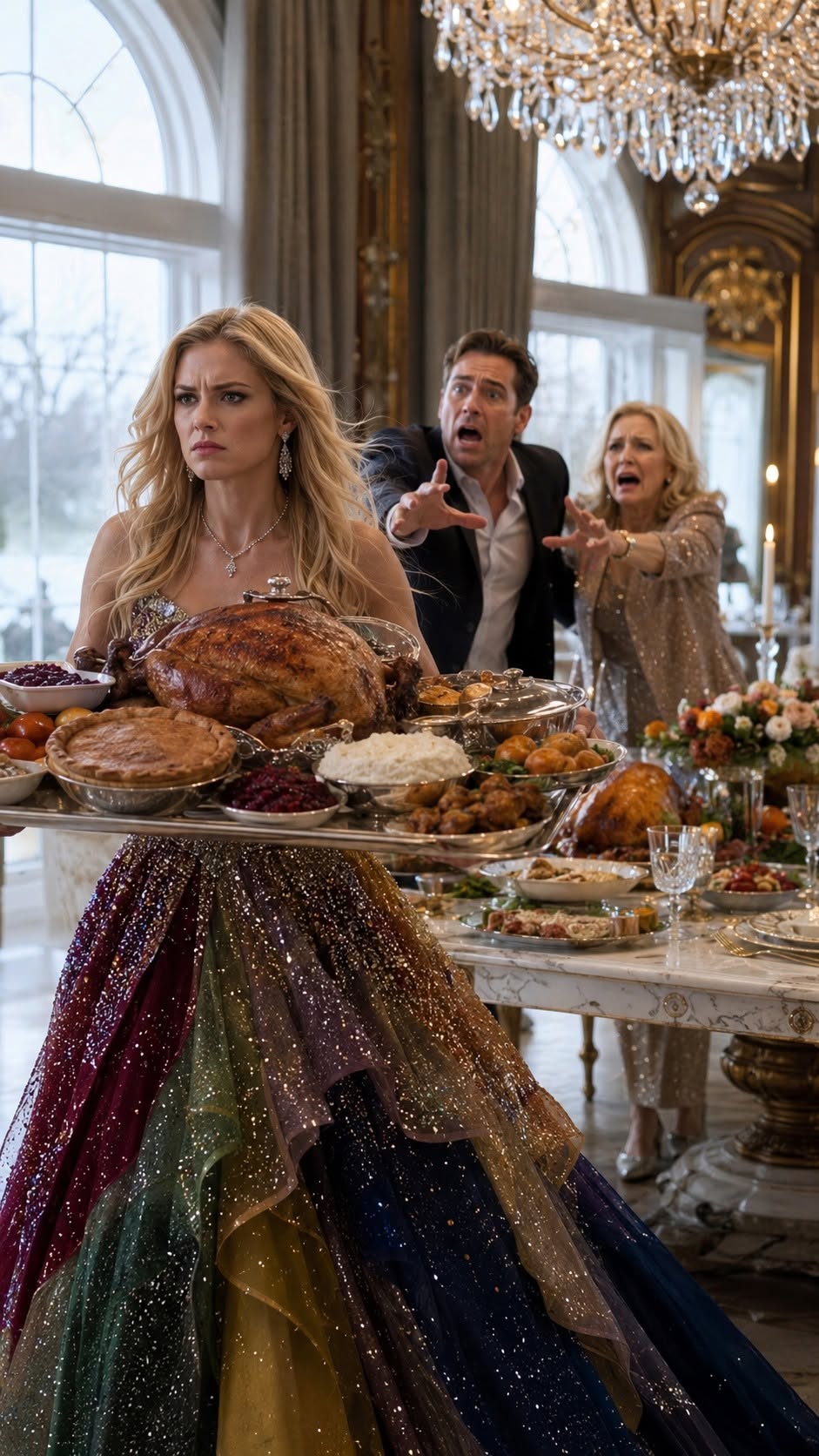
I had been awake since four o’clock in the morning on Wednesday. The house was submerged in that profound, heavy darkness that only exists right before the dawn. I stood in my kitchen wearing thick wool socks and a faded, flour-dusted apron I had held onto since my college days, rhythmically basting a turkey that had been resting in a meticulously spiced brine since Monday night. By Thursday afternoon, when I finally began loading the spoils of my labor into the back of my SUV, the inventory was staggering.
There was the fourteen-pound bird, its skin glistening like polished mahogany. There was a cast-iron skillet filled with green bean casserole, a ruby-red jar of homemade cranberry sauce laced with orange zest, two deep-dish pies, a heavy Dutch oven filled with mashed potatoes that were still radiating a buttery warmth, and a woven basket overflowing with honey wheat rolls I had finished shaping as the clock struck midnight.
I was exhausted. Not just physically drained, but bone-tired in that specific, hollowed-out way that only comes from pouring every ounce of your spirit into something you are genuinely, fiercely proud of. I drove forty-five minutes to my in-laws’ immaculate house in the affluent suburb of Westerville.
Forty minutes later, I was reversing out of their manicured driveway, gravel crunching under my tires, with every single dish still sitting untouched in the back of my car.
Four hours after that dramatic departure, my husband appeared on my mother’s front porch. His heavy winter coat was shrugged half on, one collar flipped up against the biting wind, the other tucked inward. He looked entirely hollowed out, wearing the expression of a man who had just woken up to realize he had been standing in the wrong room for a very long time. And right behind him, echoing through the quiet hallway, my cell phone began to ring.
What I said when I finally answered that call—three quiet words, devoid of any theatricality—made every single person in my mother’s bustling kitchen stop talking simultaneously. The silence was deafening. But to understand that silence, I have to take you back to the beginning.
My name is Stella. I am thirty-four years old, and I spend my days navigating chaos as a registered nurse at a sprawling hospital about twenty minutes from our modest home in Columbus, Ohio. My husband, Lucas, is thirty-seven. We have been navigating the unpredictable waters of marriage for six years. Our daughter, Poppy, just celebrated her fourth birthday. She inherited her father’s expressive, impossibly dark eyes, and my absolute, unyielding stubbornness—a trait Lucas makes a point to remind me of with alarming regularity.
From the outside looking in, we are the quintessential portrait of an ordinary family. And for the most part, we truly are. The friction in my life didn’t come from my marriage; it came from the periphery.
The thing about my in-laws—the specific, suffocating reality that is nearly impossible to articulate to outsiders—is that nothing they ever did was monumental enough to point a finger at. There were no explosive screaming matches. There was no overt, cruel exclusion. It was an atmospheric pressure. It was the kind of insidious dynamic that only crystallizes if you are the one living inside the terrarium.
It was a lingering comment here, a subtle comparison there. A sigh. A glance. If I were to recount these infractions at a casual dinner party, people would undoubtedly tilt their heads, offer a sympathetic smile, and say, “Well, surely she didn’t mean it like that.”
And they would be right. She probably didn’t mean it maliciously. But that, ironically, was the hardest part to swallow.
Linda, my mother-in-law, is sixty-two years old. She clawed her way up from a childhood defined by scarcity in a dusty, forgotten town in central Ohio. Consequently, she has spent the last three decades meticulously curating her existence to ensure her home, her family, and her life look as though she was born into effortless abundance. She isn’t an inherently mean woman. Rather, she is careful. She is guarded. She cares with an intense, almost terrifying fervor about what the rest of the world thinks of her. And that suffocating blanket of care spills outward, smothering everyone in her immediate orbit.
Then there is Cassie, Lucas’s twenty-nine-year-old sister. On a superficial level, Cassie and I exist in a state of polite neutrality. She occasionally forwards me viral videos of clumsy dogs. She remembered to mail Poppy a birthday card this year. But Cassie harbors a specific, deeply ingrained habit that I have monitored for half a decade: she has a penchant for bringing up Lucas’s ex-girlfriend in a manner that is far too frequent to be considered accidental.
Her name was Ryan. She and Lucas dated for three years during their mid-twenties, long before he and I ever crossed paths in a crowded hospital cafeteria. I have never actually laid eyes on Ryan in the flesh. Yet, some days, her ghost takes up so much oxygen in the room it feels as though I’ve known her my entire life.
Conversely, Warren, my father-in-law, is a man constructed of silence. He rarely speaks more than three sentences in an afternoon, but he has never, not once, been unkind to me. And in a house built on subtle judgments, that silence has always mattered deeply.
Early in my marriage to Lucas, eager to please, I brought a homemade blueberry buckle to Sunday dinner. I realized the moment I pulled it from the oven that it had betrayed me. It was tragically flawed—far too heavy on the sugar, severely lacking the sharp bite of lemon zest. I knew it. Linda knew it, gently setting her silver fork down on her china plate after a single, microscopic bite, her lips pressed into a thin line.
But Warren? Warren quietly ate two full pieces. As he pushed his empty plate away, he cleared his throat and muttered that it reminded him of a pastry his late mother used to bake on Sunday mornings. I will never know if that was a genuine memory or an act of profound, calculated mercy, but I have replayed that moment in my mind a thousand times since.
That Thanksgiving, the Thanksgiving that changed the trajectory of our family, I had formulated a plan. I had received a modest quarterly performance bonus from the hospital in late October—nothing life-changing, roughly eight hundred dollars. I decided, with a surge of naive optimism, to funnel a portion of it into orchestrating a genuine, from-scratch holiday feast. I wanted to recreate the kind of culinary magic my own mother conjured during my childhood, where the entire house was steeped in the intoxicating aroma of roasted sage and browned butter for two solid days. A meal where you could practically feel the ambient, loving heat of the oven radiating all the way into the living room.
I desperately wanted to offer that specific, golden warmth to Lucas’s family. Sitting here now, reflecting on year six of my marriage, I am not entirely sure why I still craved their validation. But the truth was, I did.
So, I initiated the elaborate brine on Monday evening. I simmered the fresh cranberries on Tuesday, folding in curls of bright orange zest and thick ribbons of pure Vermont maple syrup. The pies emerged from the oven on Wednesday as dusk settled over Columbus, their crusts perfectly fluted and golden.
By midnight on Wednesday, I was standing at the flour-covered island, painstakingly rolling and shaping the honey wheat dough. Lucas was sitting at the edge of the kitchen table, nursing a glass of water, pretending to read a medical journal. In reality, he was just watching me. He had that specific, furrowed-brow expression he wore whenever he was witnessing something he didn’t quite comprehend but knew better than to interrupt.
“You know you really don’t have to do all this, right?” he asked softly, the glow of the kitchen pendants catching in his hair.
“I want to,” I replied, my hands working the elastic dough. And I meant every syllable.
I need to state that clearly for the record, because context is everything. I was not walking into this blindly. I was not a naive bride eager to impress. I knew exactly how Linda operated. I fully anticipated that Cassie would likely launch a verbal grenade that would land sideways at the table. I baked and roasted and puréed anyway because my spirit felt light, I had two rare days off from the hospital, my kitchen smelled like absolute heaven, and sometimes, the simple act of trying is its own reward.
We pulled up to the two-story brick house in Westerville right at one o’clock on Thursday afternoon. The sky was the color of a bruised plum, threatening snow. Poppy bounded out of her car seat, sprinting up the paved walkway to ring the brass doorbell three consecutive times. Lucas trailed behind her, grunting slightly as he hauled the massive roasted turkey in its aluminum fortress. I brought up the rear, carrying two heavy grocery bags in my left hand, with a fragile pie tin balanced precariously on each forearm.
The heavy mahogany door swung inward. Linda stood in the foyer, dressed impeccably in a cream-colored cashmere sweater. Before her eyes even registered my face, her gaze snapped directly, magnetically, to the pie tin hovering inches from my chin.
Not at my eyes. At the aluminum rim.
“Oh,” she breathed, a delicate flutter of her manicured hands. “You brought two pies.”
“Pumpkin and salted caramel apple,” I said, offering a bright, strained smile.
She made a tiny, unidentifiable sound in the back of her throat. It wasn’t quite a word of gratitude, but it wasn’t exactly an insult, either. It was a phantom syllable. She took half a step backward, just enough to let the cold wind push us over the threshold, and the door clicked shut behind us.
I didn’t know it yet, but the countdown had officially begun.
Chapter 2: The Ghosts of Thanksgivings Past
The foyer smelled of expensive vanilla diffusers and lemon polish. I nudged Poppy forward, relieved her of her puffy coat, and followed Lucas into the expansive, sunlit living room.
Cassie was draped across the pristine white sectional sofa, her feet tucked under her. Next to her sat her boyfriend, Todd, a remarkably quiet man I had only briefly met the previous Christmas. He possessed a gentle demeanor and seemed genuinely terrified of the family dynamics.
As I lugged the grocery bags toward the gleaming granite island in the kitchen, Cassie finally glanced up from the glowing screen of her iPhone.
“Wow,” she drawled, her eyebrows arching perfectly. “You really went all out this year, Stella.”
“It was actually a lot of fun,” I replied, carefully unearthing the Tupperware containers.
Cassie offered a thin, practiced smile. Her eyes immediately darted back to her phone screen. “Hey, do you do those stuffed mushrooms? You know the ones. Ryan used to make this absolutely incredible stuffed mushroom appetizer every single year. Whipped goat cheese, fresh herbs, toasted panko. Lucas, you remember those, right? The guests literally begged for the recipe before they left.”
I froze. My hands hovered over the container of green beans. There it is. Ten minutes in, and the ghost of Ryan had already materialized in the kitchen.
Lucas, who was currently wrestling the heavy turkey onto the countertop, didn’t even turn around. “I really don’t remember, Cass,” he mumbled into the foil.
“Well, I made the cranberry sauce,” I interjected, my voice a pitch higher than normal. I just needed to inject my presence into the airspace.
“Yeah,” Cassie said, not looking up, her thumb rapidly scrolling through a social media feed. “She totally would have done the mushrooms, though.”
Breathe, I told myself. Just let it go.
When you spend six years in the trenches of a passive-aggressive family, you develop a bizarre psychological armor. You become an expert at identifying the exact millisecond a scratch appears across the polished surface of your sanity, and you train yourself to simply inhale, exhale, and ignore the bleeding.
I pivoted back to my tasks. I preheated the oven to keep the turkey warm. I meticulously arranged the cold sides on the glass shelves of the refrigerator. I unwrapped the woven basket of honey wheat rolls and placed it proudly in the center of the island.
Warren shuffled through the kitchen, wearing his standard worn flannel and corduroys. He caught my eye, gave a single, solid nod of acknowledgment, poured himself a mug of black coffee from the carafe, and retreated to his leather recliner in the den. That was the entirety of his greeting. For him, it was practically a monologue.
Linda, however, began to hover. She was a master of the atmospheric orbit. She floated around the kitchen island, adjusting a coaster here, wiping an invisible smudge there. Finally, she stopped in front of the roll basket. She reached out and picked it up, rotating it slowly in her hands with the intense scrutiny of a pawnshop broker examining a potentially fake Rolex.
“Did you actually make these yourself?” she asked, her tone laced with a feathery disbelief.
“Yes,” I said, wiping my hands on my apron. “Honey wheat. The dough took all night.”
She gently set the basket back down on the granite, her fingers lingering on the woven edge. “You know, Ryan’s mother always brought those lovely brown-and-serve rolls from that expensive little bakery down on Fifth Avenue. The ones with the perfectly flaky, buttery tops.” Her voice dropped an octave, becoming soft, wistful, dripping with a manufactured nostalgia that made my skin crawl. “People absolutely adored those.”
I stood paralyzed, the damp dish towel gripped tightly in my fists. I didn’t say a word. I simply let the silence stretch out, heavy and suffocating, until the sudden blast of the doorbell shattered the tension.
It was Warren’s younger brother, along with his loud wife and their perpetually bored teenage son. The ambient noise level in the house immediately spiked, a chaotic symphony of heavy coats, forced laughter, and clinking ice cubes. I retreated to the safety of the oven, pretending to check the internal temperature of a bird that was already fully cooked.
The next thirty minutes were a masterclass in Midwestern polite endurance. We congregated awkwardly around the appetizer station—a massive, commercially processed cheese log coated in slivered almonds that Linda had undoubtedly plucked from the deli section at Kroger, flanked by sleeves of water crackers. We discussed the agonizing traffic on Interstate 71. We debated the crumbling offensive line of the Ohio State Buckeyes. We speculated on the impending snowstorm.
I stood on the periphery, balancing Poppy on my hip. She was deeply engrossed in making her stuffed plush giraffe march rhythmically up and down my cardigan sleeve.
Suddenly, Warren’s sister-in-law, a boisterous woman named Brenda, pointed a manicured finger toward the kitchen island. “Oh my goodness, who brought those gorgeous rolls?”
Before I could even open my mouth to claim my late-night labor, Linda swooped into the conversation with the grace of a predatory bird.
“Stella brought them,” Linda announced to the room, her voice a pitch-perfect blend of maternal pride and subtle condescension. “She insists on doing absolutely everything from scratch. She is just… very ambitious.”
A small, rippling wave of easy laughter drifted through the room. It was the kind of laughter that wasn’t directed at anyone specifically, but it clung to my skin like static electricity.
From her throne on the white sectional, Cassie piped up again, her voice cutting through the chatter. “Hey Lucas, seriously, do you remember what Ryan called that mushroom thing? Was it a crostini? I’m almost positive it had baked Brie in the center. I swear, her guests literally fought over the recipe.”
“Cassie, I honestly don’t remember,” Lucas sighed, rubbing the bridge of his nose, looking desperately at the muted football game on the flat screen.
I kept my eyes locked on Poppy. I focused entirely on the soft, worn fabric of the giraffe’s legs against my arm. I built a fortress in my mind, brick by brick.
And then, Linda drifted back through the archway, a small cheese knife in her hand. She spoke softly, almost as if she were murmuring a secret to herself, but the volume was meticulously calibrated to carry across the entire room.
“The rolls are a little dense, don’t you think?” she mused, adjusting a cracker on the platter. She still wasn’t looking at me. “I wonder if they were allowed to proof long enough.”
From the direction of the sofa, I heard Cassie emit a tiny, sharp sound. It wasn’t quite a laugh, and it wasn’t quite a cough. It was the sound of a victorious strike.
I have analyzed that specific moment a thousand times since. I always assumed that if I were to ever reach my breaking point, it would be accompanied by a violent, blinding rush of hot anger. I imagined screaming, throwing a plate, demanding respect.
But what I actually felt in that moment was the exact opposite.
It was a profound, icy quiet. A sweeping sense of calm washed over me, chilling my veins. It felt as though a massive, complicated puzzle had suddenly, violently snapped into perfect alignment.
I gently lowered Poppy to the floor, guiding her to sit beside her father on the couch. I smoothed down the front of my shirt. And then, with deliberate, unhurried steps, I walked out of the living room and back into the kitchen.
The war of attrition was over. It was time for the scorched earth.
Chapter 3: The Rebellion of Tupperware
I stood alone in the kitchen, the ambient noise of the television and forced family banter muffled by the heavy walls. My hands moved with a mechanical, terrifying efficiency. I began snapping the plastic lids back onto the containers.
Snap. Snap. Snap.
The sound was sharp, definitive. I pulled the heavy roll of aluminum foil from the drawer, tore off a massive sheet, and draped it over the gleaming turkey, crimping the edges tight.
Three minutes later, Linda floated through the archway, an empty wine glass dangling from her fingers. She paused, her brow furrowing in confusion as she took in the scene.
“Stella? The turkey still needs to rest for another hour before carving.”
“I know,” I said. My voice didn’t shake. It didn’t tremble. It sounded completely foreign to my own ears—hollow and absolute. “I’m taking it with me.”
Linda blinked. Her perfectly applied mascara caught the overhead light. “What?”
“I am taking the food,” I repeated, my tone utterly conversational. “All of it.”
I picked up the heavy container of mashed potatoes and slotted it into the first canvas grocery bag.
“You mentioned Ryan’s bakery rolls twice in the first ten minutes,” I continued, not looking at her, focusing entirely on the geometry of packing. “You mentioned her mythical stuffed mushrooms. And then you announced to the entire family that my bread was dense.”
I finally stopped and looked up. I met her eyes directly. “I think, for tonight, you and your guests would be far more comfortable eating food from somewhere else.”
Linda’s mouth opened slightly, but no sound came out. The polished veneer cracked, revealing a frantic, terrified confusion beneath. She looked at the half-empty counters, then back at me.
“Stella…” Her voice had drastically changed. The authoritative lilt had vanished. She sounded remarkably small.
I reached for the plastic wrap and began sealing the salted caramel apple pie. “I’m not upset, Linda,” I told her quietly.
And that was the most bizarre revelation of the entire afternoon. I was speaking the absolute truth. The anger had bypassed me entirely. I was simply, profoundly exhausted. I was tired in a way I hadn’t allowed myself to articulate until this exact second. I was exhausted from the endless emotional labor of crafting something beautiful, only to watch it be turned over in someone’s hands and inspected for flaws, deemed forever unworthy.
A shadow fell across the kitchen floor. Lucas materialized in the doorway.
He took in the scene in a fraction of a second: me aggressively taping down a pie box; his mother standing frozen by the sink, her hands hanging limply at her sides. His posture instantly stiffened.
“Stella?” he asked, his voice thick with apprehension.
“I am bringing all of this to my mother’s house,” I informed him, tying a tight double knot in the plastic bag holding the honey wheat rolls. “You are more than welcome to stay here and order a pizza. But I’m taking Poppy.”
Lucas stared at me. Then he slowly turned his head to look at his mother, who was now staring at the floor. He looked back at me.
I braced myself. I waited for the inevitable. I waited for the gentle, diplomatic mediation. I waited for the classic ‘you know how she gets when she’s stressed’ speech. I waited for the careful, practiced pressure he always applied to sweep the ugliness back under the rug so we could endure another six months of peace.
But it never came.
Lucas didn’t say a single word. He simply stood in the doorway, a silent sentinel, watching his wife dismantle Thanksgiving.
It took me three separate trips to haul everything back to the SUV. On the final trip, I handed Poppy the woven basket of rolls, informing her that she was the chief security officer of the bread. She took the job with fierce solemnity, clutching the basket to her chest as I buckled her into her five-point harness.
I slid into the driver’s seat. I started the engine. I threw the car into reverse and backed out of the driveway. I glanced in the rearview mirror one last time.
The heavy mahogany door remained firmly shut. Not a single person had come outside.
My mother, Helen, was in the middle of watching the finale of the Macy’s Thanksgiving Day Parade when we unexpectedly burst through her front door in New Albany. She had spent the morning reading and enjoying the quiet solitude.
She heard the commotion in the mudroom and walked into the entryway, a steaming mug of tea in her hand. She stopped dead in her tracks when she saw me standing there, breathless, my winter coat unzipped, balancing a covered pie tin in each palm, with a four-year-old clutching a basket of rolls like precious cargo beside me.
“Good Lord in heaven,” my mother breathed, her eyes darting over the spread. “Stella, what is all this?”
“Happy Thanksgiving,” I rasped, the adrenaline finally beginning to ebb.
My mother is a woman of profound emotional intelligence. She gave me one long, piercing look—the kind of maternal gaze that can read a four-page essay of suffering in two seconds flat. She didn’t ask a single question.
“Put those down,” she commanded softly. “I’ll go put the heavy kettle on.”
We sat at her worn oak kitchen table while Poppy sprawled out on the living room rug, mesmerized by a marching band on the television. Over mugs of scalding Earl Grey, I spilled the entire story. I recounted the cheese log, the phantom ex-girlfriend, the dense comment, the quiet packing.
My mother listened intently. She possesses the rare and magnificent gift of listening without making performative sounds of outrage. She simply absorbed it.
When I finally ran out of words and the silence settled between us, she stared at her teacup for a long moment.
“Well,” she finally said, pushing her chair back and standing up. “We are going to need a lot more chairs.”
She walked to the landline and dialed my Aunt Deb, who lived a mere ten minutes down the road. Aunt Deb immediately hung up and called my cousin, Wesley, a twenty-two-year-old college student who had been tragically planning to eat a frozen Stouffer’s lasagna alone in his dark apartment. Wesley promptly called his new girlfriend.
By the time the massive fourteen-pound turkey had finished reheating in my mother’s oven, there were seven of us crammed around a circular table designed to seat five. We were sitting on a mix of dining chairs and unstable folding stools dragged out from the garage.
It was chaotic. It was loud. And it was perfect.
Not a single person at that table asked if the honey wheat rolls had proofed long enough. Not a single person brought up a stranger’s recipe for stuffed mushrooms. Cousin Wesley practically inhaled two massive slices of the salted caramel apple pie, wiped his mouth with the back of his hand, and declared, with absolute religious fervor, that it was the greatest thing he had consumed in a calendar year.
And he said it the way people say things when they possess zero ulterior motives.
For the first time since my alarm clock had gone off at 4:00 AM, I tipped my head back and laughed. A genuine, unguarded laugh that rattled in my chest.
An hour later, the plates were cleared, and I was standing at the porcelain sink, my hands submerged in warm, soapy water.
That was when I heard the unmistakable crunch of tires on the gravel driveway.
I froze, peering out the window above the sink. Through the twilight, I watched Lucas’s sedan idle in the driveway, parked at a bizarre, crooked angle. The driver’s door swung open. Lucas stepped out into the freezing cold. His coat was still on wrong—one collar flipped up against his ear, the other smashed down flat. He looked panicked, like a man who had driven recklessly fast and hadn’t registered the journey.
My mother intercepted him in the mudroom before he could even knock. I heard the low murmur of her voice. She offered him a plate of warm food. He politely declined. She offered him a mug of black coffee. He accepted, purely out of nervous habit, and sank into a chair at the kitchen table, staring blankly at the dark liquid.
A few minutes later, he found me standing by the sink, a dripping sponge in my hand.
“Stella,” he whispered, his eyes searching mine. “Can we talk?”
The fallout had officially arrived.
Chapter 4: The Cold Porch and the Scorched Butter
We stepped out onto my mother’s enclosed back porch. The November cold in Ohio is a specific, aggressive breed of weather. It’s a damp, biting chill that immediately finds the gap at your collar and settles into your bones.
There was a string of cheap, solar-powered fairy lights draped lazily along the wooden fence—decorations my mother had stubbornly put up last July and never bothered to take down. In the freezing twilight, they glowed with a faint, defiant amber hue.
Lucas leaned heavily against the wooden railing, the mug of coffee warming his hands. His breath plumed in the freezing air. He stared out into the dark, dormant garden.
“You should have said something to her,” he said finally, his voice barely cutting through the wind.
I pulled my cardigan tighter around my chest. “I did say something. I said it tonight. With my actions.”
He shook his head, a gesture of deep frustration. “You know what I mean. Before it got to this. Before you packed up a whole dinner.”
I stepped closer to him. “Lucas, I have been saying something for six goddamn years.”
He snapped his head toward me, opening his mouth to argue, but I didn’t let him. I kept my voice entirely devoid of rage; I kept it terrifyingly clear.
“I’ve been saying it in small ways. I’ve been pointing out the paper cuts. And every single time I tried to show you the blood, the message I got back from you was that I was being too sensitive. You told me, ‘That’s just how she is.’ You told me, ‘You just need to give her more time to warm up.’ Six years, Lucas. How much more time was I supposed to give her to decide I was worthy of sitting at her table?”
He looked away, staring back at the pathetic, glowing string of solar lights. The silence stretched, heavy and profound.
“I know,” he whispered.
“Do you?” The two words hovered in the freezing air between us, sharp as icicles.
He let out a long, ragged exhale that seemed to deflate his entire posture. “Yeah, Stella. I do know.”
And the strangest thing happened. The way he said it—he wasn’t explaining away her behavior. He wasn’t leaping to her defense out of ingrained familial loyalty. He was simply, finally, admitting defeat. It was fundamentally different from every other circular version of this argument we’d had since our wedding day.
I could physically feel the tectonic plates shifting between us. Something deep inside his psychological framework had finally cracked and moved.
“Being here,” he murmured, nodding his head backward toward the sliding glass door, toward the bright, chaotic kitchen where Wesley was currently arguing loudly with Aunt Deb about a movie. “It’s… it’s just different.”
“This is what a family is actually supposed to feel like,” I told him gently.
He didn’t attempt to answer that. He didn’t need to. We were just standing there in the freezing darkness, letting the realization settle over us, when the sharp, blaring ringtone of his cell phone shattered the quiet.
He dug the phone out of his coat pocket, glancing at the screen. He frowned. “It’s Uncle Ted.”
He swiped the screen and lifted it to his ear. I watched the color rapidly drain from his face. His posture transformed from defeated to rigidly alert in a matter of seconds.
“What happened?” he barked into the receiver. “Is he okay? How bad is it?”
He looked up, meeting my eyes, panic flashing in his dark irises. He mouthed the word: Dad.
“Okay. Yeah, we’re leaving now. We’re on our way.” He jammed the phone back into his pocket, turning to me frantically. “My dad burned his hand. Badly. He tried to cook something on the gas stove after everyone left. He hasn’t cooked a meal in thirty years. Uncle Ted had to rush him to the urgent care clinic.”
I didn’t ask a single question. My nurse training kicked in, overriding the domestic dispute. “Get in the car,” I said, already turning toward the door to grab my keys.
We pulled back into the driveway in Westerville just past seven o’clock.
The house felt fundamentally different as we pushed through the front door. The manufactured, lemon-scented perfection was gone. Instead, the air was thick, suffocating, and smelled violently of scorched butter and panic.
Warren was sitting rigidly on the edge of the pristine white sectional. His right hand was swathed in thick, white medical gauze. He looked incredibly pale, but mostly, he looked sheepish—wearing the specific, deeply awkward expression of a stoic man who has just done something he considers humiliatingly incompetent.
Cassie was sitting incredibly close to him, her knees pulled to her chest, her phone nowhere in sight.
Through the archway, I could see Linda pacing the kitchen tiles, speaking frantically into her cell phone, one hand buried in her perfectly styled hair, ruining the volume.
The moment Warren looked up and saw me stepping through the foyer, the tight, defensive lines around his mouth instantly relaxed. His entire face softened with a profound relief.
“Warren,” I said softly, dropping my purse on the floor and walking directly to him. “Let me see.”
“It’s really not that bad, Stella,” he mumbled, refusing to make eye contact. “Ted overreacted. Made me go to the damn clinic.”
“You went to urgent care for a reason,” I countered, sitting beside him on the sofa. “Let me look.”
He reluctantly extended his wrapped hand. I gently turned his wrist, inspecting the professional bandage job. I couldn’t see the skin, but based on the padding and his wincing, I could diagnose it easily. It was a decent, painful burn stretched straight across the meat of his palm. A solid first-degree burn, likely edging into a blistering second-degree along the tender side of his thumb. The clinic staff had wrapped it correctly with non-stick gauze and burn cream. He was going to be in pain for a week, but he would survive.
I looked up from his hand, meeting his embarrassed eyes. “What on earth were you trying to make, Warren?”
He swallowed hard, looking toward the kitchen where Linda was still pacing.
“For Linda,” he whispered, his voice incredibly raspy. “She… she hadn’t eaten anything since breakfast. I just tried to fry an egg. The butter popped.”
I stared at him for a long, heavy moment. This quiet, unassuming man. The man who had choked down my atrociously sweet blueberry buckle and offered a kind lie to save my pride. The man who, in six years of Sundays and holidays, had never once found a single fault with anything I had ever brought across his threshold.
“Don’t move,” I instructed him gently. “Sit tight. I’m going to make something.”
I walked into the kitchen. Linda stopped pacing and stared at me, the phone hovering near her ear. I ignored her entirely.
I opened her massive, stainless-steel refrigerator. I was on a mission. I bypassed the deli meats and found a carton of organic eggs, a half-stick of unsalted butter, a container of leftover roasted root vegetables from the day before, and a sharp block of aged cheddar cheese.
I moved with the fluid, unthinking grace of a chef in their element. I preheated a skillet. I whisked the eggs until they were frothy. I chopped the vegetables with rapid precision. Within fifteen minutes, a massive, golden frittata was sliding out of the pan onto a serving platter. I threw several slices of thick artisan bread into the toaster.
As I reached into the back of the fridge for some butter, my fingers brushed against a small, forgotten plastic container. It was a half-pint of the fresh cranberry sauce I had accidentally left behind during my frantic evacuation.
I popped the lid off, set it on a saucer, and placed it directly in the center of the dining table without a single word of commentary.
As the smell of toasted bread and melting cheese filled the kitchen, effectively masking the scent of the burnt butter, I realized I was no longer alone.
Cassie had materialized in the kitchen archway.
She just stood there for a long time, her arms crossed tight over her chest, watching me slice the frittata.
“Stella?” she finally croaked. Her voice sounded raw.
“Yeah?” I replied, not looking up, transferring the slices to plates.
“I’m… I’m really sorry about today.” She paused, taking a ragged breath. “About the whole Ryan thing. I do it. I know I do it. And I don’t always hear how awful it sounds from the outside until it’s too late. But I know that’s not a valid excuse.”
I stopped slicing. I set the knife down on the cutting board and finally turned to face my sister-in-law.
“Is it a conscious habit, Cassie?” I asked, my voice calm, stripping away the armor to ask the genuine question. “Or is it just a reflex?”
She looked down at her bare feet, her shoulders slumping. “I think… yeah, maybe it’s a bit of both. Ryan was around for a really long time when Lucas and I were younger. My mom practically worshipped her. And I just… I never actually stopped to think about what it must feel like to be you, having to sit there and listen to that ghost story over and over again.”
I searched her face. She wasn’t performing. The trademark snark was entirely absent. Her expression was pinched, incredibly uncomfortable, and deeply vulnerable. It was the face of someone who had just realized they were the villain in someone else’s story.
“Thank you for saying that,” I told her quietly.
She looked up, her eyes wide and fearful. “Do you hate me?”
The sheer childlike nature of the question surprised me so much I almost let out a laugh.
“No, Cassie,” I smiled softly. “I have never hated you. Frustrated? Absolutely. But never hated.”
She let out a slow, shuddering breath, as if she had been holding it in for five years. “Okay. Good.” She shifted her weight, glancing toward the dining table. “For what it’s worth… those rolls were absolutely incredible. I sneaked one in the kitchen before you packed them all up.”
My smile widened, reaching my eyes. The ice was finally breaking.
Chapter 5: The Turning of the Tide
After we forced Warren to eat a massive slice of the frittata—which he devoured with his left hand, praising it softly with every bite—we all migrated back into the living room.
The dynamic of the room had fundamentally shifted. The oppressive, curated tension was gone, replaced by the heavy, exhausted reality of a family that had narrowly avoided a crisis.
Warren was visibly more comfortable, leaning back in his recliner, the pain medication from the clinic finally dulling the burn.
Linda, however, was a ghost. She sat perched on the edge of the sofa, quieter than I had ever seen her in my life. She didn’t adjust a single throw pillow. She didn’t offer a single critique of the television volume.
At some point, Cassie’s phone vibrated, and she excused herself to step out onto the back patio to take the call. Lucas had taken Poppy upstairs to search for her missing plush giraffe, which had somehow gotten wedged deep beneath a guest bed.
It was just me, Warren, and Linda in the dimly lit room.
Linda slowly turned her head and looked directly at me. She didn’t speak right away. She just stared at her own hands, resting limply in her lap, fingers intertwining nervously.
“I don’t even know how to start,” she whispered into the quiet room. Her voice cracked, betraying her age.
“You don’t have to say anything tonight, Linda,” I told her, keeping my voice gentle.
“No,” she insisted, shaking her head stubbornly. “I want to. I need to.”
She took a deep, shaky breath, her eyes welling with unshed tears. “Stella, I have spent my entire life being hyper-aware of how things look to other people. I grew up with absolutely nothing. Dirt floors, hand-me-down clothes, empty cupboards. And when you grow up terrified and poor like that, it breaks something in you. You spend the rest of your adult life terrified that someone is going to figure out you’re a fraud. You worry endlessly about appearances—whether the food is expensive enough, whether the house looks perfect to every single stranger who walks through the front door.”
She paused, a single tear escaping and tracking through her foundation.
“I think… I think I became so obsessed with guarding the front door, I completely forgot that the people already sitting inside the house matter infinitely more than the fleeting opinions of the people just passing through it.”
The room was painfully quiet. The television murmured in the background, playing a black-and-white movie that no one was watching.
“I never consciously meant to make you feel compared to anyone,” she continued, her voice dropping to a desperate whisper. “Ryan… Ryan is just a name I say because it’s familiar. It’s a habit. I speak without thinking, when I should be thinking about you.”
She finally looked up, meeting my eyes with a raw, terrifying honesty. “I know an apology tonight doesn’t magically fix six years of making you feel small.”
“No,” I agreed softly, refusing to offer a fake absolution. “It doesn’t fix it instantly. But it is a very real start.”
An hour later, Linda had retreated upstairs to rest, utterly emotionally drained. Cassie was in the kitchen, loudly washing the frittata pan.
I was gathering my coat from the back of a chair when I felt a heavy gaze on me. I looked up. Warren caught my eye from across the room. He waited patiently until he was absolutely certain it was just the two of us.
He looked down at his thickly wrapped hand, staring at the white gauze as if it were a crystal ball showing him all his past failures.
“I should have said something a long, long time ago,” the patriarch of the family rumbled, his voice thick with gravel and regret.
“Warren, it’s okay—” I started, but he held up his good hand to stop me.
“No. It’s not okay,” he corrected firmly. “I sat in this chair. I heard the things they said to you over the years. The little digs. The comparisons. And every time, I cowardly told myself that it wasn’t my place to interfere between the women. I told myself to stay out of the crossfire.”
He slowly lifted his eyes to mine. The depth of the sorrow in his expression anchored me to the floor.
“But this is my house, Stella,” he said, his voice trembling slightly with suppressed emotion. “And you are my family. It was my place to protect you. And I failed.”
His voice was rough, scraping against his throat, yet incredibly careful at the same time.
“I am so incredibly sorry, Stella.”
In six years. Six years of forced Sunday dinners, agonizing holidays, awkward birthdays, and polite silence. In all that time, my father-in-law had never once spoken to me with such direct, piercing intimacy. It felt as though a massive, invisible weight had just been lifted off the foundation of the house.
I swallowed hard against the sudden, sharp lump in my throat. I didn’t trust my voice to form a complete sentence without breaking.
“Thank you, Warren,” I whispered.
It was just two words. But in that room, on that night, it was everything.
Chapter 6: A New Recipe for Family
We finally left the house just past nine o’clock.
The drive back to Columbus was silent, but it wasn’t the heavy, suffocating silence of years past. It was the peaceful quiet of a battlefield after the treaty has been signed. Poppy was fast asleep in her car seat, her head lolling to the side, the stuffed giraffe firmly tucked under her chin.
The dashboard lights cast a soft blue glow over the interior of the car. Lucas reached his right hand across the center console and gently, firmly wrapped his fingers over mine.
“I am going to do better, Stella,” he said to the dark windshield. “I promise you. I’m going to protect us.”
“I know you are,” I replied, squeezing his hand back.
And I meant it. I wasn’t saying it blindly out of hope. I had stopped being blind about the reality of my marriage approximately six years ago. But I had witnessed something profound tonight. I had seen how he stood in that kitchen doorway, frozen, and deliberately chose not to ask me to unpack the food. He let me leave. He let me blow the whistle.
It was a small victory, but it was incredibly real. It felt like a heavy wooden door that had been jammed shut for a decade was finally, agonizingly coming loose on its hinges. Some things in life take vastly longer than they should to break open. The only question that truly matters is whether they ever break open at all.
The holidays marched on in their relentless, inevitable rhythm. November bled into a bitter, freezing December.
For the first time since our wedding, we hosted Christmas at our modest house in Columbus. It was partly my suggestion, and partly Lucas’s insistence. We braced ourselves for tension.
But midway through the afternoon, Linda walked into my kitchen. She stood by the island for a long moment, watching me chop celery. Then, without a single word of commentary, without asking for permission, she picked up a clean dish towel, grabbed a wet bowl from the drying rack, and began drying it.
We worked side by side for an hour, silently handing each other utensils, shifting around the small space. It wasn’t entirely effortless, but for the first time, it felt almost easy.
In late January, my mother’s ancient furnace finally gave out during a massive blizzard, and she was forced to stay in our guest room for three nights while the parts were ordered. On the second evening, the roads cleared enough for Linda and Warren to come over for dinner.
After the plates were cleared, I found myself in the living room with Lucas. Through the open archway, I could see my mother, Helen, and Linda sitting at the kitchen table. The two women ended up sitting there for over two hours. They drank cheap red wine and talked intensely about their own mothers—the generational trauma they had inherited, the toxic traits they had desperately tried not to pass down to their daughters, and the painful realization of the things they had passed on anyway, entirely by accident.
I purposely didn’t listen in on the details, granting them their privacy. But at one point, I heard a sudden, sharp bark of laughter from the kitchen. It was Linda.
It surprised me to my core. And then, a moment later, it didn’t surprise me at all.
The following Thanksgiving, the cycle began anew.
I was standing in my kitchen on a Wednesday night. I was wrestling the exact same size turkey into the brine. I was simmering the exact same fresh cranberries. I was baking the exact same two pies. I was wearing the exact same wool socks and the exact same faded college apron.
My cell phone buzzed on the granite counter right around nine o’clock. The caller ID flashed Linda’s name.
I wiped my hands on a towel and answered. “Hi, Linda.”
“Hi, Stella,” her voice was bright, a little nervous. “Listen, I’m planning on bringing some stuffed mushrooms tomorrow.”
My hand froze on the towel. My heart gave a tiny, reflexive flutter of panic.
“The… the ones Ryan’s mother used to make,” Linda continued quickly, her words rushing out. “I actually tracked down the baker and got the real recipe. I’ve been meaning to try my hand at making them from scratch for years.”
She paused. The silence on the line was thick with anticipation.
“Do you mind, Stella? Do you mind if I bring them?”
Something tight and guarded inside my chest suddenly, gently unfurled. It was the sound of permission being asked. It was the sound of respect.
“I don’t mind at all, Linda,” I told her, smiling at the dark window. “I think that sounds wonderful.”
A short, relieved exhale came through the speaker. “Okay, good. Because I thought… well, I thought I’d bring a double batch to your mother’s house tomorrow. If that’s still alright with Helen? Since you mentioned she’s hosting the merged dinner this year.”
I set down the silicone basting brush I had been holding. I leaned against the counter, overwhelmed by the sheer, miraculous growth of it all.
“Linda,” I said softly, my voice thick with emotion. “She would absolutely love that.”
And she did.
That Thursday afternoon, my mother’s house in New Albany was practically bursting at the seams. It was a beautiful, chaotic collision of worlds. Aunt Deb was arguing with Cousin Wesley. Linda and Warren were sitting on the sofa. Cassie and Todd were laughing in the corner. Lucas, Poppy, and I were navigating the madness.
We had pushed two heavy dining tables together in the center of the room. We utilized every single wooden chair in the house, plus three ugly metal folding chairs dragged in from the freezing garage.
Linda’s stuffed mushrooms emerged from the oven looking like absolute culinary perfection. When my Aunt Deb took a bite and loudly demanded the recipe, Linda’s face flushed with a color that looked suspiciously like genuine, unadulterated happiness. She didn’t mention Ryan. She just smiled and promised to text the ingredients.
Poppy spent the entire dinner sitting squarely on Warren’s lap. She meticulously ripped apart one of my honey wheat rolls and fed him tiny pieces with her sticky fingers, and the silent patriarch of the family happily chewed and swallowed every single one.
At some point during the meal, amid the clinking of silverware and overlapping conversations, my mother leaned over and whispered something into Linda’s ear. Whatever she said made my previously stoic mother-in-law laugh so fiercely she had to slam her wine glass down onto the table to avoid spilling it.
I sat quietly in my corner seat, a mismatched chair at the very edge of the borrowed folding table. I observed the entire room. I breathed in the heavy, intoxicating aroma of roasted sage, melted butter, and woodsmoke.
I looked at these deeply flawed, complicated people who had, slowly and imperfectly, figured out exactly how to show up for one another.
My mind drifted back to the exact same day, exactly one year prior. I thought about how I had driven forty-five miles to a pristine house where I felt like a defective product that had failed a rigorous quality inspection. I thought about the fury, the exhaustion, and the silent drive home with a trunk full of rejected love.
I didn’t pack up that food out of malicious spite. I didn’t do it out of a burning, explosive anger. I did it because, in that specific moment, I was finally too exhausted to pretend that the pain wasn’t real.
I learned a profound lesson that day. Sometimes, the smallest, quietest act of rebellion—simply taking back the love and effort that isn’t being appreciated—is the only language loud enough to show people exactly what they have been taking for granted all along. You cannot force someone to respect your table; sometimes, you just have to pack up the feast and build a new table somewhere else. And sometimes, if you are very, very lucky, they will eventually ask for a chair.
The homemade cranberry sauce circulated the long table twice. Poppy aggressively pointed a sticky finger at the ruby-red dish and loudly declared to the entire room that it was her absolute favorite food in the whole wide world.
“Well, little one, you can thank your mother for that,” Warren rumbled simply. He wasn’t speaking to anyone in particular. He was just putting a true, beautiful thing out into the universe.
I reached across the table and placed my hand over Poppy’s small fingers. She squeezed my hand back tightly.
Outside the frosted windowpanes, the late afternoon light was shifting, casting a brilliant, warm gold over the bare, shivering silhouettes of the November trees. I took a slow sip of my wine, surrounded by the beautiful, messy noise of my family.
It was, without a single doubt in my mind, the greatest Thanksgiving I could have ever asked for.
If you found Stella’s journey of setting boundaries and healing family dynamics inspiring, please like and share this post if you find it interesting!