The Architect of My Own Vindication
Chapter 1: The Blood Deficit
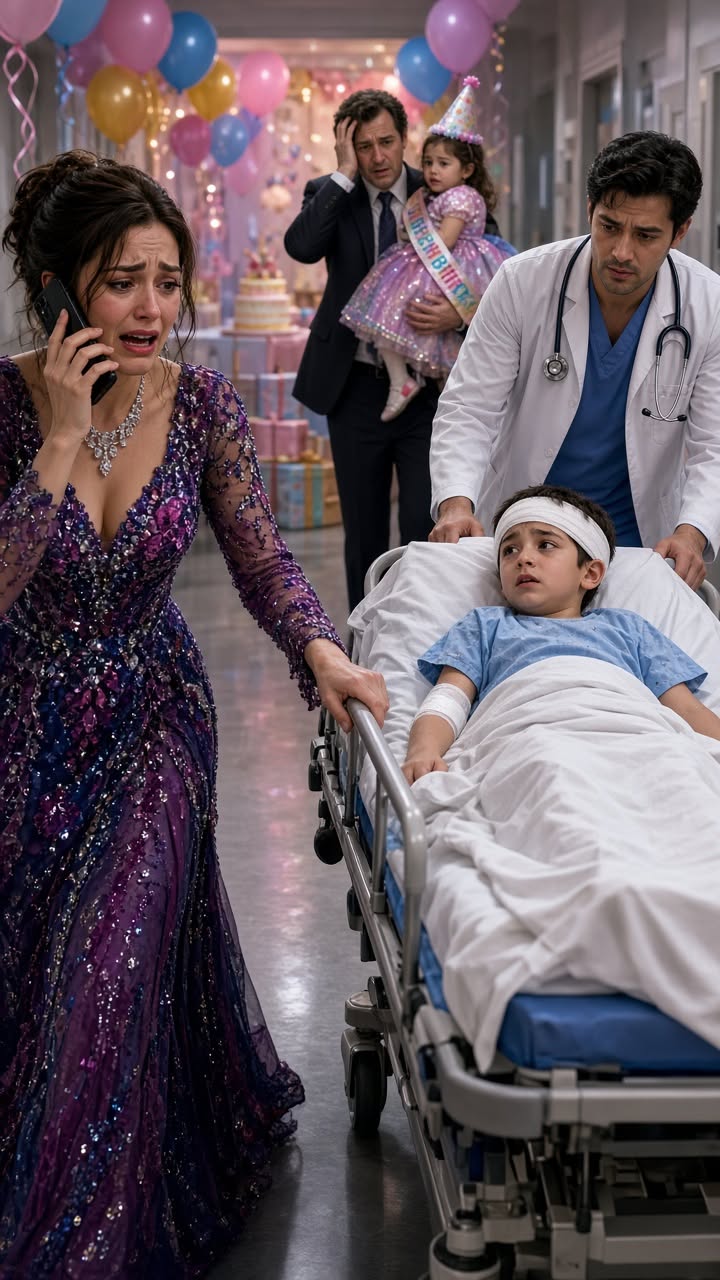
The unforgiving, sterile glare of the emergency ward stretched the corridor into an abyssal labyrinth. Crouched just beyond the swinging doors of the trauma unit, I clutched my smartphone like a lifeline, the crescents of my fingernails biting fiercely into the soft flesh of my palms. The screen illuminated a damning ledger. Missed call from Carter. Missed call from Carter. Forty-seven of them, stacked like a digital monument to my husband’s absence.
A triage nurse burst through the double doors, her rubber-soled shoes squeaking against the polished linoleum, leaving a trail of slanted, frantic footprints. I bolted upright. My legs had gone entirely numb, my kneecaps striking the plaster wall with a dull thud, yet I registered absolutely no physical pain. The adrenaline had cannibalized my nervous system.
“Family of Leo Evans?” the doctor asked, trailing just behind the nurse.
“I am his mother,” I rasped, my throat feeling like crushed glass.
“Compound fracture in the right tibia, severe internal injuries including a ruptured spleen,” the physician rattled off, his eyes glued to a metal clipboard. “His hemorrhagic shock is critical. Blood pressure is plummeting at a dangerous velocity.” He flipped a page, his brow furrowing deeply. “Blood type is O-negative. Unfortunately, our in-house blood bank is entirely depleted of that specific reserve. We initiated an emergency transfer protocol with the regional blood center ten minutes ago.”
“How much did you request?” I demanded, the metallic tang of fear flooding my mouth.
“We requested three units, but…” He hesitated, a shadow of genuine bewilderment crossing his features. “The regional center informed us that their entire stockpile of O-negative was urgently requisitioned earlier this afternoon. It was transferred to a private facility. Specifically, Sunrise Hospital, operated by the Evans Medical Group.”
I heard the words, but my cerebral cortex outright refused to synthesize them. “Transferred out? To my husband’s hospital?”
“Yes. The requisition mandate classified it for ‘VIP backup surgical reserves.’” The doctor offered me the clipboard, pointing to the bottom of the authorization form.
There, etched in arrogant, sprawling cursive, was the authorizing signature: Carter Evans.
I stared at that ink. My phone vibrated uselessly in my grip. The scarlet notification badge of forty-seven missed calls now looked like a row of gaping, unattended wounds.
“Then what is the protocol for my son?” I whispered.
“We are currently administering synthetic volume expanders to stabilize his vitals,” the doctor replied gently. “We’ve contacted a neighboring state’s facility. But realistically, we are looking at a three-hour transit time.”
“Three hours?” A violent tremor seized my right hand. It wasn’t a subtle shake; it was a spasmodic flailing, as if the limb had severed communication with my brain. I clamped my left hand over my right wrist, forcing it down against my thigh. As I did, a caustic wave of stomach acid surged up my esophagus. I swallowed it back, leaned my full weight against the wall, and dialed the forty-eighth call.
It rang four agonizing times.
“I’m currently occupied,” Carter’s voice floated through the receiver, flat and devoid of urgency.
Beneath his baritone, a distinct melody tinkled—a mechanical, whimsical tune you only hear on carousel rides at amusement parks.
“Leo was struck by a vehicle,” I stated, stripping every ounce of emotion from my voice.
Two seconds of suffocating silence followed. “Is the situation dire?”
“His spleen is ruptured. He is currently bleeding out in a trauma bay, requiring three units of O-negative blood.” I bit down on every syllable, grinding them into weapons. “The regional center informed us that you unilaterally requisitioned their entire emergency supply.”
“Excuse me?”
“I am not stuttering, Carter.”
He paused. Through the phone, a little girl’s exuberant shriek drifted over the line. “Uncle Carter, watch! I spun three times and didn’t even get dizzy!”
Then came a woman’s laughter—a soft, melodic sound laced with toxic gratitude. I recognized that laugh instantly. It belonged to Sarah Mitchell, Carter’s quintessential college sweetheart. Three years ago, she had materialized in our city with a four-year-old daughter in tow. Carter had dismissed her as a “casual friend in need of occasional patronage.”
The carousel music looped cheerfully.
“You are at a theme park,” I breathed, the revelation crystallizing the ice in my veins.
“I can be at the hospital shortly,” he deflected.
“What about the blood, Carter?”
“What blood?”
“The O-negative units you signed away at two o’clock this afternoon! My five-year-old son is lying in a trauma ward, his life draining out of him, waiting for the exact medical resource you hijacked. Where did you send it?”
Silence. A silence so profound, so agonizingly drawn out, that I could vividly hear the carousel complete an entire rotation through the earpiece.
“That… that was an administrative maneuver for the corporate hospital’s VIP backup reserves,” he stammered, the smooth facade finally cracking.
“It was not.”
“I will contact the logistics director immediately. I’ll have it routed back to your location.”
“Three hours,” I stated, my voice dropping to a terrifying deadpan. “The neighboring state’s transit takes three hours. You signed that form at two in the afternoon. It is now ten minutes past five. My son has already been bleeding for three hours.”
“Olivia, you need to remain rational—”
I terminated the call. The screen faded to black, mirroring the sudden, absolute void in my chest. Above me, the fluorescent tubes buzzed, sounding like a swarm of trapped, desperate insects. I slid down the plaster wall, buried my face against my knees, and sank my teeth into the back of my hand to stifle the scream.
I did not shed a single tear. Weeping was a luxury for the helpless. Tears were not going to manifest life-saving plasma from the sterile ceiling tiles. But in that clinical darkness, a terrifying clarity began to take root. If my husband was willing to trade our son’s life for an afternoon of playing savior to another woman, I was going to systematically dismantle the empire he stood upon.
Chapter 2: The Epiphany of Silence
Sixty excruciating minutes later, the transport vehicle from the neighboring state screeched into the ambulance bay. Forty minutes after the transfusion began, the surgical nurse emerged to deliver the news: the internal hemorrhaging was secured. The child had stepped back from the precipice.
When I finally gained clearance to enter the pediatric recovery unit, I found Leo swallowed by the sterile white sheets. His right leg was entombed in a massive fiberglass cast. His complexion was translucent, completely drained of its usual rosy vitality. An intravenous line was taped to the back of his tiny hand, the surrounding tissue blooming into a vicious, purple contusion.
His eyelids fluttered open. When his hazy gaze locked onto me, his cracked lips parted. “Mom.”
I rushed to the bedside, enveloping his free hand in both of mine. His fingers were icy, feeling as though they had just been retrieved from winter water. “Does the pain hurt terribly, my brave boy?”
He gave a minute shake of his head. A five-year-old child, biting down on his lower lip until it turned white, his eye sockets rimmed with exhaustion, yet refusing to cry. “I’m not crying,” he whispered, his voice incredibly fragile. “The nice nurse lady told me that brave warriors heal the fastest.”
I perched on the edge of the mattress, pressing his freezing knuckles against my cheek, desperately trying to transfer my own body heat into him. The only companionable sound was the rhythmic, monotonous beeping of the cardiac monitor.
“Did Dad arrive yet?”
I swallowed the bile rising in my throat. I remained silent.
“Did Mom remember to call Dad?”
“I did, sweetheart.”
“What time did he promise he would come?”
Outside the window, the city had surrendered to the night. Occasional clatter from rolling medical carts echoed down the hall. The emerald glow of the monitor painted shifting shadows across Leo’s pallid face.
“He is dealing with a severe corporate emergency,” I lied, the words tasting like ash.
Leo did not press the issue. He stared blankly at the acoustic ceiling tiles, blinked twice with heavy lids, slowly retracted his hand from my grasp, and curled tighter into himself.
“Mom?”
“I’m here.”
“Today, when that big black car hit me near the crosswalk… I was really terrified.” His voice was barely a breath, as if confessing a shameful secret. “I wanted to scream for Dad. But then I stopped myself. Because Dad is never there when I call.”
An invisible vice clamped around my throat, cutting off my oxygen.
“So, I screamed for Mom instead.” He rolled his head on the pillow to meet my eyes, his dark pupils incredibly lucid. “Because Mom always shows up.”
“Always,” I choked out. “I will always show up.”
“Then, from now on…” He hesitated, his small fists bunching the hospital blanket. “Mom, I don’t want to wait for Dad anymore. Is that okay?”
My mouth opened, but the grief paralyzed my vocal cords.
“Every time I sit and wait for him, he never walks through the door,” Leo continued, his tone unnaturally pragmatic for a kindergartener. “I don’t want to wait anymore. When I wait, my chest hurts.”
He meant his emotional heart, not his bruised ribs. He was five. He couldn’t articulate the anatomy of abandonment, but he felt its crushing weight perfectly.
I gave a slow, definitive nod. “It’s a deal. We are officially done waiting.”
Leo exhaled a long breath, as if a physical boulder had been lifted off his chest. He nested his head into the pillow, his eyelashes fluttering shut. Within moments, the steady rhythm of his breathing signaled he was asleep.
I sat vigil in the plastic chair, studying him. My son. An IV needle burrowed into his wrist, a fractured limb suspended in plaster.
I retrieved my phone from my pocket. It was 9:40 PM. Carter had not attempted to call back. No texts. Absolute radio silence.
I opened my Instagram application and navigated to my feed. The algorithm, cruel as ever, presented Sarah Mitchell’s latest post at the very top. The location tag proudly declared: Galaxy Dreamland Theme Park. It was a sprawling, exclusive facility on the city’s outskirts that strictly prohibited walk-in traffic; gaining entry meant renting the entire estate.
It was a carousel of nine meticulously curated photos. Pastel balloon arches, a colossal unicorn inflatable, the antique merry-go-round adorned with cascading fairy lights. In the centerpiece photograph, a little girl draped in a fuchsia tutu was perched triumphantly atop Carter’s shoulders. Both were caught in mid-laugh, radiating domestic bliss. The backdrop was a massive floral wall with gilded balloons spelling out: SWEET FIVE.
Sarah’s daughter was also five years old.
The caption read: “Eternal gratitude to Uncle Carter for manifesting a true princess birthday. The entire park belongs to me today! I am the luckiest girl in the universe.”
In the comment section, Sarah herself had pinned a reply: “So blessed for this beautiful encounter. Thankful for you walking this complex journey with us.”
Carter’s verified account had liked the post.
Between the hours of two and five this afternoon, my child was violently launched across asphalt by a speeding SUV. He lost nearly half his blood volume. During the three agonizing hours he lay on the brink of death, waiting for the O-negative reserves that had been actively diverted, his biological father was across the metropolis, financing an entire theme park to entertain another woman’s five-year-old.
I exited the app and logged into the Evans Medical Group internal administrative portal. During my seven years in the medical device industry, I had structured Carter’s procurement interface. He had requested I build the backend three years ago, and in his administrative arrogance, he had never revoked my master access.
I navigated to the Blood Bank Transfer Logs.
Timestamp: 14:17.
Destination: Sunrise Private Hospital (Evans Medical Group).
Blood Type: O-negative.
Volume: Three Units.
Purpose: VIP Client Pre-Surgical Reserve.
Authorizing Signature: Carter Evans.
I bypassed the security firewall to access the associated VIP client dossier. There, buried in the physician’s notes, was a single, damning sentence: Per the urgent mandate regarding Ms. Sarah Mitchell, her minor daughter requires long-term stockpiling of rare blood types due to a diagnosed congenital heart anomaly.
A congenital heart anomaly.
I stared at the glowing pixels, and a profound, terrifying tranquility washed over me. It wasn’t that the betrayal had ceased to sting; it was that the pain had surpassed the threshold of human endurance, transforming into absolute, calculating coldness.
Carter had not merely made an administrative error. He had made a definitive choice. Presented with the limited lifeblood required to sustain existence, he had chosen to build a safety net for his mistress’s child, actively stripping it away from his own flesh and blood.
I locked my phone screen. On the hospital bed, Leo shifted in his sleep, murmuring my name before settling back into a deep slumber. I leaned over, brushing a stray curl from his forehead.
Tomorrow, the era of passive endurance would end. I was about to show Carter Evans what happens when a mother stops weeping and starts auditing.
Chapter 3: Forging the Arsenal
Three days post-surgery, I pushed open the heavy glass door of an old-school, chrome-and-vinyl diner situated squarely beneath the towering skyscrapers of downtown Manhattan. Sitting at the furthest booth, obscured from the street view, was David.
We had practically survived college together before he morphed into one of the most ruthless commercial litigation attorneys in the financial district. A sleek MacBook sat open before him, flanking a rapidly cooling mug of black coffee and an untouched pastrami sandwich.
“You look like a walking ghost,” he remarked, peering over the rim of his tortoiseshell glasses as I slid into the booth opposite him. “Let’s skip the pleasantries and talk business.”
I unzipped my leather tote, extracted a silver encrypted flash drive, and slid it across the sticky laminate table.
“What exactly am I looking at?” he asked, arching an eyebrow.
“The unredacted backend server records of Sunrise Private Hospital, an entity entirely owned by Evans Group,” I stated flatly. “Blood bank logistical logs, highly classified VIP client dossiers, and a comprehensive ledger of all abnormal financial transfers executed over the past thirty-six months.”
David’s fingers hovered over the drive. “You maintained backend master access? Does Carter have any inkling you still possess these credentials?”
“He tasked me with building the procurement architecture three years ago because his in-house IT lacked the competence. He never bothered to deactivate my clearance.”
David plugged the drive into his machine, double-clicked the encrypted folder, scrolled through a seemingly endless matrix of data, and abruptly paused. He leaned back against the vinyl upholstery, his expression shifting from casual interest to predatory focus.
“This is not a negligible volume of data, Olivia. But this alone is just corporate mismanagement. Where is the kill shot?”
I unlocked my smartphone, retrieved a high-resolution scan, and pushed the screen toward him. It was the title page of a highly complex legal document: Intellectual Property Reversion & Proxy Holding Agreement. The execution date was precisely five years ago. The embossed corporate seal of the Evans Group anchored the bottom right corner.
“Five years ago,” I began, my voice steady, “I legally transferred the rights of fifteen core medical device patents into the Evans Group under a strict proxy holding agreement. We executed the papers and had them formally notarized. I kept the original wet-ink documents secured in my late father’s bank vault. I retrieved them yesterday.”
David stared at the digital image, processing the magnitude of the claim. “Fifteen patents?”
“Affirmative. Six of those constitute the proprietary, core computational architecture for their flagship ventilators. Three govern the exclusive manufacturing process for their hemodialysis consumables. The remaining six are the foundational IP for their automated surgical instruments. As of this fiscal quarter, eighty percent of the Evans Group’s entire medical division revenue is generated solely through the exploitation of these specific patents.”
David slowly, deliberately, closed his laptop. The steam from his coffee had entirely vanished.
“Without these fifteen patents,” David summarized, his tone hushed, “the medical division of Carter’s empire is effectively paralyzed. It’s a multi-million dollar carcass.” He met my eyes. “Olivia, I need you to understand the gravity of this. Once you detonate this, there is no walking it back.”
“I made my peace with the fallout the night my son nearly bled to death,” I replied, unflinching. “I need you to execute two directives. First, scrutinize the legal infallibility of this proxy agreement. Can I instantaneously trigger the reversion clause and claim return of ownership via an injunction? Second, I need your forensic accountants to trace a specific bank account registered to Eleanor Evans, my esteemed mother-in-law. Over the past five years, she has systematically wired ten thousand dollars every single month to an external account. The beneficiary is Mary Mitchell—Sarah Mitchell’s mother.”
David’s eyes narrowed into dangerous slits. “How did you uncover that financial routing?”
“The hospital backend. Sarah’s VIP medical file mandated an emergency financial contact. I merely followed the breadcrumbs.”
He nodded, pushing his neglected sandwich to the perimeter of the table. “The patent reversion is straightforward. The proxy agreement is fully notarized, and you retain the indisputable proof of intellectual property contribution. You can exercise the termination clause at your discretion. However,” he tapped a manicured finger against the table, “you cannot afford to let Carter catch wind of this prematurely. If he senses the guillotine, he will utilize corporate shell games to transfer the licensing rights offshore.”
“I am acutely aware. That is precisely why I am currently maintaining a facade of domestic hysteria.”
David adjusted his glasses. “So, what is our timeline?”
“I am waiting for him to force my hand.”
Two days later, Leo was medically cleared for discharge. The anticipated black SUV was conspicuously absent from the hospital roundabout. I navigated the discharge bureaucracy alone, maneuvered Leo into a wheelchair, and hailed a battered yellow taxi.
As we drove away, Leo pressed his pale face against the smudged windowpane. “Mom, are we going back to the big house?”
“We are not returning to the Evans estate,” I said softly, adjusting his cast. “Mom secured a beautiful new apartment in the Historic District. There is a diner right below us that serves the absolute best milkshakes in the city, and a giant orange stray cat that sleeps in the courtyard. Would you like to be in charge of feeding him?”
Leo’s eyes ignited with a spark of genuine excitement. He clutched the stuffed bear a nurse had gifted him. A five-year-old child, his leg encased in heavy fiberglass, smiling as though his world hadn’t just been shattered by the man supposed to protect it.
Our new sanctuary was a third-floor walk-up in a pre-war brick building. The hardwood floors creaked, and the air constantly smelled of roasting coffee and crisp bacon from the diner downstairs. It was small, vibrant, and fiercely ours.
The moment we crossed the threshold, my phone began to vibrate violently. Carter.
I let it ring three times before accepting the call.
“Where are you?” his voice demanded, clipped and irritated. “The pediatric ward informed me you initiated the discharge process without my authorization.”
“I did.”
“Why did you fail to inform me? I would have dispatched the chauffeur to retrieve you.”
“Your logistics were unnecessary.”
A heavy sigh crackled through the speaker. “Olivia, are we still entertaining this silent treatment?”
I said nothing.
“Look, I acknowledge my peripheral responsibility for the administrative oversight that day. The blood bank miscommunication was unfortunate. I have already instructed the board to overhaul the requisition protocols. But taking our child to reside in some dilapidated, historic slum? You are taking this tantrum entirely too far.”
“A tantrum?”
“Leo requires specialized rehabilitation! At the estate, we have the private chef, the live-in nanny, the on-call physical therapist. I have orchestrated a perfect recovery environment!”
“Then you are welcome to reside in it,” I countered, my voice icy.
“What exactly is your endgame here, Olivia?” his voice rose, betraying a crack of genuine panic beneath the corporate bravado.
“I will communicate with you when I have actual business to discuss.” I terminated the connection.
That evening, as Leo slept soundly in the small bedroom, David arrived at the apartment holding a thick manila envelope. The atmosphere in the room shifted the moment he walked in; he carried the weight of terrible knowledge.
He spread the documents across my small dining table. “The financial forensics are complete. Eleanor Evans didn’t just wire six hundred thousand dollars to Sarah’s mother over five years. She also purchased a 1.5-million-dollar luxury condo downtown. The deed is in Eleanor’s name, but the registered occupants are Sarah Mitchell and her daughter.”
I stared at the property records. “She bought her a life.”
“It gets worse,” David murmured, sliding a second folder forward. “Three years ago, the Evans Group Charity Foundation issued a three-hundred-thousand-dollar grant to a nonprofit called ‘Heartstrings Children’s Care.’ The legal representative? Sarah Mitchell. It’s a ghost entity. No staff, no office, zero charitable expenditures. It is a blatant shell company designed to funnel corporate capital directly into Sarah’s pockets.”
“If this moved through corporate channels, it constitutes felony embezzlement,” I noted, my mind racing.
“Yes. But the authorizing signature belongs to Eleanor, not Carter. However, that isn’t why I drove over here tonight.” David paused, taking a deep, shuddering breath. “I initiated the deep dive you requested regarding the hospital where you suffered your miscarriage five years ago.”
My blood instantly ran cold. The ambient noise of the street outside seemed to vanish.
“We located her,” David’s voice dropped to a grim whisper. “The attending nurse who administered your IV treatments, Amanda Jones. Two weeks subsequent to your discharge, she abruptly tendered her resignation. Seventy-two hours later, a wire transfer of forty thousand dollars materialized in her personal account.”
“Who initiated the transfer?” I demanded, my hands gripping the edge of the table.
“A shell company. The registered agent of that company is the legal spouse of Robert—Eleanor Evans’s personal executive assistant.”
I stood up, walking blindly toward the window. The ancient oak tree outside rustled violently in the wind. Five years ago. I was three months pregnant. The sudden bleeding. The agonizing ten days in isolation. I had blamed my own biology. I had wept at gravesites, believing my body was a broken vessel.
“Are we capable of subpoenaing her?” I asked, the words slicing through the air like a scalpel.
“She relocated to Ohio, working under her married name. I have a private investigator sitting outside her clinic right now. She is ready to crack.”
I locked the terrifying truth into the deepest vault of my mind. The time for mourning was over. The time for the slaughter had arrived.
Chapter 4: The Empty Throne
On the tenth day of our separation, a black SUV idled outside the pre-war building. The buzzer rang. I checked the security feed to find Carter standing awkwardly on the stoop, clutching a designer grocery bag and a brightly wrapped box from a high-end toy boutique.
I unlocked the door, leaning against the frame as he stepped into the cramped entryway. His eyes aggressively scanned the peeling paint near the baseboards, his jaw tightening in aristocratic distaste.
“I came to evaluate Leo’s condition,” he announced, attempting to project authority.
From the small balcony where he was coloring, Leo turned his head. There was no joyful shriek, no frantic scrambling to embrace his father.
“Hello, Dad,” Leo recited, his tone possessing the polite, chilling detachment one reserves for a distant substitute teacher. He immediately returned his attention to his crayons.
Carter froze. He awkwardly unpacked a highly detailed, remote-controlled Tyrannosaurus Rex. “I acquired this for you. I thought you might appreciate it.”
“Thank you, Dad,” Leo murmured without looking up. “You can place it on the table.”
Carter’s hand lingered in mid-air. He set the toy down, the plastic clattering against the wood, and turned to face me. The mask of the infallible CEO was beginning to slip.
“What kind of psychological manipulation are you running on him?” Carter hissed, his voice dropping. “He treats me like a stranger.”
“He treats you like a man who wasn’t there,” I corrected smoothly.
“Olivia, enough. You are dragging this vendetta out to absurd lengths. The house is prepared. The staff is waiting. When are you returning?”
“I am not.”
“Then what exactly do you want?” he exploded, his voice echoing off the narrow hallway walls.
I looked at him. He stood there draped in a bespoke three-thousand-dollar cashmere overcoat, offering twenty dollars of organic fruit as penance for nearly killing our child.
“You want to know what I want?” I stepped closer, dropping my voice to a lethal whisper. “Sarah’s daughter is five years old. Leo is five years old. Born the exact same month.”
Carter’s shoulders flinched. A microscopic, betraying twitch.
“Sarah’s daughter suffers from a congenital heart defect,” I continued, my cadence perfectly controlled. “She requires a perpetual stockpile of rare blood. That is precisely why you executed the requisition mandate, hijacking the regional center’s emergency supply. You were throwing her a lavish fifth birthday party, ensuring her medical security. Meanwhile, your biological son, sharing the exact same O-negative blood type—a fact you have known since his birth—was bleeding out on asphalt.”
Carter’s face drained of color. His hands retreated into his coat pockets, the knuckles stark white against the dark fabric.
“You didn’t just make an administrative error, Carter. You made a choice. You gambled with my son’s life to play the heroic patriarch for your mistress.”
“I… I had no foreknowledge of the accident,” he stammered, his voice fracturing. “I didn’t know it would be him.”
“But you knew someone would need it. You just didn’t care who died, as long as your illegitimate safety net was secured.” I pointed toward the door. “I want Leo to grow up in a reality where he doesn’t have to engage in a gladiatorial combat for his father’s basic decency. If you cannot provide that, he does not require a father. Get out.”
He stood paralyzed for a full sixty seconds before turning on his heel. The door clicked shut.
That evening, David’s name flashed on my screen. “We have a severe escalation,” he said immediately. “Thomas, the estate manager, just contacted me. Eleanor has summoned the entire extended family for a mandatory luncheon at the Hamptons estate this Saturday. She specifically demanded your presence. Thomas also intercepted a courier; Eleanor procured forged, back-alley divorce papers. She intends to ambush you publicly and announce you have been formally expelled from the family.”
I stared out the window at the glowing streetlamps. “Let her set her own stage. I will not be attending.”
“You’re going to let her control the narrative?”
“No,” I smiled, a cold, feral expression. “While she is busy performing her little theater of humiliation, I need you to meet me. We are taking a trip to the US Patent and Trademark Office. We are filing the emergency IP reversion and injunction Saturday morning. By the time they serve dessert, Carter won’t own his own company.”
Saturday morning dawned crisp and clear. At 9:30 AM, while the Evans family gathered for mimosas and character assassination, David and I sat in the sterile waiting area of the federal patent office.
At 10:15 AM, the clerk stamped the towering stack of notarized proxies, capital injection proofs, and reversion claims.
“Documentation is immaculate,” the clerk confirmed. “Emergency injunction application accepted.”
I walked out of the federal building, the sun warming my face. My phone buzzed with frantic texts from Thomas, providing a live play-by-play of the disaster unfolding at the estate.
Thomas: Eleanor just produced the forged divorce decree. The entire living room is in shock.
Thomas: Wait. Mr. Evans Sr. just intercepted it. He called it out as a cheap forgery. He humiliated Eleanor in front of everyone.
Thomas: Mr. Evans Sr. just told Carter he doesn’t deserve you. The luncheon has imploded.
I pocketed my phone. “David,” I said, my voice light. “Check the status of the court order.”
David tapped his tablet. A triumphant smirk spread across his face. “The judge fast-tracked the freeze based on the embezzlement evidence regarding the charity shell company. As of 12:18 PM, the primary operating accounts for the Evans Group R&D center are officially frozen.”
By 1:00 PM, my phone was a chaotic symphony of incoming calls and unhinged text messages from Carter.
Carter: The corporate accounts are locked! What did you do?
Carter: We have three clinical trials stalling! Hundreds of vendors panicking. Call me immediately!
I switched the device to silent, ordered a bowl of mac and cheese for Leo at the diner, and watched him eat.
At 8:00 PM, the doorbell to my apartment buzzed. Carter had bypassed the security gate. He stood in the hallway, looking like a man who had survived a shipwreck only to realize he was stranded in a desert. His tie was missing; his eyes were manic.
“You froze the corporate accounts,” he gasped, leaning heavily against the doorframe. “You are deliberately trying to bleed the company dry.”
I kept the chain lock engaged, speaking through a three-inch gap. “Did your mother enjoy her performance with the forged documents today?”
He flinched. “That was her madness. I had no part in it!”
“Just as you had no part in the blood requisition? Or the theme park?” I pulled my phone from my pocket and held it up to the crack in the door. Displayed on the screen was the digital receipt from the USPTO.
Carter squinted at the screen. It took five seconds for the acronyms to process in his panicked brain. When they did, the last remaining drops of blood vanished from his face.
“The fifteen core medical patents,” I whispered. “Clause seven, section three of the proxy agreement. Ownership never transferred. I retained the right of reversion. I filed the paperwork this morning. You no longer own the technology that generates eighty percent of your revenue.”
His knees visibly buckled. He slid his hand down the wood of the door, his voice a ragged, hollow rasp. “You cannot do this. You are obliterating the empire.”
“I am merely repossessing my own architecture,” I replied. “Five years ago, I gave you my genius to build your throne. You used that power to protect a mistress and sacrifice my son. Now, I am tearing the throne down.”
I slammed the door shut, sliding the deadbolt home.
Chapter 5: The Gavel’s Echo
The courtroom possessed the heavy, oppressive atmosphere of a mausoleum. I sat perfectly still in my tailored navy blazer, David operating as a methodical weapon beside me. Across the aisle, Carter looked as though he had aged a decade in two weeks. Beside him sat Mr. Sterling, the most aggressively priced divorce litigator on the Eastern Seaboard.
“Your Honor,” David began, his voice projecting absolute authority. “We are seeking a dissolution of marriage with extreme prejudice. Grounds include chronic abandonment, a long-term extramarital affair resulting in an illegitimate child, the malicious diversion of life-saving medical resources, and the respondent’s mother orchestrating a massive conspiracy to defraud marital assets.”
Mr. Sterling leapt up, adjusting his rimless glasses. “Your Honor, these are theatrical exaggerations! My client admits to a demanding schedule, but he emphatically denies any illicit affair. Ms. Mitchell is merely a charitable acquaintance. The blood transfer was a tragic, unforeseeable coincidence.”
David didn’t even blink. He queued the projector.
“Exhibit A,” David announced as a document illuminated the screens. “A certified DNA paternity report. Probability of paternity between Carter Evans and Ms. Mitchell’s daughter: 99.99%. Ordered and signed by Carter Evans himself four years ago.”
A collective gasp rippled through the gallery. Sterling’s jaw dropped. He whipped around to glare at Carter, who was staring a hole into the mahogany table, his thumbnail carving into his own flesh.
“Exhibit B,” David continued ruthlessly. “The Sunrise Hospital blood bank transfer logs. Executed by the respondent at 14:17. At 14:17, his marital child was hemorrhaging on asphalt. And where was the respondent?”
The screen shifted to the Instagram carousel. The fuchsia tutu. The unicorn bouncy castle.
“He was renting a commercial theme park to celebrate the birthday of the child he just claimed was merely a ‘charitable acquaintance.’”
The judge’s gavel cracked sharply against the wood, silencing the murmuring crowd. “Respondent’s counsel, do you have a rebuttal?”
Sterling was sweating profusely. “My… my client acknowledges an error in judgment, Your Honor, but categorizing this as premeditated malice is legally unfounded.”
“Perhaps,” David countered, his voice dropping to a terrifyingly calm register. “But we have not yet presented Exhibit C. Evidence pertaining to a potential Class A felony.”
The courtroom air turned instantly glacial.
David extracted a sworn affidavit from a manila envelope. “Five years ago, the petitioner, Olivia, suffered a catastrophic miscarriage while hospitalized. It was deemed a natural tragedy. However, we have recently located the attending nurse, Amanda Jones.”
Carter’s head snapped up. His posture went completely rigid.
“In this sworn affidavit,” David read, “Ms. Jones confesses that she was contacted by an agent of Eleanor Evans, the respondent’s mother. She was bribed with forty thousand dollars to introduce a pharmacological agent into the petitioner’s intravenous drip—a chemical designed to induce violent uterine contractions and terminate the pregnancy.”
The silence in the room was absolute, suffocating, broken only by the frantic clattering of the court reporter’s stenograph.
“We have provided the corresponding bank transfer records, linking the forty-thousand-dollar payout directly to a shell company controlled by Eleanor Evans’s personal assistant.”
I looked at Carter. The sheer, unadulterated horror on his face was genuine. His eyes were wide, panicked, searching my face for a denial that would never come. He was a man who had just realized he was living in a haunted house of his own family’s making.
“That… that child,” Carter croaked, his voice cracking into a pathetic, high-pitched wheeze. He ignored his attorney’s frantic gesturing. “Our first baby…”
I stood up. The judge did not stop me. Every camera, every eye, locked onto my silhouette.
“Five years ago, while I was bleeding out on an operating table, you were unreachable,” I said, my voice echoing off the vaulted ceiling. “For three years, I carried the guilt of a broken body. I bought flowers for an empty grave.”
Carter’s hands gripped the edge of the table so hard his knuckles looked ready to shatter.
“You didn’t know your mother murdered our child,” I continued relentlessly. “Just as you didn’t know that the woman you spent five years protecting—Sarah Mitchell—was a paid mercenary.”
Carter stopped breathing. “What?”
“Sarah’s return was not serendipity, Carter. Your mother recruited her. Eleanor decided I was a defective vessel who couldn’t provide an heir, so she purchased a fertile substitute. Your mother bought Sarah a 1.5-million-dollar condo and funneled three hundred thousand dollars into a fake charity to keep her compliant. You thought you were the noble savior, rescuing a lost love. You were just another oblivious pawn on your mother’s chessboard.”
I sat down.
The judge slowly removed his spectacles, rubbing the bridge of his nose. “Given the introduction of substantial evidence alleging felony conspiracy and aggravated assault, this court is calling an immediate recess. All relevant materials are hereby remanded to the District Attorney’s office.”
As I exited the heavy oak doors of the courtroom, I heard a chair violently crash to the floor behind me.
“Olivia!” Carter’s voice was a primal, gutted howl.
I did not stop walking.
“Our baby!” he screamed, the sound echoing down the marble corridors, a phantom pain that would haunt him for the rest of his miserable life. “Is it true?!”
I pushed through the revolving doors into the blinding afternoon sun. I left him to drown in the truth.
Chapter 6: The Architect of Her Own Peace
The fallout was swift and apocalyptic.
Forty-eight hours after the hearing, the District Attorney’s office executed a no-knock warrant on the Evans estate. Eleanor Evans was dragged out in handcuffs, her knees buckling as they loaded her into the squad car. She was indicted on charges of corporate embezzlement, money laundering, and conspiracy to commit grievous bodily harm.
Sarah Mitchell didn’t wait for the knock. She drained the offshore accounts and fled the state in the dead of night, leaving Carter with a ghost and a deactivated phone number.
Two weeks later, Thomas requested my presence at the estate. Richard Evans, Carter’s father, sat in his mahogany study, looking frail but entirely lucid.
“I have a document for you, Liv,” the old man said, his voice carrying the rasp of a long, exhausting life. He slid a sealed envelope across the desk.
Inside was his Last Will and Testament, drafted and notarized five years ago. It decreed that upon his death, his controlling thirty-seven percent share of the Evans Group would bypass Carter entirely and transfer directly to me.
“You knew,” I whispered, staring at the date. “You knew what Eleanor was doing.”
“I knew she brought the girl back. I was diagnosed with a failing heart that same month,” Richard sighed, staring out at the manicured lawns. “I feared if I exposed her and died the next day, you would be left utterly defenseless. So, I wrote this. An insurance policy. I just didn’t expect you to endure the torment for so long before fighting back.”
“I don’t need the shares, Richard.”
“Keep them anyway,” he smiled, a sad, weary expression. “My son had everything a man could ever desire. He threw it into the fire with his own two hands. If your father were alive, Liv, he would be immensely proud of the warrior you’ve become.”
Spring arrived, washing the city in vibrant greens and golden light.
The criminal courts finalized the reckoning. Eleanor Evans was sentenced to seven consecutive years in a state penitentiary. Carter, implicated by his signature on the fraudulent charity audits, pleaded down to misprision of a felony. He avoided a cell, receiving two years of heavily restricted probation, stripped of his corporate titles, his reputation incinerated.
The divorce was finalized. The courts awarded me full custody of Leo and seventy percent of the liquid marital assets. The federal patent office officially logged my sole ownership of the fifteen core IP patents. I launched Genesis Medical, my own boutique R&D firm, funded entirely by the extortionate licensing fees the crippled Evans Group was now legally mandated to pay me to stay afloat.
On a breezy Saturday morning, I was in my apartment kitchen, pouring hot chocolate, when the buzzer rang.
I pulled up the video feed. Carter stood outside. He looked unrecognizable. The tailored suits were gone, replaced by a faded gray hoodie. His cheekbones were hollow, his eyes sunken and bruised with chronic insomnia. He looked like a man who had spent three months walking through hell, only to find the exit door locked.
I opened the door, leaving the security chain dangling.
“I just want to see him,” Carter whispered, his voice cracking. “Just for one minute. Please.”
“He doesn’t want to see you,” I replied, my voice devoid of malice or pity, merely stating an objective fact.
“I have nothing left, Olivia. The company, the money, my mother, Sarah… it’s all gone. I understand now. I understand the magnitude of what I destroyed. I want to make amends.”
“Amends for what?” I asked softly. “You played the hero for a woman who was paid to be there. You sacrificed your actual son for a fantasy. And now that the fantasy has evaporated, you want to come back here and play the tragic, repentant father? I won’t allow you to use my son as a bandage for your ego, Carter.”
“Mom!” Leo’s voice chirped from the living room. “The little pig in my book learned how to swim!”
Carter flinched as if he had been shot. He leaned his head against the doorframe, trying to catch a glimpse of the boy on the sofa.
Leo looked up from his picture book. His eyes swept casually over the haggard man standing in the doorway. There was no flicker of recognition. No trauma. No longing. Just the mild curiosity a child affords a passing stranger. Leo turned back to his book, kicking his fully healed leg happily against the cushions.
Carter let out a soft, devastating sob. He took a step back, the reality of his total erasure finally cementing in his mind. He turned and walked down the stairs, his footsteps fading into the hum of the city.
I closed the door, threw the deadbolt, and walked into the living room.
“Who was that man, Mom?” Leo asked, taking a sip of his hot chocolate.
“Just someone who got lost looking for the right address,” I smiled, sitting beside him.
“Oh.” Leo shrugged, pulling a handful of cat treats from his pocket. “Can we go downstairs and feed Big Orange now?”
“Absolutely.”
We walked out into the courtyard. The old oak tree was in full bloom, casting a protective canopy of emerald leaves over the brick pavement. Big Orange the cat came trotting over, weaving between Leo’s legs, purring like a rusty engine.
I stood in the sunlight, watching my son laugh as the stray cat ate from his open palm. The heavy, suffocating waiting was over. We weren’t looking down the street for a car that would never arrive. We weren’t listening for a phone that would never ring. We had built a fortress out of the wreckage, and inside it, we were finally, beautifully free.