PART 1: THE GILDED CAGE

Where the red carpet shines under the glare of a thousand heavy spotlights, the distance between the absolute peak of pride and a devastating fall is sometimes measured in the blink of an eye. In my case, it happened in the span of a single afternoon inside a crowded hall.
My name is Alistair Prescott. If you follow the financial papers or frequent the charity galas of Boston’s elite, you know my face and the public narrative. People know me as the self-made titan of high-stakes investment funds, the man who turned a modest inheritance into a sprawling empire of glass towers and offshore accounts. What the bespoke suits hide, however, is the chronicle of my complete personal bankruptcy.
It was a Tuesday afternoon, and the air inside the Symphony Center in downtown Boston was thick with expensive cologne and nervous ambition. Banners bearing the crest of the National Scholastic Excellence Tournament hung from the vaulted ceilings, bathed in the warm glow of stage lights. Soft instrumental music drifted from hidden speakers, fighting a losing battle against the rustle of designer gowns and the sharp clack of leather shoes clicking against polished marble floors.
This was not merely an academic competition for the wealthy families gathered inside the room. It was a bloodless battlefield where we gathered to measure social status, parade our offspring like prized thoroughbreds, and seek the kind of validation that translates into leverage.
I stood near the VIP partition with a crystal tumbler of sparkling water clutched in my right hand, my left tucked into the pocket of a suit that cost more than most families make in a year. I was in my mid-forties, and the world liked to tell me that time had been a generous friend. I possessed the untouchable aura of a man who held immense corporate power and millions of dollars at his fingertips. The heavy platinum watch on my wrist caught the ambient light, casting cold reflections against the velvet curtains lining the walls.
Beside me, Genevieve sat engaged in a frantic, whispered war with a lapel. She was my wife, a woman whose beauty was maintained with the ruthless discipline of a military campaign. She wore a skin-tight scarlet dress, her face a flawless mask of cosmetic care designed to hide the creeping anxiety in her eyes. Her manicured fingers were aggressively smoothing the collar of the blazer worn by Benedict, her twelve-year-old son from a previous marriage.
“You better do this right today, Benedict,” Genevieve whispered with a sharp tone as she leaned closer to the boy. “Do you hear me right now?”
The boy physically recoiled from her harsh breath, staring down at his polished black shoes.
“Alistair canceled a massive board meeting with our top investors today just to sit here with you,” Genevieve continued, her grip tightening on his shoulder. “The private tutors we hired for you are top-tier university professors who cost tens of thousands of dollars every month. If you do not take home a major award today, how am I supposed to face all these people in our circle?”
I watched the boy carefully as he shrank away from her heavy gaze. His face was pale and slightly soft from a life devoid of physical struggle, showing an exhaustion that did not belong on a child his age. He was accustomed to being wrapped in luxury, but he was equally accustomed to functioning as an expensive ornament on his mother’s social vehicle.
I offered a faint, rehearsed smile, using the exact expression I relied on when closing a hostile corporate takeover. I stepped closer and placed my hand on the boy’s trembling shoulder.
“Be confident out there, Benedict,” I said, dropping my voice into a low, authoritative cadence. “Since you are part of this family now, you must walk out there with your head held high. The best study materials, the finest tutors, and perfect conditions have all been secured by me. Your only job today is to go up on that stage and bring back that title for us.”
It sounded commanding and perhaps even reassuring to a bystander, but I knew the boy could feel it was utterly devoid of paternal warmth. Genevieve’s posture instantly relaxed when she heard my voice. A triumphant smile stretched across her painted lips, and she leaned her weight against my arm while her eyes swept over the adjacent clusters of parents. It was a silent declaration that the most powerful corporate figure in the room belonged to her, and her son’s future was paved with my gold.
As the heavy scent of Genevieve’s custom perfume invaded my lungs, a sudden chill swept through my blood. I felt as though the oxygen had been sucked out of the room completely. It had been thirteen years since I traded my integrity for a seat at this table. Thirteen years had passed since I plunged into the cutthroat world of multi-million-dollar hedge funds, extravagant real estate acquisitions, and late-night parties that bled into the dawn. I had systematically destroyed my past to construct my own gilded throne.
I had everything the elite world promised, including unquestioned status, the fearful respect of my rivals, and a woman on my arm who fed my ego continuously. Yet as the ice clinked softly in my glass, I wondered why my chest felt like an empty cavern.
The truth was that money could purchase public submission, but it could not buy a single second of genuine peace. My life was a meticulously choreographed theater production. Genevieve loved the title of a billionaire’s wife along with the inexhaustible credit limits, while Benedict called me by my first name with a stuttering reverence born of fear. Beneath the expensive exterior, the foundation of my life had rotted away.
A memory I had spent a fortune trying to forget suddenly surfaced in my mind. Thirteen years ago, I was not Alistair Prescott the titan. I was a broke, ambitious, and deeply bitter man named Rick who was suffocating in the grip of poverty. In those dark days, there was a woman who stood as my absolute anchor. She saved every dime from her meager paycheck, cooked warm meals on a broken stove during brutal winters, and looked at me as if I held the universe together.
Her name was Beatrice Montgomery.
When I closed my eyes against the glare of the grand chandeliers, I did not see Genevieve’s bright scarlet dress. I saw Beatrice with her clear, unwavering eyes, her hair tied back with a simple elastic band, and her hands slightly roughened by daily survival.
“Alistair, what are you staring at right now?” Genevieve asked, her sharp tone snapping my memory in half as she shook my arm gently for the cameras nearby. “You look like you are a million miles away from this room.”
I blinked quickly and swallowed the dry taste in my mouth. “It is nothing,” I lied smoothly. “I was just turning over a corporate acquisition in my head.”
“Leave the corporate acquisitions for tomorrow morning,” Genevieve purred, leaning her head against my shoulder so the photographer nearby could catch the angle. “The ushers are directing the guests into the main auditorium now, and I have already messaged several journalist friends to ensure we get proper media coverage tomorrow because we need to remind everyone what real class looks like.”
“Let us head inside then,” I replied, adjusting the silk cuffs of my shirt mechanically.
As we moved through the velvet ropes toward our assigned seats, whispers trailed in our wake like ghosts. People murmured my name, pointed at my suit, and whispered about the massive fortune behind our family. Once, those whispers were the narcotic that fueled my daily ambition, but today they sounded like noise over a sinking ship.
I took my seat in the center of the VIP section where the plush seating yielded perfectly to my weight. Genevieve immediately produced a compact mirror to fix a microscopic flaw in her eyeliner, while Benedict slouched in his seat and mindlessly tapped at his smartphone hidden beneath his jacket.
I slumped against the backrest and stared at the massive red curtains covering the stage. I took a deep breath to steady my erratic heartbeat, telling myself that I was still the master of my universe and the author of my own destiny. I had no idea that sitting less than fifty feet away from me was the architect of my complete undoing, waiting quietly for the curtain to rise.
PART 2: THE GHOSTS OF THE PAST
The auditorium lights began their slow descent, plunging the massive room into an expectant twilight. A single circle of bright white light pierced the gloom, illuminating the center of the stage before the host strode out with a voice trained to project into the farthest corners. Applause crashed through the room like a wave of physical noise.
To me, the sound was muffled as if I were listening from under deep water. My body was anchored to the velvet seat, but my mind was violently pulled backward across a decade to an autumn afternoon that defined the rest of my life.
Our small, rented apartment in an old neighborhood always smelled of damp rain. The moisture seeped through the porous brick walls, mixing with the earthy scent of herbal teas Beatrice drank to soothe her stomach. I was twenty-nine years old back then, drowning in the catastrophic failure of my first tech venture. The capital I had scraped together had evaporated, and the people who had drank my liquor stopped answering my calls. I was cornered, humiliated, and suffocating under debt.
Then came Genevieve. She was an investor five years my senior who possessed the charm of someone who had never been denied anything in her life. More importantly, she held the keys to financial survival through her family trust fund that could wipe out my debts with a single signature. She saw my desperation, and I saw her utility.
Our business meetings quickly morphed into a quiet, transactional affair. Genevieve was transparent about her expectations, needing a competent man to manage her complex inherited estate, while I needed a ladder out of my financial grave. Her offer came with a strict condition that required me to be completely unencumbered by my past.
I made my choice without hesitating.
The memory of the day I packed my duffel bag remained etched into my mind. Beatrice had been sitting at our small kitchen table, her knuckles white as she held the edge to ride out a wave of morning sickness. Resting between us on the scratched surface was a sonogram printout that showed two distinct, tiny shadows.
I had rehearsed my speech for days and expected a storm of anger. I expected her to scream, throw dishes, or fall to her knees and beg me to stay. I had prepared myself to be the practical realist who explained that a drowning man could not save two infants and a struggling partner.
Beatrice did not scream at all.
She sat in a silence so heavy that I could hear the rhythmic dripping of the leaky faucet in the nearby bathroom. When she finally looked up at me, there were no tears in her eyes. Her expression had turned cold and distant, looking at me not as a partner, but as a complete stranger.
She placed her hand over her stomach, nodded once, and spoke in a steady voice.
“You can leave now,” Beatrice said softly. “From this moment on, you go your way and I will go mine. These children belong to me, and they have nothing to do with your life.”
I walked out of that building feeling a surge of relief, convincing myself that I was acting out of necessity. I told myself she would eventually realize the economic impossibility of her situation and reach out for help, assuming my absence would teach her a practical lesson.
Yet for thirteen years, Beatrice vanished completely. She became a ghost who never demanded child support, never left angry messages, and never filed legal claims. Her complete silence was a daily reminder that there was someone who considered my empire of dollars utterly worthless.
“Look at Benedict right now,” Genevieve’s sharp whisper yanked me back to the present as she pointed at her son, who was openly yawning during the opening speeches. “He stayed up all week doing mock exams for this event. If he does not win a top prize today, I will personally complain to the directors because we paid fifty thousand dollars to his academy.”
I looked at Benedict and felt a quiet surge of frustration. I remembered the boy throwing a glass on the floor because the staff brought the wrong brand of water, and I remembered writing large checks to private schools just to make his poor marks vanish. He was a hollow container filled only with the entitlement his mother poured into him.
A heavy thought seized my mind. I wondered what had become of my own blood and what happened to those two tiny shadows on that old sonogram. Did they grow up struggling, or were they bitter teenagers angry at the father who left them behind? I had always pushed those questions away beneath stock portfolios, but sitting here, the void in my chest opened wider.
“We now ask the audience to welcome our competitor delegations to the main stage,” the host announced loudly over the sound system.
Music filled the room while bright spotlights swept across the crowd. I adjusted my posture and tried to rebuild my composure, refusing to let old memories unravel me in public. I glanced sideways at Genevieve, who was holding her phone on a small tripod to live-stream her face while whispering about success to her online followers.
Disgusted by the display, I turned my head away and reached for my glass. As my eyes swept across the vast auditorium toward the opposite VIP tier, my hand froze mid-air.
Five rows up, sitting quietly in her seat, was a woman wearing a simple, tailored dark green dress. She wore no loud jewelry, just a plain silver pin holding back her dark hair. Amidst the crowd of posturing figures, she radiated an untouchable, calm presence.
My heart stopped for a second, and the crystal glass slipped slightly in my fingers. It was Beatrice.
She had not broken or surrendered to circumstance. She was sitting in the VIP section of the most exclusive academic gathering in the region, and as she looked calmly toward the stage, I realized with complete certainty that my past was standing right in front of me.
PART 3: THE UNBROKEN BOND
“Alistair, why are your hands shaking like that?” Genevieve asked, her voice cutting through my thoughts.
I set the glass down quickly on the small table beside my seat and pressed my hands against my knees to hide the tremor.
“It is nothing,” I replied quietly. “The air conditioning in this section is just cold.”
Genevieve did not press further because her eyes had already followed my gaze across the room to the woman in the green dress. Her lip curled into an expression of immediate disdain.
“Look at her over there,” Genevieve whispered loudly enough for nearby guests to hear. “She looks like someone who won a door prize just to sit in this section. That dress looks completely average, and the organizers are letting anyone sit in the VIP tier nowadays, which completely ruins the prestige.”
Her words felt heavy and grating. I looked at Genevieve, taking in the thick makeup and the constant need for attention, and felt a profound sense of fatigue. I ignored her entirely and grabbed the glossy event program from my lap, flipping through the heavy pages with cold fingers.
I scanned the list of honored guests, sponsors, and directors, trying to understand why she was in the room. I wondered if she was working for one of the attending schools or assisting an executive. My eyes locked onto a small paragraph near the back of the booklet.
Special Guest Assessor and Founder of the Vanguard Educational Trust: Beatrice Montgomery.
The program slipped from my fingers and landed softly on the carpeted floor. Beatrice was not a struggling guest or an assistant. She was an honored director who had built a respected institution through her own work and intellect, completely independent of my wealth. The realization shattered whatever pride I had left. I had spent thirteen years believing I had won our silent separation, but I was completely wrong.
“Honored guests and students,” the host’s voice projected clearly across the room. “We will now begin the formal awards presentation for the National Scholastic Excellence Tournament.”
Genevieve sat up straight in her chair and tapped Benedict’s arm forcefully. “Put that phone away right now and pay attention,” she commanded.
Benedict shoved the device into his pocket with a bored look on his face.
The announcer began reading the lower-tier placements, calling out third place, second place, and minor commendations. With every name called that was not Benedict’s, Genevieve’s fingers dug deeper into her leather handbag as her impatience turned into quiet anger.
“Why have they not called his name yet?” she demanded under her breath, turning to me. “It has to be the top honor because the academy guaranteed us a placement.”
I could not answer her. My eyes remained fixed on Beatrice, who sat comfortably across the aisle, clapping politely for every student who stepped onto the stage. She showed no anxiety or hesitation, looking like someone who was entirely at peace with her surroundings.
The stage lights dimmed suddenly before two bright white beams swept across the audience, focusing directly on a row of seats in the student section.
“And now for the top honor of the afternoon,” the host announced with genuine enthusiasm. “The Gold Trophy and individual medals for the highest overall score go to two students who achieved a perfect mark, a result never before recorded in the history of this competition.”
The room fell quiet while Genevieve leaned forward in her seat, ready to stand up.
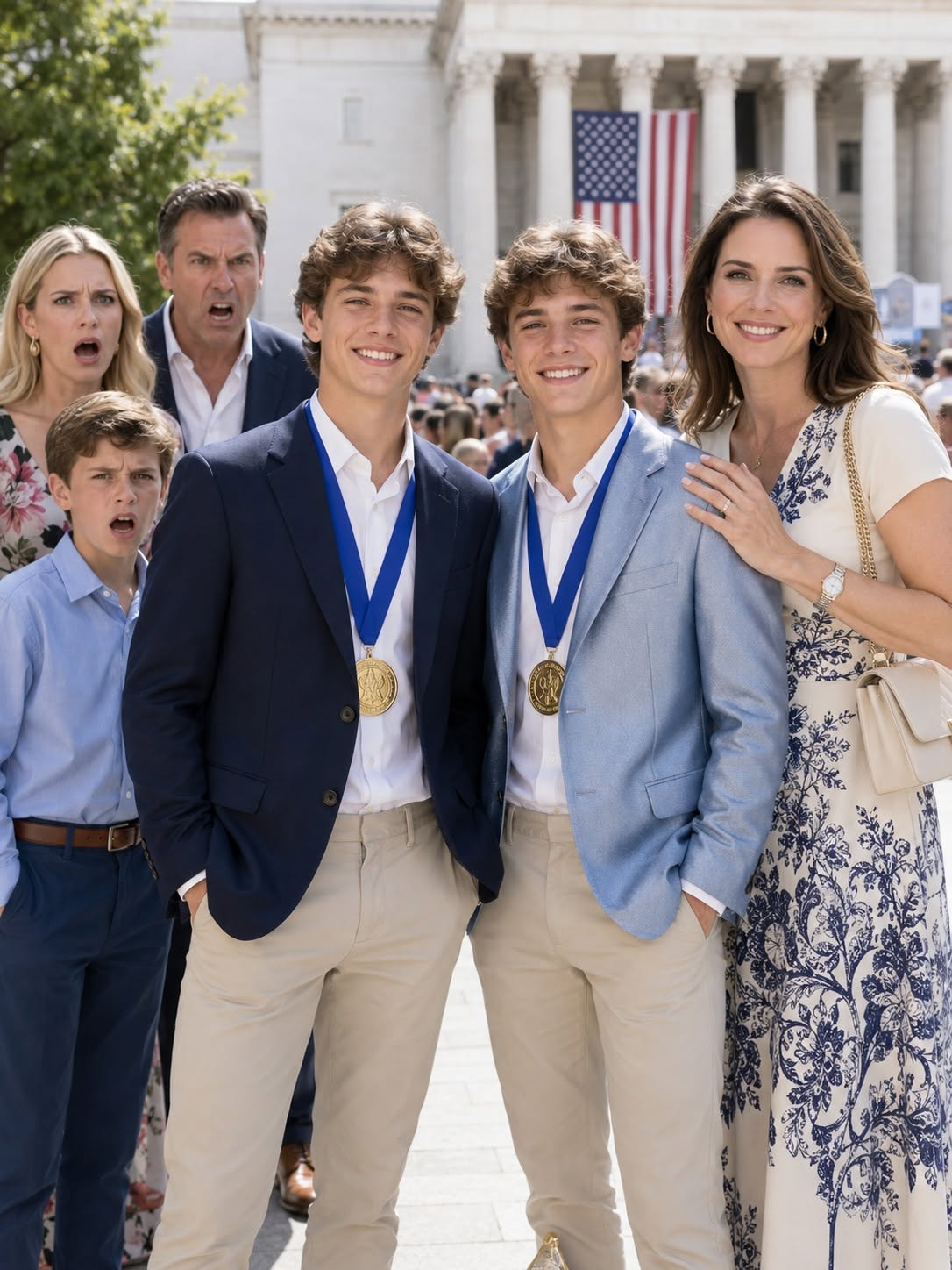
“Congratulations to the twin brothers, Bennett Montgomery and Caleb Montgomery!”
The auditorium erupted into applause, but the sound felt distant to my ears. From the illuminated row, two young men stood up in matching dark suits and white shirts. They were tall and broad-shouldered, and as they moved toward the aisle, the large digital screens flanking the stage showed their faces clearly.
I stopped breathing entirely. I was looking at my own features reflected in two young men. They shared the same sharp jawline, high bridge of the nose, and structured brow that I saw in the mirror every morning. They were exact representations of how I looked at their age.
Yet their eyes were entirely different from mine. Their dark, focused gaze carried a calm strength that came from Beatrice, devoid of any arrogance or entitlement.
“Montgomery,” the host repeated into the microphone.
It was Beatrice’s family name.