Chapter 1: The Shattered Glass
The music in the ballroom hadn’t stopped, but the silence that fell over the crowd was deafening. It was the kind of absolute, suffocating quiet that only occurs when the ultra-wealthy are confronted with a vulgarity they cannot politely ignore.
I pushed through the throng of stunned executives and socialites just in time to hear the sharp, sickening crack of flesh meeting flesh.
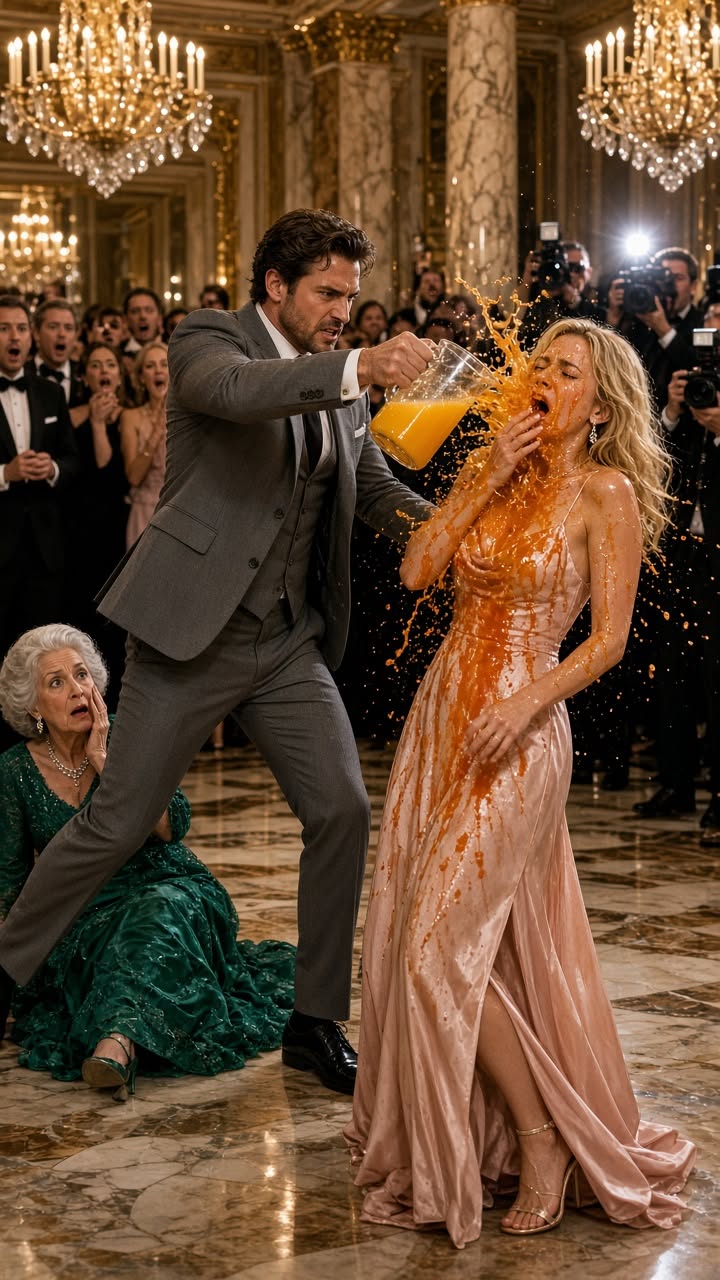
My mother, Marianne Voss, stood frozen. A faint, blossoming redness was already spreading across her left cheek. At her feet lay the shattered remains of a crystal flute and a spreading puddle of orange juice. Standing opposite her, trembling with a rage that distorted her otherwise flawless features, was Sloane Harrow. Sloane’s scarlet designer gown bore a single, barely noticeable damp spot near the hem, but her eyes were alight with the terrifying entitlement of a woman who had never been told no.
“Get on your knees,” Sloane hissed, her voice vibrating with venom, carrying clearly across the marble floor. “Get on your knees and clean it up. Now.”
A few of the guests—cowards whose portfolios were tied to Sloane’s billionaire father—actually chuckled. A low, sycophantic murmur of amusement.
The cold fury that seized my chest was absolute. I stepped between them, blocking Sloane’s view of my mother. I didn’t yell. I didn’t need to. I spoke with a quiet, lethal precision. “You have exactly three minutes to get your things and get off my property, Sloane. If you are still inside these gates when the clock strikes, I will have security drag you out by your hair.”
Three nights later, my mother stood by the tall windows of the kitchen, looking out over the moonlit lawns of the estate as if the sprawling stone mansion itself had committed a mortal sin against her. She was wearing a faded cotton robe she had owned for a decade, refusing to don the silk ones I had bought her.
“Sell the house, Graham,” she whispered, her breath fogging the cold glass.
I lowered my coffee mug, the ceramic clinking softly against the granite island. Of all the demands she could have made—after seventy-two hours of me canceling contracts, refusing calls from Conrad Harrow, and instructing my legal team to sever every financial artery connecting my company to the Harrow empire—this was the one I hadn’t anticipated.
“Mom, Sloane is gone,” I replied gently, walking toward her. “She’ll never cross that threshold again. I’ve burned the bridge.”
Marianne finally turned. The discoloration on her cheek was fading into a sickly yellow bruise, poorly concealed by foundation. Seeing it made my blood heat all over again. “This isn’t about Sloane.”
I studied her. The estate had been my ultimate trophy. Eighteen months ago, after taking my tech firm public, I had purchased this sprawling Connecticut River property for forty million dollars. It was a monument to how far we had come from the freezing, rat-infested apartments of my childhood. Marianne had always complained it was too large, too drafty, too ostentatious. But she had never asked me to abandon it.
“Then what is it about?” I pressed.
She looked past me, her gaze drifting down the long, shadowed corridor leading toward the older, unrestored western wing of the mansion. “Did you ever find out who owned this place before you bought it?”
I almost laughed, though there was no humor in it. “Some old-money dynasty. The Bellamys, I think. Why?”
The coffee cup in her hands trembled. It was a microscopic tremor, but I had spent my life studying her moods. I saw the blood drain from her face, leaving her looking fragile and terrified.
“August Bellamy?” she breathed, the name catching in her throat.
My forced smile vanished. “You know him?”
She set her cup down on the windowsill with agonizing care. “I knew his family.”
The kitchen suddenly felt like a shrinking cage. I stepped closer, but she shrank back against the glass. “I want you to promise me something, Graham,” she pleaded, her eyes shining with unshed tears. “Whatever you find out about this house… leave it alone.”
“Why?”
“Because there are debts people pay with money,” she said, her voice cracking. “And there are debts that ruin everyone who tries to collect them.”
She hurried out of the room before I could demand an explanation. Ten minutes later, I was on the phone with my lead attorney. By noon, I had the original, unredacted property deeds. By sunset, I understood exactly why my mother had recoiled at the name.
What I didn’t understand, however, was why a shadow corporation tied to the Bellamy family trust had quietly injected seed capital into my first startup twelve years ago—back when I was a broke, desperate twenty-six-year-old who firmly believed no old-money aristocrat even knew I existed.
I was about to learn that my entire empire was built on a ghost’s foundation.
Chapter 2: Echoes in the Woodwork
The photographs from the party leaked by morning. They didn’t show the slap, but they showed Sloane standing over my mother, and they showed me interceding. The financial blogs had a field day: Private Equity Heiress Ejected from Tech Billionaire’s Estate.
My phone vibrated violently against the mahogany desk in my study. The caller ID flashed: CONRAD HARROW.
I let it ring out. Thirty seconds later, it buzzed again.
When I finally answered, Conrad didn’t shout. Men who control four billion dollars in institutional capital rarely need to raise their voices. “I assume you’ve seen the morning papers, Graham,” he said, his tone dripping with paternalistic disappointment. “This has gone too far. I would prefer to resolve this before the market decides there is instability at your company.”
“Your daughter assaulted my mother,” I replied, staring out at the frost-covered lawns.
“Sloane was embarrassed. The situation became heated,” Conrad countered smoothly, turning a physical assault into a mutual misunderstanding. “I am not asking you to applaud her. I am asking if you intend to act like a CEO preparing for a massive capital event, or a child settling a petty family grievance. Monday’s board meeting proceeds as planned. You release a statement calling it a private misunderstanding, and we move forward.”
It was a brilliant, sociopathic squeeze. Harrow Capital wasn’t just my lead investor; they were the anchor for three other firms. If Conrad pulled his funding, the domino effect could bankrupt my expansion plans and leave thousands of my employees vulnerable. He was putting a price tag on my mother’s dignity.
“Monday’s meeting is canceled,” I said. “And your money is no longer welcome.” I hung up before he could articulate the threat I knew was coming.
By noon, the retaliation began. Harrow’s legal team filed injunctions, board members panicked, and my CFO, Marcus Hale, was practically hyperventilating over a video call from Manhattan. But as I sat in the library, surrounded by old property schematics, the corporate war felt secondary.
Sloane had taunted my mother at the party: Maybe before you start deciding who belongs here, you should find out why your mother looked terrified the first time she saw it.
I took the architectural blueprints and walked into the western wing. The air here was colder, smelling of lemon polish and old dust. The blueprints indicated a service corridor that had been walled off during a 1990s renovation. I found the seam in the oak paneling behind a heavy bookcase in the old music room.
It took a crowbar and twenty minutes of sweating in my dress shirt to pop the concealed door open.
Beyond it was a narrow, windowless passage leading to a locked administrative office. I kicked the door in, the brittle wood splintering around the deadbolt. Inside sat a rusted filing cabinet and a desk coated in decades of grime. This was a staging room from when Bellamy Hospitality used the estate for private corporate retreats.
I spent two hours pulling files. Most of it was garbage—catering invoices, maintenance schedules from the late eighties. But in the bottom drawer, inside a manila folder marked INTERNAL REVIEW: 1992, I found my father’s name.
Daniel Voss — Facilities Division.
My lungs seized. My father, who had died a broken, impoverished man when I was ten, had worked for the Bellamys.
I flipped the page. A second index sheet listed incident reports. Several pages had been meticulously excised with a razor blade. But one line remained, glaring up at me in faded type ink:
Marianne Voss — Witness Statement. Status: Statement Withdrawn.
Beneath it was a handwritten note: M. Voss requested direct meeting with August Bellamy. No counsel present. D. Voss payment declined.
I sat in the suffocating silence of the hidden room, my mind spinning. My mother had sworn she had only been to this estate once. Yet here she was, entangled in a corporate cover-up, withdrawing legal statements, and meeting secretly with the patriarch of the Bellamy empire.
My phone buzzed in my pocket. It was Marcus.
“I traced the beneficial owner of North Crest Partners, the shadow firm that saved you twelve years ago,” Marcus said, his voice tight with disbelief. “It wasn’t August Bellamy.”
“Then who?”
“His younger son. Julian Bellamy. And Graham? Julian didn’t just authorize the investment. He attached a note to the wire transfer.”
Marcus forwarded me the scan. The handwriting was sharp, jagged, and underlined twice: Proceed regardless of valuation. This is not to be treated as an ordinary investment.
Why was a billionaire’s son secretly funding a nobody from Hartford? And what did my mother trade in this very house thirty years ago to make it happen?
Chapter 3: Sins of the Father
She found me in the greenhouse just before dusk, pruning a dead rosemary bush with a violence that made her wince. When I confronted her with the documents—the incident report, my father’s refusal of payment, Julian Bellamy’s hidden hand—her fragile composure finally shattered.
She collapsed into a wrought-iron patio chair, her hands covering her face. For a long time, the only sound was the rhythmic dripping of condensation from the glass roof.
“I never wanted you to carry my grudges, Graham,” she whispered, looking up at me with hollow, exhausted eyes. “Children inherit money, but they also inherit the hatred of their parents if it’s placed carefully enough into their hands.”
“I’m thirty-eight years old, Mom,” I gritted out, dragging a chair to face her. “I am currently at war with a billionaire over you, and I am finding out my entire career was subsidized by a family that terrified you. I need the truth.”
She closed her eyes and finally, painfully, opened the vault.
In the autumn of 1992, my father had uncovered a massive fraud ring at the Bellamy Hotel in Hartford, orchestrated by a senior executive named Malcolm Reeve. Reeve was embezzling funds by neglecting critical safety repairs and forging inspection documents. When a young maintenance worker fell from a rotten platform and was paralyzed, my father gathered the evidence to blow the whistle.
“Reeve realized what Daniel was doing,” my mother explained, her voice trembling. “They fabricated evidence framing your father for the safety failures. They fired him, blacklisted him across New England, and threatened to ruin us if he didn’t sign a confession and take a settlement.”
My father, a man of lethal pride, refused the money. He wanted to go to the press. But before he could, his health collapsed. The neurological condition that would eventually kill him began presenting as blinding migraines and seizures. We had no insurance. We were facing eviction.
“August Bellamy summoned him here, to this house, to force his silence,” she said, gesturing toward the looming stone walls of the mansion. “Daniel refused again. But a week later, when the doctors told me he wouldn’t survive the winter without surgery… I came back.”
I felt the blood drain from my extremities. “You came here alone.”
“I walked through the service entrance,” she confessed, a tear finally spilling over her lashes. “I met with August Bellamy. I gave him all of your father’s evidence. I signed an airtight non-disclosure agreement, trading the truth for your father’s medical bills. I sold out that paralyzed boy’s justice so my husband could live a few more years.”
The air in the greenhouse felt impossibly heavy. “Did you kneel?” I asked, the memory of Sloane’s command echoing in my skull.
Marianne met my gaze, stripping away decades of maternal armor. “Yes. Not because he asked me to. I knelt because I was exhausted, terrified, and so deeply ashamed of how badly I needed his money. Julian Bellamy—August’s son—was the one who found me crying in the corridor afterward. He drove us home. He never looked at me with pity. But I never asked him to fund your company, Graham. I swear it.”
I believed her. The agony in her voice was too raw to be manufactured. But if she hadn’t brokered the investment, Julian had done it on his own.
My phone rang, breaking the heavy silence. It was Marcus again.
“Graham, you need to sit down,” my CFO said, his voice laced with static and panic. “I didn’t just find corporate records. The forensic accountants dug into Julian Bellamy’s private family trusts. The ones shielded by offshore holding companies.”
“And?” I demanded.
“Julian didn’t start funding you when your company went broke twelve years ago. He set up a contingent beneficiary designation in your name. Graham… the document is dated 1994. You were six years old.”
I stared at my mother, who was looking at me with equal parts terror and confusion. I wasn’t just a guilty investment. I was a ghost in the Bellamy family’s will.
Chapter 4: The Poisoned Chalice
By Wednesday, Harrow Capital’s withdrawal had triggered a localized market panic. Two secondary lenders pulled out. My board was in open revolt, holding emergency sessions in Manhattan to discuss stripping me of my CEO title to appease the sharks circling our stock.
In the midst of the corporate bleeding, I received a secure message from Sloane. If you want to know why Julian Bellamy bought your life, meet me at the Oak Room. Come alone.
The private dining club off Madison Avenue smelled of aged leather and expensive bourbon. Sloane was waiting in a secluded mahogany booth, dressed in funeral charcoal, nursing a martini. The bruise on her jaw was gone, replaced by the chilling, calculating mask of a predator.
She didn’t apologize. She simply slid a thick, leather-bound folio across the table.
“My father knew you would trace North Crest Partners eventually,” she said smoothly, her eyes tracking my every micro-expression. “Conrad has spent years tracking Julian Bellamy’s shadow trusts because Julian controlled assets my father wanted to acquire. Your tech firm was one of them.”
I opened the folio. Inside were encrypted emails between Conrad Harrow and a corporate espionage firm, dated eight months before I had supposedly “met” Sloane by chance at a charity gala.
“You didn’t fall in love with me,” I realized, the betrayal tasting like ash in my mouth. “I was an assignment.”
“I found you suitably ambitious,” Sloane corrected coldly. “My father needed to know if Julian Bellamy still held veto power over your company’s board. He sent me in to find out if your mother knew you were the Bellamy family’s pet project. That’s why I provoked her at the party. I wanted to see if she would run to them for protection.”
I wanted to flip the table. I wanted to tear the smug superiority off her face. Instead, I forced my breathing to slow, turning the pages until I hit a highlighted legal memo.
Subject Voss represents a non-financial obligation attached to Julian Bellamy.
“What does that mean?” I growled.
“Conrad never found out,” Sloane replied, sipping her drink. “But Julian sent a warning to my father a year ago. It’s the last page.”
I flipped to it. It was a letter from Julian’s attorneys to Conrad Harrow: Mr. Bellamy will view any attempt to weaponize Graham Voss’s history against him as a hostile act. Mr. Voss is to remain unaware of our protection.
“My father wanted to trap you,” Sloane said, standing up and smoothing her skirt. “He wanted to own you. I’m giving you this because after Monday night, I have no interest in protecting his timing. Enjoy the ruins, Graham.”
I took the folio back to the Connecticut estate. The answers arrived the following morning, not from an investigation, but from the grave.
Julian Bellamy had died of pancreatic cancer in a Swiss clinic three days ago.
His death unsealed a master memorandum that had been locked in a probate vault for thirty years. Samuel Pierce, an ancient, hollow-cheeked estate attorney, delivered the archival box to my dining room in person. He asked my mother to sit with me as he broke the wax seal on a handwritten journal.
Julian had documented everything. How he had caught Malcolm Reeve planting evidence to frame my father. How he had forced his own father, August, to fire Reeve. But the final pages were a gut punch that knocked the wind out of me.
My father, knowing he was dying and refusing to take a single dime of Bellamy “hush money,” had met Julian in secret one last time.
Daniel Voss asked me for nothing but a promise, Julian’s elegant handwriting read. He knew his pride had cost his family their security. He asked me to ensure his son’s education and future were protected, but commanded me to never let Marianne know she was indebted to a Bellamy again. He did not want Graham raised believing wealth could buy their dignity. I have honored Daniel’s dying wish. The money was never charity. It was an inheritance of honor.
I looked up. My mother was weeping silently, her hands pressed over her mouth. The secrecy hadn’t been a sinister plot. It had been my father’s final, desperate act of love—and Julian had spent three decades acting as the silent architect of my survival.
And Conrad Harrow was trying to steal the company my father had indirectly paid for with his life.
I decided, right then, that I was going to burn Harrow Capital to the bedrock.
Chapter 5: Scorched Earth
The war lasted six months, and it was the bloodiest corporate slaughter Wall Street had seen in a decade.
I didn’t play defense. Through a dark-web intermediary, I spent a million dollars acquiring illegally hacked servers from Harrow Capital’s offshore subsidiaries. The files proved Conrad was orchestrating massive market manipulation, artificially depressing my stock, and defrauding secondary investors to fund his hostile takeovers.
“You are crossing a line you can never uncross, Graham,” my mother warned me one evening, standing in my study as I prepared to leak the decrypted drives to the SEC and the New York Times simultaneously. “Your father fought a corrupt man, but he refused to become one to win.”
“Conrad Harrow wanted to own my soul,” I replied, my voice devoid of emotion. “He used his daughter to infiltrate my bed. He tried to humiliate you. If I play by the rules, he wins. I’m taking off the gloves.”
I hit send.
The resulting explosion fractured the financial sector. Federal agents raided Harrow Capital within forty-eight hours. Billions of dollars in paper wealth evaporated. Conrad Harrow was indicted on twenty-two counts of federal fraud and racketeering. Sloane’s trusts were frozen, her social standing annihilated. She became a pariah overnight, the toxic daughter of a Ponzi architect.
But I did not walk away clean.
The FBI eventually traced the hacked documents back to my intermediary. I was indicted for corporate espionage and conspiracy to traffic stolen data. My high-priced lawyers begged me to plead ignorance, to throw the intermediary under the bus.
I refused. I had made the call. I owned the consequences. I pleaded guilty.
The judge, noting that my crimes had exposed a massive systemic fraud, showed leniency, but the law demanded its pound of flesh. I was sentenced to eighteen months in a minimum-security federal facility.
The board stabilized Voss Technologies without me, guided by Marcus Hale. Before I surrendered myself to the marshals, I liquidated the remainder of Julian Bellamy’s trust fund, pouring every cent into a legal defense foundation for blue-collar workers injured by corporate negligence. I named it after my father and the paralyzed maintenance worker, Luis Ortega.
Epilogue: No One Kneels Here
The visiting room at the federal prison in upstate New York smelled of bleach and institutional despair. But when my mother walked in on a crisp October afternoon, wearing a simple navy dress, she carried an air of invincible grace.
She sat across the metal table from me, placing her hands over mine. “I brought photos,” she said softly, sliding a glossy print across the scratched steel.
It was the Connecticut estate. But it was no longer a monument to my ego. I had signed the deed over to the Voss-Ortega Foundation. The western wing, where the secret Bellamy files had hidden for decades, had been gutted and converted into a pro-bono legal clinic. The grand ballroom, where Sloane Harrow had demanded my mother kneel, was now a subsidized housing wing for families traveling to Hartford for pediatric cancer treatments.
“It’s beautiful,” I whispered, tracing the image of children playing on the marble floors.
“Look at the second photo,” she instructed, a proud, watery smile touching her lips.
It was a close-up of a small, polished brass plaque bolted to the archway of the ballroom. I leaned in, reading the engraving through the blur of tears that suddenly stung my eyes.
No one kneels here to earn mercy.
I looked up at my mother, the woman who had sacrificed her pride so I could have a future, the woman who had taught me that true power wasn’t about dominating a room—it was about who you became after the humiliation faded.
When I walked out of the prison gates six months later, there was no fleet of black SUVs waiting for me. There were no reporters. There was only a beat-up, ten-year-old sedan idling in the gravel lot.
My mother leaned across the center console and pushed the passenger door open.
I tossed my duffel bag into the back, slid into the seat, and closed the door. As we pulled onto the highway, leaving the concrete walls behind, I didn’t look back. We were finally driving home, and for the first time in my life, I knew exactly what that word meant.