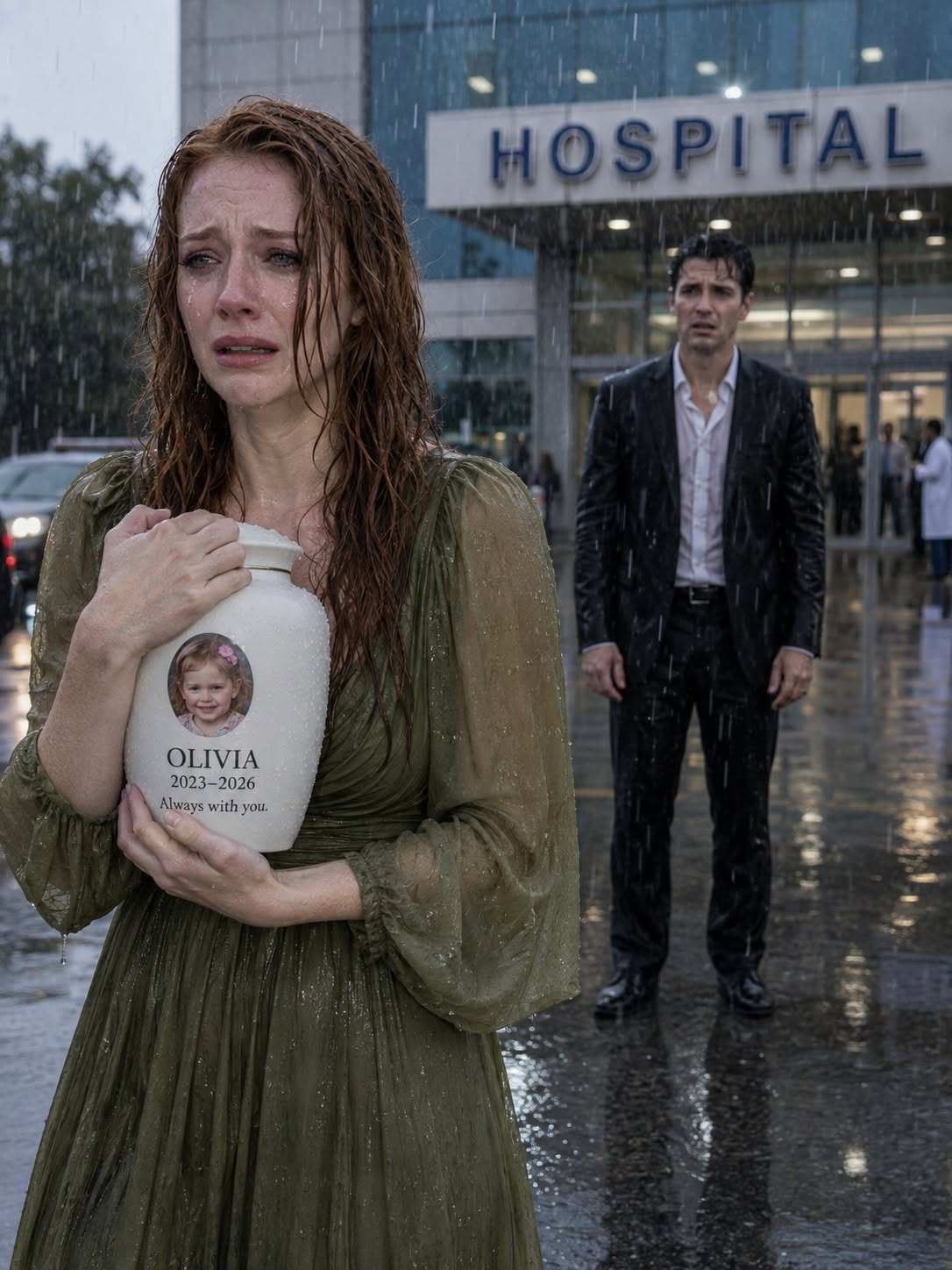
“Stop making a scene and take the girl home, because I have already authorized payment for her treatment,” Mason told me over the phone as I walked out of the hospital with a small white urn clutched tightly against my chest.
For a few seconds I could not even bring myself to answer him. Outside, a bitter rain was falling over San Antonio and the winter air felt entirely freezing. My daughter Daisy had died three days ago at only three years old, having suffered from a severe congenital heart defect that made her weigh so little that holding her felt like holding a tiny wounded bird. Now everything that remained of her life fitted inside this wooden box.
“Okay,” I replied quietly into the receiver.
Mason hung up immediately without noticing anything unusual in my voice. In the background behind his phone line, I could hear soft lounge music, clinking glasses, and the bright laugh of Sabrina, the woman he had been seeing openly at upscale dining spots around San Antonio for the past few months.
I flagged a taxi and headed straight to the Ross family residence in Alamo Heights. I had spent three long years living in that grand house as Mason’s wife, though everyone there treated me like an unwanted intruder.
His sister, Brenda, greeted me right near the front entry hall with an annoyed expression.
“Are you coming from the hospital again?” she asked, rolling her eyes. “Seriously, Elizabeth, this endless obsession of yours has made living in this house completely unbearable for everyone.”
She glanced down at the box in my arms with mild curiosity.
“What did you bring back with you this time?” she inquired.
“Your niece,” I said softly.
Brenda let out a small laugh, assuming I was making a sarcastic joke.
“Don’t be ridiculous,” she sneered.
I looked her directly in the eyes without flinching.
“These are Daisy’s ashes,” I stated plainly.
Her expression froze instantly, and her body went entirely still.
I walked past her and went up the stairs toward the back storage room, where Mason had ordered our daughter’s crib to be moved months ago. He had insisted that the medical equipment, monitors, and crying of a sick child ruined the pleasant atmosphere of the main residence.
For years, whenever I needed to buy specialty infant formula, schedule a doctor appointment, or hire a home nurse, I had to submit formal requisitions through his family’s financial system. Every single expense was reviewed by Megan, Mason’s personal assistant, who unilaterally decided whether a medical request was reasonable or unnecessary.
I had earned a degree in actuarial science and spent years analyzing financial risk before my marriage, yet in this household I was forced to justify even a single package of diapers.
Daisy’s final medical crisis had been terrifyingly swift. Her cardiologist urgently prescribed a high-cost imported medication to stabilize her declining condition, so I immediately submitted the lab results, official prescription, cost estimate, and medical diagnosis to the portal.
Megan rejected the claim within hours, stating, “This expense exceeds your authorized quarterly limit.”
I called Mason seventeen times in a row that afternoon.
He never answered a single call.
Desperate, I drove to his office building and waited in the lobby for five full hours. When he finally walked out of the executive elevator, Sabrina was holding onto his arm.
“Don’t ever embarrass me like this in public again,” he warned me coldly in the lobby. “If you have issues with money, take them up directly with Megan.”
A compassionate hospital doctor ended up paying out of his own pocket for a single dose that kept Daisy stable for a few extra days while I submitted another emergency appeal to the office.
That second request remained marked as under review for an entire week.
On the morning of the seventh day, my tiny daughter stopped breathing.
That night, as I placed the small urn inside her empty crib, I heard Mason coming up the hallway laughing loudly with Sabrina.
“Megan did the right thing by putting a stop to her spending,” he was saying to Sabrina. “Elizabeth thinks she can throw my family’s money around whenever she pleases.”
Hearing that, I pulled an old cell phone from the very bottom of a nightstand drawer, a phone I had not turned on since my wedding day, and dialed a number I remembered by heart.
“Mr. Callahan?” I called out softly.
The elderly man on the line remained silent for a long pause before speaking.
“Miss Elizabeth,” he answered with a deep breath. “I have been waiting for this phone call for three whole years.”
I looked down at my daughter’s urn in the dim light.
“Execute everything my father prepared before he passed,” I instructed him firmly. “Do it completely, without protecting anyone involved.”
At that exact moment, I heard Mason’s heavy footsteps reaching the top of the stairs outside the room. I had no idea what horrifying truth I was about to uncover about my daughter’s final days.
PART 2
Mason pushed the door open abruptly and looked at my face before his eyes landed on the urn.
“What is that thing?” he asked, narrowing his eyes.
“Your daughter,” I replied calmly.
He frowned in deep irritation.
“Stop playing games with me,” he barked.
“Daisy died three days ago,” I said, looking straight at him. “Her medical treatment was suspended because the hospital never received the funds, and I called you seventeen times to save her.”
The color completely drained from his face within seconds.
“Megan told me you were just exaggerating her sickness to get attention,” he stammered.
I pulled a completed divorce petition out of my leather bag and placed it on the small table.
“Well, you can keep believing her if you want,” I said.
He refused to sign the paperwork and tried to physically block the doorway, asking where I thought I could go without a job, an income, or his prestigious family name.
I did not bother to answer him. I simply packed Daisy’s small stuffed bunny, her light blue baby blanket, and the hospital footprint card into a tote bag, then walked out of that mansion holding her urn tightly.
I took a cab to a small one-bedroom apartment in San Antonio that I had leased myself back when I was a college student.
At nine o’clock the next morning, a knock sounded at my front door.
A young professional in a sharp charcoal suit stood in the hallway holding a thick leather folder.
“My name is Caleb,” he said politely. “Mr. Callahan asked me to deliver these original files directly to you.”
The cover of the folder was stamped with the name Vantage Group Holdings.
My late father, Samuel Vance, had been one of the most powerful private venture investors in the country. When I married Mason, I had voluntarily frozen my entire inheritance because Mason despised the thought of me holding an independent fortune, and I desperately wanted to prove that I was marrying him purely for love.
My father passed away two years later, fully aware of Mason’s arrogance and convinced that I would eventually need an escape route.
Caleb opened the folder across from me on the small kitchen table.
“Your legal rights were fully restored early this morning,” Caleb explained. “You now hold absolute voting control over the master trusts, global real estate holdings, and international investment funds that your father set up.”
He then placed a metallic silver drive on top of the documents.
“This contains complete internal records regarding Ross Enterprises,” he added.
I plugged the drive into my laptop immediately.
The folders contained full financial audits, offshore wire transactions, shell companies, and detailed reports on a critical international deal that Mason desperately needed to close in order to save his company from insolvency.
“Who ultimately controls this foreign fund?” I asked.
Caleb looked at me with absolute seriousness.
“You do,” he replied.
For the very first time since Daisy passed away, I felt a sensation that was not pure grief. It was not joy either, but total clarity.
A few days later, I made my official return to the corporate financial sector. My former university mentor, Dr. Warren, invited me to serve as a keynote panelist at a major private equity forum in downtown Houston, where Mason was also scheduled to speak.
When my name was announced as the new Managing Director of Apex Capital, I walked onto the main stage in front of several hundred executives.
Mason was sitting in the front row. He stared up at me as if he were looking at a ghost.
During the afternoon break, he approached me near the grand foyer, his face flushed with anger.
“Who is backing you behind the scenes?” he demanded quietly.
“Nobody,” I answered truthfully.
“That firm appeared out of absolute nowhere,” he spat out.