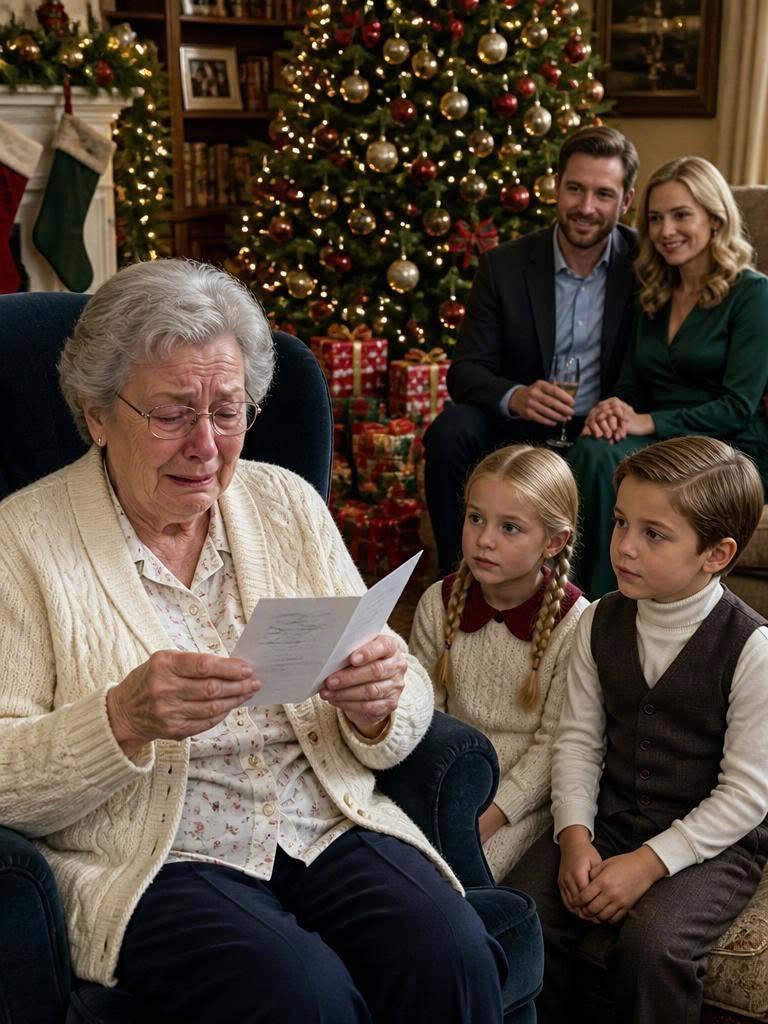
The Christmas card shook slightly in my hands as laughter echoed through my son’s living room.
Zuri stood beside David’s chair with a satisfied smile, looking as though she had just told the funniest joke anyone had heard all year.
My son was laughing too. He actually had tears in his eyes.
Even my grandchildren looked back and forth between the card and my face, unsure whether they were supposed to laugh along.
“Come on, Myrtle,” Zuri encouraged, taking a sip of her wine. “Read all of it.”
I lowered my eyes to the card again.
“Roses are red, violets are blue. We don’t want a sick grandma. Christmas isn’t for you.”
Another wave of laughter swept through the room.
For several seconds, everything else disappeared. I couldn’t hear the crackling fireplace. I couldn’t hear the soft Christmas music playing in the background. I couldn’t hear the children tearing wrapping paper from their presents.
I could only hear David laughing.
My son. The child I had raised almost entirely on my own after his father, Harold, left when David was twelve. The boy I worked overtime as an accountant to put through college. The man whose failed business ventures I had helped rescue more than once. The son whose mortgage I had quietly been subsidizing for three years.
Zuri lifted her glass in a mocking toast. “Oh, Myrtle. It’s just a joke. You know we love you.”
I slowly folded the card in half. Then I folded it again.
“So where exactly do you expect me to spend Christmas?” I asked, my voice terrifyingly calm.
Zuri’s expression barely changed. “There are facilities for people in your condition.”
I understood perfectly.
Six months earlier, I had been diagnosed with Parkinson’s disease. It was still in its very early stages. My doctor had explained that with proper medication and lifestyle management, I could remain independent for a very long time.
I still drove myself everywhere. I cooked. I kept my own house spotless. I managed my own medical appointments, prescriptions, investments, and personal finances.
But from the moment David and Zuri learned about my diagnosis, everything I did became proof that I supposedly couldn’t take care of myself.
If my hand trembled slightly while holding a cup, they noticed. If I spilled a few drops of wine, they exchanged meaningful glances. If I walked slowly near a staircase, Zuri would immediately ask whether someone should hold my arm. Every small human imperfection was suddenly weaponized into evidence of my decline.
David leaned toward me, setting his scotch down. “Mom, we’re just worried about you. What happens if you fall? What if you leave the stove on?”
His voice was soft and careful, but I knew my son. He didn’t sound frightened. He sounded rehearsed.
I looked around the room. The Christmas tree sparkled with vintage glass ornaments I had collected throughout my life. At the top sat the crystal angel that once belonged to my grandmother. I had cooked most of the holiday meal everyone had eaten that evening, even though Zuri had repeatedly suggested my shaking hands might make cooking “hazardous.”
And now, after finishing the feast I had prepared, they were sitting back, sipping my expensive wine, and laughing about putting me in a home.
I pushed myself up from the chair. “I need some fresh air.”
David didn’t stand up. He didn’t offer his arm. He simply said, “Take your time, Mom.”
Outside, the crisp Connecticut winter air cut through my sweater. I gripped the wooden porch railing and watched my breath drift into the dark, snowy night.
Through the glass patio doors, I could see the celebration continuing without a hiccup. Zuri was showing her sister a diamond bracelet. David was pouring himself another double. The grandchildren were tearing into high-end electronics. Nobody appeared concerned that I was standing alone in the freezing cold.
I looked down at the folded card still clutched in my right hand.
And strangely, the sharp sting of hurt vanished. In its place came an icy, beautiful calm. Something had finally become crystalline: they no longer saw me as a mother or a grandmother. They saw me as an inconvenience. A chore to manage. A financial burden they wanted a state-run facility to assume.
What they failed to understand was that the comfortable life surrounding them was entirely funded by the woman they were trying to discard.
David knew his late father had left me some investments, but he had never bothered to ask what they were worth. He knew there was a life insurance policy, but he never asked how I had reinvested the capital. He knew I lived modestly in my small ranch home, but he never wondered how much I had accumulated over forty years of smart financial management.
Most importantly, he had never bothered to investigate who was quietly paying several of his family’s largest monthly bills.
I drove home that night and didn’t sleep a wink.
At 9:00 AM the following morning, my phone rang. David.
I watched the screen flash until it went to voicemail. A few minutes later, I listened to the recording.
“Hey, Mom. Just wanted to make sure you made it home okay. Zuri’s joke was probably a little harsh, but you know how her humor is. Anyway, maybe sometime this week we can look at a few assisted living places. No pressure.”