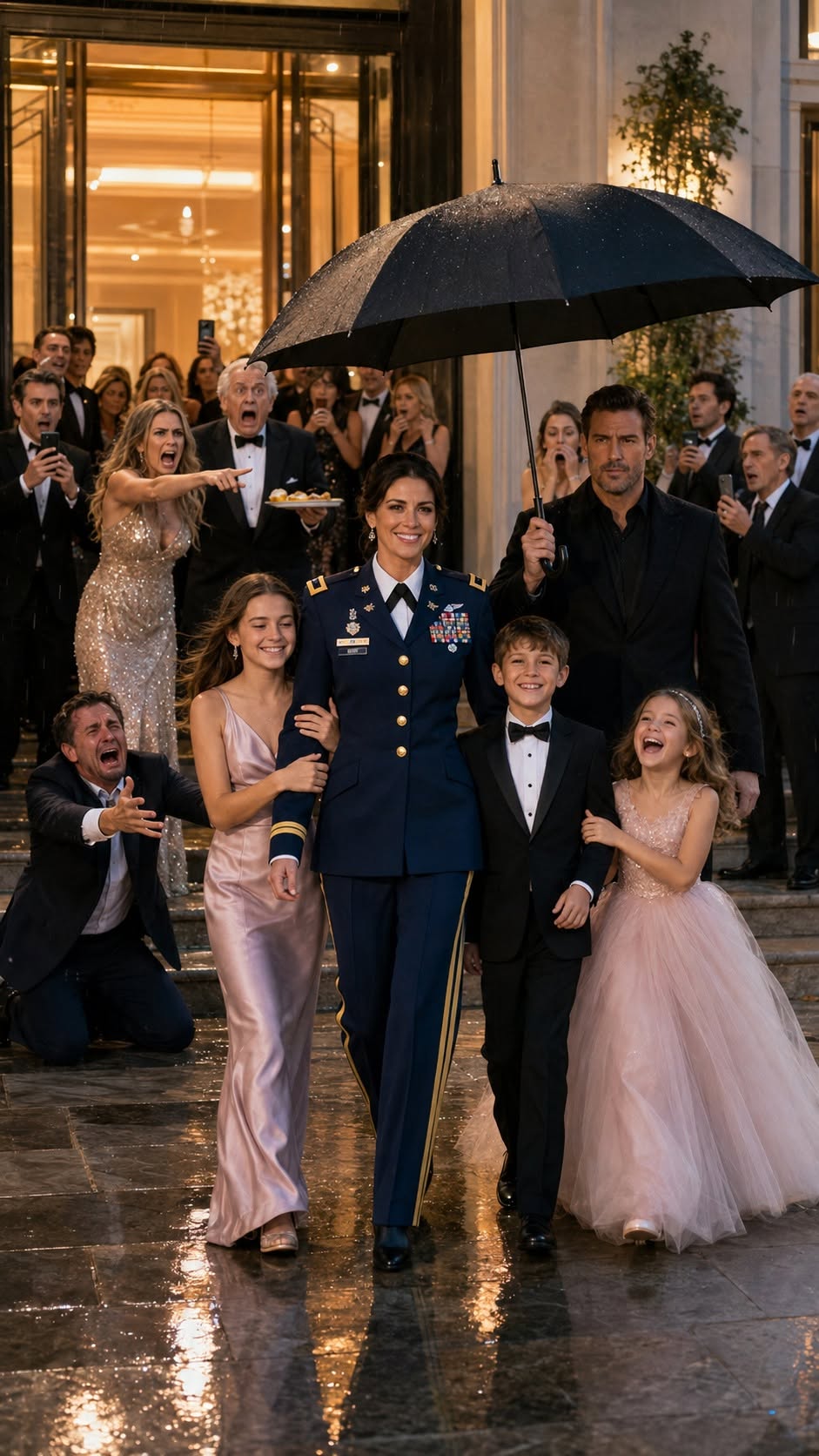
Chapter 1: The Arena of Hubris
The dining room of the Mercer family estate was a suffocating masterpiece of performative wealth. The air was thick, heavy with the scent of roasted rosemary beef, expensive claret, and the underlying, metallic tang of unearned arrogance. A massive crystal chandelier suspended from the vaulted ceiling cast a harsh, unforgiving light over the twelve people seated around the sprawling mahogany table. Outside, a brutal December blizzard was burying the affluent suburb of Fairview in a foot of snow, but inside, the true freeze was radiating from the people I had the misfortune of calling my family.
Tonight was supposed to be a celebration. It was the official retirement dinner for my father-in-law, Walter Mercer, the founder and patriarch of Mercer Construction—a mid-tier commercial development firm that constantly clawed at the edges of Fairview’s true elite society, desperate for a seat at the billionaire’s table.
Instead of celebrating Walter, however, the evening had devolved into what it always devolved into: the ritualistic, psychological execution of Rachel Mercer.
I sat near the corner of the table, my hands resting quietly in my lap, staring at the reflection of the chandelier in my untouched water glass. I was wearing a simple, elegant black dress, entirely devoid of the flashy, gaudy designer logos that my mother-in-law, Elaine, practically demanded as the uniform for entry into her presence.
My husband, Daniel, was holding court at the center of the table. Daniel was a man whose entire existence was a carefully constructed facade of patriarchal dominance, built on a foundation of profound, shivering insecurity. He was the Vice President of his father’s firm, a title handed to him rather than earned, and he thrived on turning his private inadequacies into my public humiliation.
“I’m just saying, Rachel, it wouldn’t kill you to put a little effort into your presentation,” Daniel announced, his voice slicing through the clinking of crystal glasses and the polite murmur of his aunts and uncles. He swirled his wine, looking at me with a mixture of boredom and venom. “Walter is retiring. I am stepping up. I need a wife who looks like she belongs at a charity gala, not a woman who looks like she’s about to attend a funeral for a librarian.”
The room went dead silent. Twelve pairs of eyes snapped toward me.
I felt the familiar, sickening heat flush across my cheeks, but I did not lower my gaze. I had spent three years swallowing these insults. I had spent three years shrinking myself, dulling my own shine so that Daniel’s fragile ego could catch the light.
“Your dress is fine, Rachel,” Elaine, my mother-in-law, chimed in from the head of the table. She offered a tight, venomous smile, the kind of smile a predator gives right before it bites. “But Daniel is right about the larger picture. A successful man needs a partner who contributes to the household’s prestige. Not someone who just… occupies space.”
Before I could even process the sheer cruelty of Elaine’s endorsement, the final, unforgivable knife was thrust into my ribs by the youngest person at the table.
Daniel’s sixteen-year-old daughter from his first marriage, Brooke, let out a loud, dramatic scoff. She didn’t even bother to look up from the glowing screen of her smartphone.
“Dad’s right,” Brooke drawled, rolling her eyes, her thumbs flying across her screen as she texted her friends. “You don’t even have a real job, Rachel. You leave the house for, like, a few hours twice a week, and the rest of the time you just read books. You’re basically a deadbeat.”
“Brooke,” Daniel said, though his tone was entirely devoid of reprimand. He was grinning. He was enjoying it.
“Brooke could have phrased that a bit more delicately,” Elaine noted, dabbing the corners of her mouth with a linen napkin. “But perhaps this is a good time to think seriously about your future, Rachel. Daniel carries this entire household on his back. The mortgage, the cars, Brooke’s private school… it is a tremendous burden for one man. You really should find a way to contribute, even if it’s just a little part-time clerical work at the firm.”
My face burned with the heat of a thousand accumulated humiliations. The sheer, breathtaking audacity of their delusion was almost enough to make me laugh out loud, a hysterical, jagged sound that I forced down into my chest.
For three agonizing years, Daniel had bragged to his country club friends, his family, and to my own face about “carrying the household.” He strutted around our five-bedroom suburban home like a conquering king, demanding absolute obedience and gratitude because he “paid the bills.”
He completely, conveniently omitted a fundamental, mathematical truth.
Every single month, on the first day of the month, an automated ACH wire transfer originated from a blind trust registered under my maiden name, Evans. That transfer was deposited directly into the escrow account that held the mortgage on our home. It paid exactly fifty percent of our living expenses.
Daniel didn’t know the transfer came from me. He assumed it was a dividend payout from an old, minor investment his father had set up years ago, because Daniel was fundamentally lazy. He never bothered to look at the actual banking ledgers. He never questioned the source of the funds, just like he never bothered to ask why I disappeared every Tuesday and Thursday afternoon for six hours.
He never asked why I received encrypted phone calls late at night. He never asked why, on three separate occasions, total strangers had approached me in the aisles of the upscale grocery store, grabbed my hand with trembling fingers, and wept tears of profound gratitude while calling me their savior.
I didn’t yell across the dining table. I didn’t defend myself against people who were aggressively, maliciously committed to misunderstanding me.
The terrified, people-pleasing, desperate-for-approval wife died in that dining chair. Her death was absolute, painless, and completely irreversible.
In her place, an apex predator woke up.
I sat perfectly still. I picked up my wine glass by the delicate crystal stem. I took a slow, measured sip of the dark red liquid, letting the silence stretch until it became uncomfortable for them. I was no longer a victim trapped in a hostile environment; I was a master strategist sitting in a blind, armed with the terrifying, infinite patience of a woman who knows exactly how the movie ends.
“I appreciate your concern for Daniel’s financial burdens, Elaine,” I said, my voice eerily calm, devoid of any daughterly deference or wifely submission. “I am absolutely certain that the financial dynamics of this household will be fundamentally restructured very, very soon.”
Daniel scoffed, shaking his head. “Whatever that means. Just try to be a little more present, Rachel. Tonight is about my father and the future of Mercer Construction.”
Walter, who had been sitting quietly at the head of the table, puffed his chest out. “Speaking of the future,” Walter boomed, changing the subject to his favorite topic. “I received a call from the mayor’s office today. The city council is finalizing the bids for the new waterfront commercial district. If Thomas Whitaker signs off on the developmental zoning, Mercer Construction is poised to land a forty-million-dollar municipal contract. It will put us in the major leagues, Daniel. Your inheritance.”
Daniel beamed, raising his glass to his father. “To Whitaker Construction, and to our new empire.”
The entire table raised their glasses, murmuring their greedy approvals.
They worshipped the name Thomas Whitaker. Thomas was the unofficial king of Fairview, a billionaire real estate mogul and philanthropist whose company basically owned the state. Mercer Construction was a tiny, insignificant fish swimming in Whitaker’s vast ocean, desperately begging for the scraps that fell from his corporate table. Getting a contract approved by Thomas Whitaker was the holy grail for Daniel and Walter.
Suddenly, the heavy, brass doorbell of the Mercer estate echoed through the grand foyer.
Walter frowned, checking his gold Rolex. “Who on earth is ringing the bell in the middle of a blizzard? We aren’t expecting anyone else.”
“I’ll get it,” Daniel said, annoyed by the interruption. He stood up, tossing his napkin onto his chair, and marched out of the dining room toward the grand entryway.
I didn’t move. I didn’t turn my head. I simply took another slow sip of my wine, feeling the cool, beautiful wind of impending, apocalyptic justice rushing toward the house.
The family was entirely, blissfully unaware that the man currently standing on their snow-covered front porch was not a lost traveler. He was the harbinger of their absolute destruction, and he was about to shatter their entire socioeconomic reality into a million, irreparable pieces.
Chapter 2: The Entrance of the Leviathan
From my seat in the dining room, I heard the heavy oak front door swing open, accompanied by the howling, freezing rush of the winter wind.
“Can I help you?” I heard Daniel’s voice echo from the foyer. His tone was clipped, irritated, and dripping with the assumption that whoever was standing on his porch was beneath him.
The response was a low, resonant, incredibly powerful baritone that seemed to vibrate through the very floorboards of the house.
“I apologize for the intrusion on a Sunday evening. I am looking for Rachel.”
In the dining room, Walter Mercer’s eyes widened. The color drained from his ruddy cheeks. He recognized that voice. Anyone who did business in Fairview recognized that voice.
Walter stood up so fast his heavy dining chair scraped violently against the polished hardwood floor, nearly tipping over. He practically sprinted out of the dining room, pushing past his confused relatives.
I stood up slowly, smoothing the front of my simple black dress, and followed at a leisurely pace.
When I reached the archway of the foyer, the scene before me was a masterpiece of shifting power dynamics.
Daniel was standing frozen, his mouth slightly open, his arrogant posture completely collapsed. Walter was hovering behind him, attempting to project the confidence of a peer, though his hands were trembling with sycophantic, desperate eagerness.
Standing in the center of the marble foyer, bringing the cold and the storm inside with him, was Thomas Whitaker.
He was a tall, broad-shouldered man in his late forties, possessing the kind of rugged, undeniable authority that cannot be bought, only earned. He wore a dark navy cashmere overcoat, the shoulders dusted with fresh, white snow. He did not look like a businessman dropping in for a chat; he looked like a force of nature, a leviathan rising from the deep.
“Tom? Mr. Whitaker?” Walter stammered, his voice pitching upward in panic. “What… what an unexpected honor! What are you doing here in this weather? Please, come in, let me take your coat. We were just having a family dinner.”
Thomas Whitaker, the billionaire kingmaker of Fairview, didn’t even acknowledge my father-in-law. He didn’t look at Daniel. He didn’t hand over his coat.
His cold, assessing, slate-gray eyes swept the room with predatory precision until they landed directly on me.
Before Thomas could speak, the heavy oak door behind him burst open wider.
Three figures bundled in thick winter coats, scarves, and snow boots scrambled into the foyer, bringing a sudden, chaotic explosion of bright, unadulterated energy into the suffocating toxicity of the Mercer home.
It was Lily, aged fourteen; Mason, aged ten; and Ava, aged six.
They didn’t politely take off their boots. They didn’t shake hands with Walter or Daniel. They completely ignored the “important” men standing in the room.
Their eyes locked onto me, and their faces lit up with a joy so pure, so brilliant, it felt like staring directly into the sun.
“Rachel!” Ava, the youngest, shrieked.
She sprinted across the wet marble floor, her snow boots squeaking, and collided with me in a chaotic, joyous wave. I dropped to my knees instantly, opening my arms, catching her as she buried her cold, red face into my neck, gripping my dress like a lifeline.
Mason was right behind her, throwing his arms around my shoulders, beaming a gap-toothed smile. “We knew you’d be here! Dad said we had to come get you!”
Lily, the oldest, the teenager who had spent two years locked in a fortress of silent, agonizing trauma, walked over with tears shining in her eyes. She knelt down beside her siblings and wrapped her arms around my neck, resting her forehead against mine.
She whispered the words that stopped my husband’s heart dead in his chest.
“Dad said we could finally tell people, Rachel,” Lily whispered, her voice choked with profound, overwhelming emotion. “He said we didn’t have to keep it a secret anymore. We wanted you to spend the holidays with us. With your real family.”
The foyer descended into an absolute, paralyzed silence.
The metallic clatter of Walter dropping his silver wine glass, which he had carried from the table, echoed like a gunshot. It shattered on the marble, red wine bleeding across the white stone like a crime scene.
Daniel’s face drained of all blood. His skin turned the sickly, hollow color of wet ash. His mouth opened, but his vocal cords were completely paralyzed. He stared at the three heirs to the Whitaker billion-dollar empire clinging to his “deadbeat” wife as if I were the center of their entire universe.
In the archway leading to the dining room, Elaine and Brooke stood frozen, their jaws unhinged in absolute, world-shattering shock. The narrative they had built—the lie that I was a worthless, invisible parasite—was violently, publicly imploding before their eyes.
I stood up slowly, keeping one hand resting gently on Ava’s shoulder.
Thomas slowly, deliberately removed his dark leather gloves, pulling them off finger by finger, and slipped them into his coat pocket. He looked at the terrified, pale faces of the Mercer family gathered in the foyer. Then, he locked his piercing gaze directly onto my husband.
“I apologize if my arrival is interrupting your celebration, Walter,” Thomas said. His voice was entirely stripped of professional courtesy. It dropped into a lethal, freezing register that made the hairs on the back of my neck stand up.
He took a slow step toward Daniel, towering over my husband.
“But as I was standing on your porch, waiting for someone to answer the bell,” Thomas continued, his eyes boring into Daniel’s soul, “I couldn’t help but overhear the conversation echoing from your dining room.”
Thomas didn’t yell. He didn’t scream. His quiet, controlled anger was infinitely more terrifying than any shouting match could ever be.
“If I heard correctly,” Thomas whispered, the words dropping like heavy stones onto the marble floor, “someone in this house just called the woman who saved my family’s life a deadbeat.”
Chapter 3: The Revelation of the Hero
“Mr. Whitaker, please… there’s been a massive misunderstanding,” Daniel stammered, his voice cracking with sheer, unadulterated panic. He took a frantic step forward, his hands raised in a pathetic, trembling gesture of surrender. “You… you must have misheard. We were just joking around. It’s a family dynamic. Rachel is a wonderful wife. We provide everything for her.”
“She doesn’t need you to provide anything for her, you arrogant fool,” Thomas corrected, his voice echoing like rolling thunder in the confined space of the foyer.
He didn’t break eye contact with Daniel. He was surgically, methodically dissecting my husband’s entire ego.
“Let me correct your fundamental misunderstanding of the woman you are married to,” Thomas announced, addressing the entire Mercer family, ensuring every single aunt, uncle, and cousin listening from the dining room heard the truth.
“Three years ago, my wife, Sarah, was killed in a horrific, highly publicized car accident on Interstate 95. I was driving. I survived. She didn’t. My children were in the backseat.”
A collective, horrified gasp rippled through the Mercer family. Everyone in the state knew about the Whitaker tragedy. It had dominated the news cycle for months.
“After that day, my children completely shut down,” Thomas continued, his voice tightening with the raw memory of his agony. “Lily stopped speaking entirely. She didn’t say a single word for eight months. Mason began suffering from night terrors so violent he had to be sedated. Ava regressed to infantile behaviors. They were drowning in a sea of trauma, and with all my money, all my power, I was completely, utterly powerless to save them.”
Thomas turned his head slightly, looking at me with an expression of such profound, overwhelming reverence that it brought tears to my eyes.
“I hired the best pediatric psychiatrists in the country. I flew experts in from Europe. None of them could reach my kids. They were all clinical, cold, and useless. And then, a colleague recommended a specialist who operated completely outside the traditional hospital system. A woman who only took the most severe, impossible cases, and who demanded absolute, strict anonymity and privacy to protect her clients from media scrutiny.”
Daniel stared at me, his eyes wide, his brain desperately trying to reconcile the woman standing in his foyer with the titan being described.
“Rachel stepped into my home every Tuesday and Thursday afternoon for the last three years,” Thomas said, his voice ringing with absolute certainty. “She didn’t just treat my children. She sat on the floor with them. She held them while they screamed. She fought the darkness back, inch by inch, day by day, until she pulled them back into the light.”
Thomas placed a heavy, protective hand on his son Mason’s shoulder.
“She is not a deadbeat,” Thomas declared, turning his lethal gaze back to Daniel. “Rachel Evans is a brilliant, highly specialized, elite trauma consultant. She holds a double doctorate. She is the highest-paid private medical contractor on my corporate payroll. She makes more in a single Tuesday afternoon than you make in a month, Daniel.”
Brooke, my stepdaughter, who had marched into the foyer to see the commotion, physically sank against the doorframe. Her face burned with an ugly, mottled red flush of absolute, terrifying humiliation. The teenager who had just mocked me for reading books realized she had been insulting one of the most highly educated, highly compensated women in the state.
“And you,” Thomas said, stepping so close to Daniel that my husband physically recoiled, “sat at the head of your dining table, drinking wine I probably paid for, and allowed your spoiled, arrogant daughter to call her a parasite. You allowed your mother to mock her. You stood by and let them degrade the woman who holds my family together.”
Walter Mercer, sweating profusely, desperate to save the evening, his reputation, and the impending municipal contracts, launched himself into the line of fire.
“Tom, please, you have to understand, we had absolutely no idea!” Walter pleaded, throwing his own son under the bus in a heartbeat. “Rachel is very modest! She never speaks of her work! She kept it a secret from us! If she had told us who she was treating, if we had known she was connected to you, we would have treated her with the utmost respect!”
“If I had told you, Walter, you would have exploited it,” I interrupted.
My voice was not loud, but it cut through the frantic apologies like a diamond blade. I stepped forward, releasing Ava’s hand, and walked directly into the center of the confrontation. I didn’t hide behind Thomas. I claimed my own space.
I looked at Walter, then at Elaine, and finally at Daniel.
“You wouldn’t have respected me for my intellect, or for saving children,” I said, my voice steady, staring down the people who had abused me for years. “You would have simply used my confidential, ethical medical relationship with Thomas to secure the municipal waterfront contracts your construction firm has been desperately begging him for. You would have weaponized my career to line your own pockets. That is why I kept it a secret. Because I knew exactly what kind of parasites you truly are.”
Daniel’s eyes widened in absolute, apocalyptic horror.
He looked from me to Thomas, the catastrophic magnitude of his mistake finally penetrating his thick skull. The promotion he had been boasting about all month, the future of Mercer Construction, hinged entirely on securing the massive, forty-million-dollar waterfront contract with Whitaker Construction.
He hadn’t just insulted his wife. He had actively, maliciously degraded the most beloved confidant of the man who held the absolute power of life and death over his entire career.
“Mr. Whitaker… please,” Daniel whimpered, the arrogant patriarch dissolving into a pathetic, groveling beggar. “I beg of you, don’t let a private family dispute affect our business relationship. Mercer Construction is the best firm for the waterfront job. We need that contract.”
Thomas looked down at my husband with an expression of pure, unadulterated disgust. He didn’t say a word. He simply raised his hand to silence Daniel, entirely unaware that I had already initiated the legal protocols to permanently sever my ties to the Mercer name, and the true execution was about to begin.
Chapter 4: The Execution
The silence in the foyer was so profound I could hear the snow hitting the windowpanes outside.
“You don’t need to worry about the municipal waterfront contracts, Walter,” Thomas said, his voice entirely stripped of the polite, professional courtesy he usually maintained with local contractors.
Walter let out a small, hopeful gasp, wiping the sweat from his forehead with a handkerchief. “Thank you, Tom. I knew you were a reasonable man. We will exceed your expectations on the build.”
“You misunderstand me, Walter,” Thomas corrected, his eyes flat and dead. “You don’t need to worry about the contracts, because as of five minutes ago, while I was waiting on your porch, I sent an email instructing my executive board to permanently pull all pending bids from Mercer Construction.”
Walter froze. The handkerchief dropped from his trembling fingers. “What? Tom, you can’t be serious. That contract is the future of my firm! It’s millions of dollars!”
“I am entirely serious,” Thomas stated, delivering the professional kill shot with terrifying precision. “Whitaker Construction prides itself on partnering with entities of high moral character. I do not, and will never, do business with weak men who allow their families to mentally and emotionally abuse the people who save mine. Daniel’s presence in your executive leadership is a massive liability. Your firm is blacklisted, Walter. Effective immediately.”
Elaine Mercer let out a loud, strangled sob from the archway. She clutched her chest, the reality of their sudden, catastrophic financial ruin crashing over her performative arrogance. Without the Whitaker contracts, Mercer Construction would inevitably default on their over-leveraged corporate loans.
Daniel dropped to his knees. Literally.
He sank onto the wet marble floor of his foyer, the knees of his expensive tailored suit soaking up the melted snow from Thomas’s boots. His arrogant, domineering facade was completely incinerated, leaving nothing but a terrified, pathetic coward.
“Rachel, please!” Daniel wept, reaching his hands out toward me, grasping at the hem of my simple black dress. “Please, talk to him! Tell him we love each other! I’m your husband! You can’t let him do this to my family! We can go to counseling! We can fix this!”
I looked down at the man who, twenty minutes ago, had demanded I find part-time clerical work so I wouldn’t be a “burden” to him.
I reached into my purse. I bypassed my phone and my keys. I pulled out a thick, heavy manila folder, prominently stamped with the red seal of the State Family Court.
I didn’t hand it to him. I dropped it. It hit the marble floor right in front of his knees with a heavy, satisfying slap.
“I’m not fixing anything, Daniel,” I said coldly, looking down at his pathetic, tear-streaked face. “I’m amputating.”
Daniel stared at the red stamp on the folder. “What is this?” he choked out.
“Those are formal, finalized divorce petitions,” I announced, ensuring the entire family heard every single word of his ruin. “And attached to them is a comprehensive, legally certified forensic audit of our joint and private finances.”
I took a step back, separating myself from him permanently.
“The audit proves, beyond a shadow of a legal doubt, that I have been paying exactly fifty percent of this house’s massive mortgage from my private trust for the last three years,” I declared, mathematically dissecting his worthlessness. “You didn’t carry this household, Daniel. I subsidized your delusions of grandeur.”
Elaine gasped, her hand flying to her mouth as the myth of her successful son shattered.
“Furthermore,” I continued, my voice gaining unstoppable momentum, “because you used our joint checking account—which contained my deposited funds—to purchase your ridiculous Porsche and fund Brooke’s exorbitant private school tuition, you have commingled marital assets. My attorney, Lena Ortiz, filed an emergency motion at 4:00 PM on Friday. We are legally forcing the immediate sale of this property to recover my equity.”
Brooke, standing near her grandmother, began to hyperventilate. The spoiled, arrogant teenager realized her comfortable, luxurious life was vaporizing before her eyes.
“Dad, what is she talking about?!” Brooke shrieked, panic pitching her voice into hysteria. “She can’t sell our house! What are we going to do?!”
I turned my gaze to my stepdaughter. The girl who had called me a deadbeat while I paid for the very roof over her head.
“You’re going to learn how to get a real job, Brooke,” I whispered, my voice dropping to a glacial calm. “I hear the local drive-thru is hiring for the night shift.”
I turned my back on the weeping, shattered, ruined remains of the Mercer family.
I didn’t pack a bag. I didn’t need to. I had been slowly moving my essential belongings to a secure luxury apartment in the city for the past month. I was entirely free.
I took Ava’s small, warm hand in mine. I looked at Thomas, offering him a single, profound nod of gratitude.
“Let’s go home, Rachel,” Thomas said gently, resting a hand on my shoulder.
I walked out the heavy oak front door, stepping out into the crisp, freezing, beautiful winter blizzard. I didn’t look back as the door clicked shut behind me, sealing the Mercers inside their ruined, toxic castle. I took a deep breath of the freezing air, feeling the absolute, intoxicating rush of freedom filling my lungs, completely unaware that the best chapter of my life was just beginning.
Chapter 5: The Ashes and the Sanctuary
Over the next six agonizing, meticulously documented months, the name Mercer transitioned from a desperate pillar of Fairview’s high society to a dark, pathetic cautionary tale whispered in the aisles of the local upscale grocery stores.
The fallout from the dinner party was absolute and apocalyptic.
Stripped of the massive Whitaker waterfront contracts, and formally blacklisted by the unofficial king of the city, Walter’s construction firm rapidly hemorrhaged money. Unable to secure new municipal bids, they defaulted on their heavy corporate loans and were forced into Chapter 11 bankruptcy.
Furious at the loss of his life’s legacy, and desperate for a scapegoat, Walter violently turned on his own blood. He publicly fired Daniel from the collapsing firm, blaming his son’s “arrogant, toxic incompetence” for insulting Thomas Whitaker.
Daniel, carrying the toxic stench of a man who had crossed the Whitakers, found himself entirely unhirable within the county limits. Desperate and drowning in legal fees from my aggressive divorce lawyers, he was forced to take a humiliating, mid-level sales management job at a generic supply company two towns over, commuting two hours a day in a used sedan after his Porsche was repossessed.
The sprawling Mercer estate was sold at auction to quickly pay off my massive, documented equity and settle their mounting debts.
Elaine, Daniel, and Brooke were forced to move into a cramped, outdated three-bedroom apartment complex near the interstate. Brooke’s college fund was completely liquidated to cover Daniel’s aggressive, failing legal defense against my asset recovery. Stripped of her allowance and her social standing, the teenager who had mocked my “unemployment” was forced to work the evening drive-thru at a local fast-food restaurant, finally experiencing the grueling, grease-scented physical reality of a “real job.”
They were utterly, profoundly isolated, living the exact nightmare of poverty and social irrelevance they had spent years trying to force me into.
My reality, however, was anchored in absolute, blinding, intoxicating light.
I didn’t hide in a cheap apartment to mourn a failed marriage. With the massive influx of recovered capital from the sale of the house, combined with my untouched private trust and my immense salary, I initiated the next phase of my career.
I officially opened the Evans Pediatric Trauma Center in downtown Fairview.
Thomas Whitaker didn’t just back the project; his philanthropic foundation built the state-of-the-art facility from the ground up. I became the Executive Director, surrounded by a hand-picked staff of brilliant, compassionate therapists dedicated to helping children navigate the darkest moments of their lives.
I sat in my massive, sun-drenched executive office on a Tuesday afternoon. The walls were painted a calming seafoam green, a stark contrast to the oppressive, dark mahogany of the Mercer dining room.
Through the glass wall of my office, I watched Lily, Mason, and Ava sitting in the central play area, drawing vibrant, chaotic pictures on a massive white board, their laughter echoing down the hallway. Thomas was sitting with them, helping Ava reach the top of the board, looking like a man who had finally found peace after years of storms.
Our relationship had evolved from a clinical partnership into a profound, unshakeable chosen family. We weren’t married, but we were bound by a loyalty stronger than any legal contract. We had saved each other in different ways.
The chronic, suffocating, leaden anxiety of never being “enough” for Daniel’s family, the terror of saying the wrong thing at a dinner party, the constant need to shrink my intellect to make a mediocre man feel powerful—it was entirely, permanently gone.
I had spent three years of my life confusing silence with submission. I believed that endurance was love.
The brutal betrayal at the dinner table didn’t break me; it shattered the illusion, saving me from a lifetime of psychological subjugation. I had walked into that dining room as a mocked, silent, invisible wife, enduring the cruelty of parasites.
But I had walked out an apex predator. I had excised a massive, malignant tumor from my life, and in the space it left behind, an absolute, unshakeable sanctuary had bloomed.
I was safe. My heart was full. I was winning.
But true closure, the absolute severing of the trauma bond, rarely comes without one final, desperate test from the darkness you left behind.
Chapter 6: The Architect of Destiny
I sat at my sleek, modern glass desk in the Evans Pediatric Trauma Center, reviewing a stack of grant approvals for a new community outreach program.
My executive assistant, a sharp young woman named Chloe, knocked gently on the open door frame.
“Excuse me, Dr. Evans,” Chloe said, holding a single, crumpled envelope. “This just arrived in the mail. It bypassed the screening room because it was marked ‘Personal and Confidential,’ but it doesn’t have a professional return address.”
“Thank you, Chloe, just leave it on the desk,” I replied, not looking up from the grant file.
When she left, I picked up the envelope.
I looked at the cheap, coarse, lined paper clearly visible through the thin, generic white envelope. The return address printed in the top left corner bore a zip code from a decaying, low-income suburb near the interstate.
It was Daniel’s handwriting. The ink was slightly smudged, the letters slanted, rushed, and frantic.
It was undoubtedly a sprawling, emotionally manipulative, desperate manifesto. I could imagine the pathetic contents with absolute, crystal clarity. It would be a frantic attempt to invoke the memory of a dutiful, submissive, peace-keeping wife who no longer existed. He would be begging for a financial loan to save his repossessed car, pleading for me to speak to Thomas Whitaker to get him his job back, or demanding a second chance, claiming he had “changed” and seen the error of his ways. He would try to remind me of our wedding vows, conveniently forgetting the moment he sat grinning while his daughter called me a deadbeat.
A year ago, before the dinner party, before the blinding realization of the absolute lethality of my own power, the mere sight of his name written on an envelope might have elicited a physiological response. I would have felt a spike of residual, trained anxiety, a dull ache of betrayal, or the deeply ingrained, toxic urge to open the letter and try to justify my actions to him.
Today, the woman looking at the envelope felt absolutely nothing.
There was no anger. There was no vindictive, gloating triumph. There was only a profound, oceanic sense of complete and utter apathy. The letter was just a minor administrative annoyance, holding all the emotional weight of a piece of junk mail advertising a sale on aluminum siding.
I didn’t even slide my silver letter opener under the flap. I didn’t grant his words the dignity of my eyesight.
Without a moment of hesitation, I picked up the envelope, leaned over, and dropped it directly into the heavy-duty, industrial cross-cut shredder tucked discreetly beside my desk.
The machine roared to life. I listened to the deeply satisfying, mechanical whine of the steel blades turning his final, desperate manipulation, his excuses, and his very existence into illegible, meaningless confetti in less than three seconds.
I turned my back on the shredder permanently.
Three years later.
I stood in the grand, sparkling lobby of my clinic, hosting our annual winter charity gala. The room was packed with Fairview’s true elite—philanthropists, doctors, and city officials—and we had already raised over two million dollars to provide free mental health care for vulnerable children.
I wore a stunning, backless emerald gown. I wasn’t hiding anymore. I was radiating power.
Thomas stood beside me, dressed in a sharp tuxedo, holding a glass of champagne. He was a steadfast partner in my mission, a man who respected my brilliance rather than fearing it. Across the room, Lily, Mason, and Ava—now thriving, fiercely confident, deeply happy teenagers—were handing out auction programs to the arriving guests, their laughter echoing under the vaulted ceilings.
Society constantly conditions women to swallow humiliation. We are taught from birth to compromise our boundaries, to dull our intellect, and to blindly believe that maintaining the illusion of a perfect family is worth sacrificing our own dignity, our own peace, and our own financial security.
They assume that if a woman is quiet, if she avoids conflict at a dinner table, she is compliant. They believe she is defeated, weak, and ready to be conquered by the arrogance of mediocre men.
But what Daniel, Elaine, Brooke, and narcissistic monsters exactly like them will never, ever understand is the terrifying, explosive alchemy of a woman who finally realizes she holds the key to the vault.
When you mock the woman holding up your world, when you laugh at her in front of your family, and when you arrogantly declare her a deadbeat while spending her money, you do not assert your dominance. You do not win.
You simply strip away her mercy entirely.
You teach her how to stop playing the role of the victim. You teach her how to meticulously weaponize her silence. You teach her how to lock the heavy iron gates of the global economy against you, and how to comfortably, peacefully watch you drown in the shallow end of the pool you arrogantly thought you owned.
I smiled at the crowd, raising my glass to Thomas, stepping fully into the brilliant, limitless luxury of my future. I was completely, fundamentally at peace with a profound, echoing truth.
The most dangerous weapon on earth is not a screaming man.
It is a quiet woman who finally decides to introduce you to her friends.
If you want more stories like this, or if you’d like to share your thoughts about what you would have done in my situation, I’d love to hear from you. Your perspective helps these stories reach more people, so don’t be shy about commenting or sharing.