Chapter 1: The Art of Severance
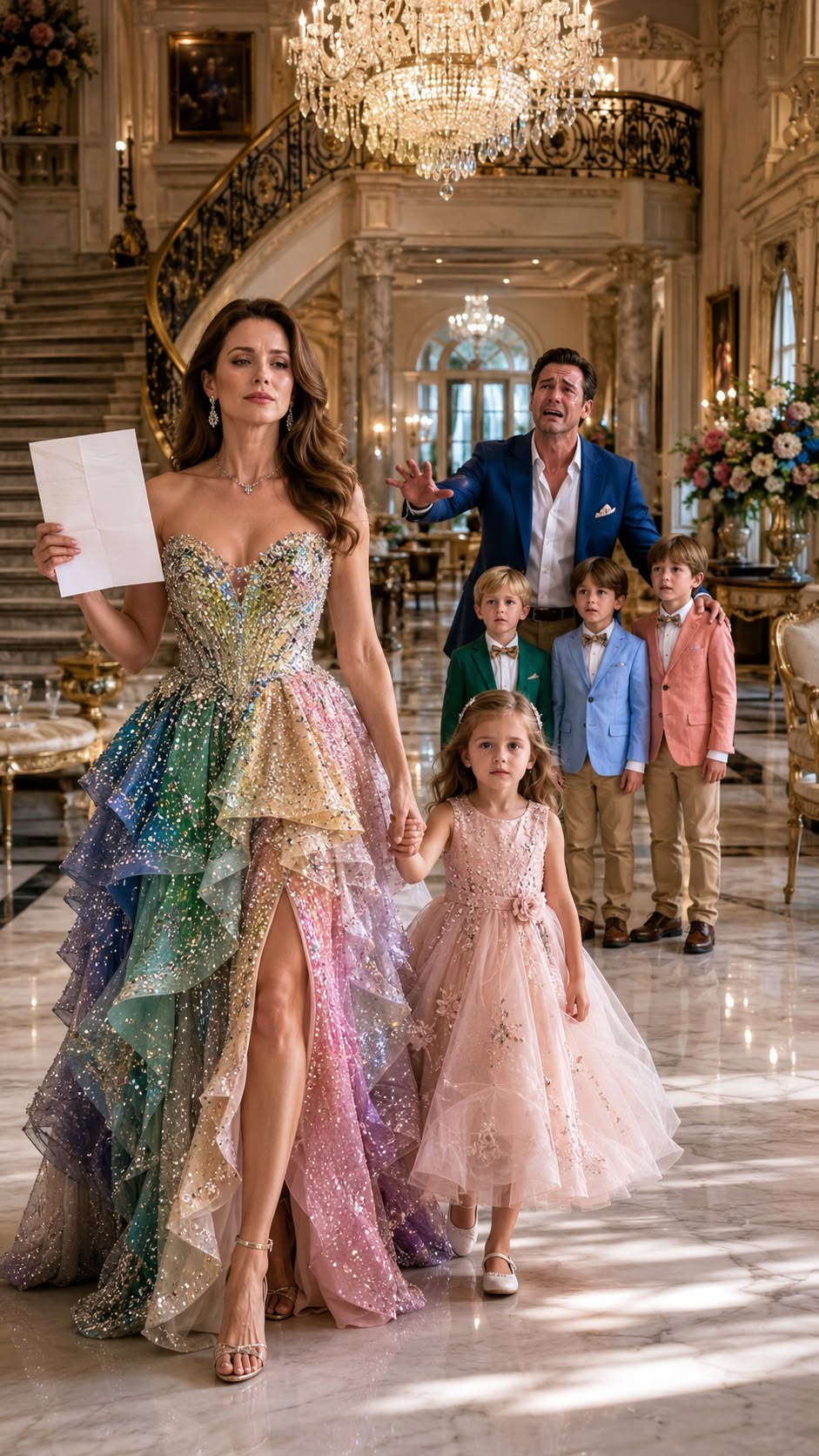
When the crisp, heavy parchment of the separation agreement was finally thrust into my trembling fingers, my husband’s voice echoed through the cavernous room, demanding I choose one of our three sons to take with me.
I didn’t weep. I didn’t beg. I merely reached down, laced my fingers through my five-year-old daughter’s tiny hand, and offered a smile that held the chill of a New England winter.
“They are not my children,” I stated, the words dropping like stones into a glass pond. “I won’t be taking a single one of them.”
That year, autumn had descended upon Boston with a premature, bitter edge. The gales sweeping off the public gardens whipped dry, brittle leaves against the imposing wrought-iron gates of the Beaumont Estate, scattering them across the slate-gray cobblestones. I had begun that day believing I was merely orchestrating the annual family autumn banquet. I had no idea it would be the precise evening a decade of my life would be cleanly, surgically severed.
My name is Genevieve Hayes. I am thirty-four, born to the quiet humility of Western Massachusetts. In another lifetime, I studied fine arts, harboring quiet dreams of curating a modest gallery bathed in natural light. But upon speaking my vows to Alister Beaumont, the dynamic CEO of Apex Holdings, I boxed up my watercolors, shoving my brushes deep beneath our king-sized bed. Society columns whispered of my immense luck, painting me as the provincial girl who snagged a titan and a mansion overlooking the park. But only those trapped within those gilded walls understand a terrifying truth: some houses are so vast, so immaculately soundproofed, that no one can hear you breaking.
My mother-in-law, Eleanor Beaumont, was a woman of sixty-six who wore her wealth like armor. Her silver hair was perpetually locked in a severe chignon, a heavy, intimidating gold cuff always encircling her wrist. “The Beaumonts,” she would frequently declare to anyone listening, “possess an abundance of capital, but suffer from a modern famine of tradition.”
Her definition of ‘tradition,’ stripped of its polite veneer, dictated that a woman married into the bloodline must seamlessly fade into the wallpaper. Grandsons were exalted as the living, breathing future of the corporate empire. Granddaughters? They were decorative assets, expected to photograph well and marry into parallel portfolios.
Three boys dominated the estate: Sterling, ten; Brooks, eight; and Pierce, a demanding toddler of eighteen months. Eleanor heralded them as the great triumvirate of the Beaumont legacy. Sterling occupied a sprawling suite on the second floor. Brooks had an army of tutors for piano, French, and competitive swimming. Pierce merely had to inhale sharply, and the entire domestic staff would scramble.
Then there was my daughter, Cora. She had recently turned five and was relegated to the drafty, formal guest wing, entirely segregated from the vibrant, chaotic nursery. I had managed to sneak a low pine bed into her room, decorating her walls with a few simple, hand-painted daisies. Eleanor had swiftly condemned even that meager splash of color as an “undisciplined indulgence,” insisting a Beaumont female required a pristine, austere environment to groom her for high society.
That pivotal evening, the air was thick with the scent of roasted duck and cherry reduction. I had been oscillating between the high-end caterers and the floral designers since dawn. As dinner commenced in the grand dining hall beneath a dripping crystal chandelier, Eleanor immediately monopolized the carving knife, slicing the most succulent breast meat for Sterling.
“Eat, Sterling,” she commanded, her eyes gleaming. “The apex of this family requires a strong constitution.”
Sterling smirked, chewing with open entitlement. Brooks clamored for the crispy skin, while Pierce demanded warm popovers. Eleanor fawned over them all.
Beside me, at the far, cold end of the table, Cora eyed the elaborate dessert cart. “Grandma,” she whispered, her voice barely audible. “May I have a small piece of the chocolate tart?”
Eleanor’s silver fork hovered mid-air, the temperature in the room plummeting. “A young lady of your pedigree must monitor her silhouette from infancy, Cora. Sugar is the crutch of the undisciplined. Do you want our guests to assume your mother has instilled zero restraint in you?”
Cora’s tiny hand retracted as if burned. I forced a piece of white meat onto her plate, my throat tightening. “Just eat this, sweetie,” I murmured. I looked across the expanse of mahogany at Alister, desperately waiting for him to shield his only daughter.
He didn’t even look up from his smartphone. “Genevieve, cease spoiling the ambiance. Mother is entirely correct. She merely wants the girl properly cultured.”
I carefully placed my fork onto the porcelain. For a decade, I had worshipped at the altar of peacekeeping. I had swallowed my pride to keep the waters calm. But as I watched my daughter shrink into herself, a revelation clicked into place: some surrenders do not purchase peace. They only finance your own subjugation.
After the plates were cleared, Alister summoned me to the upper drawing room. The space was dominated by an oil portrait of the family. In it, Alister and Eleanor stood proudly with the boys. Cora and I were painted so far to the margins we looked like hired help.
Alister slouched onto the leather sofa and slid a heavy, azure folder across the glass table. Eleanor stood by the fireplace, adjusting her pearls, her expression that of a judge peering down at a petty thief.
“Divorce papers,” Alister stated flatly. “Read them. Sign them. And spare us the theatrics.”
The document was a masterpiece of corporate cruelty. I was to voluntarily vacate the premises, waive all claims to the marital estate, and sign a draconian non-disclosure agreement regarding Apex Holdings. The spousal support proposed wouldn’t cover a month in a decent Boston apartment, and Cora’s child support was a statistical insult.
“Ten years, Alister,” I whispered, my voice shaking with a decade of suppressed rage. “Is this the sum total of my worth?”
Eleanor scoffed, setting down her teacup with a sharp clink. “You are a woman who should recognize her limits. We provided you a stratosphere you could never have reached. Letting you depart amicably is an act of sheer charity to spare you public humiliation.”
Alister produced a secondary document. “Regarding the boys, my legal team has drafted a generous custody addendum. You may maintain primary custody of either Brooks or Pierce, complete with an extravagant stipend, provided you adhere to the NDA. Sterling, naturally, remains with me. A mother requires a son to channel her maternal energies. This ensures your comfort.”
I stared at the man I had once sworn my life to. He wasn’t a husband, nor a father. He was a warehouse manager, inventorying human lives.
“You see,” Eleanor chimed in, “though you proved biologically incapable of providing us heirs, you did tend to them. Granting you one of the boys is a profound mercy.”
From the shadows of the hallway, Cora stepped into the light, her eyes red, clutching a threadbare teddy bear. Mommy, where are we going? her tearful gaze seemed to ask.
The wind howled outside, violently rattling the antique windowpanes. I looked at Alister, then at Eleanor.
“I have made my choice,” I said, my voice eerily calm. “I choose Cora.”
Eleanor slammed her hand against the mantelpiece. “Have you lost your faculties? I am offering you the guardians of the Beaumont trust funds! Cora is a female. She will never sit on the Apex board. To walk away from the future titans of this empire is the act of an absolute imbecile.”
“I am taking my daughter because she is exactly that—my daughter,” I replied, standing taller than I had in ten years. “As for your heirs…”
I reached into my canvas tote bag, retrieving a thick, unadorned brown envelope. I withdrew three distinct sheets of laboratory results and spread them across the glass table.
“These are the genetic profiles for Sterling, Brooks, and Pierce. They are undeniably your sons, Alister. But they share zero maternal DNA with me.”
The silence that followed was absolute, a vacuum that sucked the oxygen from the room.
Alister’s complexion drained to a sickly ash. Eleanor snatched the documents, her eyes darting over the medical jargon. “Fabrications! You forged these to extort us!”
“I utilized three separate, independent laboratories,” I countered smoothly. “I have the receipts, the timestamps, and the chain of custody for the samples. If you prefer, we can demand a court-ordered extraction. I have absolutely nothing to fear.”
From the spiral staircase, a soft, trembling voice broke the silence. “Mrs. Beaumont… please, this must be a misunderstanding.”
It was Sabrina, the family’s ‘live-in nurse.’
I turned to her, a bitter laugh escaping my lips. “Still calling me Mrs. Beaumont, Sabrina? You’ve played the demure caretaker flawlessly. Tell me, why do the archived records of the Genesis Clinic list the name Sabrina Wells precisely nine months before Sterling was ‘born’ to me? Why does Pierce possess the exact same crescent birthmark on his neck as you do?”
Alister surged to his feet, veins bulging in his neck. “Enough! Do not interrogate my staff!”
“Staff?” I mocked. “Or the woman you used as a surrogate, smuggled into this house to play nanny to her own biological children, while you pawned them off on me to raise to protect your pristine corporate image?”
Eleanor began to shriek, ordering the children to their rooms. I didn’t stay to watch the fallout. I grabbed my suitcase, took Cora’s hand, and walked out of the heavy oak doors. The cold night air hit my face like a baptism. I had walked in a naive girl; I was walking out a dangerous woman.
But as the heavy iron gates clicked shut behind my taxi, I knew Alister Beaumont. He was a man who preferred to destroy his enemies rather than let them walk away with his secrets.
Chapter 2: The Architecture of a Lie
The taxi’s tires hissed over the rain-slicked pavement as we pulled away from the estate. Cora lay exhausted against my chest, her breathing finally evening out. Watching the receding, cold glow of the mansion, I didn’t shed a tear. When betrayal cuts deep enough, the wound cauterizes itself.
My mind violently rewound to a freezing December a decade ago. I had been a newlywed of six months, three months pregnant with our first child. Eleanor, in her infinite cruelty, had dismissed the event planners for the annual charity gala, forcing me to oversee the massive outdoor tent construction in the freezing sleet to “prove my mettle.”
I remembered the dizzy spells, the sharp, agonizing cramp in my abdomen. I remembered Eleanor barking at me to carry a stack of heavy porcelain platters. I remembered the world tilting, the crash of china, and the horrifying bloom of crimson staining my cream-colored dress.
Not meant to be, Alister had coldly whispered in the sterile hospital room later that night.
Days later, Alister had driven me to the Genesis Clinic, a discreet facility hidden in the Boston suburbs. A doctor with a practiced, soothing smile had spoken of high miscarriage risks and the necessity of immediate, heavily supervised IVF. Let me handle the bureaucracy, Alister had murmured, holding my hand. Focus on resting.
I was drowning in grief, desperate for a lifeline. I signed the paperwork he placed in front of me, never noticing the blank spaces, the hastily obscured clauses. Months later, he brought home an infant in swaddling clothes. Our son, Sterling, he had declared.
I wept with joy, believing heaven had returned my stolen child. Then came Brooks, supposedly from the remaining embryos. Then came Pierce. With Pierce came Sabrina, hired to massage Eleanor’s aching joints, moving through the house with the quiet compliance of a ghost.
It wasn’t until Cora was born—a child I carried and birthed myself, a child Alister barely glanced at—that the invisible strings of the puppet show began to catch the light. The discrepancies in blood types during a hospital visit. The slip of a nurse’s tongue asking for “Mama Sabrina.” The matching birthmarks.
I hadn’t screamed when I figured it out. A woman trapped in a predator’s den doesn’t scream; she quietly sharpens a blade. I had spent months covertly collecting DNA samples—hair from a pillow, a discarded pacifier—and sending them to labs.
As the taxi bumped over a pothole, Cora stirred. “Mommy, are we going to sleep in the cold?”
I kissed her forehead, the scent of her baby shampoo grounding me. “No, my love. We are going to a place where no one will ever make you feel invisible again.”
We arrived at a rundown, brick apartment building in Dorchester, leagues away from the manicured lawns of Back Bay. The air here smelled of frying garlic, damp concrete, and exhaust. It was a sensory shock, but to me, it smelled like oxygen.
The apartment I had secretly rented from an old college friend was a meager six hundred square feet. Peeling floral wallpaper, chipped linoleum. But there was a window that let in the moonlight. I laid Cora on the sagging mattress, covering her with a thin blanket.
I opened my suitcase. Beside my meager clothing sat a small, dented tin box. Inside were not just the DNA results. Inside was a standard, black memory card.
Over the years, Alister had treated me like a glorified administrative assistant, carelessly tossing me hard drives and demanding I scan contracts for Apex Holdings late at night. Just file them, Genevieve. Don’t ask questions.
I hadn’t asked questions, but I had quietly made copies. What started as a nagging feeling about inflated invoice prices had blossomed into a terrifying digital archive of shell companies, phantom vendors, and a charity foundation that was little more than a sophisticated laundering operation.
I knew Alister would come for me. The DNA was a humiliation; the memory card was a prison sentence.
I sat by the window as the sun began to peek over the gritty horizon. I was a sparrow who had been cast out of a golden cage, but I had secretly memorized the blueprints of the castle. The war had just begun.
Chapter 3: The Siege Commences
Three days into our new reality, the Boston skies opened up, unleashing a relentless, freezing downpour. I had set up a small easel near the radiator, taking on freelance illustration gigs to keep our bank account breathing. Cora was on the floor, happily coloring a cat neon yellow.
“Mommy,” she chirped. “Can cats have blue tails?”
“In our house, they can have any color they want,” I smiled, the tension in my shoulders momentarily thawing.
Suddenly, a violent pounding rattled the flimsy door frame. Thump. Thump. Thump. It wasn’t the polite knock of a neighbor. It was an aggressive, entitled demand for entry.
Cora flinched, dropping her crayon. I quickly ushered her into the bedroom, locking the door behind her. Peering through the peephole, my stomach bottomed out. Standing in the dingy hallway, looking utterly absurd in a violet cashmere coat, was Eleanor. Beside her stood Sabrina, clutching a designer handbag like a shield.
I cracked the door open, leaving the heavy chain engaged.
“Are you going to subject me to the indignity of this corridor like a vagrant?” Eleanor snapped, pushing against the wood.
“This is a private residence, Eleanor,” I said, my voice steady. “State your business.”
Sabrina stepped forward, her eyes pooling with manufactured tears. “Genevieve, please. The boys are inconsolable. Pierce won’t eat. Sterling is lashing out. You raised them. Don’t you feel a shred of maternal guilt abandoning them?”
I stared at the woman who had birthed the children she now begged me to raise. “My maternal guilt is reserved for the daughter you two treated like a stray dog. You don’t miss me, Sabrina. You miss the unpaid nanny and the live-in housekeeper.”
Eleanor struck the concrete floor with her cane. “Do not speak to us with such insolence! Look at this squalor! The walls are weeping mold! Do you intend to drag a Beaumont descendant into this poverty? Alister is willing to allow you to reside in the guest house. Return, manage the children, and we will overlook this hysterical outburst.”
“The guest house?” I laughed, a harsh, grating sound. “You want me to commute from the backyard to raise your husband’s illegitimate children? The audacity is almost impressive.”
Before Eleanor could unleash her venom, heavy footsteps echoed up the stairwell. A tall man in a tailored charcoal suit, shaking an umbrella, appeared behind them.
“Excuse me,” a deep, authoritative voice boomed. “Who is harassing my client at her legal domicile?”
It was Marcus Thorne, a notoriously ruthless family law attorney I had secured using the very last of my personal savings.
Eleanor sneered. “And who are you? This is a private family dispute. Vacate the premises.”
Marcus calmly handed her a stark white business card. “I am the legal counsel representing Genevieve Hayes. This constitutes unlawful harassment. One more word spoken in a threatening manner to my client, and I will have you both detained by local authorities for trespassing and intimidation.”
Sabrina tugged frantically at Eleanor’s sleeve. “Eleanor, let’s go. The neighbors are staring.”
Eleanor glared at me, her eyes burning with a toxic hatred. “A lawyer won’t save you, Genevieve. You have no money, no power. We will crush you until you crawl back.”
“I’d rather walk on glass,” I whispered as they retreated down the stairs.
Marcus entered the apartment, his expression grim. He placed his briefcase on my small dining table. “They are panicking. Which means they are going to escalate. Are you prepared for the mudslinging?”
“Let them sling,” I said, retrieving the tin box from my closet. “Because I brought a bulldozer.”
Marcus plugged the memory card into his encrypted laptop. As he scrolled through the financial ledgers of Apex Holdings, his eyebrows crept higher and higher. “Genevieve… this isn’t just infidelity. This is systemic, multi-million dollar corporate fraud. If these documents are authenticated, Alister isn’t looking at a messy divorce. He’s looking at federal indictments.”
“Then we make sure they are authenticated,” I said, my voice devoid of mercy.
But I had underestimated the speed of Alister’s retaliation.
The next morning, my phone began vibrating off the table. A former art school colleague had forwarded me a link to a prominent Boston gossip blog. The headline screamed: “Wife of Tech Titan Abandons Three Sons in Vicious Extortion Plot.”
The article didn’t name me directly, but it painted a grotesque caricature of a gold-digging, provincial woman who faked a maternal bond for ten years, only to abandon her sick children the moment her financial demands weren’t met. The comments section was a digital firing squad, calling me a monster, a sociopath.
By noon, my new publisher called, nervously suspending my freelance contract due to the “unpleasant online optics.”
I sat in the dim light of the kitchen, staring at the screen. They were trying to starve me out. They were trying to destroy my character so that when I finally presented the evidence, no one would believe the word of a ‘deranged, greedy ex-wife.’
I didn’t cry. I opened a fresh document on my computer, painstakingly taking screenshots, logging timestamps, archiving every single piece of slander. We do not fight with tears, Marcus had told me. We fight with undeniable paper trails.
But the digital war was merely a distraction from their true strike.
Chapter 4: The Predator in the Playground
I had fundamentally altered my routine. Every morning, I watched Cora physically walk into her preschool classroom before I left the premises. But on a Tuesday afternoon, I was detained in a downtown subway tunnel due to a signal failure. My phone had zero reception.
I emerged into the daylight to find seven missed calls from Ms. Gable, Cora’s teacher, and a frantic voicemail.
“Genevieve, it’s Ms. Gable. Cora’s grandmother arrived with a driver. She had an emergency authorization text from Alister’s phone stating there was a family medical crisis. I couldn’t reach you. She took Cora.”
The phone slipped from my hand, clattering against the pavement. The world tilted on its axis, the sounds of the city rushing in my ears like a waterfall.
Eleanor took my child.
I didn’t hail a cab; I sprinted. I ran three blocks until my lungs burned, throwing myself into the back of a taxi, screaming the address of the preschool. With trembling, icy fingers, I dialed Alister’s personal number.
He answered on the second ring, his tone infuriatingly serene. “Have you reconsidered my offer, Genevieve?”
“Where is my daughter?” I shrieked, the sound tearing my throat.
“Calm yourself. Mother simply missed her granddaughter. They went for a late lunch.”
“Listen to me, you arrogant sociopath,” I hissed, the adrenaline transforming my fear into pure, lethal rage. “You have thirty minutes to return my child to that school. If Cora is not standing safely inside those gates, I am sending the entire Apex financial ledger to the Securities and Exchange Commission, the FBI, and the Boston Globe simultaneously. I will burn your empire to ash while you watch.”
The line went dead quiet. He knew I wasn’t bluffing.
“Twenty-nine minutes, Alister.” I hung up.
When the taxi screeched to a halt outside the preschool, a black town car was already idling at the curb. Alister’s personal assistant stepped out, pulling a weeping Cora from the backseat.
Cora sprinted toward me, burying her face in my coat, sobbing hysterically. Her hair was disheveled, her tiny hands shaking violently.
“Did she hurt you?” I frantically checked her arms, her face.
“Grandma said… Grandma said if I cried, you would never come back for me,” Cora wailed, clinging to my neck with desperate strength.
I closed my eyes, absorbing the psychological violence they had just inflicted on a five-year-old. I marched into the principal’s office, slamming my emergency custody injunction onto the desk.
“If that woman, or any representative of the Beaumont family, steps foot on this property again, you lock the doors and call the police. Or I will hold this institution legally complicit in child endangerment.”
That night, Cora refused to sleep in her own bed. She lay plastered against my side, jumping at every creak of the floorboards. I realized then that defense was no longer an option. I had to go on the offensive.
The next day, Marcus arranged a clandestine meeting at an obscure diner in the industrial district. We weren’t meeting an investigator. We were meeting the one person who knew where the Beaumont skeletons were buried.
Tanya Beaumont, Alister’s estranged cousin and the former Chief Financial Officer of Apex Holdings.
Tanya sat in the booth, nursing a black coffee. She was a sharp, pragmatic woman who had resigned a year prior under ‘mysterious circumstances.’
“I heard what they did at the preschool,” Tanya said, her eyes lacking warmth but holding a grim respect. “They are terrified of you, Genevieve. And they should be.”
“I need to know how the foundation operates,” I said, sliding into the booth. “I have the numbers, but I need the context.”
Tanya let out a bitter sigh. “Apex is a three-layer cake of corruption. The top layer is inflated invoicing. Alister uses shell companies to double the cost of raw materials for municipal projects. The second layer is Eleanor’s beloved charity. Out of every ten dollars donated for underprivileged children, maybe two dollars reaches them. The rest pays for PR, galas, and Eleanor’s private jewelry acquisitions.”
My stomach turned. “And the third layer?”
Tanya leaned closer. “The third layer is Sabrina. Alister didn’t just use her as a surrogate. He put the shell companies in the names of Sabrina’s relatives. She holds the physical evidence—the forged clinic documents, the double-entry ledgers. She is Alister’s living, breathing safety deposit box. They have mutually assured destruction. If he goes down, she goes down.”
Marcus slid a non-disclosure waiver across the table. “Will you testify, Tanya?”
Tanya looked at the paper for a long time. “I have a daughter, too. When she asks me one day why I let monsters thrive in our family, I want to have a good answer.” She signed the document and handed Marcus an encrypted flash drive. “These are the original emails. Follow the money.”
But the financial ruin of Alister Beaumont wasn’t enough. I needed to shatter the lie that bound me to those three boys.
Through a private investigator, Marcus located a retired night nurse who had worked at the Genesis Clinic during the years Sterling and Brooks were born. We met her in a dimly lit park.
The woman looked nervous, clutching her purse. “I shouldn’t be talking to you. Dr. Frawling was paid a fortune to keep this quiet.”
“I just need the truth,” I pleaded. “They are using these children as weapons.”
The nurse sighed. “A woman named Sabrina Wells came in for the deliveries. But the birth certificates were never filed under her name. A man from the Beaumont estate would arrive with a briefcase. Days later, they would bring you in, heavily medicated or grieving, and have you sign ‘IVF consultation’ paperwork. They took your signatures and transplanted them onto the maternity intake forms. It was a highly illegal, orchestrated adoption bypassing all state laws.”
I felt the last vestige of my sanity crack and solidify into ice. Eleanor had paid for it. Alister had orchestrated it. Sabrina had facilitated it.
I now held the matches. It was time to start the fire.
Chapter 5: The Collapse of the House of Beaumont
The pressure we applied was invisible but crushing. Marcus anonymously leaked the preliminary findings of the charity fraud to a federal auditor. Within forty-eight hours, Apex Holdings was scrambling. Major investors began pulling out. The glossy society magazines suddenly dropped Eleanor from their social columns.
The gilded cage was rusting at an astonishing speed.
One evening, as I was cooking dinner, a frantic knock sounded at my door. Not the arrogant pounding of Eleanor, but a desperate, rhythmic tapping.
I looked through the peephole. Standing in the hallway, soaked in rain, was ten-year-old Sterling. Behind him stood Brooks, clutching his asthma inhaler, and little Pierce, holding a broken toy car.
I opened the door, shock paralyzing me. “Sterling? How did you get here?”
Sterling’s face was a mask of furious grief. He pushed past me, his eyes wild. “Is it true?” he screamed, his voice breaking. “Grandma said you abandoned us because you hate us! But Dad was screaming at Sabrina. He said… he said Sabrina is our real mother! Tell me it’s a lie!”
My heart shattered into a thousand jagged pieces. I looked at the boy whose feverish brow I had kissed a hundred times. The adults’ war had finally breached the nursery.
“Sterling…” I started, my voice trembling.
He grabbed one of Cora’s new drawings off the table and tore it in half, throwing the pieces on the floor. Cora shrieked and hid behind my legs.
“You lied to us!” Sterling sobbed, his anger masking his profound terror. “You don’t love us! You only love her!”
I stepped forward and caught his wrists, holding them firmly but gently. “Sterling, look at me. Look at me!”
He struggled, but I held on until his tear-filled eyes met mine.
“I did not lie to you,” I said, my voice thick with emotion. “When I rocked you to sleep, that was real. When I held Brooks during his asthma attacks, that was real. I loved you with every fiber of my being. But the adults in your house—your father, your grandmother—they built your life on a terrible secret. I had to leave to protect Cora, and to stop them from using me.”
Brooks stepped forward, his breathing shallow. “If you’re not our mom… what do we call you now?”
Tears finally spilled over my cheeks. “You call me Genevieve. And you remember that none of this—not one single bit of this—is your fault.”
I called a cab and paid the driver to return them to the estate, texting the housekeeper to meet them at the gate. As they walked down the stairs, looking like lost refugees, I knew I had to end this swiftly, before the children were irreparably destroyed.
The internal collapse of the Beaumont mansion was apocalyptic. Tanya’s contacts inside the house relayed the chaos. Alister, realizing the feds were closing in on Star Consulting, summoned Sabrina to his study.
“You are going to take the fall,” he had demanded coldly. “You will tell the authorities you set up the shell companies to embezzle from me. I will ensure you have a comfortable life after prison. If you refuse, I will destroy you.”
Sabrina, finally realizing that the man she had bred children for viewed her as disposable collateral, didn’t argue. She nodded, went to her room, and packed a single duffel bag. More importantly, she retrieved a dark blue, fireproof lockbox she had kept hidden beneath Eleanor’s floorboards—the box containing the original, unadulterated evidence of every crime Alister had committed.
She fled into the night.
When Alister discovered the box missing, his rage was legendary. He tore the mansion apart, screaming at his mother, blaming her for letting the ‘viper’ escape.
But a cornered animal is the most unpredictable. And Eleanor Beaumont was losing her mind.
I was at the local market buying fresh vegetables when my phone buzzed. Caller ID blocked.
I answered. “Hello?”
“If you ever wish to see your daughter breathe again, you will come to the abandoned lumberyard behind the East Side transit depot. Come alone.”
The voice was raspy, hollow, and unmistakably Eleanor’s.
The bag of groceries slipped from my fingers, tomatoes rolling into the gutter. “Cora is at school…”
“I have my ways, Genevieve. Doors can be breached. Come alone, or I will end the Beaumont shame tonight.”
The line clicked dead.
Chapter 6: Into the Inferno
I ran to the apartment. The deadbolt had been violently drilled out. The door swung open. The living room was trashed, Cora’s crayons crushed into the carpet. Her little bunny backpack was gone.
My vision narrowed to a pinprick. The world muted.
I pulled out my phone and activated the live location tracker, sharing it directly with Marcus. I typed a frantic, disjointed message: Eleanor took Cora. East Side lumberyard. Do not call me. Bring police.
I didn’t wait for a response. I hailed a cab, offering the driver a hundred-dollar bill to break every speed limit in the city.
The East Side lumberyard was a decaying monolith of rotting wood, rusted corrugated iron, and overgrown weeds. The sun was setting, casting long, bloody shadows across the desolate industrial park.
I stepped out of the cab a block away, my heart hammering against my ribs like a trapped bird. The silence was oppressive, broken only by the crunch of gravel beneath my boots.
The main warehouse door hung off its hinges. I stepped inside the cavernous, darkened space. The air was thick with dust, the smell of damp rot, and an overwhelming, chemical stench that made my eyes water.
Flammable solvent.
“Eleanor!” I shouted, my voice echoing off the rafters.
“Stop right there.”
From the shadows emerged Eleanor Beaumont. She looked feral. Her immaculate hair was tangled, her designer coat smeared with grease. In her left hand, she held a stack of legal documents.
In her right hand, she held a heavy, metallic flare lighter.
Behind her, tied to a rusted steel chair with industrial zip ties, was Cora. A piece of duct tape covered her mouth, her wide, terrified eyes locked onto me. Surrounding her chair were several open jerry cans, their noxious contents pooling on the dry, sawdust-covered concrete.
“Mommy is here, Cora,” I choked out, fighting the primal urge to rush forward. One spark in this tinderbox, and we would all be incinerated.
“Do not take another step!” Eleanor shrieked, her thumb hovering over the igniter. “You think you can dismantle my family? You think you can strip us of our legacy and walk away to paint your little pictures?”
“Let the child go, Eleanor,” I said, holding my hands up, palms open, trying to project a calm I did not possess. “This is between you and me. She is your own blood. She is five years old.”
Eleanor let out a deranged, hacking laugh. “She is the catalyst of our ruin! Sign these papers! A full retraction of the financial allegations, a waiver of all assets, and a public statement claiming the DNA results were fabricated by you in a state of manic depression. Sign them, or I will drop this lighter.”
She tossed the documents onto a nearby wooden crate, alongside a pen.
I slowly stepped toward the crate. Every fiber of my being was assessing the distance between Eleanor, the lighter, and my daughter.
“You talk about legacy, Eleanor,” I said softly, picking up the pen. “But look at what you have become. A woman reeking of gasoline in a condemned building, threatening to murder a child to protect a corporate bank account.”
“It is about honor!” she screamed, her hand trembling violently.
“There is no honor left!” I yelled back, my voice suddenly booming. “Alister is facing federal prison! Sabrina has fled with the evidence! The society women you worship are laughing at you! The Beaumont name is already dead!”
Her eyes widened in shock. The reality of her total defeat pierced her delusion. For a fraction of a second, her gaze dropped, her thumb slipping slightly on the igniter.
I didn’t think. I lunged.
I cleared the distance in three strides, tackling the sixty-six-year-old woman with the force of a desperate mother. We hit the concrete hard. The lighter flew from her hand, skittering across the floor, away from the pooling solvent.
Eleanor clawed at my face, her nails tearing the skin of my neck. “You ruined us!” she wailed.
I pinned her arms down, screaming, “You ruined yourselves!”
Suddenly, red and blue lights flooded the warehouse through the broken windows. The wail of sirens shattered the night. Heavy boots pounded against the concrete.
“Police! Do not move!”
Marcus was right behind them. He sprinted past the struggling officers, pulling a knife from his pocket to slice the zip ties binding Cora.
I scrambled off Eleanor as the police restrained her. I threw myself at my daughter, burying my face in her gasoline-soaked hair, weeping uncontrollably.
“I’ve got you,” I sobbed, rocking her against my chest. “Mommy’s got you. It’s over.”
Eleanor was dragged to her feet, her wrists secured in steel cuffs. She looked back at me, her face contorted in madness, screaming Alister’s name. But Alister wasn’t coming to save her.
Epilogue: The Green Window
The fallout was swift and absolute.
Sabrina was apprehended three days later at a cheap motel near the Canadian border. Terrified of Alister, she surrendered the fireproof lockbox to the authorities in exchange for a plea deal.
The evidence was damning. Alister was arrested at Logan International Airport, attempting to board a private charter to a non-extradition country under a fake passport. The man who had once treated me like a disposable asset was photographed being led away in handcuffs, stripped of his bespoke suits and his arrogance.
Eleanor was remanded to a secure psychiatric facility pending trial for aggravated kidnapping and attempted arson.
During the final divorce proceedings, Alister’s high-priced lawyers had nothing to leverage. Marcus presented the mountain of evidence, securing me sole custody of Cora and a financial settlement that reflected ten years of unpaid labor and emotional devastation.
As for the boys—Sterling, Brooks, and Pierce—they were placed in the custody of a distant, kinder relative in upstate New York. I send them letters. I send Brooks his favorite tea. They are victims of this tragedy, and I hope one day, when they are older, they will understand why I had to burn their false world down to save us all.
A year later, the Back Bay mansion was seized and liquidated to pay off federal fines.
I never returned to that neighborhood. Instead, with my settlement, I bought a sunlit, airy commercial space in Dorchester. I named it The Green Window. It is an art therapy studio dedicated to children navigating the trauma of high-conflict family separations.
On a quiet Tuesday afternoon, the studio was filled with the smell of wet paint and the sound of children laughing. Cora sat at a low table, humming to herself as she applied vibrant, chaotic streaks of yellow and blue to a canvas.
She held up the painting for me to see. It depicted a small, bright house with a massive, green window, and two figures standing outside, holding hands. There were no mansions. There were no shadows.
“It’s beautiful, Cora,” I whispered, kissing the top of her head.
There are moments in a woman’s life when she is expected to shrink, to compromise, to swallow the poison to keep the peace. But a family is not a dictatorship, and submission is not a substitute for love. I had to become the villain in their fairytale to become the hero in my own.
I looked around my studio, the afternoon sun warming my face. I had walked out of the Beaumont estate with nothing but my daughter and the truth. It turned out, that was all I ever needed to build an empire of my own.
If you found Genevieve’s journey of resilience and justice inspiring, please Like and share this post if you find it interesting! Let’s empower others to stand up for their truth.