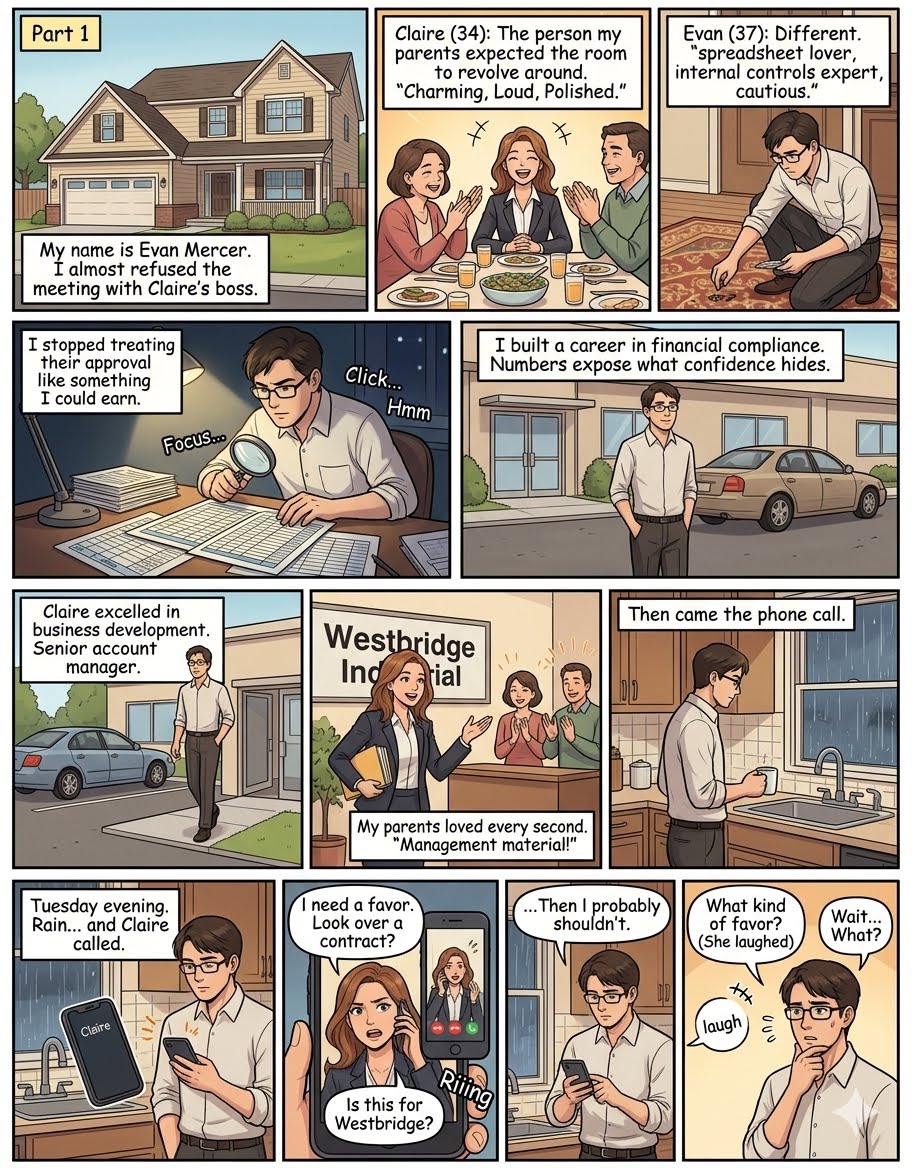
- ### Part 1
- I almost refused the meeting.
- By then, my sister had spent six months quietly turning me into a person I barely recognized.
- Jealous.
- Unstable.
- Bitter.
- Obsessed with sabotaging her career.
- So when her boss called me personally and said, “I need to speak with you alone,” I assumed Claire had finally found a way to make trouble for me at a company where I didn’t even work.
- My name is Evan Mercer. I’m thirty-seven.
- My sister Claire is thirty-four, and for as long as I can remember, Claire has been the person my parents expected the room to revolve around.
- She was charming without trying. Loud enough to be noticed but polished enough not to seem loud. She remembered birthdays, shook hands like a politician, and could walk into a room full of strangers and leave with three new friends.
- I was different.
- Give me a spreadsheet with two numbers that didn’t reconcile, and I’d stay awake until I found out why. Put me at a cocktail party with twenty people making small talk, and I’d spend half the night examining the pattern in the carpet.
- My parents weren’t cruel about the difference.
- That almost made it worse.
- When Claire got a B in high school, Mom would say, “That teacher has never liked confident girls.”
- When I got an A, Dad would glance at the paper and say, “Good. That’s what you’re supposed to do.”
- When Claire financed a car she couldn’t comfortably afford, Mom called it “investing in her image.”
- When I bought a used sedan outright, Dad laughed.
- “You always were overly cautious.”
- Eventually, I stopped treating their approval like something I could earn.
- After college, I built a career in operations and financial compliance. It wasn’t flashy. Nobody at family dinners leaned across the table and begged me to explain internal controls.
- But companies paid people like me because numbers had a habit of exposing what confidence could hide.
- I reviewed vendor agreements, tracked financial inconsistencies, and made sure contracts matched what companies believed they had agreed to.
- My life was quiet.
- I owned a modest house.
- I had savings.
- No credit-card balance.
- No expensive watch.
- No desire to impress anyone.
- Claire went into business development at Westbridge Industrial, a regional manufacturing company that had been expanding rapidly.
- She was good at it.
- Really good.
- She became a senior account manager, handled major clients, and started getting invited into rooms she had once only talked about entering.
- My parents loved every second.
- “Claire just landed another major account.”
- “Claire’s director says she’s management material.”
- “Claire could be a vice president before forty.”
- I heard some variation of that at almost every family gathering.
- And contrary to what Claire would later tell people, I wasn’t jealous.
- I was proud of her.
- That was what made the phone call so ordinary at first.
- It was a Tuesday evening. Rain tapped softly against my kitchen window while I stood over the sink rinsing a coffee mug.
- My phone buzzed.
- Claire.
- “I need a favor.”
- “What kind?”
- “Can you look over a contract?”
- My hand stopped beneath the running water.
- “Is this for Westbridge?”
- “Yes.”
- “Then I probably shouldn’t.”
- She laughed.
- It was the familiar laugh she used whenever she thought I was making something unnecessarily complicated.
- “Oh, come on, Evan. I’m not asking you to sign anything. I just want a second opinion.”
- “You have lawyers.”
- “They already looked at it.”
- “Then why do you need me?”
- There was a pause.
- “Because you notice things.”
- That should have felt like a compliment.
- Instead, something in her tone made me hesitate.
- Then an email notification appeared on my screen.
- One attachment.
- A distributor agreement.
- And one short message from my sister.
- Can you take a quick look? I’d really appreciate your opinion.
- I should have deleted it.
- Instead, I opened the file.
- And somewhere around Section 14, I found the paragraph that would eventually cost Claire much more than she ever imagined.
- ### Part 2
- I read Section 14 three times.
- The language was dense enough to make most people skim it, which was exactly why clauses like that could become dangerous.
- Performance guarantees.
- Secondary losses.
- Responsibility that extended beyond failures directly caused by Westbridge.
- I wasn’t an attorney, and I had no intention of pretending otherwise, but I had reviewed enough vendor agreements to recognize a clause that deserved another pair of eyes.
- I called Claire.
- She answered on the second ring.
- “Well?”
- “I’d have legal review Section 14 again.”
- “What about it?”
- “It looks broader than I would be comfortable with.”
- “They’ve already reviewed the contract.”
- “Then ask them specifically about that section.”
- I heard papers shifting on her end.
- “Is it actually bad?”
- “I’m not your attorney.”
- “Evan.”
- “I’m serious. What I’m telling you is that if I were reviewing this internally, I’d flag it.”
- There was silence.
- Then, quieter, “Why?”
- “Because it could make Westbridge responsible for losses that aren’t directly caused by Westbridge.”
- Another pause.
- “Are you sure?”
- “Sure enough that I wouldn’t ignore it.”
- She thanked me.
- That was all.
- No argument.
- No accusation.
- No warning that I had supposedly crossed some line.
- Two weeks later, she called again.
- The warmth was gone.
- “Did you tell anyone about that contract?”
- I leaned away from my computer.
- “No.”
- “Are you sure?”
- “Yes.”
- “Because people here are asking questions.”
- “What people?”
- “People.”
- “That’s not an answer.”
- She exhaled sharply.
- “Never mind.”
- “Claire, why would anyone be asking me? I don’t work there.”
- “I said never mind.”
- She hung up.
- I remember staring at my phone and feeling something small tighten in my chest.
- Not fear.
- Not yet.
- More like the sense you get when you hear a noise downstairs at night and can’t decide whether it was the house settling or something else.
- Then nothing happened.
- A week passed.
- Then another.
- I assumed Claire’s company had handled whatever problem existed.
- Until my mother called.
- Her first words were, “Evan, what did you do?”
- I was carrying groceries into my kitchen.
- I froze with a paper bag pressed against my chest.
- “What are you talking about?”
- “Don’t pretend you don’t know.”
- “Mom, I genuinely don’t.”
- “Claire’s account.”
- “What about it?”
- “You contacted one of her clients.”
- I slowly set the bag down.
- “No, I didn’t.”
- “She says you did.”
- “Then she’s wrong.”
- Mom made that disappointed little sound she’d used since I was a teenager.
- “Evan.”
- “What?”
- “Why would Claire lie about something like this?”
- That question hurt more than the accusation.
- Not because I didn’t have an answer.
- Because apparently Claire didn’t need evidence.
- She just needed to say something.
- “What exactly does she claim I said?”
- “That you told people she wasn’t qualified to handle the account.”
- I laughed once, mostly from disbelief.
- “I’ve never spoken to her client.”
- “She says otherwise.”
- “Ask her for proof.”
- Mom’s silence said everything.
- A few days later, Dad called.
- “You need to stay away from Claire’s work.”
- “I already do.”
- “She’s building a career, Evan.”
- “So am I.”
- “This isn’t a competition.”
- “I know.”
- “Then act like it.”
- I stood in my hallway staring at the framed college diploma I’d hung there years earlier.
- For some reason, I suddenly remembered graduation day.
- Claire had been in the middle of telling a story when Dad congratulated me.
- He’d shaken my hand, said, “Good job,” then immediately turned back toward her.
- That old feeling returned.
- The realization that defending myself was pointless if the verdict came first.
- So I stopped.
- I didn’t call Claire.
- I didn’t call my parents back.
- I told myself distance would fix it.
- Then I learned Claire’s boss had discovered I’d reviewed the contract.
- And suddenly the story changed.
- I wasn’t merely jealous anymore.
- According to Claire, I had accessed confidential company material without permission.
- The accusation was more serious.
- It was also impossible.
- Because sitting quietly in my inbox was the email she apparently believed I had forgotten existed.
- ### Part 3
- I didn’t forward the email to anyone.
- I didn’t screenshot it and send it to my parents with some dramatic message.
- I didn’t contact Westbridge.
- I saved it.
- That was all.
- The original email.
- The original attachment.
- The date.
- Her words.
- Can you take a quick look? I’d really appreciate your opinion.
- I spent my career around records. One thing you learned quickly was that people’s memories became strangely flexible when consequences arrived.
- Documents usually didn’t.
- For the next few months, Claire and I barely spoke.
- But the story apparently kept growing.
- A cousin asked me during a phone call whether everything was “okay between us.”
- An aunt became weirdly quiet when I mentioned Claire.
- Then an old family friend said, “Sometimes siblings get competitive.”
- I knew exactly where that had come from.
- Claire wasn’t confronting me directly anymore.
- She didn’t need to.
- She had made me into a character.
- The bitter older brother who couldn’t tolerate his younger sister’s success.
- Once people accepted that story, every quiet thing I did became evidence.
- If I defended myself, I was obsessed.
- If I stayed silent, I was resentful.
- If I avoided Claire, I was holding a grudge.
- There was no winning.
- Then Dad’s birthday arrived.
- Mom invited me to dinner.
- I almost declined.
- Instead, I went because part of me still believed families could sit at a table and behave like adults for two hours.
- The house smelled like roasted potatoes and the lemon cleaner Mom had used on the dining table for as long as I could remember.
- Dad opened a bottle of wine.
- Claire arrived late.
- She wore a charcoal blazer, set her handbag beside her chair, and barely looked at me.
- For twenty minutes, everyone behaved normally.
- Mom asked about work.
- Dad complained about a neighbor’s fence.
- Claire talked about a client dinner.
- Then halfway through the meal, Dad placed his fork beside his plate.
- The tiny metallic click sounded far louder than it should have.
- “There’s something we need to clear up.”
- I looked at Claire.
- She was already looking at me.
- “You need to stop interfering with my career.”
- Mom stared at her plate.
- I folded my napkin slowly.
- “What exactly did I interfere with?”
- “You know what you did.”
- “No, Claire. I honestly don’t.”
- “You contacted people at my company.”
- “I didn’t.”
- “You told them I was hiding information.”
- “I’ve never spoken to anyone at Westbridge.”
- Her mouth tightened.
- “You always do this.”
- “Do what?”
- “Act calm so everyone thinks I’m overreacting.”
- That almost impressed me.
- Somehow my refusal to shout had become evidence too.
- Dad sighed.
- “Evan, just apologize.”
- “For what?”
- “Whatever happened.”
- I looked at him.
- “You don’t even know what happened.”
- “We know enough.”
- “No. You know what Claire told you.”
- Claire leaned forward.
- “See? This is exactly what I’m talking about. You can’t stand that I’m doing better than you.”
- For a second, I didn’t recognize my sister.
- Not because she looked different.
- Because she sounded completely convinced.
- And suddenly I laughed.
- Not loudly.
- Not because anything was funny.
- I laughed because I finally understood that the conversation had never been about facts.
- They had already decided who I was before I walked through the door.
- I looked around the table.
- “Okay.”
- Everyone went quiet.
- Claire frowned.
- “Okay what?”
- “I’m sorry you feel like I interfered.”
- “That’s not an apology.”
- “It’s the only honest one I can give.”
- I stood.
- Dad stared at me.
- “You’re leaving?”
- “Yes.”
- Mom looked wounded.
- “Over this?”
- I picked up my coat.
- “No. I’m leaving because I don’t want to spend another year trying to prove something to people who decided I was guilty before asking me what happened.”
- Nobody followed me.
- Nobody called my name.
- Outside, the night air felt painfully cold against my face.
- I drove home without turning on the radio.
- And for the first time in my life, I didn’t plan what I would say to make my family understand me.
- I simply stopped trying.
- Three days later, an email appeared in my inbox.
- The sender was Nathan Cole, Claire’s director at Westbridge Industrial.
- His message contained only a few lines.
- Evan, I believe there is something you need to know.
- Please call me.
- And when I read those words, my first instinct wasn’t relief.
- It was fear.
- ### Part 4
- I almost deleted Nathan’s email.
- Instead, I stared at it for nearly a minute before calling.
- He answered immediately.
- “Evan?”
- “Yes.”
- “Thank you for calling.”
- “What is this about?”
- A brief pause.
- “I’d rather explain in person.”
- My grip tightened around the phone.
- “Does Claire know you’re contacting me?”
- Another pause.
- “No.”
- That answer made me more nervous than anything else he had said.
- We arranged to meet at a coffee shop near Westbridge’s offices.
- The following morning, I arrived ten minutes early.
- Nathan was already there.
- He looked somewhere in his late forties, wearing a navy coat over a pale blue shirt. A closed folder rested on the table beside his coffee.
- He stood when I approached.
- “Thanks for coming.”
- We shook hands.
- His expression wasn’t hostile.
- That didn’t reassure me.
- I sat.
- “What’s going on?”
- Nathan looked around the mostly empty café before speaking.
- “I owe you an apology.”
- I hadn’t expected that.
- “For what?”
- “I believed something about you that I shouldn’t have believed without checking.”
- A milk steamer hissed behind the counter.
- Someone dropped a spoon.
- Small sounds suddenly seemed unusually sharp.
- Nathan rested both hands around his cup.
- “We’ve been investigating what happened with the national distributor contract.”
- I waited.
- “Someone raised concerns internally about how the agreement was handled.”
- “Okay.”
- “Your sister told us you obtained confidential information and advised her regarding certain provisions.”
- “That’s not what happened.”
- “I know.”
- Two words.
- That was all.
- But after six months of hearing variations of “Claire says,” those two words hit me harder than they should have.
- Nathan opened the folder.
- He pulled out a printed email and placed it face down between us.
- Then he turned it over.
- I recognized it before I finished reading the first line.
- Claire’s email.
- Can you take a quick look? I’d really appreciate your opinion.
- The contract attachment was listed beneath it.
- My stomach tightened.
- “Where did you get this?”
- “Westbridge’s email archive.”
- He tapped the page.
- “We found it during an internal review.”
- I stared at my own name in the recipient field.
- Nathan continued.
- “The document wasn’t accessed improperly. Claire sent it directly to you.”
- “Yes.”
- “Voluntarily.”
- “Yes.”
- “And as far as we can determine, you never forwarded it.”
- “No.”
- “Never contacted the distributor?”
- “Never.”
- “Never contacted anyone at Westbridge?”
- “Not until you contacted me.”
- Nathan sat back.
- For several seconds, neither of us spoke.
- Finally, I asked the question that had been sitting in my chest for months.
- “Then why did she tell everyone I accessed it?”
- His eyes shifted toward the folder.
- “We don’t know yet.”
- Yet.
- That word mattered.
- He pulled out another sheet.
- It was a timeline.
- Dates.
- Meetings.
- Contract revisions.
- Internal approvals.
- Nathan slid it toward me.
- “Look here.”
- I followed his finger.
- One decision Claire had publicly blamed on my supposed interference had occurred days before she sent me the contract.
- Another had happened more than a week before our conversation.
- I looked up.
- “These decisions were already made.”
- Nathan nodded.
- “Yes.”
- “Before I ever saw the contract.”
- “Yes.”
- “Then why am I involved?”
- Nathan looked genuinely uncomfortable.
- “Because someone needed the sequence of events to look different than it actually was.”
- He didn’t say Claire’s name.
- He didn’t have to.
- I looked at the timeline again.
- Months of accusations began rearranging themselves in my head.
- This wasn’t just Claire being embarrassed.
- She had constructed a version of events in which my involvement started earlier than it actually had.
- I finally asked, “Why are you showing me this?”
- “Because the company is considering disciplinary action, and before we finalize anything, I wanted your side.”
- My first reaction surprised even me.
- “I don’t want Claire fired.”
- Nathan’s eyebrows rose.
- “After everything?”
- “She’s my sister. But more importantly, that’s not my decision.”
- “You don’t want anything from Westbridge?”
- I thought about my parents.
- The family dinner.
- Dad telling me to apologize for “whatever happened.”
- All the quiet conversations I hadn’t been invited to.
- Then I looked at the printed email.
- “I want one thing.”
- Nathan waited.
- “I want the truth documented.”
- For the first time that morning, he gave a slight nod that almost looked like respect.
- “That’s what I hoped you’d say.”
- Then he asked something I hadn’t prepared for.
- “Would you help us reconstruct exactly what happened?”
- And suddenly the folder sitting between us no longer felt like Claire’s problem.
- It felt like the first open door I’d seen in six months.
- ### Part 5
- I agreed to help.
- Not because I wanted revenge.
- I agreed because somebody had finally asked me what happened before deciding who I was.
- Over the next two weeks, I gave Westbridge exactly three emails.
- Nothing more.
- Nothing dramatic.
- No secret recordings.
- No hidden dossier.
- Just three messages Claire herself had sent.
- Can you take a quick look?
- What do you think of this clause?
- Thanks for catching that.
- The last one became the most important.
- Nathan called me one afternoon.
- “Do you remember why Claire wrote ‘Thanks for catching that’?”
- “Section 14.”
- “You’re certain?”
- “Yes.”
- “Did she ask what she should do?”
- “I told her to have legal review it specifically.”
- “Did you tell her to reject the contract?”
- “No.”
- “Did you tell anyone else?”
- “No.”
- He was quiet.
- Then he said, “That’s consistent with what we’re finding.”
- I sat at my desk after the call, watching late-afternoon light creep across the floor.
- For months, Claire’s version had been complicated.
- I was jealous.
- I interfered.
- I contacted people.
- I accessed confidential documents.
- I sabotaged negotiations.
- The truth fit inside three ordinary emails.
- That was the strange part.
- Lies often needed detail.
- Truth usually needed dates.
- I later learned that the clause I warned her about had become one of the central problems in negotiations.
- The distributor’s interpretation created exposure Westbridge hadn’t intended to accept.
- Legal concerns surfaced.
- Internal teams disagreed.
- Weeks stretched into months.
- The deal eventually collapsed.
- And somewhere during that process, Claire made a choice.
- She didn’t tell people, “My brother noticed this before we did.”
- She didn’t say, “I received a warning and decided not to push harder.”
- Instead, she gradually moved me from the person who had noticed the problem to the person who had caused it.
- Nathan never told me every detail of the investigation.
- He didn’t need to.
- The timeline explained enough.
- Claire had been under pressure.
- People wanted to know why issues hadn’t been escalated sooner.
- Her credibility on the account was at risk.
- And suddenly there was a convenient outsider.
- Me.
- Her quiet older brother.
- The one everyone in our family already believed was overly cautious.
- The one who had reviewed the agreement.
- The one who didn’t work at Westbridge and therefore wasn’t sitting in conference rooms defending himself.
- A perfect scapegoat.
- When Nathan called again, his voice was formal.
- “The internal review is complete.”
- I stood from my desk and walked toward the window.
- “Okay.”
- “Claire isn’t being terminated.”
- I realized I’d been holding my breath.
- “She’s being removed from the distributor account and placed on a performance review.”
- I didn’t celebrate.
- I didn’t smile.
- I simply asked, “And the allegation about me?”
- “Westbridge has formally documented that you did not improperly obtain, access, distribute, or disclose confidential company information.”
- I closed my eyes.
- There it was.
- Six months of accusations reduced to one sentence.
- Nathan continued.
- “If anyone contacts you regarding the matter, our position is clear.”
- “Thank you.”
- “I mean that, Evan.”
- “So do I.”
- When we hung up, I walked into my kitchen.
- The house was quiet except for the refrigerator humming.
- I poured a glass of water and stood there expecting some huge emotional release.
- Nothing came.
- No triumph.
- No satisfaction.
- Mostly exhaustion.
- The truth had finally arrived.
- It was just late.
- I thought that would be the end.
- Then my phone rang.
- Mom.
- I stared at her name until the screen nearly went dark before answering.
- “Hello?”
- Her voice sounded small.
- “Evan.”
- “Yeah?”
- “Can we talk?”
- “Sure.”
- She didn’t speak for several seconds.
- Then she said four words I had waited most of my life to hear.
- “We were wrong about you.”
- And somehow, instead of making me feel better, they made me angry all over again.
- ### Part 6
- I sat down at my kitchen table.
- “What changed?”
- Mom breathed slowly into the phone.
- “Claire told us what happened.”
- I stared at the wood grain beneath my hand.
- “She told you?”
- “We saw the emails too.”
- There it was.
- Not We remembered what you said.
- Not We should have listened.
- The emails.
- Proof.
- “So you finally believe me.”
- Mom’s voice cracked slightly.
- “Yes.”
- I didn’t know what to do with that word.
- For months, I had told the truth.
- It became acceptable only when somebody else authenticated it.
- Then Dad came on the phone.
- “Son.”
- I almost laughed at the sudden softness.
- “Hi, Dad.”
- “I owe you an apology.”
- I don’t think I had ever heard those words from him.
- Not sincerely.
- “We spent too much time assuming Claire was right.”
- I waited.
- “Because she was the one we were proud of.”
- That sentence landed differently than he probably intended.
- “The one you were proud of?”
- He went quiet.
- “You know what I mean.”
- “I think I do.”
- “No. Evan, I said that badly.”
- “You said it honestly.”
- He exhaled.
- “That’s not fair to you.”
- “No. It wasn’t.”
- Silence.
- Then he said, “I don’t know how to fix it.”
- That was the first useful thing either of my parents had said.
- “You probably can’t fix the past.”
- “I know.”
- “But you can stop repeating it.”
- “We will.”
- I wanted to believe him.
- I didn’t promise that I did.
- That mattered.
- Old me would have rushed to make them comfortable.
- I would have said, It’s okay.
- I would have reduced years of resentment into something easier for everyone else to swallow.
- Instead, I said, “We’ll see.”
- Mom called me again the following weekend.
- Then Dad.
- They were careful at first, like people walking across ice.
- I let them.
- Apologies didn’t restore trust.
- Consistent behavior might.
- A few weeks later, Claire called.
- I watched her name pulse across my screen.
- Part of me wanted to ignore it forever.
- Eventually, I answered.
- “Hi.”
- “Hi.”
- Her voice sounded tired.
- Not theatrical.
- Just tired.
- “I owe you an apology.”
- I said nothing.
- “I was scared.”
- “Of what?”
- “Losing my position. Looking incompetent. Admitting I’d ignored your warning.”
- I stood beside my living-room window.
- Outside, someone was pushing a stroller past my driveway. A dog barked across the street.
- Ordinary life continued while my sister finally admitted she’d spent months trying to destroy my credibility.
- “You didn’t have to make me the villain.”
- “I know.”
- “That part wasn’t panic, Claire. That was a choice.”
- “I know.”
- Her voice broke slightly.
- “I thought if everyone believed you caused the problem, nobody would ask why I made the decision.”
- I closed my eyes.
- There it was.
- Not confusion.
- Not a misunderstanding.
- A decision.
- “You knew they already saw me as jealous.”
- She didn’t answer.
- “Didn’t you?”
- “Yes.”
- That hurt more than anything.
- Because Claire hadn’t just lied.
- She had used our family dynamic as a weapon.
- She knew exactly which story my parents would believe.
- She knew she didn’t need evidence.
- She only needed to give them a version of me they already understood.
- “I’m sorry,” she whispered.
- I believed she meant it.
- That didn’t erase what she’d done.
- After a moment, she asked, “Are we ever going to be okay?”
- I thought about birthdays.
- Christmas dinners.
- Childhood vacations.
- The hundred tiny moments that make you believe family is permanent.
- Then I thought about that dining-room table and how easily she had looked me in the eye and accused me of something she knew I hadn’t done.
- “I don’t know.”
- She was quiet.
- For once, she didn’t argue.
- “I understand.”
- “No, Claire. I don’t think you do yet. But maybe someday.”
- We hung up.
- I didn’t block her.
- I didn’t forgive her either.
- And that was the part my parents struggled with most.
- They believed an apology should close the wound.
- I had finally learned that sometimes an apology only tells you who caused it.
- ### Part 7
- Nothing magically repaired itself.
- There was no Sunday dinner where Claire cried, I hugged her, and everyone agreed to forget what happened.
- I wasn’t interested in pretending betrayal disappeared because somebody finally admitted it.
- My relationship with Claire became polite.
- That was enough.
- She texted on birthdays.
- I replied.
- At Christmas, we could stand in the same kitchen without creating tension.
- But I stopped telling her things that mattered.
- She no longer knew details about my work.
- She didn’t know how much I earned.
- She didn’t know who I spent time with.
- She didn’t get access to the parts of my life she had once treated as guaranteed.
- Trust wasn’t a punishment I withheld.
- It was something she had broken.
- My parents changed too, though slowly.
- Dad started asking about my job without immediately pivoting to Claire.
- Mom called just to talk.
- At first, every conversation felt suspiciously deliberate.
- Then one evening, Dad asked me about a compliance project I was working on.
- I explained the basics.
- He listened.
- Actually listened.
- When I finished, he said, “That sounds complicated.”
- “It can be.”
- “You like it?”
- “I do.”
- “Then that’s good.”
- No Claire comparison.
- No joke about me being cautious.
- It lasted maybe ninety seconds.
- Yet I noticed.
- A few months after Westbridge completed the investigation, Nathan called me again.
- “I have a question.”
- “Okay.”
- “Would you consider consulting for us?”
- I almost laughed.
- “You’re serious?”
- “Very.”
- “Does Claire know?”
- “Not yet.”
- That gave me pause.
- “I don’t want this being used to humiliate her.”
- “It won’t be.”
- “What would I be doing?”
- Nathan explained that Westbridge was strengthening internal contract review and operational compliance after problems exposed during the failed distributor negotiations.
- They needed someone who could identify risk without creating bureaucracy for the sake of bureaucracy.
- Apparently my name had come up.
- I almost declined.
- Working with Claire’s company felt too close to everything that had happened.
- Then I realized I was still letting the situation control me.
- If it was a good opportunity, why should I reject it to protect Claire from discomfort?
- I accepted.
- Not for revenge.
- Not because Claire had stumbled.
- Not because I wanted my parents to brag about me at family gatherings.
- I accepted because the work was interesting, the terms were fair, and Nathan respected what I did.
- My first morning at Westbridge, the building smelled faintly of coffee and industrial carpet.
- Nathan met me near reception.
- “You ready?”
- “As I’ll ever be.”
- Claire wasn’t there.
- That helped.
- For the first several months, I worked mostly with finance, legal, and operations.
- I wasn’t hired to oversee my sister.
- I didn’t ask about her performance review.
- I avoided gossip.
- That became strangely important to me.
- Claire had damaged me by shaping other people’s opinion before they met me.
- I refused to become the same kind of person.
- If someone asked, I said only, “Claire and I had a family issue that crossed into work. It’s resolved.”
- Nothing more.
- Over time, Westbridge expanded my consulting role.
- Then another company called.
- Then another.
- My quiet career became less quiet.
- And something changed inside me that had very little to do with money.
- For years, I had treated being underestimated like an insult I needed to correct.
- I stopped doing that.
- If someone underestimated me, fine.
- They could discover the truth when it became relevant.
- I had nothing to prove in advance.
- About a year after everything happened, Dad invited me to dinner.
- Claire wasn’t there.
- After the plates were cleared, he leaned back in his chair.
- “Can I ask you something strange?”
- “Sure.”
- “Do you still think about what Claire did?”
- “Sometimes.”
- “Are you angry?”
- I considered the question carefully.
- “I was.”
- “Are you now?”
- I looked toward the kitchen, where Mom was rinsing dishes beneath the warm light.
- “No.”
- Dad nodded.
- Then he said something that once would have meant everything to me.
- “I think that’s what I admire about you.”
- I looked at him.
- And for the first time, I realized I didn’t need the compliment nearly as much as I once had.
- ### Part 8
- “Thanks,” I said.
- Dad smiled.
- That was it.
- No dramatic speech.
- No father-son embrace.
- No attempt to rewrite history.
- Just two people sitting at a kitchen table finally talking without Claire’s success hanging over us like a scoreboard.
- Years earlier, that compliment would have stayed with me for weeks.
- Now it felt good, but it wasn’t necessary.
- That difference mattered more than the words themselves.
- My parents and I eventually found a relationship that worked.
- It wasn’t the old one repaired.
- It was something new.
- More limited.
- More honest.
- They learned that if they dismissed me because Claire said something, I would leave the conversation rather than defend myself endlessly.
- They also learned I wasn’t interested in being their new favorite child.
- When Mom once started comparing my consulting work to Claire’s career, I stopped her.
- “Please don’t do that.”
- She looked confused.
- “I’m complimenting you.”
- “By comparing us.”
- Her expression changed.
- “Oh.”
- “I don’t want her old position in this family.”
- Mom understood.
- That was probably the healthiest thing to come from the entire mess.
- Claire remained at Westbridge.
- She worked her way through the performance review and eventually moved into a different group.
- We crossed paths occasionally.
- The first time happened near the elevators.
- She saw me and stopped.
- For half a second, both of us looked like people who had accidentally opened the wrong door.
- Then she said, “Hey.”
- “Hey.”
- “How’s consulting?”
- “Good.”
- “I’ve heard.”
- There was no sarcasm.
- I nodded.
- “How are you?”
- “Better.”
- “I’m glad.”
- The elevator arrived.
- Before she stepped inside, she looked at me.
- “I know you probably don’t believe this, but I am proud of you.”
- The doors remained open behind her.
- A year earlier, that sentence might have made me furious.
- Now I simply said, “Thank you.”
- She waited, maybe expecting more.
- There wasn’t more.
- The doors closed.
- I continued toward the conference room.
- That was our relationship.
- Not hatred.
- Not forgiveness disguised as closeness.
- Distance.
- Respect where possible.
- Boundaries everywhere else.
- Claire once asked our mother whether I would ever trust her again.
- Mom later mentioned it to me.
- My answer was simple.
- “I don’t know. And I don’t spend much time deciding.”
- That was the truth.
- I didn’t need Claire to suffer.
- I didn’t need her fired.
- I didn’t need her marriage to fail, her career to collapse, or our parents to turn against her.
- Revenge would have kept her at the center of my life.
- I wanted the opposite.
- Freedom.
- My consulting work grew enough that I eventually reduced my other employment and began working independently.
- I built a small client base around exactly the kind of work my family had once found boring.
- Contract controls.
- Risk reviews.
- Operational compliance.
- The quiet things businesses ignored until those quiet things became expensive.
- Sometimes Nathan still called.
- Sometimes we had coffee.
- He once apologized again for initially believing Claire.
- I told him, “You corrected it when you found evidence. That’s more than most people do.”
- He laughed.
- “Low bar.”
- “Still surprisingly difficult for some people.”
- We both knew who I meant.
- The strange thing was, Claire’s attempt to ruin my reputation did expose something.
- Just not what she intended.
- It exposed how dependent I had been on being understood.
- By my parents.
- By my sister.
- By anyone who heard the story.
- I thought being falsely accused meant I had to chase every person down and convince them.
- I didn’t.
- The people worth keeping eventually asked questions.
- The people who preferred gossip to evidence were never mine to manage.
- The email Claire sent remained stored in an archive on my computer.
- I haven’t opened it in years.
- I don’t need to.
- I remember the line.
- Can you take a quick look? I’d really appreciate your opinion.
- One ordinary sentence.
- One attachment.
- One fact she couldn’t eventually talk her way around.
- For six months, I thought the worst part of what happened was that my sister had lied.
- It wasn’t.
- The worst part was realizing how many people who claimed to know me were willing to believe her without asking me one question.
- That changed the way I looked at my family forever.
- I forgave my parents enough to have a relationship with them, but I never gave them back the unquestioned trust they’d once had.
- I accepted Claire’s apology, but I didn’t forgive her in the way she wanted.
- I didn’t restore our old relationship.
- Some things don’t need to be repaired simply because the person who broke them is finally sorry.
- A few years later, people sometimes asked whether I considered the whole situation a blessing because of the consulting career that came from it.
- I never liked that description.
- Betrayal isn’t a blessing.
- Being lied about isn’t a gift.
- Pain doesn’t become good simply because you learned something useful afterward.
- But I did learn something.
- For most of my life, I’d believed winning meant finally proving my family wrong.
- I was measuring my life with their ruler.
- Claire was charismatic.
- Claire was ambitious.
- Claire got attention.
- Therefore, if I wanted to matter, I needed some bigger achievement that forced everyone to admit I mattered too.
- I don’t believe that anymore.
- Nathan didn’t ask to meet me because I was secretly powerful.
- He asked because eventually the evidence became louder than Claire’s story.
- My parents didn’t apologize because I argued better.
- They apologized because the facts left them nowhere comfortable to stand.
- And I didn’t become whole because Claire faced consequences.
- I became whole when I stopped allowing other people’s version of me to become my responsibility.
- That was the strangest lesson of all.
- Nothing I did to defend myself worked as well as simply keeping the truth.
- I saved the emails.
- I kept the original attachment.
- I didn’t exaggerate.
- I didn’t retaliate.
- I didn’t call Claire’s clients.
- I didn’t campaign against her.
- And when someone finally sat across from me and asked, “What actually happened?” I didn’t need a better story than hers.
- I only needed the real one.
- Sometimes integrity isn’t winning the argument.
- It isn’t getting even.
- It isn’t watching the person who hurt you lose everything.
- Sometimes integrity is much quieter than that.
- It’s knowing the truth when nobody believes you.
- Keeping the evidence without using it as a weapon.
- Walking away when people demand an apology for something you didn’t do.
- And continuing to live the same way until one day, the truth finally walks into the room without needing you to drag it there.
- Claire wanted me to become the villain in her story so she wouldn’t have to admit she’d made a mistake.
- For a while, my parents believed her.
- People at her company believed her.
- Even I started wondering whether staying silent made me weak.
- It didn’t.
- Silence isn’t weakness when the facts are still intact.
- And when Nathan closed that office door and placed Claire’s printed email on the desk between us, I finally understood something that changed the rest of my life.
- I didn’t need to destroy the lie.
- I only needed to survive long enough for the truth to catch up with it.
- And when it finally did, I didn’t take my sister back.
- I didn’t ask my parents to make up for thirty years of comparisons.
- I didn’t demand anyone crown me the successful child.
- I simply took my name back.
- Then I built a life where nobody else got to define what it meant.
- THE END!
After My Sister Ruined My Reputation, Her Boss Asked Me For One Private Meeting Alone. She Had Told Everyone I Was Unstable, Jealous, And Bitter. I Expected Another Confrontation. Instead, Her Boss Closed The Office Door And Put A Printed Email On The Desk Between Us…