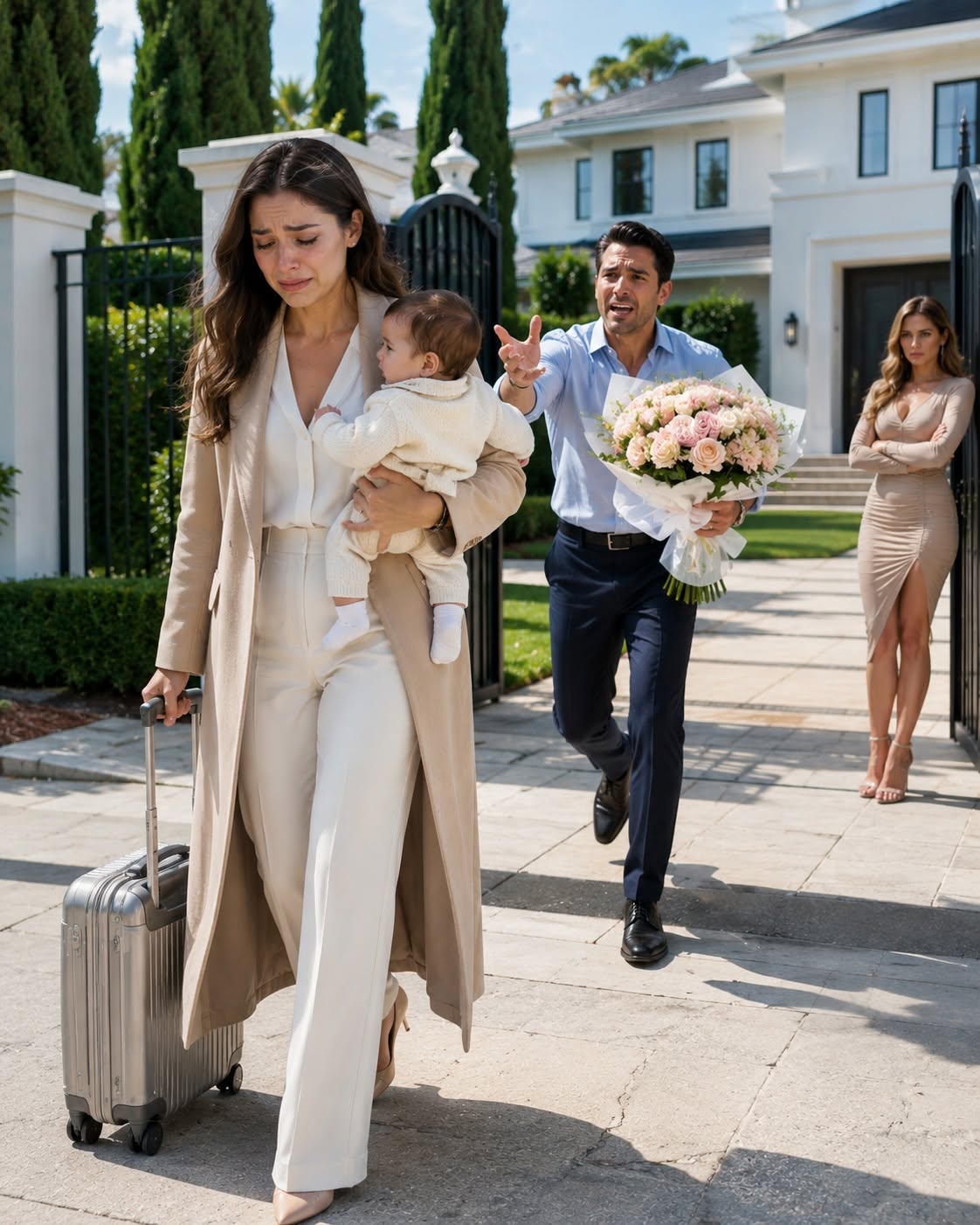
Nathan Whitmore walked into his home in Pacific Palisades whistling, his skin bronzed from the sun, a brand-new suitcase rolling beside him, and an enormous bouquet of pale champagne roses cradled in his arms.
They were the exact same flowers he always bought whenever he needed to cover up a lie.
For 10 days, he had told everyone he was in Key West supervising construction on a luxury resort. In reality, he had spent most of that trip with Madison, an interior designer he had been secretly seeing for more than a year.
He expected to find Caroline furious, perhaps crying, but eventually willing to forgive him after hearing one of the explanations he had carefully practiced.
Instead, the house was silent.
There were no baby bottles on the kitchen counter.
No diapers scattered around the living room.
No stroller parked near the front door.
He couldn’t even hear Noah, their newborn son, crying.
Dorothy, the woman who had worked for their family for 8 years, was taping up a cardboard box in the kitchen.
“Where’s Caroline?” Nathan asked.
Dorothy avoided looking at him.
“Mrs. Whitmore left with the baby 15 days ago. She asked me not to touch anything until you came home.”
Nathan let the roses fall from his arms.
“15 days ago? Where did she go?”
“She didn’t say. She only left this for you.”
On the kitchen table was a photograph of Noah inside an incubator, connected to monitors, with a tiny bandage wrapped around one arm.
On the back of the photograph, Caroline had written:
“While you were drinking and celebrating, your son was fighting to stay alive.”
Nathan felt his stomach twist.
“What is this supposed to mean?”
Dorothy placed a thick envelope in front of him.
Inside were bank statements, invoices, restaurant receipts, hotel bookings, and copies of wire transfers.
Everything was arranged perfectly.
A luxury handbag.
2 diamond rings.
Oceanfront dinners.
Madison’s apartment in Newport Beach.
And a transfer of $250,000.
On the final page was another message:
“All of this happened while I went through the final weeks of pregnancy alone. I hope your so-called business trip was worth it.”
Nathan rushed into his home office.
He tried logging into his accounts.
Several had been frozen under a court order.
He called his attorney immediately.
“Caroline filed for legal protection of the marital assets,” the attorney explained. “And for a judge to approve something this serious, she had to provide substantial evidence. I need to ask you something directly: did you use company funds to pay personal expenses?”
Nathan said nothing.
The $250,000 he had transferred to Madison had come from an account meant for construction deposits.
At that moment, he remembered something he had spent years dismissing.
Before becoming a mother and temporarily stepping away from her career, Caroline had been a forensic accountant.
And she had been very good at it.
“What happened to Noah?” Nathan asked Dorothy.
“He started turning very yellow the day after you left. Mrs. Whitmore tried to reach you several times.”
Nathan vaguely remembered seeing one of Caroline’s messages.
He also remembered Madison taking his phone from him that afternoon while they were stretched out beside the pool.
“Forget it,” she had said. “You came here with me.”
Dorothy took a breath.
“The baby ended up in the hospital with severe hyperbilirubinemia.”
Nathan covered his mouth.
“But I told Caroline to put him near a sunny window…”
“And Caroline called a pediatrician.”
Dorothy then handed him a USB drive.
Nathan plugged it into his computer.
Madison’s voice filled the room.
“Caroline, seriously, stop being dramatic. Nathan says living with you feels like watching paint dry. I’m the woman who inspires him. Last week he gave me $250,000 for whatever I wanted. Do you honestly think you still matter to him?”
Then Caroline’s calm voice followed:
“Thank you. That was all I needed to confirm.”
The recording ended.
A chill ran down Nathan’s back.
Caroline hadn’t left because of a sudden emotional breakdown.
She had been gathering evidence.
Nathan grabbed his keys and started toward the hospital.
Before he reached the front door, his phone rang.
It was his attorney.
“Nathan, don’t go anywhere until you listen to me. Ryan just submitted an internal audit to the board.”
Ryan was his closest friend.
His business partner since college.
The man who had helped him build the firm from nothing.
“What did he submit?”
The attorney hesitated before answering.
“Documents that could ruin you.”
And Nathan still had no idea that the $250,000 was only the beginning.
Ryan Mitchell and Nathan had known each other since studying architecture at USC.
They had started their careers in a cramped little office in Silver Lake, sharing an outdated computer and surviving on takeout while dreaming about designing hotels, retail centers, and upscale residential developments.
18 years later, their firm was managing projects worth hundreds of millions.
That was why Nathan couldn’t understand why Ryan had chosen to speak.
“Why would he betray me?” Nathan asked his attorney.
“He didn’t betray you,” the attorney replied. “He’s trying to save the company and 40 employees. Caroline showed him transactions that didn’t make sense, and he ordered an independent audit.”
The attorney paused.
“They found inflated contracts, vendors nobody recognizes, and payments routed into accounts connected to you.”
Nathan stopped breathing for a moment.
“How much?”
“They’re still calculating it.”
He drove to the hospital barely conscious of the road.
When he reached the neonatal intensive care unit, he saw Caroline through the glass.
She wore jeans, a white blouse, and her hair pulled into a simple ponytail.
Dark circles sat beneath her eyes. Her body still carried the exhaustion of pregnancy and childbirth.
Yet she stood beside the pediatrician taking notes, asking about every result, and reviewing the medication schedule.
Nathan tapped softly on the glass.
“Caroline.”
She looked up.
Their eyes met for 2 seconds.
There was no screaming.
No crying.
Not even anger.
Only a distance that frightened Nathan far more than any argument ever had.
Caroline turned back toward the doctor.
Nathan’s phone vibrated.
Madison was calling.
“My card just got declined at South Coast Plaza,” she complained without even saying hello. “And the account is frozen too. Fix this.”
Nathan looked toward the incubator.
“Noah is in intensive care.”
There was silence.
“And what do you want me to do about that?”
A pressure tightened around his chest.
“He’s my son.”
“Nathan, I still have rent to pay. Don’t mix two completely different things.”
She hung up.
For the first time, Nathan understood what he had refused to admit for months.
To Madison, he had never been a great love story.
He had been financial security.
Minutes later, an email arrived from Caroline’s attorney.
The proposed agreement was straightforward.
Nathan had to repay the funds he had diverted.
He had to surrender part of his ownership in the firm to compensate for the losses.
The family home had to be placed in a protected trust for Noah.
And Nathan would pay the legally required child support.
In return, Caroline would not interfere with the corporate investigation or deliberately turn the case into a public spectacle.
Nathan had 24 hours to respond.
When Caroline finally stepped out of the medical unit, Nathan hurried after her.
“We can fix this.”
She kept walking.
“Caroline, please.”
She stopped.
“Do it for Noah,” Nathan said.
Caroline slowly turned around.
“Don’t use your son now.”
“I made a mistake.”
“No.”
Her answer was immediate.
“A mistake is forgetting a dinner reservation. You spent months lying, inventing business trips, creating accounts, paying for another woman’s apartment, and hiding transactions. Those were choices.”
“I didn’t know Noah was that sick.”
Caroline stared at him.
“Because you chose not to know.”
Nathan frowned.
“I called you 6 times that afternoon,” she continued. “Eventually, somebody answered your phone.”
Nathan felt his stomach drop.
“Madison?”
“She told me to stop bothering you because you were relaxing.”
Caroline swallowed.
“While I was signing medical consent forms in case our son needed a transfusion, you were beside a swimming pool drinking with her.”
Nathan wanted to defend himself.
Nothing came out.
“I’m not doing any of this because I want revenge,” Caroline continued. “I’m recovering what you took from Noah and what belongs to the people who work at that company.”
At that moment, Dr. Benjamin Hayes approached them.
He was a pediatric specialist and an old college friend of Caroline’s.
“Noah is responding well,” Benjamin said. “The next tests will matter, but so far the progress is encouraging.”
Caroline closed her eyes for several seconds.
Nathan realized then that Benjamin had been there when he hadn’t.
Not as a romantic rival.
As a doctor.
As a friend.
As somebody who answered when Caroline called.
Ryan called that same night.
“We found another account,” he said.
Nathan froze.
“What account?”
“One I didn’t even know existed.”
The following morning, the board received the complete audit.
The truth was worse than anyone had expected.
For 18 months, Nathan had used 3 fake vendors to inflate project costs and redirect company money.
At first, the amounts had been small.
Then Nathan started believing nobody could touch him.
Vacations.
Restaurants.
Jewelry.
Gifts.
The Newport Beach apartment.
In total, nearly $560,000 was missing.
Caroline had noticed the first clue after hearing Madison brag about receiving the $250,000.
She examined tax and business documents Nathan legally kept in their home, compared dates, and discovered duplicate invoices.
She never hacked his accounts.
She never accessed private systems.
She simply showed the suspicious records to Ryan.
Ryan took it from there.
That evening, Nathan went to Madison’s apartment.
He found her stuffing dresses, shoes, and cosmetics into 3 suitcases.
“You’re leaving?”
“What did you think I was going to do?”
“You said you loved me.”
Madison laughed nervously.
“Come on, Nathan. I enjoyed being with you, but this has become way too serious.”
“That’s all this was?”
She snapped one suitcase shut.
“You offered me a lifestyle. I accepted. I never promised I’d destroy my life with you.”
Nathan told her that investigators would probably contact her about the transfers.
Madison removed the additional credit card from her wallet and placed it on the table.
“Then your lawyer can call me.”
She walked out.
Nathan remained alone inside the apartment he had paid for because it made him feel younger, more desirable, and more powerful.
He stared at the furniture.
The designer lamps.
The bottles of wine.
Suddenly, every part of it looked artificial.
He had traded a real family for a rented fantasy.
The next morning, Nathan accepted Caroline’s agreement.
He surrendered a large portion of his shares to cover the damages, returned everything that could still be recovered, and placed the family house into a protected trust for Noah.
Ryan decided to cooperate fully with authorities and keep the firm operating.
Nathan was removed from management.
His name vanished from the firm’s biggest projects.
Clients stopped calling.
Executives who had once fought for the chance to sit beside him at dinners suddenly acted as though they had never met him.
But the worst moment came when Caroline allowed Nathan to review Noah’s medical records.
Every page felt like a blow to the face.
Appointments.
Tests.
Lab results.
Hours of monitoring.
Signatures.
Consent forms.
Caroline’s name appeared again and again.
Where the forms asked for the father’s name, many of the lines were blank.
When Noah was finally released from the hospital, Nathan watched from a distance as Caroline held the baby carefully against her chest.
Benjamin walked beside her.
Nathan wanted to go closer.
He stopped himself.
“Caroline,” he called from several feet away. “I’m not going to ask you to forget what I did. I only want to tell you I’m sorry.”
She looked at him.
“I hope someday those words become meaningful to you.”
She adjusted Noah’s blanket.
“To me right now, they mean less than you actually being here would have.”
Months later, Nathan no longer lived in Pacific Palisades.
He rented a small apartment in Long Beach and worked as a draftsman for a modest construction company.
He sold his luxury SUV.
He replaced expensive restaurants with neighborhood diners.
And for the first time in years, he took instructions from people he once would have considered beneath him.
At first, he experienced every moment as humiliation.
Eventually, something began to change.
He designed a wheelchair ramp for a young boy.
He redesigned a small house so an elderly woman could move safely without falling.
He learned how to create ventilation and shade for families who could not afford air conditioning.
He stopped wondering whether his projects might appear in architecture magazines.
Instead, he started asking whether those projects would actually improve someone’s life.
3 months later, Ryan asked him to meet at a coffee shop.
He handed Nathan an envelope.
Inside were photographs of Noah.
Sleeping.
Smiling.
Trying to sit upright.
Playing with a stuffed bear.
There was a short note from Caroline:
“He’s growing well. I’m not sending these pictures to erase what happened. I’m sending them so you remember that he survived. I hope you learn how to live differently too.”
Nathan cried quietly.
From that day forward, he paid every financial obligation on time.
He never appeared without permission.
He never demanded access to Noah.
2 years later, Benjamin called him.
Caroline and Benjamin were getting married.
And Benjamin wanted to legally adopt Noah.
The news crushed Nathan.
He asked to meet Caroline.
They sat down at a café in Laguna Beach.
“You want me to give up being his father?” Nathan asked.
Caroline shook her head.
“I want you to understand what being a father actually means.”
She looked directly at him.
“Do you know what food he’s allergic to?”
Nathan said nothing.
“Do you know which song he asks for at bedtime?”
Silence.
“Do you know whose hand he reaches for when he’s frightened?”
Nathan lowered his eyes.
“Benjamin was there for every vaccination, every fever, every sleepless night. You fulfill your financial responsibilities, and I recognize that. But Noah needs stability. He doesn’t need adults fighting over him.”
The documents remained between them on the table.
Nathan stared at them for several minutes.
Then he signed.
Something inside him seemed to break.
But Nathan also understood something.
Refusing only so he could preserve a legal right he had barely exercised would simply be another act of selfishness.
Several weeks later, something unexpected happened.
Caroline discovered that the shares Nathan had surrendered were worth more than everyone had originally calculated.
She transferred the difference back to him.
“I don’t want the money,” Nathan told her.
“It isn’t a gift,” Caroline replied. “It belongs to you. Returning it is the right thing to do.”
Nathan could have used the money to return to the world of prestigious architecture firms.
He chose not to.
Instead, he bought a small piece of property outside Santa Barbara and started a nursery specializing in drought-resistant plants.
Working with the soil taught Nathan something no corporate boardroom ever had.
A plant cannot survive on promises.
It needs water.
Time.
Presence.
You can buy the most expensive planter in the world, but if you never care for what’s inside it, the plant will eventually die.
Over the years, Caroline founded the Fresh Start Foundation, an organization that helped women dealing with financial abuse, hidden debts, and manipulation of shared assets.
She never turned her personal story into a public campaign against Nathan.
When a journalist once asked whether she was grateful that she had discovered the affair, Caroline answered:
“I’m not grateful for being betrayed. I’m grateful that I remembered who I was before I let someone convince me I couldn’t survive on my own.”
Nathan read the interview years later.
The photograph showed Caroline, Benjamin, and Noah.
Noah was 12.
All 3 were smiling.
To Nathan’s surprise, he didn’t feel jealous.
He felt relieved.
10 years had passed since the adoption.
Nathan’s nursery had grown.
He started training young apprentices and designing community gardens without charging for his work.
He never recovered his former wealth.
He never remarried.
But eventually, he stopped living as if another person’s forgiveness was the only thing that could make his life worthwhile.
One Tuesday afternoon, while Nathan was trimming a rosebush, he heard the bell above the nursery entrance.
When he looked up, he saw a teenage boy wearing a backpack.
The boy had Nathan’s same dark eyes.
“Are you Nathan Whitmore?”
The pruning shears slipped from Nathan’s hand.
“Yes.”
“I’m Noah Hayes.”
Nathan had to steady himself against the worktable.
“Does your mother know you’re here?”
“Yes. My parents told me the truth once I was old enough to understand it.”
The word “parents” hurt.
But it also told Nathan something important.
Benjamin had kept his promise.
Noah removed a small box from his backpack.
Inside was an antique watch.
“Mom said this belonged to your grandfather.”
Nathan took it with trembling hands.
“Do you hate me?”
Noah shook his head.
“I don’t agree with what you did. But Mom taught me that someone can take responsibility for doing something terrible without having to remain that terrible thing forever.”
Nathan’s eyes filled with tears.
“Benjamin is your dad,” he said.
“Yes.”
Noah smiled faintly.
“And you’re my biological father. I didn’t come here to replace anyone. I just wanted to know the part of my story I hadn’t seen yet.”
Nathan didn’t defend himself.
He told Noah everything.
His vanity.
The lies.
The money.
The affair.
The phone call he chose not to answer.
The terror he had felt the first time he saw Noah lying inside that incubator.
Nathan didn’t ask Noah to call him Dad.
He didn’t ask for another chance.
He simply told him:
“Never mistake buying things for someone with actually being there for them.”
They talked for hours.
As evening settled over the nursery, Noah stood.
“Can I come back sometime?”
Nathan smiled through his tears.
“This door will always be open. But you only walk through it when you want to.”
Noah hugged him.
It wasn’t the embrace of a son returning home.
Noah’s home was with Caroline and Benjamin.
It was the embrace of a young man choosing to understand where he came from without betraying the people who had raised him.
When Noah finally disappeared down the path, Nathan slipped his grandfather’s watch onto his wrist.
He had lost his marriage.
His fortune.
And the right to raise his son.
All because of decisions nobody had forced him to make.
Nothing could erase that.
But Nathan finally understood that remorse does not mean demanding another chance.
It means becoming different even when no one promises to forgive you.
The roses in the nursery swayed gently in the evening breeze.
Nathan remembered the champagne-colored bouquet he had carried home 12 years earlier, intending to hide yet another lie.
This time, there were no flowers he could use to purchase forgiveness.
There was only soil.
Silence.
And the weight of a truth he had learned far too late:
Love is not proven with money, family names, gifts, or speeches.
It is proven by staying when someone needs you.