The Price of a Legacy
Part 1: The Porcelain Cage
“Be grateful I didn’t pack them off to a state orphanage. Three daughters are profoundly useless when it comes to carrying on a family dynasty.”
My mother-in-law, Margaret Whitmore, hissed those words like venom, her voice a razor blade wrapped in velvet. A split second later, the sharp sting of her palm collided with my cheek. The sound cracked like a whip across the cavernous expanse of the grand dining room.
I was precariously balancing a heavy, ornate silver tray laden with antique coffee cups. The physical impact threw me off balance, but it was the humiliation that paralyzed me. The fine porcelain rattled violently. One delicate cup slid past the silver rim and shattered against the imported Italian marble floor. A jagged spiderweb of ceramic and spilled espresso stained the pristine stone.
Then, a suffocating silence settled over the charity luncheon.
Forty distinguished guests—the elite of Greenwich, Connecticut—froze in their tailored suits and designer dresses. They were the premier donors of the Whitmore Foundation, gathered under vaulted ceilings and crystal chandeliers to ostensibly support a campaign for abused women. The irony was so thick it was choking me. They had just spent an hour applauding speeches about empathy and compassion, completely blind to the fact that the woman hosting them treated her own daughter-in-law like indentured property.
No one moved. No one dared to breathe.
No one, except the solitary man seated at the absolute far end of the sprawling mahogany table.
My name is Emily Carter. I was thirty-two years old, and for the past six agonizing years, I had existed as little more than a phantom—unpaid, unseen, and unvalued help trapped inside my late husband’s ancestral mansion.
When my husband, Michael Whitmore, perished in a mangled wreck on Interstate 84, Margaret had descended upon my grief like a vulture. Before his ashes were even cold, she claimed he had left behind a mountain of catastrophic, hidden debts. According to her meticulous, icy calculations, I owed the Whitmore family my life, my labor, and my absolute submission.
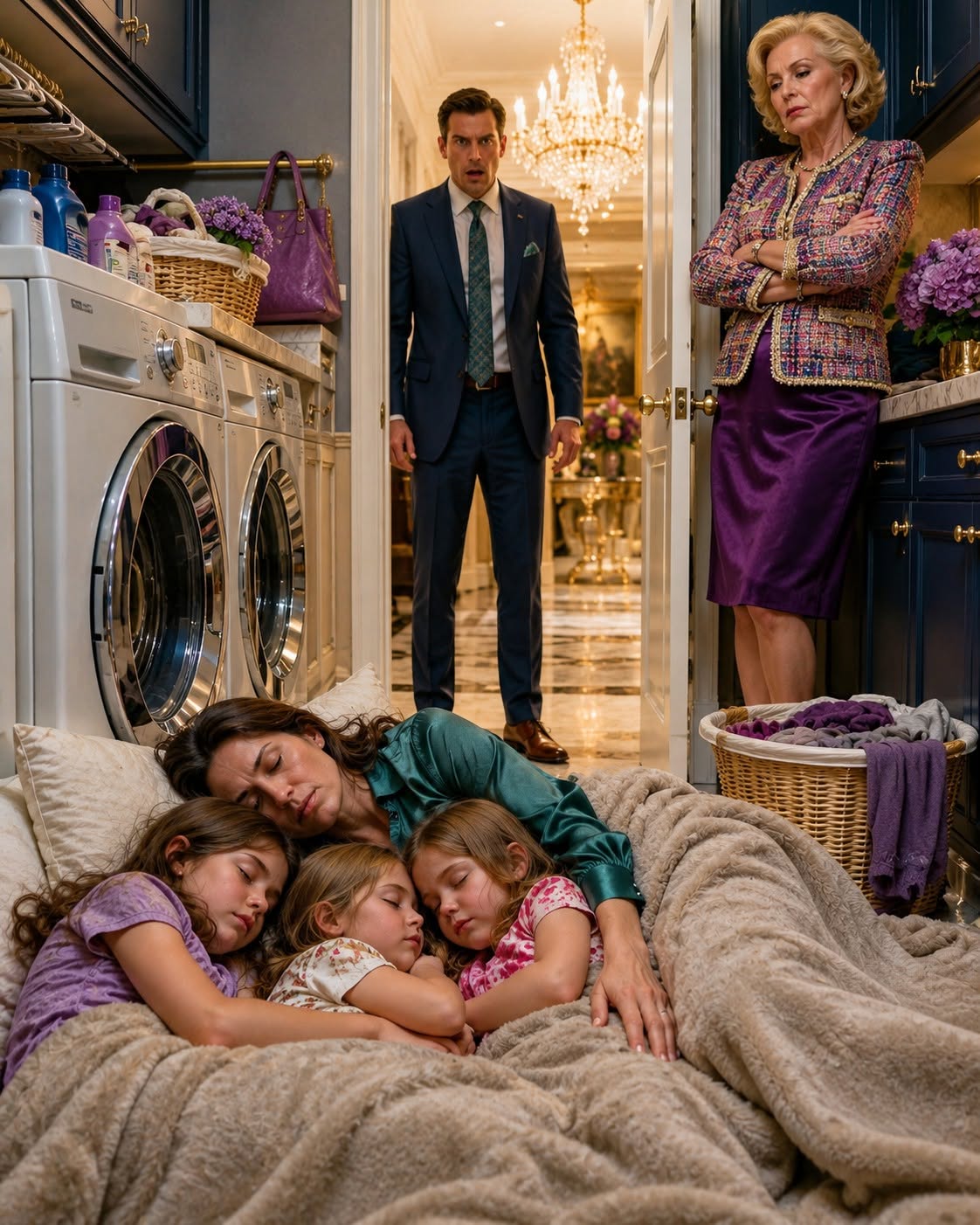
She legally seized our modest townhouse. She intercepted and drained Michael’s life insurance policy. She even confiscated the sapphire pendant my own mother had left me, claiming it as collateral. In exchange for my crushing debt, she graciously allowed my three daughters and me to sleep on thin mattresses in a windowless storage room wedged tightly beside the estate’s industrial laundry machines. The eternal smell of harsh bleach and damp lint was the perfume of our daily existence.
My girls were my only anchor to sanity. Olivia, quiet and watchful at eight years old; Grace, a timid six; and little Lily, who had just celebrated her fourth birthday in the shadow of a commercial dryer.
Margaret never dignified them by using their given names. To her, they were simply “the three disappointments.” She reminded me daily that I had failed Michael, failed the bloodline, and failed my duty by not producing a male heir.
That morning, my bones ached with exhaustion. I had been awake since half past four, orchestrating breakfast for a dozen caterers, polishing crystal goblets until my fingertips bled, vacuuming endless yards of Persian rugs, and arranging towering floral centerpieces. I was the invisible engine running a masquerade of philanthropy.
I touched my throbbing, split lip. I could taste the metallic tang of copper.
At the far end of the table, Richard Bennett calmly set his crystal water glass down. The soft clink sounded like a gavel dropping.
Richard was a ghost in high society. The billionaire founder of one of the nation’s most expansive private hospital networks, newspapers frequently painted him as a brilliant enigma—distant, fiercely intelligent, and emotionally impenetrable. Having lost his mother under tragic circumstances as a young boy, he had never married and treated social galas like a necessary plague. The Whitmore Foundation’s survival was practically tethered to his massive annual endowments.
“Is that what you classify as discipline, Margaret?” Richard’s voice was remarkably quiet, yet it carried a baritone weight that demanded total submission from the room.
Margaret’s face underwent a terrifyingly smooth transformation. The monster vanished, replaced by the poised socialite. She offered a practiced, synthetic smile.
“Oh, Richard. Emily is family,” she purred smoothly, waving a dismissive, manicured hand. “She simply requires firm boundaries. Grief has made her terribly manipulative. She frequently forgets her place.”
A cold fire suddenly ignited in my chest. I lowered the heavy silver tray to a side table. My hands were trembling, but my voice, when it came out, was steady.
“I am only considered family when there are four floors of baseboards that need scrubbing,” I said, the words echoing in the hushed room. “Otherwise, I am treated like an indentured servant who isn’t even granted a wage.”
Margaret’s eyes narrowed into dark, hateful slits. She lifted her hand, the heavy diamond on her ring finger catching the light, ready to strike me down for my insolence.
This time, she didn’t make contact.
A shadow fell over me. Richard had crossed the length of the dining room with predatory speed. He stepped smoothly between us, his broad shoulders forming an impenetrable wall between me and my tormentor.
“My funding ends today,” he stated.
A collective gasp rippled through the audience. Every head snapped toward him.
Margaret stared at him, her composure visibly fracturing. The polite veneer shattered. “You must be joking,” she stammered, her voice shrill. “You would torpedo years of vital charitable work—millions of dollars—over the delusions of one bitter, hysterical servant?”
Richard didn’t look at her. He looked down at me. His intense, dark eyes scanned the fresh blood on my lip, then drifted down to the faded, yellowish bruises peeking out from the rolled-up sleeves of my ill-fitting uniform. Something dangerous flared in his gaze before he turned back to Margaret.
“I am not destroying your charity, Margaret,” he said softly. “I am simply refusing to underwrite your hypocrisy any longer.”
Margaret’s face mottled with ugly, purple rage. She lost whatever restraint she had left. “Security!” she shrieked, pointing a trembling finger at me. “Remove this ungrateful wretch from my property immediately! Throw her in the street!”
A spike of pure adrenaline shot through my veins. My girls.
“My daughters are upstairs!” I cried out, lunging toward the grand staircase.
Margaret had ordered them locked in a secluded guest wing on the third floor. “Children ruin the aesthetic of elegant events,” she had sneered that morning.
Before the burly security guards could close the distance, Richard spoke again. His voice wasn’t loud, but it possessed a terrifying authority.
“Stand down,” he commanded the guards. Then, he looked at Margaret. “She is not leaving alone. She, and her three daughters, are leaving with me.”
The room plunged into absolute, frozen disbelief. Margaret actually let out a harsh, barking laugh, though her eyes were frantic.
“You are making a colossal mistake, Richard. You have no earthly idea what kind of parasite you are involving yourself with.”
“I know exactly what I am looking at,” Richard replied.
He didn’t wait for permission. He bypassed the guards and took the marble stairs two at a time. I scrambled blindly after him, my heart hammering against my ribs like a trapped bird.
When we reached the locked oak door of the guest wing, Richard didn’t bother asking for a key. He slammed his shoulder against the wood, splintering the frame, and pushed it open.
My girls were huddled together on a velvet sofa, their eyes wide with quiet terror. When they saw me, they rushed forward.
Minutes later, we were descending the grand staircase. Richard was carrying four-year-old Lily in his arms, her face buried in his neck. Olivia clutched his left hand as if it were a lifeline, while Grace clung desperately to my waist.
We burst through the heavy front doors. Outside, the sky had broken open. A torrential downpour was hammering the circular, gravel driveway, turning the manicured lawns into gray sludge.
Without a moment’s hesitation, Richard shrugged out of his bespoke suit jacket. He draped the expensive wool over my three girls, sheltering them from the biting rain, and ushered us into the back of his waiting black SUV. He didn’t cast a single glance back at the mansion.
Margaret had followed us to the portico. The rain plastered her hair to her face as she screamed into the storm.
“She’s a thief! She’s mentally unstable!” she shrieked, her voice cracking. “Those are my son’s children! You’ll regret this, Bennett! I’ll destroy you both!”
Richard ignored her. He opened the passenger door for me. As I slid into the leather seat, shaking from the cold and the shock, he leaned in.
“You’re safe now, Emily,” he whispered over the roar of the rain.
For the first time in six agonizing years, looking into the eyes of a virtual stranger, I almost believed it.
His sprawling, modern estate overlooking the rolling hills just outside Greenwich felt impossibly, terrifyingly quiet. There were no harsh commands. No slamming doors. Just the soft hum of central heating and the smell of cedar wood.
A housekeeper led the girls to a suite of rooms. They stood in the doorway, staring at thick, fluffy duvets and wide windows that overlooked a vibrant garden instead of a concrete loading dock.
Lily refused to relinquish Richard’s damp suit jacket. She crawled right into the center of a massive bed, wrapped herself tightly in the dark wool, and closed her eyes.
“It smells safe, Mommy,” she mumbled into the fabric.
I sat on the edge of the bed and wept until I was hollowed out. I truly believed the nightmare had finally broken.
I couldn’t have been more wrong.
That very same night, under the cover of darkness, Margaret Whitmore dialed the chief of police. She formally accused me of embezzling three million dollars from the Whitmore Foundation.
But she didn’t stop there. She filed an emergency petition with the state family court, demanding immediate, sole custody of my daughters. Her affidavit claimed I was a transient, unstable vagrant who had kidnapped her grandchildren and was using them to sexually manipulate one of Connecticut’s wealthiest bachelors.
As I watched my daughters sleep peacefully for the first time, a storm was gathering to tear them away from me forever.
Part 2: The Paper Prison
At exactly seven o’clock the next morning, the illusion of sanctuary shattered.
The jarring flash of red and blue lights painted the walls of my bedroom. I threw back the covers and rushed to the window. Two police cruisers and a satellite news van were idling ominously at the foot of Richard’s massive wrought-iron gates.
My stomach plummeted, a cold dread coiling tightly in my gut. My daughters had barely slept through the night. For the first time since their father died, they had known the luxury of warm blankets and silence. Now, the wolves were at the door.
I heard the heavy oak front door open downstairs. I crept to the landing. Richard, dressed in a crisp white shirt and slacks, was already speaking with a grim-faced detective on the marble portico.
“Mrs. Emily Carter?” the detective called out, spotting me on the stairs.
My knees threatened to give way. I gripped the mahogany banister until my knuckles turned white and descended slowly. “I’m Emily.”
“Ma’am, we’ve received a sworn complaint from Margaret Whitmore alleging grand theft, corporate embezzlement, and the unlawful removal of three minor children.”
“They are my daughters,” I choked out, my voice thick with panic. “I am their mother.”
“The complaint states you currently possess no permanent residence, hold no lawful employment, and have absolutely no financial means to shelter or feed them. Given the severity of the financial charges, Child Protective Services has been notified.”
Before I could spiral into a full panic attack, Richard stepped directly into my line of sight, blocking the detective.
“My legal team is arriving in three minutes,” Richard said, his voice a blade of cold steel. “Every word spoken in this house today will be recorded and heavily scrutinized by the best litigators in the state. Proceed carefully, Detective.”
Within forty-five minutes, Richard’s mahogany-lined library was transformed into a war room. Half a dozen men and women in sharp suits analyzed documents and barked into cell phones.
Because Margaret’s allegations lacked immediate physical proof, the police grudgingly refrained from placing me in handcuffs. However, a family court judge issued an emergency mandate: an immediate, invasive investigation into my fitness as a mother, while financial detectives ripped through my nonexistent history.
Margaret wasted absolutely no time weaponizing the media.
By noon, every local news channel and social media feed in New England was broadcasting high-definition footage of her standing on the steps of the Whitmore Foundation. She was dressed in funereal black, delicately dabbing at dry eyes with a lace handkerchief.
“I opened my home and my heart to my daughter-in-law after my beloved son’s tragic passing,” Margaret told a swarm of microphones, her voice trembling with manufactured grief. “I treated her like my own flesh. She repaid my boundless kindness by stealing millions intended for domestic abuse victims, and by seducing and manipulating Mr. Bennett to escape justice. My only desperate concern is shielding my innocent granddaughters from a dangerous, unstable woman.”
The internet is a cruel, hungry beast. Social media exploded with vitriol. To half the state, I was a master-manipulator, a gold-digger who had ensnared a billionaire. To the other half, I was an abusive, neglectful mother using her children as pawns.
By late afternoon, the nightmare breached our walls. Olivia, my observant eight-year-old, had wandered into the kitchen and glanced at an iPad left on the counter by a paralegal. She saw Margaret’s face.
She ran into the library and climbed directly into my lap, her small body trembling like a leaf. Her eyes were wide pools of terror.
“Mommy,” she whispered, burying her face in my neck. “Are we going back to the laundry room? Are we going back to the bleach smell?”
I wrapped my arms around her, pressing my face into her hair. Grace and Lily immediately rushed over, forming a tight, frightened knot of small bodies around me.
“Never,” I vowed fiercely, kissing the tops of their heads. “I promise you, we are never going back.”
I sounded like a warrior. Inside, I was bleeding out from sheer terror.
The rest of the day was an exercise in humiliation. A court-mandated social worker subjected my girls to grueling, isolated interviews, probing them for signs of my supposed neglect. Then, a female physician arrived. She asked me to undress in a guest bathroom and meticulously photographed every yellowish-purple bruise, every scrape, and every faded scar covering my ribs and arms. Each mark of Margaret’s “firm boundaries” was clinical documented and dated.
Late that evening, as the rain started to fall again, a quiet knock sounded at the estate’s heavily fortified service entrance.
Richard’s head of security escorted a frail, elderly woman into the kitchen. She was clutching a damp paper bag from a local bakery. It was Evelyn Brooks, the Whitmore family’s head housekeeper. She had served that miserable family for twenty-five years before quietly retiring last spring.
Evelyn didn’t offer a greeting. Her hands shook as she reached into the bakery bag, bypassed the loaf of sourdough, and pulled out a small, black USB flash drive.
“The Whitmore house has hidden security cameras in the hallways and the kitchen,” Evelyn whispered, her eyes darting toward the windows as if Margaret might materialize from the shadows. “Margaret ordered the security firm to wipe the servers completely yesterday morning.”
She swallowed hard, looking at me with immense sorrow. “But I knew her soul. Before I retired, I copied the encrypted recordings.”
Richard didn’t say a word. He took the drive, strode to his study, and plugged it into a massive monitor. We stood behind him in stunned, suffocating silence as the files populated.
Video after video painted a portrait of a private hell. There was Margaret, screaming in my face over a misplaced fork. There she was, violently slapping me across the jaw. In one horrific clip, she grabbed me by the hair and dragged me toward a bucket of dirty mop water, all while I was desperately trying to balance a feverish Lily on my hip.
Another file showed Margaret gleefully ripping open sealed, personal envelopes Michael had left in a safe for his daughters, before tossing them into a roaring fireplace. There was high-definition footage of her screaming at me to sign thick stacks of blank legal paper, threatening to throw the girls out into the snow if I refused.
But the final video was the smoking gun. Time-stamped at 2:00 AM, just weeks after Michael’s death, the camera captured the Whitmore Foundation’s sleazy chief accountant carrying three heavy bankers’ boxes of financial records out the back door and loading them into Margaret’s private car.
A wave of dizzying relief washed over me. We had it. We had the ultimate proof.
Or so I foolishly believed.
The next morning, Margaret’s high-priced legal defense team didn’t just dismiss the recordings as AI-generated fabrications; they executed a lethal counter-strike.
They submitted official, authenticated bank statements to the district attorney.
Next to the videos, Richard’s lawyers displayed the documents on a projector. Twelve consecutive wire transfers, totaling exactly three million dollars, bled from the Foundation’s accounts. Every single penny had been deposited into an offshore account registered squarely under my name.
I stared at the projector screen, the breath knocked completely out of my lungs.
“I… I don’t understand,” I stammered, my vision blurring. “I’ve never seen that bank name in my life. I haven’t had a bank account since Michael died.”
The lead defense attorney clicked a button. The next slide showed the account application. Attached was a pristine copy of my driver’s license. Below it, the signature.
It looked flawless. It was my handwriting, perfectly replicated.
“Someone used the blank papers she forced me to sign,” I whispered, the horrifying realization dawning on me. “Or they traced old tax documents.”
A forensic handwriting examination was immediately ordered by the court. But the legal process was agonizingly slow, and until the expert ruled, I was officially a prime suspect in a massive felony fraud.
The scandal ripped through Connecticut’s elite business community like a wildfire.
By Friday afternoon, three major pharmaceutical corporations threatened to immediately withdraw fifty million dollars in pledges from Richard’s hospital network if he didn’t publicly sever ties with me.
I was standing in the hallway when one of Richard’s oldest friends and business partners stormed into the study, his face red with fury.
“Are you out of your mind, Richard?!” the man bellowed, slamming a newspaper on the desk. “You have spent thirty years building an unimpeachable reputation! You’re risking the hospitals, the board, and your entire legacy for a stray woman you’ve known for three damn days!”
I held my breath, waiting for the inevitable. Waiting for Richard to realize the math didn’t favor me.
Richard didn’t even raise his voice. “If protecting an abused mother and her children costs me my reputation, Arthur, then my reputation was a fragile, worthless thing to begin with.”
“If those donors walk away, pediatric wards will close!” Arthur countered.
“If they walk away over this,” Richard replied, his tone icy, “then they were only ever investing in public appearances, not in human principles. Let them walk.”
That evening, after Arthur had stormed out, Richard found me in the library. He poured two glasses of sparkling water and sat across from me. The exhaustion in his eyes was profound.
“Margaret’s lawyers are petitioning the judge tomorrow morning,” he said softly. “They are going to argue that because you are unemployed and under criminal investigation, you provide no stable home. They will ask the state to place the girls in foster care while the fraud case proceeds.”
A primal noise escaped my throat. “I will fight them with my bare hands. I will take the girls and run.”
“You won’t have to run,” Richard said steadily. He leaned forward, resting his elbows on his knees. “I have another option. But you have to trust me.”
I looked at him, my eyes burning with unshed tears. “I trust you. What is it?”
“Civil marriage.”
The words hung in the air, heavy and surreal. I stared at him, certain I had misheard.
“Excuse me?”
“If we are legally married, tomorrow morning,” Richard explained, his logic sharp and clinical, “your daughters instantly acquire a permanent, fortified residence. They acquire premium health insurance, infinite financial protection, and a barrier of legal safeguards that Margaret cannot pierce. A judge will not remove children from this estate.”
My mind spun. “Richard, you barely know me.”
“I know exactly enough.”
“My past is toxic. My baggage will completely destroy your future.”
“My future,” Richard said, his voice softening into something incredibly vulnerable, “means absolutely nothing to me if I choose to ignore what is right in front of me.”
“But your name… your legacy…”
Richard smiled. It was a sad, knowing smile. “Emily, my name isn’t more valuable than watching three little girls sleep safely through the night for the first time in their lives.”
I couldn’t speak. A jagged fissure opened in my chest, spilling cold relief and overwhelming gratitude into my veins.
The ceremony was executed the very next afternoon inside the sunlit library.
There were no white dresses. No flowers. No celebratory champagne. It was a tactical maneuver. The only people present were a discreet local magistrate, Richard’s stone-faced attorneys, and Evelyn, who stood in the corner dabbing her eyes with a tissue.
I signed the official marriage certificate with hands that shook so violently I could barely form the letters. Richard signed his name with fluid confidence, then gave me a polite, solemn nod.
There were no hollow vows. There was no kiss. We were just two desperate people linking arms to forge a legal shield over three innocent children.
We had barely set the pens down when the shrill ring of Richard’s private cell phone shattered the quiet.
He answered it. I watched the color rapidly drain from his face, leaving him pale and rigid.
“Where?” he asked sharply. “Is he alive?”
He hung up the phone and looked at me, a muscle feathering in his jaw.
It was the local hospital. The state-appointed handwriting expert—the sole forensic examiner capable of proving my signature on the bank documents was a forgery—had been run off a treacherous mountain road by an unidentified semi-truck.
He was alive, currently in critical condition in the ICU.
But his briefcase, containing the certified, hard copy of his final report, had mysteriously vanished from the wreckage. Someone had reached the crash site before the paramedics. Margaret had beaten justice to the punch.
But as Richard’s phone pinged with a secure file transfer from the police detectives who had just recovered the expert’s crushed cell phone, a new reality emerged.
Inside the recovered phone was one final, unsent voice memo. Recorded mere minutes before the impact.
We were about to discover just how far Margaret Whitmore was willing to go.
Part 3: The Weight of the Crown
The forensic examiner’s shattered phone didn’t hold the written report that could instantly clear my name. But as Richard connected the audio file to the library’s speakers, the silence in the room became absolute.
He clicked play.
A strained, breathless voice filled the room, accompanied by the muffled sound of a car engine running hot.
“Mr. Bennett… I’m being followed. Black SUV, no plates. If anything happens to me… you need to know. The signatures on Emily Carter’s offshore bank applications are fraudulent. They were digitally traced from a 2018 tax return and printed using a high-resolution plotter. It’s a perfect mechanical copy… not humanly written by her.”
The sound of tires screeching violently echoed through the recording. The man gasped.
“You have to look at the bank manager. He facilitated the account bypassing standard KYC protocols. But the mastermind… look for Ernest Collins. The Whitmore Foundation’s chief accountant. He authorized every single wire transfer from the inside…”
A horrifying, concussive crash of metal violently tearing into metal violently ended the recording.
Then, static.
I clamped a hand over my mouth, suppressing a sob. Richard immediately transmitted the audio file to the Connecticut State Police, attaching it to Evelyn’s security footage, my exhaustive medical records detailing the physical abuse, and the blank documents Margaret had forced me to sign.
It was a mountain of circumstantial smoke, but the fire was still hidden. The evidence wasn’t robust enough to secure an immediate arrest warrant for a woman of Margaret’s immense social standing.
However, it was more than enough to paralyze family court. The judge halted the custody proceedings indefinitely, granting me physical and legal sanctuary with my daughters while the criminal fraud investigation expanded into an attempted murder probe.
We were safe, momentarily. Yet, true peace felt entirely alien to me.
For the first time in six years, I woke up in a sprawling suite that didn’t reek of industrial detergent. But trauma is a ghost that haunts the body long after the mind realizes it’s safe.
Every morning, driven by a deeply ingrained, anxious compulsion, I woke up at four o’clock. By the time the sun crested the hills, I was frantically cleaning.
One bleak Tuesday, Richard walked into the massive chef’s kitchen at five in the morning. He was dressed in sweatpants, rubbing his eyes, only to find me furiously scrubbing the grout of the tile floor with a toothbrush, tears streaming silently down my face.
He stopped in his tracks. He slowly approached, knelt beside me on the cold tile, and gently but firmly took the toothbrush from my cramping fingers.
“Emily,” he murmured, his voice incredibly soft. “You do not work here. You are not the help.”
“I have to earn my keep,” I whispered frantically, avoiding his gaze. “I don’t want to be a burden, Richard. If I’m a burden, you’ll send us away.”
He reached out, placing a warm hand under my chin, forcing me to meet his dark, empathetic eyes.
“A burden is something people merely tolerate,” he said, emphasizing every syllable. “You and your girls are my family. You belong here.”
His voice cracked imperceptibly on the word family.
Later that humid afternoon, as we sat on the veranda, Evelyn brought me a cup of tea and quietly revealed the missing puzzle piece of Richard Bennett’s soul.
Richard’s mother hadn’t just died tragically when he was ten. His father, a titan of Wall Street, had brutally abused her behind closed doors for years. The bruises were hidden beneath expensive silks. The screams were muffled by thick mansion walls. Everyone in their elite social circle knew. No one ever intervened, because the Bennett wealth bought a deafening, cowardly silence.
One horrific night, ten-year-old Richard had found his mother beaten unconscious on the floor of her bedroom. He had hidden beneath her bed, terrified and powerless, until the wail of police sirens finally pierced the night. She died in the ambulance.
“From that day forward,” Evelyn whispered, watching Richard play tag with Lily in the distant garden, “he made a blood vow to himself. If he ever possessed the power, and he ever witnessed another woman living in terror, he would burn his own world to the ground before he ever looked away.”
Suddenly, the universe snapped into perfect focus.
He hadn’t married me out of pity. He wasn’t rescuing a maid. He was retroactively trying to save his mother. He was honoring a sacred promise made by a terrified ten-year-old boy.
Under the umbrella of that profound, unspoken respect, my daughters slowly began to thaw.
Olivia stopped hoarding bread rolls in her pockets, finally believing that tomorrow’s breakfast was guaranteed. Grace, whose voice I hadn’t heard in months, began humming little melodies while she painted bright watercolors at the kitchen island.
Lily discovered the magnificent Steinway grand piano in the parlor. At first, she just banged her fists against the keys. Instead of scolding her, Richard would patiently sit beside her on the bench, his large hands guiding her tiny fingers, teaching her simple nursery rhymes one note at a time.
Though we were bound by a legal marriage certificate, we lived as deeply respectful roommates. He slept in the east wing; I slept in the west. He always knocked on my door and waited for an answer. He never once picked up or hugged the girls without asking their permission first. He consulted me on every decision involving them, from their diet to their tutoring.
That steady, quiet dignity acted as a balm, slowly healing psychological wounds I hadn’t even realized were still weeping.
Margaret, however, was a wounded animal, making her exceptionally dangerous.
Desperate to control the narrative, she leaked unauthorized, grainy photographs of our austere courthouse wedding to a vicious tabloid. The headline screamed: THE BILLIONAIRE AND THE MAID: HOW A GOLD DIGGER TRAPPED CONNECTICUT’S MOST ELIGIBLE BACHELOR.
The social fallout was brutal. News vans permanently camped at the end of the driveway. When I tried to take Olivia and Grace to their elite private school, affluent parents literally turned their backs on us in the parking lot. One mother, dripping in diamonds, loudly referred to them as “the thieving maid’s mutts.”
Richard immediately pulled them out of the school and hired a team of private educators, but the damage was done. The toxicity was bleeding into his empire.
His hospital foundation began hemorrhaging support. Major corporate sponsors, terrified of the PR nightmare, withdrew their multi-million dollar pledges. The board of directors convened an emergency session, demanding he divorce me to save the network.
Late one night, unable to sleep, I crept downstairs for water. I paused outside the heavy oak doors of his study. He had left them slightly ajar. I could hear a heated phone conversation on speakerphone.
“You must leave her, Richard,” the Foundation’s Chairman pleaded, his voice ringing with panic. “The fraud investigation is making us radioactive. Buy her a secluded house in Vermont. Set up a trust fund for the kids. Do whatever it takes, but legally sever this disastrous marriage before we lose the new pediatric wing!”
Richard’s response was a masterclass in controlled fury.
“I did not purchase a wife, David,” he said coldly. “I chose to extend my protection over my family.”
“You are going to lose everything you’ve spent your life building over pride!”
“If I lose it all,” Richard countered smoothly, “then I will finally have a clear picture of who truly believed in the work we do, and who was merely renting proximity to my wealth. I will not abandon her. Do not bring this up again.” The line clicked dead.
I stood in the dark hallway, my heart aching with a suffocating, unbearable guilt.
He was losing his life’s work. The hospitals that saved children were suffering because I was an anchor dragging him into the abyss. Margaret was winning.
That night, poisoned by the belief that love requires martyrdom, I made the most catastrophic mistake of my life.
I packed a single, small canvas duffel bag. I woke the girls at 3:00 AM, telling them we were going on a secret adventure. Moving like ghosts, we slipped out the back door and walked two miles in the dark to a deserted highway, where I hailed a passing taxi.
I took them to a heavily fortified, undisclosed women’s shelter run by Sister Julia in the inner city of Hartford, purposely leaving my cell phone behind so I couldn’t be tracked.
I left only a handwritten letter on the marble kitchen island.
Richard,
I love you too much to watch you become the architect of your own destruction because of me. The thousands of women and children who depend on your hospitals need you infinitely more than I do. You saved us. Now, I have to save you. Please, do not look for us. Let them think you cast me out. Save your legacy.
Emily.
I truly believed running away was the ultimate act of selfless love.
I was profoundly, devastatingly wrong.
Part 4: The Fireflies
Ten agonizing days into our exile at the shelter, the world collapsed.
Lily, whose energy had been waning all week, suddenly collapsed on the linoleum floor of the communal dining hall. Her lips turned a terrifying shade of blue, and she was gasping for air like a fish out of water. Her skin was burning with a dangerously high fever.
An ambulance rushed us to the nearest underfunded public hospital. In the chaotic emergency room, a grim-faced pediatric cardiologist delivered a death sentence.
Lily had an undiagnosed, congenital heart defect. The stress and the infection had triggered acute heart failure. She required immediate, highly specialized open-heart surgery to repair a failing valve.
I stood in the glaring fluorescent lights of the corridor, my pockets completely empty. I had no health insurance. I had no savings. The offshore account was frozen by the feds. I had absolutely no way to save my little girl’s life.
Sister Julia, ignoring my tearful protests, went to a payphone and dialed the only number that mattered.
Richard Bennett arrived exactly forty-one minutes later.
He burst through the sliding doors of the ER, his hair soaked from a sudden rainstorm, his tie discarded. He looked feral—like a man who hadn’t slept a single minute in ten days. The dark circles under his eyes were bruised with exhaustion and terror.
He didn’t yell at me. He didn’t demand to know why I had abandoned him.
He walked straight past me, into the pediatric ICU, and dropped to his knees beside Lily’s bed. He carefully took her tiny, frail hand in his large one, pressing it to his lips, his shoulders shaking silently.
Only then did he stand and turn to face me. The raw emotion in his eyes stripped me bare.
“Do not ever,” he whispered, his voice trembling with a ferocious intensity, “decide for me what I am willing to lose, Emily.”
“Richard, your foundation… the hospitals…” I sobbed, the guilt crushing me.
He crossed the room and gripped my shoulders, pulling me against his chest. “Without the four of you,” he breathed into my hair, “that massive mansion became a tomb again. You are my legacy. Not the buildings.”
Within an hour, Richard’s immense influence completely reorganized the hospital. He paid for every scan out of pocket. He activated a specialized children’s emergency medical fund that he himself had created years ago—but, true to his unshakeable ethics, he insisted Lily receive the exact same surgical protocols and waiting periods as any other critical patient. No bribery. No cutting lines. Only equal, exceptional care.
Word of his presence leaked. By the time the surgical team wheeled Lily into the OR, a ravenous pack of reporters had surrounded the hospital’s main entrance, eager for the next chapter of the “Billionaire and the Maid” saga.
Richard didn’t sneak out the back. He walked purposefully down the main corridor and stepped directly out into the blinding flash of cameras. I stood a few feet behind him, my heart in my throat.
“Mr. Bennett!” a reporter shouted over the din. “Is it true the woman who defrauded the Whitmore Foundation is hiding inside? Are you still legally married to a domestic servant?”
Richard stepped up to the cluster of microphones. The air seemed to crackle around him.
“Yes,” he stated, his voice booming over the courtyard, silencing the crowd instantly. “Emily Carter worked as unpaid domestic help for a family that treated her like livestock. Yes, she lives with me. And yes, I proudly married her.”
A stunned murmur rippled through the press corps.
“I did it,” Richard continued, his eyes burning into the camera lenses, “because I looked into a dining room and saw a remarkable woman being physically beaten, and three brilliant little girls being treated as though they mattered less simply because they were born female.”
The silence in the courtyard was absolute. You could hear the rain hitting the pavement.
“My own mother,” Richard said, his voice dropping an octave, raw and full of old ghosts, “died after years of hidden domestic abuse. She died because powerful, wealthy people chose to protect a family’s reputation instead of protecting a bleeding victim. I was ten years old when I found her.”
Several reporters actually lowered their cameras, captivated by the vulnerability of the untouchable billionaire.
“I swore on her grave that if I ever witnessed that brand of cruelty again, I would never walk away. I don’t care if it costs me every cent I possess. The scandal, ladies and gentlemen, is not that my foundation is helping abused women. The true scandal is a society that pretends this abuse doesn’t exist behind the walls of mansions.”
He turned, looked at me with a fierce, unwavering devotion, and walked back inside.
That impromptu speech didn’t just make the evening news; it shifted the tectonic plates of the entire country.
The clip went viral overnight. Millions of people watched it. By morning, thousands of women began sharing their own harrowing stories of financial and physical abuse under the hashtag #NeverWalkAway. An absolute tidal wave of grassroots donations crashed into domestic violence shelters nationwide. Corporate sponsors, realizing public sentiment had drastically violently pivoted, scrambled to publicly apologize and double their funding to Richard’s hospital network.
And then, the dam finally broke.
Watching Richard’s speech on a television in a dive bar, Ernest Collins—the cowardly chief accountant of the Whitmore Foundation—realized the tide had turned. He knew Margaret was planning to entirely frame him for the forged documents if the heat got too close.
He decided to save his own skin.
At 8:00 AM, Collins walked into the District Attorney’s office with a high-powered defense lawyer and cut a plea deal.
He surrendered the encrypted hard drives containing the real financial ledgers. He handed over internal emails tracing the digital forgery of my signature. But his crown jewel was a secret, hidden audio recording he had captured inside Margaret’s private office.
On the tape, Margaret’s voice was crystal clear, venomous, and arrogant.
“Open the offshore account in Emily’s name, Ernest. Move the three million. When the auditors come, we feed her to the wolves. That pathetic girl has no resources. She can’t fight us. Oh, and ensure Michael’s life insurance payout is routed to my personal creditor. The girls don’t need it. If Emily ever opens her mouth about the bruises, I’ll simply have the court take the girls away. No judge in this state will ever believe a maid over me.”
The house of cards spectacularly collapsed.
Within hours, a judge signed a stack of high-level arrest warrants for Margaret Whitmore. The charges were staggering: grand larceny, identity theft, domestic battery, filing false police reports, and massive financial conspiracy. Furthermore, the State Police officially upgraded the handwriting expert’s crash to attempted murder, tying the truck driver to a shell company owned by one of Margaret’s oldest country club associates.
At noon, right as the surgeon stepped out of the OR to tell us Lily’s heart repair was a complete success, police intercepted Margaret at John F. Kennedy International Airport. She was carrying a forged passport and a suitcase full of bearer bonds, attempting to board a private jet to a non-extradition country.
I didn’t cheer when I saw her perp walk on the hospital waiting room TV. I didn’t feel triumphant. I just slumped into a plastic chair, too emotionally depleted to feel anything but overwhelming relief.
My legs gave out completely. Richard caught me before I hit the linoleum. He pulled me into his arms, burying his face in my neck. Olivia and Grace ran over, wrapping their little arms around our waists.
Standing there in the harsh hospital light, smelling of sterile alcohol and fear, we finally, truly looked like a family.
The subsequent criminal trial was a media circus that lasted eight grueling months.
Forensic experts conclusively dismantled the forged signatures. Financial investigators successfully traced years of charitable donations Margaret had illegally diverted to maintain her lavish lifestyle. A parade of former maids, gardeners, and even Evelyn took the stand, testifying to the reign of terror inside the Whitmore mansion.
Justice was thorough. The court ordered Michael’s stolen life insurance restored and placed into a secure trust for Olivia, Grace, and Lily. The fraudulent transfer of our townhouse was reversed, returning the property to me.
Margaret Whitmore was convicted on all fourteen felony counts. The judge, citing her complete lack of remorse and the predatory nature of her crimes, sentenced her to twenty years in a federal penitentiary.
She never once apologized.
As the bailiffs led her away in handcuffs, stripped of her silks and wearing a standard orange jumpsuit, she stopped at the aisle, locked her cold eyes on me, and sneered.
“You destroyed an empire. You destroyed this family.”
I stood up, holding Richard’s hand, and met her gaze with absolute, unshakeable calm.
“No, Margaret,” I replied, my voice steady and clear. “You confused a family with a collection of possessions. My daughters were not born into this world just to preserve your empty last name.” I squeezed Richard’s hand. “They were born to live completely free from it.”
When the trial concluded and the dust finally settled, Richard and I returned to the quiet sanctuary of the estate.
That evening, I walked into the dining room and stopped. Lying in the absolute center of the long mahogany table was a thick manila envelope. Inside were our finalized divorce papers.
Richard was standing by the window, looking out at the gardens. He didn’t turn around.
“They’re already signed by my lawyers,” he said quietly, his voice devoid of emotion, though his shoulders were incredibly tense. “You have your house back. You have the trust fund. Your name is cleared. You are completely safe now, Emily. You don’t owe me a single thing. You are free to go.”
I stood there, looking at the broad back of the man who had willingly sacrificed his billionaire donors, his social standing, and countless sleepless nights just to stand between my children and a monster. A man who had possessed all the power in the world, yet had never once made me feel small.
I picked up the thick stack of divorce papers.
Without saying a word, I gripped the pages and tore them violently in half. The sound of ripping paper was loud in the quiet room. I tossed the pieces into the fireplace.
Richard turned around, his eyes wide with shock.
I walked slowly across the room until I was standing inches from him. I reached up and gently rested my hand against his cheek.
“The first time I married you, Richard Bennett,” I whispered, tears finally spilling over my lashes, “it was a transaction. It was a shield to protect my daughters.”
I leaned in, resting my forehead against his.
“But this time… I am asking to stay. Because I am utterly, irrevocably in love with you.”
A single, rogue tear broke free and rolled down Richard’s cheek. He wrapped his arms around me, pulling me flush against his chest, and for the first time in our strange, chaotic relationship, he kissed me. It wasn’t a desperate kiss; it was a promise.
Months later, we held a second wedding.
There were no media, no board members, no sprawling ballrooms. We stood on a quiet, sunlit dock beside the water in Mystic, Connecticut.
Olivia, beaming with pride, carried our rings. Grace sang a soft, beautiful melody as I walked down the short wooden aisle. Lily, completely recovered and full of endless energy, aggressively scattered white flower petals everywhere. Evelyn sat in the front row, sobbing happily into a handkerchief, while Sister Julia delivered a simple, profound blessing over our lives.
Using the recovered life insurance money and the sale of the townhouse, I founded a new nonprofit organization. I purchased a sprawling, secure property and transformed it into a sanctuary providing emergency housing, elite legal representation, and financial independence counseling for domestic workers and mothers escaping abuse.
Richard aggressively funded the medical and legal clinics attached to it, but he adamantly insisted the main building bear my name.
I refused. Instead, I named it Three Fireflies House.
I named it after my daughters. Because I had learned that even during the most suffocating, pitch-black nights, they had never once stopped shining.
Our grand estate slowly transformed from a quiet museum into a chaotic, vibrant home. Bright crayon masterpieces covered the stainless steel refrigerator. Tiny, mismatched shoes were permanently gathered in a pile by the grand front doors. Laughter and music constantly echoed through the long hallways.
Lily eventually learned to perfectly play the lullaby I had once hummed to her while crying beside a commercial washing machine. One summer evening, I leaned against the doorframe of the parlor, watching Richard sit beside her on the piano bench, his large hands guiding her small ones over the ivory keys.
Watching them, a profound realization washed over me.
For years, Margaret had beaten into me the belief that true strength meant suffering in silence. Later, driven by trauma, I believed that love meant martyring yourself and walking away before you ruined someone else’s pristine life.
Both beliefs were lies.
True strength sometimes means having the incredible courage to fall to your knees and ask for help. And real, enduring love doesn’t ever ask someone to disappear into the shadows. It asks them to stay, in the light, and continually choose each other, day after day.
Later that night, as the warm summer air drifted across the backyard, I sat on the veranda with Richard. We watched our three daughters enthusiastically chasing fireflies across the manicured lawn, their jars glowing with captured light.
I rested my head on his shoulder and intertwined my fingers with his.
“Do you ever regret it?” I asked softly. “Those words you said in the dining room that day. You and your daughters are leaving with me. You lost millions of dollars and a piece of your empire because of that one, split-second decision.”
Richard smiled, his eyes tracking Lily as she ran, shrieking with joy, across the grass.
“I didn’t lose millions, Emily,” he murmured, turning to kiss the top of my head. “I simply lost the dead weight of people who only valued me for my bank account.”
He squeezed my hand tight.
“And in return, I found the only thing I never knew my soul was starving for.”
Margaret Whitmore spent years trying to convince me that my three little girls were inherently worthless, simply because they weren’t born male.
Today, those exact same three girls are the vibrant inspiration for hundreds of broken women who walk through the heavy, safe doors of Three Fireflies House, looking for sanctuary, justice, and a second chance at life.
Society once called me a maid. The tabloids called me a thief and a gold digger.
But today, my daughters call me Mom.
And the untouchable billionaire who once swore he would die alone?
He just calls me home.