- How much did you think you were going to make by doing favors for a lonely old woman?”
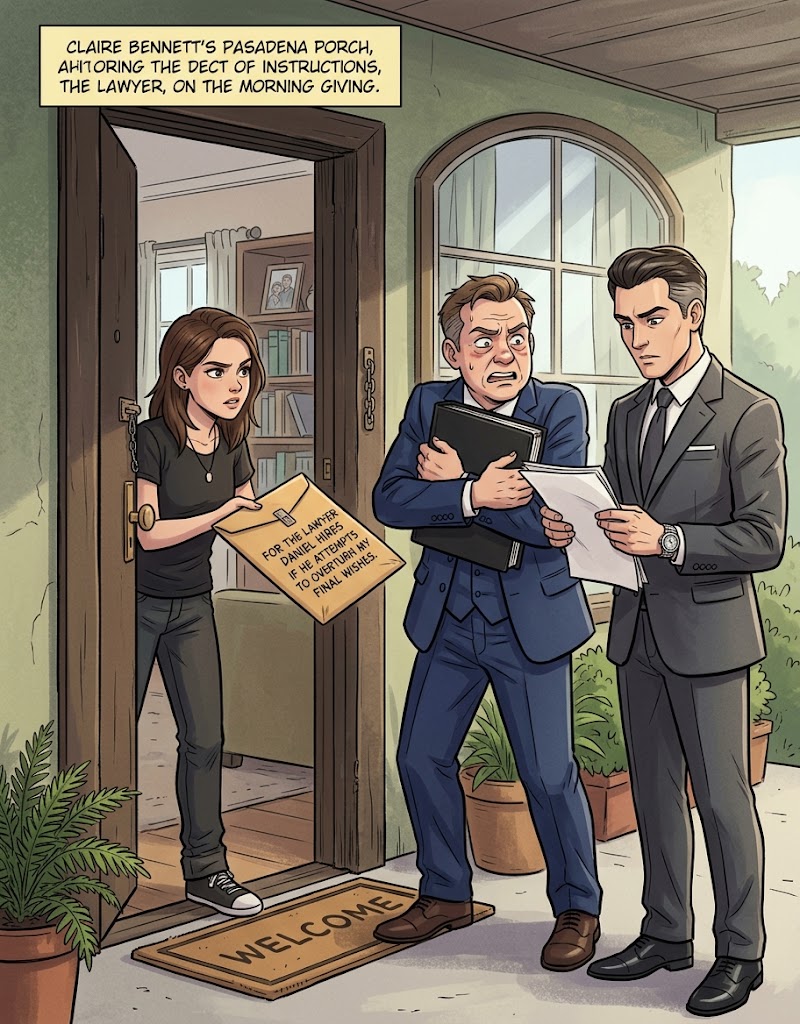
- Those were the first words Daniel Parker said to me the morning after his mother’s funeral, standing outside my front door in Pasadena with an attorney beside him and a black folder pressed tightly against his chest.
- He didn’t say good morning.
- He didn’t ask how I was holding up.
- He didn’t mention that Margaret had died barely 24 hours earlier, or that the same black dress I had worn to the funeral was still hanging over the back of a chair because I hadn’t found the strength to put it away.
- He simply arrived with that accusation, sharp as a kitchen blade.
- I opened the door but left the security chain fastened.
- Daniel was 52, dressed in a navy suit that looked far too expensive for an ordinary morning on our quiet street. His eyes were swollen, though I couldn’t tell whether he had been crying or whether anger had kept him awake. The attorney beside him looked as though he had just walked out of some polished downtown Los Angeles office: spotless shoes, silver watch, measured expression.
- “Mrs. Claire Bennett,” the attorney said. “My name is Michael Grant. I’m Daniel’s attorney. We need to ask you a few questions concerning Mrs. Margaret Parker.”
- “You can ask them from where you’re standing,” I replied.
- Daniel gave a dry little laugh.
- “Of course. Always careful, aren’t you? Always so discreet.”
- I glanced toward the house next door.
- Margaret’s bougainvillea still spilled over the old iron gate. The curtains in the living room were drawn. For the first time in years, the porch light had remained dark after sunset.
- Margaret was 84 when she died. She had lived in that house since 1974, back when that part of Pasadena smelled more like wet soil and orange blossoms than expensive coffee shops. Her husband died in 2012, and afterward the garden slowly became its own little wilderness: crooked rosebushes, cracked clay pots, and an old metal chair that always looked as though it were waiting for someone to sit down.
- I met her almost by accident.
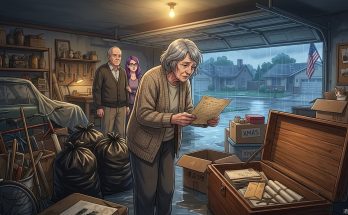
- One Tuesday in April 2019, I noticed an orange water shutoff notice taped to her front door. It said that unless the bill was paid by Friday, the water would be disconnected.
- The overdue amount was $540.
- I stood there staring at that piece of paper as if someone had posted her humiliation for the whole neighborhood to see.
- Margaret stepped outside at that exact moment, carrying a grocery bag in one hand. She walked slowly, but she still moved with the dignity of a woman who had survived too much in life to bow her head for anybody.
- Before she noticed the notice, I tore it down and slipped it into my purse.
- That same afternoon, I called Pasadena Water and Power, asked how I could pay someone else’s account as a third party, and settled the balance. The next month, I did the same thing.
- And the month after that.
- For 6 years, I paid Margaret’s water bill.
- I never told her.
- It wasn’t charity. At least, it never felt that way to me. I was simply making sure that a woman who took cold showers to save on her gas bill would never have to ask anyone’s permission to remain independent.
- Margaret would never have accepted cash from my hand.
- If she had known, she would have felt smaller every time we crossed paths on the sidewalk.
- I didn’t want that.
- I wanted her to keep stepping outside in the afternoons wearing her gray shawl. I wanted her to keep complaining to the man at the neighborhood food cart because he had started getting stingy with the sauce. I wanted her to continue living in her own home as Margaret Parker, not as “that lonely old lady at the end of the block.”
- Daniel lifted a yellowed sheet of paper.
- “I found this in my mother’s drawer.”
- It was an old water bill.
- Across the top, written in Margaret’s shaky but unmistakably clear handwriting, was my name:
- Claire has been paying this since 2019. She’ll insist she never did anything important. Don’t embarrass her.
- My throat tightened.
- Until that moment, I had believed my secret had died with Margaret.
- “I found something else,” Daniel continued. “Three days before the funeral, her estate attorney sent me a copy of her updated will.”
- “I didn’t know she had changed her will.”
- “Don’t insult my intelligence,” he snapped. “My mother wouldn’t even switch coffee brands without thinking about it for 3 weeks.”
- Michael opened the folder.
- “We’re trying to determine whether there may have been undue influence over a vulnerable elderly person.”
- “I paid her water bill.”
- “You made her dependent on you,” Daniel said. “You worked your way in little by little. One bill here. One visit there. A bowl of soup when she was sick. So what did you ask for in the end?”
- I stared at him without answering.
- I had spent years listening to Margaret defend that man.
- “Daniel works so hard.”
- “Daniel lives far away.”
- “Daniel doesn’t call because he has too much going on.”
- There was always an explanation for his absence.
- Mothers have a terrible gift for wrapping abandonment in beautiful paper.
- “When was the last time you spoke to her?” I asked.
- Daniel blinked.
- “That has nothing to do with this.”
- “September 11. You called at 8:04 that evening and hung up at 8:09. I was standing in her kitchen replacing the refrigerator light bulb.”
- His jaw tightened.
- “I was busy.”
- “In February, she fell in the bathroom. She was on the floor for 47 minutes before I heard her banging against the wall.”
- Michael looked up.
- Daniel’s face lost a little color.
- “Why didn’t anyone call me?”
- “Because she asked me not to.”
- “She was my mother.”
- “Then you should have known she was terrified of hospitals ever since your father died in one.”
- Daniel looked down for a moment.
- Then the anger came rushing back.
- Sometimes guilt, when it has nowhere to escape, puts on the face of rage.
- “You don’t have the right to judge me.”
- “I’m not judging you. I’m answering your questions.”
- Michael cleared his throat.
- “Mrs. Bennett, we need to establish whether you received anything in exchange for paying those bills.”
- “Then you need to hear the whole story.”
- I stepped back inside and went straight to the dresser in my bedroom.
- Inside the bottom drawer was the manila envelope Margaret had handed me the previous October.
- She had come into my kitchen one afternoon carrying cinnamon rolls and wearing an expression that was strangely peaceful.
- “Don’t open this, Claire,” she had told me. “Just give it to whatever lawyer my son brings here when he decides I’m no longer capable of defending myself.”
- I hadn’t asked any questions.
- Maybe I should have.
- I returned to the porch and handed the envelope to Michael.
- Across the front, Margaret had written:
- For the attorney Daniel hires if he tries to undo my decisions.
- Daniel stared at me as though he had just uncovered some enormous betrayal.
- “So you did plan this together.”
- “No,” I said. “She planned it. I only kept the envelope.”
- Michael broke the seal.
- He read the first page.
- Then he went back to the top and read it again.
- His expression changed so abruptly that Daniel seemed to stop breathing.
- “Daniel,” Michael said, his voice suddenly much quieter, “I need to ask you something before we go any further.”
- Daniel frowned.
- “What?”
- Michael looked up from the document.
- “Why did you continue transferring money from your mother’s accounts after she revoked your financial power of attorney?”
- And just like that, the anger disappeared from Daniel’s face as though someone had turned off a switch.
- The silence on my porch became heavier than the May heat.
- Daniel opened his mouth.
- Nothing came out.
- Michael held the document where he could see it.
- “This states that your mother granted you temporary financial power of attorney in 2020 following hip surgery. It also states that she revoked it in August 2021 after discovering unauthorized transfers.”
- “My mother was already getting confused by then,” Daniel said.
- “No,” I said before I could stop myself. “Margaret got confused by her television remote. She did not get confused about her money.”
- Daniel shot me a look filled with venom.
- “You weren’t family.”
- “No. Which meant I could listen to her without expecting anything in return.”
- Michael continued sorting through the papers.
- He pulled out bank statements marked in red ink, copies of transfers, and a page bearing the letterhead of a company called Parker North Development.
- “The transfers total $386,000,” he said. “Every one of them went to an account connected to your company.”
- Daniel’s jaw tightened.
- “They were loans.”
- “Where are the loan agreements?”
- “She was my mother.”
- “That isn’t a legal answer.”
- “She knew my company was struggling.”
- “Did you ask her permission before transferring the money?”
- Daniel looked toward the street.
- A woman carrying two grocery bags was walking along the sidewalk.
- A dog barked behind a wooden fence.
- The entire neighborhood continued as usual, as though an invisible grave weren’t being opened directly in front of my house.
- “I was going to pay it back,” Daniel finally said.
- “Did you?” Michael asked.
- Daniel said nothing.
- I remembered Margaret sitting at my kitchen table months earlier, both hands wrapped around a cup of tea.
- “My son thinks I don’t understand things anymore,” she had told me.
- “Understand what?”
- “That a house isn’t only property. That a bank account isn’t only a balance. That a mother isn’t a safe full of old family photographs.”
- That was the afternoon she told me about the money.
- She asked me not to report him.
- I argued with her.
- I became angry.
- She only looked at me with the exhausted sadness mothers sometimes carry when they love someone who is slowly breaking them.
- “He’s my son, Claire.”
- “That doesn’t give him the right.”
- “No. But I don’t want to spend the last years of my life hating him.”
- And now Daniel was standing outside my door, trying to turn a $540 water bill into some elaborate conspiracy while his mother’s documents exposed something much uglier.
- Michael pulled out another page.
- “There’s also a medical evaluation from 2023. It confirms that Mrs. Parker had full mental capacity to make legal and financial decisions.”
- “She did all this?” Daniel whispered.
- “Yes,” Michael said.
- “How long had she known?”
- “Since 2021.”
- Daniel’s face collapsed.
- He didn’t look like some villain from a television drama.
- That would have been easier.
- He looked like a son who had arrived ready to defend himself against the wrong accusation and had suddenly discovered the real one.
- Michael handed him a folded letter.
- “This is for you.”
- Daniel took it with rigid hands.
- He recognized his mother’s handwriting immediately.
- He began reading silently.
- Halfway through, his breathing faltered.
- Michael lowered his gaze.
- I stayed perfectly still because I knew that letter wasn’t mine to witness.
- Then Daniel read one sentence aloud.
- “I didn’t change my will because I stopped loving you. I changed it because loving a son doesn’t mean allowing him to treat me like something he owns.”
- He covered his mouth with one hand.
- For the first time since arriving at my house, he no longer looked angry.
- He looked small.
- “I loved her,” he said.
- “I know.”
- And I meant it.
- Margaret knew it too.
- That was what made everything so painful.
- Some people love you and still hurt you.
- They love you, but they don’t visit.
- They love you, but they control you.
- They love you, but they keep postponing an apology until death finally shuts the door in their face.
- “My mother talked about you constantly,” Daniel said, glancing at my windows, my front gate, the inexpensive floor inside my entryway. “It was always, ‘Claire stopped by.’ ‘Claire brought me bread.’ ‘Claire fixed the faucet.’”
- He swallowed hard.
- “I thought you were trying to replace me.”
- “No one can replace a child.”
- “Then why did she leave you something?”
- I didn’t answer.
- Because I didn’t know what Margaret had changed in her will either.
- I didn’t know whether she had left me a letter.
- A plant.
- A coffee cup.
- Maybe one of her recipes.
- Michael carefully returned the documents to the folder.
- “Daniel, after seeing this, I would strongly advise against contesting the will. If you do, these records will become part of the court proceedings.”
- “Are you threatening me?”
- “I’m explaining your legal exposure.”
- Daniel turned toward his mother’s house.
- The old blue front door remained closed.
- “What did she leave Claire?”
- Michael didn’t respond.
- “Tell me,” Daniel demanded.
- “That information needs to come from the attorney handling the estate.”
- But the answer was already approaching us.
- A gray sedan pulled up along the curb.
- Rebecca Collins, Margaret’s estate attorney, stepped out holding a brown folder.
- She looked at me first.
- Then at Daniel.
- “Good,” she said. “You’re both here. Margaret left one final instruction that must be read with both of you present.”
- Daniel stepped toward her.
- “What did my mother do?”
- Rebecca opened the folder and removed a key with a small handwritten tag tied around it.
- It didn’t say house.
- It didn’t say inheritance.
- Rebecca simply read Margaret’s words aloud.
- “Give the key to Claire. She’ll know what to do with the porch light.”
- And that was when I understood that the real shock hadn’t even arrived yet.
- Rebecca didn’t read the full will on the sidewalk.
- She said the street wasn’t the right place, there were too many neighbors within earshot, and Margaret had left very specific instructions.
- Daniel suggested we go inside his mother’s house.
- I wanted to refuse.
- Not because I was frightened.
- Because walking into that house without Margaret felt like admitting I would never again see her appear in her gray shawl and house slippers, saying the same thing she always said:
- “I’m only staying for 5 minutes.”
- Margaret’s 5 minutes always became an hour.
- Rebecca unlocked the blue door.
- The house smelled like lavender, old wood, and coffee grounds.
- Margaret’s beige sweater was still draped over the armchair, the one she wore while insisting she wasn’t cold even when her hands were trembling.
- Her glasses rested beside an unfinished crossword puzzle.
- In the kitchen, a clean mug sat upside down in the drying rack.
- Daniel stepped inside like a man entering a church.
- I remained near the doorway.
- Rebecca set the brown folder on the dining room table and removed a document.
- “Margaret Parker amended her will 11 months ago. She signed the changes in my office in the presence of two independent witnesses, after completing a medical evaluation. There is no evidence whatsoever that anyone pressured her.”
- Daniel didn’t speak.
- “She left her son, Daniel Parker, a personal letter, several family possessions, and the right to collect all family photographs, documents, and keepsakes.”
- Daniel closed his eyes.
- He was waiting for the blow.
- Rebecca continued.
- “The house has been left to Claire Bennett.”
- For a moment, I felt as though the floor had moved beneath me.
- “No,” I said immediately.
- Rebecca looked at me.
- “That is what the will states.”
- “I can’t accept someone’s house.”
- Daniel gave a broken laugh.
- “Of course you can. That’s what those 6 years of water bills were for, right?”
- The words still hurt.
- But they had lost their power.
- They sounded like the wild swing of someone already sinking underwater.
- Rebecca removed another envelope.
- “Margaret anticipated both of your reactions.”
- She handed it to me.
- There was only one word written on the front.
- Claire.
- I didn’t want to open it.
- I truly didn’t.
- Some part of me believed that if I saw Margaret’s handwriting again, her death would become permanent in a way it hadn’t yet.
- But I opened it.
- Dear Claire,
- I’m sure you still think I never discovered what you were doing with the water bills.
- I found out during the second winter.
- I called the utility company to ask why my account kept showing as paid. They wouldn’t tell me who had paid it, but they didn’t need to.
- There was only one person on this street stubborn enough to help me and kind enough to make sure I never felt obligated to thank her.
- I never told you because I knew you would stop.
- People like to think kindness always arrives with flowers, speeches, or heroic sacrifices.
- That isn’t true.
- Most kindness arrives quietly.
- It arrives when someone notices you haven’t opened your curtains.
- It arrives when someone knocks on your door without making you feel helpless.
- It arrives when someone quietly pays $540 so an old woman can wash her face without feeling like she needs someone else’s permission to exist.
- You allowed me to remain Margaret.
- I wasn’t your project.
- I wasn’t some poor helpless old woman.
- I wasn’t a burden you carried around while looking noble for everyone else.
- I was your neighbor.
- And that saved me in more ways than you will ever understand.
- I am leaving you my house, not as a reward, but as a responsibility.
- Do not give it to Daniel.
- I am not doing this to punish him.
- I am doing it because I need him to understand that family is not proven by waiting for an inheritance.
- Family is proven by being there long before there is anything left to divide.
- I am also leaving a restricted fund of $1,250,000 for repairs, property taxes, insurance, accessibility improvements, and maintenance during the first few years.
- If you accept this responsibility, turn this house into a place where invisible people can be seen again.
- Let older people drink coffee without having to admit they are lonely.
- Let children sit here and read after school.
- Let a tired woman rest for 20 minutes without anyone asking why she can’t keep going.
- Open the curtains.
- Turn on the porch light.
- And please don’t let my roses die.
- With love,
- Margaret.
- By the time I finished reading, the words had blurred through my tears.
- I sat down in one of the kitchen chairs and cried harder than I had cried at the funeral.
- Daniel remained silent for a long time.
- Then he picked up the letter his mother had written for him.
- He read it standing beside the refrigerator, in the exact spot where Margaret had covered the door with souvenir magnets from places she had never actually visited.
- His face slowly came apart, line by line.
- “She knew everything,” he whispered.
- “Yes,” Rebecca said.
- “And she still wrote me a letter.”
- “She was your mother.”
- Daniel placed one hand on the table.
- “I checked the value of this house every 3 months. I knew exactly what homes sold for per square foot around here. I knew how much a developer would pay to tear this place down and build luxury units.”
- His eyes were red when he looked at me.
- “But I didn’t know thunderstorms scared her.”
- Nobody answered.
- Because there was no answer capable of cleaning something like that.
- Rebecca explained what would happen next.
- If Daniel contested the will, Margaret’s bank statements, the revocation of his financial authority, the medical evaluation, and her written statement would all become part of the court record.
- If he chose not to challenge it, he could sign an agreement requiring him to return the money he had taken and place it into the house’s maintenance fund.
- Daniel sat down.
- For the first time since he had appeared on my doorstep, he seemed to actually be listening.
- “I’m not going to fight for the house,” he finally said.
- Then he took a breath.
- “And I’ll give the money back.”
- I didn’t believe him immediately.
- Fresh guilt can make impressive promises.
- But 3 weeks later, Daniel signed the agreement.
- He sold his truck, closed an office he could no longer afford to keep running, and repaid the entire $386,000 in 4 separate payments.
- It wasn’t heroic.
- It was late.
- But it was real.
- I didn’t accept Margaret’s house immediately either.
- For days, I walked past that blue gate without going inside.
- Holding the keys felt wrong.
- It felt as though I had somehow been handed ownership of someone else’s life.
- Then one afternoon, I found Mrs. Linda from down the block sitting on the curb with a pharmacy bag in her lap.
- She told me she was waiting for her son.
- “He’s almost here,” she said.
- An hour later, she was still sitting there.
- So I invited her into Margaret’s house.
- I made coffee.
- Linda sat beside the window and released a long breath, as though she had been holding it inside for years.
- That was the moment I understood.
- Margaret hadn’t left me the house so I could possess it.
- She had left it to me so I could open it.
- During the next 8 months, we transformed the house into something new without erasing what Margaret had left behind.
- We repaired the roof.
- We reinforced the porch railing.
- We replaced the old electrical system.
- We installed ramps.
- We painted the walls a soft cream.
- And we rescued Margaret’s roses with help from a neighbor who insisted he knew absolutely nothing about gardening but somehow spoke to the flowers every single morning.
- Daniel came every Sunday.
- At first, he arrived looking uncomfortable, carrying brand-new tools he barely knew how to use.
- He broke a hinge.
- He spilled paint.
- He ruined two coffee makers.
- But he kept coming back.
- One afternoon, I found him standing on the porch cleaning the old lamp.
- “My mother used to tell me that this light should never be allowed to go out,” he said. “I thought she was being dramatic.”
- “She wasn’t.”
- “I know.”
- We hung a wooden sign beside the entrance.
- MARGARET’S PORCH
- Fourteen people showed up on opening day.
- A widower who hadn’t shared coffee with another person since burying his wife.
- Two little girls who needed somewhere quiet to finish their homework.
- A retired nurse who offered to check blood pressure for free every Tuesday.
- A high school boy who asked whether he could study there because his parents were always arguing at home.
- Mrs. Linda brought cinnamon rolls.
- Mr. Frank carried in folding chairs.
- Daniel made coffee strong enough to wake the dead, and nobody complained.
- Every morning, the curtains were opened.
- Every evening, the porch light came on.
- One year after Margaret’s funeral, a woman arrived carrying an old photograph.
- Her name was Rachel Moore.
- She was around 50 and held a folder filled with old letters.
- In the photograph, Margaret was much younger, maybe 45, with her arms around a little girl wearing a red sweater.
- “That girl is me,” Rachel said. “Margaret was my legal guardian for 7 years.”
- Daniel froze.
- “My mother raised you?”
- Rachel nodded.
- The story came out slowly, like an old wound afraid of being opened.
- When Daniel was 22 and working in Seattle with his father, Margaret and her husband separated for several years.
- During that time, one of Margaret’s former students entered addiction treatment and asked Margaret to care for her young daughter.
- Margaret agreed.
- Rachel lived in that house from the age of 7 until she turned 14.
- Then an aunt obtained custody and moved Rachel to Portland.
- Rachel wrote to Margaret for months.
- Margaret wrote back.
- But after Margaret’s husband returned home, he hid the letters from both of them.
- He also hid several letters Margaret had written to Daniel.
- Rachel believed Margaret had stopped caring about her.
- Margaret believed Rachel wanted to leave that chapter of her life behind.
- Years later, after Margaret became a widow, she discovered all of those letters inside a box hidden in the back of a closet.
- Finding Rachel took years because Rachel’s last name had changed.
- They finally reunited in 2022.
- From that point forward, they spoke every Sunday.
- “Why weren’t you at the funeral?” Daniel asked, his voice breaking.
- “I was at the cemetery,” Rachel said. “But I saw the argument about the inheritance from a distance. I didn’t want what happened between Margaret and me to become one more weapon people could use against each other.”
- Rachel placed the bundle of letters on the table.
- Daniel opened the first one.
- Dear Daniel,
- There is a little girl staying with me.
- Her name is Rachel.
- She is 7 years old, hates peas, and firmly believes every dog in America understands English.
- She has already watched too many people walk out of her life.
- I am trying to become one person who stays.
- I hope you get to meet her one day.
- Daniel covered his face and began crying silently.
- Rachel didn’t hug him.
- She simply rested her hand on his shoulder.
- Sometimes forgiveness doesn’t burst into a room like sunlight.
- Sometimes it barely enters through a crack.
- Quietly.
- Carefully.
- Almost afraid to be noticed.
- Rachel began visiting Margaret’s Porch once every month.
- Eventually, she created a small support program for families caring for elderly relatives: guidance, caregiver respite, basic legal information, and, most importantly, conversation.
- Because conversation was what people came looking for more than anything else.
- Not coffee.
- Not books.
- Not classes.
- They came because they wanted someone to say their name as though it still mattered.
- Five years later, Rebecca returned with a wooden box.
- Margaret had instructed her to keep it sealed until the house had remained open for 5 years.
- Inside were hundreds of tiny handwritten notes.
- Mrs. Linda: says she hates celebrating her birthday, but she secretly loves strawberry cake.
- Frank: pretends he comes here to fix things, but he really comes because he misses having someone ask how he’s doing.
- Rachel: remind her that she was never abandoned until her heart finally believes it.
- Daniel: don’t let his guilt become another version of selfishness. Help him learn how to love better.
- Then I found one with my own name.
- Claire Bennett: takes care of everyone except herself. Remind her that accepting love does not create a debt.
- Underneath all the notes was one last letter.
- Dear Claire, Daniel, and Rachel,
- If you are reading this, then the house is still full of people.
- Which means I never completely left.
- Claire, you gave me more than water.
- You gave me dignity.
- Daniel, put down your guilt once it has taught you everything it needs to teach you.
- Regret is only useful when it changes the way we treat people who are still alive.
- Rachel, I should have fought harder to find you.
- You were never forgotten.
- You were never less of a daughter simply because we didn’t share blood.
- The world is filled with people waiting for someone to notice them.
- Don’t wait for some enormous opportunity to be kind.
- Knock on a door.
- Learn someone’s name.
- Turn on a light.
- Thank you for seeing me.
- Now see one another.
- With love,
- Margaret.
- Today, I have more gray hair than I did when all of this began.
- My knees crack whenever I open the curtains in the morning, and Daniel jokes that I should stop being stubborn and let him do it.
- Rachel brings fresh pastries on the first Sunday of every month.
- The children who once came here to read now sometimes arrive carrying children of their own.
- Every once in a while, someone asks me what Margaret left behind.
- They expect me to say a house.
- They expect me to say money.
- They are wrong.
- Margaret left behind a way of seeing people.
- She taught Daniel that love isn’t something you inherit.
- It’s something you practice.
- She taught Rachel that distance cannot erase belonging.
- And she taught me that allowing yourself to receive love is also an act of humility.
- Everything began with an orange notice taped to a front door and a $540 water bill.
- I didn’t rescue Margaret.
- I simply noticed her.
- And sometimes, being noticed is enough to change an entire life.
- I see you.
- You matter.
- You are not alone.
- Every night, when the porch light comes on above the bougainvillea, the house next door fills with voices, footsteps, laughter, and memories.
- Because thanks to Margaret, that house was never empty again.
For six years, I secretly paid the water bill for my 84-year-old neighbor. After her funeral, her son arrived with a lawyer and accused me of manipulating her to get her inheritance.