- Part 1:
- I believed saying goodbye to the man I had loved for most of my life would be the most painful thing I would ever endure.
- I was wrong.
- The true reason Thomas had returned to me was not revealed until after he was gone.
- Rain tapped gently against the window of my small rented apartment as I sat alone, stirring a cup of instant coffee that my budget could barely afford.
- At seventy-three, I had returned to the town I had left when I was seventeen. The buildings had changed, the shops had different names, and many familiar faces were gone.
- Yet somehow, the streets still remembered me.
- My pension was not enough to cover the rising rent and everyday expenses, so I had taken my old nursing badge from a drawer, bought a new uniform, and returned to work at the local hospital.
- It was the same profession I had retired from years earlier.
- Coming home was strange.
- Almost nothing looked the way I remembered, but everything carried the same feeling.
- I had never married.
- I had never had children.
- There had been a few relationships over the years and several kind men who had tried to build a life with me.
- But none of them had ever been Thomas.
- I had not spoken his name aloud in more than fifty years.
- Thomas had been my first love.
- We were both seventeen when we met, young enough to believe that promises could last forever simply because we meant them when we made them.
- I had earned a place at a college in another city.
- Thomas had chosen to remain in town and work at his father’s hardware business.
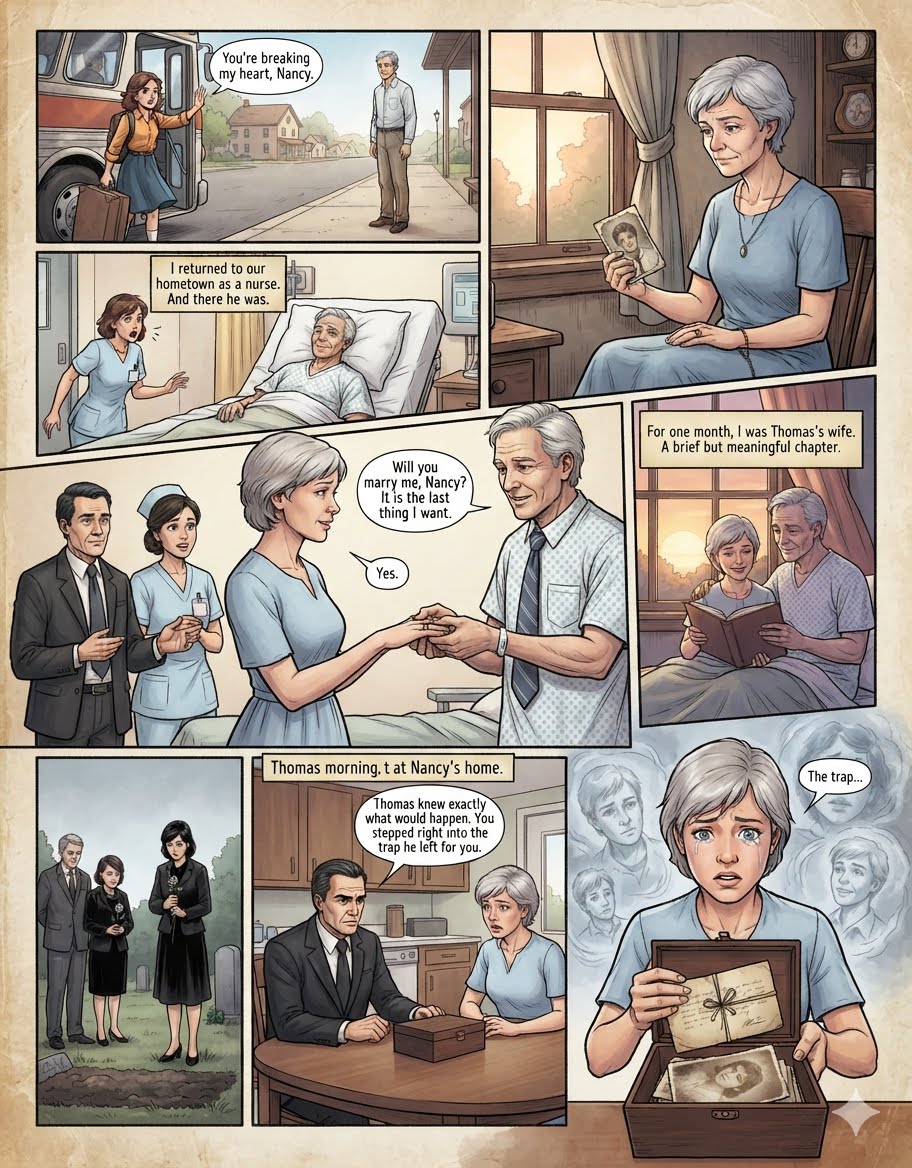
- On the day I left, he stood beside me at the bus station with tears in his eyes.
- “Please don’t go, Nancy,” he begged.
- “I have to,” I told him. “I worked too hard to give this opportunity up.”
- “Then you’re breaking my heart.”
- Those were almost the last words he ever said to me.
- I boarded the bus, left town, and spent the next fifty-six years believing I would never see him again.
- The ringing telephone pulled me out of the memory.
- I knew who it was before I answered.
- “Nancy, it’s Raymond,” a cheerful voice said. “I’m checking on my favorite cousin.”
- Favorite cousin.
- Raymond and I had barely spoken in thirty years.
- But ever since I returned to town, he had started calling nearly every week.
- His voice was always friendly, yet his questions made me uncomfortable.
- “How’s the apartment?” he asked. “Rent must be difficult on a pension.”
- “I’m managing.”
- “Have you organized your paperwork? Your will? Your banking information? A woman living alone at your age needs to prepare for these things.”
- I forced my voice to remain polite.
- “I’m fine, Raymond.”
- “You know, I used to visit Aunt Margaret all the time before she died. I helped her handle her finances and personal affairs. Family should take care of family.”
- Something about the way he said it made my coffee suddenly taste bitter.
- “That was kind of you,” I replied. “But I have to get ready for work.”
- I ended the call before he could ask anything else.
- The hospital smelled of disinfectant, medicine, and the quiet anxiety that seemed to live permanently inside its walls.
- That morning, I pushed my cart down the long hallway, checking room numbers and patient charts.
- I was already exhausted, and it was not even ten o’clock.
- Room 220.
- A new patient had been admitted for long-term care.
- I opened the door, stepped inside, and glanced at the chart.
- The first name made me stop breathing.
- Thomas.
- Then I saw the surname beneath it.
- My hands tightened around the file.
- It could not be him.
- There had to be hundreds of men with that name.
- But when I raised my eyes toward the patient lying in the bed, I recognized him immediately.
- Fifty-six years had passed, but they had not erased the face I remembered.
- Thomas was thinner now.
- His skin was pale, and illness had left deep shadows beneath his eyes.
- Yet those eyes were still the same ones that had watched me board a bus all those years ago.
- He looked at me and smiled as though he had been expecting me.
- “Hello, Nancy,” he said softly.
- For several seconds, I could not speak.
- I stood beside his bed holding a blood pressure cuff, feeling as if my entire life had followed me into that hospital room.
- “Thomas,” I finally whispered. “Oh my goodness. Thomas.”
- After that day, I found reasons to visit his room during every shift.
- Sometimes I checked his medication.
- Sometimes I brought him water.
- Sometimes I simply sat beside him after my duties were finished.
- Thomas told me he had never married.
- I confessed that I had not married either.
- We laughed about our gray hair, our aching knees, and the foolish dreams we had once shared.
- Other times, we sat in silence, comfortable in a way that made the lost decades between us feel smaller.
- “You still drink your coffee black?” he asked one afternoon.
- “I do.”
- “I knew you would.”
- There was something unusual about his calmness.
- Many patients with serious illnesses were frightened, angry, or overwhelmed.
- Thomas seemed peaceful.
- He carried himself like someone who had been waiting a very long time for one final thing to happen.
- One morning, he asked me a careful question.
- “Do you have any family nearby, Nancy? Anyone helping you?”
- “Only a distant cousin named Raymond. He has been calling more often since I moved back.”
- For one brief moment, Thomas’s expression changed.
- His jaw tightened.
- Then he relaxed and quickly changed the subject.
- I did not understand why at the time.
- That same week, Raymond’s calls became even more persistent.
- “Are you seeing anyone?” he asked. “You shouldn’t be alone at your age.”
- “I’m doing fine.”
- “Have you made a will? Someone responsible should be listed in case something happens.”
- “I told you, Raymond. I’m fine.”
- He asked which bank I used.
- He wanted to know whether I owned the apartment.
- He mentioned Aunt Margaret again, proudly describing how he had handled everything near the end of her life.
- I remembered that Margaret had died almost penniless in a rented room.
- For the first time, I wondered why that memory made me so uneasy.
- Still, I ignored my instincts.
- I had spent much of my life ignoring things that made me uncomfortable.
- Then, one afternoon, Thomas asked me to sit beside him.
- His hand found mine on top of the blanket.
- It felt light and cold.
- “Nancy,” he said, “I feel terrible asking this.”
- Our conversations had grown more affectionate with each passing day, but the seriousness in his voice frightened me.
- “Ask me.”
- “I have loved you for my entire life.”
- Part 2:
- My breath caught.
- “I know I don’t have much time left,” he continued. “But there is one thing I always dreamed of doing.”
- He looked directly into my eyes.
- “Will you marry me?”
- For several seconds, the room disappeared.
- Fifty-six years of questions, regrets, and imagined possibilities seemed to gather between us.
- Part of me heard Raymond’s voice warning me that I was being foolish.
- But another voice—the voice of the seventeen-year-old girl I had once been—told me not to walk away again.
- Thomas had advanced cancer.
- He knew he was dying.
- This was his final wish.
- “Yes,” I whispered.
- Tears filled his eyes.
- Mine did too.
- “Yes, Thomas. I’ll marry you.”
- He squeezed my hand.
- “You won’t regret it, Nancy. I promise you that.”
- There was something unusual in the way he said those words.
- It sounded less like reassurance and more like a carefully planned vow.
- At the time, I believed he was only talking about our marriage.
- I did not yet understand that he meant something far greater.
- The wedding took place three days later inside his hospital room.
- One of the nurses stood beside us as a witness.
- A quiet man wearing a gray suit introduced himself as Walter, Thomas’s attorney.
- I thought it was unusual for a lawyer to attend such a small ceremony.
- But Thomas held my hand, and I pushed the thought aside.
- His eyes shone when he said his vows.
- Mine did too.
- After the ceremony, Walter opened a leather briefcase and placed a folder on the rolling table beside Thomas’s bed.
- “There are a few documents that need your signature,” he explained. “Take as much time as you need.”
- I did not take much time.
- I trusted Thomas completely.
- Whenever Walter pointed to a line, I signed my name.
- That evening, I told Raymond what had happened.
- His reaction was immediate.
- “Have you completely lost your mind?” he shouted through the phone. “You married a dying man you barely know?”
- “I have known Thomas longer than I have known you.”
- “You’re being manipulated,” Raymond snapped. “Some stranger sees an elderly nurse with a pension and convinces her to marry him. You need to get the marriage annulled immediately.”
- “No.”
- “Nancy, you don’t understand what you’ve done.”
- “I understand perfectly.”
- I ended the call.
- One month later, Thomas passed away.
- He died peacefully in the early morning with my hand wrapped around his.
- The grief was far greater than I had expected.
- We had only spent a few weeks together, but somehow those weeks contained all the love and longing of the fifty-six years we had lost.
- The funeral was small.
- I stood beside his grave and finally allowed myself to cry.
- Raymond attended, of course.
- He waited until most of the mourners had left before approaching me.
- “You know I’m your only living relative,” he said while adjusting his tie. “Family should manage family matters.”
- I said nothing.
- “Older people shouldn’t sign documents they don’t understand.”
- “I understood everything Thomas said to me.”
- Raymond gave me a thin smile.
- “I helped Aunt Margaret with all her affairs. She was very grateful.”
- A cold feeling moved through me.
- I remembered the way Thomas’s face had changed whenever I mentioned Raymond’s name.
- “I need to go home,” I said.
- “We’ll talk soon,” Raymond replied. “We need to discuss your finances.”
- I walked away without answering.
- The next morning, someone knocked on my apartment door.
- When I opened it, Walter stood outside holding a small wooden box beneath one arm.
- “May I come inside?”
- I stepped aside.
- He placed the box on my living room table and sat across from me.
- “Thomas instructed me to deliver this the morning after his funeral,” Walter explained. “Not before.”
- I stared at him.
- Walter continued.
- “I also sent Raymond a legal notice this morning. It informs him that your finances and future care are now protected by a trust.”
- “What are you talking about?”
- Walter smiled gently.
- “Thomas was right. You walked directly into his trap.”
- My hands began to tremble.
- Walter removed a folded letter from his jacket.
- “Thomas asked me to read this exactly as he wrote it.”
- He unfolded the page.
- “‘My dearest Nancy, please forgive me. I created a trap, but you were never the person I intended to catch.’”
- I gripped the edge of the table.
- Walter looked up at me.
- “The documents you signed after the wedding did far more than accept Thomas’s estate.”
- He explained that one document created a trust funded entirely by Thomas’s property and savings.
- Walter had been appointed to manage it for my benefit.
- Another document gave Walter legal authority to protect my financial and medical affairs if I ever became unable to make decisions for myself.
- “Raymond has no control over anything,” Walter said. “He cannot pressure you into signing away your money or property. Any important document must be reviewed through the trust first.”
- He placed his hand on the wooden box.
- “That was Thomas’s trap. He built a legal wall around you so that no one could take advantage of you.”
- Walter slid the box across the table.
- My fingers shook as I touched the small brass latch.
- I thought about Raymond’s questions.
- I thought about his interest in my bank accounts and will.
- Then I thought about Thomas’s final promise.
- I opened the lid.
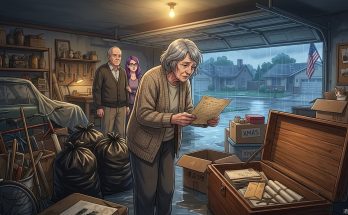
- Inside was the deed to Thomas’s family home.
- Beneath it were legal trust documents bearing my name.
- But that was not what made me gasp.
- Part 3:
- A thick bundle of letters lay beneath the papers, tied carefully with a piece of twine.
- There were fifty-five letters.
- One for almost every year Thomas and I had been apart.
- A handwritten note rested on top.
- I pressed a hand to my mouth as tears ran down my face.
- “I don’t understand,” I whispered.
- “Read the note,” Walter said. “Thomas wanted you to learn the truth in his own words.”
- Thomas explained that my Aunt Margaret had been a customer at his family’s hardware store for forty years.
- Over time, she had also become his friend.
- Years earlier, Thomas had accidentally discovered that Raymond was quietly taking money from Margaret’s accounts.
- He had tried to warn her.
- But Margaret trusted her nephew and refused to believe the accusation.
- When she eventually died with almost nothing, Raymond had walked away with far more money than anyone expected.
- Thomas never forgot what had happened.
- Years later, he learned that I had returned to town.
- He also discovered that Raymond had started calling me regularly and asking questions about my finances.
- Thomas understood what Raymond was planning.
- “He knew?” I whispered. “Thomas knew Raymond was trying to take advantage of me?”
- Walter nodded.
- “That is why Thomas arranged to be transferred to your hospital ward. He wanted to see you again, but he also wanted to protect you before it was too late.”
- The wedding had not been a rushed decision made by a dying man.
- Thomas had planned everything.
- He knew that becoming my legal husband would give him a powerful way to protect me.
- He had placed his estate inside a secure trust and appointed an attorney who would prevent Raymond—or anyone else—from gaining control of my life.
- “The trap was never meant for me,” I said.
- “No,” Walter replied. “It was meant for Raymond.”
- I pressed Thomas’s letter against my chest.
- For more than fifty years, I had avoided saying his name.
- Now it was the only name I wanted to speak.
- Three days later, Raymond arrived at my apartment and pounded angrily on the door.
- He carried a folder filled with threats, accusations, and promises to challenge everything Thomas had arranged.
- Walter happened to be sitting at my kitchen table drinking tea.
- “Every document is legally valid,” Walter told him calmly. “You are welcome to challenge the trust, but you will lose.”
- Raymond stared at me with fury.
- “You foolish old woman.”
- I looked directly at him.
- “No, Raymond. I am a woman who was deeply loved. There is a difference.”
- He left without another word.
- That spring, I moved into Thomas’s family home.
- Every Sunday morning, I made a cup of black coffee, sat beside the window, and opened one of his letters.
- I read them slowly.
- Some told me about his work.
- Others described the life he had imagined we might have shared.
- Many simply said that he hoped I was happy.
- For decades, I believed love had passed me by.
- But it had not.
- Love had waited fifty-six years for me to come home.
- And even after Thomas was gone, it found one final way to wrap its arms around me.
I Married My High School Sweetheart at 73 Because It Was His Final Wish – After His Funeral, His Lawyer Knocked on My Door and Said, ‘You Walked Right Into His Trap