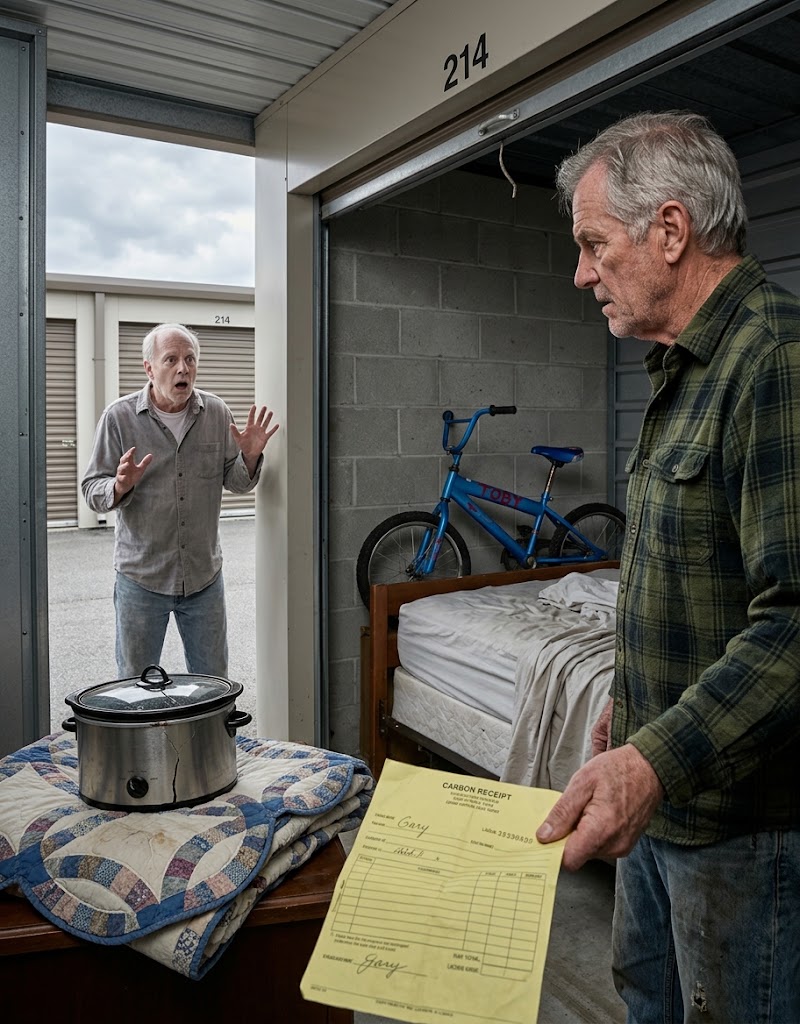
PART 3 His voice cracked on the last word. We had been brothers for sixty-seven years. I knew when he was lying. I also knew when he was scared. This was fear. But I couldn’t tell what he was afraid of. I folded the access sheet and put it back in my pocket. “Then tell me why your name is on my wife’s authorization form.” He rubbed both hands over his face. “Tom, you need to go home.” “I am home.” “You know what I mean.” “No, I don’t.” He looked toward the road. A truck passed at the end of the row, tires throwing dust behind it. Gary waited until it disappeared. Then he said quietly, “Did Sharon know you bought this?” “No.” “Does she know you’re here?” “No.” “Then don’t tell her yet.” I stared at him. “That’s your advice?” “I’m serious.” “So am I.” He stepped closer. “Tom, listen to me. You don’t know what you’re looking at.” “I know what a receipt looks like.” “You don’t know what it means.” “Then explain it.” He opened his mouth. Nothing came out. I pointed at the bicycle. “Who is Toby?” Gary’s face changed. It was subtle. But I saw it. His jaw tightened. His eyes dropped. And then he whispered four words that made the back of my neck go cold. “That’s not Toby’s bicycle.” I stared at him. “What?” He didn’t answer. “Then whose is it?” He looked at the bed. “Do you really want to know?” “Yes.” “You’re going to hate me.” “I already might.” He closed his eyes.
Then he said, “The boy who slept in that bed wasn’t Toby.” I felt something inside me go very still. “Who was he?” Gary looked directly at me. “I don’t know.” I laughed once. Not because anything was funny. Because sometimes your mind gives you the wrong reaction when the right one is too painful. “You don’t know?” “I know what I was told.” “By who?” He hesitated. “Sharon.” I took my hand out of my pocket. For a moment, I honestly thought I might hit my own brother. Instead, I stepped away from him. “Start talking.” He looked at the open storage unit. “Not here.” “Why?” “Because cameras.” I looked up. There was a security camera mounted on the corner of the building. Gary pointed at it. “If Sharon paid for this place for six years, there’s a reason she didn’t want anyone knowing about it.” I said, “You were helping her.” “Yes.” “How long?” He didn’t answer. “How long, Gary?” “Six years.” I felt my stomach turn. Six years. The same six years printed on the receipt book. I thought about every dinner. Every Christmas. Every time Sharon told me she had gone shopping with her sister. Every Tuesday and Friday afternoon when I assumed she was at the grocery store, the beauty shop, the church, anywhere but here. “Why?” Gary shook his head. “You’re asking the wrong question.” “What is the right one?” “Who was the boy?” I stared at him. “You just said you didn’t know.”
“I said I didn’t know his name.” My heart began beating harder. “Where is he?” Gary looked toward the entrance. “I don’t know.” “Is he alive?” He didn’t answer. I stepped toward him. “Gary.” He finally said, “The last time I saw him, he was alive.” The words seemed to echo inside the empty unit. I looked at the bed. The sheets were clean. Too clean. There was a pillow on the mattress with a small indentation in the middle, as though someone had recently slept there. I hadn’t noticed that before. I walked over. I touched the pillow. It was cold. But the room smelled faintly of laundry detergent. And underneath that, something else. Baby powder. I turned around. “Why does this place smell like someone lives here?” Gary looked at the floor. “Because sometimes someone does.” My throat tightened. “Who?” “I told you. I don’t know.” “Then why did you come here with Sharon?” He rubbed his forehead. “Because she asked me to.” “When?” “Six years ago.” “Why?” He looked at the bicycle. “She said somebody was threatening her.” “Who?” “She wouldn’t tell me.” “Did she tell you about the boy?”
“Yes.” “What did she say?” Gary sat on an old wooden chair near the wall. He looked suddenly older than his sixty-seven years. He said, “She told me she had a grandson.” I stopped breathing for a second. “You just said our daughters don’t have children.” “I know.” “She told you she had a grandson?” “Yes.” “Whose child?” Gary looked at me. “That’s what she wouldn’t tell me.” I shook my head. “No.” “Tom—” “No. Don’t do this. Don’t give me half an answer and expect me to fill in the rest.” He lowered his voice. “She said the boy was in danger.” “From who?” “She never said.” “Where did she get him?” “I don’t know.” “Where are his parents?” “I don’t know.” “Who is Toby?” “I don’t know.” “You know something.” He looked away. I walked toward the bicycle. There was a small metal tag hanging from the handlebar. I picked it up. It was an old hospital identification bracelet. The plastic had yellowed with age. There was a name printed on it. TOBIAS MILLER. Date of birth. I read it twice. Then I looked at Gary. “Miller?” He didn’t move. “Gary.” Still nothing. “Miller is Sharon’s maiden name.” “I know.” My hands started shaking. I looked back at the bracelet. Tobias Miller. My wife’s maiden name. A boy. A hidden storage unit. Six years of payments. A bed. A bicycle. And my brother. I whispered, “Is he Sharon’s grandson?” Gary didn’t answer. That was answer enough. I sat down on the edge of the bed. For the first time since I bought the unit, I felt genuinely weak. Not because of my heart. Because my entire marriage suddenly felt like a house with the walls removed.
I thought about our daughters.
Emily was thirty-five.
Rachel was thirty-two.
Neither had ever had a child.
At least, neither had ever told us.
I had been there for every birthday.
Every graduation.
Every broken relationship.
Every apartment move.
I had watched them grow up.
I had watched them become women.
I had never seen either one pregnant.
Unless—
I stopped.
There was something.
A memory.
Something from years ago.
Rachel had been twenty-six.
She’d disappeared for nearly three months.
Sharon had told me she was helping a friend in Colorado.
I remembered calling her.
Rachel had sounded strange.
Tired.
She told me she didn’t want to talk.
Then she came home.
Three months later, she was herself again.
Or I thought she was.
I looked at Gary.
“Rachel.”
He closed his eyes.
“What about Rachel?”
“Did this have something to do with her?”
He didn’t answer.
“Gary.”
He whispered, “You need to ask Sharon.”
“I will.”
“Not yet.”
I stood.
“I’m going home.”
He looked relieved.
Then I added, “And I’m taking that hospital bracelet.”
He stood quickly.
“No.”
I froze.
“What did you say?”
“Don’t take it.”
“Why?”
“Because if Sharon finds out you found that, she’ll know I told you.”
I stared at him.
“So you are still protecting her.”
“I’ve been protecting that boy.”
“From what?”
Gary’s eyes filled with tears.
“From his father.”
I felt a chill move through me.
“Who is his father?”
Gary shook his head.
“I don’t know.”
“You’re lying.”
“No.”
“You’re my brother.”
“Yes.”
“You owe me the truth.”
“I do.”
“Then give it to me.”
He looked toward the door.
“Let’s leave.”
I didn’t move.
“Not until you tell me one thing.”
“What?”
“Did Sharon hurt that boy?”
Gary’s face collapsed.
“No.”
The answer came instantly.
“No, Tom. Never.”
That was the first thing he’d said all morning without hesitation.
I believed him.
But somehow that made everything worse.
Because if Sharon wasn’t hurting the boy, then what exactly had she been hiding?
We left the unit.
Neither of us spoke until we reached the parking lot.
I watched Gary get into his truck.
Before he closed the door, I said, “I’ll give you until tonight.”
He looked at me.
“For what?”
“To decide whether you’re going to tell me the truth.”
He shook his head.
“You don’t understand what you’re getting into.”
“Then help me understand.”
He started the engine.
“Don’t go home yet.”
“What?”
“Go somewhere else.”
“Why?”
He looked at me through the open window.
“Because if Sharon knows you found the unit, she may not be waiting at home.”
Then he drove away.
I stood there for almost a minute.
The parking lot was silent.
I called my daughter Emily.
She answered on the third ring.
“Dad?”
“Where are you?”
“At work.”
“Are you alone?”
She laughed nervously.
“That’s a strange question.”
“Emily.”
A pause.
“Yes. I’m alone.”
I sat in my truck.
“Did Mom ever tell you about a boy named Tobias?”
The silence on the other end was immediate.
Too immediate.
Then she said, “Why are you asking me that?”
I closed my eyes.
“Because I found his bicycle.”
She stopped breathing.
At least that’s what it sounded like.
Then she whispered:
“Dad, where?”
“Storage unit.”
Another silence.
“Which one?”
“214.”
Her voice became very small.
“Dad, you need to leave.”
“Why?”
“Because Mom isn’t the person you think she is.”
I gripped the steering wheel.
“What does that mean?”
“Did Uncle Gary tell you?”
“No.”
“Then he will.”
“Emily—”
“I have to go.”
“Wait.”
She hung up.
I stared at the phone.
Then it rang.
Sharon.
My wife.
Thirty-eight years.
Her name glowing on my screen.
I almost didn’t answer.
But I did.
“Hello?”
Her voice was normal.
Too normal.
“Tom? Where are you?”
“Out.”
“Out where?”
“Running errands.”
“What kind of errands?”
I looked at the storage facility.
“Why?”
“I was going to ask you to pick up milk.”
I almost laughed.
“Milk?”
“Yes.”
“Anything else?”
“No.”
She paused.
Then she said, “Tom, did you go back to the storage unit?”
My blood went cold.
I didn’t answer.
She whispered, “You should have told me.”
I felt my grip tighten around the phone.
“Why?”
There was another pause.
Then my wife said something I will never forget.
“Because now they know you found it.”
The line went dead.
I sat there staring at the phone.
For thirty-eight years, I had thought I knew my wife’s voice.
That afternoon, I realized I had never heard it before.
Not really.
I drove home slowly.
The front door was locked.
Everything looked normal.
The porch light was on.
Sharon’s car was in the driveway.
I walked inside.
She was standing in the kitchen.
Waiting.
She had changed clothes.
Her hair was brushed.
Dinner was already on the stove.
She looked at me and smiled.
“Did you have a good day?”
I stood in the doorway.
“No.”
Her smile disappeared.
“I know.”
I put the hospital bracelet on the kitchen table.
She stared at it.
Her face went white.
I said, “Who is Tobias Miller?”
She closed her eyes.
Then she sat down.
For a long time, neither of us spoke.
Finally she said, “Our grandson.”
I felt something inside me break.
“Which daughter?”
She looked at me.
“Neither.”
“Then whose?”
She whispered, “Mine.”
I didn’t understand.
“Your son?”
She shook her head.
“I had another child.”
The room seemed to tilt.
“What?”
“Before you.”
I stared at her.
“I had a son.”
“You never told me.”
“I couldn’t.”
“Why?”
She looked toward the window.
“Because he died.”
I waited.
She continued.
“He was nineteen when he died.”
My voice was barely audible.
“Then how can Tobias be your grandson?”
She looked at me.
“Because my son had a son.”
The kitchen clock ticked.
Once.
Twice.
Three times.
I said, “Where is Tobias?”
Sharon’s eyes filled with tears.
“He’s alive.”
“Where?”
She shook her head.
“I don’t know.”
“You don’t know?”
“I haven’t seen him in six years.”
“Then why did you keep that unit?”
Her hands trembled.
“Because I promised his mother.”
“Who is his mother?”
Sharon looked directly into my eyes.
And that was when I knew there was still another secret.
A bigger one.
A secret so large that even after thirty-eight years of marriage, my wife was still afraid to say it.
She whispered:
“Your brother knows.”
I stood very still.
“Knows what?”
She began crying.
“Who Toby’s mother really is.”
I stepped backward.
“No.”
“Tom—”
“No.”
I understood suddenly.
Not everything.
But enough.
I thought about Rachel.
I thought about Emily.
I thought about six years of storage receipts.
I thought about my brother’s face when he saw that bicycle.
And then I remembered something else.
Something I’d forgotten for years.
The night Rachel came home after those three missing months, she had stood in this exact kitchen.
She had been twenty-six.
She had looked at her mother and said, “You promised me he’d be safe.”
I had assumed they were talking about a friend.
I had been wrong.
I looked at Sharon.
“Rachel is Toby’s mother.”
She didn’t answer.
That was enough.
I grabbed the back of the chair to steady myself.
My wife whispered, “She was only twenty-six. She was scared. The boy’s father was dangerous.”
“Who?”
“I don’t know.”
“Stop saying that.”
“I don’t know his real name.”
“Where is Rachel now?”
“She doesn’t know Toby is alive.”
I stared at her.
“What?”
“She believes he died.”
My heart sank.
“Why would you let your daughter believe her child was dead?”
Sharon covered her face.
“Because the alternative was worse.”
“What alternative?”
She lowered her hands.
“The boy’s father found out Rachel had given birth.”
I said nothing.
“He wanted the child.”
“Why?”
“I don’t know.”
“Sharon.”
“He was involved with people who didn’t care about laws, Tom.”
I shook my head.
“This is insane.”
“I know.”
“You let me live in this house for six years while you hid a child from me.”
“I was protecting him.”
“You lied to our daughter.”
“I was protecting her too.”
“And Gary?”
“He helped me.”
“From what?”
Sharon looked toward the hallway.
Then she said:
“From the people who are looking for Tobias.”
I felt a coldness spread through my body.
“People are still looking for him?”
She nodded.
“And they know about the storage unit?”
“I think so.”
“Who?”
“I don’t know.”
I stared at her.
Then my phone buzzed.
A text message.
Unknown number.
I opened it.
There was only one sentence.
YOU SHOULD NOT HAVE OPENED 214.
Underneath it was a photograph.
A photograph of the storage unit.
Taken that afternoon.
Taken from inside.
I looked at Sharon.
She saw the screen.
Her face changed.
“Tom,” she whispered.
“What?”
“That’s not possible.”
“Why?”
She pointed at the photograph.
“The bed.”
I looked again.
The bed was visible.
The blue bicycle was beside it.
The quilt was folded on the chair.
But there was something else.
Something I hadn’t noticed.
A small figure was standing in the far corner.
A boy.
Ten years old, maybe.
Thin.
Dark hair.
Wearing a gray sweatshirt.
And looking directly at the camera.
I zoomed in.
My hands began to shake.
The boy had one hand pressed against the wall.
And on his wrist was a hospital bracelet.
I looked at Sharon.
“Where is he?”
She was crying.
“I don’t know.”
Then my phone buzzed again.
Another message.
This time, there was no photograph.
Only five words.
ASK YOUR BROTHER ABOUT JUNE.
PART 4
I read the message three times.
ASK YOUR BROTHER ABOUT JUNE.
My first thought was that June was a person.
My second was that it was a date.
My third was that I already knew exactly what it meant.
June.
The month I had nearly died.
The month my wife had spent an afternoon at a storage unit while I was lying on a hospital table.
The month Gary had entered 214.
I looked at Sharon.
“What happened in June?”
She didn’t answer.
“Sharon.”
Her eyes remained fixed on my phone.
“Who sent that?”
“I don’t know.”
“Did you give somebody my number?”
“No.”
“Did Gary?”
“No.”
“Then how did they know I found the unit?”
She shook her head.
I put the phone on the counter.
“I’m going to ask Gary.”
Sharon stood suddenly.
“No.”
I turned toward her.
“You don’t get to say no anymore.”
“I am asking you to wait.”
“For what?”
“For me to explain everything.”
“You’ve had six years.”
She looked down.
“I know.”
“Thirty-eight years, Sharon.”
“I know.”
“You let me sit at that kitchen table every night and talk about my day while you were hiding a child from me.”
“I know.”
“You let Rachel believe her son was dead.”
Her eyes filled with tears.
“I know.”
“You kept our marriage intact by lying to me.”
She whispered, “I thought I was keeping our family alive.”
I shook my head.
“That isn’t the same thing.”
“No.”
She sat down again.
“I need to tell you what happened in June.”
“Tell me.”
She took a long breath.
“Not the June you think.”
I waited.
“Six years ago, Tobias disappeared.”
“From where?”
“From me.”
“What does that mean?”
“He was staying with me.”
I stared at her.
“You had him here?”
“No. Never here.”
“Where?”
“A house Gary owned.”
I closed my eyes.
My brother.
Again.
“Why didn’t you tell me?”
“Because Rachel didn’t want you to know.”
“Why?”
“Because she was ashamed.”
“Of what?”
Sharon looked at me.
“She was afraid you would hate her.”
“I would never hate my daughter.”
“I know that now.”
“What changed?”
“You almost died.”
I didn’t understand.
“When you had the heart attack,” she continued, “Rachel called me.”
I remembered that day.
I had been mowing the backyard.
One minute I was standing.
The next, I was on the grass.
Everything after that was fluorescent lights and nurses and my wife crying in the hallway.
“You told me Rachel was out of town,” I said.
“She was.”
“Where?”
“Trying to find Tobias.”
My mouth went dry.
“Where was she looking?”
Sharon looked away.
“Here.”
I stared at her.
“Here?”
“She had been told someone had seen him.”
“Who?”
“A man named Daniel.”
“Who is Daniel?”
She shook her head.
“I don’t know.”
“Stop saying that.”
“I swear to you, Tom, I don’t know his real name.”
“Then how did you know him?”
“Because he contacted me.”
“When?”
“Six years ago.”
She rubbed her hands together.
“He said Tobias’s father wanted him back.”
I felt a cold pressure in my chest.
“And you believed him?”
“I had proof.”
“What proof?”
“A photograph.”
I looked at the phone.
“The same kind of photograph?”
“No.”
She reached into a kitchen drawer.
Her hands shook as she opened it.
From the back she removed a small envelope.
She placed it on the table.
I opened it.
Inside were three photographs.
The first showed a little boy sitting on a playground swing.
The second showed him sleeping in a car.
The third showed him standing beside a man whose face had been cut out of the photograph.
On the back of the first picture was a date.
June 11.
I looked at Sharon.
“This was the day I had my stents.”
She nodded.
“Who took these?”
“Daniel.”
“Why?”
“To prove Tobias was alive.”
I looked at the boy again.
He was younger in the photographs.
Maybe six.
Seven.
But there was something familiar about him.
The shape of his eyes.
The way he held his mouth.
I had never met him.
Yet somehow I knew him.
“Why didn’t you tell me?”
“Because I was afraid.”
“Of Daniel?”
“No.”
She looked at me.
“Of you.”
That hurt more than I expected.
“You were afraid of me?”
“I was afraid of what would happen if you knew everything.”
“I loved you.”
“I know.”
“You still do?”
She nodded.
“More than you know.”
“Then why?”
“Because I made a promise.”
“To whom?”
“Tobias.”
I frowned.
“A child?”
“He was seven when I made it.”
“What did you promise?”
“That I would never let his father find him.”
I stood.
“Where is Tobias now?”
“I don’t know.”
“Where was he when you last saw him?”
“In the storage unit.”
I stared at her.
“What?”
“He was there.”
“Six years ago?”
“No.”
Her voice dropped.
“Last Thursday.”
The room went silent.
I looked at her.
“You’re telling me Tobias was inside 214 last Thursday?”
“Yes.”
“Then where is he now?”
“I don’t know.”
“You were there?”
“No.”
“Who was?”
She didn’t answer.
“Gary?”
She nodded.
I stepped toward the door.
“I’m calling him.”
“Tom, wait.”
I turned.
Sharon was crying again.
“Don’t go to Gary’s house.”
“Why?”
“Because if someone is watching you, they’ll know where you’re going.”
“Who?”
She looked at the photograph of Tobias.
“The people who took him.”
My blood ran cold.
“You said he wasn’t missing.”
“He wasn’t.”
“Then what happened?”
Sharon whispered:
“He was taken from the unit.”
“When?”
“Last Thursday night.”
I remembered the first time I’d opened the door.
The bed.
The bicycle.
The quilt.
Everything had looked untouched.
But I remembered something else.
The lock.
There had been fresh scratches around it.
At the time I thought nothing of it.
Now I understood.
Someone had been inside.
Someone had taken a boy.
And the boy had been there shortly before me.
I picked up my keys.
“I need to know what happened.”
Sharon grabbed my arm.
“Tom.”
I looked at her hand.
She let go.
“Please.”
“I’m going.”
“Then take this.”
She handed me a small brass key.
“What is it?”
“Gary’s old house.”
I looked at it.
“You said not to go there.”
“I said don’t go alone.”
“Why?”
“Because there is something in the basement.”
I stared at her.
“What?”
She swallowed.
“Tobias’s things.”
I drove to Gary’s house.
It was twenty minutes away.
The whole way there, I kept thinking about that photograph.
The boy in the corner.
Looking directly at the camera.
If that picture had been taken from inside the storage unit, then someone had been there after me.
And if the message had been sent to me that night, whoever took the photograph knew exactly what I had found.
I arrived at Gary’s house at 7:14.
His truck wasn’t there.
The front door was unlocked.
I stood on the porch for several seconds.
Then I went inside.
“Gary?”
No answer.
The house was dark.
I switched on the kitchen light.
A coffee cup sat on the counter.
Still half full.
I touched it.
Cold.
I called his phone.
It rang inside the house.
I followed the sound.
It was on the living room floor.
His phone was lying beside the couch.
That was when I knew something was wrong.
I called the police.
Then I searched the house.
Nothing.
No broken windows.
No signs of a struggle.
Except for one thing.
The basement door was open.
I remembered Sharon’s warning.
I went down.
The basement smelled damp.
There were boxes everywhere.
Christmas decorations.
Old tools.
Furniture.
Then I saw the wall.
One section was covered with photographs.
Dozens of them.
I walked closer.
Tobias.
Tobias at five.
Tobias at six.
Tobias at seven.
Tobias riding the blue bicycle.
Tobias sleeping.
Tobias eating.
Tobias sitting beside a woman.
I stopped.
I knew the woman.
Rachel.
My daughter.
She was holding a baby.
I took the photograph from the wall.
On the back was written:
June 18 — first time Rachel held him.
I sat down on the basement steps.
My daughter had been holding her son.
And I had never known.
I looked at another photograph.
Rachel was crying.
Gary stood beside her.
Sharon was behind them.
The three of them looked terrified.
I turned over another.
This one had a handwritten note.
He knows who his father is.
My heart began pounding.
I kept searching.
At the bottom of the wall was a photograph of a man.
This time his face had not been cut out.
I stared at it.
I knew him.
Not personally.
But I knew the face.
I had seen him once.
At my daughter’s college graduation.
He had stood near the parking lot.
A man Rachel had told me was “just a friend.”
His name was Daniel Mercer.
I remembered because I had shaken his hand.
I remembered his cold eyes.
And I remembered Rachel telling me afterward:
“Dad, if you ever see him again, don’t talk to him.”
I had forgotten that until now.
I pulled out my phone.
I searched the name.
Nothing useful.
Then I found an old newspaper clipping pinned beneath the photographs.
The headline read:
LOCAL CONTRACTOR QUESTIONED IN DISAPPEARANCE OF CHILD
I read the article.
Daniel Mercer had been questioned six years earlier after a child named Tobias Miller disappeared.
But the police had never charged him.
The article said there wasn’t enough evidence.
I felt sick.
Six years.
Six years of hiding.
Six years of fear.
Six years of my wife and brother protecting a child.
And now Gary was missing.
I heard something upstairs.
A floorboard creaked.
I froze.
Then another.
Someone was walking through the kitchen.
I turned off my phone screen.
The footsteps stopped.
I heard a man’s voice.
“Tom?”
I knew that voice.
Daniel.
I stood slowly.
He appeared at the top of the basement stairs.
Older than I remembered.
But unmistakable.
He smiled.
“You finally found the truth.”
I backed away.
“Where’s my brother?”
Daniel didn’t answer.
“Where’s Tobias?”
His smile disappeared.
“You don’t understand what you’ve done.”
“I know exactly what I’ve done.”
“No.”
He stepped down one stair.
“You opened a door that was supposed to stay closed.”
“Where is my brother?”
“Alive.”
I felt a tiny bit of relief.
“Where?”
Daniel looked behind him.
“Not for long if you keep asking questions.”
I reached for my phone.
Daniel raised his hand.
“Don’t.”
I stopped.
“You’ve got a choice.”
“What choice?”
“You can walk away.”
I laughed bitterly.
“You kidnapped my grandson.”
“He isn’t your grandson.”
“He is my daughter’s son.”
“He is my blood.”
“Then why did you leave him?”
Daniel’s face hardened.
“I didn’t.”
“Then who did?”
He stepped closer.
“Ask Rachel.”
I shook my head.
“She didn’t know.”
Daniel smiled.
“You really believe that?”
I didn’t answer.
He reached into his coat.
I thought he was pulling a weapon.
Instead, he pulled out a photograph.
He held it toward me.
It showed Rachel.
She was standing beside a car.
Beside her was Tobias.
And beside Tobias was another child.
A little girl.
Maybe five years old.
I looked at Daniel.
“Who is she?”
He said nothing.
I took the photograph.
On the back were four words.
SHE IS YOUR GRANDDAUGHTER TOO.
I looked up.
Daniel was gone.
I ran upstairs.
The front door was wide open.
His car was already disappearing down the road.
I stood in the doorway, holding the photograph.
Then my phone rang.
It was Rachel.
I answered.
“Rachel?”
Her voice was shaking.
“Dad, where are you?”
“At Uncle Gary’s.”
She began crying.
“Get out of there.”
“Why?”
“Because I just found out where Tobias is.”
“Where?”
A long silence.
Then she whispered:
“He’s not the only child they’ve been hiding.”
My eyes dropped to the photograph.
The little girl stared back at me.
Rachel said:
“Dad, you need to listen carefully.”
“I am.”
“Because the little girl in that picture…”
Her voice broke.
“…is your granddaughter.”
I closed my eyes.
“Who is her mother?”
Rachel took a shaky breath.
“Me.”
I couldn’t speak.
Then she said the words that changed everything.
“And Dad…”
“Yes?”
“Tobias isn’t missing.”
“What?”
“He came looking for me.”
I felt the air leave my lungs.
“Where is he?”
Rachel whispered:
“He’s at the house.”
“What house?”
“Our house.”
I stared toward the road.
“My house?”
“No.”
She began sobbing.
“The yellow house across from yours.”
I went completely still.
The yellow house.
The one I had never paid attention to.
The one that had been empty for years.
The one with the curtains always closed.
Rachel whispered:
“Dad, don’t go there alone.”
Then the line went dead.
And from across the street, behind the yellow house’s upstairs curtain, I saw a small hand slowly pull the fabric aside.
A boy was standing there.
And even from that distance, I knew him.
It was Tobias.
He was looking directly at me.
And beside him stood a little girl.
The girl from the photograph.
She raised one finger to her lips.
Then she pointed behind me.
I turned.
Gary was standing in the middle of my driveway.
His face was bruised.
His shirt was torn.
And he was holding something in his hand.
A blood-stained blue bicycle bell.
He looked at me and shouted:
“GET INSIDE, TOM!”
Then every light in the yellow house went out.
PART 5
Every light in the yellow house went out.
For one second, nobody moved.
Then Gary ran toward me.
“Inside!” he shouted again.
I didn’t argue.
We rushed through my front door and slammed it behind us.
I locked it.
Then the deadbolt.
Then the chain.
Gary leaned against the wall, breathing hard.
There was blood on his eyebrow and a tear in his shirt.
I grabbed a clean towel from the kitchen and pressed it against his forehead.
“What happened?”
He looked at me.
“Where’s Sharon?”
“At home.”
“Call her.”
I did.
She answered immediately.
“Tom?”
“I’m with Gary.”
Silence.
Then Sharon whispered, “Oh God.”
“He’s hurt.”
“Is he alive?”
“I’m standing right here,” Gary muttered.
Sharon began crying.
“Where are you?”
“My house.”
“Don’t leave.”
“Sharon, I saw Tobias.”
Another silence.
Then she said, “You weren’t supposed to.”
I looked at Gary.
He shook his head.
“Who is the girl?” I asked.
Sharon didn’t answer.
“Mom?”
It was Rachel.
I turned.
She was standing in my doorway.
I hadn’t heard her come in.
Her face was wet with tears.
She looked older than I had ever seen her.
Not physically.
Something inside her had changed.
“Dad,” she said.
I stared at her.
“You’re Tobias’s mother.”
She nodded.
“And the little girl?”
Rachel closed her eyes.
“My daughter.”
I felt my knees weaken.
“You have a daughter?”
“Yes.”
“How old?”
“Five.”
I sat down.
Five.
A five-year-old granddaughter I had never known existed.
Rachel sat beside me.
Her hands were shaking.
“I wanted to tell you.”
“Why didn’t you?”
“Because Mom said you would be in danger.”
I looked at Sharon’s name still displayed on my phone.
“She was right about one thing.”
Rachel looked at me.
“Daniel is dangerous.”
Gary interrupted.
“He isn’t the only one.”
I looked at him.
“What do you mean?”
Gary pulled the blood-stained bicycle bell from his pocket.
“This was on the floor at the yellow house.”
He placed it on the table.
“Where is Tobias now?” I asked.
Rachel looked toward the window.
“Still there.”
“Why?”
“Because he won’t leave without his sister.”
I stared at her.
“What?”
Rachel nodded.
“They took my daughter five years ago.”
My stomach dropped.
“Who?”
“Daniel.”
“Why?”
“Because he wanted Tobias to come back.”
Gary said quietly, “He used the girl as leverage.”
Rachel wiped her eyes.
“Daniel didn’t raise them. He kept moving them between houses. Different people. Different names.”
“Then how did you find them?”
“I didn’t.”
She looked at me.
“They found me.”
I didn’t understand.
“Tobias has been searching for me for years.”
“How?”
“Your mother’s storage unit.”
I looked at Gary.
He nodded.
“We kept letters there.”
“Letters?”
“From Rachel to Tobias.”
I stared at my daughter.
“You were writing to him?”
“Yes.”
“For six years?”
“Yes.”
“But you believed he was dead.”
“I was told he was dead.”
“Who told you?”
Rachel looked toward the window.
“Daniel.”
She took a breath.
“He came to the hospital after Tobias disappeared. He told me my son had been killed.”
I remembered the photographs.
The bed.
The bicycle.
The storage unit.
The years of lies.
Then I asked the question that mattered most.
“Why did Tobias come back now?”
Rachel looked at me.
“Because he found the letters.”
My throat tightened.
“He knew I was his mother?”
“Yes.”
“Does he know who his father is?”
Rachel looked at Gary.
Then at me.
“Yes.”
“Who?”
She whispered:
“Daniel.”
The room went silent.
Gary shook his head.
“That was the part we never wanted you to know.”
I stared at my daughter.
“You had Daniel’s child?”
“I was twenty-six.”
“Did you love him?”
Rachel shook her head.
“No.”
“Then why?”
“He wasn’t who I thought he was.”
She looked down.
“He was charming. He helped me when I was struggling at college. He knew exactly what to say. By the time I realized what he was involved in, I was pregnant.”
“What happened?”
“He wanted the baby.”
“Why?”
“Because he had a family business.”
I frowned.
“What kind of business?”
“Private security.”
Gary interrupted.
“That’s the clean version.”
Rachel nodded.
“They weren’t just security.”
I understood.
“They were criminals.”
“Yes.”
“Money?”
“Money. Drugs. Extortion. Anything people paid them to do.”
I looked at the little girl in the photograph.
“And your daughter?”
Rachel’s voice broke.
“Daniel’s people took her when she was five months old.”
“Why?”
“To control me.”
She covered her face.
“I tried to get her back. I went to the police. But every time I got close, they threatened Tobias.”
“So you went along with them.”
“I had no choice.”
I looked at Gary.
“And you?”
“I helped Sharon hide Tobias.”
“Why didn’t you tell me?”
“Because you were the only person in the family Daniel didn’t know how to control.”
I stared at him. “What does that mean?” Gary gave a sad smile. “You were unpredictable.” I almost laughed. “I’ve never been called that before.” “You’ve always done the right thing.” He looked at me. “That made you dangerous to people like him.” My phone buzzed. A message. Unknown number. COME TO THE YELLOW HOUSE. ALONE. I showed it to everyone. Rachel shook her head. “No.” Gary stood. “We don’t go.” I looked toward the window. Tobias was still there. Then I saw something. A white curtain moved. Three times. Left. Right. Left. Rachel gasped. “He’s signaling.” “What does it mean?” “He used to do that when he was little.” “What does it mean?” “Help me.” I stood. “We’re going.” Gary grabbed my arm. “No.” “I am going.” “Tom, think.” “I’ve thought for six years.” I looked at my daughter. “I’m getting my grandchildren.”
Rachel nodded. Gary sighed. “Then I’m coming.” We crossed the street together. The yellow house door was unlocked. Inside, it smelled like dust and old wood. “I’m here!” I shouted. No answer. Rachel called: “Toby!” A door upstairs slammed. We ran up. At the end of the hallway was a small bedroom. The window was open. Tobias stood inside. He was thinner than he looked from across the street. He couldn’t have been more than eleven. His eyes were cautious. He looked at Rachel. “Mom?” Rachel froze. For six years she had imagined this moment. But imagination could never prepare a mother for hearing her child call her by that word. She stepped forward. “Toby.” He ran to her. She fell to her knees. They held each other. I turned away. I didn’t want them to see me crying. Then a little girl appeared behind the bed. She was holding a stuffed rabbit. She looked at me. I knelt.
“What’s your name?” She didn’t answer. Rachel whispered, “Emma.” I smiled. “Hi, Emma.” The girl stared at me. Then she asked: “Are you Grandpa?” My heart broke. “Yes.” She walked toward me. I held out my arms. She hesitated. Then she stepped into them. She was so small. I held her carefully. For the first time in five years, my granddaughter was in my arms. And I knew one thing. Nobody was ever taking her from me again. A noise came from downstairs. Tobias pulled away from Rachel. “Someone’s here.” Gary reached for his phone. Then the lights went out. A man’s voice came from the hallway. “You should have stayed home, Tom.” Daniel. I pushed Emma behind me. Gary stepped forward. Daniel appeared at the end of the hall. He wasn’t alone. Two men stood behind him. Daniel smiled. “Give me the children.” “No.” “Tom, this doesn’t concern you.” “They’re my family.” “They’re my blood.” “Then act like it.” His smile disappeared. “Last chance.” I stepped forward. “You killed nobody.” Daniel looked confused. “What?” “Tobias was never dead.” “You don’t know what you’re talking about.”
“Yes, I do.”
I pulled the hospital bracelet from my pocket.
“Tobias Miller.”
Daniel’s face changed.
“You’ve been looking for him for six years.”
“No.”
“You wanted everyone to think he was dead.”
“No.”
“You used my daughter.”
His jaw tightened.
“And you took her child.”
Daniel stepped closer.
“You think you’re a hero?”
“No.”
I looked at him.
“I’m just a grandfather.”
Behind me, Gary quietly pulled his phone from his pocket.
Daniel didn’t notice.
He kept talking.
“You don’t understand how this works.”
“Then explain it.”
“You think the police will believe you?”
“They don’t have to.”
Daniel frowned.
I smiled.
“Because my brother has been recording everything.”
Daniel turned.
Gary held up his phone.
The screen showed a recording timer.
Daniel’s face went white.
“You idiot.”
Gary smiled.
“I’ve been an idiot for six years.”
He tapped the screen.
A police siren sounded outside.
Daniel looked toward the window.
More sirens.
Then another.
And another.
He stepped backward.
“How?”
Gary said, “Because Tom called them before we crossed the street.”
Daniel looked at me.
“You planned this.”
“No.”
I looked at Rachel.
“She did.”
Rachel stepped forward.
“I’ve been waiting six years.”
Daniel turned to run.
The two men with him hesitated.
Police officers rushed through the front door.
Within seconds, Daniel was on the floor in handcuffs.
One of the officers shouted:
“Daniel Mercer, you’re under arrest.”
Daniel looked at me.
His face was filled with hatred.
“You think this is over?”
I said nothing.
He was taken away.
The two other men surrendered.
Outside, the street filled with police cars.
For the first time in six years, Rachel could breathe.
But the story wasn’t over.
Because the police found something in the basement.
A locked metal box.
Inside were documents.
Birth certificates.
Fake passports.
Bank records.
Photographs.
And a list of names.
Dozens of them.
People Daniel’s organization had threatened or disappeared.
The investigation lasted almost a year.
Daniel eventually confessed to enough crimes to put him away for decades.
Several other people were arrested.
And the storage unit became evidence.
The truth about Tobias finally came out.
He had been hidden because Daniel wanted to use him as leverage against Rachel.
The blue bicycle had belonged to Tobias when he was six.
The bed had been where he slept when Sharon secretly moved him from one safe house to another.
The reason the unit was kept for six years was simple.
It was the one place Daniel’s people never thought to search.
Sharon had saved everything there.
Letters.
Photographs.
Clothes.
School papers.
Every little piece of Tobias’s childhood she could preserve.
She hadn’t hidden him because she didn’t love him.
She had hidden him because she did.
But that didn’t erase what the lies had done to our family.
I didn’t forgive her immediately.
I couldn’t.
Some wounds don’t close because someone finally explains why they hurt you.
Sharon understood.
She never asked me to forget.
She simply told me the truth.
All of it.
And for the first time in thirty-eight years, there were no secrets between us.
It took time.
A lot of time.
Rachel moved home for a while.
Tobias started school under his real name.
Emma learned that Grandpa kept too much candy in the kitchen.
Gary recovered from his injuries.
And the yellow house was sold.
I never asked where the new owners came from.
I didn’t care.
I wanted it gone.
Six months later, I went back to the storage facility.
Unit 214 was empty.
The auction manager recognized me.
“Back for more junk?”
I smiled.
“No.”
I opened the door one last time.
The bed was gone.
The bicycle was gone.
The quilt was gone.
Only a few boxes remained.
I found the old receipt book.
Six years of payments.
Six years of secrets.
I held it for a moment.
Then I put it in the trash.
I didn’t need it anymore.
I was about to leave when I noticed something on the floor.
A small red piece of paper.
I picked it up.
It was written in a child’s handwriting.
Dear Grandpa,
I stopped breathing.
I opened it.
Thank you for finding me.
Underneath was a crooked drawing.
A little boy.
A little girl.
A woman.
A man.
And a blue bicycle.
At the bottom were four words.
Now we are home.
I sat on the floor of that empty storage unit and cried.
Not because of what we had lost.
Because of what we had found.
When I got home that evening, Emma was sitting on the front porch.
She saw me and ran toward me.
“Grandpa!”
I caught her.
She wrapped her arms around my neck.
Tobias stood behind her.
He smiled.
Rachel was watching from the doorway.
And Sharon stood beside her.
For a moment, I looked at all of them.
Thirty-eight years of marriage.
Six years of secrets.
One storage unit.
One stolen childhood.
And two grandchildren I almost never knew existed.
Life had taken something from us.
But somehow, against all odds, it had given something back.
I looked at the blue bicycle leaning against the garage.
I had fixed it myself.
The scratches were still there.
The red letters still spelled TOBY.
Emma had tied a yellow ribbon around the handlebars.
Tobias had painted a small wooden sign and hung it beneath the seat.
It said:
HOME.
I asked him why.
He shrugged.
“Because that’s where I am now.”
I looked at my wife.
Then my daughter.
Then my grandchildren.
And I finally understood something.
Sometimes the truth doesn’t arrive gently.
Sometimes it breaks down the door.
Sometimes it costs you everything you thought you knew.
But if you are brave enough to open that door…
you may discover that the thing you were most afraid to find was the very thing your family had been waiting for you to save.
I never bought another storage unit after that.
But every Saturday morning, I still wake up early.
I make coffee.
I sit on the porch.
And Tobias rides his blue bicycle down the driveway while Emma runs beside him, laughing.
Sometimes Sharon sits beside me.
Sometimes Rachel joins us.
And sometimes I look across the street at the empty yellow house and remember the man I used to be before I lifted that storage door.
A man who thought he knew everything about his family.
A man who believed thirty-eight years of marriage meant there could be no secrets left.
I was wrong.
But I learned something better.
You don’t truly know how strong a family is by how well it hides its secrets.
You know by what it does when the truth finally comes out.
Ours chose to stay.
To heal.
To tell the truth.
And to make a home for the two children who had spent too many years wondering where they belonged.
That was enough for me.
More than enough.
Because sometimes the greatest treasure isn’t what you find inside a storage unit.
Sometimes it’s the family waiting on the other side of the door.
Then he asked me quietly, “Is he coming back tonight?” I was standing beside him. Rachel had Emma wrapped in a blanket behind us. Gary was downstairs talking to two detectives. Three patrol cars blocked the street. Another officer was photographing the hallway. And somehow none of it was enough to convince an eleven-year-old boy that the danger was over. “No,” I told him. Tobias kept watching the window. “You sure?” “Yes.” “How?” I almost gave him the answer adults give children when we desperately want the world to be simpler than it is. Because the police have him. Because you’re safe now. Because bad people eventually lose. But I had already spent too many years inside a family built partly from comforting lies. So I did something different. “I’m not sure about everything,” I said. Tobias finally looked at me. His eyes were Rachel’s. I could see it clearly now. Same slight narrowing when she was suspicious. Same habit of pressing her lips together when she was trying not to show fear. “But I know he isn’t coming through that door tonight,” I continued. Tobias studied me. “You promise?” “I promise that.” He nodded. It was a small movement. Then he turned back toward the street. Daniel was being placed into the back of a police cruiser. His hands were cuffed behind him. He looked smaller somehow. Men like Daniel depend on rooms being afraid of them. Take away the darkness. Take away the locked doors. Take away the frightened people standing alone. Put them beneath flashing police lights with their hands restrained behind their backs. Sometimes you finally see their real size.
Daniel turned before the officer closed the car door. He looked toward the yellow house. Toward us. Even through the glass, I knew he could see Tobias. Daniel smiled. Tobias stepped backward. I immediately moved between him and the window. “Don’t look at him.” “He saw me.” “I know.” “He knows I’m here.” “I know.” Tobias grabbed my sleeve. It was the first time he had touched me voluntarily. His fingers were cold. “He always finds us.” Not found. Finds. Present tense. That told me more about the previous six years than any police report ever could. I crouched until we were eye level. “Toby.” His expression changed when I used the name. Not badly. Just surprised. “Can I call you that?” He shrugged. “Mom does.” Rachel made a sound behind us. A tiny broken sound. She covered her mouth. Tobias glanced at her. There were six years between them that neither one knew how to cross yet. Six birthdays. Six Christmas mornings. Six first days of school. Six years of nightmares Rachel had not been there to calm. Six years of questions Tobias had asked strangers instead of his mother. Finding somebody is not the same as getting the lost years back. We were only beginning to understand that.
I looked at Tobias again. “Then listen to me, Toby.” He waited. “You spent a long time learning that Daniel could find you.” He nodded. “It’s going to take time before you believe he can’t.” His eyes moved toward the window. “But tonight you don’t have to figure that out.” “What do I do?” “You come home with us.” He looked at Rachel. Then at Emma. Then at me. “What home?” That question nearly destroyed me. Not where is home? What home? As though the word itself described something he had heard about but never owned. “Our house.” “Your house?” “Yes.” “Where Grandma Sharon lives?” I paused. Rachel looked at me. That was another complication waiting for us. “Yes.” Tobias lowered his eyes. “She lied to Mom.” “Yes.” “She lied to you.” “Yes.” “She lied to me too.” I didn’t defend Sharon. Not then. Children who have been lied to do not need another adult explaining why the lies were supposedly necessary. “Yes,” I said.
Tobias nodded. Then he asked, “Are you mad at her?” “Yes.” That surprised him. “But you still live with her?” “Yes.” “Why?” I looked through the doorway toward the staircase. I could hear detectives moving around downstairs. “I haven’t decided what happens next.” He frowned. “You can do that?” “Do what?” “Not know.” I almost smiled. “At my age, you get very good at it.” That produced the smallest hint of a smile from him. It vanished quickly. But I saw it. And because I saw it, I knew there was still a child somewhere beneath everything Daniel had forced him to become. Rachel approached carefully. “Toby?” He looked at her. She stopped several feet away. She did not touch him. I noticed that. Every part of her wanted to. But she waited. “Would you come home with us?” Tobias looked at Emma. His sister had fallen asleep against Rachel’s shoulder. “She comes too?” “Of course.” “You won’t separate us?” Rachel’s face crumpled. “Never.” Tobias stared at her. “You said that before.” Rachel went completely still. I looked at her. So did Tobias. “When?” she whispered. Tobias immediately seemed to regret saying it. He looked away. “Toby.” “Forget it.” “When did I say that?” “I said forget it.” Rachel lowered Emma gently into my arms. Then she knelt. “Toby, please.” He backed toward the wall. Gary appeared in the doorway behind us.
One look at Tobias’s face stopped him.
Rachel whispered,
“Where did you hear me say that?”
Tobias shook his head.
“You won’t believe me.”
“Try me.”
His eyes filled with tears.
“The recordings.”
Rachel turned pale.
“What recordings?”
“The ones Dad had.”
Nobody moved.
Even Gary looked confused.
I said,
“Daniel recorded Rachel?”
Tobias nodded.
“He had lots.”
“What kind?”
“Phone calls.”
Rachel covered her mouth.
Tobias continued.
“You kept saying you were going to find us.”
Rachel began crying.
“You heard those?”
“He played them when I didn’t listen.”
I felt something ugly rise inside me.
“What do you mean?”
Tobias looked at the floor.
“He’d play your voice.”
Rachel whispered,
“Why?”
“So I’d know you weren’t coming.”
“Toby, I was looking for you.”
“I know.”
“No, sweetheart, listen to me.”
She moved closer.
“I never stopped.”
“I know now.”
“What did he tell you?”
Tobias looked toward the window.
“That you knew where we were.”
Rachel shook her head immediately.
“No.”
“That you didn’t want us.”
“No.”
“That you had another family.”
“No.”
“That Grandma Sharon paid him to keep us away.”
Gary cursed quietly.
Rachel reached for Tobias.
Then stopped herself.
“Toby, none of that was true.”
“I know.”
“How?”
He looked at her.
“Because of the letters.”
The room became silent.
“What letters?” I asked.
Tobias glanced at Gary.
Gary closed his eyes.
Rachel whispered,
“The storage unit.”
Tobias nodded.
I suddenly understood why 214 had mattered so much.
It was not simply a hiding place.
It was a mailbox.
A bridge.
A place where the truth had waited for a child who had been taught his entire family had abandoned him.
“How did you find them?” Rachel asked.
Tobias wiped his face with his sleeve.
“Emma found the first one.”
Emma stirred in my arms but did not wake.
Tobias looked at his sister.
“We were staying with a woman named Mrs. Vale.”
Gary’s head snapped up.
“Vale?”
Tobias nodded.
Gary and Rachel exchanged a look.
I caught it.
“You know that name.”
Gary answered first.
“Maybe.”
“Gary.”
“There was a woman named Catherine Vale connected to Daniel’s company years ago.”
“Connected how?”
“Bookkeeping.”
Rachel added,
“She handled shell companies.”
I looked at Tobias.
“Was her name Catherine?”
“I don’t know.”
“What happened at her house?”
Tobias hesitated.
Then he began telling us.
And that was when I discovered that finding my grandson was not the end of our story.
It was the beginning of hearing what had actually happened to him.
PART 7 — THE HOUSE WITH NO FAMILY PHOTOGRAPHS
Mrs. Vale lived in a brick house with green shutters.
That was the first thing Tobias remembered.
The second was that there were no family photographs anywhere.
Not on the walls.
Not on the refrigerator.
Not beside the television.
Nothing.
“She said pictures made houses look messy,” Tobias told us.
“How long were you there?” Rachel asked.
“I don’t know.”
“Months?”
“Maybe.”
“Years?”
“No.”
Emma had awakened by then.
She sat beside me on the bed clutching her stuffed rabbit.
Every few minutes she checked that Tobias was still in the room.
I noticed Tobias doing the same thing with her.
Two children who had learned to count each other repeatedly.
Not because they were playing.
Because disappearing was something that happened in their world.
Tobias continued.
“Mrs. Vale had rules.”
“What rules?”
“We weren’t supposed to answer the door.”
Rachel’s hands clenched.
“We couldn’t tell anybody our real names.”
“What names did she give you?”
“I was Caleb.”
He pointed toward Emma.
“She was Lucy.”
Emma whispered,
“I hated Lucy.”
For reasons I could not explain, that tiny complaint nearly made me cry.
“What else?” I asked.
Tobias shrugged.
“No windows after dark.”
“No phone.”
“No school.”
Rachel looked horrified.
“You weren’t going to school?”
“Sometimes.”
“What does sometimes mean?”
“When we stayed places longer.”
He said it as casually as another child might describe changing classrooms.
I looked at Gary.
He had gone pale.
“How many places?”
Tobias counted silently.
“Seven.”
Rachel stared at him.
“Seven houses?”
“Maybe eight.”
“In six years?”
He nodded.
“Did Daniel stay with you?”
“Sometimes.”
“And other times?”
“Other people.”
“Who?”
“I don’t know their real names.”
There it was again.
That phrase.
I don’t know.
For days I had been furious every time Sharon or Gary said it.
Now I understood something.
Daniel had built an entire system around nobody knowing enough.
One person knew a house.
Another knew a car.
Another knew an alias.
Another knew where money went.
Nobody held the entire map.
Except perhaps Daniel.
“What happened at Mrs. Vale’s house?” I asked.
Tobias looked at Emma.
“One night she got scared.”
“Of Daniel?”
“I think so.”
“What happened?”
“She packed bags.”
“For you?”
“For everybody.”
“Where were you going?”
“She wouldn’t tell me.”
“What happened next?”
“A man came.”
“Daniel?”
“No.”
“Who?”
“I don’t know.”
“What did he look like?”
“Old.”
Gary muttered,
“That narrows it down.”
Tobias almost smiled.
“Older than Grandpa.”
Gary looked offended.
“I’m younger than him.”
“By eleven months.”
“Still younger.”
For one brief second the room felt normal.
Then Tobias continued.
“The man yelled at Mrs. Vale.”
“What about?”
“Money.”
“What money?”
“I don’t know.”
“He said she had taken something.”
Rachel leaned forward.
“What?”
“A key.”
I felt my stomach tighten.
“What kind of key?”
“Small.”
“Like a house key?”
“No.”
He thought about it.
“Like something for a computer.”
Gary and I looked at each other.
“A flash drive?” I asked.
Tobias nodded.
“Maybe.”
“Did you see it?”
“No.”
“What happened?”
“Mrs. Vale told us to go upstairs.”
“Did you?”
“Emma did.”
“And you?”
“I listened.”
I couldn’t help it.
“Good.”
Rachel looked at me.
“What?”
“If somebody is holding my grandson against his will, I’m not going to lecture him about eavesdropping.”
Tobias smiled properly that time.
It lasted perhaps two seconds.
I treasured both of them.
“What did you hear?”
“Mrs. Vale said she had insurance.”
“Insurance?”
“That’s what she called it.”
“She said if anything happened to her, somebody would know.”
“Who?”
“She didn’t say.”
“Then what?”
“The man left.”
“And Mrs. Vale?”
“She came upstairs.”
His expression changed.
“She gave me a piece of paper.”
“What was on it?”
“Numbers.”
“Do you remember them?”
He nodded.
Every adult in the room leaned forward.
Tobias recited:
“Two-one-four.”
I felt the hair rise on my arms.
Unit 214.
“What else?”
“B-row.”
Gary sat down.
Rachel whispered,
“She gave you the storage unit.”
Tobias nodded.
“She said if I ever got away, go there.”
“Did she give you the address?”
“Yes.”
“How did you keep it?”
“I memorized it.”
“Why?”
“Because Daniel searched our clothes.”
Nobody spoke.
He continued.
“Mrs. Vale burned the paper.”
“What happened to her?”
“I don’t know.”
“When did you last see her?”
“That night.”
“What happened?”
“Daniel came the next morning.”
“And?”
“He moved us.”
“Where?”
Tobias looked at Emma.
“To a motel.”
“What about Mrs. Vale?”
“She wasn’t there.”
I knew what everyone was thinking.
Nobody said it.
Not in front of the children.
Rachel asked,
“When did you finally get to 214?”
“Three weeks ago.”
I stared at him.
“You were there three weeks?”
“Not the whole time.”
“Explain.”
“I went there first.”
“How?”
“Bus.”
“Alone?”
He nodded.
“How old are you?”
“Eleven.”
I looked away.
An eleven-year-old had navigated across the county alone because every adult who should have protected him had either failed, disappeared, or been forced away.
“What happened when you reached the storage facility?”
“The code didn’t work.”
“Which code?”
“The one Mrs. Vale gave me.”
Gary looked up.
“What was it?”
Tobias told him.
Gary went pale.
“That was Sharon’s old access code.”
I looked at him.
“How did Catherine Vale know Sharon’s code?”
Gary shook his head.
“I don’t know.”
Rachel stood.
“Somebody had access to everything.”
“What do you mean?”
“The unit.”
“The letters.”
“Mom’s code.”
“Daniel’s houses.”
She looked at Tobias.
“Catherine wasn’t just working for Daniel.”
Gary slowly understood.
“She was helping Sharon.”
Rachel nodded.
“Or trying to.”
Tobias continued.
“The manager saw me outside.”
“Dale?”
“I don’t know.”
“Older man?”
“Yes.”
“Glasses?”
“Yes.”
My heart sank.
Dale.
The same man who had printed nine pages of access records for me.
“What did he do?”
“He asked why I was there.”
“What did you say?”
“That my grandma had something for me.”
“What happened?”
“He asked her name.”
“And you told him?”
“No.”
“Good.”
Tobias shrugged.
“I ran.”
“Where?”
“The gas station.”
“How did you get inside eventually?”
“I waited.”
“For what?”
“Grandma.”
Sharon.
Every Tuesday.
Every Friday.
Her code.
Gary’s four minutes later.
A pattern Tobias could have learned simply by watching.
“Did Sharon see you?”
“No.”
“Did Gary?”
“No.”
Gary looked devastated.
“You were there?”
“Across the road.”
“Why didn’t you come to us?”
Tobias looked directly at him.
“Because I didn’t know if you were good.”
Gary had no answer.
Neither did I.
Tobias continued.
“I watched Grandma put something inside.”
“The letters?”
He nodded.
“Then she left.”
“And you entered?”
“I waited until dark.”
“How?”
“The lock.”
“What about it?”
“Somebody had already cut it.”
I remembered the fresh scratches.
Someone had been inside before I ever bought 214.
“Who?”
“I don’t know.”
“What did you find?”
“The bed.”
“The bicycle?”
He nodded.
“That was mine.”
“And the letters?”
His face changed.
“Yes.”
“How many?”
“A lot.”
Rachel started crying.
Tobias looked at her.
“I read all of them.”
She could barely speak.
“All?”
He nodded.
“Even the birthday ones?”
“Yes.”
“The one about your first tooth?”
“Yes.”
“The Christmas one?”
“Yes.”
“The one where I told you—”
Her voice broke completely.
Tobias finished for her.
“That you loved me even if I hated you.”
Rachel covered her face.
Tobias crossed the room.
This time he was the one who reached for her.
She wrapped her arms around him.
He stood stiffly for several seconds.
Then slowly, very slowly, his arms moved around his mother.
I turned away.
Gary did too.
Some moments belong to the people who lost them.
But just as I thought perhaps we had finally reached the deepest part of the truth, Tobias spoke against Rachel’s shoulder.
“There was another letter.”
Rachel pulled back.
“What letter?”
“Not yours.”
“Whose?”
“I don’t know.”
“Who was it addressed to?”
Tobias looked at me.
“You.”
I stared at him.
“Me?”
He nodded.
“Where is it?”
“I hid it.”
“Where?”
“In the bicycle.”
My heart started pounding.
“Where in the bicycle?”
“Inside the handlebar.”
I thought about the blue bicycle.
The bicycle currently sitting inside police evidence.
And suddenly I understood why Daniel had been so desperate to recover it.
It was never about Tobias’s childhood.
Something had been hidden inside it.
Something intended for me.
PART 8 — THE LETTER INSIDE THE BLUE BICYCLE
It took two days before the police allowed us to see the bicycle.
Those forty-eight hours felt longer than the previous thirty-eight years.
Detective Lena Morales was the lead investigator.
She was in her late forties, calm, precise, and completely unimpressed by anyone trying to hurry her.
Including me.
Especially me.
“You understand this bicycle is evidence?”
“Yes.”
“You understand I cannot simply let you take it apart?”
“Yes.”
“You understand asking me every ninety minutes will not change that?”
“I wasn’t asking every ninety minutes.”
She looked at her notebook.
“8:12.”
“9:46.”
“11:19.”
“12:51.”
I cleared my throat.
“That’s closer to ninety-four minutes.”
For the first time, Detective Morales smiled.
“I see where Tobias gets it.”
“He gets nothing from me biologically.”
“I wasn’t talking biology.”
That shut me up.
Eventually, a forensic technician removed the rubber grip from the right handlebar.
Inside was a tightly rolled plastic sleeve.
The technician pulled it out with tweezers.
There were two pieces of paper.
One was a letter.
The other was a list.
Detective Morales read the list first.
Her expression changed.
“What?”
She did not answer.
“What is it?”
“Mr. Miller—”
“Tom.”
“Tom, I need you to wait outside.”
“No.”
“This could be part of a much larger investigation.”
“My name is on that letter.”
“The letter is different.”
“Then give me the letter.”
She hesitated.
Finally she placed it inside a clear evidence sleeve and slid it across the table.
The handwriting was unfamiliar.
The first line read:
Tom,
If you are reading this, Sharon finally ran out of places to hide the truth.
I stopped.
Detective Morales watched me.
“Do you know the handwriting?”
“No.”
I continued.
My name is Catherine Vale.
You don’t know me.
But your wife does.
Your brother does.
And your grandson Tobias does, although he may know me by another name.
I helped Daniel Mercer hide money for eleven years.
Then I helped Sharon hide Tobias.
Neither choice makes me a good person.
But perhaps the second keeps me from dying as the first.
I looked up.
“Catherine knew Sharon.”
Morales nodded.
“We’re trying to locate her.”
“Is she alive?”
“We don’t know.”
I continued.
Daniel believes Tobias belongs to him.
He does not.
A child belongs to himself.
Remember that if Daniel ever tries to convince you blood gives him ownership.
Tobias was never the real reason Daniel kept chasing Rachel.
Rachel saw something she was not supposed to see.
My heart started pounding.
I read faster.
She saw Daniel kill a man.
I stopped.
“What?”
Detective Morales remained silent.
“Did you know this?”
“We suspected.”
“Rachel never told me.”
“She may have been afraid.”
I kept reading.
The man was Daniel’s business partner, Anthony Greer.
Daniel told everyone Anthony disappeared with company money.
Rachel witnessed what actually happened.
Daniel kept Tobias because a frightened mother is easier to control than a witness who believes she has nothing left to lose.
Emma made that control stronger.
If Rachel ever testified, Daniel intended to disappear both children permanently.
My hands were shaking.
At the bottom of the page Catherine had written:
The list with this letter contains accounts, addresses, and names.
Give it to someone Daniel cannot buy.
If you are wondering why I chose you, Sharon once told me:
“My husband is the worst liar I have ever met.”
I almost laughed.
Then I reached the final sentence.
She said that was why she trusted you.
I sat there for a long time.
Thirty-eight years.
Sharon had trusted me because I couldn’t lie.
And hidden the biggest truth of our marriage because she believed telling me would make me incapable of pretending I didn’t know.
I hated the logic.
I also understood it.
That was harder.
“Can I see the list?”
Morales shook her head.
“Not yet.”
“Why?”
“Because at least three names on it are people with access to law enforcement information.”
I stared at her.
“Police?”
“I didn’t say that.”
“You didn’t have to.”
She leaned forward.
“Tom, from this point forward, you stop investigating.”
“I wasn’t investigating.”
“You bought a storage unit, confronted your brother, entered a house connected to a kidnapping investigation, confronted Daniel Mercer and helped recover two missing children.”
“When you say it like that—”
“I’m saying it exactly like that.”
I leaned back.
“What happens now?”
“We investigate.”
“And my family?”
“You go home.”
“That’s it?”
“No.”
She looked directly at me.
“You begin doing the part nobody puts in stories.”
“What part?”
“Living afterward.”
I did not understand what she meant.
Not then.
I would.
Because bringing Tobias and Emma home turned out to be easier than teaching them they were allowed to stay.
PART 9 — THE FIRST NIGHT HOME
Emma refused to sleep in a bedroom.
We prepared one anyway.
Rachel bought yellow sheets.
Sharon found a little lamp shaped like a moon.
I assembled a white bookcase and swore at the instructions for forty-five minutes.
Gary came over and told me I had the side panels backward.
I told him to leave.
He fixed them first.
Tobias chose the room across the hallway.
He asked for almost nothing.
A mattress.
A desk.
A lock.
That last request hurt.
“A lock?”
He nodded.
“On the inside?”
“Yes.”
I installed one.
Rachel objected.
“What if something happens?”
“He asked for a lock.”
“He’s eleven.”
“He’s spent six years living in houses where adults walked into his room whenever they wanted.”
She became quiet.
I put the lock on.
But neither child slept upstairs that first night.
Emma curled beneath the dining table.
Tobias slept on the floor beside her.
At 2:13 in the morning, I found them there.
I did not wake them.
I sat on the kitchen floor with my back against the cabinet.
Sharon came downstairs twenty minutes later.
She saw me.
Then she saw the children.
She sat beside me.
For a while neither of us spoke.
Finally she whispered,
“I’m sorry.”
I stared at the dark kitchen.
“I know.”
“I should have told you.”
“Yes.”
“I wanted to.”
“That doesn’t help.”
“I know.”
Emma moved in her sleep.
Tobias immediately woke.
His eyes opened.
He checked the room.
Saw us.
Checked Emma.
Then closed his eyes again.
Sharon started crying silently.
“He never used to do that.”
“You knew him before?”
“Until he was seven.”
“What was he like?”
She smiled through the tears.
“Loud.”
I looked at the sleeping boy.
“Tobias?”
“Constantly talking.”
“About what?”
“Dinosaurs.”
I smiled.
“He knew every dinosaur name.”
“He used to correct me.”
“He’d say, ‘Grandma, a pterodactyl technically isn’t a dinosaur.’”
I laughed quietly.
Sharon laughed too.
Then stopped.
“I missed four birthdays.”
“So did I.”
That landed between us.
“I know.”
“No.”
I looked at her.
“You don’t get to say that like we lost the same thing.”
She lowered her eyes.
“I knew he existed.”
“I didn’t.”
“I know.”
“You got seven years.”
“Yes.”
“I got nothing.”
She began to speak.
I stopped her.
“I’m not saying you didn’t suffer.”
She nodded.
“I’m saying your decision made my suffering invisible because I didn’t even know there was something to grieve.”
Sharon wiped her eyes.
“That is fair.”
“I don’t want fair.”
“What do you want?”
“The truth.”
“You have it.”
“No.”
I looked at her.
“I have facts.”
“That isn’t the same thing.”
She stared at me.
“What else do you want to know?”
“Everything.”
And so at 2:47 in the morning, sitting on our kitchen floor while two grandchildren slept beneath our dining table, my wife began telling me about the life she had lived before she met me.
About the son she lost.
About the grandson she hid.
About the daughter who had begged her for help.
About Catherine Vale.
About Gary.
About every Tuesday.
Every Friday.
Every lie.
And eventually we reached June 11.
The day of my surgery.
“Why did you leave the hospital?” I asked.
Sharon looked ashamed.
“I got a message.”
“From whom?”
“Catherine.”
“What did it say?”
“That Tobias had been seen.”
“So while I was having heart surgery—”
“I thought you were stable.”
“You thought?”
“I spoke with the nurse.”
“And then?”
“I called Gary.”
“He met you at 214.”
“Yes.”
“What did you find?”
“Nothing.”
“What do you mean?”
“The unit had been disturbed.”
“The bicycle?”
“Moved.”
“The bed?”
“The sheets were different.”
“And?”
She hesitated.
“What?”
“There was blood.”
My stomach tightened.
“Whose?”
“We didn’t know.”
“How much?”
“Not much.”
“Where?”
“On the floor.”
“Did you call police?”
“No.”
I stood.
Even whispering, I could feel my anger returning.
“You found blood in a hidden room connected to a missing child and didn’t call the police?”
“Daniel had people inside the department.”
“You didn’t know that.”
“We suspected.”
“You always suspected.”
“Because every time Rachel went to police, Daniel knew within hours.”
I stopped.
That changed things.
Not enough.
But it changed them.
“What did you do?”
“We cleaned it.”
“You cleaned blood?”
“Yes.”
“Why?”
“Because if Daniel knew we had found it, he would know the unit was still active.”
I stared at her.
Then Tobias spoke from beneath the table.
“It was mine.”
Both of us froze.
He was awake.
“What?”
“The blood.”
Rachel appeared in the hallway behind him.
She had heard it too.
Tobias sat up.
“I cut my hand.”
“When?”
“That day.”
Sharon crawled toward him.
“You were there?”
He nodded.
“I was hiding.”
“Where?”
“The box spring.”
Sharon covered her mouth.
“You were inside that room while Gary and I were there?”
“Yes.”
“Why didn’t you come out?”
His answer destroyed her.
“Because I didn’t know if you still wanted me.”
Sharon broke.
Not politely.
Not quietly.
She folded onto the kitchen floor and sobbed.
Tobias watched her.
Then he crawled out from beneath the table.
He stood in front of her.
For several seconds neither moved.
Finally he said,
“I know now.”
Sharon looked up.
“Know what?”
“That you did.”
She reached toward him.
Stopped.
He stepped forward.
And my wife held her grandson for the first time in six years.
PART 10 — RACHEL’S TESTIMONY
Three months later, Rachel entered a federal courthouse.
I walked beside her.
She wore a navy dress.
Flat shoes.
No jewelry.
Her hands shook the entire way from the parking garage.
“You don’t have to look at him,” I told her.
“Yes, I do.”
“Why?”
“Because I spent six years looking over my shoulder.”
She took a breath.
“Today he can look at me.”
Daniel sat at the defense table.
For the first time since this began, he was not smiling.
Rachel testified for four hours.
She told them about college.
About meeting Daniel.
About the charm.
The control.
The threats.
The pregnancy.
The night she saw Anthony Greer die.
The birth of Tobias.
The first disappearance.
Emma.
The second kidnapping.
The recordings.
The threats.
The years of believing her son was dead.
At one point Daniel finally looked at her.
Rachel stopped speaking.
The courtroom became silent.
The prosecutor asked,
“Ms. Miller?”
Rachel continued staring at Daniel.
Then she said,
“He used to tell me nobody would ever believe me.”
The judge watched her.
Daniel looked down.
Rachel turned back toward the jury.
“I believe me.”
That was all.
But I knew something had changed.
Daniel had spent years deciding what Rachel believed about herself.
That morning, she took the decision back.
PART 11 — THE BOY AND THE BICYCLE
Tobias would not ride the bicycle at first.
I brought it home after the police released it.
I cleaned the chain.
Replaced the brake pads.
Straightened one wheel.
The red letters were still on the crossbar.
TOBY.
I left them.
He watched me working in the garage.
“You could repaint it,” I told him.
“No.”
“Different color?”
“No.”
“Want me to remove the letters?”
He thought about it.
“No.”
“Why?”
“Because they’re mine.”
That was the first time I heard him claim something from his old life without fear.
The following Saturday he wheeled the bicycle onto the driveway.
Emma ran beside him.
Rachel stood on the porch.
Sharon beside her.
Gary sat in a lawn chair drinking coffee he had not been invited to drink.
Tobias put one foot on a pedal.
Then stopped.
“What?”
I asked.
“What if I fall?”
“You probably will.”
He frowned.
“Grandpa.”
“What?”
“You’re supposed to say I won’t.”
“I told you already.”
“I’m a terrible liar.”
He smiled.
Then pushed off.
He made it halfway down the driveway.
Wobbled.
Corrected.
Reached the street.
Turned around.
And came flying back.
“Grandpa!”
“What?”
“Look!”
“I’m looking!”
Emma chased him.
Rachel laughed.
Not cried.
Laughed.
There is a difference between the two sounds that you only understand after hearing somebody do too much of the first.
Tobias rode past me.
For perhaps thirty seconds he was not a missing child.
Not evidence.
Not Daniel Mercer’s son.
Not Rachel’s secret.
Not the boy from Unit 214.
He was eleven.
He was riding a bicycle.
And the world owed him thousands more ordinary moments exactly like that.
PART 12 — THE LAST SECRET
Catherine Vale was found seven months later.
Alive.
She had been living under another name in New Mexico.
Detective Morales called me herself.
“You might want to sit down.”
“I’m seventy-one.”
“I’m aware.”
“I’m usually sitting down.”
“Tom.”
I sat.
Catherine agreed to testify.
Her records broke the remaining pieces of Daniel’s organization apart.
Accounts were frozen.
Properties were seized.
Three officials resigned.
Two people were charged.
Families who had spent years believing nobody would ever listen finally had someone listening.
But Catherine asked for one thing before she entered protective custody.
She wanted to speak with Sharon.
They met privately.
I did not ask what they said.
That surprised Sharon.
“Aren’t you curious?”
“Yes.”
“Then why aren’t you asking?”
“Because I’m learning there’s a difference between privacy and secrecy.”
She looked at me for a long time.
“That sounds suspiciously healthy.”
“Don’t get used to it.”
She smiled.
Our marriage did not magically repair itself.
That would be a lie.
There were weeks I slept in the guest room.
There were arguments.
Counseling.
Silences.
Questions I asked twice because I needed to hear the same answer again.
There were moments Sharon became defensive.
Moments I became cruel.
Moments both of us wondered whether love could survive after trust had been dismantled.
Eventually I understood something.
Forgiveness was not pretending the six years had not happened.
It was deciding whether the truth we built afterward could become stronger than the lies that came before it.
I chose to try.
So did Sharon.
PART 13 — ONE YEAR LATER
On the anniversary of the auction, I woke before sunrise.
Habit.
I made coffee.
Walked onto the porch.
And found Tobias already sitting there.
“You’re up early.”
“So are you.”
“I’m old.”
He shrugged.
“Maybe I’m old.”
“You’re twelve.”
“Almost thirteen.”
“Which is basically retirement.”
He rolled his eyes.
The bicycle leaned against the railing.
Emma had tied another ribbon to it.
Purple this time.
“You know what today is?” Tobias asked.
“Yes.”
“The auction.”
“Yes.”
“Ninety dollars.”
I looked at him.
“Who told you?”
“Uncle Gary.”
“Never trust Gary with financial information.”
Tobias smiled.
“Was I worth ninety dollars?”
I stopped.
He was joking.
Mostly.
Children sometimes disguise their most serious questions as jokes because it gives them somewhere to hide if the answer hurts.
I put my coffee down.
“No.”
His smile faded.
“You were worth me losing every dollar I ever had.”
He looked at the driveway.
“That’s cheesy.”
“I’m your grandfather.”
“I’m legally required to be cheesy.”
He laughed.
Then became serious again.
“Do you ever wish you didn’t buy it?”
“No.”
“Even after everything?”
“Especially after everything.”
“Why?”
“Because before that door opened, you existed.”
He looked at me.
“But you didn’t exist to me.”
I tapped my chest.
“Not here.”
He understood.
“You know what scared me most?”
“What?”
“That I had missed too much.”
“Did you?”
“Yes.”
His face dropped slightly.
“But I learned something.”
“What?”
“You don’t fix missing yesterday by missing today too.”
He thought about that.
Then nodded.
Behind us the front door opened.
Emma came running outside in pajamas.
“Grandpa!”
“What?”
“Pancakes!”
“Is that a request or an emergency?”
“Emergency!”
Rachel appeared behind her.
“Do not listen to her.”
“Chocolate chips!”
“No chocolate chips,” Rachel said.
Emma looked at me.
I looked at Rachel.
Then at Emma.
“Your mother has spoken.”
Emma’s shoulders dropped.
I waited.
“Fortunately, Grandma outranks her.”
Emma screamed happily and ran inside.
Rachel pointed at me.
“You are impossible.”
“I lost thirty-eight years of opportunities to spoil grandchildren.”
“You did not lose thirty-eight years.”
“Don’t ruin my argument with mathematics.”
Tobias laughed.
Sharon appeared in the doorway.
She looked at me.
“Coffee?”
“Please.”
She brought me another cup.
Our hands touched.
A year earlier that tiny contact might have made both of us tense.
Now it didn’t.
Not everything was healed.
But healing was happening.
Slowly.
Honestly.
Without hiding.
PART 14 — THE FINAL VISIT TO UNIT 214
I returned to the storage facility one final time.
Dale no longer worked there.
The company had replaced the locks.
Installed new cameras.
Changed procedures.
Unit 214 was empty.
I stood inside it anyway.
Concrete floor.
Metal walls.
One bare bulb.
Hard to believe so much of my family had once been compressed into that little rectangle.
The crockpot.
My mother’s quilt.
The bed.
The bicycle.
Letters.
Photographs.
Fear.
Hope.
I remembered Gary standing outside the unit.
I remembered holding that authorization form in his face.
I remembered believing the worst thing I could discover was an affair between my wife and my brother.
Funny how quickly your definition of disaster can change.
I heard footsteps.
Tobias appeared at the entrance.
“You followed me?”
“Mom drove.”
Rachel appeared behind him.
“Apparently nobody in this family understands the phrase ‘one final visit.’”
Emma squeezed past both of them.
“Echo!”
Her voice bounced around the empty unit.
She laughed.
“Echo!”
Tobias walked inside.
He stood where the bicycle had once leaned.
“You slept here?” I asked.
“Sometimes.”
“Were you scared?”
“Yes.”
“What helped?”
He pointed toward the wall.
“Grandma’s quilt.”
I swallowed.
“My mother made that.”
“I know.”
“How?”
“Grandma told me.”
He smiled.
“She said your mom made it for your wedding.”
“She did.”
“And then Grandma stole it.”
Rachel laughed.
“I believe the official family terminology is ‘secretly relocated.’”
I looked at her.
“She stole my crockpot too.”
“That crockpot was terrible.”
“It worked.”
“It had a cracked handle.”
“Character.”
Emma found something on the floor.
A small red scrap.
She handed it to me.
“Trash.”
I took it.
It reminded me of the red note Tobias had once left.
Dear Grandpa.
Thank you for finding me.
Now we are home.
I put the scrap in my pocket.
“Ready?” Rachel asked.
I looked around one last time.
“Yes.”
Tobias reached for the door.
“Can I?”
I nodded.
He grabbed the rope.
Pulled.
The metal door rolled downward.
The empty unit disappeared.
The door hit the concrete.
Bang.
For years that sound had meant something being hidden.
Now it meant something different.
Finished.
I stood beside the mailbox for several seconds with the envelope in my hand. The morning was quiet. Too quiet. Tobias had already left for school. Emma was inside eating cereal. Rachel was getting ready for work. Sharon was upstairs. Across the street, the yellow house had finally been sold. A landscaping crew was tearing out the dead shrubs along the front porch. Everything looked ordinary. But I had learned not to trust ordinary. The envelope had my name written across the front. TOM MILLER. Block letters. Black ink. I turned it over. Nothing. My first instinct was to open it. My second was to call Detective Morales. For once, the second instinct won. I took a photograph of the envelope and sent it to her. Then I called. She answered with, “What did you find this time?” “I resent the implication.” “Tom.” “An envelope.” A pause. “What kind?” “The paper kind.” “Tom.” “No stamp.” “No return address.” “My name on it.” Her voice changed immediately.
“Do not open it.” “I figured.” “Where are you?” “Driveway.” “Put it down.” “On the ground?” “Yes.” “It rained last night.” “I do not care about the envelope’s comfort.” I placed it on top of the mailbox. “Done.” “Go inside.” “Do you think it’s dangerous?” “I think you have a history of stumbling into situations that become federal investigations.” “That happened once.” “Once was sufficient.” I walked toward the house. Then I stopped. Something was lying beneath Sharon’s car. A tiny object. Metal. I crouched. “Morales.” “What?” “There’s something under the car.” “Do not touch it.” “I wasn’t going to.” “That sentence has never reassured me.” I leaned closer. It was a key. Brass. Old. A small white tag was attached. Three numbers were written on it. 317. My stomach tightened. “Tom?” “It’s a key.”
“Don’t touch it.” “I heard you.” “What’s on it?” “Three-one-seven.” Silence. “Does that number mean anything to you?” “No.” “Storage unit?” “Not ours.” “Hotel room?” “No idea.” “Stay inside.” “How long?” “Until an officer arrives.” I went inside. Sharon was standing in the kitchen. She looked at my face. “What happened?” “Nothing yet.” That answer immediately frightened her. “What does that mean?” “Someone left an envelope in the mailbox.” She became still. “And?” “A key under your car.” Her coffee cup stopped halfway to her mouth. “What number?” I stared at her. “You know there’s a number?” She closed her eyes. There it was. That old feeling again. The one I had hoped never to experience in my marriage after everything that happened.
The feeling of discovering Sharon knew the shape of a secret before I had even finished describing it.
“Sharon.”
She put down the cup.
“What number?”
“317.”
Her face drained of color.
I did not raise my voice.
That made the moment worse.
“What is 317?”
She looked toward the hallway.
Emma was sitting in the living room watching cartoons.
“Not here.”
“No.”
“Tom.”
“No more moving conversations into private rooms because children cannot hear them.”
“This has nothing to do with Emma.”
“How do you know?”
Sharon stared at me.
“Because 317 existed before Emma was born.”
That did not make me feel better.
“What is it?”
She sat down.
For several seconds she said nothing.
Then:
“Another storage unit.”
I laughed.
Not because anything was funny.
I had simply run out of reasonable reactions to storage units.
“You’re kidding.”
“No.”
“You had another one?”
“Not me.”
“Who?”
“Catherine.”
Catherine Vale.
The woman who had helped Daniel hide money.
Then helped Sharon hide Tobias.
The woman whose letter had been inside the bicycle.
The woman now living under protection.
“Where?”
“I don’t know.”
“How do you know the number?”
“Because Catherine mentioned it once.”
“When?”
“Six years ago.”
“What did she say?”
“Only that if something happened to her, 317 mattered.”
“And you never thought that information might have been useful during the federal investigation?”
“I told them.”
“Morales?”
“Yes.”
“Then why does she seem not to recognize it?”
Sharon’s expression changed.
She looked toward my phone.
“Did you tell Morales?”
“Yes.”
“What did she say?”
“She didn’t know what it meant.”
Sharon stood.
“That doesn’t make sense.”
“What?”
“She knew.”
“How?”
“Because I told her myself.”
A cold feeling moved through me.
“You’re sure?”
“I sat in the interview room and told her.”
“When?”
“Eight months ago.”
“Exact words?”
“I said Catherine once mentioned a place marked 317.”
“Did Morales write it down?”
“Yes.”
I took my phone out.
“Maybe she forgot.”
Sharon shook her head.
“You don’t know Detective Morales.”
“I know enough.”
“She remembers everything.”
That was true.
This was the woman who had remembered the exact times I called her about the bicycle.
Something was wrong.
Before either of us could say more, a patrol car stopped outside.
A uniformed officer walked toward the mailbox.
I opened the front door.
He raised a hand.
“Stay inside, sir.”
I remained in the doorway.
He photographed the envelope.
Then the key.
He put on gloves.
Placed both inside separate evidence bags.
A second vehicle arrived.
Not police.
Dark SUV.
Government plates.
A man and a woman stepped out.
I recognized neither.
The man approached the porch.
“Thomas Miller?”
“Yes.”
He showed identification.
“Special Agent Aaron Pike.”
The woman did the same.
“Special Agent Melissa Trent.”
I looked at their badges.
Then at the officer.
“Where’s Detective Morales?”
Pike answered.
“She won’t be coming.”
“Why?”
He hesitated.
That was enough to make me nervous.
“What happened?”
Agent Trent glanced toward the open doorway.
“Can we speak inside?”
“No.”
She looked surprised.
“I’ve learned bad things happen after somebody asks me to have a conversation inside.”
Pike almost smiled.
Trent did not.
“Mr. Miller, Detective Morales has been suspended.”
I stared at her.
“For what?”
“We’re not able to discuss the details.”
“Then you can leave.”
“Tom.”
Sharon was behind me.
I turned.
She looked terrified.
Agent Pike lowered his voice.
“This involves the Mercer investigation.”
That changed everything.
“What did Morales do?”
“We don’t know that she did anything.”
“You suspended her.”
“Pending review.”
“For?”
Agent Trent looked at the envelope.
“Information connected to Catherine Vale disappeared from an evidence system two nights ago.”
“What information?”
“Addresses.”
“Account records.”
“And a reference to something called 317.”
I looked at Sharon.
She looked back at me.
Agent Pike noticed.
“You recognize it?”
“Yes.”
“What is it?”
I pointed toward the evidence bag.
“Apparently someone wants us to find out.”
PART 16 — DETECTIVE MORALES
The agents stayed for nearly two hours.
They asked about the envelope.
The key.
Catherine.
Daniel.
Unit 214.
They asked questions we had already answered months earlier.
Then they asked them again using slightly different words.
I knew what they were doing.
They were checking whether our answers changed.
Mine did not.
Sharon’s did not either.
That surprised me more than it should have.
After they left, I called Morales.
Her phone went directly to voicemail.
I tried again.
Same thing.
Sharon stood by the window.
“You think she did it?”
“No.”
“You barely know her.”
“I know what she did for Tobias.”
“So did a lot of people who lied to us.”
She had a point.
I hated that.
At 4:26 that afternoon, somebody knocked on the back door.
Not the front.
The back.
I was in the garage.
I heard Sharon call my name.
“Tom?”
I went inside.
She was standing ten feet from the door.
A woman was visible through the glass.
Baseball cap.
Jeans.
Dark jacket.
Morales.
I opened the door.
“You’re suspended.”
“Apparently news travels fast.”
“Why are you here?”
“Because you’re in danger.”
“You could have called.”
“My phone is being monitored.”
“That sounds reassuring.”
She stepped inside.
Sharon crossed her arms.
“Did you remove the 317 records?”
“No.”
“Do you know who did?”
“No.”
“Then why are you here?”
Morales looked at both of us.
“Because whoever deleted them knows I had them.”
“So?”
“So they also know where I got them.”
Sharon.
I felt my jaw tighten.
“You think somebody inside law enforcement is still working for Mercer.”
“I think someone inside the investigation has been protecting something older than Mercer.”
“What does that mean?”
Morales took a folded sheet of paper from her jacket.
She put it on the kitchen table.
It was a photocopy.
A property record.
The owner was listed as:
RAVEN HOLDINGS LLC.
“What is this?”
“An abandoned self-storage facility outside Broken Arrow.”
I looked at the unit number printed on the page.
317.
Sharon sat down.
“You found it.”
“Months ago.”
“Why didn’t you tell us?”
“Because it was empty.”
“Then why does somebody have the key?”
“It wasn’t empty the first time federal agents searched it.”
I stared at her.
“What did they find?”
Morales looked toward the living room.
Tobias and Emma were not home yet.
Rachel was picking them up from school.
She lowered her voice anyway.
“Children’s belongings.”
My stomach tightened.
“How many?”
“We couldn’t determine.”
“What kind?”
“Clothes.”
“School records.”
“Toys.”
“Medication bottles.”
“Photographs.”
Sharon whispered,
“Daniel?”
“That’s what we assumed.”
“You don’t anymore?”
Morales shook her head.
“Mercer leased properties through intermediaries.”
“But 317 was being paid for before his company existed.”
“How long before?”
“Eleven years.”
Gary entered through the front door while she was speaking.
Nobody had invited him.
This was normal behavior for Gary.
He stopped when he saw Morales.
“I thought you were suspended.”
She stared at him.
“How does everybody know that?”
“Small town.”
“It happened this morning.”
“Fast small town.”
He looked at the document.
“What’s 317?”
I sighed.
“Another storage unit.”
Gary stared at me.
“No.”
“Yes.”
“I’m leaving.”
“You just got here.”
“I survived one storage unit.”
“You were kidnapped.”
“Exactly.”
Morales interrupted.
“Mr. Miller—”
“Gary.”
“Gary, did Catherine Vale ever mention Raven Holdings?”
His joking expression disappeared.
“No.”
“You’re sure?”
“Yes.”
“What about someone named Nathan Creed?”
Gary froze.
The room changed immediately.
I looked at him.
“Who is Nathan Creed?”
Gary shook his head.
“No one.”
Morales stepped closer.
“Gary.”
“He’s dead.”
That was not the same answer.
“Who was he?”
Gary sat down.
“Sharon knows.”
I turned toward my wife.
Sharon looked as confused as I felt.
“No, I don’t.”
Gary stared at her.
“Yes, you do.”
“Gary, I have never heard that name.”
He rubbed his face.
“Not by that name.”
Morales placed another photograph on the table.
A man in his forties.
Short dark hair.
Mustache.
A scar along his chin.
Sharon gasped.
I looked at her.
“You know him.”
Her lips parted.
“That’s Anthony.”
Rachel had witnessed Daniel killing Anthony Greer.
At least that was what Catherine’s letter said.
Morales shook her head.
“No.”
“What do you mean?”
“Anthony Greer never existed.”
Nobody spoke.
Morales tapped the photograph.
“This man’s real name was Nathan Creed.”
Gary stood abruptly.
“No.”
“Yes.”
“No.”
Morales looked at him.
“What do you know?”
Gary stared at the photograph.
Then he looked at Sharon.
Finally, at me.
“I saw him after he was supposed to be dead.”
My skin went cold.
“When?”
“Six years ago.”
“Where?”
Gary swallowed.
“Unit 214.”
PART 17 — THE MAN WHO WAS SUPPOSED TO BE DEAD
Gary had never told Sharon.
Never told Rachel.
Never told police.
Never told me.
He had seen Nathan Creed inside Unit 214 three weeks after Rachel was told Tobias had died.
“You were there alone?” Morales asked.
“Yes.”
“Why?”
“Sharon asked me to check the unit.”
“What time?”
“Late.”
“How late?”
“After midnight.”
“Why after midnight?”
“Because we thought Daniel was watching Sharon during the day.”
Gary leaned against the table.
“I opened 214.”
“The bed wasn’t there yet.”
“The bicycle wasn’t there.”
“It was mostly boxes.”
“And Nathan was sitting on the floor.”
“What did he say?”
Gary’s eyes were distant.
“He said, ‘Close the door.’”
“Did you?”
“Yes.”
“Why?”
“Because I thought he was dead.”
Morales leaned forward.
“How did you know him?”
“I had seen his photograph.”
“Rachel showed you?”
“No.”
“Catherine.”
That surprised all of us.
“You knew Catherine?”
“A little.”
“How?”
“She came to me first.”
Sharon whispered,
“What?”
Gary could not look at her.
“Before you ever asked me to help.”
Sharon stood.
“You told me Catherine barely knew you.”
“I lied.”
A year earlier that sentence might have destroyed the room.
Now it simply exhausted us.
“Why?” I asked.
Gary looked at me.
“Because Catherine didn’t trust Sharon.”
My wife flinched.
“Why?”
“She thought you were too emotionally involved.”
“Tobias was my grandson.”
“Exactly.”
“What did Catherine want from you?”
“A backup.”
“For what?”
“Everything.”
Morales asked,
“What did Nathan say that night?”
Gary breathed slowly.
“He said Daniel believed he was dead.”
“Was Daniel responsible for the supposed murder?”
“I don’t know.”
“Did Rachel really witness it?”
“Yes.”
“Then how did Nathan survive?”
Gary looked at the photograph.
“He said it was staged.”
Rachel entered at that exact moment.
The children were behind her.
She saw the photograph.
The grocery bag dropped from her hand.
Apples rolled across the floor.
“Tobias,” I said immediately.
“Take Emma upstairs.”
He looked at Rachel.
“Mom?”
“Go.”
He obeyed.
Rachel shut the front door.
Then stared at the photograph.
“Where did you get that?”
Morales answered.
“Federal archive.”
“That man is dead.”
“No.”
Rachel backed away.
“I watched Daniel kill him.”
“What did you see?”
“He shot him.”
“Where?”
“Warehouse.”
“Where did the bullet hit?”
Rachel stopped.
“I don’t know.”
“You saw blood?”
“Yes.”
“Did you see the body afterward?”
“No.”
“Did you attend a funeral?”
“No.”
“Did you see a death certificate?”
“No.”
Rachel’s breathing quickened.
“No.”
Morales lowered her voice.
“Rachel, I think what you witnessed was staged.”
“Why?”
“To make you believe Daniel was capable of killing someone in front of you.”
“He was capable.”
“I’m not disputing that.”
“Then why fake it?”
“That is what we need to understand.”
Gary sat down.
“I asked Nathan the same thing.”
Everyone looked at him.
“What did he say?”
Gary stared at the table.
“He said Rachel wasn’t the target.”
Rachel whispered,
“What?”
“He said the murder was staged for someone else.”
“Who?”
Gary looked at Sharon.
“Your mother.”
Sharon seemed physically struck.
“Me?”
“Why would Daniel stage a murder for me?”
Gary’s voice was quiet.
“Because Nathan said Daniel had been watching this family long before Rachel met him.”
I felt the old floor shift beneath my understanding of my own life.
“How long?”
Gary looked at me.
“Since before Emily was born.”
PART 18 — BEFORE OUR DAUGHTERS
I sat down because my legs no longer trusted me.
“Thirty-five years?”
Gary nodded.
“That’s impossible.”
“Maybe.”
“You’re saying Daniel Mercer knew our family before Rachel was even alive.”
“Not Daniel.”
“Then who?”
“Nathan.”
Sharon looked at the photograph again.
“I never saw this man before Rachel showed me his picture.”
Gary shook his head.
“You did.”
“When?”
“Your first wedding.”
Silence.
I looked at Sharon.
She looked at Gary.
Then me.
“My what?”
Gary closed his eyes.
And somehow I knew.
There are moments when a truth arrives a few seconds before the words.
You feel it in the body first.
The chest tightens.
The stomach drops.
The room becomes too small.
I looked at Sharon.
“You were married before?”
“No.”
Gary whispered,
“Not legally.”
Sharon turned toward him.
“What are you talking about?”
Gary stared at her.
“You really don’t remember?”
“Remember what?”
Morales said quietly,
“Gary, explain.”
He took a long breath.
“When Sharon was seventeen, she disappeared for almost a year.”
I knew that part.
Her parents had sent her to relatives in Missouri.
At least that was the story I had heard.
“She got pregnant,” Gary continued.
I looked at Sharon.
Her son.
The child she had told me about after Unit 214.
“Yes,” I said.
“She told me.”
Gary nodded.
“But she didn’t tell you who the father was.”
Sharon became very still.
I turned toward her.
“Did you know?”
She whispered,
“I knew his first name.”
“What was it?”
“Michael.”
Gary shook his head.
“No.”
Sharon stared at him.
“You don’t know what you’re talking about.”
“Michael Creed.”
Morales looked sharply at the photograph.
Rachel whispered,
“Creed?”
Gary nodded.
“Nathan’s older brother.”
Sharon stood so quickly the chair scraped the floor.
“No.”
“Sharon—”
“No.”
She pointed at Gary.
“Michael’s last name was Hayes.”
“That’s what he told you.”
“You were twelve.”
“I remember.”
“You didn’t even meet him.”
“I saw him.”
“Where?”
“At Dad’s garage.”
Her face changed.
Gary continued.
“He came looking for you after your parents sent you away.”
Sharon shook her head.
“No.”
“They told you he disappeared.”
“He did.”
“They paid him to leave.”
“No.”
“They tried.”
“No.”
“He came back.”
Sharon’s eyes filled with tears.
“When?”
“After the baby was born.”
She whispered,
“My parents told me he never contacted them.”
“They lied.”
It was strange watching someone else discover that the foundation of their life had also been built over hidden rooms.
“What happened?” I asked.
Gary looked at Sharon.
“Your father threatened him.”
“With what?”
“Police.”
“For what?”
“Michael was twenty-two.”
Sharon had been seventeen.
Nobody needed the rest explained.
Gary continued.
“Michael left.”
“And Nathan?”
“Came looking for the baby.”
Sharon covered her mouth.
“My son?”
Gary nodded.
“Why?”
“I never knew.”
“What happened to him?”
Sharon whispered.
“My son died when he was nineteen.”
Gary looked at her.
“I know.”
There was something in his tone.
Morales heard it too.
“How?” she asked.
Sharon stared at the floor.
“Car accident.”
Morales looked at Gary.
He shook his head.
“What?”
I asked.
“Gary.”
He whispered,
“It wasn’t an accident.”
Sharon made a sound I had never heard from another human being.
Not crying.
Not screaming.
Something between the two.
She grabbed the chair.
“What are you saying?”
Gary started crying.
“I found out six years ago.”
“And you didn’t tell me?”
“I couldn’t prove it.”
“Who killed my son?”
Gary looked at Nathan Creed’s photograph.
“Nathan.”
PART 19 — THE SON SHARON LOST TWICE
His name had been Matthew.
That was the first time Sharon said it in front of all of us.
Matthew Hayes.
Born when she was seventeen.
Raised by another family.
Sharon had been allowed to see him twice before the adoption was finalized.
Then her parents told her to forget him.
As though forgetting a child were an administrative task.
She did not.
She kept one photograph.
One hospital bracelet.
One tiny knitted hat.
She had carried those things from house to house for decades.
I had never seen them.
“Where are they now?” I asked.
She looked at me.
“Unit 214.”
Of course.
The quilt had not been the oldest secret in that room.
Matthew had been.
Sharon was twenty-nine when he found her.
She was already married to me.
Emily was four.
Rachel was one.
A young man appeared at the grocery store where Sharon worked part-time.
He had her eyes.
He asked,
“Are you Sharon Miller?”
She knew immediately.
A mother sometimes knows the person before she knows the facts.
Matthew did not want money.
He did not want to ruin her marriage.
He wanted to know why she had given him away.
Sharon told him the truth.
That she had been seventeen.
That her parents controlled everything.
That she had begged to keep him.
That she had thought about him every birthday.
Matthew cried.
So did she.
They began meeting quietly.
Coffee shops.
Parks.
Once at a diner outside town.
“Why didn’t you tell me?” I asked.
“I was afraid.”
“You thought I’d leave?”
“Yes.”
“I had two daughters with you.”
“I know.”
“He was your son.”
“I know.”
“I would have welcomed him.”
“I know that now.”
There are five words capable of doing enormous damage after thirty-eight years.
I know that now.
She had learned too late that I might have been stronger than the version of me she had feared.
“What happened when he was nineteen?”
Morales asked.
Sharon wiped her eyes.
“He called me.”
“He said someone had found him.”
“Who?”
“He wouldn’t say.”
“He was frightened.”
“He asked about his biological father.”
“What did you tell him?”
“That his name was Michael Hayes.”
“And?”
“He said there was no Michael Hayes.”
Gary lowered his head.
Sharon continued.
“He had searched records.”
“He thought the name was fake.”
“He wanted to meet.”
“We arranged lunch.”
“He never came.”
“Two hours later, police called his adoptive parents.”
“His car had gone off a bridge.”
I looked at Gary.
“How did you discover Nathan was involved?”
“Catherine.”
“Again.”
“Yes.”
“She found a ledger Daniel kept.”
“It included payments going back decades.”
“One payment was labeled M.H. cleanup.”
Sharon began shaking.
“Matthew Hayes.”
Gary nodded.
“The date matched.”
Morales asked,
“Why would Nathan kill Matthew?”
Gary answered:
“Because Matthew had found Michael.”
Sharon whispered,
“His father?”
“Yes.”
“Where?”
“Prison.”
That surprised everyone.
“Michael was alive?” Sharon asked.
Gary nodded.
“Until twelve years ago.”
“What was he in prison for?”
Morales asked.
“Fraud.”
“Conspiracy.”
“Extortion.”
“The Creed family business existed before Daniel.”
Morales became very still.
“So Mercer wasn’t the beginning.”
“No.”
“Who was?”
Gary looked at Nathan’s photograph.
“The Creeds.”
PART 20 — 317
By nightfall, the federal agents had returned.
This time Morales did not leave.
Neither did Gary.
Nobody pretended she was officially part of the investigation.
Nobody asked her to.
Agent Pike spread photographs across our dining room table.
Raven Holdings.
Nathan Creed.
Michael Creed.
Daniel Mercer.
Catherine Vale.
Old companies.
Old bank accounts.
Properties.
Dates.
The story forming in front of us was older than Tobias.
Older than Rachel.
Older than my marriage.
The Creed brothers had built a network that moved money through construction companies, private security firms, and real estate.
Michael tried to leave.
Nathan did not.
Michael met Sharon.
Sharon became pregnant.
Her parents forced an adoption.
Years later, Michael began cooperating with authorities.
Nathan discovered it.
Michael was arrested before he could testify fully.
Then Matthew, their son, found him.
And Matthew started asking questions.
“He became a liability,” Pike said.
Sharon stared at him.
“You mean my son.”
Pike looked ashamed.
“Yes.”
“My son became a liability.”
“I’m sorry.”
“Don’t use that word.”
Pike nodded.
The room fell silent.
Then I pointed to 317.
“What’s inside?”
“We don’t know.”
“You searched it.”
“Years ago.”
“And?”
“Boxes.”
“Records.”
“Nothing enough to explain why someone is suddenly pointing you toward it.”
“Where is the unit now?”
“Facility was abandoned.”
“Can we go?”
“No.”
I sighed.
Pike looked at me.
“Absolutely not.”
“You answered too fast.”
“Because I know you.”
“You’ve known me for nine hours.”
“I read the case file.”
“Unfair advantage.”
He ignored me.
“Agents are going tonight.”
“When?”
“Already there.”
His phone rang.
He looked at the screen.
Answered.
“This is Pike.”
He listened.
His expression changed.
“How long?”
More silence.
“Anything else?”
Then:
“Don’t touch it.”
He hung up.
“What?” I asked.
Nobody answered quickly enough.
“What did they find?”
Agent Trent looked toward Sharon.
“A room.”
“What kind of room?”
“Behind Unit 317.”
My stomach dropped.
“Another hidden room?”
“Yes.”
“What’s inside?”
Pike hesitated.
Then he looked at Sharon.
“A wall covered in photographs.”
She went pale.
“Of who?”
Pike answered.
“Your family.”
PART 21 — THE PHOTOGRAPHS
Not just Sharon.
All of us.
Me mowing the lawn.
Emily leaving for college.
Rachel at seventeen.
Rachel at twenty-two.
Rachel pregnant.
Gary at the grocery store.
Sharon leaving church.
Tobias as a baby.
Matthew.
Even photographs from before I met Sharon.
The hidden room behind 317 contained thirty-four years of our lives.
Someone had been watching.
Documenting.
Waiting.
The agents photographed everything before removing it.
They found notebooks too.
Dates.
License plates.
Work schedules.
Medical records.
My heart surgery was listed.
So were the girls’ schools.
Sharon’s volunteer schedule.
Gary’s hunting trips.
Our anniversary dinners.
The most recent entry had been written only four weeks earlier.
TOM BOUGHT 214.
I read that line twice.
Then a second.
RETURN EVENT INITIATED.
“What does that mean?”
Pike shook his head.
“We don’t know.”
“What return?”
“No idea.”
“Who wrote it?”
“We’re testing the notebooks.”
Morales studied one of the photographs.
It showed Tobias entering the storage facility.
Three weeks before I bought the unit.
“He was being watched before he reached 214.”
Rachel whispered,
“By Daniel?”
Morales shook her head.
“Daniel was searching for him.”
“If Daniel’s people had taken this photograph, they wouldn’t have waited.”
“Then who?”
Nobody answered.
Tobias entered the room.
We all went silent.
He saw the photographs.
His face changed.
“You found 317.”
Every adult in the room stared at him.
I stood.
“How do you know about 317?”
He immediately looked toward the hallway.
“Toby.”
He shook his head.
“Who told you?”
“Mrs. Vale.”
“Catherine?”
“Yes.”
“What did she say?”
“That 214 was for letters.”
“And 317?”
His eyes filled with fear.
“Toby.”
He whispered:
“She said 317 was where the truth lived.”
Agent Pike crouched.
“Did Catherine ever take you there?”
“No.”
“Did she tell you what was inside?”
“No.”
“What exactly did she say?”
Tobias thought carefully.
“She said if Grandpa ever found 214, someone would wake up.”
I felt cold.
“What someone?”
“She didn’t say.”
“What did she mean by wake up?”
“I don’t know.”
Then he remembered something.
“There was a name.”
“What name?”
“On a card.”
“What card?”
“She kept it inside her wallet.”
“What did it say?”
Tobias closed his eyes.
He was trying to see the memory.
Then:
“Project Homecoming.”
Nobody spoke.
Pike slowly stood.
“What?”
Tobias looked at him.
“Project Homecoming.”
Morales turned toward Pike.
“You know it.”
Pike denied it too quickly.
“No.”
Morales stepped closer.
“Yes, you do.”
Pike looked at Trent.
Then at us.
Finally he said,
“It was the name of a federal informant operation.”
“When?”
“Thirty years ago.”
“Against who?”
“The Creed organization.”
Sharon whispered,
“Michael.”
Pike nodded.
“Michael Creed was one of the informants.”
My pulse increased.
“What happened to the operation?”
“It collapsed.”
“Why?”
“The lead informant disappeared.”
“Michael?”
“No.”
“Who?”
Pike looked at me.
“A woman named Rebecca Hayes.”
Sharon stopped breathing.
“My mother.”
PART 22 — THE GRANDMOTHER WHO STARTED IT ALL
Sharon had spent her whole life believing her mother forced her to give Matthew away because she was ashamed.
That was only partly true.
Rebecca Hayes had known exactly who Michael Creed was.
And exactly what his family was.
She had discovered it because she had been helping federal investigators.
For years.
Quietly.
Rebecca worked at a bank.
The Creed organization used accounts there.
She noticed unusual transfers.
At first she reported them internally.
Nothing happened.
Then she contacted authorities.
Eventually she became an informant.
Project Homecoming.
The name had nothing to do with Tobias.
It had existed decades earlier.
“What happened to her?” Sharon asked.
Pike looked uncomfortable.
“She withdrew from the operation.”
“My mother never withdrew from anything.”
“She disappeared for four months.”
“When?”
“The year you became pregnant.”
Sharon stared.
“My parents told everyone Mom was caring for Aunt Evelyn.”
Pike shook his head.
“She was in protective custody.”
I felt Sharon’s hand find mine beneath the table.
She had spent decades believing her mother had abandoned her emotionally during the most frightening year of her adolescence.
Instead, Rebecca may have been trying to save her.
“Why didn’t she ever tell me?”
“Because the operation was compromised.”
“How?”
“We don’t know.”
“Somebody leaked names.”
“Michael was exposed.”
“Rebecca was exposed.”
“The investigation collapsed.”
“And Matthew?”
Pike looked down.
“Your parents believed the adoption would make him harder for the Creeds to locate.”
Sharon began crying.
“They weren’t ashamed of him.”
“No.”
“They were hiding him.”
“Yes.”
She covered her face.
For a long time nobody spoke.
Then Sharon whispered,
“I hated my mother for forty years.”
No one knew what to say.
She looked at me.
“I buried her believing she had stolen my son from me.”
I held her hand.
For once there was nothing to fix with words.
Morales asked Pike,
“Was Rebecca ever officially cleared?”
“No.”
“What happened after the operation failed?”
“She returned home.”
“And the records?”
“Sealed.”
“Why?”
“Multiple informants were still alive.”
“Any now?”
Pike hesitated.
“One.”
“Who?”
He looked at Tobias.
Then Sharon.
Then me.
“Catherine Vale.”
PART 23 — CATHERINE’S REAL NAME
Catherine Vale had never been Catherine Vale.
Her real name was Catherine Creed.
Nathan’s daughter.
Daniel Mercer’s half-sister.
The woman who had helped Daniel hide money was not merely an employee.
She had been born inside the organization.
She had spent most of her adult life trying to escape it.
Michael was her uncle.
Nathan was her father.
Daniel was Nathan’s son from another relationship.
And Tobias was tied to all of them.
By blood.
By fear.
By history.
When Catherine realized Rachel was pregnant with Daniel’s child, she recognized the cycle repeating itself.
Another young woman.
Another Creed man.
Another baby being treated like property.
That was when she began helping Sharon.
It explained the storage unit.
The codes.
The letters.
The hidden records.
It explained why Catherine knew so much.
But it did not explain the envelope.
The key.
Or why someone had activated “RETURN EVENT.”
“Is Catherine safe?” I asked.
Pike nodded.
“As far as we know.”
“Can we talk to her?”
“No.”
“Can you?”
“Yes.”
“Then ask her what Return Event means.”
“We already have.”
“And?”
Pike looked at Morales.
“She refuses to answer unless she speaks to Tom.”
I laughed once.
“Of course she does.”
Sharon looked at me.
“Why you?”
“I’ve been asking myself that since a crockpot ruined my retirement.”
Pike almost smiled.
“Catherine says there is one final piece of information she never gave investigators.”
“What?”
“She won’t tell us.”
“And she wants me?”
“Yes.”
“When?”
“Tomorrow.”
“Where?”
“That remains classified.”
I looked at Sharon.
She was frightened.
So was Rachel.
Tobias stood in the hallway.
Listening.
Again.
I pointed at him.
“You are terrible at pretending not to eavesdrop.”
He shrugged.
“Family trait.”
“From which side?”
He smiled.
For one second.
Then asked:
“Are you going?”
I looked at him.
“Yes.”
“Why?”
Because after everything we had learned, I finally understood something about our family.
Secrets did not disappear simply because the people who kept them had good intentions.
They waited.
In storage units.
In letters.
In photographs.
In children.
In marriages.
In old evidence files.
They waited until somebody opened the right door.
I looked at Tobias.
“Because I think Catherine has been waiting thirty years for somebody to finish what your great-grandmother started.”
Tobias nodded slowly.
“What did she start?”
I looked at the old Project Homecoming file lying on our table.
“I think she tried to bring everybody home.”
PART 24 — THE WOMAN BEHIND THE GLASS
They took me to a federal building two counties away.
No sign outside.
No public entrance.
No windows in the room where I waited.
Pike sat beside me.
“You understand Catherine is protected.”
“Yes.”
“You cannot ask where she lives.”
“Fine.”
“You cannot discuss transportation.”
“Fine.”
“You cannot repeat details that identify personnel.”
“Fine.”
He stared at me.
“You say fine very easily.”
“I’m seventy-one.”
“I have limited enthusiasm for instructions.”
The door opened.
A woman entered.
Late sixties.
Gray hair.
Thin face.
Simple clothes.
Catherine.
She looked at me for perhaps ten seconds.
Then said,
“You look exactly like Sharon said.”
“How did she say I looked?”
“Tired.”
“That sounds like my wife.”
Catherine sat across from me.
Pike remained by the wall.
She shook her head.
“He leaves.”
Pike said,
“No.”
She looked at him.
“Then I say nothing.”
He sighed.
“Five minutes.”
“Twenty.”
“Ten.”
“Fifteen.”
He looked at me.
“Why am I negotiating?”
“I’ve known her thirty seconds.”
“I’m already on her side.”
He left.
Catherine smiled.
“That explains why Sharon married you.”
I leaned forward.
“What is Return Event?”
Her smile vanished.
“So you found 317.”
“Someone gave us the key.”
“Who?”
“I hoped you knew.”
She looked genuinely afraid.
“That is not good.”
“What does it mean?”
“Return Event was Rebecca’s emergency protocol.”
“Sharon’s mother?”
“Yes.”
“What emergency?”
“If Project Homecoming was compromised.”
“What was supposed to happen?”
“Evidence would be duplicated.”
“Accounts exposed.”
“Safe houses emptied.”
“Children moved.”
I frowned.
“Children?”
Catherine looked at me.
“The Creed organization has always understood one thing very well.”
“Families are easier to control than individuals.”
“Threaten a man and he may fight.”
“Threaten his child and he may obey.”
I thought of Rachel.
Tobias.
Emma.
Matthew.
Sharon.
Three generations.
“What happened thirty years ago?”
“Someone activated the protocol.”
“Rebecca?”
“No.”
“Who?”
“We never knew.”
“And now?”
“Someone activated it again.”
“How?”
“When Unit 214 went to auction.”
I stared at her.
“My purchase triggered it?”
“Yes.”
“How?”
“The facility’s auction database.”
“You’re telling me somebody built a warning system around a storage auction?”
“Not somebody.”
“Rebecca.”
“But she’s dead.”
“Yes.”
“For how long?”
“Seventeen years.”
I sat back.
“Then who maintained it?”
Catherine’s eyes filled with tears.
“That is the question I was hoping you could answer.”
“Why me?”
“Because Rebecca left one instruction.”
“What?”
Catherine reached into a folder.
Removed an old piece of paper.
Yellowed.
Typed.
One handwritten sentence at the bottom.
IF HOMEcoming EVER REACTIVATES, FIND TOM MILLER.
I stared at my own name.
The date on the page was thirty-one years earlier.
I had been married to Sharon for seven years.
I had never met Rebecca more than a handful of times.
She had barely tolerated me.
At least I thought she had.
“Why me?”
Catherine whispered,
“Because Rebecca believed you were the only person in the family nobody had recruited.”
I looked up.
“Recruited for what?”
She answered:
“To lie.”
PART 25 — THE ONE PERSON WHO KNEW NOTHING
I used to think ignorance made me foolish.
For thirty-eight years, everybody around me knew pieces of a story I did not.
Sharon.
Gary.
Rachel.
Catherine.
Even Tobias eventually knew more than I did.
But Rebecca had seen my ignorance differently.
She trusted it.
Not because I was smarter.
Because I was outside the system.
Nobody had asked me to move money.
Hide a child.
Protect an informant.
Change a name.
Keep a secret.
I had not been compromised because nobody believed I mattered.
That may have saved us.
“What did Rebecca want me to do?” I asked.
Catherine slid another page across the table.
Only one sentence.
WHEN THEY COME HOME, BELIEVE THE CHILDREN.
I read it twice.
“That’s it?”
“That was her final instruction.”
“What children?”
Catherine looked at me.
“We assumed Matthew.”
“Then Tobias.”
“Then Emma.”
“But?”
She looked toward the closed door.
“We may have been wrong.”
My pulse increased.
“How many?”
“I don’t know.”
“Catherine.”
“I genuinely don’t.”
“Are there more children?”
She nodded.
“How many?”
“At least three.”
“Where?”
“I don’t know.”
“Whose?”
She stared at me.
“Some may not even know their real names.”
I felt sick.
“Daniel?”
“Not necessarily.”
“Nathan?”
“Possibly.”
“What does this have to do with my family?”
“Rebecca’s system had one purpose.”
“To create a path back.”
“Back where?”
“To somebody who would believe them.”
My throat tightened.
“Me.”
Catherine nodded.
The storage units were not merely hiding places.
They were markers.
214.
317.
Possibly others.
A trail built over decades.
A secret map designed for people who might one day escape.
A path home.
I stared at the handwritten instruction again.
WHEN THEY COME HOME, BELIEVE THE CHILDREN.
Then somebody knocked.
Pike entered.
His face was pale.
“What happened?”
He looked at Catherine.
Then me.
“We need to leave.”
“Why?”
“Your house.”
I stood.
“What about it?”
“There’s someone there.”
“Who?”
“We don’t know.”
“Rachel?”
“She called emergency services.”
“Is everyone safe?”
“Yes.”
I grabbed my jacket.
“What happened?”
Pike looked directly at me.
“A teenage girl walked up your driveway about twenty minutes ago.”
My heart began pounding.
“And?”
“She asked for you.”
“What’s her name?”
“She says she doesn’t know.”
I stopped.
“What does she know?”
Pike swallowed.
“She had a key around her neck.”
“What number?”
He answered:
“512.”
And suddenly I understood.
Unit 214 had never been the whole story.
Neither had 317.
They were chapters.
Doors.
Markers.
A trail stretching across generations.
Somebody had spent decades building a way for lost children to find their way back to us.
And now another one had reached our porch.
She looked sixteen. Maybe seventeen. Thin. Dirty sneakers. Oversized gray sweatshirt. A backpack at her feet. Her hair had been cut unevenly, as though somebody had done it with kitchen scissors. Around her neck was a black cord. At the end of it hung a brass key. A white tag was tied through the hole. 512. I stopped halfway up the driveway. The girl looked at me. Her eyes widened. Then she stood. “You’re Tom?” I glanced at Rachel. She nodded. The girl asked again. “Tom Miller?” “Yes.” She stared at my face as though comparing me to a photograph. Then she began crying. Not loudly. Her face simply folded. She covered her mouth. I approached slowly. “What’s your name?” She shook her head. “I don’t know.” “What do people call you?” “Anna.” “Is that your real name?” “I don’t think so.” Behind me, Agent Pike’s SUV pulled to the curb. He got out fast. Morales was with him. The girl immediately stepped backward. “No.” Pike stopped. “It’s okay.” “No police.”
“We’re not going to hurt you.” “No police.” Her breathing changed. Tobias stepped off the porch. “Hey.” Rachel grabbed his sleeve. “Toby.” He gently pulled away. The girl looked at him. Tobias pointed toward the key. “I had one too.” She stared at him. “What number?” “Not like that.” “But I knew a unit.” “214.” Her face changed. “You’re Tobias?” Everyone froze. Tobias whispered, “You know me?” She nodded. “How?” The girl began shaking. “I saw your picture.” “Where?” She looked toward me. “512.” Pike moved closer. She immediately backed away again. I raised my hand. “Give her space.” He stopped. I looked at the girl. “Anna.” She stared at me. “Can I call you that for now?” A small nod. “What is 512?” “A room.”
“Storage?” “I think.” “Where?” “I don’t know.” “You had the key?” “Yes.” “Who gave it to you?” She reached beneath the collar of her sweatshirt. For a moment I thought she was looking for something else. Then she pulled out a folded strip of paper. She held it toward me. Pike started to move. I looked at him. “Don’t.” He stopped again. I took the paper. Only six words were written on it. WHEN YOU FIND TOM, TELL HIM ROSE. I read it twice. “Rose?” Anna nodded. “Does that mean anything to you?” Morales asked. “No.” Rachel whispered, “Dad.” I turned. Her face was white. “What?” “Rose was Grandma Rebecca’s middle name.” Sharon came out of the house. She had heard. “What did you say?” Rachel repeated it. “Rose.” Sharon looked at the girl. Then at the paper. Her knees almost gave out. I caught her. “My mother used Rose as a code word.” Pike looked at her. “For what?” “When I was little.” “If somebody else had to pick me up from school, they had to know the word.”
“Rose meant they were safe.”
The girl’s eyes filled with tears.
“She said you’d know.”
“Who said that?”
Anna whispered,
“The old woman.”
“What old woman?”
“She called herself Rose.”
Nobody moved.
Sharon gripped my arm.
“My mother has been dead seventeen years.”
Anna looked genuinely confused.
“No.”
Sharon stared at her.
“What do you mean, no?”
“I saw her.”
“When?”
“Four days ago.”
The porch became completely silent.
PART 27 — THE WOMAN WHO CALLED HERSELF ROSE
Agent Pike wanted Anna taken immediately to a protected interview location.
Anna refused.
The moment he said the words secure facility, she panicked.
Not ordinary fear.
Training.
She backed into the porch railing and pulled the key against her chest.
“No rooms.”
“No locked doors.”
“No buildings where I don’t know the exits.”
Pike softened his voice.
“You don’t have to go anywhere right now.”
“Yes, I do.”
“No.”
“You’ll make me.”
“No one is going to make you.”
She looked at Tobias.
“Did they make you?”
He shook his head.
“Not these people.”
That answer mattered more to her than anything Pike could have said.
She sat down again.
Morales crouched several feet away.
“Anna, can you tell us about Rose?”
The girl looked toward Sharon.
“She was old.”
“How old?”
“I don’t know.”
“Older than me?”
Anna studied Sharon.
“Yes.”
Sharon swallowed.
“My mother would be ninety-three.”
Anna shrugged.
“She looked old.”
“When did you meet her?”
“I’ve always known her.”
That sentence changed the air.
Sharon whispered,
“What?”
Anna looked confused.
“She raised me.”
Nobody spoke.
I looked at Pike.
He looked as stunned as the rest of us.
“Where?”
Morales asked.
“Different places.”
“What places?”
“Houses.”
“Motels.”
“One cabin.”
“Sometimes apartments.”
“Were there other children?”
Anna nodded.
“How many?”
“I don’t know.”
“More than five?”
“Yes.”
“More than ten?”
She hesitated.
“Over time.”
“What does that mean?”
“People left.”
“Children?”
“Yes.”
“Where did they go?”
“I don’t know.”
“Were they taken?”
“Sometimes.”
“By whom?”
“The men.”
“What men?”
“Different ones.”
“Daniel?”
At that name Anna became completely still.
“You know Daniel Mercer?” Morales asked.
She nodded.
“How?”
“He came twice.”
“Did he know Rose?”
Anna’s face changed.
“He hated her.”
“What happened?”
“They argued.”
“About what?”
“Us.”
“Children?”
“Yes.”
“What did Rose say?”
Anna stared at the floor.
“She said we weren’t property.”
I looked at Catherine’s words from earlier.
A child belongs to himself.
Same language.
Same belief.
Different woman.
Or perhaps not.
“Did Rose ever tell you her real name?”
“No.”
“Did she have photographs?”
“Yes.”
“Of whom?”
“Lots of people.”
“Did she have one of Sharon?”
Anna looked at my wife.
“Yes.”
Sharon started crying.
“What age?”
“Younger.”
“Was I a child?”
Anna thought about it.
“Some pictures.”
“Some older.”
“Did she ever call me by name?”
“Yes.”
“What did she say?”
Anna’s eyes moved toward Tobias and Emma.
“She said she failed you once.”
Sharon covered her mouth.
“She said she wouldn’t fail the children again.”
PART 28 — REBECCA HAYES DID NOT DIE IN 2009
The official records said Rebecca Hayes died in 2009.
Stroke.
Hospital.
Funeral.
Closed casket.
I had been there.
Sharon had been there.
Gary had been there.
We had watched six men carry the coffin.
Sharon had cried against my shoulder.
I had helped lower flowers into the grave.
Now federal agents were asking whether the woman inside that coffin had actually been Rebecca.
Pike made calls.
A judge authorized exhumation.
Sharon sat at our kitchen table and stared into nothing.
“I saw her in the hospital.”
“You saw someone in the bed?”
“My mother.”
“Did you see her face?”
She closed her eyes.
“She had oxygen.”
“The room was dark.”
“She looked thinner.”
“Did she speak?”
“No.”
“Sedated?”
“That’s what they said.”
“Who said?”
Sharon’s expression changed.
“A nurse.”
“What nurse?”
“I don’t remember.”
“Doctor?”
“Dr. Lawson.”
Pike typed the name.
Ten minutes later he looked up.
“There was no Dr. Lawson credentialed at that hospital in 2009.”
Sharon stood.
“No.”
Pike turned the laptop toward her.
“No physician by that name.”
“That’s impossible.”
Morales asked,
“Who arranged the funeral?”
“My father.”
“When did he die?”
“2013.”
“Did he ever discuss Rebecca’s death afterward?”
“Never.”
Gary was quiet.
Too quiet.
I noticed.
“Gary.”
He looked up.
“What?”
“You’re doing that thing.”
“What thing?”
“The thing where you know something and pray nobody notices your face.”
“I don’t know anything.”
I stared.
He sighed.
“Fine.”
Sharon turned.
“What?”
Gary rubbed his forehead.
“The funeral director.”
“What about him?”
“I knew him.”
“So?”
“He told me something strange.”
“When?”
“Years later.”
“What?”
“He said your father insisted nobody prepare Rebecca’s body locally.”
Sharon stared.
“Why?”
“He said arrangements had already been made.”
“Where?”
“Oklahoma City.”
Pike immediately wrote something.
“Name of funeral director?”
“Harold Kemp.”
Morales asked,
“Still alive?”
Gary nodded.
“Retired.”
Pike was already making the call.
I looked at Anna.
She was sitting at the edge of the living room sofa eating toast.
Emma had given her the stuffed rabbit.
Anna held it awkwardly as though she had never been given anything simply because someone wanted her to have it.
Tobias sat nearby.
He was not asking questions.
That impressed me.
He knew better than any of us that sometimes telling a story requires safety before words.
Sharon looked at Anna again.
“If Rose was my mother, why didn’t she come home?”
Anna heard her.
“She couldn’t.”
“Why?”
“She said home was watched.”
“For seventeen years?”
Anna nodded.
“She said if she came back, people would know where the path ended.”
“What path?”
Anna looked at me.
“The children.”
PART 29 — THE PATH HOME
Rebecca had not built Project Homecoming as an investigation.
Not originally.
The federal government had called it that later.
To Rebecca, it was something simpler.
A route.
For people trapped inside criminal families.
For witnesses.
For women.
For children.
People were given numbers instead of names.
Units.
Lockers.
Safe houses.
Bus station boxes.
Abandoned properties.
Each location led to another.
Never the whole route.
Never enough to expose everyone.
214 had been one point.
317 another.
512 another.
Some were dead.
Some still active.
Rebecca designed the system because she had seen what happened when witnesses were told simply to call the police.
Sometimes the wrong person answered.
Sometimes information leaked.
Sometimes frightened people went home because official protection felt more dangerous than the abuser they already understood.
So Rebecca created redundancy.
A trail that could survive betrayal.
That was what Catherine explained by secure video the following day.
We sat in the dining room.
Anna was upstairs with Rachel.
Catherine appeared on a laptop screen.
Sharon stared at her.
“Is my mother alive?”
Catherine did not answer immediately.
“Catherine.”
“Yes.”
Sharon collapsed into the chair.
I grabbed her shoulder.
She whispered,
“You knew.”
“For seven years.”
“You let me believe she was dead.”
“I did.”
“Why?”
“Because she demanded it.”
“My mother does not get to decide whether I mourn her.”
“No.”
Catherine’s voice broke.
“But she decided whether people following her could use you to find the children.”
Sharon started crying.
“Where is she?”
“I don’t know now.”
“You just said she’s alive.”
“She was alive four days ago.”
“How do you know?”
“She contacted me.”
“What did she say?”
Catherine looked toward me.
“512 had opened.”
“What does that mean?”
“Anna left.”
“Was she supposed to?”
“Yes.”
“Why now?”
“Because Rebecca believed the network was collapsing.”
“What network?”
“The old Creed organization.”
“Daniel is already arrested.”
“Daniel was never the top.”
That sentence silenced everyone.
Pike leaned toward the screen.
“Who is?”
Catherine shook her head.
“I don’t know.”
“You grew up in it.”
“That is exactly why I don’t know.”
Pike frowned.
Catherine continued.
“You keep imagining a pyramid.”
“One boss.”
“People beneath him.”
“That isn’t how the Creed network survived.”
“It was cells.”
“Families.”
“Businesses.”
“Officials.”
“Some never met each other.”
“Nathan controlled one part.”
“Daniel inherited another.”
“Others survived independently.”
Morales asked,
“And Rebecca?”
“She spent thirty years dismantling the routes one person at a time.”
“Why secretly?”
“Because Project Homecoming had been compromised from the beginning.”
“By whom?”
Catherine looked frightened even through the screen.
“That is the one name Rebecca never wrote down.”
“Why?”
“Because she said if the name existed on paper, people would die.”
I felt my stomach tighten.
“What did she call them?”
“Only one thing.”
“What?”
“The Keeper.”
PART 30 — THE KEEPER
For the next week, everything in our house changed.
Again.
Federal agents parked down the street.
Tobias and Emma were escorted to school.
Rachel took leave from work.
Anna slept in the guest room but kept her backpack packed beside the bed.
Every morning.
Every night.
Ready.
I noticed on the third day.
“You can unpack.”
She shook her head.
“You’re staying.”
No response.
“Anna.”
She looked at me.
“You’re not being moved tonight.”
“How do you know?”
“Because nobody is moving you without telling you.”
She almost smiled.
“That isn’t what I asked.”
She was smart.
Annoyingly smart.
“Fine.”
“I don’t know.”
“Then why unpack?”
“Because living out of a bag tells your body it should keep waiting for danger.”
She stared at me.
“Did someone tell you that?”
“No.”
“I’m making it up.”
That got a small laugh.
The next morning, half her clothes were in the dresser.
That was progress.
Tobias and Anna became close quickly.
Not romantic.
Not even quite friendship at first.
Recognition.
They shared habits other children would not understand.
Both sat facing doors in restaurants.
Both woke at small noises.
Both memorized license plates.
Both hid food.
Both disliked adults standing behind them.
One afternoon I found Emma lining crackers along the kitchen counter.
She was copying them.
Three children.
Three different ages.
All taught by fear to plan for scarcity.
That was when anger returned.
Not hot anger.
Cold.
The kind that lasts.
Morales came by that evening.
She had been reinstated.
No wrongdoing.
Someone else had used her credentials to remove the 317 records.
“Who?”
I asked.
“We’re still working on it.”
“The Keeper?”
“Maybe.”
“What do we know?”
“Very little.”
She handed me a photocopy.
An old Project Homecoming memo.
One sentence had been underlined.
CONTACT KEEPER ONLY IF PRIMARY ROUTE FAILS.
I looked at her.
“Keeper sounds like one of Rebecca’s people.”
“That’s what we thought.”
“You don’t anymore?”
Morales shook her head.
“We found a second memo.”
She handed it over.
This one was handwritten.
IF KEEPER CONTACTS YOU FIRST, ROUTE IS COMPROMISED.
I stared at it.
“So Keeper might have infiltrated Homecoming.”
“Yes.”
“For thirty years?”
“Or the title passed from one person to another.”
“Do we know anything else?”
“One symbol.”
She showed me a photograph.
A small circle with a vertical line through it.
I had seen it before.
I knew I had.
But I could not place it.
Then Anna walked into the room.
She saw the photograph.
The plate in her hand dropped.
It shattered on the floor.
She stepped backward.
“No.”
Morales stood.
“Anna?”
“No.”
Tobias came running from the hallway.
“What happened?”
Anna pointed at the symbol.
“That’s him.”
“Who?”
“The man who visited Rose.”
My heart pounded.
“When?”
“Lots of times.”
“What did he look like?”
“I never saw his face.”
“Why?”
“He wore a hat.”
“Did Rose call him anything?”
Anna nodded.
“What?”
She whispered,
“Pastor.”
Sharon went completely still.
“Pastor?”
Anna looked at her.
“Yes.”
Sharon grabbed the back of a chair.
I knew that face.
Another memory.
Another old door opening.
“Sharon.”
She looked at me.
“When you were seventeen.”
“Yes?”
“Who convinced your parents to send you away?”
Her mouth opened.
Nothing came out.
Then she whispered:
“Pastor Bell.”
PART 31 — THE MAN AT EVERY FUNERAL
Pastor Samuel Bell baptized Sharon.
He married her parents.
He counseled them when she became pregnant.
He officiated Rebecca’s funeral.
He officiated Sharon’s father’s funeral.
He baptized Emily.
He baptized Rachel.
He had stood at nearly every major threshold of our family for forty years.
And I had never once questioned why.
He was ninety now.
Retired.
Living in assisted care twenty miles away.
When Morales showed us his old church records, we found something else.
Donations.
Large ones.
Anonymous.
Every year.
For decades.
The church bank account had once been held at the same bank where Rebecca worked.
“Coincidence?” I asked.
Morales shook her head.
“We stopped believing in those around Unit 214.”
Pike arranged an interview.
I insisted on going.
He said no.
I went anyway.
Pastor Bell sat in a wheelchair beside a window.
Thin white hair.
Blanket over his legs.
Bible on the table.
He looked fragile.
That is the problem with evil when it gets old.
Sometimes age gives it the costume of harmlessness.
Bell smiled when he saw me.
“Tom.”
“You remember me?”
“Of course.”
He looked at Sharon.
Then smiled more softly.
“Little Rose.”
Sharon froze.
Nobody had called her that.
Not me.
Not Gary.
Not even her mother, as far as I knew.
Bell saw her reaction.
“I suppose Rebecca told you.”
Sharon stepped forward.
“My mother is alive.”
Bell closed his eyes.
“So she finally did it.”
“Did what?”
“Came home.”
“Where is she?”
He looked toward the window.
“She always was stubborn.”
Morales placed the symbol photograph in front of him.
Bell looked at it.
His smile disappeared.
“You shouldn’t have brought that here.”
“Why?”
“Because symbols are promises.”
“What promise?”
Bell looked at me.
“That somebody will finish what was started.”
“Are you the Keeper?”
He laughed.
A weak old laugh.
“No.”
“Do you know who is?”
“Yes.”
Every agent in the room became alert.
“Name.”
Bell shook his head.
“No.”
Pike stepped forward.
“You may be implicated in kidnapping, obstruction, fraud, conspiracy—”
Bell waved a trembling hand.
“I’m ninety years old.”
“Prison is still available.”
Bell smiled.
“You think prison frightens people at ninety?”
I leaned toward him.
“Maybe not.”
He looked at me.
“But children do.”
His expression changed.
I continued.
“There are children still missing.”
Silence.
“You spent your life preaching about protecting the innocent.”
Bell looked away.
“Was all of that fake?”
“No.”
“Then help them.”
He closed his eyes.
For almost a minute nobody spoke.
Finally:
“The Keeper was never part of Creed.”
Morales frowned.
“What?”
“He was supposed to watch the watchers.”
“Federal?”
“No.”
“Church?”
“No.”
“Who?”
Bell looked at Sharon.
“Rebecca chose him.”
“Who?”
He whispered:
“Your father.”
Sharon staggered backward.
“My father?”
Bell nodded.
“Harold Hayes was the first Keeper.”
PART 32 — THE FIRST KEEPER
Everything we thought we understood changed again.
Harold Hayes.
Sharon’s father.
The man she remembered as controlling.
Cold.
Strict.
The man who forced the adoption.
The man who arranged Rebecca’s fake funeral.
The man who died in 2013.
He had helped Rebecca build Homecoming.
He had been the emergency contact if every other route failed.
The Keeper.
But after Harold died, someone continued using the symbol.
“That’s impossible,” Sharon said.
Bell shook his head.
“Harold chose a successor.”
“Who?”
“I don’t know.”
“You just said you knew the Keeper.”
“I knew Harold.”
“And the new one?”
“No.”
“Then why did Anna see you meeting Rose?”
Bell stared at her through the observation glass.
“Because Rebecca contacted me.”
“For what?”
“To find Harold’s successor.”
“Did you?”
His face tightened.
“No.”
“Why?”
“Because the successor found me first.”
Everyone went quiet.
“What happened?”
“He told me to stop.”
“Who?”
Bell looked at Pike.
“I never saw his face.”
Anna had said the same thing.
“A man?”
“I assumed.”
“Voice?”
“Distorted.”
“Age?”
“Unknown.”
“Then how do you know it was the successor?”
“He had Harold’s book.”
“What book?”
Bell looked at Sharon.
“Your father kept the locations.”
“All of them?”
“Not addresses.”
“Codes.”
“Numbers.”
“Rules.”
“Enough to reactivate the network.”
My heart sank.
“214.”
“Yes.”
“317.”
“Yes.”
“512.”
“Yes.”
“How many are there?”
Bell shook his head.
“I never knew.”
“Rebecca?”
“Maybe.”
“Who has the book now?”
“The Keeper.”
“And what happens if they’re not on Rebecca’s side?”
Bell looked at me.
“Then every child using the route is walking toward the same person.”
PART 33 — UNIT 512
Anna finally remembered where 512 was.
Not consciously.
Through smell.
We were eating dinner when Sharon opened a new jar of cedar-scented cleaner.
Anna froze.
Then said:
“The hallway smelled like that.”
“What hallway?”
“512.”
She closed her eyes.
“Wood walls.”
“Green door.”
“Train sounds.”
Pike used maps.
Rail corridors.
Storage facilities near tracks.
Old depots.
Within hours they narrowed it down to a converted warehouse outside Sapulpa.
Unit 512.
Agents entered the next morning.
Empty.
Almost.
Inside were twelve metal lockers.
Eleven open.
One locked.
On the wall was the circle-and-line symbol.
Beneath it:
HOME IS NOT A PLACE.
IT IS A PERSON WHO BELIEVES YOU.
I stared at the photograph.
Rebecca.
It had to be.
Inside the unlocked lockers were objects.
A child’s red shoe.
A school photograph.
A toy truck.
A bracelet.
A notebook.
A stuffed dog.
Each item tagged with a number.
Not names.
One locker contained letters addressed to people who had never received them.
Mothers.
Grandparents.
Siblings.
Apologies from children who believed they had been abandoned.
Messages from parents who thought their children were dead.
Homecoming had become an archive of interrupted families.
The locked locker was labeled:
T.M.
Pike called me.
“You recognize the initials?”
“Yes.”
“Could be someone else.”
“It isn’t.”
They opened it.
Inside was a cassette tape.
One photograph.
And a sealed envelope.
The photograph showed me at twenty-eight.
Holding Emily.
Sharon beside me.
Rachel still a baby.
I had never seen it before.
On the back:
HE DOESN’T KNOW.
KEEP IT THAT WAY UNTIL THERE IS NO OTHER CHOICE.
Rebecca’s handwriting.
The envelope was addressed:
TOM.
AGAIN.
I sat down.
Pike opened it with gloves and read silently.
Then looked at me.
“You should read this yourself.”
PART 34 — REBECCA’S LETTER
Tom,
If this reaches you, then I have failed to keep you outside of this.
I am sorry.
You may hate me.
You may hate Sharon.
You may hate Harold.
Do that later.
First, listen.
The safest person in a family under surveillance is sometimes the person who genuinely knows nothing.
That was you.
Harold wanted to tell you many times.
I stopped him.
Not because I doubted your courage.
Because I trusted it.
If you knew a child was in danger, you would act.
That is who you are.
And there were years when acting would have exposed them.
So we used your ignorance as a shield.
It was cruel.
I know that.
I also know the day might come when the shield becomes a cage.
If that day arrives, I need you to break it.
There are children you do not know.
Some are ours by blood.
Most are not.
That does not matter.
They were used because adults believed children were easier to move than evidence.
I built routes to bring them back.
Harold guarded them.
After he died, I made a mistake.
I trusted someone else.
The new Keeper knows the routes.
I believe he has changed them.
I believe some children who think they are escaping may instead be delivered back into danger.
If Unit 214 ever reaches auction, the system is compromised.
If 317 opens, evidence has been exposed.
If 512 opens, a child has reached the final route.
After that, there is only one place left.
I stopped.
My hands were shaking.
At the bottom:
713.
Do not go alone.
Do not trust anyone who already knows where it is.
Not police.
Not me.
Not even Sharon.
Find the place yourself.
Then decide who comes with you.
Rebecca.
Under her signature:
P.S.
Sharon always believed I thought you were too ordinary for her.
The truth is the opposite.
I thought ordinary might be the one thing that saved all of us.
I read the letter again.
Then again.
Morales stood beside me.
“What is 713?”
“I don’t know.”
Pike looked at the final instruction.
“Do not trust anyone who already knows where it is.”
“Yes.”
“That presents a problem.”
“What?”
“If we discover it, you’re not supposed to trust us.”
I folded the copy.
“For once, Agent Pike, we completely agree.”
PART 35 — FINDING 713
The number meant nothing.
Storage unit.
Area code.
Room.
Address.
Locker.
Highway.
Date.
July 13.
Seven-thirteen.
I went home.
No agents in the room.
No files.
No maps.
Just me.
Rebecca had written find the place yourself.
So I tried thinking like a woman who had spent thirty years hiding routes inside ordinary life.
214 had been storage.
317 storage.
512 storage.
Why would 713 be different?
Then Emma solved it.
Accidentally.
She was doing homework at the table.
“Grandpa?”
“What?”
“What’s seven plus thirteen?”
“Twenty.”
She wrote it down.
Then:
“What’s seven times thirteen?”
“Ninety-one.”
I stopped.
91.
Highway 91.
There was no Highway 91 near us.
But County Road 91 existed.
I remembered driving it when I worked deliveries decades earlier.
Old farms.
Abandoned churches.
A summer camp.
Then I remembered something else.
Camp Seven Pines.
Cabin 13.
713.
I stood.
Sharon looked at me.
“What?”
“I think I know.”
Her face changed.
“Know what?”
I stared.
Rebecca’s warning.
Do not trust anyone who already knows where it is.
“Nothing.”
Sharon looked hurt.
For the first time in our marriage, I deliberately lied to her.
It felt terrible.
Maybe that was the point.
I called only three people.
Gary.
Tobias.
Morales.
Not Pike.
Not Sharon.
Not Rachel.
Morales met us three miles from the old camp.
She wore plain clothes.
No marked vehicle.
Gary looked at me.
“You sure this is smart?”
“No.”
“Good.”
“I’d be worried if you were confident.”
Tobias sat in the back seat.
Morales turned.
“You should not be here.”
He crossed his arms.
“Rebecca’s letter said believe the children.”
“It did not say bring one into a potentially dangerous location.”
“I know Homecoming better than you.”
She hated that he was right.
So did I.
We drove.
Seven Pines had closed almost twenty years earlier.
The sign had fallen.
Cabins rotted among trees.
We found Cabin 13 near the dry creek.
Door locked.
No obvious cameras.
No vehicles.
Morales called for backup but told them to hold two miles away.
I took the brass 512 key from the evidence bag.
It did not fit.
Tobias walked around the porch.
“Grandpa.”
“What?”
He pointed at a small wooden bird nailed above the door.
The circle-and-line symbol had been carved beneath one wing.
He pushed the wing.
Something clicked.
A key dropped from inside the birdhouse.
Gary stared.
“I officially hate your family.”
“It’s your family too.”
“Unfortunately.”
We opened the door.
Inside:
Beds.
Eight of them.
Food.
Water.
Clothes in different sizes.
Medical supplies.
Maps.
A radio.
Nobody.
Then Tobias pointed toward the floor.
“Trapdoor.”
We opened it.
Stairs descended into darkness.
Morales drew her weapon.
“Stay behind me.”
We went down.
At the bottom was another room.
And in that room were six children.
The youngest looked about four.
The oldest maybe fifteen.
They stared at us.
Nobody screamed.
Nobody moved.
Then a little boy stood.
He looked at Tobias.
“Are you 214?”
Tobias swallowed.
“Yes.”
The boy began crying.
Then he looked at me.
“Are you Tom?”
I felt my chest tighten.
“Yes.”
He turned toward the other children.
“It worked.”
And that was the moment I understood what Rebecca had built.
Not a network of storage units.
Not merely safe houses.
A promise.
A promise passed from frightened child to frightened child.
If everything fails.
If every adult lies.
If every official door closes.
Keep following the numbers.
Eventually you will find Tom.
PART 36 — BUT ONE CHILD WAS MISSING
There were supposed to be seven.
The children told us that immediately.
A fifteen-year-old girl named Mara had left the night before.
Not escaped.
Taken.
“By who?” Morales asked.
A boy named Eli shook his head.
“The Keeper.”
Everyone went still.
“You saw him?”
“No.”
“Then how do you know?”
“He used the radio.”
“What did he say?”
“Route changed.”
“Why did Mara go?”
“She had the next number.”
“What number?”
The children looked at each other.
Finally the smallest girl whispered:
“808.”
Morales closed her eyes.
Another door.
Another number.
Another child.
Tobias looked at me.
“You said 713 was the last.”
“Rebecca said after 512 there was only one place left.”
Eli shook his head.
“713 isn’t a place.”
“What?”
“It’s a sorting point.”
Cold moved through me.
“What is 808?”
Nobody answered.
Then the radio crackled.
Static.
Everyone froze.
A distorted voice came through.
“Homecoming route compromised.”
Morales reached for the radio.
Tobias stopped her.
“Wait.”
The voice continued.
“Transfer 808.”
“Keeper authorization confirmed.”
Then:
“Thomas Miller is no longer safe.”
Every child looked at me.
The radio went silent.
Gary whispered,
“Well.”
“That’s inconvenient.”
PART 37 — THE MOMENT I BECAME PART OF THE ROUTE
For decades, Rebecca had protected me by keeping me outside.
That was over.
My name had become part of the system.
Which meant the safest thing about me was gone.
Morales called backup.
The children were removed from 713.
Each one entered protective care under federal supervision.
But they refused to tell anyone about 808.
Not because they did not know.
Because Rebecca had taught the route carefully.
You do not give the next location to somebody simply because they have a badge.
You wait for the proper signal.
“What signal?” Pike asked.
Eli looked at me.
“Tom has to ask.”
I stared.
“Ask what?”
Eli shook his head.
“You’re supposed to know.”
“I assure you, I do not.”
Tobias thought.
Then looked at the letters.
Homecoming.
Believe the children.
Home is a person who believes you.
He whispered,
“Ask them if they want to go home.”
I looked at Eli.
“Do you want to go home?”
He shook his head.
“No.”
The answer surprised everyone except Tobias.
“Why not?”
“Because my home is where they found me.”
There it was.
Homecoming did not mean returning children to the place they came from.
Sometimes the place they came from was the danger.
So I changed the question.
“Where do you want to be safe?”
Eli looked at me.
Then whispered:
“Eight-zero-eight West Laurel.”
Morales immediately wrote it down.
Pike searched.
Nothing.
No active address.
Old city records showed a property demolished twelve years ago.
But beneath the address was something else.
A municipal utility tunnel.
Closed.
Accessible through an abandoned laundromat.
We went that night.
This time with a full tactical team.
I stayed outside.
For approximately four minutes.
Then I went in.
Pike saw me.
“Tom.”
“What?”
“I told you to stay outside.”
“I did.”
“For four minutes.”
“You didn’t specify duration.”
He swore.
The basement access led to a narrow concrete corridor.
At the end was a steel door.
808 painted in white.
Agents opened it.
Inside:
No children.
No Mara.
Only a chair.
A camera.
And a television.
The screen switched on automatically.
An old man appeared.
Not Pastor Bell.
Not Nathan.
Not Daniel.
Someone I recognized.
My mouth went dry.
Gary whispered,
“No.”
The man on screen smiled.
“Hello, Tom.”
I knew him.
Everybody in town knew him.
Retired county judge.
Arthur Weller.
The man who had signed adoption papers for decades.
The man who had approved emergency custody transfers.
The man who had signed Rachel’s first protective order.
The man who had dismissed it two weeks later.
He looked into the camera.
“If you’re seeing this, Rebecca finally chose you.”
Morales whispered,
“The Keeper.”
Weller smiled as if he heard her.
“I imagine by now everyone has decided I’m the villain.”
“People require simple stories.”
“A good person.”
“A bad person.”
“A child saved.”
“A child stolen.”
“But Homecoming was never simple.”
I stepped toward the screen.
“Where is Mara?”
The recording continued.
“Rebecca believed every child deserved to choose where they belonged.”
“I believed children required decisions made for them.”
“That difference destroyed us.”
My hands clenched.
Weller looked almost regretful.
“Rebecca saved children.”
“So did I.”
“She simply refused to admit that sometimes saving one required sacrificing another.”
Tobias whispered,
“What does that mean?”
I already knew I would hate the answer.
The recording ended with one sentence.
“Mara is with Rebecca.”
The screen went black.
PART 38 — THE ROAD TO REBECCA
A printer beneath the television activated.
One sheet came out.
A map.
No digital coordinates.
Hand drawn.
At the bottom:
COME ALONE, TOM.
BRING SHARON.
I laughed bitterly.
“Alone.”
“Bring Sharon.”
“Apparently the Keeper struggles with definitions.”
Morales did not smile.
“This could be a trap.”
“It is.”
“You’re not going.”
“I am.”
“You cannot.”
“Watch me.”
Tobias stepped forward.
“I’m coming.”
“No.”
“You brought me to 713.”
“And learned from my mistake.”
“You need someone who knows how the route works.”
“No.”
“Grandpa.”
“No.”
He glared at me.
Good.
I preferred anger to fear.
Sharon arrived twenty minutes later.
I handed her the map.
She looked at the destination.
“I know this place.”
My heart sank.
Rebecca’s warning.
Do not trust anyone who already knows.
“What is it?”
“A farmhouse.”
“Whose?”
“My grandparents.”
“Rebecca’s parents?”
“Yes.”
“I thought it was sold.”
“So did I.”
“When were you there last?”
“Before I got pregnant.”
Forty years.
Another place hiding in plain sight.
We drove with federal teams following at a distance.
The farmhouse stood at the end of a dirt road.
White paint.
Collapsed barn.
One porch light.
Sharon gripped my hand.
“My mother taught me to ride a bicycle here.”
I looked at her.
For once the memory was simply a memory.
Not evidence.
Not a clue.
That mattered.
We approached the porch.
The door opened.
An old woman stood there.
Tiny.
Bent.
White hair.
Sharon stopped breathing.
The woman looked at her.
And whispered:
“Little Rose.”
Sharon made it three steps.
Then ran.
At seventy years old, my wife ran into her mother’s arms like a child.
Rebecca held her.
Both of them sobbed.
Forty years of anger.
Seventeen years of mourning.
A lifetime of misunderstanding.
No explanation could fit inside that embrace.
So none of us tried.
Then I saw the girl behind Rebecca.
Mara.
Safe.
Alive.
And beside Mara stood Arthur Weller.
The Keeper.
He held no weapon.
He looked tired.
Older than his recording.
Rebecca turned toward him.
“It ends tonight.”
Weller nodded.
“Yes.”
I stepped onto the porch.
“Then start talking.”
PART 39 — REBECCA AND THE KEEPER
Arthur Weller had not spent thirty years stealing children.
The truth was worse in a different way.
He had spent thirty years deciding which children were worth saving.
Rebecca created Homecoming to give every endangered child a route out.
Weller helped.
As a young attorney.
Later as a judge.
He could alter records.
Seal files.
Approve emergency placements.
For years that saved lives.
Then compromise entered the system.
Too many children.
Too few safe families.
Too many criminal networks.
Too much risk.
Weller began making choices.
Quietly.
“This child has family strong enough.”
“This one does not.”
“This child can disappear safely.”
“This one knows too much.”
Rebecca discovered it.
They split.
She kept one network.
He corrupted another.
Neither could expose the other without exposing the children.
So they fought through routes.
Numbers.
Signals.
Decades.
“Why take Mara?” I asked.
Weller looked at her.
“To protect her.”
“From whom?”
“Her father.”
“Who?”
“Nathan Creed.”
Rebecca looked at me.
“Nathan is alive.”
Gary had stayed back with the agents.
I wished he had been there just so I could watch his face.
“Nathan’s supposed to be dead?”
“He disappeared after Daniel’s arrest.”
“Where is he?”
Weller shook his head.
“That is why I moved Mara.”
“Without telling anyone.”
“Yes.”
“You kidnapped her.”
“I transferred her.”
Mara spoke for the first time.
“No.”
Weller turned.
She was shaking.
“You didn’t ask me.”
Silence.
Mara looked at Rebecca.
“She did.”
That was the entire difference between them.
Rebecca had built a system around choice.
Weller around control.
Perhaps both started with the same desire to protect.
Only one remembered that a child was still a person.
Weller lowered his head.
“I was trying to keep you alive.”
Mara whispered,
“I know.”
“You still should have asked.”
The old judge began crying.
That did not erase anything.
But it was the first time I saw him understand the harm inside his idea of protection.
Sharon looked at Rebecca.
“Why didn’t you come home?”
Rebecca touched her daughter’s face.
“Because Arthur knew the routes.”
“If I came back, I feared he would follow me to every child I had moved.”
Weller whispered,
“I would never—”
Rebecca turned.
“You already had.”
He stopped.
She looked at me.
“I needed somebody outside both systems.”
“Me.”
“Yes.”
“Why wait so long?”
“I hoped you would never be needed.”
I almost laughed.
“That would have been nice.”
She smiled.
“You were always funny when irritated.”
“Sharon says I’m mostly irritating.”
“I know.”
They looked at each other.
Mother and daughter.
A tiny shared smile after seventeen years of supposed death.
Then Rebecca became serious.
“There is still one problem.”
“Nathan.”
She nodded.
“He knows about Tom now.”
“What does he want?”
Rebecca looked toward Tobias, who was not supposed to have come but was currently emerging from Morales’s vehicle anyway.
I sighed.
“Of course.”
Rebecca saw him.
Her face changed completely.
“Tobias.”
He stopped.
“You know me?”
She nodded.
“I’ve known you your whole life.”
He walked toward her.
Rebecca held out her hands.
He hesitated.
Then took them.
She whispered,
“I’m sorry it took so long to bring you home.”
Tobias looked around the farmhouse.
Then at me.
Then Sharon.
“Maybe home had to come find me.”
Rebecca cried.
I did too.
Again.
I was becoming annoyingly emotional in retirement.
PART 40 — NATHAN’S FINAL MOVE
The first shot shattered the porch light.
Everything went dark.
Morales shouted.
Agents moved.
I hit the floor.
Someone pulled Tobias behind the stone wall.
Sharon screamed for Rebecca.
A second shot struck the porch railing.
Weller shouted:
“Nathan!”
So much for quiet endings.
Agents returned fire toward the tree line.
Vehicle lights flooded the yard.
I crawled toward Sharon.
“Are you hit?”
“No.”
“Rebecca?”
“I’m here.”
Mara was crying.
Tobias had his arm around her.
Morales shouted into her radio.
“Shooter east tree line!”
Then another sound.
Engine.
A truck burst from behind the barn.
Not toward us.
Away.
Pike shouted,
“Vehicle moving north!”
Federal SUVs followed.
Then silence returned almost as quickly as it began.
Nobody on the porch had been hit.
One agent suffered a graze.
Nathan had not come to kill everyone.
He had come to send a message.
Or perhaps retrieve something.
Rebecca realized first.
“The book.”
“What?”
“Harold’s book.”
She ran inside.
We followed.
A floorboard in the bedroom had been pried open.
Empty compartment.
Weller went pale.
“He has it.”
“What’s in it?”
Rebecca looked at me.
“The remaining routes.”
“How many children?”
“I don’t know.”
“Give me a number.”
“Possibly twenty.”
My stomach dropped.
Tobias whispered,
“Then he knows where they are.”
Rebecca shook her head.
“Not exactly.”
“What does he know?”
“The route starts.”
“That’s enough.”
I looked at Morales.
“We have to move them.”
She nodded.
“All of them.”
“How?”
Rebecca looked at Tobias.
“Homecoming.”
He understood before I did.
“You activate every route.”
“Yes.”
“What happens?”
“Every child receives the same instruction.”
“What instruction?”
Rebecca looked at me.
“Go to Tom.”
I stared at her.
“No.”
Everyone stopped.
“No?”
“You cannot send twenty frightened children to my house.”
Rebecca blinked.
“Why not?”
“Because Nathan knows where I live.”
She slowly smiled.
“What?”
“That is exactly why Harold chose you.”
I stared.
“I’m missing something.”
“Tom.”
“Homecoming does not send children to your house.”
“It sends them to you.”
I felt the meaning settle.
Not an address.
A person.
A moving endpoint.
A human being who could choose a safe place after the routes were compromised.
The safest location was the one never written down.
The destination was a person who did not know where he would be tomorrow.
I shook my head.
“Your family has made my retirement extremely complicated.”
Rebecca smiled.
Then handed me a small black notebook.
Blank pages.
“What is this?”
“The new book.”
“I don’t want it.”
“I know.”
“Good.”
“That is why you should have it.”
I looked at Tobias.
He smiled.
“Grandpa.”
“What?”
“You bought a storage unit.”
“Do not start.”
He laughed.
And for the first time since Unit 214 opened, the next chapter was not about uncovering the past.
It was about what we were going to do with the people still trying to escape it.
Because Nathan had Harold’s old book.
But Rebecca had given the future to me.
And somewhere across three states, phones were ringing.
Lockboxes were opening.
Old numbers were being activated.
Children who had spent years memorizing one final instruction were being told the same thing:
HOMEcoming ACTIVE.
FIND TOM MILLER.
And this time, I knew they were coming.
So we moved. The federal agents arranged a temporary property outside town. Old farmhouse. Two barns. Long gravel road. No visible address from the highway. Pike called it a staging site. Rebecca called it unnecessary government vocabulary. I called it uncomfortable. The couch smelled like mothballs. The coffee maker leaked. And the upstairs bathroom made a noise every time someone flushed that sounded like an animal dying inside the wall. Still, it was safe. Or as safe as anything connected to our family had managed to become. Tobias and Emma were supposed to stay with Rachel at a separate location. Tobias argued for twenty minutes. I won. Technically. He stopped arguing. That was not the same as agreeing. Sharon stayed with me. Rebecca did too. She slept in a chair beside the front window despite everyone telling her there was a perfectly usable bedroom upstairs. At 2:17, three knocks came. Pause. Two knocks. Pause. One.
Rebecca opened her eyes immediately. “That’s not Homecoming.” I was already standing. “What is?” “Four.” “Four knocks?” “Yes.” Sharon whispered, “Then who is outside?” Morales entered from the kitchen. She had been awake. Of course she had. “Nobody opens the door.” Pike spoke through the radio. “Exterior camera shows one person.” “Adult?” “Small.” “Child?” “Likely.” Rebecca stood. “Pattern?” “Three-two-one.” Her face changed. “What?” I asked. “That was Harold’s emergency signal.” “Your husband?” “Yes.” “He’s been dead thirteen years.” “I am aware.” The knocks came again. Three. Two. One. Morales moved beside the door. Pike’s voice came through her earpiece. “No visible weapon.” I stepped forward. She blocked me. “No.” “Someone came looking for me.” “That does not require you to become the first object visible when the door opens.” Rebecca whispered, “Ask.” “Ask what?” She looked at me. I understood. Not where are you from. Not who sent you. Not what is your number.
The question from the route. I moved close enough to the door to be heard. “Where do you want to be safe?” Silence. Then a child’s voice answered through the wood. “Somewhere Nathan can’t find me.” Rebecca closed her eyes. Morales unlocked the door. A boy stood outside. Barefoot. Maybe thirteen. Mud up to his knees. Black sweatshirt. A plastic grocery bag in one hand. He looked past Morales. Found me immediately. “You’re Tom?” “Yes.” He stepped inside. Then turned back toward the darkness. “Come on.” Nobody moved. I looked at Morales. “There’s someone else?” The boy nodded. “Two.” “Two more?” He shook his head. “Two families.” My stomach dropped. From beyond the edge of the porch light, people began walking toward us. A woman carrying a sleeping toddler. A teenage boy. Another woman. Two little girls. An older man limping badly. A child wrapped in a blanket. Eight people. Then ten. Then twelve. Homecoming had not sent one child. It had sent an entire group. Rebecca whispered, “It started faster than I thought.” I looked down the road. Headlights appeared in the distance. Morales immediately reached for her weapon.
Pike’s voice crackled.
“Vehicle approaching.”
Everyone on the porch froze.
The barefoot boy grabbed my sleeve.
“He followed us.”
“Who?”
He looked at me with pure terror.
“The Keeper.”
PART 42 — THE WRONG KEEPER
The vehicle stopped fifty yards from the house.
No lights.
Engine running.
Pike ordered everyone inside.
Agents moved into position.
Rebecca stood behind me.
“That won’t be Arthur.”
“No.”
“Then who?”
She shook her head.
“I don’t know.”
The vehicle door opened.
One man stepped out.
Tall.
Heavy coat.
Hands visible.
He walked slowly toward the house.
Pike shouted:
“Stop!”
The man stopped.
“Identify yourself!”
No answer.
“Hands above your head!”
He raised them.
Then said:
“Thomas Miller.”
My name.
Again.
I stepped toward the window.
Morales grabbed my arm.
“Absolutely not.”
“I’m not going outside.”
“Good.”
The man continued:
“I have something that belongs to Rebecca Hayes.”
Rebecca went pale.
Pike called from outside:
“What?”
The man answered:
“Harold’s first book.”
Silence.
Rebecca whispered,
“That’s impossible.”
I looked at her.
“You said Nathan stole it.”
“He stole the later copy.”
“There was another?”
She nodded.
“The original.”
“Where?”
“I buried it.”
The man outside smiled.
Even from the window I could see it.
“That sounds like the kind of thing you should have mentioned earlier.”
Rebecca ignored me.
Pike called:
“Name!”
The man answered:
“Jonathan Vale.”
Catherine’s surname.
Rebecca staggered backward.
“No.”
“Who is he?”
Sharon asked.
Rebecca whispered:
“Catherine’s brother.”
Morales looked sharply at her.
“She told us she had no living siblings.”
Rebecca stared at the man outside.
“She believed that.”
Pike searched quickly through his tablet.
“No Jonathan Vale in federal records.”
Rebecca shook her head.
“Because his real name would be Jonathan Creed.”
The family tree was becoming less like a tree and more like a forest fire.
“What does he want?”
I asked.
Rebecca’s voice dropped.
“To finish Homecoming.”
“Which side?”
She did not answer.
That was enough.
Pike ordered Jonathan to kneel.
He did.
Agents searched him.
No weapon.
Only a notebook.
Old.
Black leather.
Tied with string.
Rebecca saw it through the open doorway.
“That’s Harold’s.”
Jonathan looked at her.
“You left it where you thought nobody would dig.”
Rebecca stared.
“How did you find it?”
“My father told me.”
“Nathan?”
Jonathan smiled sadly.
“No.”
“Michael.”
Sharon stopped breathing.
Michael Creed.
The father of her first son.
The man she thought disappeared from her life forever.
“You’re Michael’s son?”
Jonathan nodded.
Rebecca whispered,
“That makes you—”
“Sharon’s half-brother.”
Sharon sat down.
I rubbed my face.
At this point I had stopped expecting normal family revelations.
Jonathan looked at Sharon.
“I’ve wanted to meet you for forty years.”
She stared.
“You knew about me?”
“Always.”
“You knew Michael?”
“He raised me.”
“Until?”
“Until he went to prison.”
Sharon’s voice trembled.
“Did he talk about me?”
Jonathan’s expression softened.
“Every year on your birthday.”
She began crying.
“Why didn’t he contact me?”
“Because Nathan threatened Matthew.”
The room went silent.
Her son.
Again.
Jonathan continued.
“Michael believed staying away kept both of you alive.”
Sharon whispered,
“He was wrong.”
Jonathan lowered his head.
“Yes.”
PART 43 — HAROLD’S FIRST BOOK
Jonathan’s book did not contain addresses.
Rebecca had told the truth about that.
It contained names.
Real names.
Children.
Mothers.
Fathers.
Witnesses.
People who had vanished inside Homecoming under new identities.
Some were now adults.
Some were dead.
Some still missing.
And beside certain names Harold had drawn small symbols.
A circle.
A line.
A triangle.
A star.
“What do they mean?”
I asked.
Rebecca looked over the pages.
“Status.”
“Circle?”
“Safe.”
“Line?”
“Route active.”
“Triangle?”
“Compromised.”
“Star?”
She stopped.
Jonathan answered:
“Family.”
I looked at him.
“What does that mean?”
“Some children were connected directly to the Creed line.”
“Blood.”
“Yes.”
I thought about Tobias.
Emma.
Anna.
Mara.
Sharon.
Matthew.
“How many stars?”
Morales asked.
Jonathan opened the book.
“Seventeen.”
Seventeen children.
Or people who had once been children.
Rebecca took the book.
Her hand shook.
“This page wasn’t here before.”
She pointed.
A newer sheet had been inserted.
Different handwriting.
Seven names.
All stars.
The first:
TOBIAS MILLER.
Second:
EMMA MILLER.
Third:
ANNA — ID UNCONFIRMED.
Fourth:
MARA CREED.
Then three more.
Names none of us recognized.
Each had a current status.
RETURN.
RETURN.
RETURN.
“What does return mean?”
Sharon asked.
Jonathan looked toward the windows.
“Nathan wants the bloodline back.”
“That sounds insane.”
I said.
“It is.”
“Why?”
“He believes Michael destroyed the family by cooperating.”
“Daniel failed.”
“Catherine defected.”
“Rebecca stole children away.”
“Nathan thinks the organization fell because the family stopped behaving like a family.”
I stared.
“So he wants everybody related to him brought together?”
“Not for love.”
Jonathan shook his head.
“For control.”
“People with shared blood are easier to threaten.”
Rebecca whispered,
“He wants a new generation.”
Jonathan nodded.
“Something he can rebuild around.”
I thought about the children asleep in the next room.
The frightened families who had walked down our road.
This was not about old crimes anymore.
Nathan was preparing for whatever came after Daniel.
I looked at the list again.
“Who are the last three?”
Jonathan pointed.
“Lily Creed.”
“Age fourteen.”
“Samuel Reed.”
“Age nine.”
“And Noah Hayes.”
Sharon’s head snapped up.
“Hayes?”
Jonathan nodded.
“Age six.”
I looked at Rebecca.
She had gone completely pale.
“What?”
Rebecca did not answer.
“Rebecca.”
She sat down slowly.
“Noah Hayes.”
Her voice was barely audible.
“That is impossible.”
“Why?”
She looked at Sharon.
“Because Noah is Matthew’s grandson.”
Sharon stared.
“My son had another child?”
“No.”
Rebecca shook her head.
“Matthew had a daughter.”
Sharon stopped breathing.
“Another granddaughter?”
Rebecca nodded.
“And Noah is her son.”
I almost laughed from disbelief.
Every time we found the edge of this family, another generation appeared behind it.
“Where is she?”
Sharon asked.
Rebecca’s eyes filled with tears.
“I don’t know.”
“What was her name?”
“Grace.”
“How old?”
“Twenty-seven now.”
“Did Matthew know about her?”
“No.”
“How do you know?”
Rebecca looked toward Jonathan.
He answered:
“Michael knew.”
PART 44 — GRACE
Grace had been born eight months after Matthew died.
Her mother was nineteen.
Her name was Elena Reed.
She had never known Matthew was connected to the Creeds.
She knew only that a young man she loved died in a car accident before she could tell him she was pregnant.
Michael discovered Grace through hospital records.
He told Rebecca.
Rebecca watched from a distance.
Not because she wanted another secret.
Because by then Nathan was already searching for Matthew’s remaining family.
Grace grew up without knowing Sharon existed.
Without knowing Rachel.
Without knowing me.
She had a son at twenty-one.
Noah.
Six years old now.
“And Nathan knows?”
I asked.
Jonathan nodded.
“He found them three months ago.”
“Where are they?”
“Running.”
“With who?”
“No one.”
“Homecoming?”
“Grace never knew about it.”
“Then how is Noah on the list?”
Jonathan looked ashamed.
“I added him.”
“You?”
“Yes.”
“Why?”
“So if I disappeared, someone would know he mattered.”
Sharon stared at him.
“You knew where they were?”
“Until six days ago.”
“What happened?”
“Grace stopped answering.”
Rebecca closed the book.
“We need to find them.”
Pike shook his head.
“We need to find Nathan.”
“Same thing.”
“No.”
Pike looked around the room.
“We do not send civilians searching for a woman and child connected to a wanted fugitive.”
Jonathan said:
“You’ll never find her through normal records.”
“Why?”
“Grace learned how to disappear.”
“From whom?”
“Michael.”
Sharon whispered,
“She knew him?”
Jonathan nodded.
“Before he died.”
Another piece.
Another relationship Sharon had never known existed.
She closed her eyes.
“I keep discovering people my own family knew while I knew nothing.”
I understood that sentence too well.
I took her hand.
Then one of the children in the next room screamed.
Everyone ran.
A little girl named Sophie was sitting upright on the couch.
Terrified.
“What happened?”
Morales asked.
She pointed toward the window.
“A man.”
Pike moved immediately.
Agents searched outside.
No one.
But taped to the glass was a photograph.
A woman.
Young.
Dark hair.
Holding a six-year-old boy.
On the back:
GRACE HAS 48 HOURS.
BRING THE BOOK.
PART 45 — FORTY-EIGHT HOURS
Nathan wanted Harold’s first book.
Now we understood why.
It contained real identities.
Connections.
People who had spent decades hiding.
Not simply evidence.
Leverage.
If Nathan had the book, Homecoming became a hunting guide.
Pike wanted to create a duplicate and use the original in a controlled exchange.
Rebecca refused.
“No.”
“Why?”
“Because Nathan will know.”
“How?”
“Harold marked pages.”
“Invisible ink?”
“No.”
“Paper fibers.”
“Tiny cuts.”
“Changes nobody else would notice.”
Jonathan nodded.
“He taught Michael.”
Pike looked irritated.
“Your family has a remarkable commitment to making evidence inconvenient.”
Rebecca stared at him.
“Your government lost the first operation.”
That ended the argument.
We had forty-eight hours.
Grace’s photograph had been taken recently.
Noah held a toy airplane.
Behind them was a motel curtain.
Generic.
But the corner of the image showed a partial logo reflected in a mirror.
Tobias noticed it.
Not the agents.
Not me.
Tobias.
“It’s backward.”
He pointed.
Letters.
INN.
A shape above them.
Morales flipped the image digitally.
Prairie Sun Inn.
Three locations in Oklahoma.
Agents moved.
First empty.
Second no record.
Third clerk remembered Grace.
Cash payment.
Two nights.
She had left that morning.
“With the boy?”
“Yes.”
“Alone?”
The clerk hesitated.
“No.”
“Who?”
“Older woman.”
“Description?”
“White hair.”
Rebecca.
Everyone looked at her.
She was standing beside us.
“No.”
She whispered.
“That isn’t me.”
“Then who?”
Jonathan stared at the photograph.
“Rose.”
Rebecca turned.
“What?”
“Not you.”
“The second Rose.”
She went still.
I looked at him.
“There are two?”
Jonathan nodded.
“Rebecca wasn’t the only person who used the name.”
“Who else?”
He looked toward Sharon.
“Her sister.”
Sharon stared.
“I don’t have a sister.”
Rebecca began crying.
“Yes.”
The room went silent.
Sharon whispered,
“What?”
Rebecca sat down.
“I had another daughter.”
Sharon backed away.
“No.”
“She was born before you.”
“No.”
“I was sixteen.”
“You never told me.”
“I gave her up.”
The symmetry of it was brutal.
Rebecca had forced Sharon to surrender Matthew after having been forced to surrender a daughter herself.
Sharon stared at her mother.
“You did to me what they did to you.”
Rebecca could not answer.
That silence was answer enough.
“What was her name?”
“Ruth.”
“Is she alive?”
Jonathan nodded.
“Yes.”
“Where?”
He looked at the motel photograph.
“With Grace.”
PART 46 — RUTH
Ruth had spent most of her life knowing she was adopted.
She found Rebecca when she was thirty.
Rebecca told her everything.
Not immediately.
Over years.
Ruth eventually became part of Homecoming.
Her code name:
Rose.
Same as Rebecca.
A redundancy.
If one Rose disappeared, another could continue the route.
“That’s why Anna thought you raised her.”
I said.
Rebecca nodded.
“She may have known Ruth.”
Anna was brought into the room.
We showed her an old photograph.
She pointed immediately.
“That’s Rose.”
Sharon sat down.
The woman Anna had described.
The woman who had protected children.
The woman who had met Pastor Bell.
Not Rebecca.
Ruth.
Sharon’s older sister.
“Where is she now?”
Pike asked.
Anna shook her head.
“She moved us all the time.”
“Any place she liked?”
“Libraries.”
“Why?”
“She said nobody looks suspicious reading.”
That sounded like something Rebecca’s daughter would say.
Jonathan searched old contacts.
Morales checked library security footage near the Prairie Sun Inn.
At 6:42 p.m., they found her.
Ruth.
Grace.
Noah.
Entering a public library thirty miles east.
Agents surrounded the location carefully.
No sirens.
No panic.
Ruth came out first.
She saw Rebecca through the vehicle window.
Stopped.
Then smiled.
Not surprised.
As though she had always known this day would come.
Grace followed holding Noah’s hand.
Sharon saw them.
Her granddaughter.
Her great-grandson.
She started crying before she even reached them.
Grace had no idea who she was.
That was the painful part.
Sharon could not simply run up and say:
I am your grandmother.
Family truths do not become relationships the moment blood proves them.
So she stopped several feet away.
“My name is Sharon.”
Grace nodded cautiously.
“I know.”
That surprised her.
“How?”
Ruth answered:
“I told her.”
Sharon looked at Ruth.
Her sister.
For nearly seventy years they had existed separately.
Both daughters of Rebecca.
Both carrying versions of the same family wound.
Ruth smiled sadly.
“You look like Mom.”
Sharon laughed through tears.
“So do you.”
“No.”
Ruth touched her own face.
“I look like Dad.”
Rebecca stepped forward.
Ruth’s expression changed.
“You shouldn’t be here.”
Rebecca whispered,
“I know.”
Then:
“I’m sorry.”
Ruth did not embrace her.
Not yet.
Instead she said:
“You always say that after deciding for everyone.”
Rebecca flinched.
Sharon looked at Ruth.
Something passed between the sisters.
Recognition.
Not affection yet.
But recognition.
Maybe shared anger is still a kind of beginning.
PART 47 — THE EXCHANGE
Nathan sent the location twenty-two hours before the deadline.
An abandoned church.
The same church where Pastor Bell had served his first congregation.
Rebecca recognized it immediately.
“He likes symbolism.”
Morales said.
Jonathan answered:
“He likes control.”
The plan was simple.
Which meant it became complicated immediately.
Nathan wanted the book.
In exchange, he claimed he would give us the names of every remaining child connected to the old Creed network.
“No.”
Rebecca said.
Everyone looked at her.
“No exchange.”
Sharon stared.
“There may be children.”
“There are.”
“Then why no?”
“Because Nathan never gives information he cannot use.”
“What does that mean?”
Jonathan understood.
“He already knows we want them.”
Rebecca nodded.
“If he gives us names, those names become pressure points.”
Pike said:
“We can still use the meeting to arrest him.”
“If he comes.”
“He will.”
Rebecca shook her head.
“No.”
“He will send somebody.”
I looked at the black book.
“Then we send somebody too.”
Everyone stared at me.
“No.”
Morales said.
“Yes.”
Pike shook his head.
“Absolutely not.”
“You need the person Nathan expects.”
“Which is you.”
“Yes.”
“That is why absolutely not.”
I looked at Rebecca.
“He wrote my name into this years ago.”
“He knows Homecoming ended with me.”
“If I don’t go, he knows it’s a trap.”
Morales crossed her arms.
“It is a trap.”
“For him too.”
Sharon stood.
“I’m going.”
“No.”
She looked at me.
“You do not get to use that word after everything.”
“I absolutely do when bullets are involved.”
“You went to 713.”
“That was different.”
“It was stupid.”
“Yes.”
“And now you’re planning another stupid thing.”
“Correct.”
“Then I’m coming.”
Rebecca sighed.
“You married each other for a reason.”
We went.
Against everyone’s better judgment.
Especially ours.
PART 48 — THE ABANDONED CHURCH
The sanctuary smelled like dust and wet wood.
Broken stained glass.
Rotting pews.
One old cross above the altar.
I carried Harold’s book inside a plain paper bag.
Sharon walked beside me.
Agents surrounded the property beyond sight.
Morales hated every second.
So did I.
A speaker crackled.
Nathan’s voice.
“Tom.”
“Hello, Nathan.”
“You brought Sharon.”
“You told me to bring the book.”
“I didn’t tell you to bring her.”
“She rarely follows instructions.”
Sharon whispered:
“Neither do you.”
I almost smiled.
Nathan continued.
“Put the book on the altar.”
“No.”
Silence.
“Tom.”
“You want it?”
“Yes.”
“Come get it.”
Sharon looked at me.
That had not been the plan.
I whispered,
“I’m improvising.”
“I hate when you improvise.”
“So do I.”
Nathan laughed through the speaker.
“You really are exactly what Rebecca said.”
“What did she say?”
“That you would eventually become inconvenient.”
“I’ve had that on several performance reviews.”
Then footsteps.
Behind the altar.
A man emerged.
Nathan.
Older than the photographs.
Scar along one cheek.
Thin.
Not physically imposing.
That surprised me.
So much fear generated by such an ordinary-looking man.
He looked at Sharon.
For a second something almost human crossed his face.
“You look like Michael.”
Sharon stiffened.
“Don’t.”
“He loved you.”
“Don’t use his name.”
Nathan smiled faintly.
“You think I hated him.”
“Didn’t you?”
“No.”
“He was my brother.”
“You killed his son.”
Nathan’s expression hardened.
“Matthew made choices.”
“He was nineteen.”
“He found things he didn’t understand.”
“You killed him.”
Nathan looked at me.
“You believe every death has one person behind it.”
“That makes the world easier.”
“What happened?”
Sharon demanded.
Nathan looked at her.
“Matthew was running.”
“From you.”
“From many people.”
“He drove too fast.”
“The bridge was wet.”
I watched his face.
“You didn’t kill him.”
Nathan smiled.
“Disappointed?”
“No.”
“Then who did?”
His eyes moved toward the church door.
And that was when I knew.
Someone else was coming.
Arthur Weller walked inside.
The Keeper.
Rebecca’s former ally.
Judge.
Protector.
Controller.
He carried a pistol.
Not aimed at us.
At Nathan.
“You should have stayed hidden.”
Weller said.
Nathan smiled.
“You should have died before becoming sentimental.”
Everything happened quickly.
Sharon moved.
I grabbed her.
Weller fired.
Nathan dove behind a pew.
Agents stormed the church.
Gunfire.
Glass shattered.
I pulled Sharon down.
Morales shouted.
Weller was hit.
Nathan ran toward a side door.
Jonathan appeared outside and tackled him.
The two men fell into the mud.
Agents surrounded them.
Within seconds, Nathan was pinned.
Handcuffed.
Alive.
Weller lay near the aisle.
Blood spreading beneath him.
Rebecca rushed in.
She knelt beside him.
He looked up at her.
“Still choosing everybody?”
Rebecca took his hand.
“Yes.”
He smiled weakly.
“That was always your problem.”
“No.”
She whispered.
“That was yours.”
Weller died before the ambulance arrived.
Nathan survived.
And the black book never left my hand.
PART 49 — THE NAMES
Nathan lied about many things.
But not the children.
His records led investigators to eleven people still living under Homecoming-linked identities.
Four were minors.
Seven were adults.
Some wanted contact.
Some did not.
That mattered.
Rebecca insisted on it.
So did I.
Family is not ownership.
Blood does not create a debt.
One woman learned Sharon was her cousin and said she wanted no relationship.
We respected it.
One man in Arizona discovered his father had spent thirty years believing him dead.
They met.
Another young woman wanted only medical history.
No reunion.
We gave it.
Grace chose differently.
She stayed.
Not in our house.
Near us.
Close enough for Noah to ride his scooter with Emma.
Far enough to have her own life.
Ruth rented a small apartment three streets from Rebecca.
The sisters argued constantly.
That seemed healthy.
Rebecca moved into assisted living.
She hated it.
She complained about the food.
The television.
The chair height.
The bingo schedule.
She also made eleven friends in two weeks.
Of course she did.
Nathan went to trial.
Again.
Different charges.
Decades of them.
He never rebuilt the Creed organization.
There was nothing left to rebuild.
Too many names exposed.
Too many accounts frozen.
Too many people finally speaking.
Homecoming itself was shut down.
Not destroyed.
Archived.
The safe routes were replaced with legitimate protection programs.
The children received actual identities.
Counseling.
Education.
Choices.
Not numbers.
That was the part Rebecca cared about most.
“No more units.”
She said.
“No more codes.”
“No more children learning to knock four times because they’re afraid to say their own names.”
PART 50 — THE LAST PAGE OF THE BLACK BOOK
A year later, Rebecca asked me to bring Harold’s book.
She was ninety-four.
Smaller.
Slower.
Still terrifyingly observant.
We sat in the garden outside her residence.
She opened the book.
Every old route had been crossed out.
214.
317.
512.
713.
808.
Dozens more.
At the final page, she handed me a pen.
“What?”
“Finish it.”
“With what?”
“Whatever you think belongs there.”
“I’m not good at sentimental writing.”
“I know.”
“That sounded insulting.”
“It was.”
I looked at the page.
Then wrote:
EVERYONE WHO WANTS HOME GETS TO CHOOSE WHAT HOME MEANS.
Rebecca read it.
Nodded.
“Better than Harold.”
“That’s going on my tombstone.”
She closed the book.
“What happens to it now?”
I asked.
“Burn it.”
I stared.
“All of it?”
“Yes.”
“History?”
“People are not history exhibits.”
“Those names belong to them.”
“So we burned it.”
Not dramatically.
No secret ceremony.
No midnight fire.
We used an old metal barrel behind Gary’s workshop.
One page at a time.
Rebecca.
Sharon.
Ruth.
Rachel.
Grace.
Jonathan.
Gary.
Me.
Tobias watched.
Emma wanted to throw in a page.
So did Noah.
The names curled.
Blackened.
Disappeared.
The last page remained in my hand.
My sentence.
I looked at Tobias.
“Keep it?”
He shook his head.
“No.”
“Why?”
“Because we know it.”
So I dropped it into the fire.
EPILOGUE — TWO YEARS AFTER UNIT 214
Tobias finally outgrew the blue bicycle.
For real this time.
His knees almost hit the handlebars.
I bought him a larger one.
Black.
He pretended not to like it because accepting expensive gifts still made him uncomfortable.
Then he rode it fourteen miles the first weekend.
The blue bicycle stayed in the garage.
Emma wanted it.
Tobias said no.
They argued.
Rachel intervened.
Emma cried.
Eventually Tobias gave her the bicycle on one condition.
“The letters stay.”
TOBY.
Red nail polish.
Emma agreed.
Then added her own name beneath it.
EMMA.
In purple.
Tobias complained.
Then helped her paint the second M.
Noah added a tiny N beneath the seat.
That was how the bicycle changed.
Not erased.
Added to.
That became the closest thing I ever found to a definition of healing.
Not removing what happened.
Making room beside it for what happens next.
Sharon and I celebrated forty years of marriage quietly.
No big party.
Family dinner.
Rebecca came.
Ruth came.
Jonathan.
Gary.
Rachel.
Grace.
Tobias.
Emma.
Noah.
Emily too.
Emily had spent much of the first year angry that everyone had assumed she needed protection from the truth.
She was right.
We apologized.
She took her time forgiving us.
She was right about that too.
At dinner, Gary stood with a glass.
“I’d like to say something.”
Everyone groaned.
“That’s rude.”
He said.
“Sit down.”
I told him.
“No.”
He raised the glass.
“To Tom.”
I stared suspiciously.
“The cheapest man in Oklahoma.”
Everyone laughed.
“He spent ninety dollars on a storage unit.”
“And somehow ended up with about fourteen new relatives.”
“Terrible return on investment.”
I threw a dinner roll at him.
Emma shouted:
“Speech!”
Gary continued.
“To Unit 214.”
The room became quiet.
“To every bad decision.”
“Every stupid secret.”
“Every person who thought they had to carry something alone.”
“And to the fact that somehow this family is still sitting at one table.”
Rebecca corrected him.
“Two tables.”
The children were at the smaller one.
Gary sighed.
“Thank you, Rebecca.”
“Accuracy matters.”
Everyone laughed.
I looked around.
This impossible collection of people.
Some related by blood.
Some by marriage.
Some by survival.
Some simply because we chose one another after the truth arrived.
Tobias caught me looking.
“What?”
“Nothing.”
“You’re doing the Grandpa face.”
“What Grandpa face?”
“The one where you look like you’re about to say something emotional.”
“I do not have an emotional face.”
“You definitely do.”
Emma shouted from the children’s table:
“Grandpa’s crying!”
“I am not.”
Gary looked.
“He is.”
“I hate all of you.”
Rebecca smiled.
“No, you don’t.”
She was right.
That was the problem.
I loved them.
Messy.
Complicated.
Loud.
Still occasionally dishonest.
Still learning how not to be.
And one evening, after everybody left, I walked into the garage.
The blue bicycle leaned against the wall.
Three names now marked it.
TOBY.
EMMA.
N.
The wooden HOME sign still hung beneath the seat.
I ran my hand over it.
Then I thought about the man I had been on auction morning.
Retired.
Coffee in a thermos.
Looking for furniture I could resell at a flea market.
Ninety dollars in my pocket.
No idea that behind a metal door waited half of my family’s history.
I once believed secrets were things people buried because they wanted to deceive you.
I learned that sometimes people bury them because they are afraid.
Sometimes because they think they are protecting you.
Sometimes because they are protecting themselves.
And sometimes a secret begins as protection and slowly becomes another kind of prison.
That was what happened to us.
Sharon thought silence would keep Tobias safe.
Rebecca thought disappearance would keep Sharon safe.
Harold thought codes would keep children safe.
Weller thought deciding for everyone would keep them safe.
Daniel and Nathan called control protection because it made their cruelty easier to justify.
Different people.
Different motives.
Same dangerous temptation.
To decide someone else cannot handle the truth.
I understand fear now.
More than I used to.
But I understand something else too.
People deserve a voice in their own lives.
Children especially.
Love without truth can become control.
Protection without choice can become captivity.
And family without honesty can become a beautiful house where everyone is quietly locked in a different room.
We opened ours.
Eventually.
It hurt.
God, it hurt.
But the doors opened.
And once they did, people began coming home.
Not because a storage unit saved them.
Not because Rebecca invented a perfect system.
Not because I became some kind of hero.
I didn’t.
I was simply the man who eventually stopped accepting half-answers.
Sometimes that is enough to start.
The following Saturday morning, I made coffee.
Same as always.
I sat on the porch.
Tobias rode his new bicycle down the driveway.
Emma followed on the blue one.
Noah chased both of them on his scooter.
Sharon sat beside me.
She handed me the newspaper.
I ignored it.
“What?”
She asked.
“Nothing.”
“You’re staring.”
“I’m watching.”
The children disappeared around the corner.
For half a second, the old fear returned.
Where did they go?
Who is watching?
Are they safe?
Then they came racing back.
Laughing.
Tobias first.
Emma behind him.
Noah yelling something none of us could understand.
They were not running away.
They were coming back.
There is a difference.
A very important one.
Sharon reached for my hand.
I held hers.
Then a delivery truck stopped at the curb.
The driver got out carrying a box.
I looked at Sharon.
She looked at me.
“No.”
She said.
“What?”
“If that box has a number on it, we are moving.”
I laughed.
The driver walked up.
“Thomas Miller?”
“Yes.”
“Package.”
I checked the label.
No mysterious code.
No storage facility.
No strange sender.
Just:
BICYCLE HELMET.
Emma’s name.
I signed.
Sharon looked relieved.
“Normal?”
“Normal.”
I carried the box toward the garage.
Then stopped.
On the porch step lay a small piece of red paper.
My heart skipped.
I picked it up.
Child’s handwriting.
I opened it.
Grandpa,
Meet us in the backyard.
We made something.
Toby, Emma & Noah.
I laughed so hard Sharon came outside.
“What?”
I handed her the note.
We walked around the house.
The children stood beside the old oak tree.
Under it was a wooden sign they had painted together.
Not perfect.
Letters crooked.
Paint running at the edges.
But readable.
It said:
HOME IS WHERE NOBODY HAS TO HIDE.
I stood there longer than necessary.
Tobias looked embarrassed.
“Emma came up with most of it.”
Emma shouted:
“No I didn’t!”
Noah pointed.
“I painted the H.”
The H was backward.
“It’s excellent.”
I said.
Tobias smiled.
“Can we put it by the porch?”
“Yes.”
“Really?”
“Yes.”
So we did.
And that sign stayed there.
Through rain.
Winter.
Summer.
Birthdays.
Arguments.
School mornings.
Bad days.
Good ones.
The paint faded.
The wood cracked.
Nobody replaced it.
Because some things become more valuable when you can see that they survived.
Just like people.
Just like families.
And every once in a while, someone who knows the old story asks me whether I regret buying Unit 214.
My answer has never changed.
No.
I regret the years we lost.
I regret the fear.
I regret the lies.
I regret every birthday Tobias spent wondering whether his mother wanted him.
Every night Emma slept somewhere temporary.
Every year Sharon mourned a mother who was still alive.
Every moment Rachel believed her children had been taken beyond her reach.
I regret all of that.
But the door itself?
No.
Some doors should stay closed.
That one had been closed long enough.
I was simply the old fool who happened to buy the key.
And if I learned anything from what followed, it is this:
The truth may destroy the version of your family you thought you had.
But sometimes that is the only way to finally meet the family that was there all along.
It hung from two hooks in my garage beneath the wooden sign that still read HOME. The red letters spelling TOBY had faded. Emma’s purple name beneath his had faded too. Noah’s crooked N was barely visible. I thought about repainting them once. Tobias stopped me. “Leave it.” “Why?” “Because that’s what happened to it.” I understood. Not everything needed restoring. Some things deserved to show their scars. Rebecca died peacefully the winter Tobias turned sixteen. Ninety-seven years old. She spent her final afternoon complaining that the hospital coffee tasted like boiled cardboard. That was Rebecca. Even dying could not convince her to become polite. Sharon was beside her. Ruth sat on the other side.
Two daughters who had spent most of their lives not knowing the other existed. Near the end, Rebecca opened her eyes. She looked at Sharon. Then Ruth. And whispered, “I made too many decisions for you.” Neither daughter answered immediately. Rebecca continued. “I thought protecting you meant choosing for you.” Ruth took her hand. Sharon took the other. Then Sharon said something I will never forget. “You don’t have to fix our whole lives today, Mom.” Rebecca smiled weakly. “No?” “No.” “You can just be our mother.” Rebecca cried. So did Sharon. So did Ruth. I stood near the window pretending to study the parking lot because men my age have spent entire lifetimes inventing unnecessary reasons not to admit they are crying. Rebecca died that night. No codes. No routes. No hidden rooms. No secret identity. Just Rebecca Hayes. Mother. Grandmother. Great-grandmother. A complicated woman who had made brave choices and terrible choices and sometimes the same choice had been both.
At her funeral, Tobias asked if he could speak.
I expected him to say something about Homecoming.
Instead, he walked to the front and said:
“Great-Grandma Rebecca taught me that getting someone out of danger isn’t the same thing as giving them a life.”
The church was silent.
“She helped me get out.”
“My family helped me learn what came after.”
He looked toward Rachel.
“She taught me I was allowed to be angry.”
Then Sharon.
“Grandma taught me people can tell the truth late and still mean it.”
Then me.
“Grandpa taught me that old people can be extremely annoying.”
Everyone laughed.
I pointed at him.
He smiled.
Then his expression became serious again.
“But he also taught me something else.”
I stopped smiling.
“You can miss years with somebody and still decide not to miss tomorrow.”
That sentence stayed with me.
THE THING TOBIAS ASKED ME AT SEVENTEEN
One Saturday morning, Tobias came into the garage while I was fixing a lawn mower.
He leaned against the workbench.
“Grandpa?”
“What?”
“Can I ask something?”
“You just did.”
He rolled his eyes.
“Serious.”
I turned off the wrench.
“Go ahead.”
“Do you hate my father?”
Daniel.
We had barely spoken his name in years.
I wiped my hands on a rag.
“Yes.”
Tobias nodded.
Then:
“Do you hate part of me?”
I stared at him.
He looked away.
That was when I understood this was not a question he had invented that morning.
He had carried it for years.
I put the rag down.
“Look at me.”
He did.
“No.”
“But I’m his son.”
“You’re Rachel’s son too.”
“That doesn’t cancel it.”
“No.”
“Then how do you know I won’t become like him?”
I walked toward him.
“Because people are not recipes.”
He frowned.
“What?”
“You don’t mix half your mother and half your father and automatically become whatever comes out.”
“That’s not how character works.”
He looked unconvinced.
I continued.
“You know what your father did.”
“Yes.”
“You know how it hurt people.”
“Yes.”
“And every day you decide what you do with that knowledge.”
“That choice is yours.”
He swallowed.
“What if I get angry like him?”
“Everybody gets angry.”
“What if I hurt somebody?”
“Then you take responsibility.”
“What if—”
“Toby.”
He stopped.
“You are allowed to have his eyes.”
“You are allowed to have his nose.”
“You are allowed to have whatever biology gave you.”
“You do not owe him his character.”
His eyes filled with tears.
I pointed toward his chest.
“That part is yours.”
He nodded.
Then laughed awkwardly.
“You practiced that?”
“No.”
“It sounded practiced.”
“I’m naturally profound.”
“You called the microwave a television yesterday.”
“Different issue.”
He laughed.
And that was enough.
RACHEL FINALLY STOPPED APOLOGIZING
Rachel spent years apologizing.
For not telling me.
For losing Tobias.
For losing Emma.
For trusting Daniel.
For surviving.
For crying.
For getting angry.
For needing help.
For needing space.
At some point I realized she apologized almost every time she entered a room carrying anything heavier than groceries.
So one evening I stopped her.
She had come over after work.
Emma and Noah were arguing outside.
Tobias was studying.
Rachel dropped her purse on the chair.
“Dad, I’m sorry I’m late.”
“No.”
She looked confused.
“What?”
“No more.”
“What are you talking about?”
“You apologize too much.”
She laughed.
“I do not.”
“You apologized for being late.”
“I am late.”
“Six minutes.”
“I said I’d be here at six.”
“It is six-oh-six.”
“Exactly.”
“You once apologized because it rained during Emma’s birthday.”
She smiled.
“That was mostly joking.”
“You apologized when my dishwasher broke.”
“I had used it.”
“You put a plate in it.”
She shrugged.
“Maybe it was a very aggressive plate.”
I sat down.
“Rachel.”
She saw my expression.
Stopped joking.
“You spent years being told everything was your fault.”
Her face changed.
“You don’t have to keep doing Daniel’s work for him.”
Silence.
That landed.
She sat across from me.
“I don’t know how to stop.”
“You practice.”
“How?”
“Next time you want to apologize, ask yourself whether you actually did something wrong.”
“And if I didn’t?”
“Say thank you instead.”
She frowned.
“What?”
“Instead of ‘sorry I’m late,’ say ‘thanks for waiting.’”
“Instead of ‘sorry I’m upset,’ say ‘thanks for listening.’”
“Instead of ‘sorry I need help,’ say ‘thanks for helping me.’”
She stared at me.
“Did a therapist teach you that?”
“Yes.”
“Finally.”
“Don’t get disrespectful.”
She laughed.
Months later, Rachel came over late again.
She walked inside.
Started:
“Sorry—”
Stopped.
Looked at me.
Then said:
“Thanks for waiting.”
I smiled.
“Better.”
She nodded.
“Better.”
SHARON AND I
People sometimes asked whether I completely forgave Sharon.
I never liked the question.
Forgiveness sounds like a switch.
Off.
On.
Finished.
Our marriage did not work that way.
There were things I forgave.
There were things I accepted.
There were things I understood but still wished had happened differently.
There were questions I stopped asking because the answers were no longer helping us live better.
And there were memories that still hurt unexpectedly.
One afternoon Sharon told me she was going shopping.
A completely ordinary sentence.
I felt my stomach tighten.
Tuesday afternoon.
For six years, Tuesday afternoon had meant Unit 214.
Sharon saw my face.
She stopped.
“You okay?”
I wanted to lie.
Instead:
“No.”
She understood immediately.
“Want to come?”
I shook my head.
“No.”
“Want me to stay?”
“No.”
She waited.
“What do you want?”
“I want Tuesday afternoon to become Tuesday afternoon again.”
She walked over.
Kissed my forehead.
Then went shopping.
Nothing happened.
She came home ninety minutes later with milk and bread.
It sounds insignificant.
It was not.
Trust returned to us in ordinary pieces.
A grocery trip.
A phone left on the table.
A question answered without defensiveness.
A Tuesday that meant nothing.
That was how we rebuilt.
Not through one grand moment.
Through hundreds of boring ones.
GARY’S LAST JOKE ABOUT UNIT 214
Gary never stopped making jokes.
I think humor was how he carried guilt.
At seventy-four he had knee surgery.
I visited him in the hospital.
He looked miserable.
“Need anything?”
“A new brother.”
“Insurance won’t cover it.”
“Figures.”
I sat down.
After a while he became serious.
“Tom.”
“What?”
“You ever forgive me?”
“For what?”
“You know.”
Six years of secrets.
Sharon.
Tobias.
214.
All of it.
I looked at him.
“Yes.”
He seemed surprised.
“When?”
“About three years ago.”
“You didn’t tell me.”
“You never asked.”
He laughed.
Then his eyes filled.
“I thought I was protecting everybody.”
“I know.”
“I should have trusted you.”
“Yes.”
He nodded.
“You could soften that.”
“I could.”
He smiled.
Then:
“If I die first, you better not put anything in a storage unit.”
“I’m putting everything in 214.”
He laughed so hard the nurse came in.
Gary lived another eleven years.
He died at eighty-five.
At his funeral I placed the old bicycle bell beside his photograph.
Clean.
No blood.
No fear.
Just a bell.
The same object that once terrified me had become a reminder of my brother running into my driveway shouting for me to get inside.
He made mistakes.
Big ones.
But when the moment came, he ran toward us.
That mattered.
EMMA ASKED THE HARDEST QUESTION
Emma was twelve when she asked:
“Why didn’t anyone save me sooner?”
There was no good answer.
Rachel froze.
Sharon looked down.
I could see every adult in the room reaching for explanations.
Daniel.
Fear.
Corrupt systems.
Threats.
Safe houses.
Homecoming.
Complexity.
I stopped all of us.
“Because adults failed.”
Emma stared at me.
Rachel looked shocked.
I continued.
“Not because you were hard to save.”
“Not because you did something wrong.”
“Because the adults and systems around you failed to reach you sooner.”
Emma’s eyes filled.
Rachel sat beside her.
“I tried.”
“I know.”
“I never stopped.”
“I know, Mom.”
Emma leaned against her.
Then asked:
“Can both things be true?”
“What things?”
“That you tried.”
“And that I still got hurt.”
Rachel started crying.
“Yes.”
Emma nodded.
“Okay.”
Children sometimes understand truth better when adults stop decorating it.
TOBIAS GRADUATES
The morning Tobias graduated high school, he came downstairs wearing his cap backward.
Rachel immediately fixed it.
“Mom.”
“Graduation pictures.”
“Mom.”
“Stand still.”
Emma laughed.
Noah took terrible photographs deliberately.
Sharon cried before we even left the house.
I told her she was starting too early.
She ignored me.
At the ceremony, Tobias walked across the stage under his real name.
Tobias Miller.
Not Caleb.
Not an alias.
Not a number.
Not 214.
His name.
When they called it, Rachel stood.
She did not care that everybody else remained seated.
She stood and shouted:
“THAT’S MY SON!”
Tobias covered his face.
The entire row laughed.
I stood too.
“THAT’S MY GRANDSON!”
He looked toward us.
Shook his head.
But smiled.
Afterward, he handed me his diploma.
“Hold this.”
I took it.
“Why?”
“I need something.”
He walked toward his car.
Returned with the old blue bicycle.
I stared.
“You brought that here?”
“Yes.”
“What for?”
He wheeled it beneath the school sign.
Emma stood beside him.
Noah too.
Rachel.
Sharon.
Grace.
Ruth.
Emily.
All of us.
We took one photograph.
Years earlier, Unit 317 had contained photographs of our family taken by people who watched us without permission.
This photograph was different.
We chose it.
Everyone knew they were there.
Everyone wanted to be.
That mattered.
THE LAST TIME I SAW UNIT 214
I was eighty-three when the storage facility was demolished.
A grocery store was going up.
I drove past one morning and saw excavators.
I pulled over.
The buildings were half gone.
B Row was still standing.
Barely.
I could see where 214 had been.
No door anymore.
Just twisted metal.
Concrete.
Dust.
I stood by the fence.
A construction worker approached.
“Sir, you can’t be inside.”
“I know.”
“You need something?”
“No.”
He waited.
I pointed.
“I used to own one of those units.”
He nodded politely.
Probably assumed I had forgotten furniture there.
“You want a brick or something?”
I smiled.
“No.”
Then I changed my mind.
“Actually.”
He found a small piece of concrete near where 214 had stood.
Handed it through the fence.
“Souvenir.”
“Thank you.”
I brought it home.
Put it in the garage beneath the bicycle.
Tobias saw it later.
“What’s that?”
“Part of 214.”
He stared.
“You kept rubble?”
“Yes.”
“That’s weird.”
“I’m old.”
“You’ve been using that excuse for twenty years.”
“It keeps working.”
He picked up the piece.
Then set it beside the HOME sign.
“Fits.”
I nodded.
It did.
THE FINAL LETTER
When I turned eighty-six, Tobias gave me an envelope.
No return address.
I looked at him.
“Very funny.”
He laughed.
“Open it.”
Inside was a letter.
Grandpa,
When I was little, I thought being found was the same as being saved.
Then I thought being safe meant nobody dangerous knew where I was.
Then I thought home meant your house.
I was wrong every time.
You taught me home is when you stop preparing to disappear.
I haven’t packed a bag in seven years.
I sleep with my door unlocked sometimes.
I still sit where I can see restaurant exits.
Maybe I always will.
But I no longer count the people I love every five minutes to make sure nobody vanished.
I know they come back.
You once told me we couldn’t fix missing yesterday by missing today.
I built my life around that.
I’m getting married next spring.
You already know that.
But there’s something else.
We’re expecting a baby.
I stopped reading.
Looked up.
Tobias was crying.
So was I.
“You’re going to be a father?”
He nodded.
“Grandpa.”
“I’m going to be a great-grandfather.”
“Yes.”
Sharon shouted from the kitchen:
“What happened?”
I yelled:
“TOBIAS HAS BEEN IRRESPONSIBLE!”
He laughed.
Sharon came running.
Then she read the letter.
Then everybody cried.
Again.
Our family had become very inefficient at remaining emotionally composed.
THE BABY
Her name was Rebecca Rachel Miller.
They called her Becca.
The first time Tobias placed her in my arms, I could barely hold her because my hands had started shaking with age.
He sat beside me.
“Careful.”
“I’ve held babies before.”
“Not lately.”
“Disrespectful.”
He smiled.
Becca opened her eyes.
Tiny.
New.
No idea what history existed behind the people holding her.
And that was exactly how it should be.
She did not need to inherit our fear.
She could learn the stories someday.
When she was old enough.
As stories.
Not instructions for survival.
Tobias touched her little hand.
“I keep thinking something will happen.”
“I know.”
“What if I’m too protective?”
“You probably will be sometimes.”
“What if I make mistakes?”
“You definitely will.”
“Helpful.”
“You asked.”
He looked at his daughter.
“How do I know what to do?”
“You don’t.”
“That’s terrible advice.”
“It’s parenting.”
He smiled.
Then I said:
“Ask her.”
“What?”
“When she’s old enough.”
“Ask what she needs.”
“Don’t decide everything because you’re afraid.”
He understood.
Rebecca’s mistake.
Harold’s mistake.
Weller’s mistake.
Sharon’s mistake.
All different forms of deciding for people in the name of protecting them.
Tobias nodded.
“I can do that.”
“Yes.”
“You can.”
THE REAL ENDING
I am an old man now.
Older than I ever imagined becoming on the morning I bought Unit 214.
Sharon sits beside me most evenings.
Her hair is completely white.
Mine mostly gave up years ago.
Rachel visits constantly.
Emily complains that Rachel visits constantly.
Emma is studying social work.
Noah became a teacher.
Grace lives nearby.
Ruth still argues with Sharon about everything.
Tobias has a wife, a daughter, and a house with too many bicycles in the garage.
The blue one is still mine.
Technically.
Nobody is allowed to throw it away.
The old wooden sign hangs above it.
HOME.
Beside it is the sign the children made:
HOME IS WHERE NOBODY HAS TO HIDE.
And below both sits one ugly chunk of concrete from Unit 214.
Sometimes people ask me what happened to Daniel.
Prison.
Nathan too.
Their names slowly stopped mattering.
That surprised me.
For years they seemed enormous.
Eventually they became exactly what they should have been.
Men who made choices and faced consequences.
They were no longer the center of anybody else’s life.
That may have been the greatest victory.
Not arresting them.
Not defeating them.
Becoming too busy living to keep thinking about them.
One evening Becca asked me about the bicycle.
She was six.
“Why does it have Uncle Toby’s name?”
“Toby is your father.”
“I know.”
“Then why did you call him Uncle Toby?”
She thought about it.
“I forgot.”
Fair enough.
She touched the red letters.
“Why is Daddy’s name on it?”
“Because it was his.”
“Why is Aunt Emma’s name there?”
“Because then it was hers.”
“And Uncle Noah?”
“He added himself.”
She nodded seriously.
“Can I put mine?”
I looked toward Tobias.
He was standing in the garage doorway.
He smiled.
I handed Becca a marker.
“Go ahead.”
She wrote:
BECCA.
Huge letters.
Across almost everything.
Tobias laughed.
“She covered mine.”
“New generation.”
I said.
Becca drew a heart beside her name.
Then ran outside.
Tobias stood beside me.
We looked at the bicycle.
His red letters.
Emma’s purple.
Noah’s crooked N.
Becca’s enormous name covering half the frame.
“Grandpa?”
“Yes?”
“Do you remember what you thought when you first saw it?”
Every detail.
I remembered the crockpot.
The quilt.
The bed.
The bicycle.
TOBY.
A boy none of us supposedly knew.
“I thought something was wrong.”
Tobias nodded.
“Were you right?”
I looked through the garage door.
Becca was running across the yard.
Emma was chasing her.
Rachel stood on the porch.
Sharon beside her.
Another ordinary evening.
The kind we once believed we might never have.
“Yes.”
I said.
“Something was very wrong.”
Then I looked at him.
“But finding the wrong thing eventually led us here.”
He nodded.
I touched the HOME sign beneath the bicycle.
“Ninety dollars.”
He laughed.
“Best auction you ever won?”
“No.”
He looked surprised.
“No?”
“I didn’t win anything that day.”
“What do you mean?”
“I bought a door.”
“You were all on the other side.”
Tobias became quiet.
Then he hugged me.
He was taller than me now.
Had been for years.
I closed my eyes.
And for one second I saw every version of him.
The unknown name on a bicycle.
The frightened boy behind a yellow-house window.
The child asking whether Daniel would return.
The teenager wondering whether bad blood made him bad.
The graduate walking across a stage.
The father placing his daughter in my arms.
All one person.
All Toby.
All home.
If this story has a lesson, maybe it is not that every secret should be exposed immediately.
Life is more complicated than that.
Maybe the lesson is that fear should never become the permanent author of a family.
Fear wrote too many years of ours.
Fear told Sharon to lie.
Fear told Rachel to remain silent.
Fear told Tobias not to trust.
Fear told Rebecca to disappear.
Fear convinced good people that love required control.
Eventually somebody had to write something different.
Truth.
Choice.
Patience.
Forgiveness where possible.
Boundaries where necessary.
Consequences where deserved.
And ordinary life.
Lots and lots of ordinary life.
Breakfasts.
School.
Birthdays.
Bicycles.
Arguments.
Grocery trips.
Graduations.
Babies.
Coffee on the porch.
That is what we fought for.
Not a dramatic ending.
The right to become boring.
The right to stop running.
The right to know that when somebody you love walks out the door, they are probably coming back.
So if you ask me what was really inside Unit 214, I could tell you:
A crockpot.
A quilt.
A bed.
A bicycle.
Letters.
Receipts.
Evidence.
Secrets.
But that would not be the whole answer.
What was really inside Unit 214 was a future none of us knew we were missing.
I lifted that door looking for something I could sell.
Instead, I found a reason to bring my family back together.
Not perfectly.
Not quickly.
Not without pain.
But truly.
And now, when Becca rides that old blue bicycle down the driveway with her father jogging behind her, I sit beside Sharon on the porch and listen to their laughter.
I no longer count how many people are there.
I no longer check whether the curtains across the street move.
I no longer wonder which door contains another secret.
I drink my coffee.
I hold my wife’s hand.
And when the children disappear around the corner, I wait.
Because I know something now that took me most of my life to learn.
They are not disappearing.
They are simply going somewhere.
And they know the way home.
THE END.
FINAL REFLECTION
We cannot always change the secrets that shaped our past.
We cannot recover every year stolen by fear.
We cannot guarantee that the people we love will never hurt us, disappoint us, or make terrible decisions while believing they are doing the right thing.
But we can decide what happens after the truth arrives.
We can listen.
We can apologize.
We can set boundaries.
We can stop confusing control with love.
We can give children the voice they should always have had.
We can choose not to hand our pain unchanged to the next generation.
And most importantly, we can stop spending today mourning a yesterday we cannot recover.
Sometimes healing is dramatic.
More often it looks surprisingly ordinary.
A child sleeping through the night.
A mother who no longer apologizes for existing.
A husband who learns to trust an ordinary Tuesday afternoon again.
A teenager who realizes he does not have to inherit his father’s character.
A grandmother finally telling the whole truth.
A bicycle being passed from one child to another until the old names are surrounded by new ones.
That is how cycles break.
Not by pretending the past never happened.
By making sure the future does not have to repeat it.
THANK YOU TO EVERY READER WHO MADE IT TO THE END
If you stayed with this family from the moment Tom first recognized that cracked crockpot inside Unit 214 all the way to the final ride of that blue bicycle, thank you.
Your time matters.
Your attention matters.
And I hope you leave this story carrying something more valuable than the mystery itself.
Tell the people you love what matters while you still have the chance.
Listen when children tell you something feels wrong.
Do not confuse secrecy with protection.
Do not let pride keep an apology trapped inside you for years.
And when life takes something you cannot recover, do not allow that loss to take everything that remains.
You may not be able to get yesterday back.
But tomorrow is still waiting.
Sometimes home is a house.
Sometimes it is a person.
Sometimes it is an entire family learning how to trust again.
And sometimes home is simply the place where, after years of running, you finally realize you no longer have to.
Thank you for reading.
Thank you for staying until the very last line.
And wherever life takes you next, I hope you always know the way home.