Chapter 1: The Color of Defiance
My name is Tori Ives, and I am thirty-four years old. Four silent, unblemished years after my blood relatives stood before our entire congregation and declared me a missing person, my baby brother found my front door.
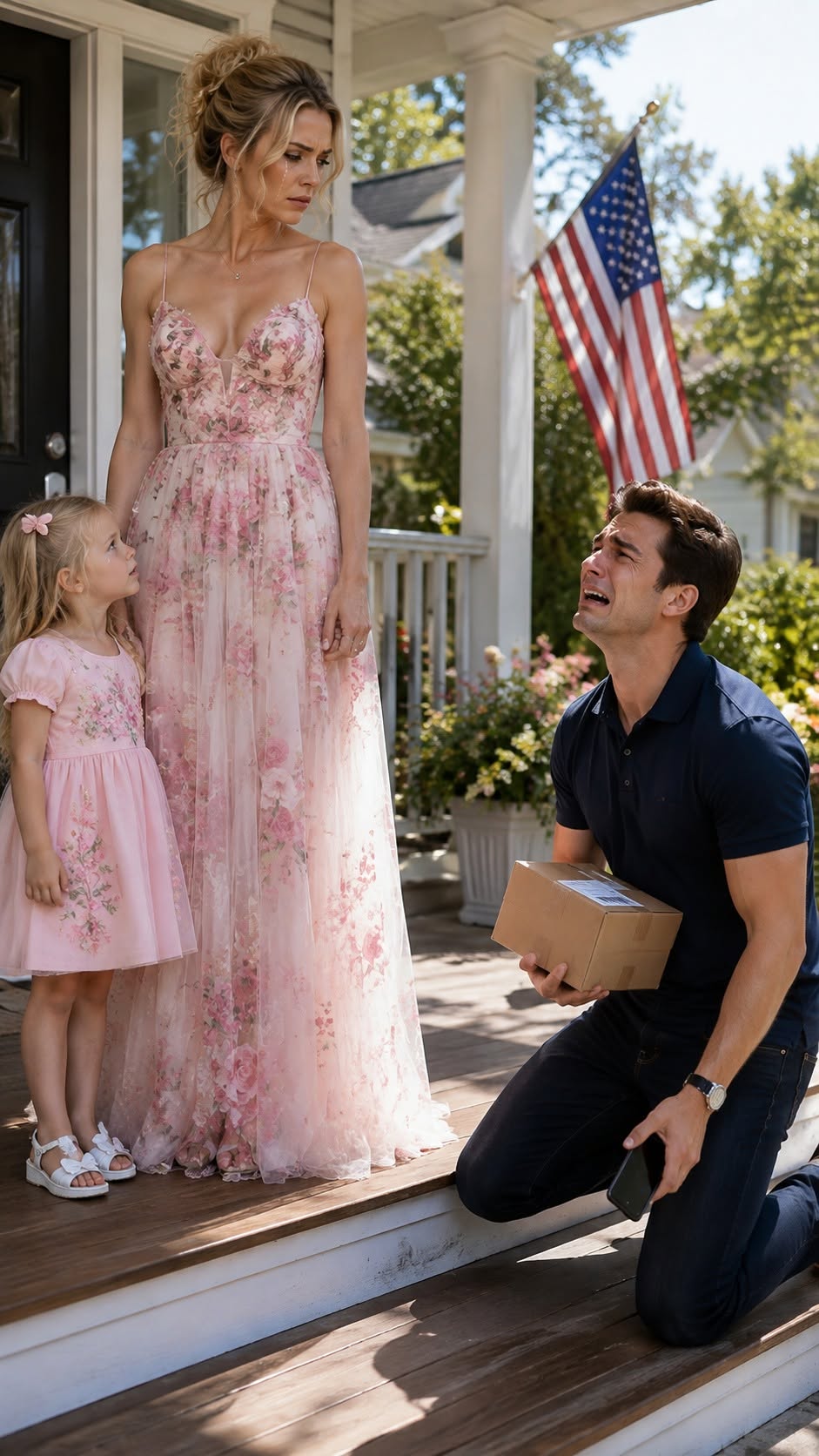
It was an unremarkable Tuesday in late September. I was standing in my sunlit kitchen in Asheville, North Carolina, methodically slicing honeycrisp apples for my daughter when the knock shattered the quiet. I wiped my hands on a dish towel, pulled open the heavy wood, and there stood Dany. He was gripping his smartphone against his chest like a ballistic shield, wearing a delivery company polo that hung loose on his frame.
He breathed my name. Then, his wide, panicked eyes drifted past my shoulder, and I watched every single drop of blood drain from his face. Without another syllable, he stumbled backward down my porch steps, the phone already pressed to his ear.
“Mom, you need to see this,” his voice cracked, trembling with a tectonic shift in reality. “She never told us…” He couldn’t finish the sentence. His throat simply seized.
What my mother chose to do with that frantic phone call—and the apocalyptic truth I finally unleashed on a Sunday morning in front of two hundred people who worshipped her—is the reason I am stripping this story down to the bone.
There is a small, sturdy brick house in West Asheville with a front door the exact, vibrant hue of a robin’s egg. I painted it myself the week we moved in. Three thick coats, a cheap nylon brush, and the golden afternoon light. The final coat of paint was applied on the exact day I permanently stopped apologizing for my own existence.
Inside this sanctuary lives a three-and-a-half-year-old hurricane named Marin, a girl who firmly believes that buttermilk pancakes constitute an independent food group. I am a registered nurse. I work grueling twelve-hour shifts—sometimes stretching to sixteen—in the downtown intensive care unit. I can blindly recite the complicated intravenous medication schedules of eight critical patients without glancing at a single chart. Most days, I am too busy keeping strangers tethered to the earth to remember to eat my own lunch. I have watched dozens of people die politely. My family, after all, taught me exactly how to do that.
That is a dark, cynical joke I only allow myself to make on the solitary drive home, where the steering wheel doesn’t judge me.
Our world is incredibly small, but it is deliberately mine. Daycare, the sterile hum of the ICU, dinosaur-shaped pancakes, and the public library on Saturday mornings. First, I scraped together rent, and eventually, a mortgage that I still can’t fathom a bank actually approved. I painted every single wall in this house, but the front door was the only pigment I agonized over. I wanted it blue. Blue like the bruised, beautiful sky at the end of a grueling night shift, when the chaotic world is hushed and finally belongs only to you.
For four years, absolutely no one from Dayton, Ohio had crossed that blue threshold. That was not a geographical accident. It was an engineered boundary. But it was certainly not the grand, tragic narrative my family had spun.
They told everyone I had disappeared.
Here is the insidious thing about the word disappeared: it is entirely passive. Morning fog disappears. Misplaced car keys disappear. It is a cowardly verb that conveniently erases the person holding the eraser. What actually transpired is that I stopped hemorrhaging money into their bank accounts, and in return, my family lost the ability to perceive my existence.
The money is where this infection started. But standing on my porch, watching my brother hyperventilate, I realized the money wasn’t where it was going to end. Dany slowly lowered his phone, his chest heaving, and reached into his pocket. He didn’t offer a hug. He didn’t offer an apology. Instead, he placed a cream-colored envelope on my porch railing with shaking fingers. The moment I saw my mother’s immaculate handwriting on the front, a cold dread coiled in my gut, forcing me to confront the ghosts I thought I had buried beneath three coats of blue paint.
Chapter 2: The Subscription of Love
To understand the envelope on my railing, you have to understand the one that started it all. I am a nurse; I thrive on exact dosages and precise timelines. The hemorrhage began a decade ago, at my own graduation dinner, sitting around my mother’s cramped kitchen table.
The spring I turned twenty-four, I became the very first Ives to secure a college degree. It was a nursing license paid for with crippling student loans and suffocating double shifts smelling of diner grease. My mother, Carol, orchestrated a celebratory dinner at our house in Dayton. There was pot roast, a wobbly folding table, and a sheet cake where my name was miraculously spelled correctly. She proudly propped my hard-earned diploma against the porcelain gravy boat, displaying it like a conquered trophy. My father, Ray, bowed his head and offered a booming blessing. Dany, then a perpetually hungry nineteen-year-old, demolished half the cake.
For approximately two hours, I was the undisputed pride of that kitchen. I would have set myself on fire to stay in that warm, golden light. I want you to memorize that desperate feeling, because my mother certainly banked on it.
As I cleared the dessert plates, Carol slid a cream-colored envelope across the faux-wood laminate. My name was inscribed on the front in her tidy, elegant church-bulletin cursive. I smiled, assuming it was a Hallmark card.
It was completely empty.
“For the house fund,” she murmured, patting my knuckles with a saintly smile. “You’re the one who made it out, Tori.”
She delivered the demand so warmly, exactly the way one might hand down a treasured family recipe. Around the table, the silence was absolute. My father suddenly found his coffee endlessly fascinating. Dany stared intently at the remaining crumbs of icing. I remember letting out a nervous, breathy laugh because I thought I comprehended the transaction. One envelope. One favor. The least a successful daughter could do. New nurses earned decent wages, their basement furnace was ancient, and I was, after all, the one who had escaped. I filled that envelope with a chunk of my very first real paycheck and mailed it north.
The second month, a fresh, identical envelope materialized in the mailbox of the cramped apartment I shared with two other rookie nurses. The third month, another.
Nobody ever asked out loud again. The asking had been permanently established at a celebration, witnessed by a family dressed in the costumes of pride. That envelope was never designed to be a one-time gift. It was a subscription. I simply hadn’t read the terms of service, because the contract was drafted in a language I had been brainwashed to call love.
By year two, the envelopes felt archaic, so I streamlined my own extortion through Zelle. On the first of every month, money vanished from my checking account before the sun even breached the horizon. Fourteen hundred dollars on a standard month. Two thousand when catastrophe allegedly struck. And in the Ives household, catastrophe was always on the calendar. A new roof after a hailstorm. I happily financed that roof, feeling a sick, twisted pride that I was keeping the rain off my father’s head from three states away. When Dany needed a used Honda for a new job, I fronted the cash.
On my side of the ledger, my life looked like this: picking up night differentials, working every single Christmas shift for six consecutive years because holiday pay was double time. My exhausted colleagues assumed I was aggressively saving for a down payment or a grand wedding. I was saving, alright. I just didn’t realize I was funding a black hole.
I kept a running total in a battered spiral notebook, updated to the very penny. Not because I harbored hopes of repayment, but because numbers were the only currency in my childhood home that refused to lie. Words in my family were slick and slippery. Words like borrow, help, and just this once. Numbers, however, stood perfectly still.
I justified the bleed until I met Caleb Brand.
Caleb was twenty-eight, a commercial builder with sawdust permanently dusted in his thick hair. He had come to the hospital to rebuild a rotted awning at the east entrance. He stopped me as I stumbled out of a grueling trauma shift, asking my professional opinion on railing heights for rehab patients. I mumbled the ADA compliance numbers from memory, half-delirious, and he wrote them down like I was reciting Shakespeare.
He rebuilt that awning twice as strong as the blueprints demanded. Then, he asked me to breakfast, noting with an easy grin that dinner time was technically the middle of my night. For three beautiful years, Caleb packed my lunches in Tupperware, meticulously labeling them by my shift schedule. When he finally proposed, he didn’t offer a diamond. He tied a tarnished brass key onto a velvet ribbon—the key to a sagging, dilapidated fixer-upper he’d just put an offer on. He swore to me we’d drink coffee on its porch until our bones turned to dust.
I said yes to the key. I said yes to the sawdust.
I brought him to Dayton exactly once. Within ten minutes, my mother asked what his hourly rate was before she bothered to ask his middle name. She interrogated him about union benefits and insurance premiums. Caleb fielded it all with his trademark, endless patience. On the quiet drive back south, he simply squeezed my knee and chuckled, “Your mom sure loves her numbers.”
He had no idea how terrifyingly accurate he was.
That night, as Caleb slept soundly beside me, my phone screen illuminated the dark bedroom. A text from Carol. “He seems steady, honey. Also, we need a small loan this month. Don’t tell your father.”
I stared at the glowing pixels until my eyes burned. My engagement, it turned out, required a cover charge. And I paid it. I want to be brutally honest with you: for six years, I always paid the ransom.
That autumn, a vicious flu strain ravaged the city, emptying half our ICU staff. The nurses left standing worked like sled dogs in a blizzard. I dragged myself home after a brutal sixteen-hour shift, collapsed onto my mattress, and slept straight through a screaming alarm for the first time in my adult life. I woke up disoriented. It was the fourth of the month.
The money had gone out three days late.
Three days. I remember tapping ‘Send’ on the banking app, stupidly thinking no one would even notice the delay.
My phone vibrated at 7:00 A.M. sharp. My mother didn’t yell. Yelling I could have defended myself against. Her voice was flat, sterile, and cold as a surgical blade. She informed me the mortgage was past due. She lamented how she’d had to nervously shuffle funds around in front of my father, which was deeply humiliating for her.
And then, she drove the scalpel in, delivering the sentence I have carried lodged in my chest cavity for five years:
“You don’t get to be tired, Tori. You’re the one who made it.”
I stood paralyzed in my kitchen, wearing scrubs so heavily laundered they felt like tissue paper, staring down at my own trembling hands. I apologized twice. She formally accepted once. We hung up like a dissatisfied customer and a bank teller.
But it wasn’t her cruelty that shames me now. It was my reaction. I spent my entire commute to the hospital agreeing with her. I obsessively brainstormed backup alarms and fail-safes so I would never again be “tired” in a way that inconvenienced her kingdom.
It would require an absolute, earth-shattering catastrophe to make me put the phone down for good. Life, in its terrible, ruthless efficiency, had one scheduled for the following week.
It was a Tuesday afternoon. The charge nurse didn’t page me; she came to find me directly. I knew before her lips even parted, because I have been the face that walks down the hallway to deliver the end of the world.
A suspended scaffold on a commercial high-rise downtown. A steel cable that the safety inspection paperwork swore was pristine had snapped.
Caleb Brand, thirty-one years old, was gone before the paramedics even cleared the second traffic light.
I have zipped up strangers in body bags with more ceremony than the universe afforded the man who wrote love notes on my Tupperware. His crew carried his casket. Eight burly builders in ill-fitting, borrowed ties, weeping openly into their calloused hands.
My family did not attend. A seven-hour drive was deemed “too long” on short notice. Instead, they sent a pathetic arrangement of white carnations with a card signed, To the Ives Family, in my Aunt Sharon’s loopy handwriting. Carol had delegated the grief.
Four days after watching Caleb go into the earth, my phone buzzed. A text from my mother.
“So sorry about everything, honey. Will this month’s transfer be late with all this going on?”
I read the words while standing barefoot in Caleb’s closet, my face buried in a flannel overshirt that still smelled sharply of cut pine and his deodorant. Grief is a paralytic. It makes you obedient long before it makes you angry. I wired the money on time.
Two weeks later, the physical toll broke me. I fainted dead away near the nurses’ station. My fiercest friend, a fellow nurse named Dena, marched me by the elbow into a fluorescent-lit pharmacy bathroom. I peed on a plastic stick, assuming the stress and night shifts had finally wrecked my biology.
Two glaring pink lines surfaced like a terrifying, neon sunrise.
I was sitting in a darkened ultrasound room, cold gel smeared across my trembling stomach, staring at a flickering monitor. The technician’s math put me at sixteen weeks. I did my own brutal calculus in that dark room. I was five months away from becoming someone’s mother. I was one phone call away from becoming no one’s daughter.
Chapter 3: The Gospel of the Missing Daughter
I planned the phone call to my mother with the clinical precision of a high-risk medication push. Order, dosage, no surprises. I stood under scalding shower water and rehearsed the sequence: Mom, Caleb is dead. Mom, I am pregnant. Mom, the obstetrician says my blood pressure is entering the stroke zone. I have to stop sending the money. I need every dollar and every calm heartbeat for this baby.
Simple. Undeniable. True.
But in what specific order are you supposed to hand a matriarch a death, a grandchild, and a financial boundary?
I chose wrong. I led with the boundary.
Carol answered on the second ring. “Mom,” I breathed, gripping the edge of the bathroom sink. “I have to stop sending the money.”
That was as far as I ever got. The line detonated.
“Ungrateful!” she shrieked, a terrifying, guttural sound I had never heard her make. “After everything we sacrificed? So this is who you are now! What about the mortgage? What about your father’s failing heart? Who do you think funded your ambition, Victoria?”
Then, a sharp click. The dial tone hummed in my ear, flat and continuous, like a patient flatlining.
I called back twice. Straight to voicemail. I slid down the bathroom cabinets and sat on the cold linoleum, feeling the words I never got to speak—Caleb’s name, the baby’s existence—settle deep into my stomach like swallowed shards of glass.
That week, my skyrocketing blood pressure earned me a referral to a maternal-fetal specialist. He looked at my charts, used the terrifying words pre-term risk, and treated the concept of ‘stress’ like it was a lethal poison. Cut the cord, he ordered gently, or spend the rest of this pregnancy in a hospital bed.
Desperate, I tried the final door. I called my father’s cell phone. Over the static, I could hear his garage radio playing classic rock. “Dad,” I sobbed, the dam finally breaking. “Please. Something terrible has happened.”
Ray Ives, the man who once drove four hours through a blizzard just to hear me sing in a middle-school choir, lowered his voice to a terrified whisper. “Don’t upset your mother, Tori.”
Not, What happened? Not, Are you safe? Every single emotional road into that family ran directly through Carol, and Carol had permanently detonated the bridge. I set the phone face down on my kitchen counter. I did not pick it up again.
Seven hours north, in the vacuum of my silence, my mother began spinning a masterpiece.
Nobody in my family ever told a lie you could actually quote on the record; they were artists of implication. Two months after she hung up on me, Aunt Sharon—my mother’s sister and the family’s personal broadcasting network—posted on Facebook: “Praying for my sister through a heartbreaking season. Some children simply forget the good people who raised them.”
Then came the coffee hour at First Grace Church. A parishioner innocently asked Carol where I had been lately. My mother, I was later told, stared mournfully at her sensible shoes. She let the silence stretch until it became heavy and suffocating, and then she whispered, “We don’t really know anymore.” She dabbed her dry eyes with a tissue.
We don’t really know anymore. It was a stroke of absolute genius because it was technically true. She didn’t know, because she had hung up before knowing was mathematically possible.
By Advent, the choir gossips were using the word disappeared. Carol never corrected them. In a small, insular church community, an uncorrected rumor quickly morphs into holy scripture. My mother never explicitly lied. She just wept at the precise intervals and allowed two hundred decent, gullible people to write the tragedy for her. In the court of public opinion, her performative grief was the only evidence required. The missing daughter was convicted without ever being called to the stand.
I knew absolutely none of this at the time. I was busy surviving.
The money that used to vanish on the first of the month stayed in my account. It transformed into a safe crib. It became a reliable car seat. It morphed into the final piece of a down payment on this little brick house in West Asheville. At first, hoarding my own paycheck felt deeply obscene, a testament to what six years of financial brainwashing does to a person’s arithmetic.
Dena, my godsend of a colleague, carried every box heavier than a lamp when I moved in at eight months pregnant. In a burst of nesting defiance, I painted the front door that vivid blue before I even unpacked my silverware.
But the silence from Ohio was a heavy ghost. In my eighth month, I sat at my new kitchen island and wrote one handwritten letter on actual paper. I addressed it to my grandmother, June—my father’s mother. At seventy-eight, June was the only soul in the Ives bloodline who preferred a jagged, ugly truth over a smooth, comfortable lie.
I poured everything onto those pages. Caleb’s death. The scaffold. The baby due in the fall. The extortion. The phone call where Carol hung up. I gave her my new Asheville address, making her the sole keeper of my coordinates. I asked for nothing but for her to simply know.
I watched the mailbox like a hawk. Two weeks passed. Six weeks. My swollen ankles ballooned. The mailbox remained a dark, empty cavern. I tried to convince myself the postal service had lost it. The alternative—that even the fierce, independent June had swallowed my mother’s Kool-Aid—was a weight I simply could not lift.
Marin Brand Ives arrived on a rainy April morning, three weeks ahead of schedule and entirely unbothered by the chaos surrounding her. The perilous blood pressure held the line just long enough. Dena stood exactly where a family is supposed to stand. She squeezed my hand through the agonizing contractions, narrating the process like an upbeat sports announcer, and when it was over, she cut the umbilical cord because someone who genuinely loved us deserved that honor.
When they placed six pounds of furious, black-haired life onto my bare chest, the dam broke. I am famous in the ICU for my dry eyes. But holding my daughter, I sobbed. I sobbed a startling, ugly cry because she was here, she was breathing, and she was finally safe.
The two people who should have been pacing the waiting room, drinking toxic coffee, didn’t even know she drew breath. One was buried in the earth. The other had chosen her pride over her child.
We named her Marin. Caleb had spoken the name once, standing on the rotted porch of the house he never got to buy, testing syllables against the wind. When he said Marin, he had grinned and whispered, “Her, someday.”
It took a mountain of legal paperwork, but Caleb’s name is permanently inked on the birth certificate of a little girl he never got to meet. And the brass house key he gave me instead of a diamond ring? It hangs in a small shadowbox right beside my blue front door.
For four years, I did the thing my mother categorized as “disappearing.” I simply lived.
The mortgage grew lighter. The dogwood tree in the front yard stretched toward the sun. I baked alarming dinosaur pancakes. Every December, I sent exactly one piece of mail north: a Christmas card to Grandmother June, featuring Marin’s latest school photo, with my return address printed neatly in the corner. No phone number, no pleas for attention. I never knew if she read them or threw them straight into the fireplace.
But sitting on my porch now, staring at my pale, hyperventilating brother, the four years of peace abruptly evaporated.
Dany lowered his phone. He looked at the framed photos visible down my hallway—Caleb’s funeral ribbon draped over his portrait, the ultrasound, the baby pictures. I watched my brother solve the great, agonizing riddle of our family in four terrifying seconds.
He didn’t yell. He sat down heavily on my porch steps and wept into his hands. I brought him inside, poured him water, and for two hours, he sat at my table and asked the single question no one in my family had ever bothered to ask: How did he die, Tori?
When he finally left to drive back to Ohio, he set that cream-colored envelope on my railing.
“She wants you there, Tori,” Dany had whispered, his eyes locked on the floorboards. “She’s going to fix this.”
I tore the envelope open. Inside was a glossy, professionally printed church bulletin insert.
Homecoming Sunday. October 12th. First Grace Church. All are Welcome Home.
Fix this? I stared at the word Welcome, realizing my mother wasn’t offering an olive branch. She was building a stage, and she needed her prop.
Chapter 4: The Sewing Box Secret
Before Dany’s taillights even faded from my street, the digital assault began.
That night, my phone vibrated constantly. A cousin forcibly added me back to a group chat titled Ives Family. By 2:00 A.M., there were forty-one notifications. Lying in the dark, I watched in real-time as my mother’s four-year narrative shed its skin and mutated into something much more venomous.
The initial texts were human enough: Oh my gosh, she’s alive! But right around midnight, the tone violently shifted.
She hid a child from us. For four years.
Her own mother is heartbroken.
We deserve answers.
Overnight, I was downgraded from the tragic daughter who disappeared to the malicious daughter who deceived. Same church, same jury, entirely new charge. The only detail that mattered? Out of forty-one messages, not a single person asked for the name of the dead man in the photo Dany had described. Grief had no cash value in the Ives family, so it didn’t register on the ledger.
The following evening, my phone screen flashed with an incoming call. It was Carol.
I answered it. I am still dissecting whether that was bravery or masochism.
She was weeping before I even finished exhaling the word “Hello.” I will give her this: my mother’s tears are technically real. They are real in the exact way that rain manufactured on a Hollywood soundstage is real water. Engineered. Timed for maximum impact.
“My baby… my baby had a baby,” she sobbed into the receiver.
I stared out the kitchen window, watching Marin collect acorns in the twilight, and I delivered the only truth I possessed. “You could have known her since the day she took her first breath, Mom. All you had to do was let me finish one sentence.”
A beat of total silence. I could hear the gears grinding in her head—grief flawlessly switching tracks to PR strategy.
When she spoke again, her voice was utterly dry. “Come to Homecoming this Sunday, sweetheart. Stand up at the pulpit with me. I will tell everyone you were terribly sick. You were, weren’t you? With your dangerous blood pressure? A sick, confused girl who couldn’t reach out isn’t a scandal, honey. It’s a powerful testimony. No one ever has to know about the money.”
I stopped breathing. The sheer, blinding audacity of it washed over me like a flash flood. Notice the architecture of that sentence. She retroactively diagnosed me with love. She converted four years of active, malicious erasure into a holy redemption arc starring herself. And she offered to bury the extortion—the six figures of stolen wealth—under the church carpet forever, provided I co-signed the lie.
She didn’t want her daughter back. She wanted the intellectual property rights to my tragedy.
“I’ll think about it,” I whispered, and hung up.
Two nights later, an unknown Ohio number lit up my screen.
“Victoria.” The voice was pure gravel and vintage lace, speaking my full name with an unwavering steel I hadn’t heard in years.
“Grandma June?” I gasped, sliding down the kitchen cabinets until I hit the floor.
“Your brother gave me this number,” she said briskly. “The first useful thing that boy has done in a decade.”
She filled the silence like a woman who had been hoarding oxygen. She had received my desperate letter four years ago. She had read every single page. She had cherished every Christmas card, watching Marin grow from afar, and kept them exactly where it was safe.
“Why didn’t you write me back?” I asked, my voice cracking, sounding like a terrified eight-year-old.
“Look at my hands, child,” June retorted gently. “They shake like a paint mixer. But more importantly, a letter leaving this house gets scrutinized at more checkpoints than a prisoner of war camp.”
Then, the gravel in her voice smoothed out into a low, lethal testimony. “I want you to hear this from me while my lungs still work. I never believed the word disappeared. Not for one single second. People do not disappear, Tori. They are erased. And I have sat at Carol’s dining table for forty years, watching very closely to see who holds the eraser.”
I clamped a hand over my mouth to stifle a sob. For four years, I had convinced myself I didn’t need a single soul in Ohio to validate my truth. You can survive on that stubborn independence. But you only realize how crushing the weight of being disbelieved is the exact moment someone finally lifts it off your shoulders.
“Now,” June commanded. “I am told there is a little girl in your house wearing my face. Bring her to me while these eyes still function. Not for Carol’s ridiculous show. For a quiet Saturday.”
I packed my bags.
The plan was a tactical strike. Drive seven hours up to Ohio after my Friday shift. Stay in a cheap motel on the outskirts of Dayton. Spend Saturday completely off the grid at June’s house. Sunday at dawn, we would be burning rubber back south before the church doors even unlocked. I would deprive my mother of her lead actress.
Saturday afternoon on June’s porch was a revelation. Marin, usually painfully shy, marched right up to her great-grandmother. June placed her trembling hands on my daughter’s cheeks and wept.
Later, June asked Marin to fetch her battered tin sewing box. “Dig under the heavy thread, child,” June instructed.
Marin pulled out a thick stack of envelopes wrapped in a rubber band. Every Christmas card I had ever sent. Their edges were soft and worn from being touched constantly.
“Why hide them under the thread?” I asked, though I already felt a cold sickness rising in my throat.
June looked at me, her eyes flinty. “Because your mother found this box at my kitchen table last Christmas when she was looking for scissors. I watched her from the hallway. She opened the box. She read every single card. She looked at the photos. She put them back. And she never said a word to me, or to anyone else.”
Last Christmas. Ten months ago.
My mother had possessed my exact address for ten months while she stood at the altar and begged God to find her lost girl. She didn’t need to find me. I was far more valuable to her missing.
At 4:00 P.M., Aunt Sharon’s Buick slowly idled past June’s house. Sharon hopped out under the guise of returning a casserole dish she had been holding hostage since Easter. Her eyes immediately locked onto Marin playing on the porch. The arithmetic processed in Sharon’s brain. She hugged me, a physical inventory disguised as affection, and sped off.
By supper time, Dany texted me at the motel. Mom knows. She just announced it at the potluck. She told the whole church God brought her lamb home, and that you are taking the stage tomorrow to make the family whole.
I sat on the motel bed, feeling a violent vertigo. I had been written into a script I had explicitly rejected.
Then, another knock on my motel door. Dany. He looked exhausted, clutching a massive, ancient spiral notebook against his chest.
“I found mom’s household ledger,” Dany whispered, stepping inside. “You need to see where your money actually went.”
I opened the notebook. I braced myself to see gambling debts, or secret luxury purchases. Instead, the reality was infinitely more pathetic.
Hailstorm roof repair: Materials $340. Labor: Ray and Dany.
My father and brother had fixed the roof themselves. The $1,400 I sent that month? Diverted.
I traced her neat columns. First Grace Building Fund in the name of Carol Ives. Benevolence Committee Sponsorship – Carol. Loans to Cousin Greg – Forgiven.
My money hadn’t been keeping the family from drowning. It had been systematically weaponized to purchase my mother a throne of unwavering adoration in a very small, very cheap kingdom.
Dany flipped to the oldest page, dated 1989. Wedding ring pawned. Mama’s back rent.
“She was twenty-four,” Dany said softly. “She sold her own wedding ring to cover our grandparents’ debts. They never paid her back. She’s not spending your money, Tori. She’s collecting a debt she fundamentally believes every daughter owes.”
It didn’t absolve her. But it instantly removed revenge from my heart. It replaced it with a crushing, suffocating pity.
“I’m paying you back for the Honda,” Dany added, ashamed.
“The car was a gift,” I said. “The gifts were never the part that hurt.”
That night, lying under a water stain on the motel ceiling, Marin rolled over in her sleep.
“Mommy,” she mumbled into the dark. “Do I have a grandma?”
The gap had opened. I lay frozen. If I fled at dawn, my silence would no longer protect me; it would simply become my mother’s raw material. She would spin a sermon about a prodigal daughter too ashamed of her sins to face the light of the Lord. And someday, my daughter would internalize that lie.
I walked into the motel bathroom, flipped on the harsh yellow light, and pulled the church invitation from my purse. All are Welcome.
I decided to go to church.
Chapter 5: The Acoustics of Truth
I did not print bank statements. Six years of financial bloodletting sat in a locked filing cabinet seven hours away, and that is precisely where I left them. I refused to stand in a sanctuary waving receipts like a desperate process server. Paper ledgers were my mother’s native tongue. I was done speaking her language.
I ironed my simple navy dress. I braided Marin’s dark hair and tied it with a bright orange ribbon. I slipped Caleb’s brass key into my pocket—not as a weapon, but as ballast.
First Grace Church holds exactly two hundred people. That Sunday, it held every single one of them, plus overflow folding chairs in the aisles. A massive paper banner hung over the double doors: WELCOME HOME.
Dany had secured our seats. June sat on the aisle of the front pew, oxygen line in place, wearing her Sunday pearls. Marin and I slid in right behind her during the second hymn. Half the sanctuary swiveled to stare. The temperature in the room was a chaotic mix of awe, judgment, and feral curiosity.
My father stood at the very back wall, twisting his cap in his hands, looking at the floor.
My mother wore a lavender suit, holding a pristine lace handkerchief and a wireless microphone. She took the pulpit. She waited out a brief audio squeal like a seasoned televangelist.
“God has brought my lost lamb home,” Carol proclaimed, her voice trembling with perfect, practiced vibrato. She dabbed her perfectly dry eyes. Then, she stepped down from the altar, walked to the second row, and extended the microphone toward me like a communion plate. “Tori, baby. Come up here and give thanks with me.”
The fans chopped the heavy air. Two hundred faces waited for the prodigal daughter to weep and beg for readmission to the fold.
I looked down at June. My grandmother gave me a single, microscopic nod.
I stood up. I stepped into the aisle.
I did not take the microphone.
First Grace was constructed in 1921. It was built with vaulted wooden ceilings designed to carry the human voice long before electronics existed. A calm, steady voice carries just fine.
I stood at the front, my hands resting easily at my sides. I was not afraid. A decade in a trauma unit recalibrates your definition of an emergency. This wasn’t an emergency. It was an autopsy.
“I didn’t disappear,” I said. The acoustics carried my voice to the very back wall. “I stopped paying for my subscription to this family. For six years, those two concepts were identical.”
A church bulletin slipped off someone’s knee and fluttered to the floor. No one moved to pick it up.
“One hundred thousand dollars,” I stated clearly. “That is not a metaphor. I kept the total. You may check my arithmetic with anyone sitting in these pews who ever received a ‘miracle’ loan from the benevolence fund.”
I watched the exact figure detonate across the congregation. I saw three faces in the middle rows—recipients of transmission repairs and security deposits—go rigid with sheer terror.
“The year I quote-unquote disappeared,” I continued, my voice never rising above a conversational tone, “I buried the man I was going to marry. I delivered our daughter entirely alone. Not a single person asked. One question would have found me.”
I turned slowly to face my mother. Her lavender suit suddenly looked like armor that was two sizes too big.
“I was allowed to be tired, Mom,” I said, handing her back her own weapon. “Just never here.”
The lace handkerchief dropped to her side. Carol, the maestro of the fellowship hall, completely lost the tempo of the room for the very first time in her life.
“How dare you,” she hissed. The microphone in her trembling hand caught the sharp P of her breath, sending a harsh, electric screech echoing off the stained glass. She was physically shaking.
I wasn’t. Quiet, it turns out, is the most deafening sound you can introduce to a room built for echoes.
I watched the sanctuary visually fracture. Some faces softened toward me with sudden, horrifying realization. Other faces—people I had known and loved since childhood—turned to unforgiving stone. They shook their heads in disgust. In their minds, I was disrespecting a saint, and no ledger in the world could alter their faith. That is the ultimate tax of the truth. It doesn’t convert everyone; it merely destroys the illusion of a unanimous lie.
I stepped back to the pew, took my daughter’s small hand, and walked her the three steps forward to the front row.
“Marin,” I said softly, “this is your great-grandmother, June. She is the only reason I still believe the word family has any meaning.”
June placed her shaking hands on Marin’s cheeks in full view of the congregation. Even the stone faces couldn’t look away from the undeniable, biological mirror of a great-grandmother meeting her stolen legacy.
I scooped Marin up onto my hip. I nodded to Dany to assist June, and I turned my back on the altar.
As I walked up the center aisle for the last time, past the gawking faces, my mother stepped away from the pulpit. As I drew level with her, she leaned in. She had lowered the microphone.
“Everything I did,” Carol whispered, her voice stripped of the theatrical cadence, vibrating with a desperate, terrifying sincerity, “I did for this family.”
She believed it. That was the most devastating tragedy of all. I could see the ghost of a twenty-four-year-old girl at a pawn shop counter, permanently learning that a daughter’s only value is her utility.
I stopped. I looked my mother dead in the eyes.
“Being needed is not the same thing as being loved, Mom,” I whispered. “I truly hope one day, somebody loves you for free.”
Her face completely shattered. I didn’t stay to watch the pieces fall.
I pushed open the heavy oak doors, and the crisp, golden October air rushed over my face. Marin squinted up at the bright sky.
“Is church over, Mommy?” she asked.
“Ours is, baby,” I replied.
Epilogue: The Cost of Keeping the Paint Fresh
We were halfway to the rental car when I heard gravel crunching frantically behind us. It was Dany. His tie was ripped loose, his chest heaving. He had left June sitting in his idling car with the heater on.
He didn’t launch into a defense of our mother. He didn’t offer empty platitudes about how ‘she means well.’ He simply looked at his niece, who was resting her head on my shoulder, and then he looked at me with open, empty hands.
“Can I come see her?” Dany asked. It was the bravest, most terrifyingly honest sentence spoken by an Ives in ten years. “No envelopes. Just an uncle.”
“Sundays,” I said, a genuine smile finally breaking across my face. “Bring nothing.”
Six weeks later, on a surprisingly warm Saturday in November, Grandmother June sat in a rocking chair on my porch in Asheville. Dany had driven her the seven hours down, complaining loudly about her terrible taste in road-trip radio. June had her tin sewing box on her lap, patiently teaching Marin how to thread a needle. Four hands were shaking for entirely different reasons, but when the thread finally slipped through the eye, they cheered like they had won the lottery.
My mother’s letter had arrived the Tuesday prior. Three pages, written in her immaculate cursive. It detailed a “season of trials,” a daughter “confused by grief,” and quoted three scriptures about honoring thy parents. The word sorry did not appear a single time.
I read it once while leaning against my kitchen counter, tossed it into the junk drawer, and went back to boiling pasta. It hurt far less than I had anticipated. That is the true miracle of walking away: the wound doesn’t vanish, but it finally stops being load-bearing.
Through Dany’s weekly FaceTime calls, I get the sanitized updates. Carol stepped down as the church treasurer, citing “health reasons.” A few relatives who had secured loans from my stolen money have quietly started pressing twenty-dollar bills into June’s hands. June takes the cash without a word and uses it to buy premium knitting yarn.
My father sent a small card. Written inside in faint pencil was a single line: I am sorry I looked away.
I have kept it. I haven’t answered it yet. Some doors require more than one coat of paint, and for the first time in my life, I am allowed to take my time.
Yesterday afternoon, Marin and I touched up the front door. She wielded her own tiny brush, getting vivid blue paint on her nose, on the porch railing, and a little on the cat. The hardware store swatch calls the color Curious House Sky.
Marin just calls it ours.
If you ever find yourself paying an exorbitant cover charge just to remain a background character in someone else’s fabricated story, drop the script and walk out the door. The people who genuinely love you will read every single page of your real story. And they will read it for free.