The General’s Order: A Chronicle of My Own Coup d’État
Chapter 1: The Shattered Altar
When Kyle Vance suddenly released my trembling fingers, the grand wedding march was still echoing from the vaulted ceilings of the banquet hall. Three hundred invited guests sat paralyzed in a suffocating silence as they watched the man I loved bolt from the dais. The coattails of his tailored tuxedo snapped in the air with every frantic stride he took, and the sudden, violent draft ripped a flurry of white petals from my bridal bouquet, scattering them across the polished floor.
The master of ceremonies froze entirely, the microphone hovering uselessly near his lips, emitting nothing but a sharp, ear-splitting screech of feedback that made the crowd wince. I stood anchored to the exact center of the stage, trapped inside a gown that had required three agonizing rounds of alterations. My heavy veil cascaded from the crown of my head down to the small of my back, and stretching out beneath my satin heels was a pristine crimson runner that led directly to the heavy oak double doors.
That was precisely where he was running. He was sprinting toward the woman standing hesitantly by the threshold.
Sarah was clad in a remarkably plain linen dress, one hand gripping the handle of a rolling suitcase. She looked as though she had caught a cab straight from international arrivals. Her chestnut hair was longer than I remembered from five years ago, her frame noticeably frailer. Yet, the very second her silhouette appeared in that doorway, Kyle’s entire universe contracted until only she remained. He tore past thirty rows of bewildered friends, past his father, Richard Vance, whose complexion morphed instantly into a terrifying shade of ashen rage. He flew past my own mother, who sat petrified, a porcelain teacup rattling violently against its saucer in her hands.
Kyle collided with Sarah, wrapping her in a desperate, clinging embrace.
A graveyard silence smothered the room for three agonizing heartbeats. Then, the dam broke, and a tidal wave of frantic whispers flooded the space.
“What on earth is happening?”
“Did the groom just bail?”
“Who is that girl with the luggage?”
“The Vances are a laughingstock… and look at the bride. She’s just standing there. Oh my god, her face.”I absorbed every single syllable. Rooted to the stage, my knuckles white as I throttled the stems of my ruined bouquet, a terrifying void expanded inside my skull. There was no fury. There was no heartbreak. There was only a profound, echoing emptiness. It felt as though an invisible hand had tipped my mind upside down and drained its contents, leaving behind a hollow porcelain shell baking under the glare of the spotlights.
The MC finally snapped out of his stupor. He covered the microphone with his palm and leaned in, his breath hot against my ear. “Miss Simmons… perhaps it would be best if you stepped down.”
The moment he spoke, I realized how violently I was vibrating. The tiny lapel mic pinned near his collar picked up the tremor of my ragged, shallow breaths, broadcasting my panic through the towering speakers. In. Out. In. Out. The sound reverberated like a death knell.
I cast my gaze downward at my bouquet. White roses and lush peonies. I had spent hours at the wholesale flower market at dawn, stubbornly haggling with the vendor to knock the price down from $450 to $400. Kyle’s brilliant diamond rested heavily on my left ring finger. When he fled, he hadn’t bothered to reclaim it, and I hadn’t possessed the presence of mind to throw it at his retreating back.
Three hundred pairs of eyes impaled me like a volley of arrows. I didn’t have to look up to feel their pity and morbid curiosity. Peripherally, I saw the glowing rectangles of smartphones recording my humiliation. Relatives of the groom, Uncle Gary and Aunt Susan, were huddled together at the third table, hissing venomous commentary. At the fifth table, my colleagues from Lincoln Elementary sat in stunned dismay. Our vice principal, Mrs. Higgins, pressed a napkin to her mouth, while Rachel, the math teacher, hovered in a half-crouch, paralyzed by the indecision of whether to rescue me.
At the eighth table, my mother remained a statue of grief, her fingers clamped onto the rim of her wine glass with such ferocity I expected the crystal to shatter.
Nobody intervened. Everyone merely spectated.
My knees threatened to buckle. The magnificent dress was suddenly a prison of lead. Three dense layers of tulle and a structured lining weighed heavily against my exhausted frame. I had borrowed my friend’s designer heels—a half-size too large—and now my toes slid agonizingly forward, my legs transforming into dead weight. The MC hovered helplessly. He had orchestrated hundreds of matrimonies, but a groom deserting his post seconds before the vows was clearly not in his playbook.
I parted my lips, desperately searching for a script. What was the protocol? Assure everyone I was fine? Beg them to enjoy the catered salmon? Announce the cancellation of my own life? The syllables glued themselves together in a thick, choking lump in my throat.
Just as the darkness began to edge into my peripheral vision, a voice sliced through the humid air of the banquet hall. It was not a shout, but its absolute clarity and terrifying authority instantly annihilated the hum of three hundred whispering mouths.
“Get rid of those flowers.”
Every head in the room snapped left, toward the second row.
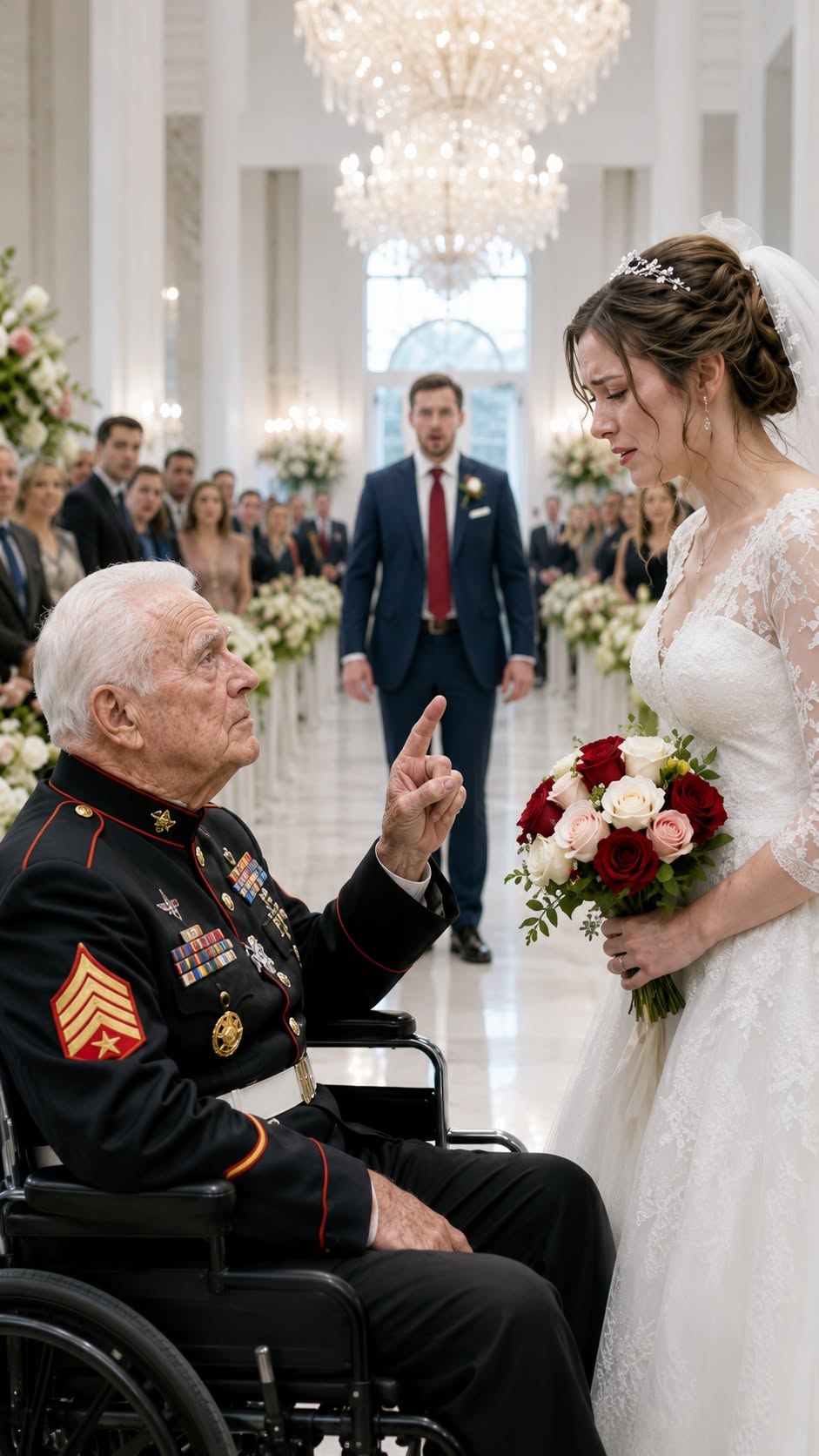
Seated there, in a high-backed wheelchair, was an elderly man. He was clad in a pristine, dark charcoal military dress uniform, his hair a cropped field of steel gray. Despite the chair, his posture was immaculate, his spine a rigid plumb line. It was abundantly clear this man was sitting solely because he chose to, not out of frailty. Standing like a monolith behind him was a broad-shouldered man in a sharp black suit, his large hands resting lightly on the chair’s grips.
The elderly man inclined his head a fraction of an inch, murmuring a command meant only for his stoic companion. The man in the suit gave a single, sharp nod and strode purposefully toward the hotel management staff hovering by the walls.
Within thirty seconds, the impossible happened. A crew of workers descended upon the lavish floral arch the Vance family had commissioned, ruthlessly dismantling it. Two men hauled away the wrought-iron frame that bore the glittering neon sign reading Kyle & Anna. On the massive LED screen behind me, a slideshow of our college memories was still looping. A photo of Kyle hugging me by the university library flashed on screen.
Suddenly, the screen died. Someone had physically yanked the power cord from the socket.
A heavy, terrified silence blanketed the room.
The old man’s wheelchair whirred, creeping forward about two feet. He lifted his chin and fixed his gaze upon me. He stared for a long, calculating moment. I saw an intense evaluation, a silent confirmation of a long-held theory, and a profound emotion I couldn’t yet identify. It was the gaze of a weary traveler who had finally stumbled upon a landmark they had been hunting for decades.
“Young lady,” he rumbled. His tone didn’t echo, yet it commanded the very air in the room. “Step down.”
I remained frozen.
“Do not just stand there. Come here.”
It wasn’t a military bark; it was the tone a patriarch uses to summon a child to the dinner table. It demanded absolute obedience without the need for justification. My paralyzed muscles finally surrendered. Perhaps his voice provided the definitive excuse I needed to flee the spotlight, or perhaps my legs had truly reached their limit. Gathering handfuls of heavy tulle, I navigated the stairs.
On the final step, my oversized heel caught the lip of the stage. I pitched forward, instinctively grabbing the brass handrail. The bouquet tumbled from my grip. The pristine roses and peonies hit the crimson carpet and were instantly, brutally crushed beneath the trailing hem of my gown.
I dragged myself over to the old man’s wheelchair and halted. Up close, his presence was monolithic. His face was a map of deep, weathered canyons—not the wrinkles of decay, but the battle scars of a violently lived life. His eyes were a piercing, unclouded blue.
“What is your name?” he inquired.
“Anna. Anna Simmons,” I replied, my voice a raspy whisper I didn’t recognize.
He offered a slow, deliberate nod. Then, his glacial gaze drifted toward the grand doors through which my future had just vanished. “That Vance boy ran off.” He stated it like an observation about a sudden change in the weather.
I offered no response. My vocabulary had been entirely depleted.
Three hundred people held their breath. In the front row, Richard Vance’s complexion shifted from puce to a sickly, translucent gray. He opened his mouth to intervene, but a corporate partner beside him wisely yanked his sleeve, forcing him back into his chair.
The old man dismissed the door and looked back at my tear-stained face. “How old are you, young lady?”
“Twenty-six.”
“Where do you hold employment?”
“At Lincoln Elementary School. In the South District. I teach English and literature.”
“Full-time?”
“Yes. Officially.”
A microscopic twitch altered the corner of his weathered mouth. It wasn’t quite a smile, but it signaled a profound satisfaction. “Good,” he murmured.
The monolithic man in the black suit immediately leaned in, anticipating the next directive. The general raised a hand. His knuckles were gnarled, the veins prominent, but his fingers were as steady as carved oak. He pointed directly at me, addressing his shadow.
“Cole. Contact Arthur. Tell him I have found him a wife.”
What will happen when the most powerful family in the city lays claim to the abandoned bride?
Chapter 2: The Weight of a Name
It felt as though someone had hit a master mute switch for the entire banquet hall. Three hundred people calcified, terrified that even a sharp intake of breath might draw the old man’s ire. It took my overloaded synapses five full seconds to decode the syllables that had just hung in the air.
Found him a wife. Arthur.
I unhinged my jaw, but my vocal cords refused to vibrate. The elderly man entirely ignored my visible shock. He continued, his low baritone cutting through the absolute stillness.
“My grandson is a Colonel in the Army Special Forces. He commands a brigade. He is thirty-one years of age.” He paused, locking his piercing blue eyes onto mine. “Young lady, will you marry my grandson?”
Pandemonium detonated. It wasn’t a roar, but a violently suppressed, frantic buzzing of a disturbed hornet’s nest. The whispering was infinitely more aggressive than when Kyle had fled.
“A Special Forces Colonel?”
“Who the hell is that old man?”
“Look at the guy pushing his chair. Look at the posture! Isn’t that General Walker? The one who commanded the national military parade last year?”Richard Vance’s demeanor shattered completely. He shot to his feet, his chair screeching violently against the floorboards. He stared at the man in the wheelchair, his Adam’s apple bobbing in a frantic, terrified rhythm. He recognized the man. He knew exactly what kind of leviathan had just surfaced in his son’s ruined wedding.
I, conversely, was completely adrift in the dark. I was just a discarded bride, drowning in a heavy dress, publicly discarded by the man I loved. And now, a stranger was offering me as a bride to a military commander.
My lips trembled as I tried to protest, but the old man raised a single finger, silencing me with terrifying gentleness.
“Do not rush to offer your answer.” The unyielding steel in his tone softened, wrapping around me like a protective cloak. “Take that heavy dress off first.” He gestured slightly to his handler. “Cole, go to the vehicle. Fetch my overcoat from the trunk.”
Cole pivoted sharply and vanished through the doors.
The general studied me again. It was an unsettling gaze. One doesn’t look at a total stranger with such profound, melancholic familiarity. He looked at me as though I were a fading, cherished photograph he was trying to commit to memory before it dissolved entirely.
“What was your father’s name?” he asked, his voice suddenly thick.
I flinched at the unexpected question. “Simmons. David Simmons.”
The general’s gnarled fingers, resting on the leather armrest, seized. It was a microscopic spasm, invisible to anyone sitting further back, but standing mere inches away, I saw the violent suppression of emotion. A heartbeat later, his hand relaxed.
“David Simmons,” he whispered to the air, and fell into a solemn silence.
Cole reappeared, bearing a massive, olive-drab military overcoat. He stepped behind me, holding the heavy wool garment open with mechanical precision. “Miss Simmons, please put this on,” he murmured.
The coat weighed a ton. The heft didn’t come merely from the thick wool, but from the invisible, suffocating history woven into its threads. A muted silver insignia glinted on the broad collar. I pulled it tightly over my ruined satin gown.
Richard Vance finally found a scrap of courage. He marched out from behind his VIP table, a sickeningly diplomatic smile plastered across his sweating face. “General Walker, surely there is a grave misunderstanding here today. This is my son Kyle’s wedding. This is a private family matter. Your—”
“Your family’s wedding concluded the second your boy ran like a coward,” the old man interrupted, his voice dropping to a dangerous, icy gravel.
Vance’s left cheek spasmed. “The boy is a fool! He panicked. A momentary lapse in judgment. I will dispatch my security to drag him back here immediately—”
“There is no need for that.” General Walker lifted his hand a fraction of an inch, a gesture that physically choked the words out of Vance’s throat. “The woman who was discarded by your son is now required by our family. The Walkers.”
He delivered the surname like a death sentence. He didn’t even grant Vance the dignity of eye contact, keeping his focus entirely on me.
“Young lady,” he said, his tone shifting into the warm cadence of a grandfather. “Ponder this carefully. Once you reach a conclusion, inform Cole. He will arrange your transport. If you decline, you are free to walk away. No one forces you. But understand this: the grave insult you suffered in this room today, the Walker family will never forget.”
With that final edict, he tipped his head. Cole seamlessly rotated the wheelchair and pushed him toward the exit. The sea of three hundred guests parted in absolute, terrified silence, clearing a wide berth. As the rubber tires rolled down the crimson carpet, they mercilessly ground the remnants of my white roses into the fabric. The old man never looked back. Sunlight briefly flooded the hall as the doors opened, then clicked shut behind them.
The room erupted into chaos, but the subject was no longer my humiliation.
“The Walkers. He said the Walkers.”
“General Peter Walker. The Pentagon elite.”
“The Vances are dead meat. They just crossed a four-star family.”I stood paralyzed inside the oversized military coat. My mother finally broke through the crowd, her face pale, and seized my hand. Her fingers were ice-cold and shaking in rhythm with mine. I looked down at her hands—hands that had spent thirty-two years gripping chalk as a math teacher at my school. I was supposed to marry the man she had proudly introduced me to.
“Mom,” I choked out, my voice finally breaking.
She squeezed my hand with desperate force. “Home,” she commanded softly.
I nodded blindly. We bypassed the grand foyer, slipping through the gray, fluorescent-lit service corridors used by the catering staff. We made it sixty feet before my adrenaline crashed. My knees gave out, and I collapsed onto the freezing linoleum tiles. The crinoline of my dress pooled around me, and the heavy olive coat slipped off one shoulder. I wasn’t weeping. My tear ducts were searing dry, but no moisture came.
Mom knelt beside me, pulling the heavy coat back over my shivering frame. “Anna, my sweet girl… what are you thinking? About what that terrifying man said?”
I shook my head violently. My brain was trapped in a horrific loop: Kyle dropping my hand. Kyle sprinting. The draft of his jacket. Five years of my life, defined by a single, repetitive phrase: “Anna, wait for me. Just wait until I close this deal, until I finish this trip.” I had waited a half-decade, and he had sprinted into the arms of the woman he swore he had blocked from his phone.
My purse, resting on the tiles, vibrated. Mom pulled out my phone. A notification flashed. It was a text from Kyle. His profile picture was still a polished corporate headshot, his smile arrogant and secure.
Anna, I am so sorry. Sarah flew back. I couldn’t stop myself. You’re a truly wonderful girl. You will definitely find someone who deserves you more than I do.
I stared at the glowing pixels. You’re a wonderful girl. I had heard the cliché in a dozen cheap romantic comedies, but seeing it weaponized against me made me violently nauseous. It was a cowardly piece of digital scrap paper thrown in my face to avoid a real conversation. I pressed the power button, plunging the screen into darkness.
Footsteps echoed from the far end of the service hall. Measured, heavy clicks of leather soles on tile. I didn’t look up until the polished shoes stopped inches from my ruined gown.
“Miss Simmons.”
It was Cole. He stood with his hands clasped behind his broad back, his expression carved from granite. He held out a thick, black cardstock business card. “General Walker instructed me to leave this in your possession.” He offered it with both hands, a gesture of profound respect. “Whatever your choice, the line is open. If your answer is no, the matter is closed. The number is active twenty-four hours a day.”
The card bore no corporate logo, no military rank. Just a name in raised gold foil: Peter Walker. And a phone number.
I accepted the card. Cole offered a crisp bow and retreated, the heavy fire door sealing shut behind him.
Mom stared at the black cardstock, a profound shadow crossing her face. “Let’s get you out of here, Anna.”
I pushed myself off the floor. Before taking a step, I looked at my left hand. The one-karat diamond Kyle had presented me on one knee outside an expensive bistro. I gripped the band and pulled it off. A pale, raw indentation remained on my skin. I didn’t hurl the ring. I simply placed it on a dusty window sill in the service hallway and walked away.
Stepping out of the staff exit, the blinding afternoon sun assaulted my eyes. Parked near the curb was a monstrous, matte-green Chevy Suburban. It bore no license plates, making the luxury sedans around it look like fragile toys. Cole was securing the General in the backseat. The old man caught my eye through the tinted window, offered a single, microscopic nod, and the SUV melted into the city traffic.
Mom hailed a cab. As we rode in silence, the radio crooning a melancholy Sinatra tune, Mom finally broke the silence.
“Peter Walker,” she whispered, her voice laced with a ghost from the past. “Your father spoke that name before he passed.”
I whipped my head toward her. “What did Dad say?”
Mom stared out the window at the blurring trees. “He told me that the only man in this world to whom he owed an unpayable, eternal debt… carried the last name Walker.”
My father, a police captain, had died in a shootout when I was fifteen.
The taxi idled at a red light. I closed my eyes, and a montage played behind my eyelids: Kyle’s retreating back, the General’s piercing stare, and an old photograph of my father in his dress blues, a medal pinned to his chest that I had never understood. I ran my thumb over the raised gold lettering on the business card. I didn’t know who Peter Walker was, but his voice echoed in my skull: The woman discarded by your son is required by our family.
It hadn’t sounded like an offer of charity. It sounded like an absolute decree.
Will Anna honor a dead man’s debt by marrying a stranger?
Chapter 3: Cold Brass and Vows
Three days later, the landline in our kitchen shrieked. Mom answered, listened in total silence for two minutes, and gently replaced the receiver. She walked into the laundry room where I was mechanically folding damp towels, the water dripping silently onto my knuckles.
“General Walker expects you tomorrow morning,” she said, her voice devoid of inflection. “Not at his estate. At the county courthouse.”
I paused, a towel hanging limply from my hands.
“He said his grandson has secured a free half-day of leave,” she added.
A free half-day.
For seventy-two hours, I had existed as a ghost in my childhood home. The curtains were drawn, my phone was powered down, and I had taken an emergency leave of absence from Lincoln Elementary. Mom had been intercepting calls from the frantic school administration and monitoring the teachers’ group chat. She spared me the details, but her tightened jaw told me the gossip was vicious.
I had logged onto social media exactly once. Kyle had already updated his profile picture. It was a candid shot of him and Sarah at an airport terminal, his arm slung protectively around her shoulders, his smile wider and more genuine than anything he had ever directed at me. I stared at his digital happiness for three seconds before locking the screen, my hands shaking violently.
“What are your intentions, Anna?” Mom asked, breaking my reverie.
“I don’t know,” I lied softly.
Mom picked at a loose thread on her sweater. “Right before your father died in that raid… he told me something. He said, ‘If a family named Walker ever finds you and asks for a favor, you fulfill it. No matter the cost. You do it for me.’” She finally looked up, her eyes bright with unshed tears. “He claimed he owed his life to that man. But Anna, your father’s blood debt is not yours to pay. Do not throw your life away for a ghost.”
I looked down at my left hand. The pale indentation of Kyle’s diamond was beginning to fade, but the phantom weight remained.
“I am going to the courthouse,” I said. Mom didn’t argue. She just nodded and turned on the kettle.
At 8:00 AM sharp, the matte-green Suburban idled at our curb. I was dressed in a stark white blouse, black slacks, and had pulled my hair into a tight, utilitarian ponytail. I wore zero makeup; the violet shadows under my eyes were a testament to my survival, and I refused to paint over them.
Cole opened the rear door. “Colonel Walker is awaiting your arrival at the registry, Miss Simmons,” he stated evenly. As the SUV glided through the morning traffic, Cole caught my eye in the rearview mirror. “There is a piece of intelligence the General requested I brief you on.”
“Go ahead.”
“Colonel Walker… he only returned from a classified field training exercise late last night. He was entirely in the dark regarding this arrangement until 0600 hours this morning. He knows nothing of your ruined wedding. He only learned he was to be married today at dawn.”
My breath caught. “I’m a blind date forced by his commanding officer?” I asked, my voice rising. “How did he respond to the order?”
Cole’s eyes remained fixed on the road. “He said, ‘Yes, sir.’”
When we pulled up to the imposing limestone steps of the county courthouse, the first thing that registered was the blinding polish of black combat boots. My gaze traveled upward over pressed olive-drab trousers, a sharply buckled belt, and a tailored dress uniform jacket dripping with subdued metallic rank insignia.
He stood at parade rest, his hands locked behind his back, his spine a steel rod. He was easily six-foot-three, with shoulders that blocked out the sun, a squared jaw, and eyes set deep beneath a prominent brow. His hair was shaved down to the scalp on the sides, maintaining brutal military precision.
Noticing my approach, he held my gaze for a single, calculating second, then closed the distance, stopping precisely five feet away.
“Anna Simmons,” he stated. His voice was a physical force—a deep, resonant baritone that commanded the space around it without needing to shout.
“Yes.”
He offered a sharp, mechanical nod. “Arthur Walker.” No title, no pleasantries. He reached into his breast pocket and extracted a manila envelope. Pulling out two marriage license applications, he handed me a pen. “I have completed my designated sections. The fields requiring your input are marked.”
I stared at the paperwork. Wherever my signature was demanded, a tiny, flawlessly drafted pencil arrow pointed to the line. Next to each arrow, in handwriting that looked like it belonged on an architectural blueprint, he had written: Full Legal Name. SSN. Permanent Residence.
He didn’t crowd me. He simply pivoted and watched the street traffic, standing guard while I signed my life away on a stone parapet. When I reached the box labeled Marital Status, my pen hovered over Single, Divorced, Widowed. I slashed a checkmark through Single. My hand didn’t tremble.
Inside the registry, he moved with aggressive efficiency. His stride was massive, but he subtly adjusted his pace, allowing me to walk slightly behind his left shoulder without falling behind. The civilian clerk gaped at his uniform, stammering about requiring commanding officer approval for active-duty personnel. Arthur silently slid a sealed Department of Defense waiver across the counter. The clerk swallowed hard and ushered us into the photography room.
It was a claustrophobic box with a cheap white backdrop. We sat on a narrow wooden bench. For the first time, our shoulders brushed. He didn’t smell of heavy cologne, but of fresh wind, starched cotton, and the faint, rich aroma of conditioned leather.
“Smile for the camera, folks,” the photographer droned. I attempted a grimace that felt like shattering glass.
The photographer frowned at his monitor. “Ma’am, you look terrified. Let’s try again. Relax your—”
“The current photograph is sufficient,” Arthur said. He didn’t raise his voice, but the absolute, chilling authority in the room instantly cowed the photographer into printing the certificate.
Sitting in the echoing hallway waiting for the seal, the silence became oppressive.
“Did your grandfather brief you on my situation?” I asked, staring at my lap.
“Affirmative.”
“That I’m a school teacher? That a man ran out on me in front of half the city three days ago?”
“Correct,” he replied, his tone as flat as a weather report.
I whipped my head to look at him. Up close, his irises were a fascinating, dark, fractured amber. “And that doesn’t bother you? Being saddled with someone else’s public humiliation?”
His thick eyebrows furrowed a millimeter—a gesture of genuine, analytical confusion. “Why would it? That man’s cowardice is his tactical failure. It has zero bearing on my operational reality.”
I had no counterargument for such brutal, clinical logic.
A minute later, he checked a heavy tactical watch. “Upon receipt of the license, I am ordered back to base by 1400 hours. My next weekend pass is in fourteen days. Cole is assigned to transport your belongings. If you find the military housing unsatisfactory, you are permitted to remain with your mother.” He didn’t demand an explanation for my silence, nor did he offer pity.
When we stepped back into the blinding morning sun, he stopped at the top of the stairs, allowing me to descend first. At the bottom, I turned around.
He stood bathed in light, the brass on his uniform burning like fire. “Miss Simmons,” he said, using the formal address. “A pleasure. My respects, ma’am.”
Slowly, deliberately, he raised his right hand. Fingers perfectly aligned, palm angled slightly downward, he executed a flawless, agonizingly slow military salute. He held it for three full seconds on the steps of a public building.
Standing on the sidewalk, clutching a green folder containing my legal tether to a stranger, the paralyzing void in my head vanished. It was replaced by a sudden, jarring sensation of striking bedrock. This wasn’t the frantic, butterfly-inducing infatuation I had felt for Kyle. This was the terrifying, grounding weight of absolute security.
“A pleasure, Colonel,” I replied, bowing my head with the polite, formal respect I reserved for the parents of my students.
As Cole drove us to the military installation, the silence in the Suburban was thick but no longer suffocating. We passed through a heavily fortified checkpoint, the military police snapping to frantic attention as they recognized Arthur’s clearance. We pulled up to a sterile, red-brick housing block.
“Third floor, Unit 32,” Arthur said, tossing a set of brass keys into my lap. “Two bedrooms. fully furnished. If logistical supplies are required, contact Cole. I reside in the officer barracks near the training grid. It is a forty-minute drive from here.”
He stepped out, opened my door, and stepped exactly five feet back. “The Chief of Staff’s spouse, Olivia, resides in Unit 31. She is an acceptable resource for civilian inquiries.” He checked his watch. “I must depart.”
He turned away, then paused, his broad back to me. “Miss Simmons. There are rations in the refrigerator. Have a productive day.”
He climbed into the passenger seat, and the Suburban vanished down the tree-lined avenue.
I unlocked Unit 32. It was spartan, immaculate, and smelled of lemon bleach. On the coffee table lay a sheet of lined paper. Breaker box in hallway. Washer on balcony. TV remote in drawer. And at the very bottom, written slightly smaller, as if he had debated including it: If an emergency arises, you have Cole’s number.
I opened the pristine refrigerator. A carton of eggs, raw chicken, and exactly two bottles of drinkable strawberry yogurt—the exact obscure brand I bought from the bodega near my school every Tuesday.
I sat on the cheap sofa, stabbed a straw into the yogurt, and pulled out my phone. Cole had programmed a new number under Arthur Walker.
I typed: I am in the apartment.
Forty minutes later, the screen lit up.
Copy that.How will the abandoned bride survive in a world of rigid military rules, and when will the Vances realize who they’ve crossed?
Chapter 4: The Silent Guardian
Monday morning arrived with the subtlety of a sledgehammer. Pushing open the heavy oak doors of the Lincoln Elementary teacher’s lounge, I felt the collective gaze of six colleagues snap toward me.
“Anna, sweetheart, how are you surviving?” Rachel, the math teacher, blurted out, her eyes gleaming with morbid hunger.
Mrs. Higgins, the formidable vice principal, shot Rachel a look that could curdle milk, and the room fell into a tense silence. I walked to my desk, booted up my computer, and began grading spelling tests, my face an impenetrable mask. The whispers in the cafeteria later that day were less discreet. “Three hundred people. Dumped for his ex. I heard she hasn’t left her house in days.”
During third period, while I was explaining the Boston Tea Party to a room of distracted nine-year-olds, Mrs. Higgins materialized in the doorway, frantically gesturing. I assigned silent reading and stepped into the linoleum hallway.
“A corporate suit from Vance Global is sitting in the principal’s office,” Higgins hissed, wringing her hands. “He’s demanding to speak with you regarding the sponsorship program.”
My stomach plummeted. “Demanding me?”
“The principal is panicking, Anna. The $150,000 grant Kyle Vance signed last year to renovate our library? They are officially placing it under ‘internal review.’ We all know what that means. The money is gone. The principal wants you to go in there and beg him to reconsider.”
I remembered Kyle standing in my classroom a year ago, signing that oversized novelty check for the cameras, weaponizing his philanthropy to make me fall deeper in love with him.
“Tell the principal,” I said, my voice dropping to a frigid whisper, “that I am an English teacher, not a corporate hostage negotiator. Whoever signed the contract can deal with the fallout.” I turned on my heel and walked back to my students.
At 3:15 PM, my phone buzzed. An unknown number.
Miss Simmons. Legal Dept, Vance Global. Funding for the library project is temporarily suspended pending audit. Contact the CEO’s office for resolution.Internal audit. Kyle was holding the children’s library hostage to force me to speak to him.
I stood by the bus stop, staring at the screen. I opened my thread with Arthur. There were exactly two messages in our history. Taking a shallow breath, I typed: Vance Global just pulled a major funding project for my school in retaliation. Do you happen to have any logistical contacts within the Department of Defense who manage educational grants?
I hit send, feeling foolish. Five minutes later, the phone chimed. Three words.
I’ll handle it.
No demand for context. No probing questions about Kyle. Just a tactical confirmation of mission acceptance.
When I exited the school gates the following afternoon, I stopped dead in my tracks. Parked illegally in the loading zone was a massive, desert-camouflage military Humvee. It looked like an apex predator resting among the minivans. Cole stepped out from the driver’s side, clad in BDUs, and handed me a thick, wax-sealed manila envelope.
“The Colonel requested I deliver these operational documents to your administration,” Cole said flatly.
I broke the seal. Inside was a contract bearing the terrifying, majestic crest of the United States Department of Defense. It was an authorization charter establishing a Junior Reserve Officers’ Training Corps (JROTC) preparatory program at Lincoln Elementary. I flipped to the funding addendum.
Annual operational budget allocation: $500,000.
I stared at the zeros. Kyle’s pathetic $150,000 was a leash he could yank whenever his ego was bruised. This document was a titanium fortress.
“The DoD has been scouting this district for fourteen months,” Cole noted, anticipating my guilt. “Your facility met all logistical parameters. The Colonel also requested I relay that this strategic deployment has absolutely zero correlation to your personal domestic situation.”
I slid the papers back into the envelope, my hands trembling slightly. “Cole… when is his next weekend pass?”
“Saturday, ma’am.”
“What does he eat?”
A ghost of a smile flickered across Cole’s stoic face. “He consumes whatever the mess hall slops on his tray, ma’am. But he possesses a severe, biological aversion to cilantro.”
“Noted.”
I marched into the principal’s office and dropped the DoD contract on his cluttered desk. He read the first paragraph, and all the blood rushed to his face. “Miss Simmons… what is this? A half-million dollars annually? How did you secure a federal defense contract overnight?”
“My husband expedited the paperwork,” I said. It was the first time the word husband had crossed my lips. A strange, phantom warmth spread across my collarbones as I said it. I turned and left the principal gaping like a landed fish.
From the second-floor window, I watched the Humvee rumble away. I pulled out my phone.
Come to the apartment for lunch on Saturday. I will ensure the perimeter is secure from cilantro.
Copy that, came the instant reply.
Can a marriage forged in brass and cold logic survive the inevitable collision with a messy, painful past?
Chapter 5: Salt and Sanctuary
Saturday morning, the base housing smelled of braised pork ribs and sweet corn. I was standing over the stove, carefully skimming the broth, when my phone vibrated violently against the counter.
It was the teachers’ group chat. Rachel had dropped a digital bomb: a link to the city’s premier society blog.
Vance Global CEO Kyle Vance steps out with new flame.
The embedded photo showed Kyle and Sarah at a charity gala, dripping in designer silk, laughing over champagne flutes. It had been barely two weeks since I was left suffocating in tulle, and he was parading her for the paparazzi.My phone chimed again. A direct text from Kyle.
Anna, don’t believe the tabloids. It was a mandatory work event. My PR team is handling the fallout. I heard you moved out of your mom’s. Where are you? We have to talk. I need to explain face-to-face.I deleted the thread without reading the final sentence.
At exactly 11:40 AM, the front door unlocked. Arthur stepped inside, trading his combat boots for civilian socks. He wore a simple, heather-gray t-shirt that stretched taut across his chest and shoulders, and faded black denim.
“Miss Simmons,” he greeted, scanning the living room like he was clearing a sector.
“Sit down, everything is ready,” I said, retreating to the kitchen. He didn’t sit. He leaned his massive frame against the kitchen doorjamb, crossing his arms, watching me ladle the broth.
“The Department of Education is sending officials on Monday to finalize your JROTC charter,” he noted casually.
“Thank you, Arthur.”
He offered a short nod. “That revoked sponsorship… it belonged to Vance’s corporation?”
My ladle froze mid-air. “Yes. They pulled it.”
He didn’t pry further, merely tapping a thick finger against his bicep.
We ate in our standard, comfortable silence. He chewed with mechanical efficiency. “Very good,” was his only culinary critique, delivered with the gravity of a field report. But I noticed something. He meticulously picked the tiny bones out of his portion of baked fish, and when he was done, he silently slid the plate of perfectly clean fillets toward me, taking my untouched, bone-filled plate for himself. He didn’t even look up. It was a microscopic gesture of service that made my throat tighten.
Three weeks bled into a routine. Every other weekend, he arrived, we ate, he read tactical manuals on the sofa while I graded essays, and he slept on the painfully narrow twin bed in the guest room, refusing to take the master. We maintained our five-foot operational distance. It was safe. It was sterile.
Until the Thursday the thunderstorms rolled in.
I was lying in the master bed, the rain lashing violently against the glass. I made the mistake of opening a news app. Another photo of Kyle and Sarah, this time at a ribbon-cutting ceremony. Anna, wait for me, his voice echoed in the dark chamber of my mind. The memories ambushed me—the late nights making him coffee while he built his empire, the promises, the humiliating crescendo on that stage.
Suddenly, I couldn’t draw oxygen into my lungs. A concrete block materialized on my chest. I scrambled out of bed, fleeing into the pitch-black living room, and curled into a tight, shivering ball on the sofa. I buried my face in my knees, trying to muffle the pathetic, ragged sobs tearing their way up my throat. I had kept the emotional dam reinforced with work and routine, but the storm had shattered it.
The front door clicked open.
I flinched as heavy boots thudded in the entryway. The soft amber lamp flickered on. Arthur stood in the doorway. His military rain slicker was drenched, dripping muddy water onto the linoleum. He wasn’t supposed to be off-duty for another week.
He took one look at my tear-streaked, puffy face, my disheveled hair, and my shivering frame. He asked no questions. He didn’t demand an AAR (After Action Report) of my emotional state. He silently stripped off his wet gear and vanished into the kitchen.
I heard the clatter of a pot, the hiss of the gas burner. Ten minutes later, he returned holding a steaming bowl of instant ramen, topped with a haphazardly poached egg and roughly chopped green onions. He set it on the coffee table. Then, he went to the coat closet, retrieved his own personal, fleece-lined tactical jacket with WALKER embroidered on the breast, and draped it heavily over my quaking shoulders.
He sat down on the far end of the sofa, establishing his five-foot perimeter, and stared blankly at the dark television screen.
The heat of the bowl defrosted my icy fingers. I took a bite. It was aggressively over-salted. I took a sip of the broth, and a fresh, violent wave of tears erupted. I hunched over the bowl, weeping silently, my tears splashing into the salty broth.
Arthur remained a statue. He didn’t slide closer. He didn’t offer empty platitudes. He simply held the line, providing a secure perimeter for me to fall apart safely.
When the tears finally ran dry, I wiped my face with the sleeve of my pajamas and finished the terrible noodles.
“Why did you come back early?” I rasped, my voice sounding like crushed gravel.
“I negotiated a shift swap,” he replied, not looking away from the black TV.
“You drove forty minutes in a flash flood.”
“It’s nothing.”
We sat in the heavy silence. “The noodles were too salty,” I whispered.
He shifted his weight. “Affirmative. I compromised the ratio. The thermal heat was too high for the egg. I will recalibrate the process for next time.”
I looked down at the empty bowl. “Arthur.”
It was the first time I had utilized his given name. He finally turned his head. His dark eyes caught the amber light. “Thank you,” I said softly.
He stared at me for three agonizing seconds. Then, slowly, deliberately, he extended his massive right hand—the one with the pale scar slicing across the knuckles—and placed it palm-up on the cushion between us. He didn’t bridge the gap entirely. He offered the territory, leaving the final maneuver to me.
I reached out, laying my trembling fingers over his. The moment our skin made contact, his large hand closed around mine with a gentle, encompassing, terrifyingly secure warmth.
We sat on opposite ends of the couch, anchored together by our hands, while the storm raged outside.
“Next time,” I whispered, “use less salt.”
His thumb stroked my knuckle. “Copy that.”
With the walls coming down, how will Arthur react when the ghost of Kyle Vance physically materializes in their territory?
Chapter 6: Echoes of the Past
The following week, the atmosphere in the school was electric with scandal. Mrs. Higgins cornered me by the photocopier, shoving her iPad into my hands.
Vance Global Operations Frozen by Federal Authorities. IRS Suspects Massive Offshore Tax Fraud.
“Do you think this is a coincidence, Anna?” Higgins hissed, her eyes wide. “A month after he humiliated you, his empire is being dismantled by the feds. Your military husband… he has a hand in this, doesn’t he?”
“My husband commands soldiers in the mud, Mrs. Higgins. He is not a forensic accountant,” I replied coolly, handing back the tablet. But as I walked back to my classroom, a sliver of doubt lodged in my mind. The Walkers wielded unimaginable power. Had they orchestrated this?
I found out the answer that very afternoon.
Walking to the bus stop in the humid afternoon heat, a sleek, black European sedan violently jumped the curb, blocking the crosswalk. The driver’s door flew open.
Kyle emerged, and I barely recognized him. The immaculate golden boy of corporate finance was gone. He looked feral. His expensive suit was wrinkled, his tie loosened, and manic, purple bags hung beneath his bloodshot eyes.
“Get in the car. We are talking right now,” he demanded, his voice a ragged bark.
“I have nothing to say to you, Mr. Vance. Move your vehicle.”
He lunged forward, closing the distance. “Don’t play coy with me! This federal audit—your new guard dog arranged this, didn’t he? It’s too perfect. I leave you at the altar, and suddenly my company is bleeding out from a dozen federal subpoenas! Tell your attack dog to call them off!”
“You committed corporate fraud, Kyle. You got caught. Stop blaming the universe for your own arrogance.”
“I am not going to lose my father’s company because of some petty revenge!” Kyle screamed, losing whatever fragile grip he had left. He reached out and violently seized my shoulder, his fingers digging painfully into my collarbone through my jacket. “You are going to fix this, Anna, or I swear to God—”
He never finished the threat.
A shadow eclipsed the late afternoon sun. A massive, heavily calloused hand clamped down over Kyle’s wrist like a steel vice. The movement was a blur of tactical precision. With a sharp, sickening torque, the hand twisted Kyle’s arm backward and upward. Kyle shrieked in agony as his legs gave out. He slammed face-first onto the hood of his own luxury sedan, the metal buckling slightly under his weight.
Arthur materialized beside me, pinning Kyle to the hood with effortless, terrifying leverage. He was in his Class-B uniform, the silver oak leaves on his epaulets glinting.
“Who the hell are you?! Let go of me!” Kyle squealed, his face mashed against the hot metal.
Arthur didn’t even look at him. He turned to me, his voice a chilling, absolute calm. “Miss Simmons. Did this hostile inflict physical damage?”
“No. He just grabbed me.”
Arthur’s jaw feathered. He leaned his weight slightly forward, eliciting another whimper from Kyle. “Identify yourself.”
“Kyle Vance! I’m Kyle Vance, you psycho! Let me up!”
“Mr. Vance,” Arthur murmured, his voice adopting a deadly, metallic edge. “You have just committed assault and battery upon the legally recognized dependent of an active-duty Special Forces officer. Our union is protected by federal military statute. I can have military police scramble a tactical unit here in one hundred and twenty seconds to process your arrest. Do we have an understanding?”
Kyle went entirely limp. The bravado evaporated, replaced by primal terror. “It was… it was a misunderstanding. I just wanted to talk to her.”
“Your previous engagements with my wife are irrelevant to my operational parameters,” Arthur stated. He released the lock.
Kyle scrambled off the hood, clutching his bruised wrist, his eyes darting frantically between Arthur’s impassive face and the military rank on his chest. He looked like a cornered rat who had just realized it wandered into a lion’s den.
Arthur stepped directly into the space Kyle had just occupied, placing himself as a physical barrier between me and my past. “Let us proceed to base, Miss Simmons.”
I didn’t look back as we walked away, leaving Kyle hyperventilating against his ruined car.
Later that evening, a call came through on Cole’s encrypted line. General Walker requested our presence at his private estate on Saturday.
The Walker compound was hidden in the foothills, concealed by ancient, creeping ivy and wrought-iron gates. Cole escorted us to a shaded stone patio beneath two towering oaks. The General sat in his wheelchair, a worn manila envelope resting on his lap.
“Sit, Anna,” he commanded gently. He didn’t waste time on pleasantries. “Your father, David Simmons. He was killed in a gang raid in 2015, correct?”
“Yes, sir.”
The General tapped his gnarled fingers against the envelope. “He never mentioned me because he was a man of humility. I did not owe him a favor, Anna. I owed him my life.”
He slid a cracked, yellowing photograph across the stone table. It depicted two young men in Gulf War-era desert fatigues, standing before a barren mountain range. One was tall and grinning; the other was shorter, with a fierce, protective scowl.
“That’s me on the left,” the General rumbled. “And your father on the right. Iraq, 1991. Operation Desert Storm. My unit was ambushed. I took mortar shrapnel to the spine. I was paralyzed in the sand, bleeding out. David carried me on his back for two miles through a hostile kill zone. He is the reason I am in this chair, and not in a flag-draped box in Arlington.”
My breath hitched. I reached out, my fingers trembling as they traced the image of my father’s face.
“When I found out he had been killed, I tried to track your mother down,” the General continued, his voice thick with old grief. “But she had moved, trying to escape the memories. I finally located you two years ago. I kept a perimeter watch. I knew about your career. I knew about Vance.”
He smiled, a grim, terrifying expression. “I secured an invitation to your wedding to ensure the man you were marrying was worthy of David’s legacy. When that boy ran… I knew what I had to do. David told me in that desert, ‘Hold on, Pete. We have kids to raise.’ He never got to see his daughter’s happiness. But I will secure it for him.”
The General signaled to Cole, who dropped a massive, blue binder onto the table.
“The Vance Global audit files,” the General stated flatly. “I did not fabricate these charges, Anna. The Vances have been embezzling offshore for a decade. The federal alphabet agencies had the file, but it was buried in bureaucracy. I merely made a few phone calls to ensure the file was moved to the top of the prosecutor’s desk.”
He leaned forward, his blue eyes blazing. “There will be no illegal revenge. They will be dismantled by the very laws they thought they were above. But know this: from the moment you put on that ring, you became a Walker. And we protect our own.”
I looked at the photograph, then up at the General. The tears I had been fighting finally spilled over. “Thank you… Grandpa.”
Arthur stepped up behind my chair. He looked at the photograph of my father, then rested his heavy, calloused hand on my shoulder. It was a brand of absolute, unyielding protection.
With the Vances facing ruin, how will Anna claim her own victory?
Chapter 7: A Salute to the Future
The collapse of Vance Global was swift and apocalyptic.
A month later, sitting in the teacher’s lounge, Mrs. Higgins read the news aloud with breathless glee. “A federal judge just denied Richard Vance bail. Assets frozen. Kyle is facing ten years for wire fraud. And rumor has it, that girl Sarah boarded a red-eye back to Europe the night the indictments dropped.”
I merely nodded, picking up my red pen to grade the next spelling test. I felt no triumphant vindication, only the quiet relief of a tumor being successfully excised.
That afternoon, the principal intercepted me in the hallway, practically vibrating with excitement. “Miss Simmons! The Department of Education has officially nominated you for the City Teacher of the Year award! The ceremony is next Friday at City Hall!”
I texted Arthur immediately. Award ceremony. Friday at 1500 hours. Wear your dress uniform.
Copy that.
The auditorium at City Hall was packed with local politicians, press, and educators. Standing backstage in a tailored navy-blue suit, my mother’s pearl earrings catching the light, I didn’t recognize the woman in the mirror. The frightened, abandoned girl in the oversized wedding shoes was dead.
When the mayor called my name, citing my work in securing the JROTC program for underprivileged students, the applause was deafening. I walked to the center of the stage, accepted the heavy crystal trophy, and looked out into the sea of faces.
In the third row, sitting on the aisle, was Arthur.
As I held up the award, Arthur stood. He was the only person in the auditorium to rise. He drew himself up to his full, imposing height, his chest glittering with commendations. Slowly, with devastating precision, he raised his right hand to the brim of his cover and rendered a flawless, rigid military salute.
He didn’t do it in the shadows this time. He saluted me in front of the press, the politicians, and the cameras. A Special Forces Colonel, honoring a third-grade English teacher.
A stunned silence rippled through the room, followed immediately by a frantic barrage of camera flashes and a roaring standing ovation. I stared only at him, and for the second time in our lives, that microscopic, incredibly warm half-smile touched his lips.
After the ceremony, we walked out to the waiting Suburban. He effortlessly took the heavy crystal trophy from my hands, carrying it as if it weighed nothing at all.
“That salute,” I murmured as we reached the vehicle. “You caused quite a scene.”
He paused, opening the door for me. “That was not merely for you, Anna. That was for David, too.”
I slid into the leather seat. Arthur climbed in beside me, the doors thudding shut, sealing us in our quiet sanctuary. The city blurred past the tinted windows, bathed in the golden, dying light of the afternoon.
I looked down at the empty space between us on the seat. Then, I reached across the leather and placed my hand firmly over his. He didn’t hesitate. He flipped his palm upward, his calloused fingers locking through mine with a crushing, permanent security.
We rode home in total silence. There were no more ghosts to fight, no more debts to pay. We had built an empire out of ruin, and the foundation was solid rock.
Like and share this post if you find it interesting!
Kyle fled our wedding when his first love returned, leaving me alone under the judging eyes of 300 guests. As I nearly collapsed, a wheelchair-bound general said, “Girl, my grandson is a special forces colonel. Will you marry him instead?”