- PART 1
- “Mom, there is no room for you in the car,” my only son, Carter, said as he turned the ignition key of his truck right in front of me. “You had better stay home and eat whatever you can find in the fridge.”
- His wife, Karla, was already sitting comfortably in the front passenger seat. My grandchildren, Bowen and Monica, were waiting in the back, buzzing with excitement because they were heading out for dinner at a high-end steakhouse in Phoenix.
- I was wearing a soft lilac cardigan that my late husband, Thomas, had gifted me on our final birthday together.
- “The reservation is strictly for four people, Marissa,” Karla added with a tight smile that never quite reached her eyes. “Besides, you get exhausted so easily nowadays.”
- Bowen let out a quiet giggle from the backseat. “And Grandma takes absolute ages to finish her food,” he chimed in.
- Monica kept her eyes glued to her phone screen, completely ignoring the scene unfolding right outside her window.
- I did not argue with them, because at sixty-eight years old, I had grown far too accustomed to smiling through my hidden pain.
- “Have a wonderful evening,” I replied softly as I stepped back onto the driveway.
- The heavy truck pulled away down the street without a single person turning around to look back at me.
- Five years earlier, right after Thomas passed away, Carter had convinced me to abandon my long-time home in Tucson and move into their residence in San Diego.
- “I do not want you living all by yourself, Mom,” he had promised me back then. “We will take complete care of you here.”
- I sold the house where I had built memories for nearly forty years and handed him $200,000, which was supposed to drastically reduce the mortgage on his new property. I kept only a small, modest apartment in Albuquerque that I had inherited from my sister, along with a bit of savings that Thomas had left under my name.
- At first, I truly felt cherished and welcomed by my family. But before long, I was waking up at five every morning to prepare breakfast, pack school lunches, handle mountains of laundry, cook full dinners, and drive Bowen to his classes.
- Gradually, I also ended up settling utility bills, funding extra tuition costs, and covering charges on an additional credit card that Karla routinely used under the guise of grocery shopping.
- The heartfelt gratitude quickly vanished into thin air.
- “You are living under this roof too, Marissa,” Karla reminded me coldly one morning over coffee. “It is only fair that you contribute your share.”
- Carter listened silently from the dining table and pretended to be deeply absorbed in his morning newspaper.
- That evening, after being left behind for dinner, I walked straight into my bedroom and pulled out a suitcase that I had been secretly packing for several days. I carefully packed my driver’s license, bank statements, the legal deed to the Albuquerque apartment, and a cherished framed photograph of Thomas.
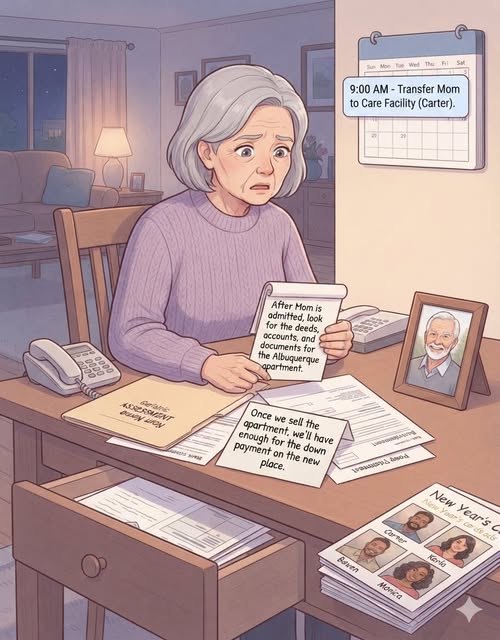
- As I walked through the living room, I noticed several holiday greeting cards neatly arranged on the dining table. Every single card featured a polished family photo of Carter, Karla, Bowen, and Monica.
- My face was nowhere to be seen on any of them.
- Suddenly, the landline telephone on the side table began to ring loudly.
- It was my late husband’s sister, Aunt Margaret.
- “Marissa, it is so wonderful to hear your voice,” she said with deep relief. “I honestly thought you were still admitted in the hospital.”
- “Hospitalized?” I asked, completely taken aback by her words.
- A heavy, uncomfortable silence lingered over the line for a long moment.
- “Karla mentioned to the family that you have severe dementia,” Margaret confessed hesitantly. “She told us that you barely recognize anyone around you anymore.”
- I felt the ground tremble beneath my feet as a wave of nausea hit me.
- I immediately opened the filing drawer where Karla kept all the family paperwork and found a folder containing a formal geriatric evaluation written under my name, right alongside a draft application for my admission into a private nursing home. Tucked right next to those documents was a handwritten note from Carter that read: “Once Mom is admitted, search her room thoroughly for the property deeds, bank accounts, and documents regarding the Albuquerque apartment.”
- Directly underneath his handwriting was a second note written in Karla’s neat script: “With the proceeds from selling that apartment, we can finally cover the down payment for our new penthouse.”
- They never had any intention of taking care of me in my golden years. They simply wanted to declare me legally incompetent, lock me away in a facility, and steal the very last property that still belonged to me.
- At that exact moment, my phone chimed with an automated notification from the shared family calendar. The entry was set for nine o’clock the very next morning, titled: “Mom is being transferred to the care facility; please inspect her room before leaving.”
- The event had been created directly by Carter.
- My own son had scheduled the precise hour he intended to erase my presence from his life completely, yet I was still unprepared for the shocking truth I was about to uncover.
- PART 2
- That very same night, I canceled all automatic bank payments for the household bills, blocked Karla’s supplementary credit card, and summoned a taxi to the house.
- Before I could walk down the front steps with my bag, my next-door neighbor, Mrs. Pace, stopped me near the porch.
- “Marissa, are you heading out somewhere so late?” she asked with genuine concern. “Karla mentioned that staff from a senior living facility would be coming by early tomorrow morning to collect you.”
- “I have urgent personal matters to attend to,” I told her quietly.
- I asked the taxi driver to head straight to the central bus station and bought an overnight ticket to Albuquerque. For the first time in many years, I sat peacefully in a window seat all to myself.
- As the bus glided onto the dark highway, a stream of frantic text messages flooded my phone screen.
- “What did you do to my credit card?” Karla demanded in her first text message.
- “We are sitting at the restaurant table and the card just got declined,” her second message read.
- “Where did you hide your financial documents, Mom?” Carter sent shortly after. “You need to answer me right now, because people are coming for you tomorrow.”
- None of them were asking if I was safe or okay. They were only panicking about the sudden loss of my money.
- When I finally reached my quiet apartment in Albuquerque the next morning, I sat down on the sofa and wept bitterly. I almost felt like giving up entirely, but I forced myself to review the strange medical report I had salvaged from Karla’s folder.
- The documentation claimed that I had been examined two weeks prior at a private medical clinic in San Diego and diagnosed with severe cognitive decline.
- I had never stepped foot inside that clinic in my life.
- Then I recalled a suspicious detail from a few weeks back when Karla asked to borrow my identification card and health insurance card for three days under the guise of updating family records.
- The next morning, I arranged an urgent meeting with Arthur Milford, an attorney I had discreetly consulted weeks before leaving. He advised me to undergo a comprehensive, independent medical evaluation without delay.
- Dr. Samuel Mitchell, a trusted physician who had known my health history for over fifteen years, examined me thoroughly for nearly an hour.
- “Marissa, I can state with absolute certainty that there are zero signs of cognitive impairment,” Dr. Mitchell declared as he wrote down his findings. “You are completely oriented, your memory is sharp, and you are entirely capable of managing your own affairs.”
- I walked out of his office with an official medical certificate tucked safely in my bag.
- Next, I called the private clinic in San Diego to demand answers about the fraudulent record.
- A receptionist looked up the records and confirmed that a woman named Marissa had indeed visited the clinic alongside a younger woman who identified herself as her daughter.
- “I do not have any daughters,” I informed the receptionist firmly. “Could you check if there are any physical descriptions written in the intake file?”
- “The notes mention that the patient arrived wearing a distinctive dark burgundy coat,” the receptionist offered after checking the system.
- My hands turned cold as ice as the piece of the puzzle fell into place.
- Karla’s mother, Miriam, was around my age, shared a similar build, and wore a dark burgundy coat everywhere she went during the winter months. They had taken Miriam to the clinic while using my legal identity cards to generate a fake diagnosis.
- However, the full extent of their betrayal was far worse than I could have anticipated.
- Attorney Milford tracked down the original electronic transfer of the $200,000 I had handed over five years ago. It turned out Carter’s residence had been purchased using a mortgage that covered almost the entire property price.
- My money had never been applied toward paying down his mortgage at all.
- Just three days after I sent the money, the entire sum had been transferred directly into a corporate bank account belonging to Apex Real Estate, a firm owned by Karla’s father, Walter. The company had recorded the payment under the label of professional consulting fees.
- “I never hired any real estate consultants,” I told Attorney Milford as we reviewed the financial records together.
- Moreover, I had found a recent property appraisal report from that exact same real estate agency tucked away in their trash bin.
- Their grand plan was far larger than I had initially realized, as they had used my life savings to fund Walter’s struggling business before plotting to declare me incompetent so they could seize and sell off my remaining assets.
- On Sunday morning, Carter sent me a short text message: “We are all driving down to Albuquerque today, so have your documents ready because it is time to settle your future.”
- I sent back a simple reply: “I will be waiting for you.”
- They truly believed they were coming to intimidate a helpless old woman, completely unaware that all the damning evidence was neatly arranged across my desk.
- PART 3
- On Sunday afternoon, I dressed in a tailored black dress that I had not worn since Thomas’s funeral service. I refused to face them wearing the kitchen apron they had forced upon me for the past five years.
- At ten fifteen in the morning, a heavy SUV pulled up to the curb outside my apartment building.
- Carter stepped out alongside Karla and her parents, Walter and Miriam. The very first detail I noticed was the dark burgundy coat wrapped around Miriam’s shoulders.
- Before opening my front door, I activated the recording app on my smartphone and rested it discreetly on a bookshelf near the entryway.
- Walter walked straight into my living room carrying a thick leather briefcase.
- “Marissa, we are here to resolve this situation like sensible adults,” Walter stated, setting his briefcase down on the dining table. “The senior residence we selected is top-tier, so let us sign these papers and avoid unnecessary drama.”
- He pulled out a thick contract, while Karla placed a photocopy of my identification card right beside it.
- “We also need you to sign a legal power of attorney so Carter can handle your finances while you adjust to the facility,” Karla added smoothly.
- I looked directly at my son. “Do you honestly believe that I am mentally ill, Carter?” I asked him quietly.
- My son shifted his weight uncomfortably and hesitated for a long moment before answering. “Mom… you have been forgetting small things lately,” he muttered, avoiding my eyes.
- “Name one single thing I have forgotten,” I challenged him.
- He stood completely silent, unable to provide a single example.
- Karla quickly interjected to protect him. “A person suffering from advanced dementia is naturally incapable of recognizing their own memory loss,” she claimed with unearned authority.
- I pulled out the official medical document signed by Dr. Mitchell and laid it on the table. “I underwent a full psychological evaluation just yesterday,” I informed them. “I am in complete possession of my mental faculties.”
- Miriam let out a harsh, contemptuous scoff from the hallway. “A random local doctor’s note holds no weight compared to a diagnosis from an elite private clinic,” Miriam snapped coldly.
- I turned my head and looked Miriam straight in the eye. “Then perhaps you would care to explain who visited that elite clinic using my name, my personal identification, and my health records?” I asked her calmly.
- Miriam’s face instantly drained of all color.
- I placed a copy of the clinic’s intake log onto the table for everyone to see. “The medical file specifically notes that the patient arrived wearing a dark burgundy coat and was accompanied by a woman claiming to be her daughter,” I said, pointing at the page. “I do not have any daughters, Miriam.”
- Miriam brought her hand to her throat in shock, while Karla turned pale as a sheet.
- Carter looked back and forth between his wife and mother-in-law in confusion. “What on earth is my mother talking about?” Carter demanded, looking bewildered.
- Walter slammed his heavy fist onto the table to regain control of the room. “None of that irrelevant nonsense matters right now,” Walter boomed aggressively. “We are here to discuss your safety and long-term care.”
- “No, Walter,” I corrected him sharply. “We are discussing grand fraud and identity theft.”
- I displayed the angry text messages where Karla had insisted I return immediately because her family’s real estate deal would collapse without my signature. Next, I laid down the draft application for the nursing home, along with the handwritten note where Carter had instructed his wife to search my room for property deeds.
- Carter slowly lowered his head, unable to meet my gaze. “Mom, I truly just wanted you to be looked after properly,” he mumbled weakly.
- “No, Carter,” I said, my voice unwavering. “You simply wanted me to vanish so I would no longer be a burden to you. For five long years, I cooked your meals, cleaned your house, raised your children, and paid your household bills. Whenever your wife humiliated me, you chose to look the other way. You may not have devised this entire fraudulent scheme yourself, but you decided it was far easier to sacrifice your own mother than to stand up for her.”
- Karla snapped and stepped forward aggressively. “That is enough of this dramatic victim routine,” Karla sneered. “If she wants to live alone in this dump, let her live alone. Just return the money she put toward our house and let us be done with her.”
- Carter raised his head suddenly, his face filled with shock. “Return what money?” Carter asked his wife. “Mom’s money was used five years ago to lower our house mortgage.”
- An icy silence immediately fell over the room.
- I handed Carter the certified bank transfer statements. “No, my son,” I told him gently. “My $200,000 never touched your mortgage. The house was financed almost entirely through a bank loan. Just three days after I transferred those funds to you, every single penny was sent straight to Apex Real Estate.”
- Carter stared at the paper in absolute disbelief before rounding on his father-in-law. “What did you do with my mother’s money, Walter?” Carter yelled, his voice cracking with emotion.
- Walter attempted to maintain his composure, clearing his throat nervously. “It was a legitimate corporate transaction,” Walter stammered out. “There were extensive advisory services and business negotiations involved.”
- “Two hundred thousand dollars for advisory services?” I asked pointedly. “Without a signed contract, and without me ever agreeing to hire your agency?”
- Karla burst into sudden tears of panic. “My father needed emergency capital for his firm, Carter,” Karla sobbed defensively. “He was fully planning to repay the money later, but then business conditions got complicated.”
- Carter looked at his wife as if he were seeing a complete stranger for the very first time. “You swore to me five years ago that we had reduced our family mortgage debt,” Carter whispered in horror.
- “It was better for our family that you did not know every little financial detail,” Karla shot back defensively.
- “The mortgage debt is registered entirely under my name!” Carter shouted.
- That single realization finally shattered whatever was left of their deceitful dynamic.
- I realized then that Carter had indeed been lied to regarding the financial theft. However, that revelation did not wipe away five years of quiet neglect, nor did it erase the note he wrote instructing them to raid my room before sending me away.
- Walter snapped his briefcase shut with a loud click. “Fine,” Walter said through gritted teeth. “Your money will be returned to you in due time. But you must immediately remove any legal obstacles preventing us from selling the San Diego house.”
- “You cannot sell that house,” I stated firmly.
- Walter froze in place, his hands trembling over his briefcase. “What did you just say?” he asked.
- “My attorney has already filed formal legal injunctions to freeze all asset movements related to that transaction while law enforcement investigates the fraud, the missing funds, and the falsification of my medical identity,” I explained calmly. “We have also formally notified the real estate licensing board.”
- Karla began to hyperventilate with rage. “Marissa, you are completely destroying an innocent family over a simple misunderstanding,” Karla cried out.
- “No, Karla,” I replied coldly. “You destroyed this family the exact moment you decided my identity, my life savings, and my dignity were disposable resources for you to exploit.”
- Miriam stepped forward and pointed a finger at my face. “Nobody in a court of law is ever going to believe the wild ramblings of a bitter old woman,” Miriam spat maliciously.
- “Which is precisely why I did not rely solely on my word,” I replied smoothly.
- I motioned toward the documents spread across the table, including the medical certificate, bank trails, text messages, fraudulent clinic reports, and identity theft files. Then I pointed directly at my phone on the shelf, which was actively recording every single word spoken in the room.
- Miriam’s hand slowly dropped to her side as her face turned pale.
- “I want all of you out of my home immediately,” I commanded calmly. “From this moment forward, any communication will go directly through Attorney Milford.”
- Carter took a hesitant step toward me, tears brimming in his eyes. “Mom, please listen to me,” Carter begged. “I swear to you that I had no idea about the stolen money.”
- “But you knew that I was not suffering from dementia, did you not?” I asked him softly.
- He stopped in his tracks, incapable of lying to my face. “Yes,” he admitted softly.
- “You knew that I could cook, travel independently, handle my finances, and take care of your children without any help,” I continued.
- “Yes,” he whispered again.
- “And yet you willingly signed the papers to lock me away in a nursing home anyway,” I said, holding his gaze.
- Carter closed his eyes in shame. “Yes,” he choked out.
- That final word hurt far more than the financial fraud or the stolen identity ever could. It came from the boy I had lovingly raised through childhood fevers, and the man to whom I had given my savings believing my old age would be safe by his side.
- “Then please do not ask me to come back into your life,” I told him gently. “Some mistakes can be resolved with money, but others permanently alter the way you view a person.”
- They gathered their belongings and walked out the door without saying another word.
- The second the door clicked shut behind them, I sank into a chair and wept for the family I thought I had.
- The following morning, I handed the audio recording over to Attorney Milford. Armed with the bank statements, fake clinic files, and text records, he initiated aggressive legal proceedings to recover my stolen capital and report the identity fraud to the authorities.
- The medical clinic launched an internal investigation into the staff involved. The sale of the house was completely halted, and Walter’s real estate agency was forced to account for the mysterious transfer of $200,000.
- At first, their legal counsel tried to settle for less than half the amount, and later offered to return only the principal sum without interest.
- I firmly rejected every single one of their low offers. I was not seeking to ruin their lives, but I was certainly not going to let them dictate the value of what they had stolen from me.
- Those following months were emotionally draining. There were late nights when I wondered if it would have been easier to remain silent, but whenever I recalled the cold care facility they had selected for me, I remembered why I was fighting back. I was no longer just fighting for my money; I was defending my fundamental right to control my own life.
- Several months later, a comprehensive legal settlement was officially finalized. I successfully recovered the entire $200,000, alongside significant monetary compensation and full coverage for my legal fees. Walter was forced to liquidate a commercial investment property to pay the debt, and his real estate agency suffered severe reputational damage before permanently closing its doors.
- Miriam never offered an apology. Neither did Karla.
- Karla’s marriage to Carter began to disintegrate rapidly once the full truth regarding the stolen funds was exposed. Carter discovered that he had been tricked into paying a massive mortgage for years under false pretenses, leading to bitter daily arguments between them.
- Eventually, Karla packed her bags and moved out of the residence, taking Monica with her and filing for legal separation. Bowen, now a teenager, firmly chose to stay behind with his father.
- Carter began calling my phone regularly.
- “Mom, I was an absolute coward,” he confessed in a voicemail one evening.
- I did not answer his calls.
- Then a barrage of text messages began arriving at all hours:
- “Please forgive me, Mom.”
- “We can rebuild our relationship and start over.”
- “I really miss your home cooking.”
- That final message made me realize that he still failed to understand the root of the problem. He missed the selfless labor I provided for his household, not necessarily the woman who performed it.
- I placed his phone number on my blocked list. It was not an act of revenge; it was an act of establishing healthy boundaries.
- The only person from that household with whom I maintained contact was my granddaughter, Monica. A few days after I had departed for Albuquerque, she sent me a sweet message: “Grandma, I am so deeply sorry for not speaking up for you that night.”
- She also sent a photo of a small card envelope I had prepared for my grandchildren before leaving. Karla had thrown my personal belongings into trash bags, but Monica had quietly rescued the envelope from the pile.
- I could never blame a child for remaining silent while surrounded by controlling adults.
- A few months later, Monica called me directly. “Grandma, would it be okay if I came to visit you?” she asked softly.
- We arranged to meet at a cozy bakery in Albuquerque, accompanied by one of her aunts. When Monica walked through the door, she rushed toward my table but paused nervously right before reaching me.
- “I do not know if you still want to hug me,” she murmured softly.
- I opened my arms wide, and Monica leaned in, weeping quietly against my shoulder.
- “Mom keeps telling everyone that you completely destroyed our family,” Monica sobbed.
- “Adults often say hurtful things to avoid taking responsibility for their own actions,” I explained gently.
- “Do you hate my mother?” she asked, looking up at me.
- I thought carefully about her question for a few moments before responding.
- “I have no desire to spend my remaining years holding onto hatred,” I told her truthfully. “However, I will never allow anyone to treat me with disrespect ever again.”
- She reached into her backpack and pulled out the small envelope she had saved, which remained completely unopened.
- I pushed it gently back into her hands. “That was always meant for you, sweetheart,” I said with a smile.
- Inside was a modest gift of money along with a handwritten note I had penned before that fateful dinner: “So you can buy something that brings joy to your heart. With all my love, Grandma.”
- Monica began to cry tears of gratitude, and I found myself tearing up right alongside her.
- That afternoon, I finally understood that setting firm boundaries with toxic adults did not mean closing my heart to the children who truly loved me.
- Once my financial settlement cleared, I moved out of the old apartment and bought a bright, beautiful condo overlooking a peaceful park in Albuquerque. On my sunlit balcony, I planted a young plum tree in a decorative pot to honor Thomas’s memory.
- On my very first night in the new place, I cooked a quiet dinner exclusively for myself.
- I sat down at the dining table without feeling rushed or anxious. No one was demanding that I warm up extra food, no one left dirty dishes for me to clean, and no one made me feel as though my presence was an inconvenience.
- For many years, I had mistakenly assumed that eating alone was a tragic sign of loneliness. That night, I discovered that it could also be a profound form of peace.
- In the weeks that followed, I enrolled in watercolor painting classes and reconnected with dear friends I had not seen in years. I took weekend trips to the scenic mountain towns of New Mexico and spent relaxing afternoons at nearby thermal hot springs. I bought new clothes simply because I loved how they looked on me, rather than choosing practical garments for scrubbing someone else’s floors.
- One breezy Saturday morning, I took the lilac cardigan out of my closet, the exact same sweater I was wearing the night Carter told me there was no room for me in his truck.
- I slipped it over my shoulders and strolled down to a lovely neighborhood café.
- There was a sunlit table available right beside the front window.
- “How many people will be joining you today?” the waitress asked warmly.
- “Just one,” I replied with a proud smile.
- I ordered a fresh coffee and a warm pastry as I watched people strolling through the plaza outside. For the first time in decades, I did not feel the desperate need to shrink myself to fit into anyone else’s life just to justify my existence.
- I thought of Thomas. I thought of Carter. I thought of the five long years during which I had confused genuine love with total self-sacrifice.
- I had spent so long believing that a good mother was required to suffer until the very end, that saying “no” was an act of selfishness, that demanding my fair share of money was putting a price tag on family, and that walking away meant abandoning my child.
- I was completely wrong.
- A family that only values your presence while you cook their meals, settle their debts, care for their children, and remain silent is not offering you a home. They are simply assigning you a servant’s role.
- Genuine love never demands that you erase yourself so others can live comfortably, nor does human dignity expire simply because grey hair appears on your head.
- At sixty-eight years old, I finally discovered a truth I wish I had learned decades earlier: I still possessed the power to choose my own seat, my own home, my own finances, my own friends, and precisely how I wanted to spend the precious years I have left.
- Carter had told me that night that there was no place for me in his vehicle.
- He was right about one thing. There was no longer any place for me in that toxic life.
- However, outside the walls of that house lay a wide, beautiful world.
- And this time, I chose my own place in it.
- THE END
January 10, My Son Left Me Out of the Family Dinner and Said, “There’s No Room for You in the Car.” I Didn’t Argue. I Took My Suitcase and Boarded the Train Alone. Hours Later, While They Were Trying to Pay, They Discovered That I Had Blocked the Card… But What I Found Out About My $1.6 Million Was Much Worse.