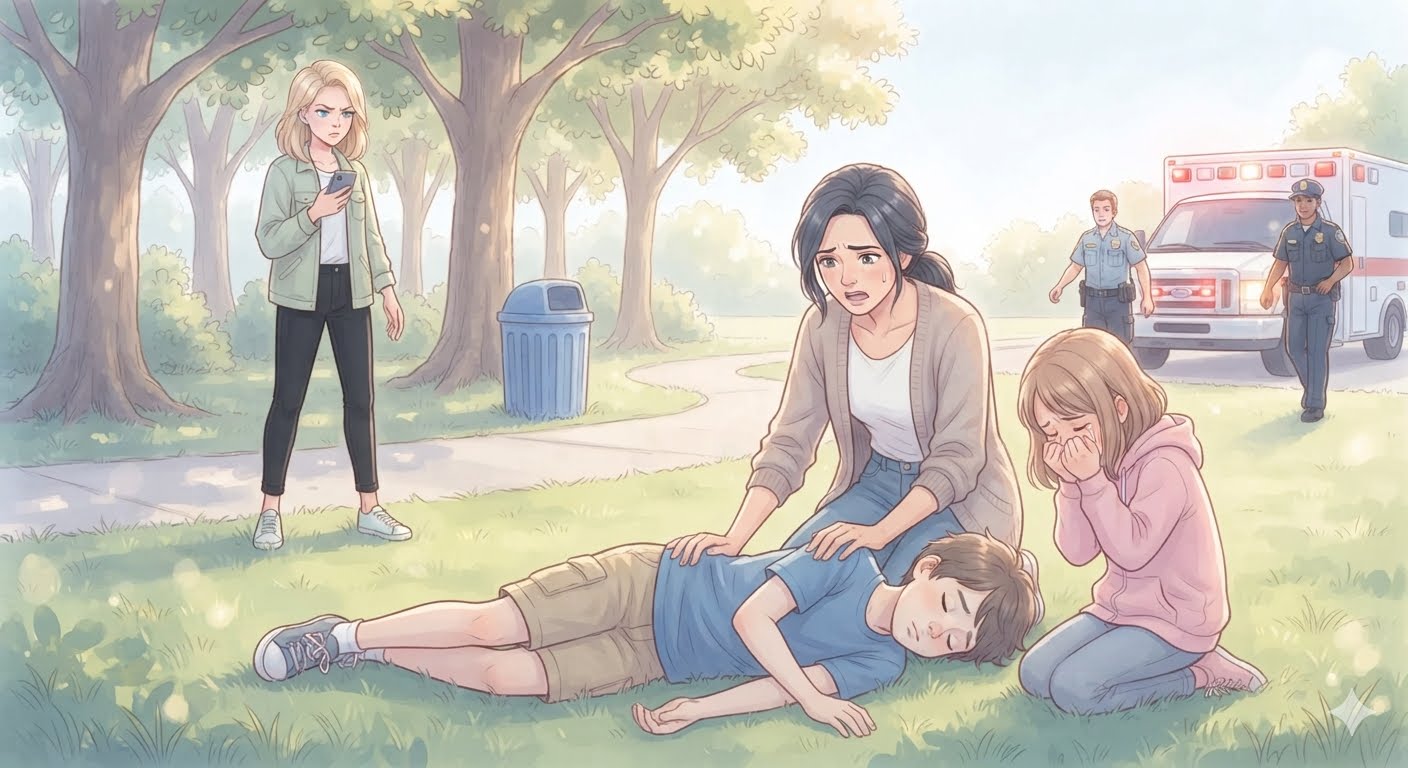
- Those were the very first words out of my sister-in-law Brenda’s mouth while my nine-year-old son, Leo, lay sprawled on the grass—pale, motionless, and struggling to breathe.
- Two hours earlier, I never could have imagined we’d end up here.
- For months, Brenda had criticized the way I raised Leo. She constantly complained that he was too energetic, too talkative, that I spoiled him, and that “kids these days just lack proper discipline.”
- So I was caught completely off guard when she pulled up to my house in suburban Columbus on a crisp Saturday afternoon with a smile and an unexpected invitation.
- “I’m taking Maya to the park,” Brenda said, motioning to her eight-year-old daughter sitting in the back of her SUV with a purple backpack in her lap. “Why doesn’t Leo come along? Let them burn off some energy.”
- I thought maybe Brenda was finally trying to extend an olive branch.
- I was dead wrong.
- Nearly two hours later, my cell phone rang. It was an incoming call from Maya’s smartwatch.
- “Hello?”
- At first, all I heard was the whistle of the wind and ragged, panicked breathing.
- “Aunt Sarah…” Maya’s voice was trembling, barely a whisper. “Come fast. Leo won’t wake up.”
- My blood ran cold. “Maya, what happened?”
- “Mom said it was a prank to get him to calm down… but he’s not moving anymore.”
- I grabbed my keys, not even bothering to lock the front door behind me. “Maya, stay right next to him. Where are you?”
- She gave me their location near a wooded walking trail at the county park. Before hanging up, she whimpered, “Mom told me not to call you.”
- I dialed 911 on speakerphone while tearing down the highway.
- When I arrived, I sprinted down the paved trail until I spotted them near a grove of oak trees. Leo was lying on his side on the grass, one of his sneakers half kicked off. Maya was kneeling beside him, weeping silently.
- Brenda, on the other hand, was standing several yards away, calmly scrolling on her phone.
- I dropped to my knees beside my son. “Leo… baby, wake up!”
- Nothing.
- He was breathing, but it was shallow and terrifyingly faint. I pressed my fingers to his neck; his pulse was weak and irregular.
- I whipped my head around to face Brenda. “What did you give him?!”
- She let out an exasperated sigh. “Oh, don’t start.”
- “What did you give him?!”
- “Just something to help him relax! He was being utterly unbearable!”
- “Was it medicine?!”
- “It’s not like it was poison!”
- Maya started sobbing louder, holding her arms. “Mom…”
- Brenda shot her daughter a lethal glare. “Be quiet, Maya.”
- I turned back to my son, shaking his shoulder. “What was in it, Brenda?!”
- “Just a little something to sleep! He’ll sleep it off in an hour!”
- “He’s not sleeping! He’s completely unresponsive!”
- Brenda rolled her eyes. “Because you turn everything into a tragic drama, Sarah. Leo’s just used to you running to him every time he throws a fit.”
- Sirens echoed in the distance, and within minutes, an ambulance pulled up to the trail edge. The lead paramedic rushed over and immediately asked what Leo had ingested.
- Brenda’s story started shifting instantly.
- First, she claimed it was just an “all-natural herbal syrup.” Then she claimed she couldn’t remember the brand name. When the paramedic asked where the bottle or packaging was, she shrugged.
- “I threw it away.”
- A police officer who had escorted the rig stepped up. “Where?”
- “I don’t know. Somewhere back there.”
- I caught Maya darting a fearful glance toward a blue trash receptacle near the bend in the path. She didn’t say a word, but her eyes gave it away.
- The paramedics loaded Leo onto a stretcher. When they lifted his arm, it fell completely limp against his side. That image burned itself into my mind all the way to the emergency room.
- At the hospital, the medical team bombarded me with questions about allergies, conditions, and daily prescriptions. Leo didn’t take any sedatives. I had never, under any circumstances, authorized Brenda to administer medication to my child.
- Two agonizing hours later, an ER physician walked out to speak with me. He explained that Leo had a high concentration of a potent prescription sedative combined with alcohol in his bloodstream. The combination had dangerously suppressed his central nervous system and respiratory drive.
- “He’s stable for now,” the doctor said, “but if you hadn’t gotten him here when you did, his breathing could have stopped entirely.”
- Brenda was still standing in the waiting room, loudly insisting to anyone who would listen that everyone was overreacting. “He’s going to wake up, and Sarah is going to look completely ridiculous.”
- Maya was huddled in a chair behind her mother, wrapping her arms around herself.
- When Brenda stepped away to talk to an officer in the hallway, I walked over to the little girl.
- “Aunt Sarah… I’m sorry,” Maya whispered, tears streaming down her face.
- “You didn’t do anything wrong, sweetie.”
- “I should have called you sooner.”
- “You called when Leo needed help. You did the absolute right thing.”
- Maya looked down at her sneakers. “Mom said he was just faking it.”
- My stomach churned. “Maya… did you see what she put in his drink?”
- She nodded slowly. “She took a little glass bottle out of her purse and poured liquid into his juice box.”
- “And what did she do with the bottle afterward?”
- Maya glanced nervously toward the hallway. “When I picked up my watch to call you, she wrapped it in paper towels and threw it in the park trash can.”
- I notified the officer immediately.
- Police units dispatched back to the park located the trash can Maya had identified. Inside, wrapped in paper towels, was a small prescription vial.
- The moment Brenda realized the police had recovered the physical evidence, her narrative flipped again. She told investigators that maybe Leo had found the medication himself in her purse. Then she claimed the bottle actually belonged to me—that I had mixed the drink before they left the house, and she had simply panicked when Leo passed out.
- The brazen lie left me speechless. My sister-in-law hadn’t just poisoned my son; she was now trying to frame me for it.
- The lead detective on the case, Officer Ramirez, walked into the consultation room holding a photograph of the recovered bottle. “The primary label was partially torn off, but our forensics team verified the pharmacy serial number.”
- “Is it in Brenda’s name?” I asked, bracing myself.
- “No.”
- “Then whose name is on it?”
- Detective Ramirez slid the photograph across the desk toward me. Beneath the torn paper, a patient name was clearly legible: MAYA HERNANDEZ.
- I lifted my eyes, stunned. “The prescription belonged to Maya?”
- “It appears so.”
- “Why would an eight-year-old be prescribed a heavy central nervous system depressant?”
- Ramirez was silent for a few seconds. “That’s what we’re currently investigating.”
- Suddenly, pieces of a terrifying puzzle began falling into place. Maya was always known in the family as the “perfect, quiet child.” She never interrupted, never threw tantrums, never argued. At chaotic family gatherings, she would routinely drift off to sleep on the living room couch with an unnerving ease. Brenda had always bragged to relatives about how well-trained and submissive her daughter was.
- Then Detective Ramirez dropped the real bombshell. “The pharmacy records show this specific controlled substance was filled three separate times over the last four months.”
- “Three times?!” I gasped.
- Ramirez nodded grimly. “We just spoke with Maya’s pediatrician. He never wrote a single one of those prescriptions.”
- Part 2
- The prosecutor’s office instructed us that no one was to question Maya informally. A forensic child psychologist conducted a sensitive, taped interview with Maya while Child Protective Services sat in. Brenda flew into a rage in the station lobby, screaming that the state was “manipulating her daughter,” but her outbursts couldn’t erase the paper trail.
- I stayed anchored to Leo’s bedside, holding his small, cold hand as he slept off the toxins.
- Nearly an hour later, Detective Ramirez walked into the hospital room, his face drawn tight.
- “Maya told the specialist that her mother routinely gave her what she called ‘sleeping juice,’” Ramirez said quietly.
- I closed my eyes, a wave of nausea hitting me. “How long has this been going on?”
- “She can’t pinpoint exact dates, but she recalled numerous instances,” Ramirez explained. “Before family visits. Before long car rides. Whenever your sister-in-law felt Maya was being ‘too loud’ or ‘too demanding.’”
- Maya disclosed that her mother would crush pills into sweet drinks or measure liquid from small vials. Whenever the little girl complained about feeling dizzy or sick, Brenda told her that “good girls trust their mothers,” followed by the conditioning: “Family business stays inside the family.” I remembered hearing Brenda utter that exact phrase at least a dozen times over Sunday dinners.
- Maya also admitted that she frequently woke up on the living room sofa or in the back of the car with zero memory of how she had gotten there. She genuinely believed every child went through this.
- The pharmacy audit revealed an even more sinister operation. The controlled prescriptions had been secured through an offshore, unverified telehealth service using Maya’s stolen health insurance details and personal identity. Brenda had submitted false medical intake forms claiming her daughter suffered from severe, intractable pediatric insomnia. Maya was never once brought to the screen during those digital consults, and the dosage level Brenda secured was intended for an adult male.
- Armed with a search warrant, detectives raided Brenda’s home. In her master bathroom, they found another hidden vial, liquid droppers, and several boxes of high-sugar drink mixes. But the most damning piece of evidence was recovered from a drawer in the kitchen pantry: a spiral notebook.
- Alongside mundane grocery lists and utility bill reminders were brief, calculated entries written in Brenda’s handwriting:
-
Maya: Half dose before dinner party.
-
Road trip: Full dose.
-
Company coming over: Keep her quiet.
- My hands shook as Detective Ramirez showed me the photographed pages. Brenda hadn’t even attempted to hide it. To her, chemically sedating her child was simply an efficient household management tool.
- CPS immediately issued an emergency protective order, placing Maya in temporary state custody. When Brenda was informed that she was barred from taking her daughter home, she went hysterical in the precinct corridor.
- “She is my daughter!” Brenda shrieked.
- Detective Ramirez stepped between them. “Which is precisely why CPS is stepping in.”
- Brenda pointed a finger at me, her face contorted in rage. “You did this! You took my child from me!”
- I looked her dead in the eye. “Maya called me because Leo wouldn’t wake up.”
- “He wasn’t dying!” she screamed back.
- A suffocating silence fell over the hallway. Brenda realized a second too late what she had just blurted out in front of three uniformed officers and a recorded room.
- The next morning, Leo finally opened his eyes. “Mom…”
- I nearly broke down crying right there on the thin hospital mattress. “I’m right here, baby.”
- He blinked, his eyes unfocused. “Where’s Maya?”
- “She’s safe, Leo. She’s okay.”
- Leo frowned slightly, trying to clear the fog from his head. “She told me not to drink the juice.”
- My heart stopped. “What do you mean, sweetie?”
- “She whispered to me at the park… she said it makes you go to sleep.”
- Later, during a formal interview with a child advocate, Leo recalled another detail. Brenda had handed him the juice box and said, “Maya drinks this all the time. Don’t be a baby.” She had used her own daughter’s forced compliance to pressure my son into drinking the laced beverage.
- Then the park security footage was processed:
-
1:18 PM: Brenda pulls a vial from her purse near the concession stand.
-
1:20 PM: She hands the juice box to Leo.
-
1:43 PM: Leo begins stumbling along the path.
-
1:47 PM: He collapses onto the grass.
-
1:50 PM: Maya panics, frantically pointing at Leo, begging her mother to help. Brenda turns her back and checks her phone.
-
1:56 PM: Maya uses her smartwatch to place the emergency call to me.
- Finally, prosecutors recovered deleted text messages from Brenda’s phone. Three days before the park trip, she had texted a friend: “Sarah lets that boy run wild everywhere he goes. Give me one afternoon with him and I’ll show her how a well-behaved child actually acts.”
- Her friend replied: “What are you gonna do, tie him to a chair?”
- Brenda’s response was chilling: “Nothing so dramatic. I already know what works.”
- When Detective Ramirez finished reading the transcript out loud, the legal reality was sealed. This was not an accidental overdose or a tragic mistake. Brenda had taken my son to the park with premeditated intent—and Maya had been her test subject for years.
- Part 3
- Three days later, a family court judge reviewed the emergency protective petition for Maya. Brenda’s defense attorney argued fiercely that the event was a “terrible lapse in judgment by an exhausted mother” and warned that removing a child would inflict severe emotional trauma.
- The court-appointed guardian ad litem stood up and delivered a quiet, devastating rebuttal: “Maya didn’t report the abuse earlier because she literally did not know she had a right to be safe in her own home.”
- The courtroom went completely quiet.
- The judge reviewed the digital logs, pharmacy records, notebook, text transcripts, and park footage. Maya did not have to testify in open court; her forensic interview spoke for itself. When asked by the child psychologist where she felt safest staying during the proceedings, Maya’s answer was heartbreakingly simple: “Wherever Leo is.”
- Because I was already caring for Leo during his physical recovery, CPS initially hesitated to place Maya in my household due to the complex familial conflict. But after home evaluations, background checks, and a glowing recommendation from the caseworker, the judge granted me temporary kinship guardianship.
- That evening, Maya arrived at my house carrying her purple backpack. She stood near the front entryway, clutching her straps tightly. “Am I staying here because my mom is in trouble?”
- I knelt down to her eye level. “You’re staying here because the adults need to make sure you are safe.”
- She lowered her head, her voice barely audible. “Is she mad at me?”
- “I don’t know, Maya.”
- Tears began spilling down her cheeks. “I told them everything.”
- “I know you did.”
- “What if she doesn’t love me anymore?”
- I reached out and gently held her hands. “Telling the truth never makes you responsible for the bad choices adults make.”
- Then she asked a question that shattered my heart into a thousand pieces: “Do I have to take anything before I go to sleep tonight?”
- I felt an ache deep in my chest. “No, Maya. Never.”
- “What if I can’t fall asleep?”
- “You can read a book. You can get a glass of water. You can come down the hall and talk to me. Or you can just lie awake and look at the stars. It is completely okay to just be awake.”
- She stared at me in total disbelief. “You won’t force me to sleep?”
- “Never.”
- That night, I set two fresh glasses of water on the kitchen counter—one for Leo, one for Maya. Neither child would touch them. For weeks, both harbored a deep, instinctive distrust of any liquid they hadn’t personally watched me pour. Leo inspected the factory seals on every plastic bottle, while Maya watched silently whenever I opened a carton of juice. The mere smell of fruit punch caused Leo to leave the room.
- The doctors assured me Leo would make a full physical recovery, but the psychological wounds would take far longer to heal. I didn’t push either of them to “get over it.” Normal wasn’t something we could go back to—we had to build a new kind of normal.
- A month into the placement, Maya walked into my bedroom late one night, holding her smartwatch in her hand.
- “Aunt Sarah?”
- “What is it, sweetie?” I asked, moving over on the bed.
- She sat on the edge of the mattress. “Is my mom in jail because I called you from the park?”
- “No, Maya. She’s in trouble because of what she did.”
- “But if I didn’t use my watch… nobody would have known.”
- “That still doesn’t make it your fault.”
- Maya traced the glass screen of her watch. “She told me not to call. She said you would make everything worse.”
- “And what did you think?”
- “I thought… maybe she was right.” She went silent for a moment. “But Leo stopped talking. I shook him and he wouldn’t wake up. I asked Mom to call 911, and she just told me I was being dramatic… just like you.”
- I pulled her into a soft hug. Brenda hadn’t just conditioned Maya to obey; she had convinced her that seeking help for a dying child was an act of betrayal.
- “Did I do the right thing by calling you?” Maya whispered against my shoulder.
- “You saved Leo’s life, Maya,” I said clearly. “You did the bravest thing a person could do.”
- She stayed quiet for a long time. Then, instead of hiding her watch under her pillow as she usually did, she set it openly on my nightstand.
- The criminal trial moved swiftly over the following months. The prosecution built an airtight case, charging Brenda with multiple counts of felony child endangerment, corrupting a minor, unlawful distribution of a controlled substance, and tampering with evidence.
- Her defense team attempted to argue that she never intended serious harm. In response, the prosecutor simply presented Brenda’s own notebook to the jury: Keep her quiet. Then they played the park footage—Leo staggering down the path, collapsing into the dirt, eight-year-old Maya desperately begging her mother for help, and Brenda turning her back to scroll on her phone. An eight-year-old child had possessed the moral courage to act while the adult responsible stood by and did nothing.
- Faced with overwhelming evidence, Brenda accepted a plea agreement. She was sentenced to twelve years in a state correctional facility without the possibility of early parole.
- Maya’s long-term custody was finalized in family court shortly thereafter. Her biological father had been absent for years and formally surrendered his parental rights after the scandal became public.
- During the final custody hearing, the family court judge looked at me over her glasses. “Mrs. Bennett, you understand that taking on Maya’s care is a permanent, lifelong commitment?”
- I looked over at the gallery seats, where Leo and Maya were sitting together, drawing in a shared sketchbook. “I do,” I answered without hesitation. “And I’m honored to be her mother.”
- The judge signed the decree, granting me full legal adoption of Maya.
- Brenda was permitted to send supervised, written letters from prison. Maya refused to open the first few that arrived, and I never forced her, keeping them safely locked in my desk drawer. When she finally asked to read one several months later, we sat together at the kitchen table. In the letter, Brenda wrote that she was “sorry for scaring her” and claimed she was “only trying to help her get a good night’s rest,” ending with the assertion that “all mothers make mistakes.”
- Maya read the letter twice, set it down, and looked up at me. “Is it still just a ‘mistake’ if you do it over and over again?”
- I chose my words carefully. “A person can make a bad choice once, Maya. But when they repeat it every week, it’s no longer a mistake—it’s a choice. And she had every opportunity to stop.”
- Maya slowly folded the paper back into the envelope. “I don’t want to write her back.”
- “You don’t have to.”
- It was one of the very first times Maya said the word no without apologizing afterward.
- Spring arrived, bringing warmer weather and blooming trees. Leo returned to little league baseball, playing second base, while Maya enrolled in an after-school studio art program.
- One Saturday afternoon, I asked them both if they wanted to visit the county park again. I didn’t make a big speech about confronting trauma or moving on; I simply asked, “Do you guys want to go to the park today?”
- Leo hesitated, looking at his sneakers. Maya looked at him and offered a gentle nudge. “We can leave whenever we want, Leo. Aunt Sarah will take us home the second we ask.”
- Leo nodded. “Okay.”
- We drove to the park. It was packed with families—kids on the swings, people walking dogs, sunlight filtering through the trees. We walked down the paved trail until we reached the oak grove. The same grass. The same blue trash can.
- Leo stayed close to my side for a few minutes until he saw a group of kids kicking a soccer ball near the pavilion. “Can I go play?”
- “Go ahead, sweetie,” I smiled.
- He ran off. Maya stayed behind with me, wearing her smartwatch on her wrist. She pointed toward a large maple tree near the path. “That’s where I stood when I called you,” she said softly.
- “I remember.”
- “I was so scared to press the button.”
- “I know, baby. But you did it anyway.”
- She watched Leo chase after the soccer ball. Suddenly, he tripped over a stray root and tumbled onto the grass. Both Maya and I froze instantly.
- But Leo popped right back up, brushed the dirt off his knees, let out a loud laugh, and kept running.
- Maya let out a long breath she had been holding. “He’s okay.”
- “He’s okay,” I echoed, pulling her close against my side.
- A few weeks later, I walked into the kitchen on a Sunday morning and saw two plastic cups sitting on the counter. Leo and Maya had poured themselves apple juice, carried the cups out to the back patio, and were sitting on the grass chatting animatedly about a comic book. Neither of them had asked me to inspect the carton. Neither had checked the seals. They had simply poured their drinks, forgotten to be afraid, and gone out to play.
- That evening, a minor argument broke out over what movie to watch. Leo wanted a superhero film; Maya insisted on an animated musical. They talked over each other, protested, giggled, and made noise.
- I sat on the living room sofa, watching them bicker, and smiled. I realized then a fundamental truth that Brenda had never understood: a safe, healthy child isn’t a silent child.
- A safe child makes noise. A safe child argues, complains, laughs loudly, changes their mind, and speaks their truth. And when something is wrong, a safe child knows they have every right to use their voice to ask for help.
- The call Brenda tried so desperately to prevent didn’t ruin our family. It saved my son’s life—and it gave a brave little girl the freedom to finally be heard.
“It was just a joke. Don’t make a scene.”