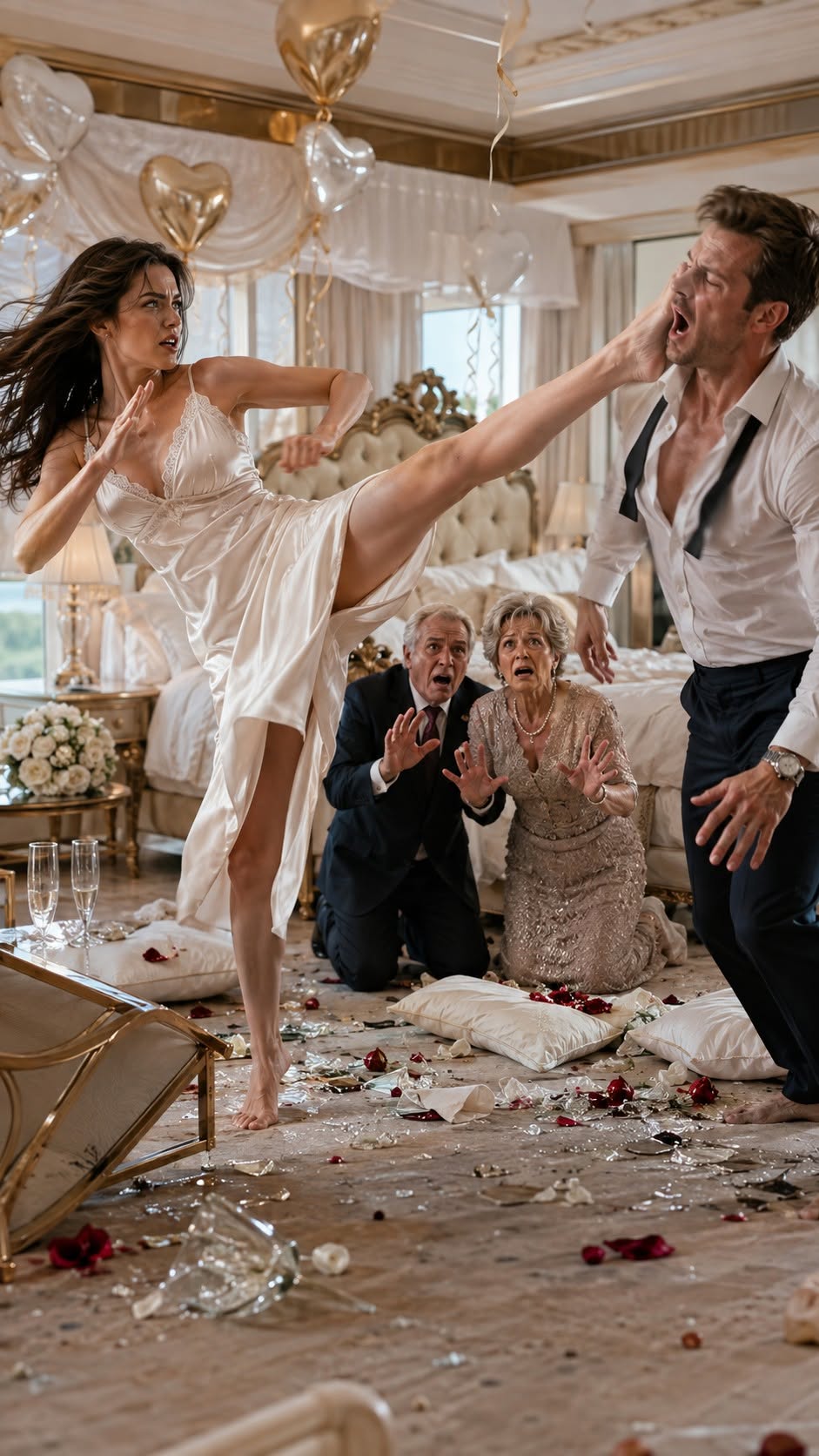
The Architecture of Grace: A Chronicle of My Own Coup d’État
Chapter 1: The Illusion of White Lace
Long before I ever wore a veil, I wore hand-wrapped cotton bandages over my knuckles. My father, Silas, was a local legend in our pocket of the Midwest—a mixed martial arts and judo instructor whose name was spoken with quiet reverence in the local gyms of Fairview County. He didn’t leave behind a vast estate or a stock portfolio. What he bequeathed to me was an architecture of the spirit: a robust physical frame, an unyielding will, and the muscle memory required to survive.
“You don’t learn to fight to conquer the world, little bird,” he would rumble, his calloused hands adjusting my stance on the worn wooden deck of our backyard. “You learn to fight so that when the world tries to conquer you, you never, ever have to bow your head.”
Those grueling, sweat-drenched twilight sessions seeped into my marrow. They transformed a naturally delicate girl into a woman with a dense, perceptive, and agile core. Yet, for all my father’s teachings about reading an opponent’s physical tells, he couldn’t teach me how to anticipate the disguised malice of an archaic social contract. The strength he forged in me was the very thing my mother later begged me to conceal at all costs.
The day I married Thatcher, the air inside the remodeled, exorbitant barn venue was thick with the scent of roasted meats and expensive champagne. It was a rustic Ohio dreamscape, brimming with snow-white tablecloths and the raucous, echoing laughter of our rural town’s elite. Thatcher, in his impeccably tailored suit, looked the part of the respectable intellectual. He possessed a soft-spoken cadence and maintained earnest eye contact, a performance so flawless it had my mother’s friends whispering praises about her magnificent luck in a son-in-law.
But beneath the clinking of crystal flutes and forced, worldly smiles, my mother’s frantic, whispered warnings were a frantic drumbeat in my ears. Just moments before the bridal march began, she had yanked me into the shadowy alcove of the bridal suite. Her hands, fragile as dry leaves, trembled violently as she shoved a heavy envelope of savings bonds and a velvet box containing our family’s heirloom diamond necklace into my clutch.
“In these old bloodline towns,” she choked out, her eyes swimming with panicked tears, “men are raised to rule their homes like petty kings. Thatcher’s family… Harlon and Loretta… they are infamous for their absolute, patriarchal grip. You must keep your head down. Swallow your pride. Do not show them the fire Silas put in you, or you will invite catastrophe.”
Looking at my mother’s terrified, sunken eyes, I nodded. I thought my submission was a temporary gift of peace to an anxious widow. I didn’t realize that by bowing my head that day, I was handing my new in-laws a blank check for my subjugation. The champagne tasted like ash, but I swallowed it anyway, completely unaware of the nightmare I had just sworn my life to.
Little did I know, the honeymoon wouldn’t end in romance, but in a shattered glass, a raised fist, and a desperate fight for my very survival.
Chapter 2: The Iron Rule of Dawn
By my second day as a daughter-in-law, the fairy tale had evaporated, leaving behind a suffocating, windowless reality. Dawn hadn’t even scratched the canopy of the ancient oak trees bordering the property when the shrill, metallic screech of my mother-in-law’s voice dragged me from the bed.
The air in the sprawling farmhouse was a bitter mix of impending winter frost and the acrid sting of cast-iron woodsmoke. It clamped around my chest like a vise. Loretta, a woman composed entirely of sharp angles, razor-blade eyes, and a perpetually disapproving sneer, stood on the back porch. Her hands were planted on her hips in a classic stance of rural dictatorship.
“Oversleeping on a Tuesday?” her voice slashed through the morning fog, dull iron dragging against wet stone. “You are ruining the rhythm of this entire estate.”
Without pausing for breath, she rattled off the unbreakable commandments of their lineage. My days were to begin in the pitch black. I was to sweep the wraparound porch, brew the chicory coffee precisely to her liking, and prepare heavy, multi-course traditional meals. But the labor wasn’t the agonizing part; it was the psychological degradation. I was not a family member. I was an indentured servant, an instrument of their convenience.
My father-in-law, Harlon, was the silent architect of this misery. He spent his hours anchored to a cracked leather recliner, nursing scalding black coffee. He would periodically clear his throat—a wet, authoritative sound—to deliver unprompted sermons on traditional feminine obedience. “A woman’s highest calling is the preservation of her husband’s comfort,” he would drone, his cloudy eyes staring right through me. “Not chasing fancy degrees or pretending she has a mind for high society.”
During our first official family dinner, I reached for a sliver of pot roast, my stomach hollow from sixteen hours of unpaid labor. Before my fork could breach the porcelain, Loretta slammed her heavy silver spoon against the oak table. The sound cracked like a gunshot.
“In this house,” she hissed, her face contorting into a mask of ugly superiority, “the daughter-in-law does not eat until the elders and her husband have taken their fill. You are a savage. Uncultured. Raised by wolves.”
I looked to my left. Thatcher, the man who had promised to cherish me three days prior, sneered. He didn’t utter a syllable in my defense. Instead, he snapped his fingers and pointed at his empty water glass, ordering me to fetch a refill with the casual disdain one might use on a stray dog. I spent that entire evening swallowing a lump of pure, acidic bile, staring at the grain of the wood table, feeling a frozen, glacial energy begin to pool in the deepest chambers of my heart. Patience was a virtue, yes. But I was beginning to realize that to these people, patience was just an invitation for cruelty.
The true unmasking occurred the following dawn. The morning mist was thick, clinging to the rooftops like a shroud. I was wiping down the stovetop when Loretta marched into the kitchen, flanked by Thatcher. Her eyes darted around the room before locking onto me.
“The necklace,” she demanded, extending a bony, expectant palm. “And the bonds your mother provided. In a proper family, a wife’s assets are absorbed into the patriarchal estate. We do not tolerate secret nest eggs or divided loyalties. Bring them to me for safekeeping.”
The sheer, breathtaking audacity of the demand momentarily robbed me of oxygen. Thatcher, sipping his dark roast, didn’t even look up from his newspaper. “A wife follows her husband,” he mumbled, devoid of a shred of marital affection. “It’s family property now. Don’t make a sour face, it disrupts the harmony.”
I squared my shoulders, keeping my voice dangerously soft. “That was a gift from my widowed mother. An emergency fund. It stays in my name, under my management.”
The room exploded. Harlon stormed in from the hallway, his face an apoplectic crimson. He slammed his cane against the floorboards, hurling accusations of ingratitude, questioning my decency, and mocking my family’s lack of wealth. The three of them encircled me, a pack of hyenas attempting to systematically intimidate, coerce, and crush a solitary target.
I didn’t cry. I didn’t beg. I remembered Silas’s voice. I straightened my spine, letting my icy, piercing gaze drift from Loretta’s greedy eyes to Thatcher’s cowardly face, and finally to Harlon’s flushed cheeks. The imposing, absolute silence radiating from my posture made them all physically take a half-step back. The psychological battle had begun, but the physical violence was already brewing in the atmosphere, waiting for the sun to go down.
I survived the morning. But as the sky turned pitch black and the smell of cheap whiskey began to bleed through the front door, I knew the real test of my father’s training was about to begin.
Chapter 3: The Breaking Point
The night was a suffocating blanket of black, devoid of a single breeze to rattle the windowpanes. The rural isolation of our farmhouse made the silence in the newlyweds’ bedroom feel like the inside of a tomb. Thatcher had vanished around noon to drink with the local degenerates. He finally stumbled through the front door well past midnight, his boots dragging heavily against the floorboards.
As he shoved the bedroom door open, a wave of cheap, rancid whiskey and stale tobacco smoke hit me so hard I felt my gorge rise. I hadn’t waited up out of wifely devotion; I was simply following Loretta’s exhausting mandate that the door could not be deadbolted until the “master of the house” was tucked in.
Thatcher collapsed onto the edge of the mattress, muttering venomous, incoherent slurs. His eyes, glassy and bloodshot, fixed on me with a sudden, unprovoked hostility. Hoping to de-escalate the volatility of a severely intoxicated man, I quietly poured a glass of lukewarm water and brought over a damp cloth for his sweating forehead.
My silent compliance didn’t soothe him; it acted as an accelerant to his rage. Perhaps he had lost at cards, or perhaps my mere existence was an insult to his fragile ego. With a sudden, violent spasm, Thatcher swatted the glass from my hands.
The crystal shattered against the hardwood, sending a thousand glittering shards and a splash of water across my bare feet.
“You insolent, cold-faced…” he slurred, pushing himself up to his full, towering height. He jabbed a thick finger inches from my nose. “You walk around here like you’re owed something. Like you’re better than us.”
I froze, staring at the shattered glass, and then slowly raised my eyes to the man I had married. The tailored suit was gone, replaced by a sweating, belligerent monster. The immense, crushing pressure of my mother’s pleas for patience, Loretta’s tyrannical rules, and Thatcher’s abuse suddenly converged, compressing into a single, diamond-hard point of focus in my mind.
“Go to sleep, Thatcher,” I said, my voice eerily calm, devoid of any tremble. “Don’t cause a scene. We will speak tomorrow when you are sober.”
That was the trigger. He unleashed a guttural roar, claiming ownership of my life, my body, and the very air I breathed. He declared me a purchased object, entirely obligated to submit.
Then, he pulled his arm back.
His broad, calloused hand, reeking of nicotine, sliced through the stagnant air with a sickening whistle, aimed directly at my cheekbone. He put the entire, unbalanced weight of his drunken fury behind it.
In that microscopic fraction of a second, the universe contracted. The ambient hum of the house vanished. All I could hear was the steady, rhythmic drumming of my own heart. The survival instincts meticulously carved into my nervous system by Silas activated, snapping the invisible chains of subjugation my mother had begged me to wear.
I did not flinch. I did not close my eyes. I didn’t brace for impact like the broken women of this town were conditioned to do.
My bare feet rooted into the floorboards. My torso shifted laterally, fluid as water displacing around a falling stone. Thatcher’s massive fist struck empty, dead air. The momentum of his missed swing, compounded by the alcohol, ripped his center of gravity out from under him. He stumbled forward, his flank exposed, a cowardly tyrant laid bare.
Forgiveness evaporated. Patience died.
I pivoted, driving my heel into the floor for kinetic leverage. My first strike was clinical, landing dead center on his left floating rib—a precise pressure point that instantly collapsed his alcohol-soaked lungs.
Thatcher’s eyes bulged grotesquely. He staggered backward, his mouth opening in a desperate, silent gasp for oxygen. Before he could emit a sound, my second strike—a sharp, upward palm heel—connected flawlessly with his deltoid, deadening the nerves and entirely neutralizing his right arm’s ability to counter.
The choreography of my father’s dojo flowed through my veins. Lightning-fast, hyper-focused. I stepped inside his guard. My third strike drove upward into his solar plexus, folding his massive frame in half as a shockwave of agony short-circuited his brain.
To end the grotesque theater of his violence, I lowered my stance, rotating my hips to generate maximum torque. The fourth and final strike was a meticulously calculated hook that connected with his jawline. It wasn’t designed to kill; it was designed to shatter the fragile architecture of his borrowed pride.
Thatcher hit the floor like a felled oak. His skull grazed the bedframe with a dull, hollow thud. He writhed among the shattered glass, clutching his rapidly swelling face, emitting pathetic, high-pitched whimpers. His bloodshot eyes stared up at me in absolute, paralyzing terror. He wasn’t looking at a submissive wife; he was looking at an apex predator he had foolishly locked himself in a cage with.
Seconds later, the hallway thundered with footsteps. The door flew open, revealing Harlon and Loretta.
Loretta unleashed a banshee wail that rattled the fixtures. She threw herself onto the floor, cradling Thatcher’s bruised head, smearing her face with dramatic tears as if mourning a casualty of war. She looked up at me, her face contorted with demonic hatred, screaming that I was a bloodthirsty viper, an uneducated street thug who had tried to murder her precious heir.
Harlon clutched the doorframe, his face the color of spoiled milk. He leveled his cane at me, spitting a torrent of vile insults, accusing me of trampling the noble traditions of their bloodline.
I didn’t offer a single syllable of justification. My heart beat at a resting pace. I smoothed a wrinkle from my nightgown, looked down at the pathetic tableau on the floor, and spoke with a voice sharp enough to cut glass.
“I entered this house to be a wife. But if your son relies on his physical mass and cheap liquor to treat me like dirt beneath his boots, he will quickly learn that I am not defenseless. Pick him up.”
My words were a declaration of war. But as they dragged him to the truck to race to the rural clinic, I knew the physical fight was over. The legal and psychological war, however, was about to escalate into something far more sinister.
Chapter 4: The Vultures Circle
The aftermath of the clinic visit was a symphony of hysterical denial. The attending physician confirmed Thatcher suffered only from soft tissue contusions, alcohol intoxication, and a severely bruised ego. No fractures, no internal bleeding. Yet, Loretta demanded a regional hospital transfer, screaming about medical negligence until the clinic director threatened them with the police. They slunk home in the dead of night, simmering in a toxic stew of humiliation and impotence.
When they returned, Harlon threatened to summon the entire extended family to send me back to my mother in disgrace. I had simply sat in a wooden chair, legs crossed, and offered to pack my bags myself, daring them to explain to the town why their strapping son had been dismantled by a woman half his size. My icy indifference had silenced them, but I knew cowards never concede gracefully; they merely change their tactics.
The sunrise brought a suffocating dread. I was sweeping the autumn leaves from the porch when Harlon hobbled out, leaning heavily on his cane. His cloudy eyes were devoid of their usual screaming rage, replaced by a reptilian, calculating coldness.
“An insolent brat who beats her husband has no place here,” he rasped, a sickening grin stretching his thin lips. “But before we throw you to the curb, you’re going to pay for the damage to our reputation. Heavily.”
I felt a metallic tang of genuine alarm in the back of my throat. Not fear of his physical presence, but a deep, primal understanding of how small-town syndicates operated. These were people who wielded their local influence like a blunt instrument.
My intuition proved agonizingly correct an hour later. The wooden gate rattled, and my mother came sprinting up the driveway, her chest heaving, tears carving tracks through the dust on her cheeks.
She collapsed against the porch railing, gasping out a narrative that felt like a localized earthquake. That morning, several of Harlon’s cousins, accompanied by the County Zoning Commissioner—a man widely known to be Harlon’s lifelong drinking and fishing accomplice—had arrived at my mother’s property. Armed with dusty, fabricated documents, they brazenly claimed that the plot of land my mother and I had lived on for decades fell within a disputed easement boundary. They spun a fictitious tale that my late grandfather had only “borrowed” the land, and now, the county was reclaiming it to widen the access road to Harlon’s cousin’s estate.
The broom slipped from my fingers, clattering loudly against the wood.
This was a meticulously orchestrated extortion plot. They were leveraging corrupt local bureaucracy to steal the only piece of equity my widowed mother possessed. It was a siege tactic meant to break my spirit, forcing me to choose between my own liberation and my mother’s destitution.
Before I could comfort her, the screen door whined open. Loretta stepped onto the porch, her hands on her hips, a triumphant, venomous smirk plastered across her face.
“Your family has always been a pack of leeches,” she hissed, savoring every syllable. “So here is the reality of your situation. If you care about your fragile mother dying under a roof, you will get on your knees right now. You will beg my son for forgiveness. You will sign over your assets to us as compensation. Do that, and Harlon will make a phone call to the Commissioner to make this little land dispute… disappear.”
Through the window, I could see Thatcher. He was sitting on the sofa, a crude ice pack against his jaw, nodding eagerly. He looked like a bloated, self-satisfied tick. He believed that the combined weight of local corruption and small-town villainy would finally crush the martial artist who had bested him.
This was the tipping point. The final shred of obligation I felt toward the concept of marriage incinerated in a flash of blinding clarity.
I didn’t weep. I didn’t engage in a screaming match with monsters wearing human skin. I squeezed my mother’s hand, walked past Loretta as if she were a piece of rotting furniture, and went straight to the bedroom.
I pulled my large canvas duffel from the closet and methodically packed everything I owned. Every movement was exact, unhurried, and dripping with absolute finality. I threw the bag over my shoulder, walked back out to the porch, and stared directly into Harlon’s widening eyes.
“My family’s property is protected by state law, not the whims of a corrupt fishing buddy,” my voice rang out, cold and definitive as an axe striking granite. “I will not allow a syndicate of pathetic, insecure lowlives to extort us. As for this farce of a marriage, consider it legally severed as of this exact second.”
Harlon’s jaw unhinged. Loretta opened her mouth, but the sheer, unadulterated confidence radiating from me choked the threats in her throat.
I walked down the driveway with my mother, my head held high, stepping into a terrifying unknown. But as the adrenaline began to fade on the dusty road to Fairview, a new, desperate question emerged: How could a solitary woman fight a corrupt county government?
Chapter 5: An Echo from the Past
The midday Ohio sun was an oppressive, unseasonable weight on my shoulders as I pedaled my rusted bicycle down the highway toward the county seat in Fairview. My soul felt just as stiflingly hot and constrained. Breaking free from the farm was a moral victory, but the reality of the fraudulent land dispute loomed like a guillotine over my mother’s head.
I was heading toward a free legal aid clinic I had read about in the local paper, praying for a miracle. I knew Harlon’s network was vast, full of backroom handshakes and good-old-boy favors. I was terrified of being buried under a mountain of falsified red tape.
Lost in a spiral of anxiety, I was jolted by the sharp, polite beep of a car horn.
I pulled onto the gravel shoulder. A sleek, late-model sedan crunched to a halt beside me. The driver’s side door swung open, and a tall man in a crisp button-down shirt stepped out, calling my name with genuine astonishment.
I squinted through the glare of the sun and the sting of road dust. It took my fatigued brain a few seconds to map the refined, broad-shouldered man before me to the skinny, perpetually bruised teenager I used to spar with.
It was Callum. My old training partner from Silas’s gym.
Seeing that warm, familiar face—a face connected to the safest, strongest parts of my childhood—shattered the dam holding back my emotions. Standing there on the side of a dusty highway, humiliated, exhausted, and fleeing a tyrannical marriage, the tears I had denied Harlon and Loretta finally spilled over.
Callum’s expression instantly shifted from joyful surprise to razor-sharp concern. He didn’t barrage me with intrusive questions. He gently took the handlebars of my rattling bicycle, loaded it into his trunk, and guided me into a quiet, air-conditioned roadside diner nearby. He ordered two sweet iced teas and sat across from me in a secluded vinyl booth, leaning in, offering the silent, unyielding support of a true fighter.
Between ragged breaths, I unspooled the entire nightmare. I detailed the psychological torture of the farmhouse, the physical assault by Thatcher, my precise self-defense, and finally, the apocalyptic threat of the fabricated land dispute engineered by the Commissioner.
I expected pity. I expected him to shake his head at the cruelty of the world.
Instead, Callum’s jaw clenched. The kind eyes of my childhood friend hardened into something dangerous and fiercely protective. When I mentioned the forged zoning documents, his fist came down on the Formica table with a controlled, heavy thud.
“That is a flagrant, multi-level violation of state law,” Callum stated, his voice vibrating with professional outrage. “It qualifies as an abuse of authority for the purposes of extortion. And they picked the absolute wrong woman to try it on.”
He leaned back, adjusting his cuffs. “After the gym closed, I went to law school. I’m currently the lead litigator at the County Legal Aid Center. My entire career is dedicated to dismantling corrupt rural networks that prey on vulnerable citizens.”
It felt as though the universe had suddenly inhaled. This wasn’t just a serendipitous reunion; it was a tactical intervention by fate.
For the next three hours, the diner booth transformed into a war room. The martial arts strategy Silas had taught us merged seamlessly with Callum’s legal brilliance. We mapped out an offensive maneuver. Callum instructed me on exactly which property deeds, historic tax records, and inherited plat maps to gather. He showed me how to legally document the harassment and threats to establish a clear pattern of malicious intent.
“Do not fear their shadows,” Callum said softly, placing his hand over mine. “The law is a weapon far sharper than small-town gossip. I will absolutely not allow a cabal of two-bit bullies to steal the earth your mother bleeds for.”
As I rode home in the golden hour of the evening, the crushing weight was gone, replaced by the lethal calm of an approaching storm. Tomorrow, the hunters were going to become the hunted.
Chapter 6: The Paper Shield
The morning mist was still weaving through the pines when Callum’s sedan pulled up to my mother’s gate. The sight of a polished, authoritative stranger in a tailored suit carrying a thick leather briefcase instantly drew the parted curtains and whispered gossip of our nosy neighbors.
My mother emerged onto the porch, her face deeply etched with the terror of impending homelessness. I took her fragile hands, kissed her cheek, and introduced her to the man who was about to become our shield.
“Mother, this is Callum,” I said, a fierce pride in my voice. “He’s an attorney. And he is here to tear the masks off the men trying to ruin us.”
Hope, desperate and blinding, flared in her tired eyes. We ushered him inside to the kitchen table, wasting no time on pleasantries. We spread out decades of yellowed property maps, original deeds, and notarized boundary agreements. Callum’s eyes scanned the documents with predatory speed.
“It’s exactly as I suspected,” he announced, tapping a specific coordinate on a plat map from 1982. “Your boundaries are ironclad. There is zero historical or legal overlap. The dispute notice drafted by the Commissioner is a complete fabrication, issued without proper surveying or judicial oversight. It’s an intimidation tactic, entirely devoid of legal merit.”
He swiftly drafted an emergency injunction addressed directly to the Town Hall and the Regional Zoning Commission, attaching undeniable proof of the forgery and citing severe statutes regarding the abuse of municipal power. He officially attached his firm’s name as our legal counsel.
An hour later, Callum and I strode into the County Administration building. We bypassed the receptionists and walked straight into the Zoning Director’s office, a space reeking of stale cigars and complacency.
The Director and a local Sheriff’s deputy looked up, ready to dismiss another complaining local. But the moment Callum placed his card on the desk and began surgically dissecting the municipal codes, the atmosphere in the room plummeted by ten degrees.
Callum didn’t yell. He used the quiet, lethal tone of a man holding a royal flush. He pointed out the fraudulent signatures, the lack of a proper surveyor’s seal on Harlon’s complaint, and casually mentioned the federal penalties for using a government office to extort a private citizen.
The Director’s face turned the color of wet cement. Confronted with irrefutable, aggressively presented evidence by a licensed attorney who wasn’t part of their local club, the bravado vanished. He stammered, apologizing for a “clerical oversight,” and immediately signed an order suspending any action against our property, promising a full, impartial investigation.
News in a small town travels faster than a wildfire. By the time Callum dropped me off, the entire county knew that Harlon’s daughter-in-law had lawyered up and neutered the Commissioner.
I borrowed my mother’s truck and drove back to the farmhouse one final time to collect the rest of my belongings.
When I pushed through the front gate, the aura of the property had mutated. The oppressive fortress now felt like a crumbling ruin. Harlon was slumped in his recliner on the porch, staring blankly at the floorboards, a cigarette burning down to his knuckles. He looked ten years older, stripped of his invincibility. Thatcher was nowhere to be seen, likely hiding from the fallout.
Loretta, however, couldn’t suppress her toxic nature. As I walked onto the porch with empty boxes, she blocked the doorway, her face pale and twitching with frantic rage.
“You bring an outside lawyer to destroy your own family?” she shrieked, though her voice lacked its usual booming authority. It sounded desperate. “Get your trash and get out! But know this: I will ruin your name in this town. You will never show your face at the market again!”
I paused, holding an empty cardboard box. I looked at this pathetic, creeping woman whose entire identity was built on subjugating the weak. I let a cold, amused smile touch my lips.
“The honor of my family was built on sweat and integrity, Loretta,” I said, my voice echoing clearly across the yard. “I do not require the approval of a miserable, fraudulent woman to exist in this world. Keep your hollow name. I’m taking my life back.”
Her jaw snapped shut. She physically recoiled, unable to summon a single word of retort.
I packed the last of my things and drove away, leaving them standing in the ashes of their own arrogance. But the legal severance was still pending, and a dying animal is always the most dangerous.
Chapter 7: The Scales of Justice
The County Family Court Mediation Office was a sterile, brightly lit room that offered nowhere to hide. When the heavy oak door swung open, the air instantly grew toxic as my soon-to-be ex-in-laws filed in.
Harlon entered first, leaning heavily on his cane, his eyes downcast in a permanent scowl. Loretta followed, her lips drawn into a tight, bloodless line, her eyes darting around like a cornered rat seeking an escape route. Thatcher dragged his feet at the rear, looking disheveled, bloated, and radiating a pathetic, simmering resentment.
They expected to see a broken, intimidated girl. Instead, they found me sitting impeccably upright next to Callum, my hands folded calmly over a massive, organized binder of evidence.
Before the court-appointed mediator could even finish her opening statement, Loretta erupted. She slammed her purse on the table, screeching that the divorce was a fraudulent scam designed to extort their noble family, claiming I had run off with a lover.
The mediator banged her gavel against a sound block, her voice cracking like a whip, threatening Loretta with contempt of court if she couldn’t maintain basic civility.
The silence that followed was absolute. Callum opened his briefcase. The metallic click of the latches sounded like the cocking of a shotgun.
With surgical precision, Callum laid out the timeline. He presented the medical records from the rural clinic, cross-referenced with my sworn affidavit of the physical assault. He laid out the documented timeline of the illegal land dispute, explicitly tying it to their retaliatory efforts. He didn’t just request a divorce; he painted a masterpiece of systemic domestic abuse, financial coercion, and municipal corruption.
Harlon began to wheeze, his face turning an alarming shade of purple. He couldn’t articulate a single defense against the paper trail. Loretta tried to interrupt, opening her mouth to launch another volley of trailer-park insults, but a single, lethal glare from Callum froze her vocal cords.
I stood up. The room held its breath.
“This marriage,” I said, projecting my voice so it bounced off the walls, “was a hostage situation disguised as a union. There will be no reconciliation. There will be no grace period. I demand the immediate and definitive dissolution of this legal contract. Furthermore, I require a legally binding cease-and-desist regarding the harassment of my mother’s estate, or my counsel will pivot from civil court to criminal court.”
Thatcher leaped up from his chair, his face contorted in ugly fury. “You think you can just walk away from your duties? You think—”
“Mr. Thatcher,” Callum interrupted, his voice dropping an octave, heavy with menace. “Sit down. Unless you would prefer I file the police report regarding your assault and battery tonight? I have the photographs of the bruising. The choice is yours.”
Thatcher collapsed back into his chair, the last remaining air deflating from his ego.
The mediator reviewed the documents, her face grim. Within twenty minutes, she issued a recommendation for an uncontested, expedited divorce, heavily favoring my terms, and forced Harlon to sign a binding agreement renouncing all claims to my family’s land.
Walking out of the courthouse that afternoon, clutching the stamped decree that severed my chains, the winter sun felt warmer than it had in months. But independence requires capital, and the true test of my rebirth was about to begin on the aisles of a regional supermarket.
Chapter 8: A Symphony of Canned Goods
My new sanctuary was located fifty miles away from the poisonous gossip of my hometown. Through Callum’s network, I secured a small, pristine apartment in the city and landed a job at the largest regional supermarket in the county.
To some, a job as a stocker and floor specialist might seem menial. To me, it was a symphony of independence. The bustling, fluorescent-lit aisles were a civilized ecosystem. My manager, a sharp-eyed woman named Brenda, valued punctuality, hard work, and a calm demeanor—traits I possessed in abundance.
I learned the inventory with the same meticulous dedication I applied to judo katas. Within weeks, I was promoted to shift lead. I loved the physical exertion, the clean exhaustion at the end of a shift, and the camaraderie in the breakroom where women shared recipes instead of trading vicious rumors. I was no longer a subjugated daughter-in-law; I was a competent, financially independent woman.
But karma occasionally requires a physical confrontation to balance the scales.
It was a bustling Tuesday afternoon. I was rotating stock in the baking aisle, enjoying the rhythmic, mindless peace of the task, when a shrill, hysterical screech shattered the ambient hum of the store.
“There she is! The little harlot!”
I froze. I turned around. Marching down the center of the aisle, scattering a group of startled shoppers, was Loretta. She looked unhinged. Her faded cardigan was misbuttoned, and her eyes were wide with a manic, desperate energy. Without Harlon’s money to shield her, the ugly reality of her character was fully exposed to the public.
My coworkers paused, exchanging bewildered glances, stepping forward to intervene. I raised a hand, signaling them to stay back. I took a deep breath, feeling my pulse remain steady.
Loretta stopped three feet away, pointing a trembling, arthritic finger at my chest. “You think you can hide here? Acting like a decent worker?” she screamed, her voice echoing off the vaulted ceilings. “You destroyed my family! You beat my son half to death and stole our honor! You’re a street rat!”
Shoppers had stopped their carts, pulling out their phones, whispering. Loretta thought she could use public humiliation to break me, employing the same tactics she used on the isolated farm.
She gravely miscalculated the terrain.
I didn’t argue. I didn’t raise my voice. I reached into my apron, pulled out my smartphone, and hit record, holding the lens directly at her face.
“Loretta,” I said, my voice projecting with the calm, authoritative boom of a store manager handling a unruly trespasser. “You are currently trespassing on private property, disturbing the peace, and engaging in public defamation. This is all being recorded.”
She balked, her eyes darting to the glowing red recording dot.
“If you do not vacate these premises in the next thirty seconds,” I continued, stepping one foot closer, forcing her to lean back, “I will hand this footage over to the city police. I will press criminal harassment charges, and my attorney will sue you for civil damages, targeting whatever is left of your husband’s pension.”
The mention of the police and a lawsuit hit her like a physical blow. The color drained from her face. She looked around at the crowd of urban shoppers. They weren’t nodding in agreement; they were glaring at her with intense disgust. Someone in the back yelled, “Get out of here, lady!”
The realization that her power did not extend beyond the borders of her rural town crashed over her. Shaking with humiliation, her lips muttering incoherent stammers, Loretta turned on her heel and practically sprinted toward the automatic sliding doors, fleeing into the parking lot.
Brenda, my manager, walked up beside me, letting out a low whistle. “Handled like a pro,” she murmured.
I smiled, sliding my phone back into my pocket. I had neutralized her without throwing a single punch. But the universe wasn’t finished with the men of her family, and the news I was about to receive would test the very limits of my humanity.
Chapter 9: The Gravity of Consequences
The law of cause and effect is absolute. When you build a life on the subjugation of others, the foundation is inherently rotten. It only takes a slight shift in the wind to bring the whole structure down.
In the months following the supermarket incident, word reached me through the grapevine of the spectacular collapse of Harlon’s empire. Without the illusion of unassailable power, Harlon’s corrupt network abandoned him. The stress broke his health; he suffered a severe stroke that left him largely bedridden, trapped in a decaying farmhouse he could no longer afford to maintain.
Thatcher’s fate was equally pathetic. Stripped of his wife to abuse and his parents to enable him, his entitlement clashed violently with reality. He had secured a job as a diesel mechanic at a local shop, but his laziness and refusal to take orders led to disaster. He showed up hungover, argued with the foreman, and negligently ruined a massive, expensive commercial engine block.
He was fired on the spot and saddled with a civil judgment for thousands of dollars in property damage. The family that had once threatened to ruin my mother over a fake land dispute was now drowning in legitimate, crushing debt.
I felt no joy in their suffering. Gloating is the luxury of the weak. I simply viewed it as the inescapable mathematics of the universe.
That perspective was severely tested on a crisp, wind-whipped autumn evening. I was walking my bicycle through the city’s outdoor farmer’s market, admiring the vibrant displays of squash and local honey, when a figure huddled near a closed coffee stand caught my eye.
It was Loretta.
But it wasn’t the tyrannical matriarch who had terrorized my mornings. The woman sitting on a concrete planter looked hollowed out. Her hair was stringy and unkempt. She clutched a worn leather purse to her chest, her shoulders shaking slightly in the cold.
When she looked up and saw me, a complex wave of emotions washed over her face—shock, profound shame, and finally, a devastating, naked desperation. She didn’t scream. She didn’t curse. She struggled to her feet, her joints popping, and took a hesitant step toward me.
“Please,” she rasped. Her voice was cracked, stripped of all its venom.
I stopped my bike. I didn’t smile, but I didn’t scowl either. I waited.
Tears, genuine and bitter, began to spill over her wrinkled cheeks. “Harlon is dying,” she wept, the words tumbling out in a pathetic rush. “The bank is threatening foreclosure. Thatcher… Thatcher is drinking himself into the grave. He can’t find work. Nobody will hire him. We have nothing.”
She reached out a trembling hand, stopping inches from my sleeve. “I know what I did. I know the monster I was. But I am begging you… use your connections. Use Callum. Help my boy find a job away from the county so he can pay this debt. If you don’t, we will end up on the street.”
Here was the woman who had demanded my inheritance, who had called me a savage, who had cheered as her son tried to beat me into submission, begging for salvation at my feet.
The silence stretched between us, thick and heavy.
“Loretta,” I said, my voice steady, devoid of malice but firm as bedrock. “The accounts between us were settled by a judge. Your ruin is not my doing; it is the harvest of the seeds you planted. I will not return to your family, and I will not carry your cross.”
She sobbed, a wretched, broken sound, dropping her face into her hands.
“However,” I continued, causing her to look up sharply through her tears. “I do not kick people when they are on the ground. Tell Thatcher to sober up. I will make one phone call. What he does with that opportunity is entirely on him.”
I walked away, leaving her weeping on the sidewalk. I didn’t do it for her. I did it because holding onto hatred is like drinking poison and expecting the other person to die. But as I pulled out my phone to call Callum, I wondered if offering grace to a tyrant was an act of extreme strength, or supreme foolishness.
Chapter 10: The Architecture of Grace
The next day, sitting across from Callum in our familiar booth at the diner, I presented the situation.
Callum listened intently, swirling his black coffee. When I told him I wanted to help find Thatcher a blue-collar job in an industrial park far away from our hometown, his eyebrows rose.
“You want to save the man who tried to shatter your jaw?” Callum asked, his tone a mix of incredulity and deep reverence.
“I don’t want to save him,” I corrected, looking out the window at the bustling city street. “I want to free myself from him entirely. As long as they are starving and desperate, they are a tether to my past. If I give him a path to earn his own bread through honest sweat, I cut the cord forever. My father taught me to neutralize a threat. A working, sober Thatcher, fifty miles away, is a neutralized threat.”
Callum smiled, a slow, brilliant expression of understanding. “Silas raised a warrior,” he murmured. “I’ll make some calls. I have a client who runs a CNC machining plant three counties over. They have dormitories for workers. It’s hard labor, strict rules, zero tolerance for alcohol.”
“Perfect,” I said.
A week later, it was done. Callum acted as the intermediary, delivering the job offer and a strict wage-garnishment plan to pay off the mechanic shop debt.
The report I received back was almost surreal. Harlon, upon hearing that the woman he tried to destroy had orchestrated his family’s only lifeline, wept openly in his sickbed, his macho pride pulverized by the weight of unearned grace. Thatcher accepted the job in total silence, the crushing realization of his own uselessness finally breaking through his ego. He packed his bags and left for the factory without a word of protest.
They were gone. The storm had finally broken, leaving behind a clear, boundless sky.
Several months have passed since that day. My apartment is filled with sunlight and the laughter of new friends. My mother visits often, her face relaxed, the fear of losing her home completely vanished. I am currently training to become the assistant store manager, my career blossoming through honest, recognized effort.
Yesterday evening, as I walked my bicycle out of the supermarket, I ran into Callum. We grabbed coffee and walked through the park as the leaves turned gold and crimson. He told me Thatcher was actually holding down the factory job, humbled by the assembly line, quietly paying his debts.
As Callum looked at me, I saw more than just the protective gaze of a lawyer; I saw the deep, abiding respect of a partner who had witnessed my trial by fire.
My life, once hijacked by the cruel traditions of a toxic bloodline, is now my own. I broke the physical chains with my fists, the legal chains with my intellect, and the spiritual chains with my mercy. I learned that true power isn’t about ruling others; it’s about the absolute sovereignty over your own soul.
Patience is not submission. Tolerance is not an invitation for abuse. And sometimes, the most devastating counter-attack you can deliver to those who wish to see you broken is to live a vibrantly happy, fiercely independent life.
Like and share this post if you find it interesting.