- Cynthia didn’t ease into it. She dropped the sentence across the dinner table like she had been waiting years for the chance.
- For one long second, the only sound was the steady click of the ceiling fan overhead.
- My father, Daniel, stared down at his plate. Across from me, my eighteen-year-old stepsister, Madison, leaned back in her chair with a faint, victorious smile.
- I was twenty-five, sitting inside the same Austin house where I had spent most of my childhood. The walnut cabinet behind Cynthia had been chosen by my mother before she passed away. The faint scratch beside the doorway came from the afternoon I tried dragging my bicycle inside during a sudden thunderstorm.
- Cynthia had lived there for nine years, yet somehow she always managed to make me feel like a guest in my own home.
- And now Madison wanted my bedroom—the largest room upstairs, with tall windows, hardwood floors, a private balcony, and warm afternoon sunlight. My mother had personally helped design it during a major renovation.
- Madison wanted to turn it into a social-media studio.
- “You’re barely home anyway,” she said casually, flicking her hair over one shoulder. “I need natural light. The basement room is fine for you.”
- “The basement is my home office,” I replied evenly.
- Cynthia offered a cold, practiced smile. “You can work from anywhere.”
- “So can Madison.”
- Her fork struck her plate with a sharp metallic clatter.
- My father finally cleared his throat. “Natalie,” he said, avoiding my gaze, “maybe just do it for a few months. Keep the peace.”
- There it was—the exact phrase he had used for nearly a decade.
- Keep the peace when Cynthia gave away my mother’s Christmas dishes without asking. Keep the peace when Madison ruined my clothes and returned them stained. Keep the peace when Cynthia called me “difficult” because I refused to fund Madison’s spring-break trip.
- I looked at my father. I didn’t need a shouting match or a grand gesture. I just wanted one moment where he chose me over his own quiet comfort.
- “Tell her,” I said softly.
- His eyes lifted to mine, held my gaze for half a second, and then dropped back to his plate.
- Something inside me went completely still.
- Cynthia stood up, pressing both palms firmly against the table. “I am finished with your attitude. This is my home too. Tomorrow morning, your room becomes Madison’s. If you don’t like it, leave.”
- My father said nothing.
- I calmly folded my napkin and set it beside my plate. “All right.”
- Cynthia blinked, caught off guard. “What?”
- “All right.”
- I went upstairs, pulled two hard-shell suitcases from my closet, and packed with quiet precision: work clothes, my laptop, important documents, my mother’s jewelry, a framed photograph, and the small cedar box I had kept hidden behind winter blankets for years.
- Twenty-five minutes later, I carried everything downstairs.
- Madison actually laughed. “Wow. She’s really doing it.”
- My father sat outside on the dark porch. As I rolled my luggage past him, he finally spoke. “Natalie, don’t make this dramatic.”
- “I’m not.”
- I loaded my car, shut the trunk, and drove away. Nobody followed me.
- Forty minutes later, I turned onto a quiet private road in Westlake Hills and pressed the remote clipped inside my car. A heavy steel gate slid open, revealing a modern hillside home built from glass, limestone, and cedar, overlooking the sweeping Texas Hill Country.
- My house.
- I had purchased it six weeks earlier after years of diligent saving and a substantial bonus from the software firm where I worked. I hadn’t mentioned it to my family because Cynthia had a knack for turning every achievement into either an insufferable competition or a demand for money.
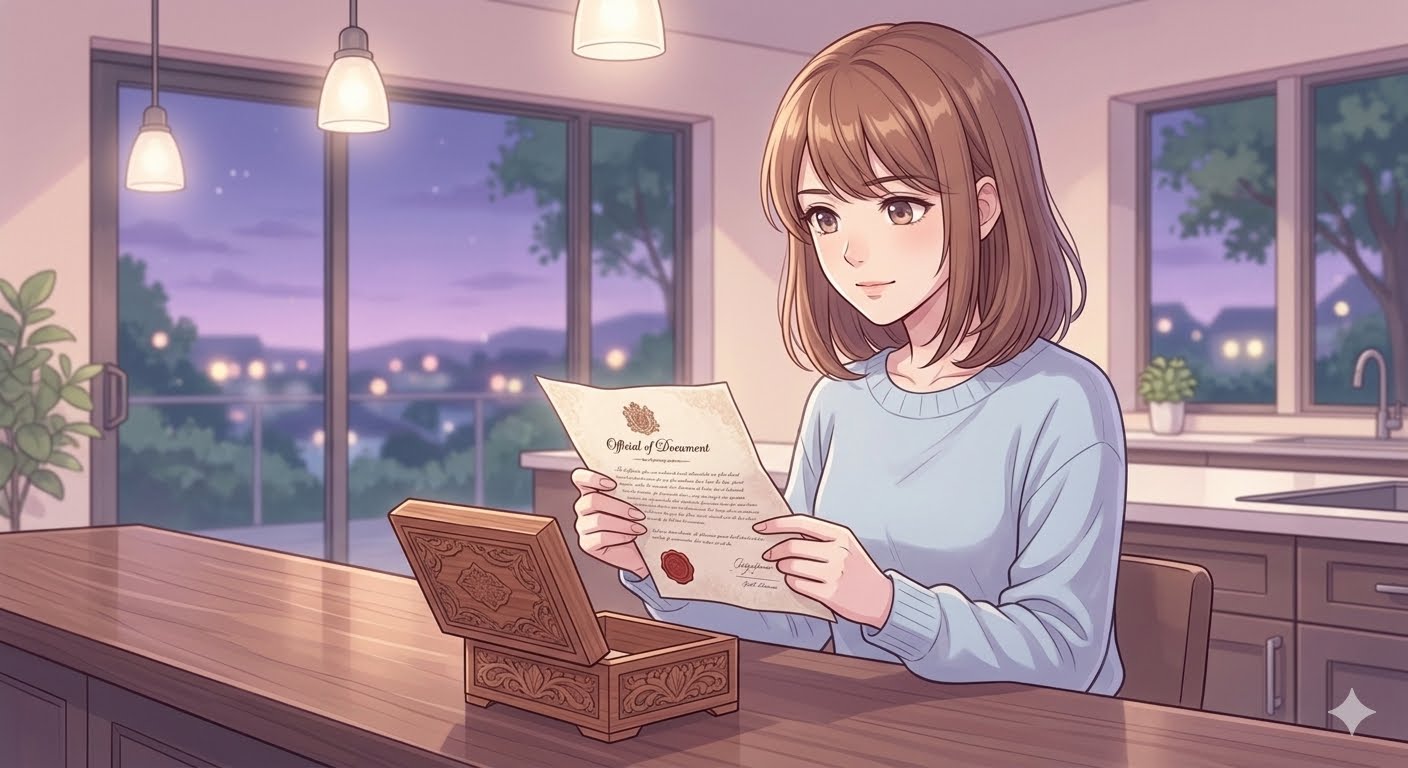
- That night, sitting at the kitchen island in my new home, I opened the cedar box. Inside rested a photograph of Mom, a faded envelope in her distinct handwriting, and a thick stack of estate documents.
- I knew my mother had left me an interest in the Austin house, but I had never closely examined the fine print. Halfway down the first page, one sentence brought me to a halt:
- “No beneficiary shall be permanently deprived of residence in the property by the surviving occupant.”
- The following morning, I called Arthur Bell, the attorney who had handled my mother’s estate. After I explained the previous night’s ultimatum, the line went quiet.
- “Natalie, bring me everything,” Arthur instructed. “Don’t sign anything, and do not discuss these documents with your father yet.”
- At his downtown office, Arthur spread the papers across a wide conference table. After a long silence, he removed his reading glasses.
- “You believe you own half the house,” he began.
- “I thought I did.”
- “You do. But that isn’t the crucial part.” He pulled out an older deed. “Your mother owned the Austin property before she ever married your father. It was acquired using funds from your maternal grandparents’ estate. When she became ill, she placed it into a trust.”
- “I’m aware of that.”
- “Not of the full structure,” Arthur clarified. “Your father was granted a life estate—a legal right to occupy the home after your mother died. Legal title was placed in trust for you.”
- I stared at him. “So Cynthia—”
- “Cynthia has never owned a single square inch of that house.”
- For nine years, she had rearranged my mother’s furniture, discarded her personal belongings, lectured me on gratitude, and treated me like an unwelcome guest. Yet she had been the guest all along.
- Arthur tapped another clause in the document. If the surviving occupant knowingly and permanently excluded the primary beneficiary, the life estate could be legally revoked.
- My pulse quickened. “Dad could lose the house because he allowed her to throw me out?”
- “Potentially,” Arthur noted. “We just need clear evidence that the exclusion was intentional.”
- That was when I remembered the dining room security camera. My father had installed a system after a neighborhood burglary two years prior. The dining room lens faced the patio doors but captured full audio and clear video of the table.
- By noon, we had pulled the cloud recording. Cynthia’s voice echoed crisp and sharp:
- “Either give your master bedroom to your sister by tomorrow morning, or pack your bags and get out of this house forever.”
- Followed immediately by my father’s complete silence.
- Arthur watched the footage twice before looking up. “That is definitive evidence.”
- Part 2
- Three days after that dinner, Arthur and a process server arrived at the Austin house.
- I was sitting on the terrace of my hillside home when my phone began vibrating continuously. Dad. Cynthia. Madison. Dad again.
- I finally answered.
- “Natalie,” my father whispered, his voice shaking. “What did you do?”
- Cynthia was screaming frantically in the background.
- “What I should have done years ago,” I replied quietly.
- “There’s a lawyer here,” Dad stammered. “He says this house… he says it isn’t mine.”
- “It never was.”
- Cynthia snatched the phone from him. “You selfish little snake! You’re trying to steal your father’s home!”
- I let out a dry laugh. “No, Cynthia. I’m stopping you from stealing my mother’s.”
- She slammed the phone down.
- By that evening, Cynthia had mobilized the family network, claiming I was evicting my grieving father out of spite. Madison posted a tearful video online about being “rendered homeless by a bitter stepsister.” Accusatory messages poured into my inbox.
- For a brief moment, the sheer pressure almost got to me. Then headlights swept across my living room wall as Cynthia’s SUV pulled up outside my gate.
- She called my phone six times before I answered. “Open the gate.”
- “No.”
- “Don’t be childish, Natalie. We need to discuss this face-to-face.”
- “You had that chance at dinner.”
- Her tone shifted abruptly, dropping into a soft, manipulative register that alarmed me far more than her yelling. “Your father will fall apart if he loses this house.”
- I watched her silhouette through the glass walls. “Then maybe you shouldn’t have ordered the legal owner to leave it.”
- Silence stretched over the line. For the first time, Cynthia grasped that I was operating with complete legal leverage.
- She quickly pivoted. “Your mother wanted Daniel taken care of.”
- “She did.”
- “And Madison is his child.”
- I tightened my grip on the receiver. At the time, I assumed she was merely defending her daughter, but I would later realize she was gauging how much I actually knew.
- “You’ve always been jealous of her,” Cynthia pressed. “This isn’t about property. You want revenge.”
- “Revenge would be forcing you to feel the way you made me feel for nine years,” I told her.
- “Then what is this?”
- “A boundary.”
- Her face hardened under the glow of her headlights. “You’ll regret humiliating this family.”
- I considered responding, but instead, I simply hung up. Ten minutes later, her taillights disappeared down the hill.
- The following morning, Arthur informed me that Cynthia had retained counsel, claiming the trust provisions had been “misrepresented” to her years ago. Arthur sounded genuinely amused, noting that if she had ever executed a prior acknowledgment of the trust, her argument would instantly collapse.
- Neither of us yet realized how much she had actually signed.
- That evening, I remembered the sealed envelope resting inside the cedar box. Across the front, Mom had written in her familiar script: For Natalie, when the house stops feeling like home.
- I broke the seal and pulled out three pages. The opening line read:
- My darling girl, if you are reading this, then the scenario I feared has likely come to pass.
- Mom explained that during the final year of her illness, she discovered my father was emotionally involved with Cynthia. They had known each other long before Dad ever admitted it to the family. Mom had uncovered their hidden messages and understood that Cynthia deeply resented the house because every wall held memories of Daniel’s first marriage.
- Then I reached the sentence that made my breath catch in my throat:
- Madison is not entering your life by coincidence.
- Years earlier, during a temporary, hidden marital separation, Daniel had engaged in an affair with Cynthia. Madison was his biological daughter. My stepsister was actually my half-sister.
- Suddenly, every piece of the past nine years clicked into place: my father’s perpetual spinelessness, his desperate obsession with “keeping the peace,” and Cynthia’s absolute conviction that Madison deserved whatever was mine.
- Mom had known the entire truth, yet she had chosen to let my father remain in the house anyway. The final page revealed her reasoning:
- “Because you loved him, Natalie. And I could not bear to make you suffer the loss of both parents at once.”
- Tears blurred my vision—not for the lost bedroom, nor for the house, but for my mother, who had used her remaining strength while dying to shield her daughter from a devastating betrayal.
- Her letter concluded with a final directive: “Do not confuse forgiveness with surrender.”
- Part 3
- The next afternoon, my father drove up to my hillside home alone. I placed Mom’s letter directly on the kitchen counter.
- All color drained from his face.
- “You knew,” I said quietly.
- “Yes.”
- “How long?”
- “I knew Madison was mine from the moment she was born.”
- “And Mom knew.”
- Dad buried his face in his hands. “Yes.”
- “You allowed me to believe Cynthia only entered your life after Mom died,” I said. “You let her erase Mom piece by piece because you were ashamed?”
- He began to weep, but for the first time in my life, his tears didn’t sway me.
- “I loved your mother,” he sobbed.
- “Maybe you did,” I replied. “But you failed to protect her memory, and you failed to protect me.”
- He nodded miserably, unable to offer a defense. Then he cleared his throat. “Arthur haven’t told you everything yet.”
- He pulled a small brass key from his pocket and set it beside Mom’s letter. “Your mother gave me this two days before she passed away. She made me promise never to use it unless the trust’s validity was challenged.”
- The key belonged to a safe-deposit box at a downtown bank. The next morning, Arthur and I went together to open it.
- Inside lay a notarized affidavit signed by Cynthia twelve years prior. Arthur scanned the document twice, his expression shifting from curiosity to shock.
- “Natalie, you need to read this immediately.”
- The affidavit confirmed that Cynthia had accepted a substantial private financial settlement from my mother years ago. In exchange, Cynthia explicitly acknowledged that the Austin property belonged exclusively to my mother’s trust, waived any future legal claims, and agreed that any attempt to secure an interest through Daniel would constitute actionable fraud.
- However, the final clause contained the true revelation: Cynthia had sworn under oath that Daniel was not Madison’s biological father.
- Attached to the back was an official DNA laboratory report. Probability of paternity: 0.00% (Excluded).
- The room felt like it was spinning. My father had spent eighteen years carrying crippling guilt over a child who wasn’t even his. My mother had known the truth. Cynthia had known the truth. And Cynthia had weaponized his guilt—and his belief in his own paternity—to manipulate and control him for nearly a decade.
- That evening, I handed the laboratory report to my father. He read the numbers twice before dropping heavily into a chair.
- “She knew?” he whispered, his voice barely audible.
- “Yes.”
- “And your mother knew too?”
- “Yes.”
- A broken, hollow laugh escaped his chest. “All these years… I thought I was paying penance for what I had done.”
- Perhaps he was—just not for the secret he thought he was keeping.
- Two weeks later, the trust formally terminated my father’s life estate due to breach of conditions. I chose not to throw everyone onto the street overnight; instead, I gave my father sixty days to secure a nearby apartment.
- I offered Madison a separate choice: she could reside in the house temporarily while completing her first semester at community college, provided she treated the home and me with consistent respect.
- She broke down crying. “I honestly didn’t know any of this.”
- “I know you didn’t.”
- “What happens to my mom?” she asked softly.
- I looked toward the entryway, where Cynthia stood beside a row of packed luggage—the exact same style of hard-shell suitcases I had rolled past her while she laughed three weeks earlier.
- “She leaves.”
- Cynthia stared at me, searching my face for a flicker of leniency. I remembered my mother’s final words: Do not confuse forgiveness with surrender.
- I opened the front door. Without a word, Cynthia picked up her bags and walked out into the afternoon heat.
- My father moved into his new apartment a month later. Madison remained until winter break before relocating to a campus dormitory. We didn’t transform into a perfect family overnight—life rarely affords such neat resolutions—but over time, we established a genuine relationship. We became sisters by choice, even after scientific evidence proved we weren’t sisters by blood.
- As for the Austin house, I chose never to live there again, preferring the peace of my hillside home. I restored my mother’s walnut cabinet, repaired the scratched entryway molding, and converted my former bedroom into a quiet reading room.
- Then, I executed one final decision: I donated the full use of the property to a local non-profit organization providing secure temporary housing for women and children rebuilding their lives after domestic displacement.
- When Arthur asked if I was entirely certain about giving up the residence, I looked out through the tall windows my mother had personally selected.
- “A home should never be used to make someone feel trapped,” I told him.
- Six months after that infamous dinner, an unmarked envelope arrived in my mailbox. Inside was an old photograph of my mother standing on the Austin porch years ago. Standing right beside her, both of them smiling, was Cynthia.
- On the back, written in my mother’s distinct handwriting, were six words:
- I knew who she was first.
- I sat quietly with the photograph for a long time as the full truth settled over me.
- Mom had never been blindsided. She had located Cynthia long before my father ever built up the nerve to confess. She had investigated the situation, protected her home, secured my financial future, and even extended financial protection to a child she believed might be her husband’s.
- She had constructed an airtight legal shield around my life while everyone assumed she was merely succumbing to her illness.
- And years later, when Cynthia arrogantly ordered me to surrender my bedroom or get out, she had unknowingly triggered a legal trap set by the very woman she had spent nine years trying to erase.
- The house had never been Cynthia’s prize to claim. It was my mother’s final, enduring act of love.
Part 1 “Either give your master bedroom to your sister by tomorrow morning, or pack your bags and get out of this house forever.”