The Ledger of Deceit: A Blueprint for Survival
Chapter 1: The White Curtain
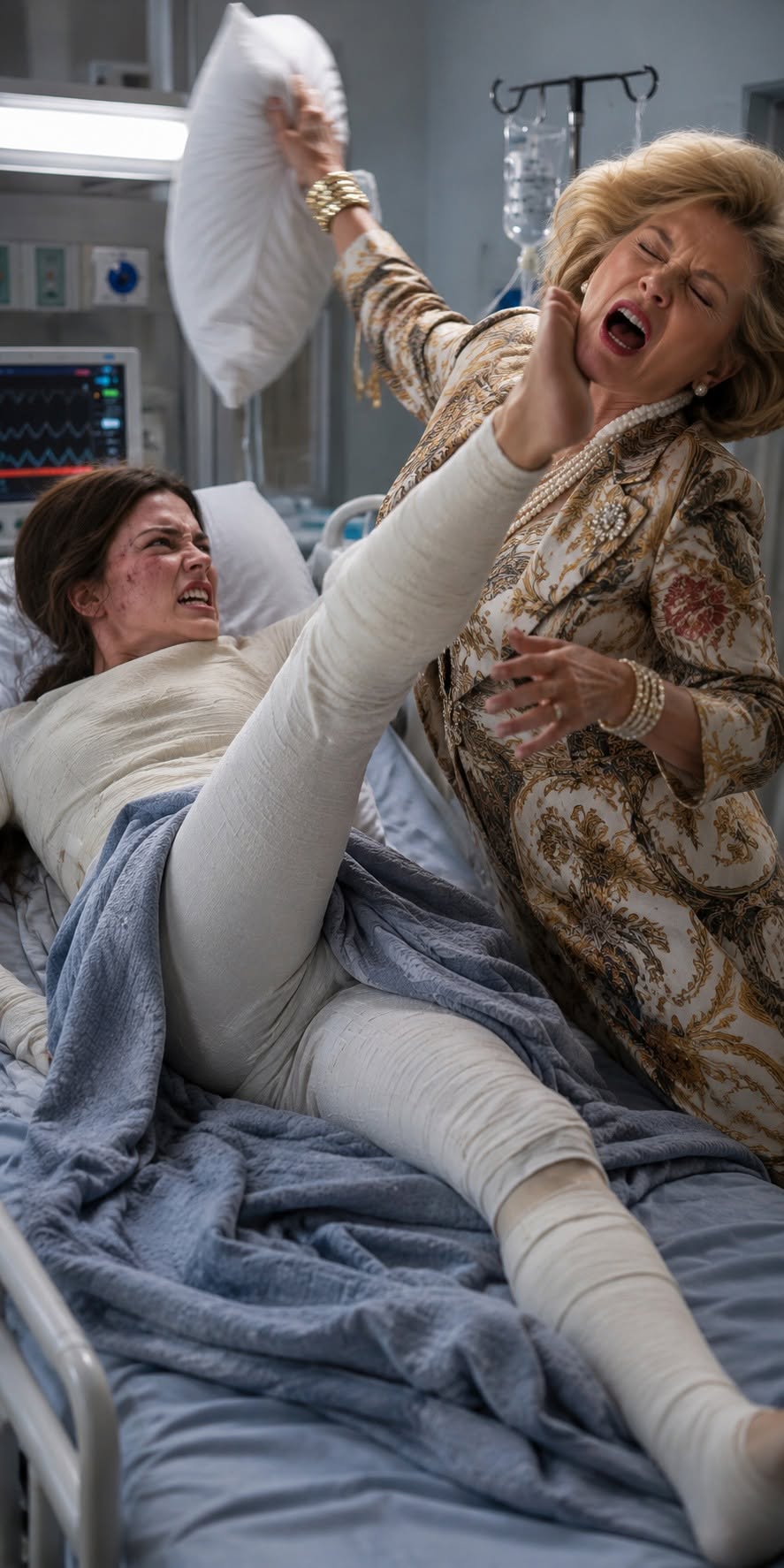
My own skeleton felt secondary to the hardened shell of plaster encasing me. I was locked in a full-body cast, a grotesque human statue stretching from my collarbones down to my ankles. Inside this suffocating armor lay a body desperately trying to heal: two cracked ribs, three fractured vertebrae, and a constellation of bruises that throbbed with every shallow breath. All of this was the souvenir of a catastrophic, supposedly accidental plunge from the third-story balcony of my own home.
The doctors called my survival a medical miracle. My mother-in-law, Vivian Hale, called it a stubborn inconvenience.
I lay trapped in the sterile quiet of room 412, my senses heightened by immobility. The heavy scent of hospital-grade bleach battled against the suffocating, powdery aroma of Vivian’s signature Baccarat Rouge perfume. She hovered over my bed, a vision of wealthy, manicured menace. Her icy fingers reached out, viciously pinching the tender, purpling flesh of my cheek. The cold metal of her heavy diamond bracelet scraped agonizingly against my jawline.
Then, her other hand brought up the pillow.
“You should have died in the fall, you cheap trash,” Vivian whispered. Her voice was not a scream, but a melodic, malicious purr that vibrated right next to my ear. “But I’ll finish the job so my son can be free.”
The pillow descended. It came down like a white, suffocating curtain over my face—soft as mercy, yet heavy as murder.
Darkness swallowed my vision. The coarse cotton pressed brutally against my mouth and nose. I could feel her weight leaning into it, her expensive silk blouse rustling as she applied pressure. My lungs immediately screamed for oxygen. Panic, raw and primal, flared in my chest, beating against my ribcage like a trapped, desperate bird.
But I did not thrash. I did not cry out. I forced my mind into a state of terrifying, crystalline calm.
I was an accountant. I understood numbers, timing, and precision. I just needed to count.
One.
Through the fabric, I could hear her breath catching—a sickly, trembling gasp of sheer excitement. She was enjoying this.
Two.
Three.
My pulse hammered a frantic rhythm in my ears.
Four.
Five.
Six.
The burning in my chest shifted to a dull, expansive ache. The edges of my consciousness began to fray, threatening to pull me under into a dark abyss.
Seven.
Eight.
Nine.
At ten, with the very last ounce of strength in my unbroken arm, my thumb felt the smooth plastic of the small, black device hidden discreetly in my palm. I pressed the silent alarm button with everything I had left.
I waited for the cavalry. I waited for the doors to fly open. But for a heart-stopping second, nothing happened. The pressure on my face only increased, Vivian’s weight crushing my fractured ribs, and the darkness began to claim me entirely.
Chapter 2: Charity in Heels
I had not always been this helpless. Before I became the paralyzed victim in room 412, I was Elena Cross, a senior forensic accountant for the state attorney’s office. I spent my days dissecting financial fraud, tracking offshore shell companies, and watching arrogant criminals weep when I slid binders of their own greed across an interrogation table. I knew how people lied. I knew how killers practiced grief in their bathroom mirrors before facing the press.
Yet, like a fool, I had missed the most dangerous fraud in my own living room.
For two excruciating years of marriage, Vivian Hale had waged a covert war against my existence. To her, I was an infection in their pristine, old-money bloodline. I was “charity in heels.” Before the state attorney’s office, I had paid my way through university by waiting tables. Vivian never let me forget it.
I remembered a specific family dinner, the mahogany table groaning under the weight of catered French cuisine and crystal wine glasses. Vivian had smiled at me, her lips painted a predatory crimson, and raised her glass.
“You know, Elena,” she had mused loud enough for the entire extended family to hear. “Some women are simply born to inherit silver. Others, unfortunately, only ever learn how to polish it.”
I had looked across the table at my husband, Adrian Hale. I waited for him to speak. I waited for the man who promised to protect me to shut down his mother’s casual cruelty.
Adrian merely looked down at his Cabernet, swirling the dark red liquid, and mumbled, “Mom doesn’t mean it like that, Elena. Just let it go.”
He never defended me. He was a handsome, hollow vessel, entirely financially dependent on the trust fund his mother dangled over him like a puppet string.
But the balcony fall had changed the geometry of our marriage forever.
It happened on a rainy Tuesday. I was standing on the terrace outside our master bedroom, the wind whipping my hair. Adrian had followed me out, his voice a whining pitch, begging me once again to sign the paperwork to triple my life insurance policy.
“It’s just a precaution, Elena!” he had argued, his eyes darting nervously back toward the house.
“It’s a two-million-dollar precaution, Adrian! We don’t need it,” I snapped, gripping the wrought-iron railing.
The next few seconds were a blur of calculated horror. I remembered Adrian’s hand suddenly gripping my wrist, tight and cold. I remembered hearing Vivian’s voice echoing from the bedroom behind us. And then, I leaned back against the iron railing.
It didn’t just break. It gave way with a sickening, metallic shriek, as if it had been waiting for my weight. I plummeted three stories, the wind roaring in my ears, before the brutal concrete of the patio shattered my world into darkness.
When I finally woke up in the hospital, drowning in morphine, Adrian was sitting beside my bed, weeping violently into his hands. Vivian was standing behind him, gripping my uninjured hand, performing for the nurses.
“My poor, clumsy daughter-in-law,” Vivian had sobbed, wiping away a tearless eye. “It was raining. She must have slipped on the tiles.”
As I lay there, unable to speak through the breathing tube, a terrifying clarity washed over me. I remembered the metallic groan of the iron. I remembered Adrian’s grip on my wrist. But most importantly, I noticed the way Adrian refused to look me in the eye.
I survived the fall. But as I looked at my grieving husband and his weeping mother, a cold dread coiled in my gut. I realized the accident wasn’t a tragedy. It was a failed rehearsal. And they were going to try again.
Chapter 3: The Ghost in the Machine
The plan to destroy them began exactly twelve hours after my breathing tube was removed.
I was physically broken. I could not sit up, I could not stand, and I couldn’t even lift my hand to scratch my own nose. But my mind—the sharp, analytical engine that had dismantled crime syndicates—was untouched. I could listen. I could calculate. I could remember.
Vivian’s first catastrophic mistake was arrogance. She sent Adrian home to “rest his nerves” while she magnanimously volunteered to keep watch over me. Her second mistake was assuming the heavy doses of Dilaudid dripping into my IV made me deaf and stupid. Her third mistake was bragging.
On the second night, believing I was entirely unconscious, Vivian had answered her cell phone. She paced the length of my hospital room, her voice a hushed, conspiratorial hiss.
“The house will be significantly easier to sell once she’s finally out of the picture,” she whispered to whoever was on the other line. “Adrian gets the insurance payout, I recoup my initial investment, and we bury the little waitress. It’s a win-win.”
She thought I was lost in a narcotic fog. She didn’t realize I had my phone tucked beneath the sheets, the red recording icon silently absorbing every damning word.
By the next morning, I requested a private consultation with the hospital’s head of security, claiming I felt unsafe. Through him, I reached out to my old supervisor at the state attorney’s office. Favors were pulled. Wheels were set in motion quietly, legally, and with lethal precision.
Enter Marcus Vane.
Marcus was a private investigator I had used for off-the-books asset tracing in the past. He was a towering man with eyes like chipped flint and a moral compass that pointed strictly toward whoever paid him to expose the truth. With the hospital’s clandestine approval, Marcus and his team infiltrated my room posing as maintenance staff. They installed microscopic, high-definition cameras in the air vents and smoke detectors.
Then, while Vivian stepped out for her two-hour lunches, Marcus held a tablet over my face so I could review the financial documents he had unearthed.
The digital paper trail was a masterpiece of stupidity.
Adrian, the coward, had forged my signature on the updated two-million-dollar life insurance policy a mere three weeks before my “accident.” But Vivian had been even sloppier. Marcus found a wire transfer from one of Vivian’s obscure shell companies—Hale Holdings LLC—to a shady independent contractor. The contractor had been hired to “repair and paint” our bedroom balcony just days before I fell.
After receiving forty thousand dollars, the contractor had vanished.
But the most chilling piece of evidence Marcus showed me was a close-up photograph of the shattered balcony railing, taken by the police before it was cleared away. I stared at the high-resolution image until my eyes burned and my tears dried.
I didn’t cry because I was shocked. I cried because I was finally, irrevocably done mourning the illusion of the marriage I thought I had.
The photograph showed the sheared bolts of the iron railing. The metal hadn’t snapped outward from the force of my weight. The threads were stripped from the inside. The railing had been meticulously loosened with a wrench hours before I leaned on it. It was a booby trap.
“She’s coming back in ten minutes,” Marcus had whispered, sliding the tablet into his jacket. He slipped a small, black panic button into my palm, wrapping my fingers around it. “We are in the room next door. You have audio and video rolling 24/7. When she makes her move, you press this. We’ll handle the rest.”
I had nodded, squeezing the button. I was ready.
But as the pillow pressed down on my face, and the oxygen fled from my burning lungs, I realized that ten seconds of suffocation feels like an eternity. As my vision spotted with black stars, the terrifying thought crossed my mind: What if the alarm didn’t work?
Chapter 4: The Wrong Woman
The heavy oak door of room 412 didn’t just open; it exploded inward with the force of a battering ram.
The deafening crash shattered the deadly silence of the room. The suffocating weight of the pillow was instantly ripped away from my face. I gasped, sucking in massive, greedy lungfuls of sterile hospital air, my chest heaving against the rigid plaster cast.
Vivian jerked backward, stumbling on her high heels. Her face, usually a mask of haughty composure, was pale, frozen, and stretched in utter shock.
The people who flooded the room were not nurses. They were not doctors. They were Marcus Vane and his two heavily built associates, moving with terrifying speed.
Marcus, moving faster than a man his size should, caught Vivian’s wrist, twisting it sharply before she could even drop the pillow to the floor.
“Step away from the patient, Mrs. Hale,” Marcus barked, his voice echoing off the linoleum.
Vivian’s shock lasted only a second. Women of her pedigree were trained to recover fast; deception was their second language. She ripped her arm from Marcus’s grip, her eyes welling with instant, manufactured tears.
“How dare you!” she shrieked, pressing a hand to her chest. “She stopped breathing! I was trying to adjust her head! I was helping her!”
The second investigator, a stocky woman named Sarah, didn’t argue. She simply lifted her smartphone, the screen glowing brightly.
“Audio is completely clean,” Sarah stated flatly. “And the 4K video from the vent camera is even cleaner. We heard every word.”
Vivian’s mouth opened, but no sound came out. The color drained entirely from her face, leaving her looking like a hollowed-out mannequin.
At that precise moment, a shadow fell over the doorway.
Adrian stood there, holding a cardboard tray with two iced coffees. He wore a cashmere sweater and a look of deep, profound confusion. He took in the scene: the strange men, his mother cornered, the pillow discarded on the floor, and me, gasping for air in my cast. Guilt was written across every inch of his cowardly posture.
“Mom?” he whispered, his voice cracking. “What’s going on?”
I turned my eyes toward him. The muscles in my neck screamed in protest, but it was the only part of my body I could move without blinding agony. I stared at the man I had vowed to love. I waited for him to see the truth.
He looked at the discarded pillow. He looked at the furious PI holding a camera. He looked at my bruised, terrified face.
And still, incredibly, miraculously, he chose his mother.
Adrian stepped into the room, his jaw setting defensively. “This is insane,” he snapped, dropping the coffees onto a side table. “Who the hell are you people? My wife is heavily medicated on opioids! She’s confused, she’s hallucinating. Get out before I call security!”
Marcus smiled, but there was zero warmth in his eyes. It was a predator’s grin.
“Funny you should say that, Mr. Hale,” Marcus replied smoothly. “She seemed remarkably clear-headed and legally competent when she hired our agency two days ago.”
Adrian froze. The defensive anger melted from his face, replaced by a cold, creeping terror. He slowly turned his gaze back to me. For the first time since my fall from the balcony, he looked genuinely afraid.
Yes, darling, I thought, staring back into his panicked eyes. You targeted the wrong woman.
“Elena?” Adrian stammered, taking a hesitant step forward. “What… what did you do?”
Before I could answer, the third investigator stepped forward, holding a thick, manila envelope. He handed it to Marcus.
Marcus unclasped the envelope and pulled out a stack of financial ledgers, bank statements, and wire transfer receipts. He tapped the papers against his palm, looking Adrian dead in the eye.
“Your wife didn’t just hire us to watch the room, Adrian,” Marcus said softly. “She also hired us to find out exactly where the forty thousand dollars went. The money that paid the contractor to strip the bolts on your balcony.”
Adrian’s lips parted. His breathing became shallow, rapid pants. I watched the realization hit him like a physical blow. He watched the documents flutter in Marcus’s hands.
The offshore accounts. The fake charities. The untraceable wire transfers. He had married a state forensic accountant, a woman who hunted dirty money for a living, and he had tried to commit a sloppy financial crime in her own house.
The physical pain of almost dying had been unbearable. But watching Adrian’s arrogant, entitled world utterly collapse before my eyes? That was the finest medicine I had ever tasted.
But a cornered animal is the most dangerous kind, and Vivian was not done fighting.
Chapter 5: The Collapse of the House of Hale
The flashing red and blue lights of the police cruisers painted the hospital room walls a chaotic purple. They arrived exactly seven minutes after Marcus placed the call.
Vivian did not scream when the uniformed officers entered. She did not cry. She instantly pivoted to negotiation, falling back on the armor of her wealth.
“I want my lawyer immediately,” she demanded, crossing her arms over her silk blouse, her chin tilted upward in defiance. “This is a grotesque misunderstanding. These thugs broke into my daughter-in-law’s room.”
“You’ll get a phone call at the precinct, ma’am,” the lead detective said wearily, pulling a pair of steel handcuffs from his belt.
“My son had absolutely nothing to do with this,” Vivian added quickly, shooting a warning glare at Adrian. “He is completely innocent of these absurd allegations.”
Adrian flinched at her words. He looked from his mother, to the police, and then to the thick stack of financial documents Marcus had handed to the detective.
That was the exact moment I knew he would betray her. He was a parasite, and parasites always abandon a dying host to save themselves.
The detective turned his attention to my husband. “Mr. Hale, we have timestamped digital evidence tying you to life insurance fraud, conspiracy, and attempted murder. You are coming with us.”
Adrian’s hands began to shake so violently he had to grip the edge of my hospital bed to stay upright.
“No!” Adrian shouted, his voice shrill and desperate. He pointed a trembling finger directly at Vivian. “No, this was all her! I didn’t want to do it! She forged the insurance documents! She hired the contractor! My mother planned everything, I swear to God!”
Silence dropped over the room like a lead weight.
Vivian stared at her son, her eyes wide with a mixture of shock and utter disgust. Then, with a speed that startled the officers, she lunged forward and slapped Adrian across the face.
The sharp CRACK of her palm hitting his cheek echoed down the hospital hallway.
“You spineless, pathetic little parasite!” Vivian spat, her aristocratic mask finally shattering to reveal the ugly, venomous creature beneath. “I did everything for you! You are nothing without me!”
There it was. The legendary Hale family love, laid bare for everyone to see.
Marcus stepped aside smoothly as two officers grabbed Vivian by the arms, forcing her against the wall as they read her Miranda rights. She fought when they cuffed her. It wasn’t a wild, desperate thrashing, but a proud, indignant struggle. She twisted her wrists, glaring at the officers as if the cheap metal of the handcuffs had personally insulted her lineage.
Before they dragged her out the door, she dug her heels into the linoleum and leaned back, locking eyes with me one last time. Her face was twisted into a grotesque snarl.
“You think you’ve won, you little street trash?” she hissed, her voice dripping with venom. “I have lawyers who will tie this up for decades. I will take everything you have.”
I didn’t blink. I slowly shifted my gaze to the clear plastic evidence bag the detective was holding. Inside it rested the white hospital pillow, still indented from where she had pressed it into my face.
Then, I looked at Adrian, who was weeping silently against the wall, his cheek blazing red from his mother’s hand.
“I survived you,” I rasped, my throat still burning from the lack of oxygen. “Putting you in a cage is just extra.”
Vivian screamed something foul, but the heavy oak door closed behind her, cutting off her rage.
The room was finally quiet. But as Marcus pulled up a chair beside my bed, looking over the remaining paperwork, my phone buzzed on the tray table. It was an alert from my old supervisor at the DA’s office.
We found the contractor, the message read. But you have a problem. He lawyered up, and he’s refusing to talk.
If the contractor didn’t testify to who paid him, the attempted murder charge on the balcony fall could collapse into reasonable doubt. Vivian’s high-priced lawyers might just find their loophole.
Chapter 6: The Ledger of Justice
The investigation moved with devastating speed, largely because I had made it impossible for them to fail. I handed the state a puzzle that was already solved.
Every audio recording from my hospital bed was meticulously time-stamped. Every offshore bank transfer was traced by my former colleagues with ruthless efficiency. The new insurance policy was analyzed by a forensic handwriting expert who proved, unequivocally, that Adrian had forged my signature.
The snag with the contractor didn’t last long. He was tracked down three days later, hiding in a cheap, bug-infested motel outside of Phoenix, Arizona. When the FBI raided his room, he tried to act tough. But when they showed him the wire transfer receipts bearing his name and explained he was facing twenty years as an accessory to attempted murder, his loyalty to the Hale family evaporated.
He traded Vivian and Adrian for a reduced sentence before he even ate his lunch.
The ensuing months were a blur of legal maneuvers and physical agony. Adrian, panicking at the thought of a real prison, tried to play the repentant husband. He attempted to send three dozen white roses to my hospital room.
I had Marcus intercept them and personally deliver them to Adrian’s defense attorney, along with a restraining order.
During the preliminary hearings, Adrian tried crying in court, putting on a show of a broken man manipulated by an overbearing mother. The judge, a stern woman with zero tolerance for theatrics, was not moved in the slightest.
By the time the actual trial commenced, the media had caught wind of the “High Society Balcony Plot.” The courtroom was packed.
Vivian arrived every day wearing a string of authentic pearls and a tailored black Chanel suit. She sat at the defense table with her spine ramrod straight, performing an air of untouchable dignity. She looked at the jury with a patronizing half-smile, as if they were peasants judging a queen.
Her performance held up brilliantly—until the prosecutor dimmed the courtroom lights and played the high-definition hospital video on the massive screen.
The jury sat in dead silence. They watched the video of Vivian Hale, in all her tailored glory, viciously pinching my bruised cheek. They watched the white pillow descend. The courtroom’s surround-sound speakers amplified her whispered, poisonous words, making them echo off the mahogany walls.
“You should have died in the fall, you cheap trash.”
“I’ll finish the job so my son can be free.”
As her own voice echoed through the room, Vivian’s haughty posture finally crumbled. Her own arrogance had dug her grave, and her own voice had shoveled the dirt.
Adrian, terrified of the trial’s trajectory, officially took a plea deal in the third week. He took the stand and testified against his own mother, detailing exactly how she had conceptualized the balcony tampering.
It was a desperate bid to save himself, but it did not work out the way he hoped. He was still convicted of felony insurance fraud, conspiracy to commit fraud, and accessory to attempted murder. When the judge brought the gavel down, reading out a sentence of fifteen years without the possibility of early parole, Adrian’s pretty, pampered face went the color of wet ash. He collapsed into his chair, sobbing uncontrollably as the bailiffs hauled him away.
Vivian received a much harsher fate.
When the judge addressed her, the courtroom was so quiet you could hear the air conditioning hum.
“Mrs. Hale,” the judge said, her voice dripping with contempt. “I have sat on this bench for two decades. I have seen crimes of passion, and crimes of desperation. But your cruelty was calculated, predatory, and entirely remorseless. You viewed a human life as an obstacle to your financial comfort.”
She was sentenced to twenty-five years in a maximum-security state penitentiary.
As the guards stepped forward to handcuff her, Vivian Hale finally looked small. She didn’t look weak—she still carried a bitter, toxic pride—but she looked small. Stripped of her mansion, her trust funds, and her illusion of superiority, she was just an old, angry woman in a cheap orange jumpsuit.
There is a profound difference between being weak and being small. I watched her shuffle out of the courtroom, and I felt absolutely nothing but closure.
But as I was wheeled out of the courthouse, my attorney leaned down and whispered a final, chilling detail into my ear.
“Vivian just fired her trial lawyers,” he murmured. “She’s hired the most vicious appellate firm in the state. She’s appealing the verdict based on the legality of the hidden hospital cameras. She’s not giving up, Elena.”
Chapter 7: Breathing Room
Six months later, I found myself standing on a balcony once again.
It was not that balcony, of course. The sprawling Hale estate had been seized and sold off months ago. The massive civil judgment I had filed, coupled with the state’s asset forfeiture, had stripped the family bare. The Hale bank accounts were frozen solid. Their century-old reputation was reduced to ash and tabloid fodder. Their high-society friends stopped answering their phone calls, erasing them from the country club rosters like a bad stain.
The Hale name, once polished and displayed like fine silver, had become a cautionary tale whispered at dinner parties.
My new apartment was a sleek, modern penthouse overlooking the winding river that cut through the city. I stood near the edge of the reinforced glass barrier, gripping a sleek carbon-fiber cane in my right hand. Beneath my flowy blue dress, I wore a rigid medical back brace. The pain in my spine was a constant, dull hum, and the physical therapists had warned me that a full recovery would take years.
I looked out over the water, letting the breeze catch my hair.
I have years, I thought, a genuine smile touching my lips.
The heavy sliding glass door opened behind me. Marcus stepped out onto the terrace, holding a thick, leather-bound folder. He had transitioned from my private investigator to my head of personal security and trusted friend.
“The final civil settlement just cleared the escrow account,” Marcus announced, leaning against the glass beside me. He handed me the folder. “The Hale trusts have been entirely liquidated. Elena, you are officially wealthier than your ex-husband ever even pretended to be.”
I opened the folder, looking at the staggering string of zeros on the bank statements. For the first time in over two years, a laugh bubbled up from my chest that didn’t trigger a sharp pain in my ribs.
“I suppose I finally learned how to inherit silver after all,” I mused, closing the folder and handing it back to him.
Below us, the city was transitioning into evening. The streets were bathed in a warm, golden twilight. Headlights flashed like tiny sparks of electricity along the highway. Down there, millions of people were rushing to work, lying to each other, loving each other, and leaving each other. Life was moving forward.
I took a deep, deliberate breath.
There was no white cotton pillow descending on my face. There was no suffocating stench of cheap bleach or expensive perfume. There were no cold, greedy hands trying to push me toward an early grave.
There was just crisp, clean air.
Suddenly, my cell phone buzzed in my pocket. I pulled it out, looking at a priority notification from my attorney.
State Supreme Court just ruled, the text read. Vivian’s appeal has been denied with prejudice. The hospital camera footage is ruled entirely admissible under emergency preservation laws. She has exhausted all options. She is going to die in prison.
I locked the screen and slid the phone back into my pocket. I closed my eyes, letting the warmth of the setting sun wash over my face.
For a long, quiet moment, my mind drifted back to the broken woman in room 412. I thought about the girl trapped in a plaster cage, unable to lift a finger, forced to listen in silence while monsters called her helpless and planned her funeral.
Then, I opened my eyes, looking out over the endless stretch of the river.
“You targeted the wrong woman,” I whispered into the wind.
And this time, there was absolutely nobody left to silence me.
Disclaimer: This story is a work of fiction created for entertainment purposes. Any resemblance to real persons, events, or places is entirely coincidental.
Like and share this post if you find it interesting and want to read more stories of justice and survival!