Chapter 1: The Ring and the Retribution
My graduation day from Georgetown University was supposed to be the absolute, undisputed beginning of my actual life. After four grueling years of academic rigor, endless graveyard shifts at a boutique hotel front desk, and the constant, gnawing anxiety of making rent, I had finally earned my degree and accepted a coveted position at a human rights nonprofit in Washington, D.C. For the very first time in my twenty-two years, my future belonged entirely to me, untethered from anyone else’s expectations.
My stepmother, Diane, had never been comfortable with that idea.
Ever since she married my father a mere fourteen months after my mother’s sudden death, she had systematically, quietly erased every single physical reminder that I had once belonged in our sprawling suburban home. She claimed the vintage photo albums were “cluttering the aesthetic” and moved them into the damp basement. She replaced my mother’s cherished holiday traditions with her own rigidly curated events. Most insidiously, she had spent years convincing everyone—my father included—that I was simply “too emotional” or “stuck in the past” whenever I dared to object to my own erasure.
By the time graduation arrived, I had completely stopped trying to earn a place in a family that actively wanted me to disappear.
Ethan understood all of it. He didn’t just see the polished, high-achieving student; he saw the exhaustion underneath.
He had met me during my sophomore year while I was working a miserable 2:00 AM hotel shift. Unlike everyone else in my life, he never tried to “fix” my silence or offer unsolicited, toxic positivity. He simply brought me coffee, sat in the lobby chair, and stayed beside me until I no longer felt profoundly alone.
One rainy Tuesday evening, a week before graduation, he proposed in the cramped galley kitchen of my tiny apartment. The smell of cheap takeout hung in the air, and the fluorescent light flickered above us.
“I want to build a life with you, Nat,” he had whispered, his hands trembling slightly as he held the small velvet box. “A life where nobody ever makes you ask for permission to be loved.”
I said yes before he could even finish the sentence.
We decided to keep our engagement private until after the graduation ceremony because I wanted to celebrate both monumental milestones together. Looking back, with the brutal clarity of hindsight, I should have realized that Diane would never, ever tolerate a day that wasn’t completely centered on her control.
That Saturday evening, my father hosted a backyard graduation party at the house. Strings of warm, amber lights glowed gently above the expensive flagstone patio. Relatives I hadn’t seen in years gathered around rented folding tables, laughing and clinking glasses. For a brief, fleeting moment, surrounded by the smell of barbecue and the hum of conversation, the house almost felt like the warm home I remembered before the cancer took my mother.
My father stood at the head of the patio, tapping a spoon against his wine glass. He lifted it with a nervous, slightly stiff smile.
“To my daughter, Natalie,” he announced, his voice carrying over the yard. “We are all incredibly proud of the woman you’ve become today.”
For one foolish heartbeat, I looked at him and genuinely believed everything might finally be different. That maybe, we had turned a corner.
Then, Ethan stepped up right beside me, slipping his arm around my waist.
“And to one more beginning,” Ethan added, his voice clear and proud.
I raised my left hand, the porch light catching the modest, beautiful diamond on my finger so everyone could see.
“We’re engaged,” I said, a massive, uncontainable smile breaking across my face.
Joyous cheers broke out across the yard. My college friends applauded wildly, my favorite history professor smiled proudly from near the buffet, and Ethan’s parents rushed over to embrace us.
The warmth lasted only a few seconds before I noticed my father’s expression curdle. He wasn’t looking at the diamond. He was staring fixedly past my shoulder, his face draining of color.
I turned around.
Diane was walking straight toward us. She moved with the terrifying, predatory stillness of a shark cutting through the water. The chatter around her died down as guests noticed her posture.
“How dare you,” she said.
She didn’t shout. She didn’t scream. That dead, calm, perfectly modulated voice frightened me far more than yelling ever could. It was the voice she used right before she destroyed something.
“Diane…” I started, stepping slightly in front of Ethan.
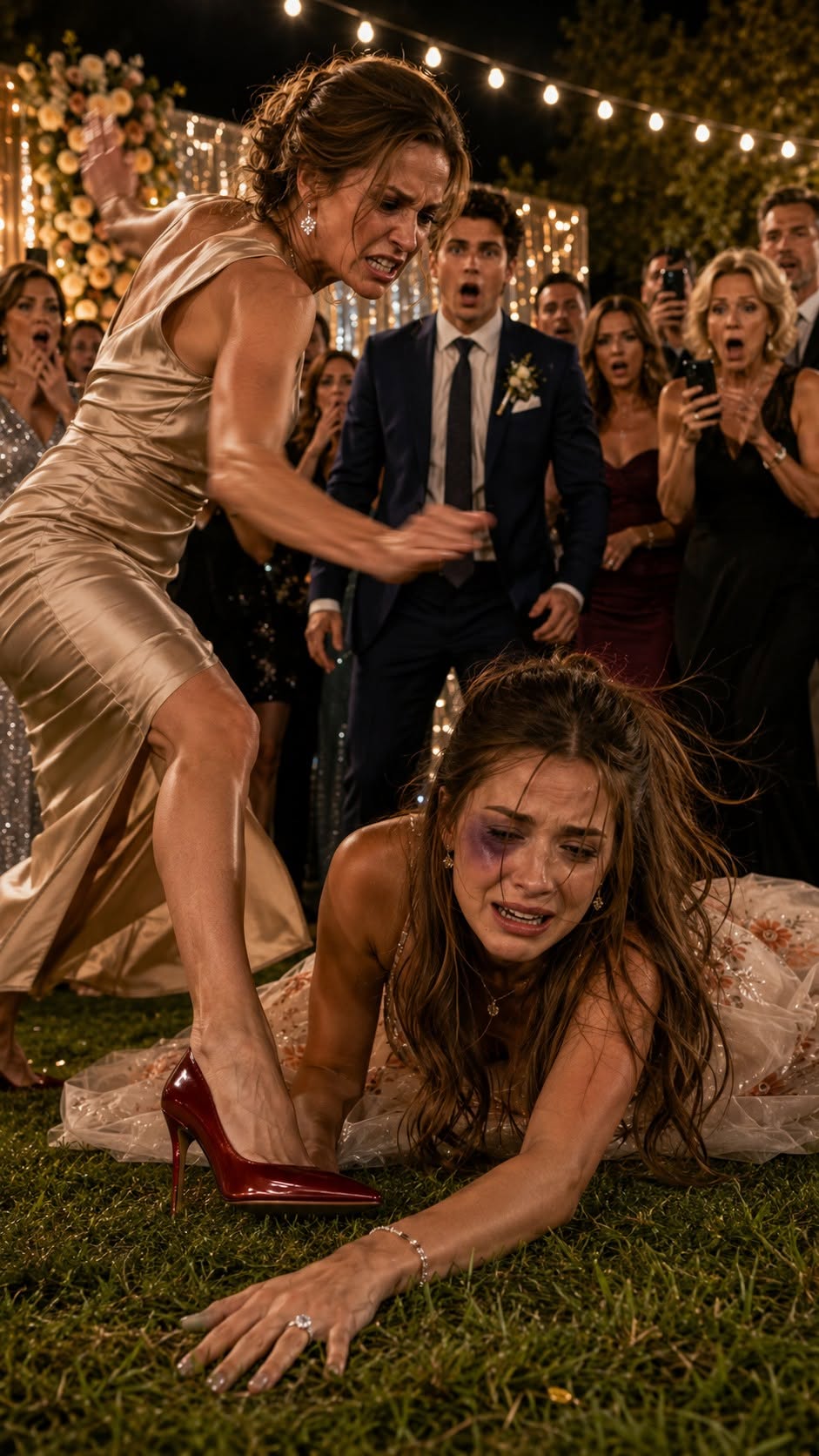
Before I could even finish speaking my stepmother’s name, her hand whipped out and struck my face with enough brutal, unhinged force to snap my head violently sideways.
The sharp crack of her palm against my cheekbone echoed like a gunshot. My lip split instantly against my teeth, the metallic taste of blood flooding my mouth. All conversations stopped dead. The music seemed to vanish. Every single guest froze exactly where they stood, paralyzed by the sheer violence of the moment.
“How dare you announce an engagement in my home without my permission!” Diane hissed, her eyes burning with a psychotic intensity.
Permission. Not congratulations. Not maternal concern. Permission.
Ethan lunged forward and caught my arm just before my knees buckled, but everything around me had already begun spinning violently. The string lights blurred into dizzying, bright white streaks. I vaguely heard my father calling my name, sounding miles away, while Diane loudly insisted to the stunned crowd that I was just “making a scene.”
Then, the ground rushed up to meet me, and the entire backyard disappeared into absolute, suffocating darkness.
Three days later, I slowly opened my eyes inside a sterile, blindingly bright hospital room. A dull, unbearable throbbing pulsed behind my eyes, and I had absolutely no idea how I had gotten there.
Ethan was asleep in the uncomfortable plastic chair beside my bed, still wearing the exact same wrinkled dress shirt from the party.
The first question that escaped my dry, cracked lips was the only one that mattered.
“Ethan… what happened?”
He jerked awake, his eyes wide and bloodshot. He rushed to the edge of the bed, gripping my hand like a lifeline. “You had a severe concussion, Nat.”
I touched my bandaged head, wincing. “From the slap?”
“From the fall after the slap,” he corrected, his voice thick with repressed anger. “Your head hit the edge of the stone fire pit when you went down.”
I tried to sit up, but a wave of nausea and blinding pain exploded behind my eyes, forcing me back against the pillows. As my vision cleared, I noticed a detail that made my blood run cold.
Two uniformed police officers were standing just outside the glass door of my room. And behind them, standing in the hospital corridor, were Diane, my father, and two of my father’s brothers… all wearing heavy, metal handcuffs.
Chapter 2: The Rewrite in the Dark
I couldn’t take my eyes off the dull gleam of the handcuffs.
Diane didn’t look ashamed; she looked absolutely furious, her jaw set in a hard, defiant line as she glared through the glass. My father stood silently behind her, his shoulders slumped, his eyes fixed on the linoleum floor as though the past three days had physically aged him by a decade.
Nothing about the surreal scene made sense until one of the officers gently pushed the door open and stepped inside, speaking in a quiet, professional tone.
“Ma’am, I know this is a lot to process,” the officer explained, consulting a small notepad. “But several witnesses gave official statements at the scene. We collected neighborhood security footage from the house next door, and a formal police report for felony assault was opened the night you were transported.”
I looked at Ethan in absolute disbelief. “You filed a police report against her?”
“Yes,” he said, without a single ounce of hesitation.
“She hit you,” my voice trembled, trying to piece the fractured memories together.
“You collapsed, Natalie,” Ethan said, leaning closer, his voice dropping to a fierce whisper. “You were bleeding from your head, unconscious on the patio. And while I was on the phone with 911, screaming for an ambulance… three people in that yard tried to convince the responding officer that you had been drinking heavily and simply tripped and fell.”
Those words hurt far more than the throbbing concussion. The physical pain was sharp, but the betrayal was a slow-acting poison. I realized in that sterile room that my family hadn’t only stood by and watched me collapse from an assault. While I lay bleeding and unconscious, they had already begun rewriting the narrative to protect their own comfortable reality.
Before I could speak, the officer motioned to his partner. They allowed Diane to step just inside the doorway, keeping a firm grip on her arm.
She instantly switched to the warm, gentle, perfectly modulated voice she always used around strangers and authority figures.
“Natalie, sweetheart, please,” Diane cooed, her eyes pleading with a sickeningly fake sincerity. “Tell these officers this is all just a terrible, drunken misunderstanding.”
Ethan moved swiftly, placing his body squarely between the door and my bed before I could even open my mouth.
“No,” Ethan commanded, his voice like iron.
“Excuse me, this is family business,” Diane snapped, her mask slipping slightly as she glared at him.
“No,” Ethan repeated, his posture unyielding. “It stopped being ‘family business’ the moment she was loaded into the back of an ambulance with a traumatic brain injury because of your hand.”
For the very first time in my entire life, someone refused to let Diane control the atmosphere of the room. She glared at Ethan with open, venomous contempt, but he never looked away from her, completely unfazed by her intimidation tactics.
Then, my father finally stepped into the doorway.
“Nat… please,” he croaked.
I looked at him and barely recognized the man standing there. He seemed so much smaller, so much weaker than the father I had idolized as a little girl. It was as though decades of pathological conflict avoidance had finally caught up with him, hollowing him out from the inside.
“Did you tell them I fell, Dad?” I asked, my voice barely a whisper.
He opened his mouth, closed it, and looked away. He couldn’t answer.
That agonizing, cowardly silence told me absolutely everything I needed to know.
The officer stepped forward and placed a thick, manila folder at the foot of my bed.
“These are the sworn witness statements, Miss,” the officer said gently. “You don’t have to read them today if you aren’t up to it.”
I pulled myself up, ignoring the shooting pain in my skull, and opened the folder anyway.
The first statement came from Mr. Henderson, our next-door neighbor, who clearly detailed seeing Diane strike me unprovoked moments after the engagement announcement. The second came from Ethan’s mother, who described in horrifying detail how Ethan frantically performed first aid and called 911 while my father remained frozen several steps away, doing absolutely nothing to help his bleeding daughter.
Then, I reached my father’s officially signed statement. And every single remaining illusion I held about my family evaporated into thin air.
He had told the police that I became highly emotional, stumbled backward on my own, and probably hit my head because I hadn’t eaten enough that day due to graduation stress.
He had signed his name at the bottom. Under penalty of perjury.
While I was unconscious, fighting for my life in an ambulance, my own biological father had officially, legally blamed me for what his wife had done.
I slowly looked up from the papers, my heart turning to stone in my chest.
“Did she tell you to say that?” I asked him, the disgust evident in my tone.
Before my father could answer, Diane interrupted, her chin raised defiantly. “He was protecting this family, Natalie. Unlike you.”
The officer immediately turned toward her, placing a hand on her shoulder. “That’s enough, ma’am.”
My father lowered his head, staring at his handcuffed wrists. “Nat… I thought… if I explained it differently to the cops… maybe we could keep this whole thing from becoming…”
He stopped, unable to finish the sentence.
“Becoming what?” I demanded, the anger finally burning through the brain fog.
“Permanent,” he whispered.
I laughed. A single, sharp, humorless sound that sent a spike of agony through my head.
“Dad… I’m lying in a hospital bed with a brain injury. It’s already permanent.”
No one in the room spoke to defend him. Not even his brothers.
For the very first time since I was a grieving child, nobody asked me to lower my voice. Nobody told me I was overreacting. Nobody demanded I stop making things difficult for the adults.
The officer quietly informed Diane that she would be taken downtown for formal processing and booking. She stared at me with the exact same cold, reptilian expression she had worn for years whenever we were alone.
“You’re really going to ruin your father’s life over one little slap?” she sneered.
I met her eyes without flinching, the terrified girl she had bullied for a decade entirely gone.
“No, Diane,” I said, my voice steady. “You’re going to answer for what you did. And he’s going to answer for what he didn’t do.”
She was escorted out of the room first, her curses echoing down the hallway. My father followed slowly behind the second officer. He stopped at the threshold and glanced back at me only once before disappearing through the doorway.
I didn’t call after him. The version of me who always desperately tried to make his life easier had finally, permanently disappeared.
Chapter 3: The Architecture of Evidence
The weeks that followed my discharge from the hospital were slow, intensely painful, and far less dramatic than television imagines recovery to be. There were no cinematic shouting matches in the rain. Just the quiet, agonizing reality of severe light sensitivity, endless nausea, and a fractured family.
Diane’s high-priced defense attorney immediately went to work, attempting to paint the assault to the prosecutor as a “minor family misunderstanding exacerbated by the victim’s emotional instability.”
My father didn’t visit. Instead, he sent a cowardly text message three weeks later, asking me not to let “one bad moment” completely destroy us. He wrote it as though years of emotional erasure, one brutal public strike, and a coordinated police lie had all just happened by total accident.
“Please don’t let one bad moment destroy us, Nat.”
I sat on the edge of my small apartment sofa, reading the message several times in the dim light. I saved it, screenshotted it for my lawyer, and did not reply.
The fundamental problem was not “one terrible moment.” The problem was that Diane had spent the last decade systematically removing every trace of my deceased mother from our home, controlling my every choice, and teaching the entire family to treat my pain as a mere inconvenience to her perfect aesthetic.
I didn’t cry. Instead, I began meticulously collecting every single document connected to the graduation party and the hospital stay. I formally requested the unredacted police report. I copied each neurological medical record. I saved every frantic, manipulative voicemail from my relatives.
And then, I did something that truly terrified my father’s side of the family: I called my Aunt Carol and asked her to rewrite her official witness statement without Diane standing right beside her dictating the narrative.
Her second, sworn account revealed far more rot than I could have imagined.
Aunt Carol admitted under oath that Diane had explicitly instructed the relatives to claim I had fainted from the heat and stress before the police arrived, and that my father had stood there and never once corrected them. She also disclosed a chilling detail that wasn’t in the original report: one of my older cousins had actually tried to pry my engagement ring off my finger while I was unconscious on the ground, purely because Diane wanted to completely control how the scene appeared before the ambulance arrived. She didn’t want the cops asking about an engagement.
The legal process moved at a glacial pace through tense phone calls, towering stacks of paperwork, deposition interviews, and silent, oppressive waiting rooms rather than one satisfying, explosive courtroom confrontation.
Faced with the overwhelming witness testimony from Ethan’s family and the neighbors, Diane eventually accepted a plea arrangement for aggravated assault to avoid jail time. She received heavy probation, mandatory anger management, and a permanent criminal record. But the false statements my relatives had given remained part of the official police record, a permanent, documented stain on everyone who had helped her try to hide what happened.
My father did not go to prison for filing a false report, mostly due to his lack of prior history and a lenient prosecutor, but he was legally required to sit in a deposition chair and explain exactly why he had signed a sworn statement blaming his bleeding daughter while she was unconscious.
Months later, we finally sat across from each other in a sterile, windowless mediation room with a court-appointed victim advocate present. For the first time in his entire life, stripped of Diane’s protection and faced with undeniable legal consequences, he broke.
He admitted aloud, his voice shaking, that protecting the illusion of his second marriage had mattered more to him in that moment than protecting his own daughter.
“I failed you, Nat,” he sobbed, burying his face in his hands. “I completely failed you.”
He cried heavily when he said it, and sitting across from him, I believed his regret was entirely real. I truly did. I simply no longer confused his regret with actual change. Because regret only hurts the person who caused the damage, while genuine change is what makes the person they harmed actually safer.
Then, wiping his eyes with a tissue, he looked up and asked the question I knew was coming. He asked whether he could still walk me down the aisle one day.
I looked at him, feeling absolutely nothing but a profound, hollow pity.
“I don’t know if you’ll even be invited, Dad.”
It was the very first boundary I had ever spoken to him without immediately apologizing afterward to soften the blow. My father looked physically wounded, as if I had slapped him, but I refused to backtrack. I refused to rescue him from the cold, hard consequences of a truth he had actively helped bury.
Chapter 4: A Promise Without Permission
Ethan and I ultimately decided to postpone the wedding. The concept of joyous celebration had become far too tangled with the traumatic memories of the graduation party, the flashing ambulance lights, and the sterile hospital room.
For weeks, my beautiful diamond engagement ring sat untouched inside a small, glazed ceramic dish beside the bathroom sink. I couldn’t bear to look at it without remembering the crack of Diane’s hand.
Until one quiet, rainy Sunday morning, Ethan found me staring blankly at the ring from the kitchen table. He didn’t ask what was wrong. He didn’t push me to talk about the assault or the betrayal.
He just leaned against the counter, crossed his arms, and asked, “Do you want me to make coffee, Nat? Or do you want to order breakfast?”
The profound, beautifully ordinary nature of the question made me laugh a sudden, genuine laugh before I started crying. Ethan had never once pressured me to put the ring back on. He just made sure I knew he wasn’t going anywhere.
That morning, I reached into the dish and chose to wear the ring again. I put it on because I finally understood something crucial: Diane’s violence did not own the promise Ethan had made to me. Her cruelty did not dictate my future.
We married eight months later in a simple, quiet courthouse ceremony attended by exactly twelve people. There were no elaborate, expensive floral decorations. There were no tense, forced speeches that made me brace myself for insults disguised as jokes. And there were absolutely no relatives present who specialized in pretending that cruelty was just a “quirky family tradition.”
My father was not invited.
He sent a thick, heavy card in the mail instead. I opened it standing in my kitchen.
“I hope someday I become someone safe enough for you to know again,” he had written in his familiar, looping scrawl.
I kept the card in a drawer, but I did not answer it. The therapy I had endured over the last year had taught me a hard lesson: healing had not made me forgiving on command. It had taught me that honesty sometimes meant leaving a heavy door firmly closed, deadbolted shut, until the person standing outside had actually, demonstrably changed. And I wasn’t convinced my father ever would.
A year after the disastrous graduation party, Ethan and I closed on a small, beautiful townhouse in a quiet Maryland suburb, with a wooden front porch wide enough for two rocking chairs.
On our first weekend there, I unpacked a specific, heavy cardboard box. I brought my mother’s framed photographs out of the dark—the ones Diane had callously hidden in my father’s damp basement for years. I took a hammer and a nail, and I hung the largest portrait right in the center of the main hallway, where no one could ever erase her, or me, again.
In the picture, my mother wore her favorite oversized blue sweater, her head thrown back, laughing brightly at something just beyond the frame.
The first time I walked past that photograph without feeling a spike of anxiety, without bracing myself for someone to scold me for displaying it, I stopped and took a deep breath. I knew, standing in that sunlit hallway, that I had finally created a home where a memory could safely exist without becoming a weapon used against me.
Nothing in this story ended perfectly. Diane never miraculously became a kind person; she simply became a convicted one. My father did not transform overnight into the fierce protector I always wished he was; he just became a lonely man living with the consequences of his cowardice. And the rest of the extended family never gathered around me with flawless, tearful apologies; most of them simply stopped calling, too embarrassed by their own complicity to face me.
But their coordinated lie had spectacularly failed.
The party that was supposed to celebrate my graduation from Georgetown ultimately became the night the world finally saw the violent hand that had been systematically erasing me for years. The hospital medical charts documented exactly what my family desperately tried to soften. The official police report carried the undeniable truth far beyond my father’s cowardly silence.
And I learned the most vital lesson of my life: harm does not require the perpetrator’s agreement before it can be named and punished.
For most of my life, Diane had effectively convinced me that I needed her explicit permission to take up space, to remember my own mother, to choose my future career, and to accept love.
But three days after my graduation party, I woke up beneath those harsh fluorescent hospital lights and watched her stand entirely powerless outside my room in steel handcuffs.
For once, everyone had to look directly at what she had done, without the luxury of looking away.
And for the rest of my life, no one was ever allowed to call me dramatic and simply move on.