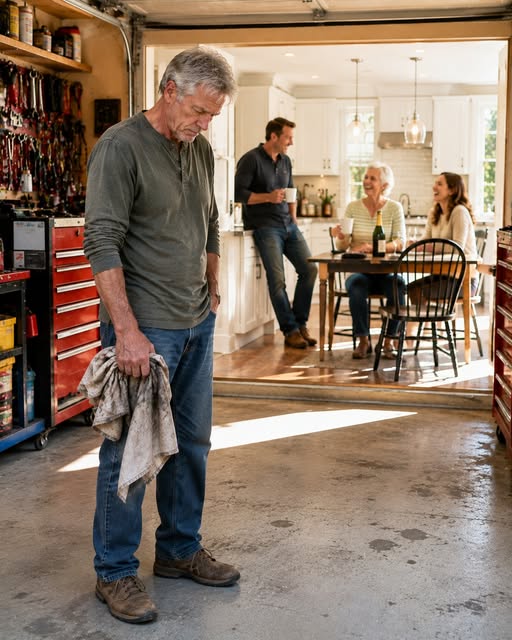
- For thirty-six years, my wife laughed every Sunday while I polished my father’s old motorcycle.
- She called it clutter.
- She called it a rusted heap of useless metal.
- She said it was the reason my workshop could never become a guest room, a craft room, or whatever new renovation idea her sister had suggested over wine that month.
- I called it my father’s motorcycle.
- That was the difference between us, though I did not fully understand how deep that difference ran until the Sunday she sold it.
- The motorcycle had belonged to my family for forty-three years.
- My father bought it secondhand when I was still young enough to believe every man in work boots understood how to repair anything.
- He rode it to the factory.
- He rode it to church twice, which irritated my mother because she said the smell of gasoline followed him into the pew.
- He rode it to my high school graduation and parked beneath a maple tree. When I walked toward him in my cap and gown, he laughed and said I looked more frightened holding a diploma than I ever had holding a wrench.
- On my twenty-first birthday, he called me into the garage behind our house and handed me a small wooden box.
- Inside were the title, registration papers, maintenance records, and the same compact tool roll he had carried for years.
- Then he nodded toward the motorcycle.
- “Look after her, son. Do that, and she’ll probably outlive both of us.”
- I kept my promise.
- After my father died, I stored the motorcycle beneath a canvas cover in my workshop.
- I did not ride it often once my knees began to hurt, but I never neglected it.
- Every Sunday morning, after breakfast and before the football games started, I opened the workshop door and followed the same ritual.
- Chrome.
- Fuel tank.
- Seat.
- Cables.
- The cloth folded twice.
- Every wrench returned to its proper place.
- It was not exciting.
- It was not productive in the way people like my wife, Linda, defined productivity.
- It was simply one hour when I could still hear my father’s voice without admitting aloud how much I missed him.
- Linda knew that.
- At least, I believed she did.
- We had been married for thirty-six years.
- We had buried our parents, paid off our mortgage, weathered blackouts with flashlights on the kitchen table, and watched the paint peel from that old workshop until I repaired it myself one summer.
- She had seen me come home from exhausting shifts and pause by the workshop before entering the house, just to make sure the canvas cover had not slipped.
- That was the trust I gave her.
- I showed her exactly what mattered to me.
- I believed that knowledge would keep it safe.
- For years, she teased me.
- “Frank loves that motorcycle more than he loves me,” she would say whenever her sister, Denise, visited.
- Everyone laughed.
- I laughed too.
- A man can become accustomed to being the joke when he still believes the person telling it respects him underneath the laughter.
- The Sunday Linda sold the motorcycle began like any other cool October morning in Boone, North Carolina.
- The air carried the first real bite of autumn. Yellow leaves had gathered against the bottom of the garage door. Across the road, a small American flag moved lazily above the porch of an old brick ranch house.
- Somewhere nearby, a lawn mower started, creating the familiar flat hum of a suburban weekend.
- I had a medical appointment in Winston-Salem at nine that morning.
- Nothing serious.
- Just the sort of routine examination men my age eventually stop pretending they do not need.
- I remember signing the clinic form at 9:17 because the receptionist studied my handwriting and said, “People don’t write that neatly anymore.”
- I thought my father’s handwriting had been better.
- When I returned home, the driveway felt wrong.
- A house tells you things before anyone speaks.
- An unfamiliar set of tire marks.
- A door that has not been closed properly.
- A silence where something important used to exist.
- I entered the workshop and stopped.
- The motorcycle was gone.
- The canvas cover lay folded carelessly on the workbench.
- Two pale impressions remained on the concrete where the center stand had rested. Near the rear wall was the small dark stain from the gearbox, the same stain that appeared every cold winter.
- I stared at it.
- It looked like a footprint left behind after someone had been taken.
- Behind me, Linda said, “It’s gone, Frank.”
- There was almost excitement in her voice.
- I did not turn.
- “I sold that old motorcycle this morning,” she continued. “You won’t believe what I got for it. Fifty-eight thousand dollars in cash.”
- I asked who had bought it.
- “A collector from a restoration shop outside Winston-Salem. He brought a trailer.”
- She sounded proud.
- “He said it had potential.”
- Potential.
- That word stayed with me.
- The buyer had recognized something Linda had spent years refusing to see.
- Value.
- Perhaps not memory.
- Perhaps not history.
- But value.
- Linda followed me into the kitchen, talking rapidly about a Mediterranean cruise Denise had been recommending and the kitchen renovation she claimed we had delayed for too long.
- Denise and her husband, Gary, were already there.
- That should have told me everything.
- A bottle of champagne sat open on the counter. My mother’s crystal glasses were lined up beside it as if we were celebrating an anniversary.
- Gary slapped my shoulder.
- “Nearly sixty grand for scrap metal. You should have let her sell it years ago.”
- Denise laughed and told me not to look so devastated.
- Linda filled the glasses.
- The champagne bubbled.
- The refrigerator hummed.
- Outside, the lawn mower continued.
- The world has a cruel habit of moving normally while a private part of your life breaks apart.
- I sat at the kitchen table.
- Denise pushed a glass toward me.
- I did not touch it.
- I looked at the woman I had shared my life with for thirty-six years and finally understood something.
- Her jokes had not been jokes.
- She had been practicing her contempt aloud.
- I wanted to shout.
- I wanted to knock every crystal glass onto the tile and force the room to sound the way my chest felt.
- For a brief, ugly moment, I imagined the champagne bottle shattering against the floor.
- Instead, I folded my hands.
- Quiet men keep records.
- That is not a proverb.
- It is how some of us survive.
- The wooden box my father gave me remained inside a fireproof safe beneath the workbench.
- Linda did not know because she had never cared where I kept the paperwork.
- Inside were the original title, my father’s handwritten transfer letter, registration history, insurance records, restoration photographs, and decades of maintenance notes.
- I had also copied the motorcycle’s serial number in three places because my father taught me never to trust memory with important information.
- At 3:36 that afternoon, after seeing the empty workshop and before sitting at the kitchen table, I had opened the safe.
- I did not make the call in front of Linda.
- I did not perform my grief for Denise or Gary.
- I verified the serial number and contacted the local police.
- I explained that a motorcycle legally titled in my name had been removed from my property without my permission.
- I gave them the buyer’s description and the name of the restoration business Linda had casually mentioned.
- Then I returned to the kitchen and allowed them to celebrate.
- The telephone rang at 4:19.
- Linda answered because she was closest.
- “This is Linda Lawson,” she said brightly.
- Her smile disappeared within seconds.
- First from her lips.
- Then from her eyes.
- “What do you mean, police officers?” she asked.
- The kitchen seemed to change temperature.
- Gary stopped talking.
- Denise froze with one hand around the champagne bottle.
- Linda turned slightly away, but the man on the other end was speaking loudly enough for us to hear.
- He demanded to know why police officers had arrived at his business.
- He asked why they were questioning him about Linda.
- He asked why a motorcycle he had purchased that morning had already been reported stolen.
- “I sold it legally,” Linda insisted. “I gave you the paperwork.”
- Then she looked at me.
- For the first time that day, she truly saw me.
- “Frank,” she whispered. “What did you do?”
- I remained silent.
- The dealer continued speaking.
- He said the officers wanted to inspect the motorcycle.
- They wanted the seller’s identification, title packet, and bill of sale.
- Then his tone sharpened.
- “Mrs. Lawson, why is your husband’s signature on this document?”
- Denise sat down hard.
- The champagne bottle struck the countertop.
- Gary moved backward as though the floor had shifted.
- Linda held the receiver with both hands.
- Her eyes dropped toward mine.
- Those hands had signed every legitimate document associated with the motorcycle.
- They had signed registrations, insurance forms, and maintenance authorizations.
- They had signed nothing that morning.
- I reached into my shirt pocket and removed the copy I had taken from the safe.
- I placed it beside the untouched champagne glass.
- No performance.
- Only paper.
- The original title.
- My father’s note.
- Registration records.
- My actual signature.
- Linda stared down at them.
- The dealer told her an officer wanted to speak with us.
- That was when Denise whispered, “Linda, please tell me you didn’t sign his name.”
- Linda did not respond.
- Some silences are confessions that have not yet found words.
- The officer came onto the line.
- He asked if he was speaking to Frank Lawson.
- I said yes.
- He asked whether I had authorized the sale of the motorcycle.
- I said no.
- He asked whether I could come to the dealership and identify it.
- I said I could.
- Linda finally found her voice.
- “Frank, don’t turn this into something ugly.”
- I almost laughed.
- Not because anything was funny.
- She had sold my father’s motorcycle while I sat in a medical office. She had invited her sister and brother-in-law over to celebrate the empty place it left.
- Yet she believed the ugliness began when I refused to accept it quietly.
- I stood.
- The chair scraped across the kitchen floor.
- Gary said my name in a low warning tone.
- I looked at him until he stopped.
- Then I picked up my keys.
- Denise began crying before Linda did.
- That surprised me.
- For years, Denise had encouraged the jokes.
- She called the motorcycle an eyesore and suggested converting my workshop into a rental room.
- She helped plan the cruise and renovation before I even knew the motorcycle had been sold.
- But once forgery entered the room, her amusement became fear.
- Gary drove her away.
- Linda followed me outside, still talking.
- She said the motorcycle was marital property.
- She said I was overreacting.
- She said fifty-eight thousand dollars would benefit both of us.
- She said the machine had made her feel second in our marriage.
- I stopped near my truck.
- The afternoon sun cast a narrow strip of gold across the hood.
- “Linda, that motorcycle never made you second,” I said. “You chose to feel second because it was the one thing I loved that you could not spend.”
- She stared at me as though I had struck her.
- I had not raised my voice.
- That made the words harder for her to dismiss.
- At the restoration shop, the motorcycle sat beneath bright overhead lights in the service bay.
- For a moment, I forgot the police officer, the dealer, and the documents.
- I only saw the bike.
- My father’s motorcycle.
- A transport strap had been tightened too firmly around the handlebar. A fresh smear from another man’s hand marked the fuel tank.
- The dealer looked physically ill.
- I did not believe he was dishonest.
- He was a businessman who thought he had purchased something valuable and accidentally stepped into a family betrayal.
- He showed the officer the bill of sale.
- The signature at the bottom was supposed to be mine.
- It resembled my name enough to deceive someone unfamiliar with my handwriting.
- It did not survive comparison with the title records.
- Linda arrived later with Denise.
- The officer began asking questions.
- Linda first claimed I had agreed to the sale.
- The officer asked why my medical appointment in Winston-Salem had been recorded at 9:17 that morning, during the exact period when the trailer was at my home.
- He asked why the dealership paperwork showed the motorcycle arriving later that afternoon.
- He asked why the title copy she provided did not match the official document filed with the county.
- Linda’s expression changed with each question.
- First irritation.
- Then calculation.
- Finally, understanding.
- The cash became evidence.
- The forged bill of sale became evidence.
- The dealership’s cameras became evidence.
- The telephone call became part of the report.
- There was no shouting or dramatic arrest.
- Real consequences often arrive quietly, through patient questions, metal desks, clipboards, and signatures placed beneath official statements.
- After the dealer cooperated and the ownership documents were confirmed, I was permitted to take the motorcycle home.
- He apologized three times.
- I believed him after the second.
- By then, darkness had settled over the highway.
- I did not ride the motorcycle. My knees would have protested, and the officer advised having it transported.
- The dealer arranged the return.
- When the trailer backed into my driveway, Linda stood on the porch with her arms wrapped around herself.
- The flag across the street was barely visible beneath the porch light.
- There was no champagne waiting in the kitchen.
- The motorcycle came down the ramp slowly.
- Its tires touched the concrete.
- The center stand settled into the same pale marks it had occupied for years.
- For the first time that day, I breathed normally.
- Linda looked at me.
- “Are you really going to press charges against your own wife?”
- I looked at the motorcycle before answering.
- “You sold my father’s bike while I was gone. Then you opened champagne before I came home.”
- Tears gathered in her eyes.
- I had seen Linda cry at funerals, in hospitals, and during the lean years when bills frightened both of us.
- These tears were different.
- They were not sorrow for what she had done to me.
- They were the shock of discovering that I had finally established a boundary she could not cross without consequences.
- I did not answer her question that evening.
- The report continued through the proper process.
- The dealer cooperated fully. The county title records established legal ownership faster than any argument inside our kitchen ever could.
- An attorney explained that the criminal issue and the marriage were separate matters.
- I told him I understood.
- The following weeks were quieter than I expected.
- Linda slept in the guest room.
- Denise called twice and left messages I never returned.
- Gary sent a text saying everyone had gotten “carried away.”
- I deleted it.
- People love that phrase when cruelty finally becomes expensive.
- Carried away.
- As though Linda had drifted into forging my signature the way autumn leaves collected outside the garage.
- As though Denise’s hand had accidentally lifted a champagne glass.
- As though Gary had unintentionally congratulated her while standing in my kitchen.
- During those weeks, the motorcycle became more than a machine.
- It became a witness.
- Every time I entered the workshop, I first saw the empty patch it had left.
- Then I saw the motorcycle occupying that space again.
- That difference mattered.
- I did not seek a divorce because of a motorcycle.
- That was the version Linda told people because it made me sound unreasonable.
- I left because my wife knew exactly where to hurt me and chose the one place where my father still lived.
- I left because she signed my name.
- I left because she invited relatives into our home to celebrate before I could even grieve.
- I left because thirty-six years of silence had taught them that my pain did not require respect.
- The house changed afterward.
- Not dramatically.
- The champagne glasses returned to the cabinet.
- The cruise brochures disappeared from the kitchen counter.
- Linda’s voice no longer filled every room as though volume alone could restore control.
- Several months later, on a cold Sunday morning, I opened the workshop door and took out the same clean cloth.
- The air smelled of oil, dust, and concrete.
- A football pregame show murmured quietly on the radio.
- Across the road, the porch flag moved in the wind.
- I rested my palm against the fuel tank.
- A faint mark remained where the dealership mechanic had touched it.
- I polished the mark away slowly.
- Not with anger.
- With care.
- My father had been right.
- The motorcycle had outlived him.
- It had nearly outlived my marriage.
- But it had not outlived the promise I made.
- That morning, I finally understood something I should have recognized long before.
- Some inheritances are not valuable because they can be sold.
- They are valuable because they reveal who celebrates when they are taken from you.
- Now, when I polish my father’s motorcycle on Sunday mornings, I am not trying to keep the past from disappearing.
- I do it because there was one moment in my life when I remained quiet long enough for the truth to arrive carrying its own documents.
For thirty-six years, my wife laughed at me every Sunday while I polished my father’s old motorcycle. Then, while I was away, she sold it for $55,000 and raised a glass with her sister