The Mermaid’s Secret: A Mother’s Fight for the Truth
PART 1
The silence of a sleeping house at two in the morning possesses a specific, fragile quality. It is a quiet so profound that you can hear the hum of the refrigerator downstairs and the rhythmic ticking of the hallway clock. That night, the stillness was shattered not by a scream, but by a sound far more terrifying to a mother’s ear: a soft, breathless whimper echoing from the doorway.
“Mommy… there are little fish swimming in my tummy… and they’re biting me.”
I jolted upright, my heart hammering against my ribs. Standing in the threshold of my bedroom was Nancy, my five-year-old daughter. The silver moonlight filtering through the blinds painted her in a ghostly hue. She was entirely drenched in a cold, clammy sweat, her small body doubled over in a tight, agonizing bow. Her golden curls, usually so bouncy and full of life, were plastered flat against her pale forehead. One tiny, trembling hand was pressed desperately against her midsection.
At first, a fleeting, irrational hope brushed my mind. Just a nightmare, I told myself. She just ate something that disagreed with her.
I threw off the covers and rushed to her, sweeping her up into my arms. Her skin felt icy, yet she was shivering uncontrollably. I pressed my lips to her forehead—no fever. But as I attempted to lay her gently onto my mattress to examine her, a groan tore from her throat. It wasn’t the typical cry of a child seeking comfort; it was a deep, visceral sound of profound distress that sent a jagged shard of ice straight down my spine.
“Where does it hurt so badly, my sweet love?” I rasped, pulling her small, fragile frame against my chest, desperately wishing I could absorb her pain into my own body.
“Right here, deep inside,” Nancy sobbed, burying her face into the crook of my neck. “The little fish… they are moving around. They won’t stop.”
My husband, Brandon, was miles away, attending an urgent corporate summit in Phoenix. We were entirely alone. Panic, cold and sharp, threatened to paralyze me, but maternal instinct violently shoved it aside. I wrapped Nancy in her favorite lavender fleece blanket, grabbed my car keys with shaking fingers, and practically carried her to the SUV.
The drive to the pediatric emergency center at a private hospital in San Diego felt like navigating through thick, suffocating molasses. Every red light was an eternity; every bump in the road elicited a muffled whimper from the back seat. I kept one hand extended backward, my fingers brushing her trembling knee.
“Stay with me, baby. We are almost there,” I chanted, the tears finally spilling over my eyelashes, blurring the neon streetlights.
The moment I carried her through the sliding glass doors, the sterile scent of iodine and floor wax assaulted my senses. The triage nurse took one look at Nancy’s pale, contorted face and immediately called for an attending physician. Within minutes, my daughter was stripped of her pajamas and placed on an examination table.
An abdominal ultrasound was ordered with frantic urgency. I stood cornered against the wall, my hands clasped together so tightly my knuckles ached. The ultrasound technician, a woman with tired eyes and a tight bun, rolled the plastic transducer over my daughter’s bare, taut belly.
I waited for her to offer a comforting smile, to tell me it was just severe trapped gas or an inflamed appendix. Instead, she said absolutely nothing.
The silence in the room stretched until it felt brittle enough to snap. The technician’s brow furrowed into a deep, troubled trench as she stared intently at the glowing monitor. Without a single word of reassurance to me, she abruptly wiped the gel from Nancy’s stomach, clicked off the machine, and briskly exited the room.
“Is everything okay? What did you see?” I called out to her retreating back, but the heavy wooden door simply clicked shut, leaving me alone with the rhythmic beeping of the heart monitor.
When the door finally reopened, it wasn’t the technician who entered, but the lead pediatric specialist. She carried a tablet displaying a series of high-resolution scans. Her face, previously warm and professional, had drained of all natural color. It was a mask of grim, clinical horror.
She didn’t look at me. She didn’t offer an explanation. She simply walked past me, picked up the wall-mounted telephone connecting to the central nursing station, and spoke in a voice that was eerily calm and devastatingly clear.
“I need to report an urgent, severe case of suspected child endangerment,” the doctor stated into the receiver. “I am looking at multiple foreign metallic objects clustered inside a minor’s lower abdomen.”
The linoleum floor seemed to dissolve beneath my feet. The walls of the room tilted. Child endangerment? Foreign objects? My brain refused to process the syllables.
Before I could even formulate a question, the nightmare accelerated. Within ten minutes, two uniformed municipal police officers strode into the clinic. They moved with a heavy, intimidating authority. Officer Elliott, a tall man with piercing, skeptical eyes, entered the room first. He didn’t bother offering a greeting. He didn’t even sit down.
“Who is the primary, daily caregiver for this child?” he demanded, his voice echoing sharply off the tiled walls.
“I am,” I whispered, my voice sounding incredibly small, as if it belonged to someone else. “I am her mother. I take care of her every single day.”
The remaining strength evaporated from my legs. I slid helplessly down the hard, painted wall, landing on the floor while Nancy continued to moan on the bed above me. The officers didn’t offer a hand. Instead, they signaled for a nurse to take over, lifted me by my elbows, and escorted me into a stark, windowless interrogation room down the hall.
Officer Peters, the younger of the two, placed a brilliantly illuminated X-ray film onto a light table positioned between us.
“Look at this,” he commanded sternly.
I forced my tear-filled eyes to focus on the ghostly image of my daughter’s internal anatomy. Across the dark expanse of her stomach area were dozens of tiny, brilliantly white dots, clustered tightly together like a sinister constellation.
“Those are thirty-six high-powered, rare-earth magnetic beads,” Officer Peters explained, his tone laced with heavy accusation. “When these specific objects pull toward one another through the delicate tissues of the intestinal walls, they cause catastrophic internal damage and severe blockages. The medical staff is entirely convinced that someone intentionally, and forcibly, fed these to her.”
“That is insane! That is completely impossible,” I shrieked, the sheer absurdity of the accusation tearing through my shock. “There is absolutely nothing like that in my home. We don’t own magnets like that!”
“You don’t hold employment outside the residence, correct, ma’am?” Officer Elliott asked, his pen scratching rhythmically against his notepad.
“No. I am a stay-at-home mother. I dedicate my life to raising Nancy,” I replied, my voice trembling with a mixture of terror and rising indignation.
The atmosphere in the cramped room shifted instantly. The very choice I had made out of love—to pause my career to nurture my child—suddenly transformed me into a solitary monster in their eyes. The logic was sickeningly simple to them: I was home with her; therefore, I was the only one who could have done this.
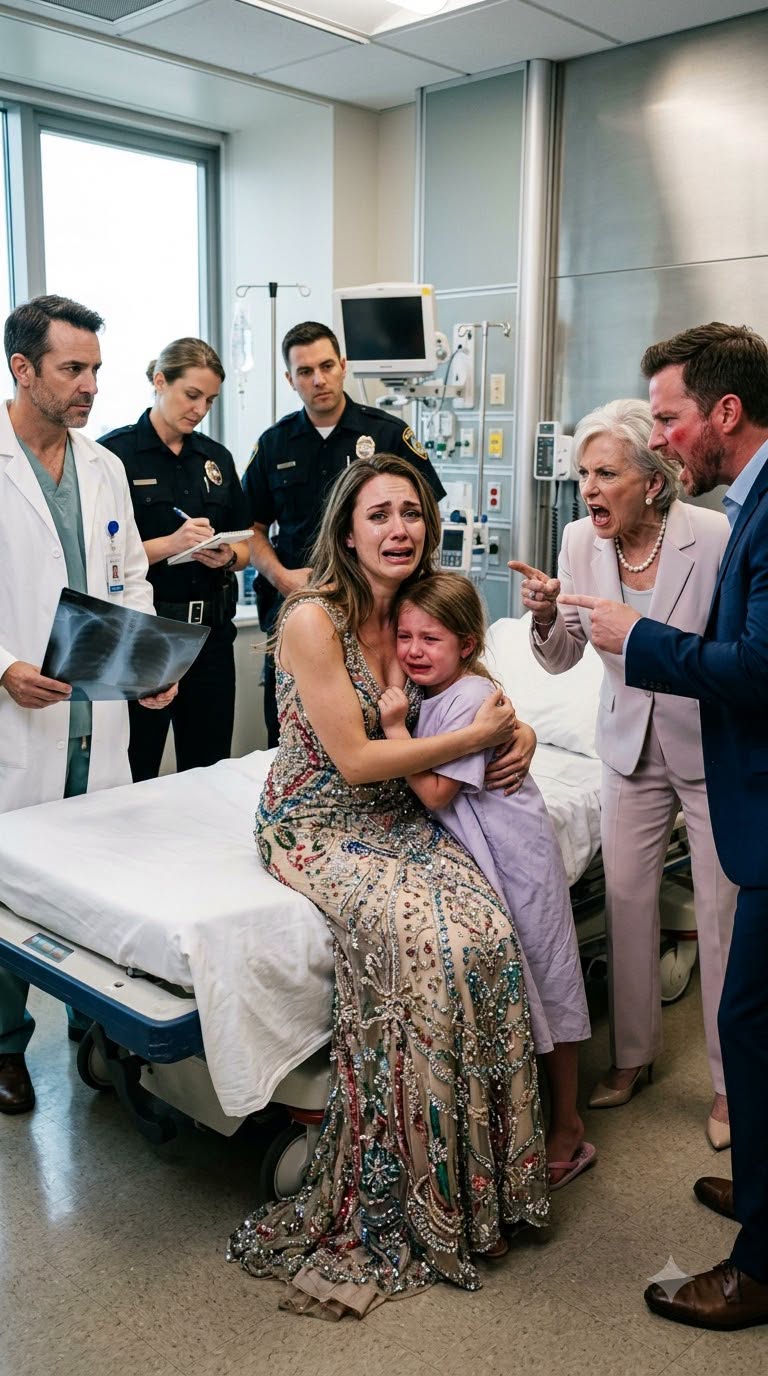
An agonizing hour later, Brandon finally arrived from the airport, having caught the first emergency flight out of Phoenix. He wasn’t alone. Trailing closely behind him was his mother, Evelyn.
When the door opened, I sprang from my plastic chair, a sob of relief tearing from my throat. I desperately needed my husband to wrap his arms around me, to tell the police they were out of their minds, to stand as a shield between me and this unfathomable nightmare.
Instead, Brandon stopped three feet away from me. His eyes, usually warm and familiar, swept over me with a chilling, unfamiliar disgust. He looked at me not as his wife, but as a stranger who had sneaked into his life to harm his flesh and blood.
“What in God’s name did you do to her, Samantha?” Brandon bellowed, his voice cracking with rage. “How could you possibly be so negligent as to let her swallow those things?”
Before I could even gasp, Evelyn clutched her pearl necklace, staggered backward, and unleashed a theatrical wail that filled the entire corridor.
“I warned you, Brandon! I always said it!” Evelyn cried out, tears streaming down her impeccably powdered cheeks. “Spending all day scrolling through social media, taking those ridiculous online photography courses—she was completely distracted from her duties! My poor, innocent little granddaughter is suffering because of her sheer incompetence!”
I stood frozen. Neither of them had asked to see the doctor. Neither of them had inquired if Nancy was awake, if she was in pain, or if she was going to survive. They hadn’t asked if I was terrified. Right there, under the scrutinizing gaze of the local police, my own family began brick-by-brick to construct a damning narrative of an unfit, abusive mother.
Three excruciating hours later, the heavy doors of the surgical wing finally swung open. The pediatric surgeon emerged, still wearing his blood-spotted scrubs. He pulled down his mask, his expression grave.
“Nancy is stable, and she survived the procedure,” he announced, his voice raspy with exhaustion. “However, the internal complications were severe. We had to surgically extract a damaged section of her small intestine. Based on the tissue degradation, those magnets had been tearing her insides apart for over twenty-four hours.”
Brandon whipped his head toward me, his jaw clenched so tightly a muscle ticked in his cheek.
“Twenty-four hours, Samantha. How could you sit in that house and not notice your own child swallowing thirty-six pieces of metal?” he barked, spit flying from his lips.
I ignored him. I took a step toward the surgeon, my hands pleading.
“Doctor, please. Look at me,” I begged. “Could a five-year-old child—a smart, cautious five-year-old—swallow thirty-six strong, metallic magnets all by herself without complaining immediately?”
The surgeon looked at me, then at Brandon, and slowly shook his head.
“Clinically speaking? That would be extraordinarily unlikely,” the doctor clarified. “These objects possess a sharp, unpleasant metallic taste. Swallowing even one causes immediate esophageal discomfort. To swallow thirty-six requires effort. It is far more plausible that an adult deliberately fed them to the child, one by one, perhaps masking them or convincing the child they were a type of candy.”
The hallway fell dead silent. Brandon’s angry tirade died in his throat. Evelyn’s dramatic sobbing abruptly ceased, as if a switch had been flipped.
I turned my head slowly, my eyes locking onto my mother-in-law. Her perfectly manicured hands were trembling. Her posture had stiffened into a rigid line. But it was her eyes that betrayed her. Beneath the layers of false concern, I saw a flash of something primitive and undeniable.
It was pure, unadulterated terror.
In that precise, crystalline second, a memory hit me with the force of a freight train. I remembered the discreet, motion-activated security camera I had installed on the top shelf of the living room bookcase two months ago to monitor our newly adopted puppy—a camera whose wide-angle lens pointed directly toward the formal dining room table.
I knew exactly what I had to do, and I knew I had to do it before anyone else realized what I had remembered.
PART 2
“I am going back to the house. Right this second,” I announced, my voice completely devoid of the trembling fear that had consumed me hours prior. It was a cold, hard declaration of war.
Evelyn dropped her hands from her face, the performative grief vanishing so fast it was almost comical. Her eyes widened into saucers.
“Have you lost your mind?” Evelyn snapped, her voice shrill with sudden panic. “How can you possibly think about abandoning this hospital while your daughter is lying in critical condition? What kind of mother does that?”
Before I could take a single step toward the elevator, Brandon shifted his weight, stepping directly into my path. He broadened his shoulders, forming a physical barricade between me and the exit.
“You are absolutely not going back into our house alone,” Brandon hissed, his tone dripping with venom. “You are the prime suspect here, Samantha. If you go back there unsupervised, you might destroy evidence. You might hide whatever else you used to hurt her.”
That horrific sentence hung in the sterile air, heavy and toxic. It was the moment my marriage officially died. The man standing before me wasn’t a distressed father seeking the truth; he was a man who had already convicted me in his mind. He was ready, even eager, to believe that the woman he slept next to every night was a sadistic monster. And Evelyn—she was desperately clinging to his bicep, her eyes darting frantically toward the exit, looking entirely unhinged at the prospect of anyone reaching that house before she did.
I didn’t argue. I didn’t cry. I simply reached into the pocket of my sweatpants, pulled out my mobile phone, and pressed a single button to redial the police station desk.
“Yes, this is Samantha Andrews at the pediatric wing,” I declared loudly, ensuring my voice carried down the hallway. “I have reason to believe there is untouched, time-stamped security footage at my residence that will definitively prove how my daughter ingested those objects. My husband and his mother are currently using physical intimidation to prevent me from leaving the hospital to retrieve it.”
Brandon lunged forward, a look of blind panic crossing his face, his hand shooting out to snatch the device from my grip.
I took a swift step back, keeping the phone raised to my ear. “Officer, the child’s father is currently attempting to physically confiscate my phone to stop this call.”
Brandon froze, his hand hovering in the air. He realized instantly that any further aggression would result in his own arrest. He slowly lowered his arm, his face flushing a deep, humiliated crimson.
Fifteen agonizing minutes later, Officers Elliott and Peters returned. We formed a grim, silent motorcade back to our gated community in the suburbs. The police were incredibly strict, marching us up the driveway and ensuring that absolutely nobody entered the premises unmonitored.
Pushing open the heavy oak door of my home felt like entering a crime scene. The eerie normalcy of the house made my stomach churn. There, resting neatly next to the armchair, were Nancy’s tiny pink sneakers. On the dining room table sat her open coloring book, a scattering of crayons, and a half-empty glass of milk. It was a snapshot of a peaceful afternoon, brutally interrupted by betrayal.
I walked straight to the living room, retrieved the small black camera from the bookshelf, and connected the memory card directly into my laptop on the kitchen island.
The officers stood right behind me, their arms crossed. Brandon stood by the sink, looking exhausted and angry. Evelyn had retreated to the farthest corner of the kitchen, her skin glowing with a sickly, translucent pallor.
“Those cheap, stupid wireless cameras never even record properly,” Evelyn muttered beneath her breath, her fingers frantically twisting her wedding band. “It’s probably just static.”
I ignored her, clicking on the video archive from the previous afternoon. The file loaded smoothly onto the high-definition monitor.
The digital timestamp read 3:15 PM. On the screen, the living room was bathed in golden afternoon sunlight. Nancy was sitting quietly at the grand dining table, her little legs swinging beneath her, meticulously coloring a drawing of a bright blue ocean. In the background, the recorded version of myself walked across the frame, carrying a heavy woven basket overflowing with dirty laundry, heading toward the upstairs staircase.
I watched the screen intently. Exactly two minutes after I disappeared upstairs, the front door chimed. Evelyn let herself in using her spare key. She moved with a strange, stealthy silence, creeping into the dining room. She sat in the heavy wooden chair directly next to my daughter and smoothly pulled a small, decorative glass jar from the depths of her designer handbag.
“What are those pretty things, Grandma?” Nancy’s sweet, innocent voice floated from the laptop speakers, echoing in the dead silence of the kitchen.
“These are incredibly special, secret mermaid pearls, my sweet girl,” Evelyn’s recorded voice replied. The tone she used was sickeningly sweet—a sugary cadence masking pure venom. “If you eat them, magic little fish will wake up and start swimming safely inside your belly.”
On the screen, Nancy hesitated. She put down her blue crayon and looked nervously toward the hallway where I had gone.
“Will Mommy be mad? Will she let me have them?” the child asked.
Evelyn leaned in close, casting a shadow over my daughter. “Oh, you absolutely cannot tell your mother about this,” she whispered, pressing a finger to her lips. “She wouldn’t understand the magic. This is going to be our special, secret game. Just between you and Grandma.”
With agonizing clarity, the high-definition camera captured Evelyn unscrewing the lid of the jar. She picked up a small, shimmering silver sphere. She instructed Nancy to open her mouth, and carefully placed the heavy metal magnet directly onto the child’s small tongue. She immediately followed it with a second, and then a third.
I stopped breathing. The air in the kitchen grew incredibly thin. I was watching the premeditated poisoning of my own child.
“Ew, they taste really yucky, Grandma,” Nancy grimaced on the video, coughing slightly and trying to push the objects out with her tongue. “They taste like pennies.”
“That just means the magic is incredibly strong and it’s working perfectly,” Evelyn urged forcefully, her hand firmly gripping Nancy’s shoulder to keep her in the chair. “You have to be a brave big girl. Take one more for Grandma. Swallow it down with your milk.”
For five excruciating minutes, the footage documented my mother-in-law systematically feeding the hazardous metallic beads to my trusting child, one after another, praising her bravery with every swallow. When the jar was finally empty, Evelyn stood up, took a paper napkin, and meticulously wiped down the table to remove any fingerprints or metallic residue.
Before walking out of the frame, Evelyn leaned down one last time, her face inches from Nancy’s. The sugary tone was entirely gone, replaced by a cold, sharp threat.
“Listen to me very carefully,” Evelyn warned, her eyes narrowing. “If you ever tell your mom about the mermaid pearls, she is going to be furious with you. She will take away all your toys, and she won’t love you anymore. Do you understand?”
Nancy, looking terrified, nodded silently.
I slammed my hand down on the laptop keyboard to pause the video. The final image was Evelyn’s smirking face.
Officer Elliott turned slowly, his boots scuffing heavily against the hardwood floor. He fixed his gaze on Evelyn, who was now trembling so violently she had to lean against the refrigerator to stay upright.
“Ma’am,” Officer Elliott said, his voice dropping an octave, carrying the heavy weight of the law. “Exactly how many of those magnetic objects did you force that little girl to consume?”
“I… I didn’t know there were thirty-six in that jar,” Evelyn blurted out, her voice a shrill, defensive squeak. “I just bought a small jar from a craft fair. I didn’t count them!”
A freezing, absolute silence swept through the room. It was a silence so profound it felt like a physical blow.
Because since we had left the emergency room—since the surgeon had confirmed the exact number—neither I, nor the officers, nor Brandon had ever mentioned the number thirty-six in her presence. We had only ever said “magnets.”
The realization of her accidental, damning confession washed over Evelyn’s face. The silence that followed was brutal, total, and irreversible.
Officer Peters didn’t hesitate. He stepped forward, unclipped the heavy steel handcuffs from his belt, and grabbed Evelyn’s wrist. The metallic click-clack of the restraints locking into place sounded like a gunshot.
“Evelyn Andrews, you are under arrest for the aggravated endangerment of a minor,” he recited coldly.
Evelyn completely lost her mind. She thrashed against the officer’s grip, her polished facade shattering into pieces. She lunged desperately toward her son.
“I did all of this for you, Brandon! I did it for us!” she shrieked hysterically, spit flying from her mouth. “That horrible, lazy woman was slowly taking your child away from you! She was brainwashing Nancy against our family!”
Brandon stood rooted to the spot, his face ashen, looking as though he had been physically struck by lightning. “Mom… you literally perforated our daughter’s internal organs. You could have killed her.”
“I didn’t mean for her to need surgery!” Evelyn sobbed, her true, twisted motive pouring out in a desperate flood. “I just researched it! I thought the child would just get a terrible stomachache! The doctors would see metal on the X-ray, they would think Samantha left dangerous things lying around the house, and the court would easily grant you full legal custody! I was trying to save you from her!”
The police officers conducted an immediate search of her designer purse on the kitchen counter. Buried beneath a silk scarf, they found the empty glass jar, still bearing a faint metallic odor, alongside a crumpled cash receipt from an online specialty retailer.
Officer Elliott pulled Evelyn’s ringing cell phone from her coat pocket. The screen lit up with a notification, bypassing the lock screen. It was a text message sent the previous evening to Evelyn’s sister, a woman who had always despised me.
Officer Elliott read the preview text aloud, his voice devoid of emotion:
“Everything is set. By tomorrow morning, the girl will be sick, Brandon will finally have a rock-solid reason to file for emergency custody, and Samantha will look utterly negligent. We will finally get our boy back.”
Brandon stared at the glowing phone screen, then slowly raised his eyes to look at his mother in absolute, soul-crushing horror. He finally understood the depth of the monster he had been defending.
But as the police dragged a screaming Evelyn out of my home, what neither of them realized was that this single text message was merely the shallowest surface of her betrayal. When the municipal authorities finally secured a warrant to fully unlock and dump the contents of her digital devices, a sinister, pathological plot planned meticulously for months would finally be dragged into the light.
PART 3
Dawn broke over the city in streaks of bruised purple and pale gray. Inside the pediatric intensive care unit, the only sounds were the rhythmic pumping of oxygen and the steady, reassuring beep of the cardiac monitors. Nancy was finally awake. She looked impossibly small in the center of the massive hospital bed, her skin appearing as fragile and pale as wet tissue paper.
I had not slept a single second. I sat rigidly in the plastic chair beside her, my fingers gently tracing the back of her tiny, bruised hand, careful not to disturb the IV lines.
“Mommy,” she whispered, her voice barely a breath against the quiet hum of the machines.
“I’m right here, my brave girl. I’m right here,” I replied, leaning in so she could smell my familiar scent.
“Have the little biting fish left my tummy yet?” she asked, a solitary tear sliding down her cheek, leaving a shiny trail.
“Yes, my sweet love,” I promised her, pressing a kiss to her knuckles. “The doctors caught all of them. They are all gone now. They can never hurt you again.”
She squeezed my fingers with surprising strength for someone so weak.
“Grandma told me not to tell you,” Nancy whimpered softly, her lip quivering. “She said you would get really mad at me and take away my dolls. I’m sorry I ate the magic pearls, Mommy.”
A fierce, burning ache erupted in my chest. “Oh, baby, no. I could never be mad at you. You did nothing wrong. You were so brave to tell me what was hurting.”
From the corner of my eye, I noticed a shadow shift in the doorway. Brandon was standing there, holding a lukewarm cup of cafeteria coffee. He looked like a ghost of the man I had married. His eyes were bloodshot, his clothes wrinkled. He took a single, hesitant step into the recovery room.
The moment Nancy saw him, her tiny body tensed. She instantly shrank back, burying her face deep into the white hospital pillow, pulling her blanket up over her eyes in a universal gesture of fear.
That tiny, instinctive motion of absolute rejection destroyed Brandon more thoroughly than any screamed accusation or thrown plate ever could. He stopped dead in his tracks, the coffee trembling in his hand, realizing that his mother’s poison had not only ruined his marriage but had fundamentally shattered his daughter’s sense of safety.
A few hours later, Officers Peters and Elliott returned to the ward. Their demeanor had shifted entirely from adversarial to deeply respectful.
“Mrs. Andrews,” Officer Peters stated formally, removing his hat. “I am here to inform you that you are completely, unequivocally cleared of any and all suspicions regarding this incident. The digital evidence, the recovered physical materials, and the suspect’s own recorded admissions point entirely and exclusively to Evelyn Andrews.”
“You acted with incredible presence of mind by demanding we secure that security footage immediately,” Officer Elliott added gently, his eyes filled with a quiet apology. “If you hadn’t, this investigation could have taken a very dark, very different turn.”
“I didn’t do it out of presence of mind,” I replied coldly, staring through the glass window at the city skyline. “I did it because I realized, in that hallway, that absolutely nobody else in this family was going to defend my daughter. I had to become her shield.”
In the weeks that followed, the deeper police investigation peeled back the layers of Evelyn’s psychosis. She had not acted out of a sudden, reckless impulse. The cyber-crimes unit discovered that for nearly eight months, Evelyn had been executing a slow, malicious smear campaign. She had sent hundreds of manipulated text messages and emails to Brandon’s relatives, influential church members, and even some of our neighbors. She had meticulously planted seeds of doubt, claiming I was suffering from severe depression, that I locked Nancy in her room, and that I was deeply negligent.
Her private digital diary was a roadmap of madness. They discovered extensive internet search histories spanning back to November, querying phrases like “small swallowed objects that cause delayed damage,” “symptoms of heavy metal ingestion in toddlers,” and “how to establish negligence in family court.”
Most chilling of all was a physical notebook found in her nightstand. It contained detailed logs tracking my daily household routine. She had memorized my patterns. Highlighted in bright yellow marker was a specific entry: “Tuesdays/Thursdays: Samantha goes upstairs to fold laundry at 3:15 PM. Window of opportunity: 10 minutes.”
When Brandon met with me and my aggressive new family attorney two days later at a neutral law office to discuss emergency custody arrangements, he looked utterly broken. He sat slumped in the leather chair, staring at the floor.
“I honestly, truly had no idea she was capable of doing something so evil, Samantha,” Brandon stammered, tears pooling in his eyes. “She’s my mother. You have to believe me, I didn’t know.”
“I believe you didn’t know about the magnets,” I confronted him directly, my voice steady and devoid of pity. “But you were entirely, eagerly ready to believe that I was capable of child abuse. You didn’t hesitate for a second to label me a monster.”
“I was terrified for our daughter!” Brandon pleaded desperately, reaching across the table.
I pulled my hands back as if he were made of fire. “I was terrified too, Brandon. But look at the difference. When I was terrified, I wrapped her up and ran through red lights to save her life. When you were terrified, you ran to the police to accuse me of a felony. You chose to protect your mother’s ego over your wife’s innocence.”
“Please, Sammy. Please forgive me,” he begged, bowing his head in profound shame.
“Forgiveness is a luxury I don’t have the energy for,” I told him quietly, standing up from the table. “And forgiveness cannot ever erase the memory of you standing in front of that hospital door, using your body to stop me from finding the truth about who poisoned our child.”
I immediately filed a petition for a permanent, lifetime restraining order against Evelyn. Concurrently, my lawyer filed for an expedited divorce, demanding sole primary legal and physical custody of Nancy, allowing Brandon only strictly supervised, professionally monitored visitation rights.
When the courier served him the heavy stack of legal paperwork, he called my phone, crying hysterically.
“Samantha, please don’t do this to me. I am her father. You can’t erase me,” Brandon wept over the line.
“Fatherhood is not just a biological fact. It is defined entirely by what you do when your child is in grave, mortal danger,” I answered coldly.
“I told you, I did not know what my mother was doing!” he repeated, stuck in his loop of denial.
“You didn’t need to know who was guilty to treat me like your partner,” I stated firmly, delivering the final blow. “You just needed to remember who I was. And you forgot.” I ended the call and blocked his number.
Nancy’s physical recovery was an agonizingly slow, heartbreaking process. She spent two full, grueling weeks in the pediatric ward. I watched my vibrant girl have to relearn how to walk upright without crying out from the pulling pain in her healing abdomen. My fiercely loyal best friend, Kathleen, practically moved into the hospital room with us, bringing Tupperware containers of hot, homemade lasagna, fresh clothes, and a fierce, protective energy. My own mother flew in from out of state to manage the house so I never had to leave Nancy’s side.
When Brandon was permitted his first court-supervised visit at a neutral family center, he arrived looking desperate. He dragged a massive, comically large stuffed bear and a giant, shiny cluster of helium balloons.
Nancy took one look at the balloons, dropped her coloring book, and immediately scurried behind my legs, wrapping her arms tightly around my knees. She refused to look at him.
“She doesn’t need expensive, giant gifts right now to make you feel better,” I told him gently but firmly, blocking his path. “She needs time, quiet, and a sense of absolute safety.”
To his credit, Brandon didn’t argue. He slowly set the toys down in the corner of the room. He walked to the opposite side of the play area, sat cross-legged on the carpet, and picked up a simple children’s book.
“Would you like me to just read this out loud, Nancy?” Brandon asked, his voice trembling heavily. “I don’t have to come any closer.”
She remained hidden behind my legs, saying nothing. He opened the book and began to read to the empty air. He didn’t try to force a hug, didn’t demand a smile, and didn’t ask for her affection. It was, tragically, the very first sensible, selfless thing he had done since the nightmare began.
Evelyn’s criminal trial commenced eight months later in superior court. The courtroom was packed. When the prosecution played the crystal-clear dining room recording on the large monitors for the jury, the silence in the room was deafening. When Evelyn’s sweet, venomous phrase, “secret mermaid pearls,” echoed over the high-fidelity speakers, Brandon, sitting two rows behind the prosecutor, buried his face entirely in his hands and wept quietly, his shoulders shaking.
The pediatric surgeon took the stand, detailing the severe, life-threatening internal perforations Nancy had suffered. He looked directly at the jury and clarified that the child’s survival was entirely due to my immediate, uncompromising action in bringing her to the emergency room the moment she showed distress.
During cross-examination, the ruthless prosecutor called Brandon to the stand.
“Mr. Andrews,” the prosecutor asked, pacing before the jury box. “When your daughter was fighting for her very life on a surgical table, and your wife was desperately trying to find the truth… who did you choose to protect first?”
Brandon stared at the microphone for a long, agonizing minute. He looked at me, then at his mother sitting at the defense table.
“I chose to protect my mother,” Brandon admitted softly, the microphone picking up the break in his voice. “And it will haunt me for the rest of my life.”
The jury deliberated for less than four hours. Evelyn was found guilty on all counts: aggravated felony child abuse, domestic violence by proxy, and criminal endangerment of a minor. The judge, citing the cold, calculated premeditation of her actions, handed down a severe, multi-year sentence in a state penitentiary, alongside a permanent, irrevocable protective order prohibiting her from ever coming within a thousand yards of Nancy for the rest of her natural life.
As the heavily armed bailiffs moved in to shackle her wrists and lead her away, Evelyn lost her final shred of dignity. She spun around, locking her furious, wild eyes on me.
“You poisoned my son against me! You ruined our family!” she screamed, her voice echoing off the mahogany walls as she was dragged toward the holding cell door.
I didn’t flinch. I stood up from the plaintiff’s table, clutching the finalized legal decree in my hand.
“I didn’t poison anyone, Evelyn,” I replied calmly, my voice cutting through her hysterics. “I simply survived your poison long enough for a judge to lock you away where you belong.”
Our divorce was finalized less than a month after the gavel fell on the criminal trial. I was legally granted sole physical and legal custody of my daughter. Brandon retained restricted, professionally supervised visits, contingent upon his ongoing participation in intensive, court-mandated psychiatric therapy to untangle the toxic enmeshment with his mother.
A year later, the dark clouds finally began to part. Nancy and I moved out of that tainted suburban house and relocated to a bright, sunlit bungalow in a different San Diego neighborhood. It had sheer yellow curtains that caught the morning light and a small, fenced backyard where I planted a vibrant vegetable garden. While Nancy still required biannual gastroenterology checkups to monitor her scar tissue, her bright, uninhibited laughter had finally returned to fill the spaces of our daily lives.
One lazy, sunny Sunday afternoon, I was brewing tea in the kitchen. I walked over to the wooden dining table where Nancy was sitting. She was intensely focused, her tongue poking out the corner of her mouth as she worked furiously with her favorite box of colored pencils.
I leaned over her shoulder to inspect her masterpiece. She was drawing an intricate, vibrant underwater scene, filled with schools of brilliantly colored, smiling fish.
“Look, Mommy,” Nancy said, beaming up at me, her eyes crinkling with pure joy as she lifted the heavy paper. “These little fish are friendly now. They are happy, and they don’t bite anyone anymore.”
A lump formed thick in my throat. I knelt beside her chair and wrapped my arms around her warm, healthy body, inhaling the scent of her strawberry shampoo as tears of profound gratitude pricked my eyes.
“They are absolutely beautiful, my sweet girl,” I whispered into her hair. “The most beautiful fish I have ever seen.”
Evelyn had tried to use my child’s innocent trust and physical suffering as a weapon to obliterate my life. My husband had instantly, instinctively doubted my fundamental character. The authorities had initially viewed me through the cold lens of a criminal suspect. But through it all, my little girl had told the absolute truth from the very first moment, using the simple, imaginative words she possessed to describe a terrifying, adult betrayal.
That evening, as the sun dipped below the horizon, Nancy proudly used a piece of tape to secure her vibrant drawing right in the dead center of our stainless-steel refrigerator door.
The little fish were finally exactly where they belonged—safe on a piece of paper, far away from any pain, and surrounded entirely by fierce, unconditional love.
Like and share this post if you find it interesting.