Chapter 1: The Architect of the Feast
That particular Saturday morning did not commence with the abrasive shriek of my digital alarm clock. Instead, I drifted into consciousness enveloped by a suffocating, dense quiet. It was a heavy, expectant stillness—the precise atmospheric pressure that precedes a violent summer squall or the dropping of a guillotine blade. For me, Vivien Carmichael, this was supposed to be the day of my ultimate vindication. This was my coronation.
I remained motionless in bed for a long time, my eyes tracing the familiar, water-damaged contours of the plaster ceiling in the decaying brick walk-up where my husband, Earl, and I had existed for three decades. While my body was still, my mind was already sprinting three hours into the future, obsessively auditing a logistical checklist I had been refining for six grueling months. I wasn’t merely planning a party; I was composing a wildly intricate symphony, and I was the unseen conductor, firmly planted in the darkened orchestra pit so the stars on stage could shine.
The imported, pasture-raised pheasants were scheduled to be unloaded from a refrigerated truck originating in rural Virginia at exactly 6:00 a.m. I had personally driven out there a month prior, physically pressing my thumbs into the breast meat of the birds to guarantee absolute culinary perfection. The linens draping the banquet tables were antique cream, painstakingly hand-embroidered by French artisans, liberated from a climate-controlled vault solely because my daughter, Camille, had deemed standard catering cotton “insulting.” The floral arrangements were entirely devoid of predictable, pedestrian roses; instead, I had secured a florist who paired delicate meadow wildflowers with temperamental, obscenely expensive orchids, conforming exactly to the aesthetic Camille had demanded.
Every single element was calibrated to the millimeter. To the fraction of a second. To the very last agonizing breath of my personal savings account.
I finally threw off the thin quilt and padded toward the bedroom window. The city below was just beginning to stir, a concrete leviathan groaning to life in the pre-dawn gray, but my nostrils were already filled with the phantom aroma of triumph. I had surrendered forty years of my youth and vitality to the merciless machinery of the high-end restaurant industry. Four decades of feeding pampered politicians, temperamental silver-screen celebrities, and arrogant tech tycoons. I was perpetually the invisible woman clad in a severely tailored black suit, fading seamlessly into the damask wallpaper, ensuring the bisque was scalding hot and the Baccarat crystal sang a perfect high ‘C’ when clinked.
I had systematically denied myself holidays. I navigated brutal winters wrapped in a wool coat that was humiliatingly threadbare at the cuffs. Earl and I hadn’t even bothered to repair the weeping faucet in our cramped bathroom for two solid years. Every sacrificed penny, every ignored ache in my lumbar spine, was for today. The day my beautiful Camille would shed the blue-collar stigma of being a caterer’s daughter and elevate herself into the stratosphere. Today, she would become a Vance.
When I walked into the kitchen, Earl was already awake. He was perched at our wobbly laminate table, fully encased in his charcoal-gray suit. The garment was at least a decade old, but he had spent the previous evening pressing it until the creases could cut glass. He was nursing a mug of black tea, his calloused hands trembling just enough to rattle the ceramic against the saucer.
“Vivien,” he whispered, his vocal cords raspy with a cocktail of exhaustion and deep-seated social anxiety. “Are you absolutely certain we belong there today?”
I crossed the linoleum floor and rested a firm hand on his shoulder. Beneath the cheap wool of his jacket, I could feel the coiled tension in his trapezius muscles, knotted as tight as marine rope.
“Earl,” I murmured, injecting a fierce certainty into my tone that I didn’t entirely possess. “Stop this right now. We don’t just ‘belong’ there. We are the foundational pillars of this event. We are the parents of the bride. Every polished silver fork, every silk napkin, every single drop of vintage Bordeaux flowing today is a direct result of our blood and sweat. The Vance family might be granting her a prestigious surname, but we gave her life. We bought this stage.”
I retreated to the bedroom and slipped into my chosen armor. It was a structured, dark chocolate sheath dress that fell modestly below the knee. It was dignified. Unassuming. I pinned a singular, understated gold heirloom brooch to my left lapel. I had no intention of attempting to out-sparkle generations of inherited wealth. Our opulence lay in our quiet dignity, in the impossible, miraculous spectacle we had miraculously orchestrated for our only child.
We descended to the street and climbed into our vehicle. Our Buick LeSabre was twelve years old, a battered, humble beast that would soon be forced to idle alongside a gleaming armada of Bentleys and Maybachs on the gravel drive of the estate. Yet, I had vacuumed the upholstery until it looked brand new. Earl gripped the steering wheel with white knuckles, navigating the treacherous city potholes as though he were hauling a fragile payload of volatile explosives.
The transit out of the concrete labyrinth and into the lush, sprawling wealth of the Hudson Valley consumed an hour. We existed in a heavy, contemplative silence. My thoughts drifted to the tense negotiations I had conducted with Frank Delgado, an old industry compatriot and the proprietor of the historic, sprawling mansion serving as the wedding venue. He had graciously waved off his astronomical site fee. “For you, Vivien? I’d pull the damn moon out of the sky. Take the grand hall. We’ll settle the incidentals later.”
Camille had explicitly informed her soon-to-be husband, Julian Vance, that these incredible venue connections were entirely her own doing. She had woven a narrative that she had personally charmed the elusive estate owner. I hadn’t uttered a word to correct her. I wanted her to possess that armor of pride as she married into a family of sharks.
Eventually, the towering wrought-iron gates of the Delgado estate materialized through the morning mist, rising from the manicured landscape like the threshold of a dark fairy tale. My heart began a frantic, arrhythmic hammering against my ribcage. I fully expected the iron jaws to be thrown wide open, flanked by cascading floral garlands and a phalanx of smiling valets in crisp white dinner jackets.
Instead, the massive gates were deadbolted shut.
Chapter 2: The Mugshot
Earl instinctively pumped the brakes, the Buick’s tires crunching aggressively into the loose gravel. He squinted through the windshield, his brow furrowing. “Viv? Why on earth is it locked down? Did I take the wrong turn? Are we too early?”
“No,” I breathed, a sudden, frigid dread uncoiling in the pit of my stomach, slithering upward to grip my lungs. “This is the main entrance. Inch forward, Earl. Slowly.”
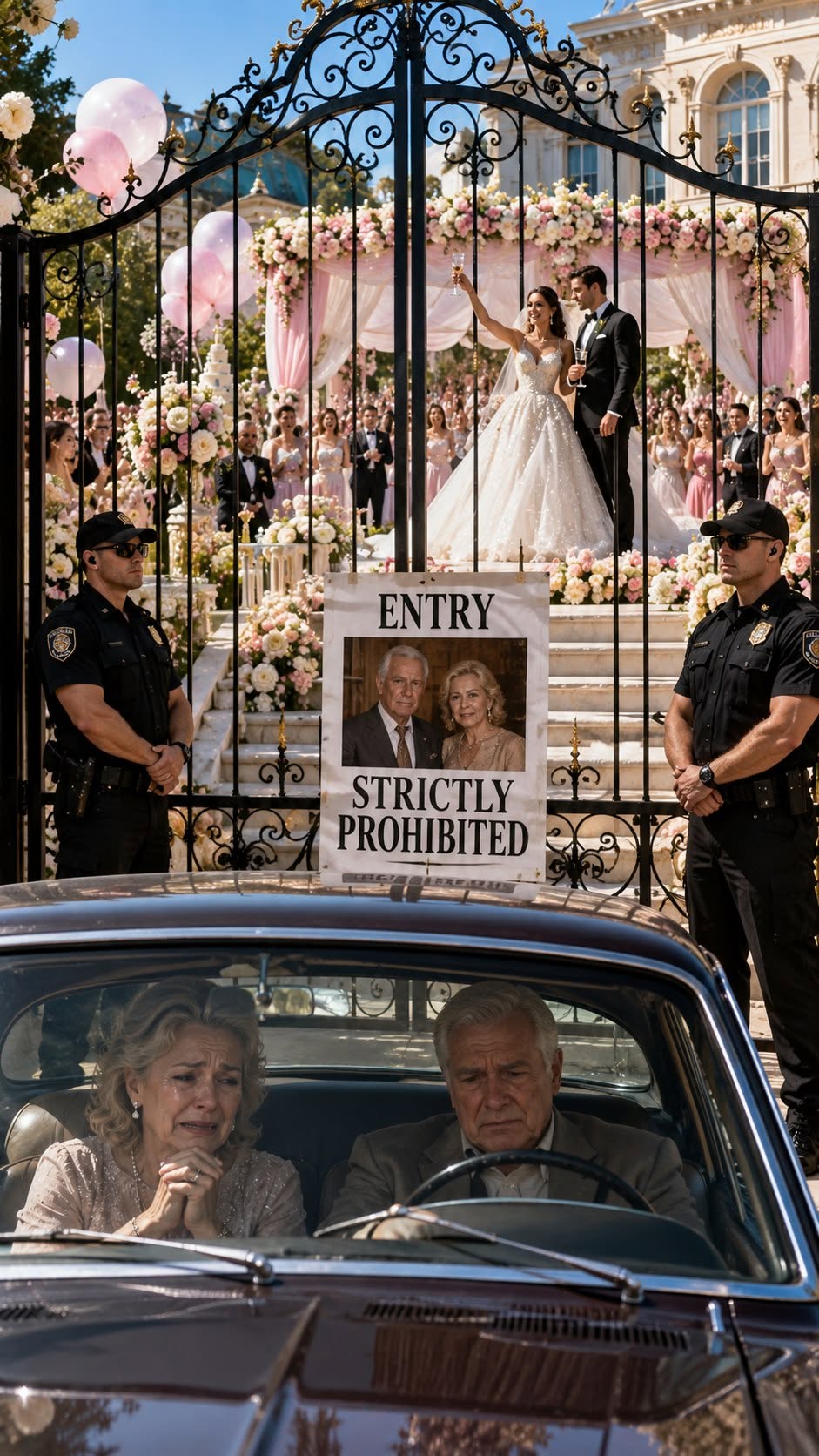
Standing squarely behind the formidable iron bars were two security contractors. They certainly weren’t part of Frank’s regular hospitality staff; I knew every man on Frank’s payroll by their first names. These towering anomalies were clad in sterile, black tactical uniforms, their postures wide and aggressive, arms folded solidly across kevlar-vested chests. They looked equipped to defend a classified military installation, not a joyous matrimonial celebration.
We rolled the Buick right up to the metal barrier. Earl killed the ignition. The surrounding silence was so absolute it was deafening.
Affixed crudely to the elegant, swirling central ironwork of the gate—using thick, industrial gray duct tape that obscenely marred the historic metal—was a massive, professionally laminated poster.
I leaned forward, squinting through the smeared glass of the windshield. My vision had steadily deteriorated over the last few years, but the high-resolution image staring back at me was horrifically, unmistakably clear.
It was a photograph of Earl and me. It was a candid, terribly unflattering snapshot I had cheerfully texted to Camille just the previous Sunday. We were slumped on our sagging apartment balcony after a grueling afternoon of repotting tomatoes. We were clad in sweat-stained, faded t-shirts, clutching chipped mugs of iced tea, our faces split in exhausted, genuine laughter. In the context of our private messages, it was a moment of intimate vulnerability.
Here, plastered on the gates of high society, it had been weaponized into a mugshot.
Slashed diagonally across our smiling, aging faces was a thick, violently red digital stamp. The block letters screamed: THIS PAIR NOT ALLOWED. ACTIVE SECURITY THREAT. ENTRY STRICTLY PROHIBITED.
All the oxygen evacuated my lungs in a violent rush, as if an invisible assailant had driven a baseball bat directly into my solar plexus.
“Vivien,” Earl gasped, the sound wet, broken, and thoroughly strangled. “What… what kind of sick joke is this?”
I couldn’t formulate a response. I sat paralyzed, my eyes locked on the brutal red ‘X’ obscuring my own face. This wasn’t merely a logistical rejection or a misunderstanding. This was a calculated, public extermination. We were being openly displayed as contaminated refuse, as undesirable vagrants who needed to be violently segregated from the delicate sensibilities of the Vance family.
And the most devastating realization of all? Camille had provided them the ammunition. No one else on this earth possessed that photograph.
One of the tactical guards finally stepped toward the vehicle. He didn’t afford us the basic human courtesy of bending down to eye level. He simply drew a collapsible steel baton from his belt, tapped it sharply against the hood of our tired Buick—thud, thud—and made a slow, deliberate, circular motion with his gloved index finger. Turn around.
My gaze mechanically tracked upward, past the humiliating poster, past the sneering guards, ascending toward the second-floor master balcony of the mansion, partially obscured by the drooping branches of ancient linden trees.
There she stood.
My Camille. She was draped in the bespoke gown. The garment that possessed a price tag heavier than the blue-book value of the car we were sitting in. Layers of ethereal French lace, hand-beaded with a thousand iridescent pearls. She looked like absolute royalty. Standing shoulder-to-shoulder with her was Alberta Vance, the terrifying matriarch of the groom’s family, sporting a monstrous fascinator hat wide enough to shelter a small family.
I sat there, practically vibrating with a desperate, pathetic hope. I waited for Camille to glance down and notice the atrocity at the gates. I waited for her to let out a horrified shriek, to gather her skirts and sprint down the grand staircase, to tear the offensive sign from the ironwork with her bare, manicured hands.
Instead, Camille looked directly at our Buick, and a slow, cruel smile blossomed across her flawless face.
She pointed a manicured finger right at our windshield. She leaned over and murmured something into Alberta’s ear, prompting the older, wealthy woman to dissolve into cruel, tinkling giggles behind a lace handkerchief. Then, my daughter—the fragile infant whose burning fevers I had broken with cool rags at 3:00 a.m., the ambitious teenager whose exorbitant college tuition I had funded by scrubbing commercial kitchen floors on my hands and knees—gracefully hoisted a crystal flute of vintage champagne into the morning air.
She toasted us. She brazenly toasted her newly acquired freedom from the sheer embarrassment of our existence. She took a delicate sip, turned her back on her creators, and sashayed back inside to enjoy the obscenely lavish party I had entirely bankrolled.
I did not shed a single tear. Tears are a biological luxury reserved for those who still harbor a shred of hope. In that microscopic fraction of a second, the sprawling reservoir of maternal hope within my chest instantly calcified, hardening into something sharp, jagged, and terrifyingly cold. Like a diamond cutter.
I reached across the console and placed my hand over Earl’s forearm. He was physically vibrating, a low-frequency tremor violently shaking his entire skeletal frame.
“Earl,” I commanded, my voice emitting a steady, chilling monotone that didn’t sound like me at all. “Put the car in reverse. Turn around.”
“But… Vivien… this is a mistake, maybe we should call…”
“Turn the car around, Earl. Right now.”
He inhaled a ragged, jagged breath that sounded dangerously close to a sob, shoved the heavy gearshift into reverse, and we traced a slow, humiliating arc in the crushed gravel. As we retreated down the access road, the guards didn’t even bother to watch us leave. In their eyes, we were simply garbage that had been successfully swept away from the curb of high society.
But those guards were terribly uneducated. They had absolutely no idea who was sitting in the passenger seat of that battered car. And they certainly didn’t know that the invisible conductor of this grand symphony had just made the unilateral decision to brutally, violently stop the music.
Chapter 3: The Black Book
The sprawling drive back toward the gray maw of the city was a psychological blur. The vibrant green foliage of the Hudson Valley flashing past my window looked artificial, like cheap, painted scenery in a high school play. Earl maintained a death grip on the steering wheel, his knuckles remaining a terrifying, bloodless white for twenty consecutive miles.
“Why, Viv?” he finally choked out, the words tearing past his vocal cords. “We gave that girl every single thing we had. We bled for her.”
“Don’t,” I snapped, cutting him off with surgical precision. “Do not pity us, Earl. Pity is a useless, dangerous emotion that softens the spine. I need my spine right now.”
I hoisted my battered leather handbag onto my lap and plunged my hand into its depths. Buried beneath a crumpled pack of spearmint gum and a wad of tissues lay an artifact I hadn’t actively utilized in nearly two years. My Little Black Book. It was a thick ledger bound in cracked, faux-alligator leather, obscenely swollen with business cards, scribbled invoices, and dog-eared sticky notes. It was the holy text of my entire professional existence. It contained the private, unlisted cell phone numbers of every Michelin-starred chef, elite florist, and master sommelier operating within the tri-state area.
More importantly, it held favors. It held leverage. It held devastating secrets.
I aggressively flipped past the tabs until I reached ‘P’. Paul.
Paul was the designated head maître d’ executing the floor plan at the Delgado estate today. Fifteen years prior, I had discovered Paul scrubbing scorched pots in a windowless, rat-infested basement kitchen. I was the one who painstakingly taught him how to pour a two-thousand-dollar bottle of wine without spilling a microscopic drop. I was the one who taught him how to maintain perfect posture when his feet were physically bleeding inside his shoes. He affectionately called me “Mama Vivien.”
I punched his number into my phone.
“Vivien Carmichael!” Paul’s voice boomed through the receiver, breathless and frantic, battling against the elegant background swell of a live string quartet and the percussive clinking of fine crystal. “Mama, are you close? Alberta Vance is having an absolute meltdown about the placement of the escort cards, but don’t worry, I handled the witch. We’re all just waiting on your arrival to signal the appetizer drop.”
“Paul,” I interjected. I deployed the specific, terrifying octave I historically reserved for when a negligent sous-chef scorched an expensive mother sauce—a tone that was icy, absolute, and utterly lethal. “Stop talking and listen to me very carefully. We are not coming.”
“What? Did the LeSabre break down on the highway? Jesus, Vivien, text me your mile marker, I’ll dispatch a private town car right now.”
“No, Paul. The vehicle is fine. The primary sponsor has officially abandoned the project.”
A beat of confused silence on the line. “Sponsor? What the hell do you mean?”
“I mean me, Paul. I am the sole client of record. I am the central bank funding this circus. And as of this exact moment, I am permanently revoking my physical presence and liquidating all of my financial obligations to the event.”
Dead silence echoed through the receiver. In the distant background, I could faintly hear the melodic, trilling laughter of a young woman—Camille, undoubtedly, holding court in her stolen kingdom.
“Paul,” I continued, ruthlessly enunciating every single syllable so there could be no ambiguity. “I need you to recall Section 4.2 of our standard union service contract. The clause regarding client absence and payment default. What does it trigger?”
“Commercial mode,” Paul whispered, the vibrant color practically draining out of his voice, traversing the cellular towers to reach my ear.
“Precisely. Effective immediately, the open bar is to be permanently shut down. The kitchen ceases all hot food production. The Virginia pheasants do not see the light of day. And the wine cellar—the special reserve vintages I personally drove up there yesterday—is to be padlocked. That is my private, intellectual property. You take the brass key and you put it deep inside your pocket.”
“Vivien… Jesus Christ, there are two hundred of the wealthiest people in the state out there. There’s already eight thousand dollars’ worth of premier cru wine uncorked and breathing on the tables.”
“Then you will charge them for it. Cash and carry, Paul. Every single poured glass, every microscopic caviar canapé. If the Vance family or their sycophants want to consume it, they will present a credit card. Now.”
“Mama Vivien, they will literally tear me apart.”
“They won’t touch you. You are simply the messenger enforcing union guidelines. You walk out there and you inform them that the primary account is frozen.”
I didn’t wait for his compliance. I severed the connection and dropped the phone back into my purse.
Earl briefly tore his eyes away from the highway to glance at me, a mixture of profound terror and absolute awe warring in his expression. “Viv… what in God’s name did you just do?”
“I just stopped being a mother, Earl,” I replied, staring blankly at the gray asphalt rolling beneath us. “I reverted to being a service provider. And in this industry, service providers do not work for free.”
But pulling the culinary rug out from under them wasn’t enough. Not nearly. The Vance family cared about aesthetics and status above all else. Food was just fuel; the venue was the true crown jewel.
I picked up the phone again and dialed the one man whose temper was shorter than mine.
“Frank,” I said when the gruff voice answered.
“Vivien? Look, Paul just ran into my office looking like he’s seen a ghost. He gave me the rundown. Damn it, Viv, I am so incredibly sorry. If I had known those tactical goons at the gate were keeping you out, I would have gone down there with a baseball bat and thrown the whole Vance clan onto the street myself.”
“I know you would have, Frank. And I appreciate it. But I need you to listen to me very carefully. You need to understand the magnitude of what is happening on your property. Camille explicitly told the Vance family that the mansion was her personal wedding gift to the groom. She told them that she owns the estate.”
The silence on Frank’s end of the line was so heavy I could hear the static crackle. When he finally spoke, his signature baritone growl physically vibrated the speaker against my ear. “She said what?”
“She told them it’s her property, Frank. They are currently parading around your ancestral home under the delusion that they have supreme domain over the grounds.”
“That little lying sociopath,” Frank hissed, the venom thick and palpable. “That’s not just a lie, Vivien. That is criminal trespassing by proxy. That is a massive insurance liability. I’ve got half a mind to…” He stopped. I heard the unmistakable sound of a heavy metal drawer sliding open on his end. “I’m coming down from the main house. And Vivien? I’m bringing the dogs.”
Chapter 4: The House of Cards
I wasn’t physically present to witness the structural collapse of Camelot, but after forty years in the hospitality trenches, I didn’t need to be. I knew the specific, chaotic rhythm of a banquet disaster better than I knew the cadence of my own heartbeat. I could visualize the entire catastrophe as if I were hovering above the grand tent.
Beneath the sweeping white canvas, the guests were undoubtedly seated, the atmosphere thick with the cloying scent of expensive designer perfume and unchecked entitlement. Camille would be practically glowing at the center of the head table, basking in the adoration. Alberta Vance would be tapping her engraved silver fork against her crystal goblet, preparing to deliver a condescending, self-congratulatory toast.
And then, the invisible gears of the machine violently ground to a halt.
Paul, his face drained of blood but his posture impeccably professional, would have marched onto the main floor. He would tap his earpiece, signaling the floor captains. Instantly, the synchronized ballet of the waitstaff would shatter. Dozens of silver trays bearing delicate appetizers would be swiftly lowered to waist height and marched backward. Bottles of champagne would be aggressively yanked away from reaching, manicured hands.
“Excuse me, sir,” a server would murmur, physically prying a bottle of Pinot Noir from the grasp of Julian’s wealthy uncle. “Technical pause.”
The string quartet would abruptly cease playing, the final note dying a pathetic death in the humid air.
Camille, instantly sensing the disruption to her coronation, would undoubtedly snap her fingers. “Hey! Paul! Why is the music off? Where are the wine pairings for the first course?”
Paul would approach the head table, refusing to offer his customary bow. “Madam,” he would announce, his voice expertly projecting into the sudden, suffocating silence of the tent. “We have encountered a critical payment discrepancy. The primary financial sponsor has officially withdrawn all authorization.”
“What sponsor?” Alberta would shriek, her massive hat wobbling as she shot up from her chair. “My son’s new mother-in-law paid for this entire affair in full!”
“The account holder of record is not present on the premises,” Paul would state, producing his metal clipboard like a shield. “Therefore, under the standard force majeure clause of the catering contract, all billing immediately transfers to the secondary organizers present. That designates you, Mrs. Vance.”
He would detach a printed slip of paper and slide it across the damask linen. “This is the outstanding invoice for the first hour of site rental, union labor, and the consumed aperitifs. Four thousand dollars. Will you be settling this with an Amex or cash?”
The resulting silence in the sprawling garden would have been absolute.
“You’re lying!” Camille would scream, her carefully applied makeup beginning to crack under the strain, her face flushing a blotchy, ugly crimson. “My mother paid! Call her! Call her right now!”
“I highly recommend you call her yourself,” Paul would reply, his tone dropping to sub-zero temperatures. “Until this outstanding balance is settled, my entire staff is walking off the floor.”
On his subtle hand signal, thirty highly trained waiters would pivot in perfect unison and march out of the tent, leaving the furious aristocrats abandoned with empty porcelain plates and locked wine buckets.
But the culinary strike was merely the appetizer. The main course arrived courtesy of Frank Delgado.
As Paul told me later, five minutes after the staff walked out, the estate’s main breaker was violently thrown. The romantic, twinkling fairy lights strung through the canopy died instantly. The massive, tiered water fountain in the center of the garden sputtered and ceased gurgling. Two hundred elite guests were suddenly plunged into the encroaching dusk, sitting in oppressive, humid darkness.
Then, the terrifying, guttural barking began.
Frank Delgado emerged from the tree line. He wasn’t wearing his customary hospitality blazer. He had thrown on a vintage camouflage jacket and heavy combat boots. Gripped tightly in his massive hands were the thick chain leashes of two massive, snarling Doberman Pinschers, their muscles corded and teeth bared. He raised a high-lumen tactical flashlight, blinding the head table, the beam locking directly onto Julian Vance’s pale face.
“Who in the hell is claiming to be in charge of this circus?” Frank roared, his voice echoing off the stone walls of the mansion.
“This is my daughter-in-law’s private estate!” Alberta shrieked, though her aristocratic bravado was severely compromised by the sight of the lunging dogs. “Turn those lights back on and get off our property before I call the state police!”
Frank slowly swung the blinding beam of light over to Camille. She was huddled deep in her chair, shaking like a wet leaf in a hurricane.
“Tell them, sweetheart,” Frank commanded softly, a dangerous, lethal edge to his voice. “Tell these lovely people exactly whose house this is.”
“It’s… it’s a rental,” Camille whimpered, shielding her eyes from the glare.
“I CAN’T HEAR YOU!” Frank bellowed.
“IT’S A RENTAL!” she finally screamed, a sound of pure, unadulterated terror. “We don’t own it! We’re totally broke! My parents are caterers!”
The fragile, soap-bubble illusion violently burst. The Vance family, realizing they were sitting in the dark, surrounded by angry dogs and unpaid bills, turned on her like a pack of starved wolves. Julian grabbed her upper arm, his fingers digging into her skin, his handsome face contorted into an ugly, furious sneer.
“You lied to us?” Julian spat, spit flying onto her lace veil. “We only married you for the goddamn money! We thought your parents were quiet venture capitalists! We’re bankrupt, you stupid girl! The Vance accounts are empty! We desperately needed your trust fund and the dowry to pay off my offshore gambling debts!”
The horrifying truth hung suspended in the humid air, ugly, naked, and undeniable. Two families of grifters, completely exposing each other in the dark.
The elite guests, smelling the overwhelming stench of poverty and scandal, began to flee. They tripped over the expensive lawn chairs, sprinting for the valet stand to retrieve their luxury cars. Camille was abandoned, sitting in the dirt beside the head table, the hem of her obscenely expensive dress stained with mud, her new husband glaring down at her with absolute disgust.
“Let her rot in the mud,” Alberta scoffed, literally stepping over the train of Camille’s dress as she marched toward the exit. “She’s entirely useless to us now.”
But I knew the Vance family. I knew their breed of desperation. They were cornered rats. And cornered rats always search for the nearest piece of cheese.
Chapter 5: The Siege
Earl and I were sitting in the cramped kitchen of our apartment, shrouded in darkness. We hadn’t bothered to turn on the overhead lights. The only illumination was the amber glow of the streetlamps filtering through the blinds.
“She lied about owning the estate,” Earl whispered, his hands clamped over his face. “Viv, if the Vances find out we aren’t wealthy…”
“They already found out, Earl,” I replied smoothly, checking the display on my cell phone. “And they are currently calculating their next move.”
Right on cue, the apartment intercom buzzed. It wasn’t a polite tap; it was a long, sustained, desperate peal that vibrated through the walls.
“It begins,” I murmured, standing up and smoothing the skirt of my chocolate dress.
I walked down the narrow hallway to the front door, intentionally leaving the heavy brass security chain engaged. I unlocked the deadbolt and pulled the door open a mere three inches.
Camille was collapsed against the doorframe. She looked like the sole, traumatized survivor of a horrific shipwreck. Black mascara streaked her cheeks like war paint, and her elaborate, pinned updo had deteriorated into a chaotic bird’s nest.
“Mom! Open the door!” she wailed, aggressively shoving her shoulder against the heavy wood. “Frank let those monster dogs loose on us! Julian dumped me at the venue! Mom, they’re poor! The Vances are totally bankrupt!”
“I am well aware,” I said, my voice eerily calm.
“You knew?!” she shrieked, her eyes widening in manic betrayal. “You knew they were broke and you still let me marry him?”
“I didn’t orchestrate the ruin of your life, Camille,” I stated, staring into the eyes of a stranger. “I simply stopped paying the premium subscription fee for your illusions.”
The elevator down the hall dinged ominously. The metal doors parted, and Julian and Alberta Vance stormed into the corridor. They were panting heavily, their designer clothes disheveled, their eyes completely wild with the manic energy of financial desperation.
“There they are!” Alberta pointed a trembling, manicured finger at the crack in the door. “The filthy little scammers! Open this door immediately! We want our goddamn money! You owe us the dowry!”
“Vacate my hallway,” I ordered softly.
“We aren’t going anywhere!” Camille cried, suddenly shifting her tactics, gripping the edge of the door. “Mom, please! I’m pregnant! You can’t throw your only grandson out onto the street!”
Earl, standing in the shadows behind me, let out a sharp gasp. “Pregnant?”
“Yes!” Camille nodded frantically, turning to her estranged husband. “Julian, tell them! I’m carrying the Vance heir!”
Julian instantly slicked his sweaty hair back from his forehead, the predatory greed returning to his eyes. “That’s right. The heir to the bloodline. You owe this unborn child a secure future. Open the damn door and transfer the funds.”
I looked closely at my daughter. The sheer, feral desperation in her eyes was pathetic. She was playing the final, ultimate card in the grifter’s deck.
“Wait right here,” I instructed.
I retreated to the small desk in the living room. I picked up a sterile white envelope bearing the logo of a private women’s health clinic. It had arrived in our mailbox three days prior—mundane mail that Camille had been far too obsessed with her floral arrangements to collect.
I returned to the entryway and smoothly slid the unopened envelope through the three-inch crack.
“Read it,” I commanded.
Camille grabbed it, her hands shaking, and tore the flap open. Alberta, impatient, aggressively snatched the paper from her grasp and held it up to the hallway light.
Alberta began to read aloud. “Patient Reminder. Follow-up appointment for contraceptive implant positioning. Effective period of device: 3 years. Device installed: One month ago.”
Alberta slowly lowered the paper. She turned her gaze to Camille, her eyes practically vibrating with pure, unadulterated hatred. “An IUD? You lied about being pregnant, too?”
“It’s… it’s a clerical mistake from the clinic!” Camille stammered, backing away from her monster-in-law.
“It is absolutely no mistake,” I clarified from the shadows. “You just needed a biological hostage to stall for time. Goodbye, Camille.”
I slammed the heavy door shut and violently threw the deadbolt.
“OPEN UP!” Julian roared, launching a heavy leather shoe against the wood, the impact shaking the frame. “You owe us the fifty thousand dollars! The dowry money! We ran the background checks, we know you have that cash sitting in a savings account! We want it now!”
“We’ll sue you into oblivion!” Alberta shrieked, pounding her fists against the door. “We’ll take this miserable little apartment! We’ll take everything!”
I unlocked the deadbolt and threw the door wide open. I stepped out into the hallway, leaving the safety of the threshold. Earl stepped out immediately behind me. Hanging loosely at his side, gripped securely in his right hand, was a massive, seasoned cast-iron skillet from our kitchen. He didn’t raise it aggressively. He simply held it, an imposing, silent sentinel.
The Vances took a collective, instinctive step backward.
“You want the money?” I asked, my voice dropping to a terrifying whisper.
“We want our rightful justice!” Alberta hissed, eyeing the skillet.
“Fine. Let’s discuss justice. You want the fifty thousand dollars my husband and I painfully scraped together over forty years? The money procured from selling my dead mother’s microscopic condo? Our burial fund?”
“Yes!” Julian yelled, pulling out his smartphone. “Wire it to my account right now and we walk away!”
“I am physically incapable of doing that,” I said. “Because I transferred the entirety of that account at precisely 4:30 p.m. this afternoon. Roughly half an hour after we drove away from your humiliating gate.”
I reached into my pocket and produced a crumpled bank receipt, holding it up to the harsh fluorescent light of the hallway.
BENEFICIARY: TRI-STATE HOSPICE AID CHARITY FUND.
TRANSFER AMOUNT: $50,000.00.
STATUS: EXECUTED AND CLEARED.
Julian lunged forward and snatched the paper from my fingers. His handsome face drained to a sickly, corpse-like gray. “You… you gave our money to a charity for dying people?”
“It was an anonymous, non-refundable wire donation. The money is entirely gone. We are completely, fabulously broke. And so are you.”
“You are a clinically insane bitch!” Julian screamed, tearing the receipt into shreds and throwing them at my feet. “You burned your own life savings?”
“I didn’t burn it,” I corrected him. “I used it to purchase my absolute freedom. Now, get out of my hallway before Earl demonstrates how to properly tenderize meat.”
The wail of police sirens began to echo up from the street below. One of our elderly neighbors, terrified by the screaming, had dialed 911.
Moments later, the elevator doors parted to reveal two burly NYPD officers. They took one sweeping look at the hysterical, screaming Vances in their ruined formalwear, and then glanced at the calm, elderly couple standing quietly in their doorway.
“Evening, folks. Are these individuals harassing you, ma’am?” the older sergeant asked, placing a hand casually on his utility belt.
“They are criminally trespassing, officers, and actively attempting financial extortion,” I stated clearly.
“Arrest her!” Alberta pointed a trembling finger at my face. “They stole our future!”
“Alright, that’s enough out of you. Let’s take a walk downstairs, folks,” the sergeant grunted, grabbing Julian firmly by the bicep. “We’re booking you for disorderly conduct and public disturbance. Move it.”
As the officers corralled them into the elevator, the doors began to slide shut on Camille’s sobbing, ruined face. Alberta squeezed her head through the closing gap, spitting her final curse. “You’re going to die alone in this dump!”
“I would heavily prefer to die of thirst than ever take a drink from hands that despise me,” I replied.
The heavy metal doors closed, cutting off their screams.
Chapter 6: The Westward Train
The hallway plunged back into a profound, echoing silence. Earl slowly lowered the cast-iron skillet. We turned around and walked back into our apartment, locking the door for the final time.
“So,” Earl breathed, collapsing heavily into his chair at the kitchen table, running a hand over his exhausted face. “We have zero money in the bank. We have no daughter. We don’t even have a burial fund to put us in the ground.”
“We have something infinitely better,” I countered.
I walked over to my purse, reached into the hidden zippered compartment, and extracted a glossy, trifold brochure. I dropped it onto the laminate table in front of him.
THE COAST TO COAST DREAMLINER. LUXURY SLEEPER CLASS.
“Viv… what exactly is this?” Earl asked, his brow furrowing as he traced the picture of the silver train.
“I confess, I didn’t tell those leeches everything,” I smiled, walking to the counter and pouring us both two generous fingers of cheap vodka. “Do you recall that dilapidated brick garage we owned downtown? The one we’ve been renting out for commercial storage for the last decade?”
“Yeah? What about it?”
“I quietly sold the deed to a developer yesterday morning.”
Earl’s eyes widened to the size of dinner plates. “Viv…”
“It sold for the exact, down-to-the-penny price of two first-class, luxury sleeper tickets from New York to San Francisco. Full board, champagne included. Our departure is scheduled for tomorrow morning at 8:00 a.m. sharp.”
Earl stared at the brochure. He looked up at me, his eyes suddenly swimming with thick, unashamed tears.
“But… what about Camille?” he whispered, the final gasp of his paternal instinct.
“Camille is a grown, married woman. Let her wait tables to pay off her husband’s gambling debts. It builds excellent character. We are finished here, Earl. We are officially retired.”
We packed our lives into two medium suitcases in absolute silence. We took only the essentials. I purposefully left the tailored chocolate dress hanging in the closet. It belonged to an invisible catering woman who no longer existed.
At 5:00 a.m., we slipped the apartment keys into an envelope, slid it under the superintendent’s door, and hailed a yellow cab to Grand Central Station.
The train was a magnificent silver bullet idling on the tracks, waiting to tear through the continent. We boarded and found our cabin. It was an oasis of crushed velvet, polished mahogany, and soft lighting.
As the massive locomotive lurched forward, pulling us away from the gray, suffocating tenements of New York and accelerating toward the vibrant green expanse of the countryside, I retrieved my cell phone.
I opened my contacts. I selected the entries for Camille, Julian, and Alberta Vance.
Block. Block. Block.
I popped the back off the phone, extracted the tiny plastic SIM card, and dropped it into the small brass trash bin bolted to the wall.
Earl sat across from me, his face pressed near the glass, watching the Hudson River flash by in the morning light.
“You know what I truly regret about all of this, Viv?” he asked, his voice softer than I had heard it in years.
“What’s that, Earl?”
“I deeply regret that we didn’t see a security sign on a gate ten years ago.”
I threw my head back and laughed, a genuine, booming sound that made me feel lighter than I had in three decades. “Better late than never, you old fool. Pour the tea. San Francisco is waiting for us.”
The train accelerated, a silver streak speeding west, carrying us far away from the wreckage we had left behind, surging toward the ocean, toward a final chapter where the only sign on our gate would read: Welcome.