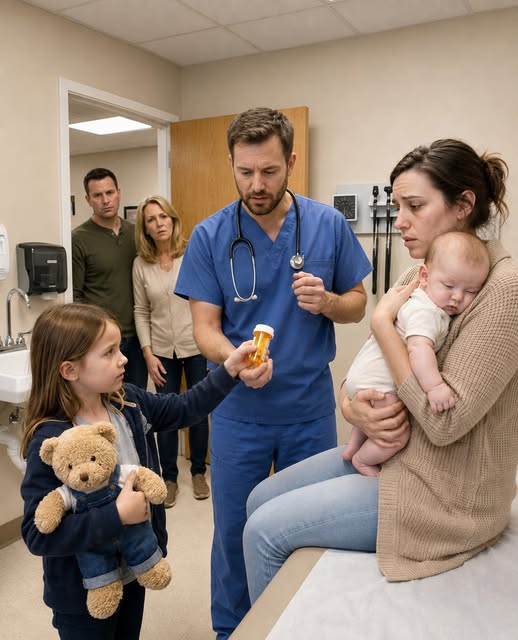
- The pediatric ward smelled like hand sanitizer, warm plastic, and the cold paper coffee Ryan had left untouched on the windowsill.
- Milo was curled against my chest, burning through his blanket.
- His cheeks were too red.
- His lips looked dry.
- The hospital bracelet around his wrist was so loose it kept sliding toward his tiny hand every time I shifted him.
- Beside the bed, the monitor beeped in a rhythm that sounded calmer than anyone in that room deserved.
- My name is Claire Donovan.
- I was thirty-two years old, married to a man named Ryan, mother to seven-year-old Ava and four-month-old Milo, and by that night I had learned something I wish every exhausted mother could know earlier.
- Sometimes the person calling you hysterical is only afraid you are right.
- Elaine had moved into our Madison suburban house six weeks before Milo got sick.
- She had fallen after hip surgery, and Ryan said we could not let his mother recover alone.
- I agreed because that was what family was supposed to mean.
- I cleaned out the spare room.
- I moved Ava’s art supplies into the laundry room.
- I bought a shower chair, put fresh sheets on the bed, and kept a small bell on Elaine’s nightstand because she said calling out made her feel helpless.
- For the first few days, I believed the tension was just pain and pride.
- Elaine hated needing help.
- She hated the walker.
- She hated the medication schedule taped to her dresser.
- She hated that I was the one in charge of meals, appointments, and quiet time.
- But by the second week, every ordinary part of motherhood had become an argument.
- If I warmed Milo’s bottle, Elaine said it was too warm.
- If I checked his diaper, she said I was fussing.
- If I let him cry for twenty seconds while I helped Ava with homework, she said women today had no patience.
- Ryan always had the same answer.
- “Mom raised three kids.”
- He said it while stepping over laundry baskets.
- He said it while packing his work laptop.
- He said it while I stood in the kitchen at midnight trying to measure formula with one hand and hold Milo with the other.
- As if raising children decades ago made Elaine immune to being wrong now.
- The morning Milo’s fever started, the house had that heavy winter silence that comes before everybody else wakes up.
- Ava’s backpack was still by the front door.
- The porch flag outside barely moved.
- The kitchen light hummed over the island.
- At 6:18 a.m., Milo whimpered against my shoulder, and when I touched my lips to his forehead, heat went through me like an alarm.
- The digital thermometer read 101.0.
- I called our pediatrician’s office when it opened.
- The nurse asked about his age, his breathing, wet diapers, whether he was nursing, and what medication we had at home.
- I wrote everything on the back of a school flyer that had been sitting under a grocery receipt.
- Medicine as directed.
- Lukewarm bath.
- Watch his breathing.
- Go to the emergency room if the fever passed 104 or he seemed distressed.
- At 9:30 a.m., I gave the first dose exactly as instructed.
- Elaine watched from the nursery doorway.
- “All those chemicals,” she said.
- Her voice was soft, but her face was not.
- I kept my eyes on the measuring syringe.
- “The pediatrician approved it.”
- “Pediatricians approve whatever companies tell them to approve.”
- Ryan came in behind her, half dressed for work, checking his email.
- “Maybe we should consider natural options,” he said.
- I looked at him so sharply he finally raised his eyes from the screen.
- “Ryan, he has a fever.”
- “I know,” he said. “I’m just saying Mom has experience.”
- Elaine smiled a little at that.
- I should have understood then that this was not about medicine.
- It was about authority.
- Not concern.
- Not tradition.
- Control dressed up as wisdom.
- By noon, Milo’s fever had climbed to 102.3.
- I called the nurse again and put her on speaker so nobody could say later that I had misunderstood.
- The nurse repeated the instructions.
- Ryan heard them.
- Elaine heard them.
- Ava, home for lunch because her school had a half day, sat at the counter swinging her feet and coloring a worksheet while the nurse said the words emergency room very clearly.
- At 2:41 p.m., I had to pick up Ava from school because she had gone back for her reading group.
- The pickup line was backed up past the curb.
- The family SUV smelled like crayons, old fries, and the paper grocery bags I still had not taken out of the back.
- I called Ryan before I left the driveway.
- “He’s sleeping,” I said. “Your mom is with him. I’ll be gone twenty-five minutes.”
- “See?” Ryan said. “You can let people help.”
- I remember gripping the steering wheel and telling myself he was right.
- I remember thinking I was tired.
- I remember thinking maybe I had become too sensitive after months of being corrected in my own house.
- When Ava and I came home, the living room was too quiet.
- Elaine sat in the recliner with Milo asleep in her arms.
- The television was muted.
- The little white medicine bottle that had been on the side table was gone.
- “See?” Elaine whispered. “Grandma knows best.”
- Ava stopped just inside the room.
- Children notice the air before adults admit it has changed.
- I reached for Milo.
- Elaine gave him to me slowly, as though she expected praise.
- The second his weight settled against me, something in my stomach dropped.
- He was not just sleeping.
- He was limp.
- His skin felt wrong under my hand, too hot and too still at the same time.
- His eyes opened halfway, glassy and unfocused, then drifted shut again.
- “What did you give him?” I asked.
- Elaine’s expression did not change.
- “Traditional cooling.”
- “What does that mean?”
- “Something harmless.”
- Ava looked at her grandmother, then at me.
- Her small face had gone pale.
- Ryan came home at 6:12 p.m.
- By then I had taken Milo’s temperature five times.
- 103.4.
- 103.6.
- 103.9.
- Then 104.2.
- I had the pediatrician’s note in my hand, the diaper bag over my shoulder, and Milo wrapped in the soft gray blanket Ava had picked out before he was born.
- “We’re going to the ER,” I said.
- Elaine sighed from the couch.
- Ryan rubbed his forehead like I had interrupted a meeting.
- “Claire, can we not turn every temperature into a crisis?”
- Then Milo’s breathing changed.
- It became thin and fast, like his whole little body was working too hard.
- Ryan saw it.
- For once, he stopped talking.
- He grabbed the keys.
- At the hospital intake desk, the nurse took one look at Milo and moved quickly.
- She asked when the fever started.
- I gave her the times.
- She asked what medication he had taken.
- I told her what I had given him at 9:30 a.m.
- Then I said, “I don’t know what my mother-in-law gave him while I was at school pickup.”
- Elaine made a small insulted sound behind me.
- Ryan said, “Mom wouldn’t give him anything dangerous.”
- The nurse did not answer him.
- She put a bracelet on Milo’s wrist, checked his temperature again, and called for a room.
- Ava followed us down the hallway holding her worn teddy bear.
- That bear had been hers since preschool.
- One eye was scratched.
- One ear had been restitched twice.
- She held it the way people hold a hand when they are too scared to ask for one.
- In the pediatric room, the nurse started an IV and checked Milo’s breathing.
- Dr. Miller came in a few minutes later.
- He was not cruel at first.
- He was tired.
- He was efficient.
- He listened with the face doctors use when they have already decided which part of the story matters.
- I gave him the timeline.
- 6:18 a.m., first fever.
- 9:30 a.m., medicine as directed.
- Lunch call to pediatrician.
- 2:41 p.m., school pickup.
- 3:08 p.m., home.
- 7:03 p.m., temperature 104.2.
- I showed him the school flyer with the nurse’s instructions written in my own hand.
- Ryan exhaled loudly.
- “She’s always overly anxious,” he said.
- I turned slowly.
- He would not look at me.
- Elaine sat in the corner chair with her purse tucked beside her knees.
- That small satisfied smirk appeared again.
- It was the same expression she wore when Ryan took her side about bottles, naps, baths, blankets, laundry, and whether I held my own baby too much.
- Dr. Miller glanced at Ryan, then at Elaine.
- Then he looked back at me.
- “New mothers often panic over nothing,” he said.
- Something inside me went very still.
- Not calm.
- Still.
- There is a kind of rage that makes noise, and there is a kind that makes you careful.
- I chose careful because Milo was in my arms and Ava was watching.
- The nurse’s hand paused on the IV tape.
- The monitor kept beeping.
- Ava’s sneakers squeaked once on the polished floor.
- I did not argue.
- I did not defend myself.
- I rocked Milo and swallowed every word burning up my throat.
- Then Ava stepped forward.
- She lifted the teddy bear like it was the only brave thing in the room.
- “Dr. Miller,” she whispered, “should I tell you what Grandma gave the baby instead of his real medicine?”
- The room changed.
- Dr. Miller stopped moving.
- Ryan’s face emptied.
- Elaine’s smirk cracked at the edge.
- The nurse looked directly at Ava, then lowered her voice.
- “Sweetheart,” she said, “you can tell us.”
- Ava pressed the teddy bear to her chest.
- “I saw Grandma in the kitchen,” she said. “She had Milo’s little spoon. She said Mommy was making him weak with chemicals.”
- Elaine stood too fast for someone with a healing hip.
- “That child is confused.”
- Dr. Miller held up one hand.
- “Sit down.”
- It was the first time all night an adult in authority had spoken to Elaine like she was not automatically the reasonable one.
- Ava started crying silently.
- “She said not to tell Mommy,” Ava whispered. “She said Mommy would make a big drama and Daddy would be mad.”
- Ryan flinched like the words had touched him physically.
- I looked at him, and for one second I saw the beginning of understanding.
- Not enough.
- But the beginning.
- Dr. Miller asked Elaine what she had given the baby.
- Elaine folded her hands in her lap.
- “An old family remedy.”
- “What was in it?”
- “Nothing harmful.”
- “That is not an answer.”
- The nurse stepped closer to Milo’s bed.
- Ava pointed toward Elaine’s purse.
- “She put the bottle in there.”
- Elaine’s hand snapped toward the purse strap.
- Ryan said, “Mom.”
- It came out small.
- Dr. Miller’s voice changed.
- “Mrs. Donovan, put the purse on the chair.”
- For a moment, nobody moved.
- The fluorescent light hummed overhead.
- Milo made a weak little sound against my chest.
- That sound broke whatever spell Ryan had been under.
- He reached for the purse.
- Elaine grabbed his wrist.
- “Don’t you dare,” she said.
- The nurse moved between Elaine and the bed.
- Dr. Miller called for another staff member.
- Ryan stared at his mother’s hand on his wrist, then at our son, then at me.
- I had seen Ryan embarrassed before.
- I had seen him annoyed.
- I had never seen him ashamed.
- He pulled the purse away from Elaine.
- The zipper rasped open.
- Inside were tissues, keys, a church bulletin, a folded pharmacy receipt, and a small unlabeled bottle wrapped in a napkin.
- Dr. Miller did not touch it with bare hands.
- He asked the nurse for a specimen bag.
- He asked Ryan when Elaine had last been alone with the baby.
- Ryan tried to answer, but his voice broke on the first word.
- I answered instead.
- “Between 2:41 and 3:08.”
- The nurse wrote it down.
- That was the moment I stopped feeling crazy.
- Not because I needed paperwork to prove my fear.
- Because every person in that room finally understood my fear had been evidence.
- Dr. Miller ordered labs.
- The nurse documented the bottle.
- A hospital social worker came in with a calm face and a clipboard.
- Elaine kept saying she had only done what mothers used to do.
- Ryan kept saying, “Mom, stop talking.”
- Ava sat beside me on the bed and pressed her teddy bear against Milo’s blanket.
- “I didn’t want him to get worse,” she whispered.
- I kissed the top of her head.
- “You helped him.”
- The labs came back slowly.
- Nothing about hospitals moves at the speed a mother’s heart demands.
- They monitored Milo through the night, gave him fluids, treated the fever, and kept asking careful questions.
- Dr. Miller apologized to me at 1:17 a.m.
- He did not make it dramatic.
- He stepped into the room while Milo finally slept more normally against the raised bed, and he said, “Mrs. Donovan, I should have listened to the timeline before I listened to anyone’s opinion about you.”
- I nodded because I did not have the energy to comfort him.
- That is another thing women are asked to do too often.
- We are expected to make people feel better about not believing us.
- Ryan sat in the plastic chair by the window with his elbows on his knees.
- His coffee had gone cold hours ago.
- Elaine was no longer in the room.
- Hospital staff had moved her out after the social worker arrived, and Ryan had called his sister to come get her.
- I did not ask where Elaine went.
- For once, I did not manage the feelings of the woman who had put her pride above my child.
- Ryan looked at me near sunrise.
- “I thought you hated her,” he said.
- I looked down at Milo’s tiny fingers curled around the edge of his blanket.
- “No,” I said. “I trusted you to love us more than you needed to defend her.”
- He covered his face with both hands.
- Ava slept curled in the chair, teddy bear tucked under her chin.
- Milo’s fever began to come down just after 5:00 a.m.
- The monitor kept beeping, but the sound no longer felt like a warning nobody wanted to hear.
- It sounded like proof he was still there.
- In the weeks after, there were phone calls, follow-up appointments, and conversations with people who took notes instead of taking sides.
- There was a hospital record.
- There was a documented timeline.
- There was the bottle in the specimen bag.
- There was Ava’s statement, given gently, with a social worker sitting beside her and a coloring book on the table.
- Ryan asked if Elaine could apologize.
- I said no.
- Not yet.
- Maybe not ever in the way he meant.
- An apology is not a key that unlocks the door you broke trying to prove you owned the house.
- Elaine moved out of our home.
- Ryan changed the locks himself, and he did it without asking me to praise him for finally doing what should have been obvious.
- For a while, our house felt strange without her voice correcting everything.
- The silence had weight.
- Then slowly, it became peace.
- Ava went back to school.
- Milo gained weight.
- The medicine chart stayed on the fridge, but now Ryan checked it too.
- Not because I needed supervision.
- Because our children needed two parents willing to read instructions before listening to pride.
- One evening, months later, I found Ava in the nursery holding her teddy bear over Milo’s crib.
- She was telling him a story in a whisper.
- When she saw me, she looked embarrassed.
- “I was just telling him Teddy helped,” she said.
- I sat beside her on the rug.
- “You helped,” I told her.
- She leaned against me.
- “Grandma said grown-ups know better.”
- I looked at Milo, asleep under the soft gray blanket that had survived the worst night of my life.
- “Good grown-ups listen when a child tells the truth,” I said.
- Ava thought about that for a long time.
- Then she nodded.
- The pediatric ward had smelled like hand sanitizer, warm plastic, and cold coffee.
- For months afterward, I could remember every beep, every light, every word said by people who thought I was panicking over nothing.
- But I remember something else more clearly now.
- A seven-year-old girl in a twisted school jacket, holding a worn teddy bear with shaking hands, brave enough to say what every adult in that room needed to hear.
- And because she did, my baby came home.
My Baby Had a High Fever, but Everyone Told Me I Was Overreacting… I Chose to Trust My Instincts, and Everything Changed.